Volume 29 (2010)
Proceedings of the
Ninth International Workshop on
Graph Transformation and
Visual Modeling Techniques
(GT-VMT 2010)
Decidable Race Condition and Open Coregions in HMSC
Vojtˇech ˇRehák Petr Slovák Jan Strejˇcek Loïc Hélouët
12 pages
Guest Editors: Jochen Küster, Emilio Tuosto
Managing Editors: Tiziana Margaria, Julia Padberg, Gabriele Taentzer
Decidable Race Condition and Open Coregions in HMSC
Vojtˇech ˇRehák1∗ Petr Slovák1† Jan Strejˇcek1‡ Loïc Hélouët2
1Faculty of Informatics, Masaryk University, Brno, Czech Republic 2INRIA/IRISA, Rennes, France
Abstract: Message Sequence Charts (MSCs)is a visual formalism for the descrip-tion of communicadescrip-tion behaviour of distributed systems. An MSC specifies reladescrip-tions between communication events with partial orders. A situation when two visually ordered events may occur in any order during an execution of an MSC is called a raceand is usually considered as a design error. While there is a quadratic time al-gorithm detecting races in a finite communication behaviours calledBasic Message Sequence Charts (BMSCs), the race detection problem is undecidable forHigh-level Message Sequence Charts (HMSCs), an MSC formalism describing potentially infi-nite sets of potentially unbounded behaviours. To improve this negative situation for HMSCs, we introduce two new notions: a new concept of race called trace-race and an extension of the HMSC formalism with open coregions, i.e. coregions that can extend over more than one BMSC. We present three arguments showing benefits of our notions over the standard notions of race and HMSC. First, every trace-race-free HMSC is also race-free. Second, every race-free HMSC can be equivalently ex-pressed as a trace-race-free HMSC with open coregions. Last, the trace-race detec-tion problem for HMSC with open coregions is decidable andPSPACE-complete. Finally, the proposed extension of coregions allows to represent in a visual fash-ion whether an arbitrary number of racing events in the usual MSC formalism are concurrent or not.
Keywords:HMSC; race condition; trace-race condition; open coregions;
1
Introduction
Message Sequence Chart (MSC)[ITU04] is a popular visual formalism for specification of dis-tributed systems behaviours (e.g. communication protocols or multi-process systems). Its sim-plicity and intuitiveness come from the fact that MSC describes only exchange of messages between system components, while other aspects of the system (e.g. content of the messages, computation steps) are abstracted away. Even such an incomplete model can indicate serious errors in the designed system. This paper focuses on a common error calledrace condition.
MSCs are based on composition of simple chronograms called Basic Message Sequence Charts (BMSCs). A BMSC consists of a finite number ofprocessesandevents. Processes are represented by vertical lines, and all events executed by some process are located on its lifeline
∗Partially supported by Czech Science Foundation (GA ˇCR), grants No. 201/08/P459 and No. P202/10/1469.
†Partially supported by the research centre “Institute for Theoretical Computer Science (ITI)”, project No. 1M0545. ‡Partially supported by Czech Science Foundation (GA ˇCR), grant No. 201/08/P375, and Ministry of Education of
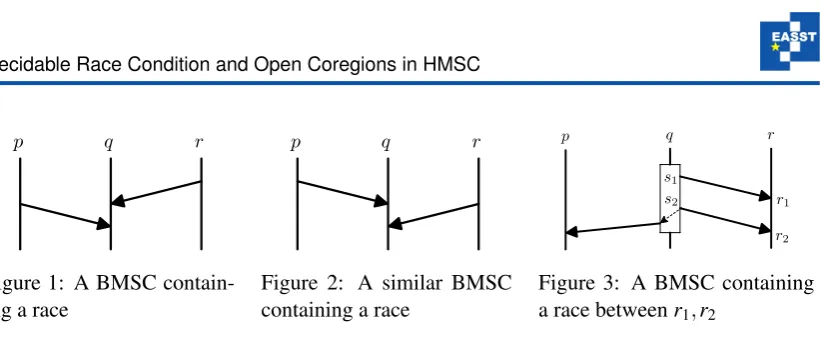
p q r
Figure 1: A BMSC contain-ing a race
p q r
Figure 2: A similar BMSC containing a race
s1 s2
r2 r1
p q r
Figure 3: A BMSC containing a race betweenr1,r2
and ordered from top to bottom. Messages are represented by an arrow from a sending event to a receiving event. Total orderings of events on lifelines and messages form avisual order<, which provides graphically information on the respective ordering of events. However, the visual order can not always be enforced by the architecture of the modelled system. In addition to the visual order, there exists acausal order, that is weaker than<. Intuitively, eventse,f are in causal ordere f, if the BMSC enforces thatealways precedes f. There are several definitions of causal order depending on the settings of the modelled system and semantics of the model. For example, if one process sends two messages to another process, the corresponding receive events are causally ordered if and only if the considered message transport protocol has theFIFO property: two messages sent from one process to another are always received in the same order. In this paper, we assume that every process has one unbounded buffer for all incoming messages and that the message transport protocol satisfies the FIFO property.
A BMSC contains arace condition(or simplyrace) [AHP96] if there are two visually ordered events that are not causally ordered (i.e. they can actually occur in an arbitrary order). For example, Figure1depicts that the processqreceives a message fromr followed by a message fromp. As processes and communication in BMSCs are always asynchronous, the messages can be also received in the opposite order as shown in Figure2. In both figures, the two receive events are in race as they are ordered visually but not causally. Races in BMSC description should be considered as a design error, as they exhibit discrepancies between the intended ordering designed in a BMSC, and the ordering that a real implementation of this BMSC would enforce. Races in a BMSC can be detected in quadratic time [AHP96].
While a BMSC describes only a single and finite communication scenario, its extension called High-level Message Sequence Chart (HMSC) [RGG96, AHP96] can describe more complex interactions, with iterations and alternatives between several scenarios. An HMSC is a finite state transition system where each state is labelled by a BMSC or a reference to another HMSC. In the sequel, we will only consider HMSCs labelled by BMSCs. Each run (i.e. a path starting in the initial state and ending in a final state) of an HMSC can be understood as a single BMSC, which is a concatenation of the BMSCs labelling the states along the run. Hence, an HMSC represents a potentially infinite set of BMSCs of unbounded size.
The definition of race was extended to HMSCs in [MP99]. Roughly speaking, an HMSC H has a race if some BMSC represented by H contains a race andH does not represent any BMSC where the two racing events are defined with the opposite visual order. Unfortunately, the problem whether a given HMSC contains a race is undecidable [MP99,ITU04].
every trace-race-free HMSC is also race-free but not vice versa. To improve the expressive power of trace-race-free HMSCs, we extend the HMSC formalism withopen coregions. A coregion is a standard part of the MSC formalism that allows some events on the same process in a BMSC to be visually unordered. In particular, coregions can be used to visually order only causally related events (hence making concurrency a visual property). While this application of core-gions can remove all races in BMSCs, it is not sufficient for removing all races in HMSCs. An open coregion is basically a coregion spread over several BMSCs. We present a transformation of an arbitrary race-free HMSC into an equivalent trace-race-free HMSC with open coregions, where equivalence means that the two HMSCs have the same linearizations. Finally, we show that the problem whether a given HMSC with open coregions contains a trace-race is decidable andPSPACE-complete. In fact, our algorithm is polynomial for HMSCs with fixed number of processes and gates. For definitions of gates and linearizations see Sections2and3, respectively. The rest of the paper is organized as follows. Section 2 recalls the definitions of BMSCs, HMSCs, and race condition for BMSCs. The race and trace-race conditions for HMSCs are de-fined and compared in Section3. Section4is devoted to the translation of race-free HMSCs into equivalent trace-race-free HMSCs. The decidability and complexity of the trace-race detection problem is discussed in Section 5. Section6 briefly summarizes benefits of the presented no-tions. Due to the space limitations, we present only crucial lemmata and theorems accompanied by explanations of basic ideas. Proofs with all technical details can be found in [RSSH09ˇ ].
2
Preliminaries
The following definitions omit some features of MSCs given by the ITU standard [ITU04], e.g. atomic actions, labelling of messages with names, timers etc. However, these restrictions are quite common, and our results can be extended to MSCs with atomic actions and message labelling using the technique of [DGH08].
2.1 BMSCs with (open) coregions, gates, and general ordering
The basic concepts of BMSCs are described in Section1. In the visual representation of a BMSC, processes are depicted as vertical lines and messages are represented by arrows between these lines. Events located on the same process line are visually ordered from top to bottom. A process line may contain segments calledcoregionsdelimiting subsets of events. Events in a coregion are a priori not in visual order, but they can be visually ordered using ageneral orderingrelation. (this relation need not be a partial order). Coregions are visually represented by rectangles and general ordering by dashed arrows between pairs of ordered events (see Figure3).
define the sets oftop gates p.G={p.g|g∈G}andbottom gates p.G={p.g|g∈G}located on processp. Given a BMSC with a set of processesP, we setP.G=S
p∈Pp.GandP.G=
S
p∈Pp.G
to be the sets of all top and bottom gates in this BMSC, respectively. We also extend the general ordering to range over both events and gates within an open coregion.
Definition 1 Let G be a finite gate name space. A BMSC over G is a tuple M = (P,ES,ER,P,{<p}p∈P,M,C,{≺C}C∈C)where
• Pis a finite set of processes.
• ES,ERare disjoint finite sets ofsendandreceive events, respectively. We setE=ES∪ER.
• P:E→Pis a mapping that associates each event with a process. • <pis a total order on all events on a process p.
• M⊆(ES×ER) is a bijective mapping, relating every send with a unique receive. We
assume that a process cannot send a message to itself, i.e.P(e)6=P(f)whenever(e,f)∈
M. For any(e,f)∈M, we useM(e)to denote the receive event f, andM−1(f)to denote the send evente.
• C is a finite set of pairwise disjointcoregions, where a coregionC∈C is a consistent nonempty subset of events and gates of a single processp, i.e.
– /0 6= C ⊆ P−1(p)∪p.G∪p.Gfor somep∈P – ife<pd<p f ande,f∈C, thend∈C.
A coregionCcontaining a top gate is calledtop-openand it has to contain all top gatesp.G
and satisfy that ife<p f and f ∈Cthene∈C. A coregionCcontaining a bottom gate is calledbottom-openand it has to contain all bottom gatesp.Gand satisfy that ife<p f and e∈Cthen f ∈C. A coregion which is both top-open and bottom-open is called justopen. • ≺Cis an acyclic relation calledgeneral orderingon elements inCsuch that≺C⊆(p.G∪
P−1(p))×(p.G∪P−1(p)), where pis the process containing the coregionC.
The definition says that a top-open coregion has to contain all top gates. As coregions are pairwise disjoint, there is at most one top-open coregion. Similarly, each BMSC contains at most one bottom-open coregion. Note that we do not impose that coregions contain events. For example, an open coregion covering an inactive process can connect top and bottom gates.
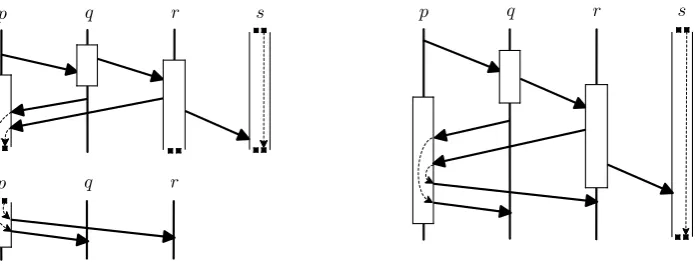
In the visual representation, an open coregion is depicted as a rectangle without the side(s) which are open. Gates are represented by small squares on the corresponding missing side of these rectangles. As gates are always depicted in the same order, their names become redundant (and they are often omitted). For example of BMSCs with open coregions see Figure4. Recall that dashed arrows represent a general ordering.
2.2 Visual order, causal order and race in BMSCs
property and the fact that every send event precedes the corresponding receive event. The visual order is actually defined over the union of events and gates.
Definition 2 LetM= (P,ES,ER,P,{<p}p∈P,M,C,{≺C}C∈C) be a BMSC overG. Avisual
order<given byMis the least preorder<⊆(P.G∪E)×(P.G∪E)such that
(i) <contains the relation [
p∈P
<p r
[
C∈C
C×C
∪ ([
C∈C
≺C) ∪ M,
(ii) <respects the FIFO property, i.e. for everye,f∈ESsuch thatP(e) =P(f)andP(M(e)) =
P(M(f)), it holds thate<f impliesM(e)<M(f).1
One can define a BMSC where<is not a partial order. This situation is clearly a design error and it can be detected by a cycle detection algorithm. In the sequel, we always assume that<is a partial order.
In contrast to the visual order, thecausal ordercaptures the partial order of events that has to be respected by all executions as it is enforced by the semantics of the design. Hence, the causal order represents the interpretation of a BMSC relevant to its implementation.
Definition 3 Given a BMSCM= (P,ES,ER,P,{<p}p∈P,M,C,{≺C}C∈C)overG, we define a
causal orderas the least partial order onE such thate f, if
• (e,f)∈M, i.e.send and receive events of each message are ordered, or
• P(e) =P(f)ande< f and f ∈ES, i.e.any send event is delayed until all previous events
took place, or
• P(e) =P(f)and∃e0,f0∈Esuch thate0<f0,P(e0) =P(f0),(e0,e)∈M and(f0,f)∈M, i.e.causal order respects the FIFO property.
Lemma 1 For every BMSC it holds ⊆<. Further, for each f ∈ESit holds e<f ⇐⇒ e f .
A race is defined as a difference between visual and causal order on events.
Definition 4 If a BMSC contains some eventse,f satisfyinge< f ande6 f, we say that the BMSC contains arace (between events e,f ). Otherwise, the BMSC is calledrace-free.
Theorem 1([AHP96]) The problem whether a given BMSC with n events contains a race is decidable in timeO(n2).
Note that [AHP96] deals with BMSCs without any coregions. However, an extension of this theorem to BMSCs with (possibly open) coregions and general ordering is straightforward.
The following lemma says that a BMSC contains a race if and only if it contains a race between two events on the same process.
Lemma 2 A BMSC contains a race if and only if there are two events e,f such that e< f , e 6f , and P(e) =P(f).
1The FIFO property is usually not included in the definition of a visual order. However, once we choose the FIFO
2.3 HMSCs
An HMSC is a finite directed graph with aninitialstate and a set offinalstates, where each state is labelled with a BMSC.
Definition 5 AnHMSCis a tuple(S,→,s0,SF,L,L)where
• Sis a finite set of states,s0∈Sis aninitial state,SF⊆Sis a set offinal states,
• →⊆S×Sis a transition relation,
• L is a finite set of BMSCs over a common gate name space, • L(s):S→L is a mapping assigning to each state a BMSC.
A sequence of statesσ =s1s2· · ·skis apath, if(si,si+1)∈→for every 1≤i<k. A path is arun ifs1=s0andsk∈SF.
To give a semantics of HMSCs, we need to define a concatenation operation on BMSCs. Intuitively, the concatenation of BMSCsM1andM2is done by gluing the corresponding process lines together with the BMSC M2 drawn beneathM1. IfM1 andM2 contain bottom-open and top-open coregions on a process p, respectively, then the two coregions are merged and each bottom gatep.gof the upper open coregion is joined with the corresponding top gatep.gof the lower open coregion. Further, whenever an evente of the upper coregion is generally ordered with a joined gate and this joined gate is generally ordered with an event f of the lower coregion, the eventse,f become generally ordered in the newly created coregion. The joined gates are then removed. IfM1contains a bottom-open coregions on a process pthat is not inM2, then the coregion remains bottom-open. However, ifM1contains a bottom-open coregion on a processp andM2 contains the processpwithout any top-open coregion on it, then the bottom side of the coregion is closed.
Definition 6 LetMi= (Pi,ESi,ERi,Pi,{<ip}p∈P,Mi,Ci,{≺iC}C∈Ci)fori=1,2 be two BMSCs over a common gate name spaceGand such that the setsES1∪ER1 andES2∪ER2are disjoint (we can always rename events so that the sets become disjoint). The concatenation ofM1andM2 is the BMSCM1·M2= (P1∪P2,ES1∪ES2,ER1∪ER2,P1∪P2,{<p}p∈P,M1∪M2,C,{≺C}C∈C)
where
<p=
<1pif p∈P1rP2
<2pif p∈P2rP1
transitive closure of <1p∪<2p∪(P1−1(p)×P2−1(p))
ifp∈P1∩P2
andCcontains all coregionsCof the following five kinds:
1. C∈C1andCis not bottom-open orCis on a process p∈P1rP2. We set≺C=≺1C.
2. C∈C2andCis not top-open orCis on a processp∈P2rP1. We set≺C=≺2C.
p q r s
p q r
Figure 4: BMSCsM1(upper) andM2
p q r s
Figure 5: ConcatenationM1·M2
4. C=C2rp.Gfor someC2∈C2 such that p.G⊆C2 and p.G∩C1= /0 for allC1∈C1, i.e.Ccorresponds to a coregion ofC2 that is top-open but there is no matching bottom-open coregion inC1. We set≺C=≺2C2∩(C×C).
5. C= (C1rp.G)∪(C2rp.G) for someC1∈C1 andC2 ∈C2 satisfying p.G⊆C1 and p.G⊆C2, i.e.C is a bottom-open coregion of C1 merged with the matching top-open coregion ofC2. We set
≺C={(e,f)| (e,f)∈≺1C1and f6∈p.G
or (e,f)∈≺2C2 ande6∈p.G
or (e,p.g)∈≺1C1 and(p.g,f)∈≺2C2 for someg∈G
}.
Note that if visual orders ofM1andM2are partial orders, then the visual order ofM1·M2 is also a partial order. Figures4and5provide an example of two BMSCs and their concatenation. Each path s1s2· · ·sk of an HMSC represents a single BMSC given by concatenation of the
BMSCs assigned tos1,s2, . . . ,sk, i.e. a pathσ=s1s2· · ·sk represents the BMSCL(σ) =L(s1)· L(s2)·. . .·L(sk). Hence, an HMSC represents a set of BMSCs corresponding to its runs. As an
HMSC may contain a cycle, the represented set of BMSCs can be infinite and there is no bound on the size (i.e. number of events) of such BMSCs.
3
Race conditions in HMSCs
First we explain the idea of race conditions for a set of BMSCs. Let us consider a system where two processes pandrsend a message to a third processq, that receives them in arbitrary order. This behaviour can be specified (even without any coregion) by two BMSCs depicted in Figures1
and2. Even if both BMSCs contain a race, the specification given by this pair of BMSCs should be considered as race-free because both permutations of the two receive events on process q allowed by causal ordering are included in the specification.
Definition 7 We say that a set of BMSCs contains araceif there exists an execution induced by some BMSC of the set and not corresponding to any BMSC of the set.
The race condition for HMSCs introduced in [MP99] follows the same principle. Unfortu-nately, we cannot directly say that an HMSC contains a race if it represents a set of BMSCs containing a race. The problem is that the BMSCs represented by the HMSC are constructed with the concatenation operation during which events can be renamed. Therefore, the events are replaced bylabelskeeping the information about sending and receiving processes. Further, the linearly ordered executions are replaced by words calledlinearizations.
Definition 8 LetM= (P,ES,ER,P,{<p}p∈P,M,C,{≺C}C∈C)be a BMSC. We define an
aux-iliary functionlabel:E→ {p!q,p?q|p,q∈P}such that
label(e) =
p!q ife∈ES, p=P(e), andq=P(M(e))
p?q ife∈ER, p=P(e), andq=P(M−1(e)).
AlinearizationofMw.r.t. a partial order<∈ {<,}is a wordlabel(e1)label(e2)· · ·label(en)
such that E={e1,e2,· · ·,en}and ei<ej implies i< j. Moreover, we define Lin<(M) to be
the set of all linearizations of M w.r.t. <. Finally, we define linearizations of an HMSC H w.r.t.<∈ {<,}to be the set
Lin<(H) = [
σis a run ofH
Lin<(L(σ)).
Intuitively, Lin(M) represents all executions induced byM, while Lin<(M) represents all executions corresponding toM.
Definition 9([MP99]) An HMSCHcontains araceifLin<(H)6=Lin(H).
This definition of race has several drawbacks. First of all, the problem whether an HMSC contains a race is undecidable even if we restrict the problem to HMSCs without core-gions [MP99, MP00]. Further, as soon as we consider HMSCs with coregions, this notion of race does not tally with the definition of race for BMSCs. For example, the BMSC drawn in Figure3 contains a race as the messages from q to r can be sent in arbitrary order while the receive eventsr1,r2 are visually ordered. If we look at this BMSC as an HMSC with only one state, then there is no race with respect to Definition 9as both eventsr1,r2 are represented in linearizations by the same labelr?qand therefore the information about their order is lost.
A simple definition of a trace-race follows.
Definition 10 An HMSCHcontains atrace-raceif there is a runσ ofHsuch that the BMSC L(σ)contains a race.
If an HMSCH contains no trace-race, then each of its runsσ represents a race-free BMSC L(σ). As visual and causal orders of a race-free BMSC coincide, we get that Lin<(L(σ)) =
p
p q r q r
Figure 6: An race-free HMSC with a trace-race
p q r
Figure 7: A trace-race-free HMSC
As the definition of trace-race does not replace events by labels, trace-race tallies with the definition of race for BMSCs, i.e. a BMSC has a race if and only if it has a trace-race when seen as a single state HMSC.
It is commonly agreed that designers should avoid races in HMSCs. We provide an intuitive explanation why we think that designers should actually avoid trace-races as well. LetH be a race-free HMSC with a trace-race. AsH has a trace-race, there has to be a run σ such that L(σ)induces an execution not corresponding toL(σ). AsH is race-free, this execution corre-sponds to some BMSCL(σ0), whereσ06=σ is another run ofH.2 Lemma 1implies that all executions corresponding to a run are also induced by the run. Hence, the execution is in fact induced by (at least) two different runs of the HMSC. This is a potential source of errors as an implementation of this kind of description tends to violate the “write things once” programming principle. Moreover, trace-race-free HMSCs are usually more compact and their use may en-courage a cleaner way for designing systems. For example, compare the trace-race-free system depicted on Figure7, which models the same behaviour as the race-free HMSC of Figure6.
4
Transformation of HMSCs into trace-race-free HMSCs
We present a transformation of an arbitrary HMSC H into a trace-race-free HMSC H0. The transformation modifies only BMSCs in the states ofH. The modified BMSCs have the same processes, events, and causal orders as the original BMSCs, but they induce different visual orders. As the structure ofH0remains the same, it has the same set of runs asH. The HMSC is changed in such a way that both visual and causal orders of the BMSC corresponding to a runσ inH0are the same as the causal order of the BMSC corresponding toσinH. Hence,Lin<(H0) = Lin(H0) =Lin(H)andH0 is trace-race-free. Moreover, ifHwas race-free (i.e.Lin<(H) = Lin(H)), then Lin<(H) =Lin(H) =Lin<(H0) =Lin(H0) and we say that H and H0 are equivalent. The transformation of the original HMSCHproceeds in two steps.
Step 1 We modify each BMSC M in a state of H such that each process is covered with a coregion open on both sides, while BMSCs represented by the resulting HMSC remain the same as those represented byH: the same events on the same processes with the same visual and causal orders. We use general orderings and two fresh gate namespre,suc to induct the same
2In fact, the linearization corresponding to the mentioned execution has to be inLin
visual (and hence also causal) orders. The definition of concatenation implies that, on a process p, all events of BMSCs precedingMin some run ofHare visually ordered before all events ofM (except those in a top-open coregion). This relation is preserved using the gatep.pre. Similarly, all events ofM(except those in a bottom-open coregion) are visually ordered before all events of BMSCs succeedingMin some run ofH. This relation is preserved using the gatep.suc.
More precisely, the general ordering≺C0 of a coregionC0 open on both sides and covering a process pis defined as the least relation satisfying the following conditions (where G0=G∪ {pre,suc}and<refers to the original visual order ofM):
• For everye∈(E∪p.G),f ∈(E∪p.G), ife< f, then(e,f)∈≺C0.
• For everye∈E, ifeis not in a top-open coregion inM, then(p.pre,e)∈≺C0.
• For everye∈E, ifeis not in a bottom-open coregion inM, then(e,p.suc)∈≺C0.
• p.suc×(E∪p.G0)⊆≺C0.
• (E∪p.G0)×p.pre⊆≺C0.
Step 2 We restrict the general orderings to induce visual orders equivalent to the original causal orders. Due to Definition3, it is sufficient to generally order pairs (e,f) such thate< f and f ∈ES(where<refers to the original visual order). Formally, we replace every general ordering
≺C0 computed in the previous step with≺C0 ∩((P.G0∪E)×(P.G0∪Es)).
5
Trace-race detection problem for HMSCs
This section studies decidability and complexity of the trace-race detection problem, i.e. the problem whether a given HMSC (with open coregions) contains a trace-race. We assume that each state of a given HMSCH= (S,→,s0,SF,L,L)appears on some run ofHand it is labelled
with a race-free BMSC. Recall thatHcontains a trace-race if and only if there is a runσsuch that the BMSCL(σ)contains a race. There is such a run if and only if there is a pathπ=s0s1s2. . .sk
whereL(s0. . .sk−1) is a race-free BMSC containing an eventeandL(sk) is a race-free BMSC
containing an event f such thatL(π)contains a race betweeneand f. Due to Theorem1, one can easily check whether a given pathπ=s0s1s2. . .sk meets these conditions. However, it does
not solve the trace-race detection problem as there could be infinitely many paths starting ins0. Our detection technique relies on a precise characterization of races appearing in concatena-tion M1·M2 of two race-free BMSCs. For this, we need two new functions returning sets of joined gates. Intuitively, a joined gatep.gfor a concatenationM1·M2is a reference to a gate that appears as a bottom gate p.ginM1and is identified with the corresponding top gate p.gofM2 during concatenation. We denote byp.GandP.Gthe sets all joined gates over gate name space
Gand the processpor all processesP, respectively.
Definition 11 Given a BMSC M = (P,ES,ER,P,{<p}p∈P,M,C,{≺C}C∈C) over gate name
spaceG, we define two functions↓(),↑() :(ES∪ER)→2P.G as↓(e) ={p.g∈P.G|e<p.g}
and↑(e) ={p.g∈P.G|p.g<e}.
characteri-zation of races inM1·M2is formulated in Lemma3. The lemma assumes that the two race-free BMSCsM1,M2are in thespecial formof Section4, where all events and gates on each process are covered by a coregion open on both sides. Note that every BMSC can be converted to this form by the first step of the transformation presented in the previous section.
Lemma 3 Let M1·M2be a concatenation of two race-free BMSCs M1,M2in the special form, e be an event of M1, and f be an event of M2 such that P(e) =P(f) = p. Then e and f are in race if and only if all the following conditions hold.
1. f is a receive event 4.label(e) =label(f) =⇒ ↓(M−1(e))∩ ↑(M−1(f)) =/0 2.↓(e)∩ ↑(f)∩p.G6=/0 5.∀receive events f0 of M2such that f0<M−1(f): 3.↓(e)∩ ↑(M−1(f)) = /0 label(e) =label(f0) =⇒ ↓(M−1(e))∩ ↑(M−1(f0)) =/0
The precondition P(e) =P(f) is not a serious restriction thanks to Lemma 2. The charac-terization says that to decide whether an evente ofM1 is in race with some event of M2, one needs to know onlylabel(e),↓(e) and, ife is a receive action, then also↓(M−1(e)). Triples (label(e),↓(e),↓(M−1(e))) for receive events e and (label(e),↓(e),/0) for send events e are calledfootprints ofM1. Note that the number of footprints for a fixed set of processesP and a gate name spaceGis bounded by 2· |P|2·2|P|·|G|·2|P|·|G|. Extending functionP to labels as
P(p!q) =P(p?q) =p, Lemma3can be reformulated as follows:
Lemma 4 Let M1 and M2 be two race-free BMSCs in the special form. The concatenation M1·M2contains a race if and only if there is a receive event f in M2and a footprint(l,F,F0)of M1such that all the following conditions hold.
1. P(l) =P(f) =p 4. l=label(f) =⇒ F0∩ ↑(M−1(f)) = /0
2. F∩ ↑(f)∩p.G6=/0 5. ∀receive events f0of M2such that f0<M−1(f): 3. F∩ ↑(M−1(f)) =/0 l=label(f0) =⇒ F0∩ ↑(M−1(f0)) = /0
Now we return to the observation from the beginning of this section. Let s,s0 be two states of the HMSCH such that(s,s0)∈→. If we have the set of footprints of all BMSCs of the form L(π)whereπ is a path leading froms0 tos, we are able to decide whether any concatenation L(π)·L(s0) contains a race. Moreover, we can effectively compute the set of footprints of all BMSCs of the formL(π).L(s0).
Hence, with each statesof the HMSC Hwe associate the set of all footprints of all BMSCs corresponding to paths starting ins0and leading tos. These sets of associated footprints can be easily computed using the fixpoint approach. If no race is detected during the computation, then the HMSC is trace-race-free. The precise algorithm, its complexity analysis, and complexity analysis of the trace-race detection problem can be found in [RSSH09ˇ ].
Theorem 2 Given an HMSC H= (S,→,s0,Sf,L,L)(with open coregions and gates) over a
gate name spaceG, the problem whether H contains a trace-race is decidable in timeO(|S|2· b3· |P|2·22·|P|·(|G|+2)), where b is the size of the largest BMSC inL. Hence, the problem is inP
if the number of processes and gates is fixed.
6
Conclusions
We have introduced two new notions for HMSCs: an extension of the formalism withopen core-gionsand a new race condition for HMSCs calledtrace-race. Definitions of race and trace-race directly imply that every tfree HMSC is also free. We have shown that every race-free HMSC can be translated into an equivalent trace-race-race-free HMSC using open coregions, where by equivalence we mean that the two HMSCs represent sets of BMSCs with identical linearizations. Hence, trace-race-free HMSCs with open coregions are as expressive as race-free HMSCs with open coregions (and we conjecture that trace-race-free HMSCs with open core-gions are in fact strictly more expressive than race-free HMSCs without open corecore-gions). While the race detection problem is undecidable even for HMSCs without coregions [MP99], we have demonstrated that the trace-race detection problem is decidable (and PSPACE-complete) for HMSCs with open coregions. Therefore, HMSCs with open coregions and the trace-race notion appear as good candidates for tractable analysis of race ambiguities in scenario based designs.
The trace-race detection algorithm is implemented in Sequence Chart Studio, a Microsoft Visio add-on available athttp://scstudio.sourceforge.net/. The studio currently supports HMSCs with closed coregions only (a support of open coregions is planned too).
Acknowledgements: We would like to thank Philippe Darondeau for an important hint.
Bibliography
[AHP96] R. Alur, G. Holzmann, D. Peled. An Analyzer for Message Sequence Charts. In TACAS’96. LNCS, pp. 35–48. Springer, 1996.
[DGH08] P. Darondeau, B. Genest, L. Hélouët. Products of Message Sequence Charts. In FOS-SACS 2008. LNCS 4962, pp. 458–473. Springer, 2008.
[GH07] T. Gazagnaire, L. Hélouët. Event Correlation with Boxed Pomsets. InFORTE 2007. LNCS 4574, pp. 160–176. Springer, 2007.
[ITU04] ITU Telecommunication Standardization Sector - Study group 17. ITU Recommanda-tion Z.120, Message Sequence Charts (MSC). 2004.
[MP99] A. Muscholl, D. Peled. Message Sequence Graphs and Decision Problems on Mazurkiewicz Traces. InMFCS’99. LNCS 1672, pp. 81–91. Springer, 1999.
[MP00] A. Muscholl, D. Peled. Analyzing Message Sequence Charts. InSAM 2000: Proceed-ings of the 2nd Conference on MSC and SDL. Pp. 3–17. 2000.
[Pra86] V. R. Pratt. Modeling concurrency with partial orders.International Journal of Parallel Programming15(1):33–71, 1986.
[RGG96] E. Rudolph, P. Graubmann, J. Grabowski. Tutorial on Message Sequence Charts. Computer Networks and ISDN Systems28(12):1629–1641, 1996.