Research Article
a
February
2018
Computer Science and Software Engineering
ISSN: 2277-128X (Volume-8, Issue-2)
LSB and DES based Quad Tree Digital Watermarking
Anamika Upadhyay
M.tech. Research Scholar, Department CSE, SRCEM Banmore, RGPV Bhopal, Madhya Pradesh, India
Email id- [email protected]
Nirupma Tiwari
A.P, Department CSE, SRCEM Banmore, RGPV Bhopal, Madhya Pradesh, India
Email id- [email protected]
Abstract— Digital watermarking technology is being adopted to make certain and facilitate records authentication, safety and copyright protection of virtual media. It is taken into consideration as the maximum important era in these day’s world, to save you unlawful copying of information. Digital watermarking can be getting to audio, video, textual content or pictures. In this paper present the quad tree decomposition of cover picture consequences in variable sized square blocks. The presented approach adaptively determines locations within variable sized quad tree blocks in a cover image for embedding the secret text. The number of blocks obtained for a cover image is controlled using a threshold and a minimum block size.
Keywords—digital watermarking; quad tree; LSB;DES.
I. INTRODUCTION
Digital Image Processing (DIP) is a highly developing area with various rising applications in Computer Science. It is a completely outstanding subject for the research work as its techniques are used in nearly all forms of tasks like human pc interface, medical visualization, image enhancement, law enforcement, artistic effect, image restoration and digital watermarking (DW) for protection purposes. The time period DW turned into first off used by TIRKEL in 1993[1]. TIRKEL supplied watermarking strategies to hide the watermark facts in the photos. DW is a form of marker which is used in hiding digital records in a carrier sign. Digital image watermarking (DIW) is a method of records hiding. Information is within the shape of virtual content material like picture, text, audio & video. Basically DW is a method for embedding some mystery records and additional information inside the cover photograph which can be later extracted or detected for distinctive purposes like authentication, owner identification content material safety and copyright protection (CP) and many others. The fundamental aim of watermarking is to embed records imperceptibility and robustly in the cowl records .Basically DW is used for safety of virtual content. DW is a completely development discipline and used in various applications that have been proved to achieve success.
These subjective tests can provide very accurate measure of perceptibility of an embedded watermark. However, they may be very pricey to administer, they're now not easily repeatable, and that they can't be computerized. The quadtrees have many applications consisting of segmentation image, data smoothing, edge enhancement and picture compression. Quad tree decomposition is used on this paper as an analytical approach to subdivide a picture into blocks which can be extra homogeneous than the picture itself. This approach reveals statistics approximately the shape of the picture. We use this data structure to look at differences amongst watermarking methods inclusive of DES, LSB, and RGB image in relation to watermark insertion. This paper is organized as follows: Section 2s provides an overview of related theories. Section 3 presents the using strategies. Section four describes the literature evaluate. Section 5 depicts the proposed gadget. In Section 6, we present experimental consequences in proposed system. Finally, Section 6 concludes the paper.
.
II. DIGITAL WATERMARK
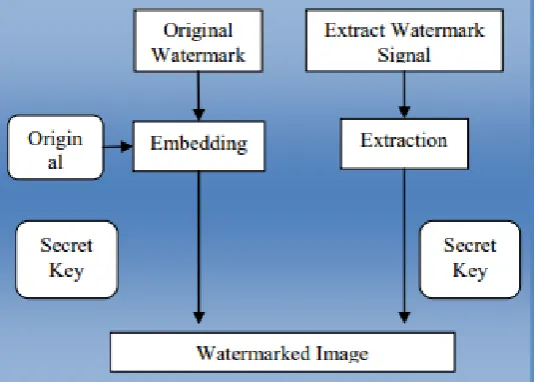
ISSN(E): 2277-128X, ISSN(P): 2277-6451, pp. 64-72 desires to take a look at the watermarks within the distorted multimedia object and probably attacked, s/he is predicated on the personal key that was used for the embed watermark.This mined watermark can also or may not resemble the antique watermark due to the object might have been attacked. Hence, to authenticate the presence of watermark, either the preceding item is used to find out and evaluate the nonblind watermarking (watermark signal) or a correlation degree is used to the identify the power of the watermark sign from the blind watermarking (extracted watermark). In the correlation based totally locating the authentic watermark collection is in evaluation with the extracted watermark series and the statistical correlation take a look at is used to outline the existence of the watermark. [3]
Fig. 1. Digital watermark Process
III. USING TECHNIQUES Least Significant bit (LSB)
In this method watermark is embedded inside the LSB of pixels. Two sorts of LSB techniques are proposed. In the primary approach the LSB of the image changed into replaced with a pseudo-noise (PN) collection even as in the 2nd a PN sequence was brought to the LSB. This method is easy to apply but now not very robust in opposition to attacks.
DES: Data Encryption standard (DES)
Specifically followed by means of employer for protection products. Algorithm layout for encryption and decryption machine has been performed with equal key. These algorithm procedures the subsequent steps. DES accepts an enter of sixty four-bit lengthy plaintext and 56-bit key (eight bits of parity) and convey output of sixty four bit block. The plaintext block has to shift the bits spherical. The 8 parity bits are eliminated from the key through subjecting the critica l component to its Key Permutation. The plaintext and key will processed through following [4].
A. The key is cut up into 28 halves
b. Each 1/2 of the key is shifted (rotated) by one or two bits, depending at the spherical.
C. The halves are recombined and venture to a compression permutation to lessen the critical element from 56 bits to 48 bits. This compressed keys used to encrypt this round‟s plaintext block.
D. The rotated key halves from step 2 are utilized in subsequent spherical. E. The records block is cut up into 32-bit halves.
F. One half is challenging to a variety permutation to growth its length to forty eight bits. G. Output of step 6 is unique-OR‟ed with the 48-it compressed key from step 3.
H. Output of step 7 is fed into an S-container, which substitutes key bits and decreases the forty eight-bit block backtrack to 32-bits.
I. Output of step 8 is difficult to a P-box to permute the bits.
J. The output from the P-container is specific-OR‟ed with different half of the facts block. K. The two records halves are swapped and grow to be the next round‟s input.
Some common sorts of quadtrees are: 1) The region quadtree:
ISSN(E): 2277-128X, ISSN(P): 2277-6451, pp. 64-72 The place quadtree is not strictly a „tree‟ (greater exactly, „bushes‟) because the positions of subdivisions are independent of the statistics. A region quadtree with a depth of n may be used to represent an photograph of 2n × 2n pixels, with every pixel valued 0 or 1. The root node represents the entire photo vicinity. If the pixels in any location aren't completely zero s or 1 s, that area is subdivided.
In this software application, each leaf node represents a block of pixels which is probably all 0 s or all 1 s. A location quadtree also can be used as a variable choice illustration of a statistics region. In this paper, the area quadtree is assumed.
2) Point quadtree:
The point quadtree is an edition of a binary tree used to symbolize -dimensional factor information. It shares the talents of all quadtrees but is a real tree due to the fact the center of a subdivision is constantly on an aspect.The shape of the tree relies upon on the order wherein the records are processed. The point quadtree is generally very green at evaluating -dimensional ordered statistics factors, generally operating in O(log n) time.
Therefore, a node contains the following information:
• Four pointers: quad [„NW‟], quad [„NE‟], quad [„SW‟], and quad [„SE‟]. • A point that, in turn, contains:
A key, usually expressed as x and y coordinates. A value, e.g., a name.
1) Edge quad tree:
Edge quadtrees are in particular used to shop strains in preference to points. This manner can result in extremely unbalanced bushes, which may additionally defeat the motive of indexing. Demonstrates the decomposition of a photograph.
The sparse matrix is used to keep the statistics of quadtree decomposition. If S is a sparse matrix, S(m, n) has the value of the block period at the location (m, n) such that best non-0 elements are given as{ (mn), value}. [5].
IV. LITERATURE REVIEW
Mohammad Rasool Mirzaei, et.al (2017) Digital image watermarking has been emerged as abasic method for copyright protection and authenticity of the owner. This paper proposes a singular and adaptive blind watermarking technique the usage of local analysis of gradients in a picture block. The approach partitions the picture into non-overlapping blocks. The embedding is accomplished inside the transfer area of each photograph block. Two transform coefficients are modified usinga variable strength factor. The value of strength factor depends onthe local complexity of the image. This value is adaptively obtainedfrom the mean gradient of each block and the DC element of the DCT coefficients of the block. [6]
V Muni SekharI,et.al (2017) In this process authentication of digital objects are essential. Toprovide authentication many watermarking schemes areproposed. Among edge based watermarking schemes special category because of low distortion while watermarking. However, present edge based watermarking scheme are suffering from smoothing effect and also reversibility is an uncertain parameter.In this paper we are proposing a Reference Image andEdge (RIE) based watermarking scheme to overcome smoothing effect problem in existing edge based watermarking schemes.RIE watermarking scheme also consider cover content information while embedding watermark pattern. Compared toexisting edge based data hiding schemes proposed RIE watermark scheme improves visual perception with more or lesssame embedding capacity.[7]
ISSN(E): 2277-128X, ISSN(P): 2277-6451, pp. 64-72
Mashruha Raquib Mitashe , et.Al. (2017) In this paper, a singular adaptive DIW model based totally on modified FCM clustering is proposed. For watermark embedding system, we used DWT. A segmentation approach XieBeni included Fuzzy C-way clustering (XFCM) is used to pick out the segments of original photo to show appropriate locations for embedding watermark. We additionally pre-processed the host picture the use of Particle Swarm Optimization (PSO) to lend a hand to the clustering manner. The intention is to recognition on proper segmentation of the image so that the embedded watermark can withstand common IP attacks and provide security to digital pictures. Several assaults were done at the watermarked photographs and authentic watermark changed into extracted. Performance measures like PSNR, MSE, CC had been computed to test the extracted watermarks with and without attacks. [9]
Wuyong Zhang Jianhua Chen , et. Al. (2016) An affine correction primarily based algorithm is proposed on this paper, which could face up to blended geometric assaults and preserve a better watermark embedding ability. The SURF set of rules and the RANSAC set of rules are used to extract, match and choose characteristic points from the attacked photograph and the original photo. Then, the least rectangular algorithm is used to estimate the affine matrix of the geometric assaults in line with the relationship between the matched function points. The assaults are corrected based totally on the expected affine matrix. A great correction step is protected to enhance the precision of the watermark detection. To withstand the cropping assaults, the watermark information is encoded with LT-coding. The encoded watermark is embedded inside the DWTDCT composite area of the photograph. Experimental results display that the proposed set of rules no longer best has a high embedding capacity, but also is robust to many types of geometric attacks. [10]
Abhishek Basu, et.al. (2016) Digital domain is today‟s most preferred area for data processing and transmission. In case of data augmentation orauthorized replication, copyright protection has become anexigent challenge. Here a spatial domain image watermarking scheme is developed through a pixel based saliencymap where the inadequate nature of human visual system isutilized. The experimental results and a brief assessment withsome existing frameworks confirm that this proposed scheme not only makes the information transparent into the cover object but also provides superior robustness and hiding capacity. cover item however additionally provides advanced robustness and hiding potential. [11]
V. PROPOSED WORK
A Reversible Quad tree based totally watermarking the usage of DES with LSB
Quadtree types
Quadtrees can be labeled based totally on the sort of data they represent, along with areas, points, traces and curves. Quadtrees may also be categorised with the aid of whether the shape of the tree is unbiased of the order wherein the data are processed.
Proposed Methodology
Step 1- First browses the cover image for hiding the text message. If (image>1)
RGB2GRAY End
Step 2- Apply quadtree decomposition on gray image and divide the into 8x8 blocks Step 3-browse image and Enter the text message to be hide into image.
Step 4-Encrypt the text message using DES.
Step 5- open the encrypted message on text window. Step 6- Hide the text into image using LSB steganography. Step 7- hide stego image into referance image
Step 8- Extract the stego image from the referance image. Step 9- extract text from stego image.
Step 10- Decrypt the encrypted text using DES. Step 11- calculate the psnr and cc
ISSN(E): 2277-128X, ISSN(P): 2277-6451, pp. 64-72
Flowchart
Fig. 2. Flowchart on Proposed methodology
VI. RESULT ANALYSIS
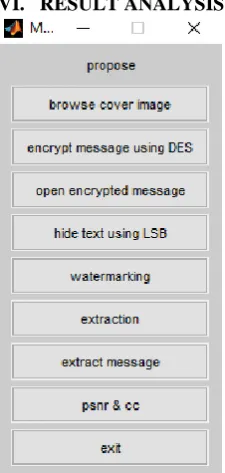
Fig. 3. 1st runs the code and we obtain the menu bar. Start
Browse the cover image
RGB2gray
Apply quad tree decomposition
Take image &Enter the message and encrypt using DES
Open encrypted text
Hide the text into image using LSB.
If the image RGB
Stop Extract the text
Now decrypt the encrypted text using DES
NO
YES
Watermarking (Hide stego image into reference image.
Extraction stego image
ISSN(E): 2277-128X, ISSN(P): 2277-6451, pp. 64-72
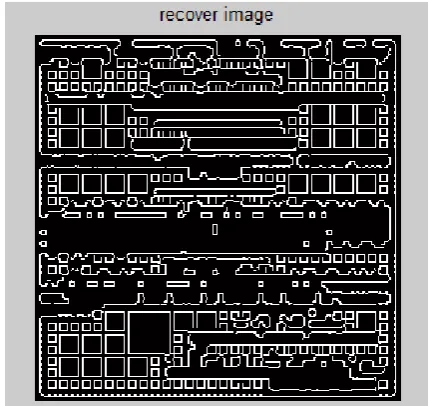
Fig. 4. Now browse the cover image and apply quad tree decomposition.
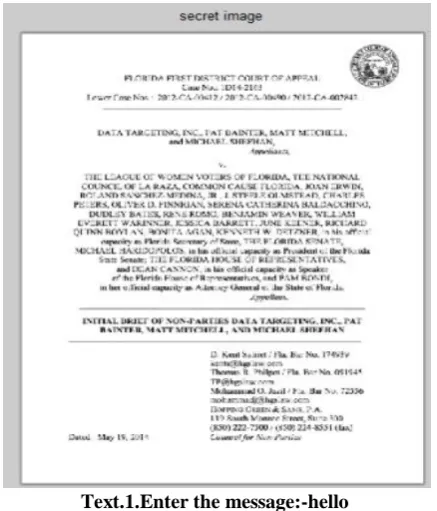
Text.1.Enter the message:-hello
Fig. 5. Browse an secret image and enter the text message to be hide in secret image.
ISSN(E): 2277-128X, ISSN(P): 2277-6451, pp. 64-72
Fig. 7. Hide stego image into reference image.
Fig. 8. Extract the stego image from referance image.
Final result =hello
Text. 2. Extract the text from the stego image.
Table 1 Base PSNR and Proposed PSNR Base PSNR Propose PSNR
20 27.7179
Graph 1. Base PSNR and Propose PSNR
0 5 10 15 20 25 30
Base PSNR Propose PSNR
Base PSNR
ISSN(E): 2277-128X, ISSN(P): 2277-6451, pp. 64-72
Table 2 Base CC and Propose CC Base CC Propose CC
0.0360 0.0934
Graph 2. Base CC and Proposed CC
VII. CONCLUSION
This paper proposed a new LSB digital watermarking scheme with the Quad Tree based decomposition. The experimental result suggests that the proposed algorithm proofs the first-rate of the watermarked image. Quad tree usually the usage of in segmentation system, on this paper we benefit of quad tree decomposition to recognize the approach of picture watermark. The effects monitor differences between the watermarked photograph and the original image throughout the techniques; this was showed via the effects of the quantitative assessment. This research demonstrates the effectiveness of the quad tree as a detector of watermarked images and shows the differences within the performance of numerous strategies.
REFERENCES
[1] Ankita Singh, Dr. A.K Sharma, “DIGITAL IMAGE WATERMARKING TECHNIQUES: A SURVEY”.ICSTM-17, ISBN 978-93-86171-30-6, 2017
[2] Dr. Nidaa A. Abbas, “IMAGE WATERMARK DETECTION TECHNIQUES USING QUADTREES”. Applied Computing and Informatics (2014), doi: http://dx.doi.org/10.1016/j.aci.2014.07.003
[3] Preeti Arya, 2Dherendra Singh Tomar and 3Deepika Dubey, “A Review on Different Digital Watermarking Techniques”.International Journal of Signal ng, Image Processing and Pattern Recognition Vol.8, No.10 (2015), pp.129-136
[4] B. Padmavathi1 , S. Ranjitha Kumari, “A Survey on Performance Analysis of DES, AES and RSA Algorithm along with LSB Substitution Technique”International Journal of Science and Research (IJSR), India Online ISSN: 2319-7064.Volume 2 Issue 4, April 2013
[5] Deepti Shukla, Nirupama Tiwari and Deepika Dubey, “Survey on Digital Watermarking Techniques”. International Journal of Signal Processing, Image Processing and Pattern Recognition Vol.9, No.1 (2016), pp.239-244
[6] Mohammad Rasool Mirzaei, Maryam Karimi, Nader Karimi, Shadrokh Samavi, “Blind Image Watermarking
Based on LocalAnalysis of Gradients”. 2017 25th Iranian Conference on Electrical Engineering (ICEE) IEEE 20 17© $3l.00/978-1-5090-5963-8/17
[7] V Muni SekharI, Ch Sravan Kumar, K V G RaoI, N Sambasiva RaoII, M Gopichand, “A Reversible RIE based Watermarking Scheme”. 2017 IEEE 7th International Advance Computing Conference, 978-1-5090-1560-3/17 $31.00 © 2017 IEEEDOI 10.1109/IACC.2017.179
[8] Andjela Draganić*, Milan Marić**, Irena Orović* and Srdjan Stanković, “Identification of image source using serialnumber-based watermarking under CompressiveSensing conditions”. MIPRO 2017, May 22- 26, 2017, Opatija, Croatia.
[9] Mashruha Raquib Mitashe, Ahnaf Rafid Bin Habib, Anindita Razzaque, Ismat Ara Tanima, Jia Uddin, “An Adaptive Digital Image Watermarking Schemewith PSO, DWT and XFCM”.978-1-5090-60047/17/$31.00©2017 IEEE
0 0.02 0.04 0.06 0.08 0.1
Base CC Propose CC
Base CC
ISSN(E): 2277-128X, ISSN(P): 2277-6451, pp. 64-72 [10] Wuyong Zhang Jianhua Chen* Rongshu Wang Xiaolong Wang Tian Meng, “Affine Correction Based Image Watermarking Robust to Geometric Attacks”. 2016 17th International Conference on Parallel and Distributed Computing, Applications and Technologies, 978-1-5090-5081-9/16 $31.00 © 2016 IEEE, DOI 10.1109/PDCAT.2016.45