Volume 47 (2012)
Proceedings of the
11th International Workshop on Graph Transformation and
Visual Modeling Techniques
(GTVMT 2012)
Model Checking Communicating Processes:
Run Graphs, Graph Grammars, and MSO
Alexander Heußner
15 pages
Guest Editors: Andrew Fish, Leen Lambers
Managing Editors: Tiziana Margaria, Julia Padberg, Gabriele Taentzer
Model Checking Communicating Processes:
Run Graphs, Graph Grammars, and MSO
Alexander Heußner
Universit´e Libre de Bruxelles – Belgium
Abstract: The formal model of recursive communicating processes (RCPS) is
im-portant in practice but does not allows to derive decidability results for model check-ing questions easily. We focus a partial order representation of RCPS’s execution by graphs—so calledrun graphs, and suggest an under-approximative verification approach based on a bounded-treewidth requirement. This allows to directly derive positive decidability results for MSO model checking (seen as partial order logic on run graphs) based on a context-freeness argument for restricted classes run graphs.
Keywords:Pushdown Systems, Hyperedge Replacement Grammars, MSO
Communicating ProcesseS(CPS) allow to model an important class of distributed processes that asynchronously communicate, e.g., via TCP-based channels or MPI, over a network topology. Hence, synchronization takes place on unbounded, lossless fifo channels. As CPS subsume com-municating finite-state machines, they inherit their well-known undecidability results, e.g., for reachability [BZ83]. Local infinite data and unbounded recursion suggests to model each process by a finite control flow automaton with a pushdown stack leading torecursive CPS(RCPS). The latter allow to reduce the Post correspondence problem or the emptiness-testing of the intersec-tion of two context free languages to RCPS’s reachability quesintersec-tion [Ram00], and thus give rise to a second source of undecidability. Hence, classical verification questions become a challenging problem on these models, especially when leaving behind simple reachability questions.
Our Contribution Extending positive decidability results from the (control-state)
Overview In the following section, we introduce the formal model of (R)CPS as well as give an overview of known restrictions and decidability results for a suite of reachability questions. Next, we recall some notions on MSO interpreted on graphs, and hyperedge replacement gram-mars, before introducing run graphs. Last, we give decidability results for MSO interpreted on run graphs of two important classes of (R)CPS. We refer to the appendix for additional de-tails/proofs.
Notation Given a setS, let|S|denote its cardinality. For anI-indexed family of sets(Si)i∈I,
we write elements of∏i∈ISiin bold face, i.e.,s∈∏i∈ISi. Thei-component ofsis writtensi∈Si, and we identifys with the indexed family of elements(si)i∈I. Analphabet Σis a finite set of
letters. We writeΣ∗ for the set of all finite wordsoverΣ. Let ε denote the empty word. Let
w=w1w2· · · ∈Σ∗, then itsforgetful projectiononΓ⊆Σis the wordw0=w01w02. . . withwi=w0i ifwi∈Γ, elsewi=ε (fori∈ {1,2, . . .}). Alabeled transition system(LTS)S=hS,s0,Act,→i
is given by a set ofstates S, an initial states0, anactionalphabetAct, and a (labeled)transition relation→ ⊆S×Act×S. We usually writes−→a s0in place of(s,a,s0)∈ →. Apushdown system
is given by a tuplehZ,z0,Act,Γ,∆i whereZ is a finite set of (control) states,z0∈Z the initial
state,Γa finite stack alphabet, andAct={push(γ),pop(γ)|γ∈Γ}the set of pushdown actions
where transition rules are given by∆⊆Z×Act×Z. The semantics of a pushdown system is given by an infinite transition system over configurations inZ×Γ∗, i.e., tuples of a control state
and a word representation of the stack’s content. Note that apush(γ)action adds the letterγ to the top of the current stack content, and that apop(γ)action blocks if the topmost letter is not equal toγ.
1
Verifying (Recursive) Communicating Processes
AtopologyTis a directed graph whose vertices are processesProcand whose edges are chan-nels Ch. The set of possible communication actions of a process p∈Proc are defined by
Comp(T,M) ={c!m|c∈Ch,src(c) =p,m∈M} ∪ {c?m|c∈C,dst(c) =p,m∈M}. We denote byc!mthe sending of messageminto channelc, and byc?mthe reception of messagemfromc.
Definition 1 Asystem of communicating processes(CPS)Q=hT,M,(Sp)p∈Proci is given by
a topologyT, a message alphabet M, and an LTS Sp for each process p∈Proc of the form hSp,s0p,Actp,→pisuch that:
– the action alphabetsActp, p∈Proc, are pairwise disjoint, and
– Actcomp =Actp∩(C× {!,?} ×M)⊆Comp(T,M)for eachp∈Proc.
Statessp∈Spare calledlocal statesofp. We writeS=∏p∈ProcSpfor the set ofglobal states. Note that the setsSp, and henceS, may be infinite. AfiniteCPS is a CPS where for allp∈Proc
theSpare finite.
The operational semantics ofQis defined by a global LTSJQK=hX,x0,Act,→i, whereX =
S×(M∗)C is the set of configurations, x
0= (s0,(ε)c∈Ch)is the initial configuration (note that
channels are initially empty),Act=S
the transition relation; the latter is defined as follows: fora∈Actp,(s1,w1)
a
−→(s2,w2) if the
subsequent conditions are satisfied:
(i) s1p−→a p
s2pandsq1=s2qfor allq∈Procwithq6=p,
(ii) ifa∈Actlocp thenw1=w2,
(iii) ifa=c!mthenwc2=wc1·mandwd2=wd1for alld∈Cwithd6=c,
(iv) ifa=c?mthenm·wc2=wc1andwd2=wd1 for alld∈Cwithd6=c.
A (finite)runin the LTS Qis an alternating sequence ρ= (x0,a1,x1, . . . ,an,xn) of configu-rationsxi ∈X and actionsai∈Actthat satisfies, for all 1≤i≤n,xi−1
ai
−→xi. A configuration
x∈X is reachablein a CPS Qif there exists a finite run of Q from the initial configuration
x0 tox. We define thereachability set ofQasReach(Q) ={x∈X |xis reachable inQ}. For
a given CPS Qand a global state s∈S, thestate reachability problem for CPS asks whether
Reach(Q)∩ {s} ×(M∗)Cis non-empty.
A pair of send/receive actions ai=c!m,aj =c?mis called matching in ρ if i< j and the number of receives onc within ai· · ·aj equals the length ofc in xi. In the following we will mainly focus runs of a certain form, so calledeager runs.
Definition 2 A runρ = (x0,a1,x1, . . . ,an,xn)iseagerif for allai with 1≤i≤nwhenai is a receive action theni>1 andai−1is its matching send action.
A configurationx∈X iseager-reachablein a CPS Qif there exists a finite, eager run from the initial configuration x0 to x. The eager-reachability set of Q is the set Reacheager(Q) of
eager-reachable configurations. We say that a CPSQiseagerwhenReacheager(Q) =Reach(Q). One can show that eagerness of CPS arises under some natural (and decidable) restriction on cyclic communication, calledmutex; the latter is a generalization of the well-known half-duplex restriction from mutual channels to larger topologies. Deciding the eagerness of a finite CPS proves to be undecidable, however, deciding whether a given finite CPS is mutex is complete in PSPACE [HLMS11]. Eager CPS subsume globally existentially 1-bounded finite-state
ma-chines [LM04].
Recursive communicating processes (RCPS) R=hT,M,(Dp)p∈Proci are CPS whose local transition systemsDpare pushdown systems. Formally, eachDpis given byhZp,z0p,Actp,Γp,∆pi
whereZpis a finite set of control states,z0pan initial state,Actpan alphabet of actions,Γpa stack alphabet and∆p⊆Zp×Actp×Zpthe set of actions.
The (local) semantics of each Dp is the common one and we assert the stack operations to be expressed by Actstackp ={push(γ),pop(γ)|γ ∈Γp} ⊆Alocp ; local configurations are written (zp,up)∈Zp×(Γp)∗. Note that eachpopaction must have amatching pushaction before, such
that the forgetful projection of a local run ofDp onActstackp is a Dyck word, i.e., a word where thepush(γ)andpop(γ)actions forγ∈Γare “well-nested”.
LetZ=∏p∈ProcZp the set ofglobal control states. AstateofRis writtens= (z,u) where
Fact 1 The state reachability problem is undecidable for finite CPS, even if we restrict the topology to two processes that are mutually connected by two channels. [BZ83]
Fact 2 The state eager-reachability problem for finiteCPSis decidable. [HLMS11]
Fact 3 TheRCPSstate eager-reachability problem is undecidable when the underlying
topol-ogy contains at least two pushdown processes that are connected by one channel. [HLMS11]
Even if eagerness is sufficient for arriving at positive results for finite CPS, we need additional architectural constraints to gain the following positive reachability result for RCPS.
Fact 4 A typed topology has a deciableRCPS state eager-reachability problem if and only if
it is non-confluent. The problem isEXPTIME-complete in the latter case. [HLMS11]
The previous result considers a semantic restriction against the direct synchronization of a RCPS’s local pushdown systems, inspired by, e.g., [LMP08, CV09]. Atyped topologyrestricts the usage of a (point-to-point) channels as follows: either the process sending on this channel can use its channel end only when its local stack empty, or the receiving process can read only when its local stack empty, or both of the previous two restrictions (i.e., sending and receiving requires the active process’s local stacks to be empty).
A typed topology isconfluentif there exists a sequence(p0,c1,p1, ...,cn,pn)of distinct pro-cessespi∈Proc(for 0≤i≤n) and channelscj∈Ch(1≤j≤n) such thatp0andpncan use their channel ends ofc1andcnwithout restriction. Anon-confluenttyped topology is not confluent. Informally, non-confluent topologies do not allow to let the information generated/read by two pushdown systems to “flow together”.
The proof of Fact 4 relies on the following: for each eager run of a non-confluent RCPS one can efficiently construct an order-equivalent run whose forgetful projection ontoActstack is globally a Dyck word, i.e., which can be simulated ononeexponentially larger global pushdown process. We capture the latter by the following definition.
Definition 3 A finite runρ of an RCPS isone-stack if the forgetful projection ofa01· · ·a0non
S
p∈PAct p
stackis a Dyck word.
Lemma 1 All runs of eagerRCPSover non-confluent architectures are one-stack.
Lemma 2 Given anRCPS, it is undecidable whetherallits runs are one-stack.
Remark1 Directly extending the previous positive results from safety/reachability verification
to the model checking ofω-regular properties is however not possible. Let us take a look at an
RCPS consisting of two local pushdown process with no channel in between, hence, an RCPS
on a non-confluent architecture where all runs are eager. Interpreting linear temporal logics
(LTL) on runs of this RCPS allows to express the synchronization of two pushdown processes
via a logical formula [Ram00]. Restricting the logic to a “weaker” (from the standpoint of expressiveness) fragment does not help either, as the negative result can already derived for the
culprit can be found in the possibility to express the synchronization of independent events via a formula that is interpreted on the global interleaving. Regarding our example: when there is no communication between the underlying local processes, all fireings of actions on both processes are assumed independent.
Thus we propose to abandon interleaving-based semantics in favor of a partial-order one and to consider (temporal) logics based on this structure. In the following, we will focus monadic
second order logic (MSO) on a rendering of the underlying partial of a run of aCPSinto graphs.
2
Run Graphs and MSO
Definition 4 For finite alphabets Λ and Π, a (Λ,Π)-labeled directed graph is a tuple G=
hV,A,arc,λ,πi whereV is the finite, non-empty set of vertices,Athe set of arcs (often called edges), the functionarcmaps each arc to an ordered pair of vertices, as well asλ:V→2Λlabels each vertex by an element from 2Λand
π:A→Πlabels each arc by an element fromΠ.
For arc(a) = (v,v0)wherea∈Aandv,v0∈V, we say thatvis thesourcevertex ofa andv0
its destination. Given a graphG=hV,A,arc,λ,πi, then a graphG0=hV0,A0,arc0,λ0,π0i is a
subgraphofGifV0⊆V andA0⊆V, andarc0,λ0,π0 can be derived by restricting the original counterparts toV0 and A0. An induced subgraph demands in addition that for alla∈Awith
arc(a) = (x,y) andx,y∈V0 it holds thata∈A0. Fora∈Alet G\abe the graph obtained by removing a fromGand by contractingthe source and destination of a to one new vertex. A graphH is a minorof a graphGifH is isomorphic to a graphG00 that can be derived fromG
by finitely many arc contractions, as well as deletions of arcs and vertices (the latter implies the deletion of arcs connected to these vertices).
Given a graphG, we define thetreewidthofGas usual via graph decompositions [RS86]. The treewidth measures by a natural number how “close”Gis to a tree where trees have treewidth 1. (Recall that the treewidth of a graph corresponds to the size of a separator for the graph, i.e., the number of edges one has to delete to separate the graph into components, which equals 1 for trees.) A class of graphs hasbounded treewidthif there exists a constantk∈Nsuch that all
graphs in this class have a treewidth lower or equal tok; else it hasunbounded treewidth.
Fact 5 For k∈N, let Gkbe the k×k grid; then(i)Gkhas treewidth k, thus(ii)the class of all
grids{Gk|k∈N}has unbounded treewidth; further,(iii)if H is a minor of G then the treewidth
of H is lower or equal to the one of G. [Bod98]
Monadic Second Order Logic on Graphs We introduce MSOV interpreted over the
previ-ously introduced graphs where formulas are constructed as below for first-order variables x,y
over vertices, andXis a second-order variable over sets of vertices. Correct MSOV formulae are given by the following BNF expression:
ϕ::=x=y|Labl(x)|Arc(x,y)|x∈X|ϕ∧ϕ| ¬ϕ| ∃x(ϕ)| ∃X(ϕ)
Informally, we interpret =as equality on V, the predicate Labl(x) for l∈2Λ is true if the vertexxis labeled byl, andx∈Xis true ifxis in the set represented by the second order variable
source vertex is represented byxand whose destination is represented byy. Note that we have existential quantification over both first and second order variables. (A formal introduction of the semantics can be found in [CE11].) We writeG|=ϕ if a graphGsatisfies a formulaϕ. We add the usual additional syntactic sugar by introducing(ϕ∨φ),(ϕ→φ), and(∀x(ϕ)).
MSOA(often written MSO2or MSO-2 in the literature) is introduced analogously whereas we
additionally allow first and second order variables over arcs, and first- and second-order quan-tification over arcs. The central difference between MSOA and MSOV is the ternary incidence predicateArc(x,y,z) in MSOA which is true ifx is an arc with sourcey and destinationz. We extend Labl(x) to include arc labellings when x is an arc and l∈Π, as well as demand the =-relation to extend to arcs.
Note that ∃x Arc(x,y,z)is equivalent to the incidence predicate of MSOV. Thus, we can directly translate any formula from MSOV to MSOA. The reverse direction only holds if we restrict ourselves to the class of graphs of bounded treewidth [CE11]. As this is the case in the following, we will not distinguish between MSOV and MSOA, thus only refer to “MSO”.
Example1 The following MSOAformulaχ(x,y,l)(with free variablesx,y,l) expresses a “causal”
reachability problem: there exists anl-labeled path from vertexxto vertexy:
χ(x,y,l)≡ ∀X
x∈X∧ ∀u,v u∈X∧arc(z,u,v)∧Labl(z)→v∈X
→y∈X
Then again, we can characterize classes of graphs that are “incompatible” with MSO as follows:
Fact 6 If a class of graphs contains for each k∈Na graph G that has Gkas induced subgraph,
then MSO is undecidable on this class of graphs. [See75]
Hyperedge Replacement Grammars We introduce hypergraphs as extension of “classical”
graphs. A ((Λ,Π)-labeled)hypergraphis tupleH=hV,A,arc,λ,πi, analogous to the previous definition of graphs, whereasAis a finite sorted setA=S
i∈NAi (i.e., theAi are disjoint), whose
elements are called hyperarcs (or hyperedges), and we definearity(a) =iifa∈Ai; further,arc
maps an arca∈Ai to a sequence of nodes of sizei, i.e.,arc(a) = (v1,· · ·,vn)forn=arity(a).
Note that the previously introduced graphs are hypergraphs where the only possible arity of (hyper-)arcs is 2.
Embeddable hypergraphs are a tuplehH,extiwhere extis a sequence of distinct “external” vertices(v1,· · ·,vk) ofH (withv1,· · ·,vk ∈V). We abuse notation and writeH for the tuple hH,extiandext(H)for the sequenceext; further lettypemap an embeddable hypergraphH to the size of its sequenceext(H). Let us assert that all the hypergraphs in the remainder are over the same two set of labelsΛandΠ. We depict external vertices by•and others by◦.
We define the operation ofhyperedge replacementas follows: letHbe a hypergraph,a∈Aone of its arcs, andH0 an embeddable hypergraph disjoint fromHwitharity(a) =type(H0)(if they are not disjoint, we take disjoint copies the usual way), thenH[a←H0]is the hypergraph that is
A hyperedge replacement grammar (HRG) is a tupleG=hN,T,P,H0i where N andT are
the sets of non-terminal and terminal hyperarcs. H0 is the initial hypergraph. P is a finite
set of production rules that map a hyperedgea∈N to an embeddable hypergraphH such that
arity(a) =type(H)and all vertices in ext(H) are labeled by /0. We write rules asR:a,→H where we add the syntactic sugar of an identifierR. The width of an HRG Gis the maximal number of vertices of the hypergraphs at the right-hand sides of all rules inPminus one.
Given an HRGG=hN,T,P,H0i, we define thederivation relation⇒G between two
hyper-graphsH,H0as follows:H⇒GH0iffH0=H[a←Hi], anda,→Hiis a rule inPfora∈Nand an embedded hypergraphHi. LetL(G)be the class of hypergraphs that can be derived fromH0
in a finite number of⇒G-derivations, and that do only contain arcs inT. We refer to [DKH97] for more details on HRG and HRG languages.
Fact 7 Given an HRGGof width k (for k∈N), then the treewidth of the class of graphsL(G)
is bounded by k. [Lau88]
As graphs generated by HRG have bounded treewidth, one can draw a bridge to the known fundamental connection of decidability of MSO on classes of graphs with bounded treewidth:
Fact 8 Given a hyperedge replacement grammar Gthat describes a class of graphs, and an
MSO formula ϕ, then checking whether there exists a graph G in this class with G|=ϕ is decidable. (follows directly by combining Fact 7 with [CE11])
From CPS to Run Graphs In Section 1 we focused an interleaving-based semantics by
view-ing CPS runs as alternatview-ing sequences of configurations and actions. Alternatively, we can regard runs as linear sequence ofeventsthat are labeled by actions. Formally, letE be a set of events, λ :E→Acttheir labelling by actions, then a finite runρ is a word inE∗. Analogously to the partition ofActintoActpforp∈Proc, we partitionE into setsEp.
Due to the underlying semantics of a CPS, the events in the setsEp(forp∈Proc) are linearly ordered; interprocess dependencies arise via communication, i.e., via events labeled by matching pairs of send and receive actions. For RCPS, we also need to take a closer look on events labeled by matchingpush/popactions. We thus introduce the three order relationssuccp,<m, and<pd onE for(e,e0)∈E×E:
– (e,e0)∈succpforp∈Procife0is a direct successor ofeon processp
– e<me0if(e,e0)is labeled by a matching pair of send/receive actions
– e<pde0ifeande0 are labeled by a matching pair ofpush/popactions.
Given a runρ= (x0,a1,x1, . . . ,an,xn)of a CPS, we derive the correspondingnatural order of
events[ρ] =h{1, . . . ,n},≤,λiwhere≤is the transitive reflexive closure ofSpsuccp∪<m. Note that we do not need to include<pd explicitly as it is already covered by the transitive closure of direct successors, however it plays an important role in causal entanglements.
Therun graphcorresponding to a runρ of a CPSQis a(Λ,Π)-labeled graph whereΛequals
{fst,lst} ∪S
p∈Proc(∆p∪Zp)andΠ={succp|p∈P} ∪ {pd,m}over the vertex setE∪ {e p
0,e
p F|
are related bysuccp/<pd/<m. In addition we assert an initial and final event vertexe p
0/e
p F per process which is connected by an succp arc to the first and from the last event and which is labeled byfst/lst. We depictm-labeled arcs by m
(dashed) andpd-labeled by pd (dotted). Given an CPS Q, let RG(Q) the set of graphs that are run graphs of a possible run of Q. We want to use MSO to represent propositions about run graphs. As the setΛ depends on the
underlying CPS Q, we parametrize the logic by the CPS and write ϕ∈MSO(Q)for an MSO formulaϕover this signature of labels.
Example 2 We can now transfer Example 1 to specify the behaviour of an RCPS R. The
following formulaφp(zp)∈MSO(R) expresses that process p ofR must pass a local control
statezp∈Zpat least once along its run:
φp(zp)≡ ∃e,e0 χ(e,e0,succp)∧Labfst(e)∧Wa∈Actp,z∈ZpLab(z,a,zp)(e0)
3
Representing Classes of Run Graphs by HRG
3.1 Bounded Finite CPS
Proposition 1 Given a finite CPSQandϕ ∈MSO(Q), then it is undecidable whether there
exists G∈RG(Q)such that G|=ϕ.
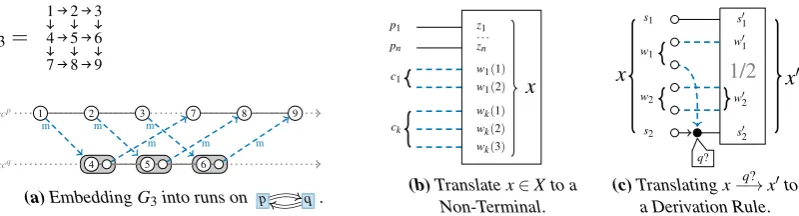
Idea of Proof Combining Fact 5(iii)and Fact 6 allows for the counterargument to the previous
decision question, as one can embed anyk×k-grid into the run graphs of a finite CPS over
the topology p q. We will exemplify the derivation of G3 as graph minor in Figure 1a.
Contracting the gray marked vertices and deleting the dotted arcs leads toG3 as proper minor.
Analogous constructions are possible for all otherGk fork∈N.
Thus, we need to focus on limitations for finite CPS. The well-established connection to MSO logics interpreted on “bounded” message sequence graphs in [GKM07, LM04] suggests the following restriction which we subsequently lift into our setting of run graphs:
Definition 5 A run of a CPS is (locally) b-bounded, if for all of its prefixes the number of
unreceived messages on each channel is less than or equal tob. A CPS is (existentially locally)
b-bounded forb∈N, if for any run there exists an order-equivalent one that isb-bounded.
Acutof a run graph is a sequence(ep)p∈Proc of vertices such thatep∈Ep, and it holds that if there is a path in the run graph fromeptoeq(forp,qdistinct elements ofProc) thenepis the only element ofEpin this path.
Definition 6 A run graph isb-bounded (forb∈N) if for each cut(ep)p∈Procthere is no channel
c∈Chwithsrc(c) =psuch that there are more thanbsend events on this channel beforeepthat are not received beforeeqwithdst(c) =q.
We construct a HRGG(Q,b) =hN,T,P,H0idirectly from thefinitetransition systemJQKof
1 2 3
4 5 6
7 8 9
G3=
succp
succq
1 2 3 7 8 9
4 5 6
m m m
m m m
(a)EmbeddingG3into runs on p q .
z1 . . .
zn w1(1)
w1(2)
wk(1)
wk(2)
wk(3)
p1
pn
c1
ck
x
(b)Translatex∈Xto a Non-Terminal.
1/2
q?
s1 s01
s2 s02 w1
w01
w2 w02
x x0
(c)Translatingx−→q? x0to a Derivation Rule.
Figure 1.Decidability Anti-Pattern via Embedding Grids / Positive Patterns via Grammar.
– G(Q,b)generates a run graph from left to right, i.e., a singlesuccp-labeled path ofEp ver-tices for allp∈Procand appropriatem-labeled arcs;
– each non-terminal stores the capacity of the channel bound that is already used as well as stores unreceived messages in fifo order, i.e., each non-terminal represents a cut/configuration ofJQK(see Figure 1b);
– thus we can directly translate each transitionx−→a x0inJQKto a HRG rule (see Figure 1c);
– and the inital configuration maps to the following initial hypergraph fst,p1 x0
fst,pn
We can interpret non-terminals as cuts: starting from the initial cutH0, where all processes are
in its initial events, a derivation inG(Q,b)corresponds to a sequence of cuts that finally arrives at the last cut, where all processes are inlst-labeled events.
Example3 Figure 2 represents the HRG generation of a run graph of a2-bounded finite CPS
over the architecture p q where|M|=|Sp|=|Sq|=1, i.e., both processes only have one
state and the message alphabet is of size one. Thus we label event vertices only by actions. (The detailed grammar can be found in the appendix.)
Lemma 3 For a given b∈Nand a b-bounded finite CPSQ, the classL(G(Q,b))equals the
class of run graphsRG(Q).
Proof. For a G∈RG(Q), we assume that ρ is a b-bounded run conform to G. Then we can generate a sequence of cuts ofGthat left-to-right tracesρ. This sequence of cuts can be generated byG(Q,b).
For the other direction, a derivation of G(Q,b) is a sequence of cuts, such that each cut can be represented by a non-terminal. By construction, there are no more thanbpending messages per channel at each non-terminal. Assert that there exists a cut in G∈L(G(Q,b)) that was not generated by the current derivation ofGbut which has more thenb messages pending for a channel. As a the production rules ofG(Q,b) are derived from the transition ofJQKand as
0/0 fst fst = ⇒G fst fst 1/0 p! = ⇒G fst fst p! 1/1 q! = ⇒G fst fst p! m q? q!
0/1 =⇒G
fst fst p! m m q? p? q!
0/0 =⇒G
fst fst m p! m m q? p? q! lst lst
Figure 2.Possible Derivation of the HRG of Example 3 .
Corollary 1 Given a b-bounded finite CPSQ, then all run graphs in RG(Q)have treewidth
bounded by|Proc| ·b· |Ch|.
Alternatively stated, the message sequence graphs (the graph rendering of the underlying mes-sage sequence charts) ofb-bounded finite CPS have bounded treewidth.
Proposition 2 Given a b-bounded finiteCPSQ, andϕ∈MSO(Q), then we can decide whether
there exists a graph G∈RG(Q)such that G|=ϕ.
Proof. We reduce the given decision problem to deciding whether there exists a graph G in the HRG languageL(G(Q,b))such thatG|=ϕ. The latter is decidable due to Fact 8, and, by Lemma 3, returns the demanded run graph ofQ.
3.2 Eager 1-stack RCPS
Proposition 3 Given a eagerRCPSRandϕ∈MSO(R), then it is undecidable whether there
exists G∈RG(R)such that G|=ϕ.
Instead of focussing RCPS with the non-confluent restriction, we will restrict ourselves in the following to the larger class of eager RCPS where for each run there exists an order-equivalent one that is both eager and 1-stack (cf. Lemma 1). W.l.o.g. we assume all channels of eager RCPS to not enter their growing phase. However, we will not derive a HRG directly as in the previous case, but follow the subsequent three steps:
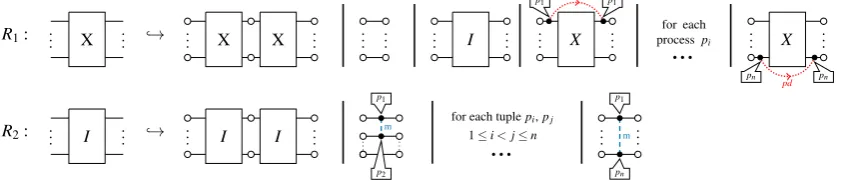
First, given an RCPSR over the set of processesProc={p1,· · ·,pn}, we construct an HRG
G(R) =hN,T,P,H0ias follows:
– H0equals X
p1,fst
pn,fst
lst,p1
lst,pn
..
.
..
. , where we additionally label vertices by process names;
– N={X,I}consists of two(2·n)-ary hyperedges;
– the production rulesPpresented in Figure 3 depend only onP;
– we depict the arc representing a matching send/receive related vertex pair in the case of eager communication by m and interpret it as m
m with respect to graph properties
like paths.
Second, we extendG(R)to an HRGGe(R)that generates run graphs with a vertex labeling over
∆ as follows: we label the initial vertices for each process additionally by z0p, we transform
a production rule of G(R) that generates a send/receive matching set of vertices for distinct
R1: ... X ... ,→ ... X X ... ... ... ... I ... ... X ...
pd
p1 p1
for each processpi
. . . .. X
.
..
.
pd
pn pn
R2: I
..
.
..
. ,→ I I
.. . .. . .. . .. . m p1 p2
for each tuplepi,pj
1≤i<j≤n . . . m .. . .. . p1 pn
Figure 3.Production Rules ofG(R)for 1-stack RCPSRoverProc={p1,· · ·,pn}.
I .. . .. . ,→ .. . .. . m pi pj maps to ( I .. . .. . ,→ .. . .. . m pi,δi
pj,δj
form∈M, letδi∈Zpi× {pi!pj(m)} ×Zpi
andδj∈Zpj× {pj?pi(m)} ×Zpj, as well as
vice versa forpjsending andpireceiving
)
Thus, weguess the exchanged messagem∈M, assure that both vertices are labeled by the appropriate matching actions, and additionallyguesstwo control-states for each process.
We analogously translate production rules that generate matching push/pop vertex pairs to a set of rules that has the same right-hand-side hypergraph but additionally guesses the γ∈Γp;
thus translatingG’s rules (right) to a set of rules ineG(R)(left):
X .. . .. . ,→ X .. . .. . pd
pi pi
maps to ( X .. . .. . ,→ X .. . .. . pd
pi,δi pi,δj
forγ∈Γpi,
letδi∈Zpi× {push(γ)} ×Zpi
andδj∈Zpi× {pop(γ)} ×Zpi )
Note that we assure that the same letter from the pushdown alphabet is assigned to a matching push/pop vertex pair.
Third, we verify that the previous guess of triplesδ is correct with respect to the underlying (Ap)p∈Procby the MSO formula
ϕ∆≡ ∀v
V
p∈Proc
ϕlabelp (v)∧ϕtransp (v)
which tests whether nodes are(i)correctly labeled by either a transition rule, or byfst/lst; and (ii)the labels of neighboring nodes mirror a correct transition ofR.
ϕlabelp (v)≡Labfst(v)∨Lablst(v)∨ W(z,a,z0)∈∆pLab(z,a,z0)(v)
ϕtransp (v)≡W(z,a,z0)∈∆p
Lab(z,a,z0)(v)→Predecessorp(v,z)∧Successorp(v,z0)
Thus, the direct predecessor/successor of a node—if is not tagged byfst/lst—is labeled by a rule that ends/starts in the control state required by the current rule.
Predecessorp(v,z)≡ ∃v0
Arcsuccp(v0,v)∧
Labfst(v0)∨W
a∈Actp,z0∈ZpLab(z0,a,z)(v0)
Successorp(v,z)≡ ∃v0
Arcsuccp(v,v0)∧
Lablst(v0)∨W
a∈Actp,z0∈ZpLab(z,a,z0)(v0)
Lemma 4 Given an RCPS R where all runs can be reordered into a run that is both eager and 1-stack, then the class of graphs, consisting of those inL(eG(R))that additionally fulfillϕ∆,
equalsRG(R).
The proof of the previous lemma relies on an argument close the proof of Fact 4 that allows to “cut” a run with respect to a context-free pattern. As before, we can directly apply Fact 8 on the formulaϕ∧ϕ∆to derive the following:
Proposition 4 Given an RCPS Rwhere all runs are order equivalent to a run that is both
eager and 1-stack, and an MSO formulaϕ over the appropriate signature of run graphs, then
we can decide whether there exists a graph G∈RG(R)such that G|=ϕ.
4
Conclusion
This article proposes to leave behind the combination of linear temporal logic and CPS in favor for MSO on the underlying partial order of events. A graph-based representation of a run by a run graph proves ideal for a high-level view on MSO-based partial order logics. Describing the evo-lution of CPS by graph grammars is a versatile tool to(i)get better insights into the intricacies that lead to undecidability result (both [BZ83] and [Ram00] can be reduced as intermediary step to a simple semantic argument on grid graphs that allow to represent halting runs of Turing ma-chines); as well as(ii)to naturally derivesemanticboundedness conditions that include currently known ones (e.g., existentialb-boundedness) and open the door for new ones; thus,(iii)this lifts the idea of semantic boundedness to the bounded width of graph grammars. The latter can also be seen as a different rendering of the fact that decidability results rely on the ability to parse the structure of a run by only storing a finite amount of information. However, the question of deriving syntacticrestrictions that lead to the semantic ones found above remains often open, e.g, in the case of eager RCPS where there always exists an order-equivalent one-stack run (see Lemmata 1 & 2).
Related Works Generating graph representations of partial order runs via graph grammars
is orthogonal to encoding the runs of transition systems itself into derivations of an appropriate graph grammar [Roz97]. The presented approach allows to specify/verify properties on runs, and not to only verify whether a configuration of a certain pattern is reachable.
gen-eral approach based on a given graph grammar and its straightforward relation to tree automata recognizing term representations of run graphs [CE11].
A closer look onto the complexities of Propositions 2 and 4 reveals a tower of exponentials depending on the quantifier height of the MSO formula [CE11]. Recent results on MSO defin-able temporal logics on traces derive better complexities [BCGZ11, GK10] based on optimized translations to automata problems. Those fragments of MSO could, e.g., define an operatorFp
(for “reachable for process p∈Proc”) as MSO formula with one free variable λx(φ(x))(see Example 2). Optimal algorithms for these MSO fragments on the classes of RCPS considered here remain an open question.
Outlook One can directly extend the previously introduced proof technique to other settings
like bounded lock graphs [KW10] or thek-phase bounded RCPS [HLMS11]. A natural ex-tension of our grammars would focus infinite run graphs or branching time properties. Besides MSO, we also started to take a look on interpreting linear temporal logics on Mazurkiewicz traces in our graph setting, which also would propose a propositional logic weaker than full MSO. Cur-rently, a variety of other graph measures came into focus, like bounded path-width [DSG11] or the vertex cover number [PL11]; these could be the point of departure for deeper insights into novel semantic restrictions for other subclasses of (R)CPS.
Acknowledgements We thank the anonymous reviewers and the GT-VMT community for
constructive feedback, as well as J. Leroux, A. Muscholl, and G. Sutre for stimulating discus-sions. This work was partly supported by the project ANR AVerISS (ANR-06-SETIN-001).
Bibliography
[BCGZ11] B. Bollig, A. Cyriac, P. Gastin, M. Zeitoun. Temporal Logics for Concurrent Recursive Programs: Satisfiability and Model Checking. In Proc. of MFCS’11. LNCS 6907, pp. 132–144. Springer, 2011.
[Bod98] H. L. Bodlaender. A partial k-arboretum of graphs with bounded treewidth. TCS
209(1–2):1–45, 1998.
[BZ83] D. Brand, P. Zafiropulo. On Communicating Finite-State Machines. JACM
30(2):323–342, 1983.
[CE11] B. Courcelle, J. Engelfriet.Graph Structure and Monadic Second-Order Logic, a language theoretic approach. Cambridge Univ. Press, 2012. (to be published).
[CF05] G. C´ec´e, A. Finkel. Verification of programs with half-duplex communication. In-formation and Computation202(2):166–190, 2005.
[CV09] R. Chadha, M. Viswanthan. Deciding branching time properties for asynchronous programs.TCS410(42):4169–4179, 2009.
[DSG11] G. Delzanno, A. Sangnier, G. Zavatarro. On the Power of Cliques in the Parame-terized Verification of Ad Hoc Networks. In Proc. of FOSSACS’11. LNCS 6604, pp. 441–455. Springer, 2011.
[GK10] P. Gastin, D. Kuske. Uniform satisfiability problem for local temporal logics over Mazurkiewicz traces.Information and Computation208:797–816, 2010.
[GKM07] B. Genest, D. Kuske, A. Muscholl. On communicating automata with bounded chan-nels.Fundamenta Informaticae80:147–167, 2007.
[Heu10] A. Heußner. Run Graphs of Communicating Processes and MSO. InCONCUR’10 YR Workshop. pp. 75–78. 2010.
[HLMS11] A. Heußner, J. Leroux, A. Muscholl, G. Sutre. Reachability Analysis of Communi-cating Pushdown Systems.LMCS, 2011. to be published.
[KG07] V. Kahlon, A. Gupta. On the analysis of interacting pushdown systems. InProc of POPL’07. Pp. 303–314. ACM, 2007.
[KW10] V. Kahlon, C. Wang. Universal Causality Graphs: A Precise Happens-Before Model for Detecting Bugs in Concurrent Programs. InProc. of CAV 2010. LNCS 6174, pp. 434–449. 2010.
[Lau88] C. Lautemann. Decomposition Trees: Structured Graph Representation and Efficient Algorithms. InProc. of CAAP’88. LNCS 299, pp. 28–39. Springer, 1988.
[LM04] M. Lohrey, A. Muscholl. Bounded MSC communication.Information and Compu-tation189(2):160–181, 2004.
[LMP08] S. La Torre, P. Madhusudan, G. Parlato. Context-Bounded Analysis of Concurrent Queue Systems. InProc. of TACAS’08. LNCS 4963, pp. 299–314. Springer, 2008.
[Mad03] P. Madhusudan. Model-checking Trace Event Structures. InProc. of LICS. Pp. 371– 380. 2003.
[MP11] P. Madhusudan, G. Parlato. The Tree Width of Automata with Auxiliary Storage. In
Proc. of POPL 2011. ACM, 2011.
[MTY05] P. Madhusudan, P. S. Thiagarajan, Yang. The MSO Theory of Connectedly Commu-nicating Processes. InProc. of FSTTCS 2005. LNCS 3821, pp. 201–212. Springer, 2005.
[PL11] M. Praveen, K. Lodaya. Parameterized Complexity Results for 1-safe Petri Nets. In
Proc. of CONCUR’11. LNCS 6901, pp. 358–372. Springer, 2011.
[Ram00] G. Ramalingam. Context-sensitive synchronization-sensitive analysis is undecid-able.ACM Trans. Program. Lang. Syst.22(2):416–430, 2000.
[RS86] N. Robertson, P. D. Seymour. Graph minors III: Planar tree-width.Journal of Com-binatorial Theory, Series B41:92–114, 1986.