CHEMICAL WATER QUALITY CHANGES ALONG A STREAM
AT AN ABANDONED Pb-Zn MINING SITE
Elza Kovács
[a]*, Dario Omanović
[b], Ivanka Pižeta
[b], Halka Bilinski
[b], Stanislav
Frančišković-Bilinski
[b]and János Tamás
[a]Paper was presented at the 4th International Symposium on Trace Elements on the Food Chain, Friends or Foes, 15-17 November, 2012,
Visegrád, Hungary
Keywords: abandoned mining site, heavy metal, surface water
In the present study, chemical water quality changes downstream a pool-riffle type stream located at a former Pb-Zn mining site are discussed. The watershed of the Toka stream (Mátra mountain, Hungary) being under rehabilitation is still continuously affected by a neutralised acidic mine drainage, and temporarily, by an abandoned mine tailing. Upstream the AMD confluence which gives the major part of the water flux in dry season, indeed, the stream is of high water quality, while, directly after that, the electric conductivity is app. quintupled, and the pH as well as the trace element concentrations increase, as expected. However, within the range of 10 kilometres, Fe, Zn and Pb concentrations are all remarkably decreased in relation to the distance from the contamination source, and they almost reach the actual background levels. The electric conductivity does not show significant change along the investigated section of the stream, which would indicate dilution. At the same time, presence of amorphous Fe(OH)3 in the sediment is obvious, based on the pH-Eh relations and
geochemical analysis, thus the adsorption processes have considerable role in the decrease of trace element concentrations in solution.
* Corresponding Author Fax: +3652508456
E-Mail: [email protected]
[a] Department of Water and Environmental Management, Faculty of Agricultural and Food Sciences, and Environmental Management, Centre of Agriculture and Economy, University of Debrecen, H-4032 Debrecen, Böszörményi 138, Hungary
[b] Division for Marine and Environmental Research, Ruđer Bošković Institute, 10002 Zagreb, POB 180, Croatia
Introduction
At the sulphide-bearing mining sites, potentially toxic elements take part in complex biogeochemical interactions. They have many chemical forms that can readily be transformed into one another, under the dynamically changing environmental conditions. In order to assess the contaminant transport it is inevitable to know the controlling (bio)-chemical and physical mechanisms, such as weathering (Eq. 1-4), secondary mineralization, hydrolysis (Eq. 5-7), precipitation, dissolution (Eq. 8), complexation, and co-precipitation, adsorption, desorption, which all dependent on the species present, their concentrations, and can hardly be measured and monitored simultaneously resulting from the complexity of the system.
Considering the mines and their drainages, sediments in the affected surface water pose risk of heavy metal remobilisation as a secondary source of pollution.1-5 As a
result of increase in pH (Eq. 9), the adsorption, precipitation and co-precipitation specific to heavy metal species take place, and the concentrations in solution show a certain removing order downstream of the discharge point6-8,
although hydrological seasons definitely affect the spatial variation, fate and transport of metals.8-11
The aim of the present study was to investigate the change in surface water quality and the main governing chemical and physical mechanisms downstream of the Toka stream (Mátra mountain, Hungary) which is affected by an abandoned Pb-Zn mine and its tailing dump, with respect to potentially toxic elements.
Experimental
Site Description and Sampling
According to the Watershed Management Action Plan (WMAP) in Hungary, Toka stream belongs to the class of the silicate-based mountainous small watersheds with gravel stream bed. In the watershed, a Pb-Zn mine and an ore processing plant were operated from 1952 to 1986, however, neutralized acid mine drainage is still led to the stream. There are two discharges, a continuous one from the AMD treated with Ca(OH)2 and settled, and a temporary one from
a tailing dump of 2.1 Mm3, where remediation has not yet
been completed. The site has already been investigated from several aspects.5 Change in surface water quality
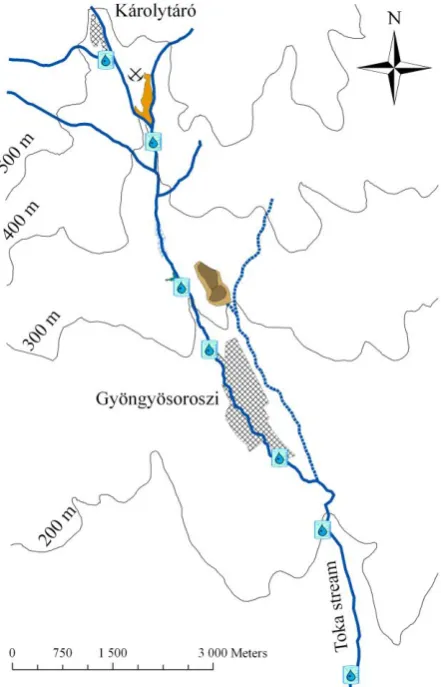
downstream and the effects of the neutralized AMD discharge were investigated along 10 km, from the source of the Toka to the town Gyöngyös. Site and the sampling points are given in Fig. 1.
2 FeS2 + 7 O2 + 2 H2O → 2 Fe2+ + 4 SO42- + 4 H+ (1)
4 Fe2+ + 10 H2O + O2 → 4 Fe(OH)3 + 8 H+ (2)
4 Fe2+ + O
2+ 4 H+ → 4 Fe3+ + 2 H2O (3)
FeS2 + 6 Fe3+ + 4 H2O→ 7Fe2+ + 2 SO42- + 8 H+ (4)
M2+ + H
2O → M(OH)+ + H+ (5)
M2+ + 2H
2O → M(OH)2 + 2H+ (6)
M2+ + 3H
2O→ M(OH)3- + 3H+ (7)
ApBq(s) ↔pA-(aq) + qB+(aq) (8)
4 FeS2 + 8 CaCO3 +15 O2 + 6 H2O →
4 Fe(OH)3 + 8 SO42- + 8 Ca2+ + 8 CO2
Figure 1. Abandoned Pb-Zn mining site and the sampling points
Sample treatment and analyses
Water samples were taken at 7 different sites along 10 km long transect of the Toka. Sampling was carried in April, 2011, during a dry period. Estimated flow of the river was ca. 0.15 m3/s upstream, while after the confluence ~ 80% of
the water originated from the treated AMD.
Samples for metal analysis were taken by 60 mL pre-cleaned plastic syringe. At each site, before taking final sample, syringe was rinsed at least 5 times by ambient water. Syringe is placed against water flow to avoid contamination of water. For dissolved trace elements, water was filtered by 0.45 µm capsule filters (Sartorius) mounted on syringe into the precleaned (washed with 10% HNO3 then thoroughly
MilliQ water rinsed) HDPE bottles. First few milliliters of filtered sample were discarded to avoid possible contamination from the filter. Blank test of capsule filters and syringes were performed in laboratory and no contamination was found for any element. Samples for metals analysis (total-unfiltered and dissolved-filtered) were acidified in laboratory by addition of concentrated nitric acid (Fluka, TraceSelect) - 100 μL on cca 60 mL of water.
Physico-chemical parameters (temperature, pH, dissolved oxygen, conductivity and redox potential) were measured
in-situ (in the river main body and in each source) by HACH
HQ40d portable multi-parameter instrument and associated probes. High Resolution Inductively Coupled Plasma Mass
Spectrometer (HR ICP-MS, Element 2, Thermo Finnigan, Bremen, Germany) was used for the determination of dissolved element concentrations. The samples for the analyses were prepared in pre-cleaned polyethylene tubes by adding 100 µL of concentrated HNO3 and 50 µL of
indium(115) internal standard (0.1 mg/L) into 5 mL of a sample aliquot. The concentrations of the elements were determined by means of external calibration plots. No special setup of the instrument operating conditions was needed. Quality control (QC) of HR ICP-MS measurements was checked by the determination of elements concentration in "River Water Reference Material for Trace Metals" (SLRS-4, National Research Council Canada). For most elements, a good agreement with the certified data was obtained.
Results and Discussion
General surface water quality
The Water quality along the Toka stream is affected by the neutralized acidic mine discharge as a point of source of heavy metals. Based on previous measurements, despite neutralization, the concentrations of Zn and Cd of the treated AMD itself were found above the environmental permissible levels, though Zn concentration was reported one third of the that in the untreated AMD. Pb concentration was found low for both the untreated and treated effluents.5,6
The dissolved element concentrations, measured in filtered samples, and the relevant environmental quality standards for surface water are given in Table 1. In the sampling campaign, and for the whole length of the stream, dissolved Pb concentration was significantly below both the standard for annual average provided in Directive 2008/105/EC, and the target value given in the Water Quality Classification for the Danube River Basin12, as
expected. Average Zn concentration was rather high along the whole stream, though it was higher by one order of magnitude compared to the target value even at the source of the stream which might be considered as background since no other sourse upstream was identified, Same was reported by others for similar sites.13 Note: relevant
regulation on surface water quality does not give limit value for Zn.
Table 1 Concentrations ± standard deviations of elements in μg L-1
determined in water (detection limit for all elements is below 10 ng L-1), pH and the relevant environmental quality standards
Element Concentration
ranges along the stream
EQS* Target Value
for Danube River Basin** AA-EQS Inland surface waters MAC-EQS Inland surface waters
Fe 73.8 ± 43.6 NG NG NG
Mn 1123 ± 829 NG NG NG
Zn 264.5 ± 190.2 NG NG 5
Pb 0.120 ± 0.044 7.2 NA 1
pH 7-8.5 NG NG 6.5-8.5
Downstream water quality changes
Based on the analytical results, treated AMD has higher pH than the Toka upstream, and even further increase of 1 pH was measured along the stream (Fig. 2). It may result from the basic mineralogical composition of the watershed, the riverbed itself and gradual removal (degassing) of CO2
from the water. Redox potential decreased significantly at the confluence (Fig. 3), however, reaching ~340 mV within 1-1.5 km and remained constant thereafter.
Figure 2. pH profile of the Toka stream, dry season
Figure 3. Eh profile of the Toka stream, dry season
Figure 4. Pourbaix diagram for iron
In the function of pH and Eh relations, metal species can be dynamically transformed into one another. Considering the basic Pourbaix diagram for iron, and taking the measured pH and Eh into consideration, Fe(OH)3 is
expected to form instantaneously at the confluence, thus local conversion of dissolved Fe2+ to Fe(OH)
3 precipitate
may have considerable role in co-precipitation mechanisms
(Fig. 4). Nevertheless, surface water is a highly complex
system from chemical point of view, thus presence of carbonate and sulphate ions that are common in treated AMD, cannot be ignored, when heavy metal precipitates are investigated.
Total Fe concentration in water, governing total Pb and Zn concentrations, decreases gradually, indicating settling resulting from flow rates decreasing temporarily at several locations downstream (Fig. 5).
Figure 5. Total Fe concentrations in both solution and colloidal form
Considering the heavy metal concentrations in water, though total Pb concentration is low even in the treated AMD, it decreases further by 5 times downstream (Fig. 6). Among its species, thermodynamically Pb(OH)2 is stable
above pH 6.5 within the Eh range of the Toka, and dissolved Pb takes part in a further equilibrium, since it is strongly associated with amorphous iron-hydroxide, which results in low, almost constant dissolved Pb concentrations measured along the stream.
Figure 6. Total Pb concentrations in both solution and colloidal form
Zinc concentration profile is similar to that of Pb (Fig. 7), however, Zn prefers dissolved ionic form up to pH 8.5, while Zn(OH)2 is stable in range of pH 8.5-11.5, which
explains elevated concentrations along the whole stream14.
formed amorphous iron-hydroxide colloidal particles cannot be ignored15. Based on the above experiments, Zn
elimination from the AMD requires an additional process to neutralization, such as the application of a passive treatment system16.
Figure 7. Total Zn concentrations in both solution and colloidal form
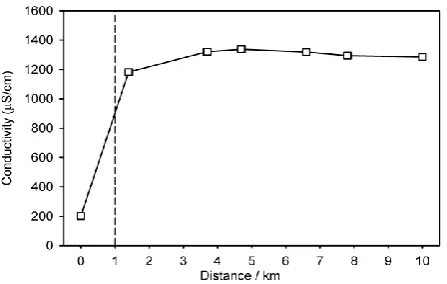
Original electric conductivity of the Toka is 200 S cm-1,
which corresponds to the WMAP classification (300 S cm-1) while it is app. quintupled at the AMD confluence, as
expected (Fig. 8). Basically, neutralization agents determine the magnitude of ion concentrations which control conductivity; Fe, Mn and Al concentrations were 465±23, 750±23 and 400±26 μg L-1, respectively, measured
previously in dry season in the neutralized AMD, in average.5 However, major ion concentrations do not show
decrease in relation to the distance from the ions’ source, which confirms that the gradual decrease in total Fe, Pb and Zn concentrations does not result from dilution, but settling of colloidal adsorbed and co-precipitated species.
Figure 8. Conductivity profile of Toka stream, dry season
Conclusions
Though, according to WMAP, the watershed of the Toka stream is relatively small, slope of the bed is ~3 %, and the flow rate as well as the stream water discharge can change extremely; rate of the minimum and maximum for the latter one can be up to 1/ 1,000. Thus, solid particles settled continuously from the confluence at the neutralized AMD along the stream bed can be resuspended resulting in increase in the total heavy metal concentrations13
measurable in unfiltered water samples, however, dissolved
concentrations are not expected to increase in case of stable pH and Eh conditions.
At the same time, while Pb and similar elements such as Cu and As are primarily in solid phase under neutral – basic conditions, Zn and similar ones e.g. Cd still have high dissolved concentration. Thus AMD treatment by neutralization cannot result in reaching the target limits12 for
these elements in such surface waters like Toka stream. Though, it defenitely and obviously changes pH that could affect dramatically the ecological systems and the environment, in the acidic range.
Acknowledgement
The research was supported by the Hungarian National Office for Research and Technology, and the Croatian Ministry of Science, Education and Sport, under the Croatian-Hungarian bilateral program, project no. HR-4/2008.
References
1Pagnanelli, F., Moscardini, E., Giuliano, V., Toro, L., Env. Pollut.,
2004, 132, 189.
2Cappuyns, V., Swennen, R., Vandamme, A., Niclaes, M., J.
Geochem. Explor., 2006, 88, 6.
3Giuliano, V., Pagnanelli, F., Bornoroni, L., Toro, L., Abbruzzese,
C., Hazard. Mater., 2007, 148, 409.
4Nikolaidis, C., Zafiriadis, I., Mathioudakis, V., Constantinidis,
Bull. Environ. Contam. Toxicol., 2010, 85(3), 307.
5Kovács, E., Tamás, J., Franciskovic-Bilinski, S., Omanović, D.,
Bilinski, H., Pižeta I., Environ. Fres. Bull., 2012, 21(5a), 1212.
6Horváth, B., Gruiz, K., Sci. Total. Environ., 1996, 184, 215. 7Lee, J.S., Chon, H.T., Geochem. Explor., 2006, 88, 37.
8Palumbo-Roe, B., Klinck, B., Banks, V., Quigley, S., Geochem.
Explor., 2009, 100, 169.
9Butler, B.A., Ranville, J.F., Ross, P.E., Sci. Total. Env., 2009, 407,
6223.
10Sarmiento, A.M., Nieto, J.M., Olías, M., Cánovas, C.R., Appl.
Geochem., 2009, 24, 697.
11Pulford, I.D., MacKenzie, A.B., Donatello, S., Hastings, L., Env.
Pollut., 2009, 157, 1649.
12International Commission for the Protection of the Danube River,
Water Quality in the Danube River Basin,TNMN Yearbook, Resch Druck, Vienna, 2001.
13Gozzard, E., Mayes, W.M., Potter, H. A. B., Jarvis, A. P., Env.
Pollut., 2011, 159, 3113.
14Beverskog, B., Puigdomenech, I., Corros. Sci., 1997, 107. 15Zachara, J. M., Cowan, C. E., Resch, C. T., Geochim Cosmochim
Ac, 1991, 55(6), 1549.
16Nairn, R. W., LaBar, J. A., , Strevett, K. A., Strosnider, W. H.,
Morris, D., Neely, C. A., Garrido, A., Santamaria, B., Oxenford, L., Kauk, K., Carter, S., Furneaux, B., Proceedings of IMWA, 2010, 255