South African Journal of Higher Education http://dx.doi.org/10.20853/32-1-1819
Volume 32 | Number 1 | 2018 | pages 90‒111 eISSN 1753-5913 90
RETHINKING VISUAL JOURNALING IN THE CREATIVE PROCESS:
EXPLORING PEDAGOGIC IMPLICATIONS
C. de Beer
Department of Fine Art and Jewellery Design
Durban University of Technology
Durban, South Africa
e-mail: [email protected]
Doctoral Student: School of Education
University of KwaZulu-Natal
ABSTRACT
I lecture jewellery design at a university of technology in South Africa. Through this study, I wish
to arrive at a deeper understanding of my own creative process, so that I can facilitate the creative
development of my students. The focus of this article is the visual journal, or reflective sketchbook,
which I require my students to keep. To establish the relationship between my creative practice
and visual journaling, I analysed a creative poetic performance I delivered at the South African
Educational Research Association’s (SAERA) 2016 conference. Using the little-c definition of
creativity, I analyse the threads that constituted and contributed to my performance, to see how
aspects of self manifested within this creative process. I did the analysis by conducting an
autoethnographic self-interview, and then examining the responses. To my surprise, I discovered
that the inspiration for my own creative work does not necessarily originate in my visual journal
and that the visual journal could play a more useful role, if used as a prompt for reflective
conversations.
Keywords: visual journal, creative design process, autoethnography, poetic performance,
self-interview
BACKGROUND
As a practising artist, lecturing jewellery design at a university of technology requires me to
teach my students how to design and make conventional jewellery, as well as producing more
creative contemporary jewellery that connects with a ‘diverse range of contemporary social,
environmental, technical or artistic trends’ (Quickenden 2000).
In my experience, this requires more creativity than would be required should the
jewellery have been designed according to well-established norms and standards. I have learned
that this type of innovation requires deliberate incorporation and inter-weaving of personal
91
number of years and, until now, I have been under the impression that keeping a visual journal
can facilitate such creative development. By ‘visual journal’, I mean something such as an artist
or designer’s sketchbook (Holtham, Owens and Bogdanova 2008), which is a combination of
text and images, and more; as shall be explained in the next section of this article.
The objective of my research, therefore, was to gain an understanding of the complexities
surrounding the contents and use of a visual journal, and to explore the pedagogical implications
inherent in this understanding. I examine my creative process using an autoethnographic
approach as it enables me to use ‘personal experience to examine and/or critique cultural
experience’ (Holman Jones, Adams and Ellis 2016, 7).
CREATIVE DESIGN JOURNALING AND WHY IT IS IMPORTANT
In dealing with the creative processes of my students, I see creativity as a little-c (everyday)
activity, and not as a big-C (legendary) endeavour (Beghetto and Kaufman 2010). The result is
that I value the personal, commonplace experiences that my students and I encounter in our
creative practice. These experiences are ubiquitous and readily accessible, when one is able to
shift one’s focus from the ‘other side of the fence’.
Fine artists and professionals involved in creative design work tend to make extensive use
of sketchbooks to record their creative process (Holtham et al. 2008). Messenger (2016) uses
the term ‘visual journal’ to refer to these notebooks, which are a combination of images and
text, and are used to document research processes. The visual journals are sometimes used for
archival purposes and at other times, they can play a role in the improvement of creative
practice, by providing material for inspiration and reflection (New 2005).
A creative designer’s visual journal is more than documentation of what has transpired. It
is a way of record keeping that allows the designers to examine their thinking, which then can
lead to them becoming aware of the bigger picture (Grauer and Naths, quoted in Scott Shields
2016). Scott Shields (2016) feels that the primary goal of a visual journal is to explore
experience; one’s own experience. Because experiences take multiple sensory forms, it is
necessary, as a creative designer, to be aware of Olver’s (2001) reminder that a visual journal
need not necessarily take the form of a book, which would exclude three dimensional forms
that include movement (such as dangly earrings), or emphasise texture, or the play of light on
a surface. Incorporating a wider range of material in a visual journal would allow the
development of a personal design philosophy that takes cognisance of more than just visual
senses, thereby establishing a foundation for future work. It would facilitate the development
92
view, visual journaling can be seen as creative self-study, ‘using the visual journal to turn
inward and engage in a creative practice focused on ... the development of a [design] identity’
(Scott Shields 2016, 5).
The requirements for the visual journals that my students need to produce are equivocal.
They have the freedom to choose their own themes or areas that interest them. They then have
to collect the necessary visual imagery or artefacts that inspire them, develop ideas for
manufacture by producing drawings and/or prototypes, and then manufacture the final pieces
after consultation with the lecturer.
My intention, in requiring my students to keep such a journal, was to provide the students
with a space in which to document the work they do, record the process of developing their
creative designs and collate the material they draw on when developing their designs. My
intention was also that it would enable personal reflection; or, what Schön (2008, 79) calls, a
‘conversation with the situation’ and facilitate conversations between my students, and with
me.
USING AN ART EXHIBITION TO TEACH/LEARN VISUAL JOURNALING
I thought that I would be able to improve my students’ ability to keep a visual journal if we
staged a collaborative art exhibition of our jewellery and then shared our experiences of the
process, by examining and discussing our journals. I intended using this work, with my
students’ permission, as the foundation for a conference presentation or journal article.
I had worked out how to keep an online visual journal, a blog, and how to use the online
capabilities to categorise the various posts by creating a tag cloud.1 This categorisation would then facilitate the compilation of a research report and it seemed a clear-cut mechanism for
reflecting on the creative design process and producing a written account thereof at the same
time.
The exhibition was staged, and some journaling took place, but not enough to do a
presentation. My journaling consisted of two blogposts: one showing the work ready for
exhibiting and the other of the gallery in disarray, as we were busy setting up. I did have
numerous photos, tracking the development of my creative work, on my phone. My students
had preparatory sketches in their journals, and photos of the exhibition on their phones. In
discussing the journaling process with my students after the exhibition, it transpired that there
seemed to be no clear goal that directed this supposedly reflective process. I perceived their
journaling as a mechanical chronologous documentation of occurrences, with no focus for
93
realised that the aim of the journal, as I saw it, was to provide material that would act as an aid
for reflection on our development as designers. I had a feeling that my students did not share
my enthusiasm, and just saw this as more work to do.
MY PRESENTATIONS
I made two presentations at the recent SAERA conference. The key presentation, or so I thought
at the time, dealt with insights I arrived at regarding the journaling activities of my students.
The other presentation was incidental (or so I thought), and was a poetic performance I staged
at the Special Interest Group for Self-Reflexive Methodologies, titled ‘Reimagining Education
through Poetic Inquiry’.
‘Reimagining education through poetic inquiry ...’
When I reflected on the presentations, I realised that the poetic performance contained
information that could assist with my research regarding the relationship between the creative
process and visual journaling. It has therefore become the focus of this article.
My performance can be seen online at https://youtu.be/nqYvhfJmm9E and the poem is
shown in Figure 1.
Figure 1: Rock, rock 1, 2, 3
94
This poem illustrates the mezzotint printing process, and reveals similarities to the teaching and learning process that I have come to notice. The title of the poem refers to the steps one does in the jive, which is the dance my wife and I are currently learning in our ballroom dancing classes. I have become aware that several aspects of my life seem to be converging and becoming integrated with each other.
The poem I performed was based on a mezzotint2 print I had done previously (Figure 7), and the process whereby the print was produced. The stanzas of the poem were arranged into three
triangles with a triangular space between them, similar to the patterns I use for the mezzotint
prints. According to Higgins (quoted in Wyatt 2016) pattern poems, which are composed in
particular visual patterns, ‘combine the visual and literary impulses, to tie together the
experience of these two areas into an aesthetic whole’. My poetic performance mirrored the
pattern of the process used for the production of a mezzotint print. I went through the rocking
motions of producing the print and then, for effect, showed a print that I had supposedly made
as part of the performance; almost like magic.
The process for producing a mezzotint is very labour intensive and requires specialised
tools and materials. One needs copper plate and a rocker for roughing the plate. I made some
of the tools, and the copper plate used for printing, by hand. (I could have bought these, but
wanted to instil some significance into the print). I made the rocker from an old file that was
re-purposed.
The pattern in which I arranged the words of the poem was similar to the geometric
patterns used by Zulu craftsmen for the straps they utilise when making their sandals. These
straps are carved from whitewall car tires that are recycled. The tires have white inlays on their
sides. The white substrate is exposed in geometric patterns by carving the black top layer away.
I encountered this process as part of a research project I undertook, which was aimed at
producing jewellery made by incorporating indigenous techniques and materials, and uses
traditional Zulu sandals as inspiration.
As I was busy writing a description of my poem for this article, I became more and more
entangled in the difficulties of using words to describe a visual image. I realised there were
nuances that were not being conveyed and that I was unable to show the richness of the poem
and how various aspects of my life unwittingly culminated in this poem.
It became clear to me that the creative product I was trying to describe was the result of a
complex creative process that defied easy documentation and classification. The pattern poem
was the result of various modalities that were interwoven and would require a different
95
attention to what I expect from my students; I became conscious that journaling was not as easy
as I had thought.
METHODOLOGY
To examine my creative practice, I used an autoethnographic methodology aimed at exploring
the various aspects of self that manifested during this process of creating and performing a
poem. I wished to understand the larger context, my creative practice and my pedagogy, by
examining my own experiences within it. I examined the various cultures inherent in my
‘multiple, shifting identities’ (Reed-Danahay 1997, 4) by writing personal narratives that were
prompted by the contemplation of objects. I examined the denotative meanings of these objects
and related things and then allowed the connotative meanings to surface, going from, what
Riggins (1994) calls referencing, to mapping. An inward and outward shift of focus, with the
intention ‘to deepen an understanding of [my selves] and [my] work ... in a broader cultural
context of making [and designing, and teaching]’ (Mitchell 2016, 180). This aligns with the
definition provided by Ellis and Holman Jones, which states: ‘Autoethnography is an approach
to research and writing that seeks to describe and systematically analyze ... personal experience
... in order to understand cultural experience’ (quoted in Ellis, Adams, and Bochner 2011, 1).
I used objects to provide me with access to memories so I could tell stories about myself
to myself, to access the network of connections between these and the links to my creative
practice, and other. I wanted to examine the ‘webs of significance [I have] spun’ (Geertz 2003,
145), and I did this by conducting a semi-structured autoethnographic self-interview.
To explore my pedagogic practice, I wrote ‘a form of self-narrative that places the self
within a social context’ (Reed-Danahay 1997, 9). A part of my social context is the programme
where I lecture jewellery design, and my students collaborate in this investigation. According
to Chang, Ngunjiri and Hernandez (2016) this is a partial collaboration, which Coia and Taylor
(2010) refer to as a ‘co/autoethnography’, as my students shared autobiographical narratives,
in the form of blogposts, that guided our discussions regarding the purpose of journaling.
TRUSTWORTHINESS
Reliability and validity are interconnected when doing autoethnography. The more credible the
account, the more reliable it is deemed to be (Ellis et al. 2011). To make my account more
credible I have, therefore, detailed the process as it transpired, with personal insights as they
occurred. I have also included images of relevant objects and places to enhance trustworthiness.
96
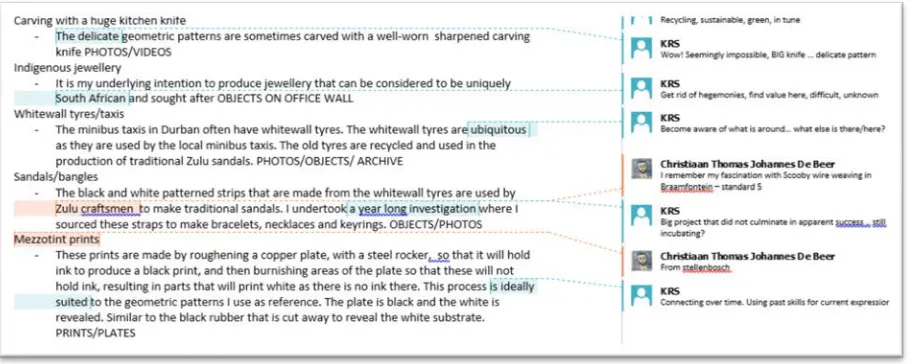
trustworthiness. A specific example is the screen clipping (Figure 2), which shows how I
conducted my self-interview. It shows comments on the right and insertions in capital letters. I
also make the link between my occupation and my own creative practice explicit, with the aim
of enhancing the trustworthiness of this study.
Autoethnographic self-interview and multivocality
When I tried to unravel what my pattern poem entailed, I became entangled in the various
threads of thought my mind was taking. I was feeling quite overwhelmed, took a deep breath,
and started to write a note to myself:
It is so difficult to untangle all these threads that go into the making of this text ... even just finding the beginning of the thread is difficult. I might just end up with one long thread as opposed to a woven cloth .... Look for lots of short threads to weave together.
I then made a list of all the threads I recognised as contributing to and manifesting in the poem
and the performance. The list of threads, which is detailed further in the Analysis section of this
article, were used as prompts to elicit connotative responses. It was similar to a brainstorming
session, where I produced a list of prompts without necessarily evaluating their relevance; this
happened afterwards.
Reflecting on the note to self, I realised I had adopted two distinctly different voices: that
of a Guiding self and that of a Seeking self.3 I was having a conversation with myself. This conforms to Anderson and Glass-Coffin’s (2013, 69) notion of an autoethnographic
self-interview which ‘involv[es] dialogue between one’s past and present selves’, and is similar to
Mizzi’s (2010) notion of multivocality. Mizzi states there are ‘plural and sometimes
contradictory narrative voices located within the researcher’ that would ‘expand the ways we
can perceive and inquire into an encounter’ (M3).
The type of self-interview I conducted differed from those of Singh (2012), and Meskin,
Singh, and van der Walt (2014). Singh (2012) examined ‘critical events’ (Webster and Mertova
2007, quoted in Singh 2012, 86) in her journey as educator and used a set of prepared questions
to maintain her focus. She responded to her questions in writing as she examined the impact
that specific ‘people, events and places’ had on her ‘educational persona’. When Meskin et al.
(2014) scrutinised their professional practice, a critical friend reviewed and asked them a set of
questions they had determined in advance. They labelled it a ‘reciprocal self-interview’ (RSI).
My questions arose when I searched for similarities between my two presentations at the
conference. I wanted to see what the underlying issues were that connected my creative practice
97 ANALYSIS
According to Riggins (1994), the responses that an informant (one of my selves) provides to an
interviewer (my other self) could be either referencing (denotative) or mapping (connotative).
When the information that is provided deals with ‘the history, aesthetic or customary uses of
an object’ (1994, 109), it is considered a referencing response, and where it reveals the ideology,
or social world, of the informant it is considered a mapping response.
The threads I had identified started as denotative (referencing) and then became more
personal and connotative (mapping). When I realised they were becoming connotative, I
stopped listing them, instead focusing on the denotative threads, which I used as prompts to
elicit the connotations that came to mind. These I examined in terms of their relevance to my
social world, which included my creative and pedagogical practice.
I then reflected on these connotations to reveal further significances, to see how I felt
about each thread. I was extracting information with the aim of recognising underlying patterns
that would possibly explain what was going on here.
The two questions I asked myself were: ‘What comes to mind when you think about this
thread?’, and secondly, ‘What type of material did this thread provide for my creative practice?
Where is the material located?’ I captured my answers as comments in a word processed
document and inserted text in CAPITAL LETTERS (see Figure 2).
Figure 2: Screengrab of self-interview
I regarded my self-interview as a narrative, so I could analyse it by looking for patterns that
made some sort of sense to me (Bernard 2011). I saw that the information could be separated
98
The prompts I used as Guiding self were denotative and my responses as Seeking self were
connotative. On coding the responses, I noticed areas where the connotative information
revealed aspects of the self and other areas that caused insights and realisations ‒ sometimes
with pedagogical implications.
The Guiding self’s denotative prompts that I developed, and respond to in the next section,
were as follows:
• Rubber from old car tyres
• Carving with a huge kitchen knife • Indigenous jewellery
• Whitewall tyres/taxis • Sandals/bangles • Mezzotint prints
• Silwerstroomstrandskulp • Maspala / samples
• Kitchen knife/Dlamini/Dominic/Thembenkosi
• Rock rock 123 123 / or 12 rock rock rock back side close • Nadene smiling/Hein
• Jive/tango • Ballroom • Relationship • Weekly routine • Doing things together
• Mezzotint • Rocker/rocking • Old file
• Punches with students • Scraper/burnish
99
I examined all the threads, however, in this article I only discuss the ones that are most relevant
in terms of creative journaling, and that have significant pedagogical implications. I discuss my
most important discoveries regarding the relationship between my creative practice and visual
journaling, and the pedagogical implications thereof, in the Discoveries section at the end.
Rock, rock, 1, 2, 3 ‒ Unravelling the threads
The poem I performed was based on a mezzotint print I had done earlier, and the process
whereby the print was produced. The stanzas of the poem were arranged into three triangles,
with a triangular space between them, similar to the patterns I use for the mezzotint prints. The
poem I performed was based on a mezzotint print I had done earlier, and the process whereby
the print was produced. The stanzas of the poem were arranged into three triangles, with a
triangular space between them, similar to the patterns I use for the mezzotint prints. The title of
the poem refers to the steps one does in the jive, which is the dance my wife and I are currently
learning in our ballroom dancing lessons.
Figure 3: The poem
What follows are my responses to the prompts. The responses consist of referencing
(denotative) observations, followed by mapping (connotative) reflections. I inserted images as
100 Indigenous jewellery
I started studying jewellery design under the impression I would become rich from making
precious jewellery from gold and gems. I was not exposed to that type of jewellery as a child,
and found it difficult to engage wholeheartedly with this kind of design. Sometime during my
first year of study, I inadvertently made a brooch that contrasted brass and nickel silver, both
base metals, and I became totally consumed by this subtle colour juxtaposition. It was in
complete contrast to the shiny precious metals we were taught to work with. In fact, I had a
‘Damascus Road’ type of aesthetic experience which has, since then, influenced my
development as a designer. I think it was then I realised there were other types of beauty lying
in wait for me. I started finding pleasing aesthetic arrangements, textures, colours and
formations in the world around me. I collected shells, twigs, leaves, stones and seeds, and
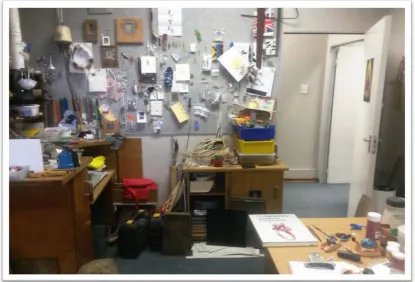
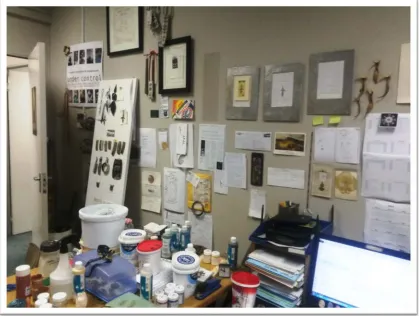
surrounded myself with these inspirational materials (see Figure 4 and 5). I also discovered the
world of ‘found’ objects. Objects that are found serendipitously and that have an aesthetic
impact on the senses of the beholder. I became aware of the richness of the world that lay just
on the other side of what I was used to, or taught to expect.
Figure 4: A collection of design reference materials on my office wall
Being in Durban, I am surrounded by traditional Zulu craft, such as beadwork, grass weaving,
101
aim is to develop jewellery designers that can produce uniquely South African jewellery. I try
to achieve this by drawing on this craft heritage and encouraging a personal aesthetic sensibility
within my students; one that is aware of the hegemony of Eurocentric values.
Figure 5: Another wall, showing artworks and reference materials
Mezzotint
Figure 7 shows one of my mezzotint prints which depicts a black and white pattern derived
from one of the sandal strap patterns. The embossed chequerboard pattern underneath is based
on the ‘Maspala’ pattern, which is discussed next. These prints are made by roughening a
copper plate, with a steel rocker, so that it will hold ink to produce a black print, and then
burnishing areas of the plate so that these will not hold ink, resulting in parts that will print
white, as there is no ink there. This process is ideally suited to the geometric patterns I use as
reference for my creative work. The printing plate is made to print black and the white is then
‘revealed’; similar to the black rubber that is cut away in the sandal-making to reveal the white
substrate.
I encountered the mezzotint process when I was a student and did not think that I would
implement it one day. It was when I started looking for a way to use the black and white
patterns, and focused on the way the white is ‘revealed’ that I remembered about mezzotints. It
102
way. I sometimes get stuck creatively, because I cannot think of a piece of jewellery to make,
even though I would like to. Pursuing the printmaking process provides me with another
creative outlet.
Figure 6: The mezzotint print in situ on my office wall
I intend using the printing plates, after I have printed a numbered edition of about 10, to make
brooches or pendants. To this end I have a number of plates that are in the process of being
103
The print is one of numerous objects on display on my office walls, and that I refer to during
my creative work, see Figures 4 and 5.
Figure 7: The mezzotint close up
Maspala / samples
Maspala is a Zulu term for ‘Municipal’, referring to the chequerboard pattern on the caps of
Municipal police. It is one of the patterns that Zulu craftsmen carve into the whitewall tyre
straps that they use for making sandals (Figure 8) from recycled tyres.
I encountered the Zulu sandals during my explorations of the area around the University.
A few blocks down the road is a complex where cattle hides are tanned and traditional Zulu
craftsmen, all involved with the design and manufacture of traditional Zulu dress, have stalls
from which they trade. With one of my Zulu students to act as interpreter I would go from stall
104
a tanned hide I had commissioned, I saw two young Zulu men carving patterns on long rubber
strips. I recognised what they were doing; they were making the rubber straps from which the
sandal straps are made. I ordered two straps from them, which I collected the following
weekend. I realised these long patterned straps could be made into bangles quite easily and
would be a step along the way towards making indigenous jewellery.
Figure 8: A traditional Zulu sandal made from recycled car tyres
I made a number of bangles, which I sold at a local craft market. A few weeks later an
overseas buyer approached me, wanting to know how big an order of bangles I could guarantee.
I went back to the complex where I had ordered the two straps, but the young men had gone
‘back to the farm’. I started searching for white wall tyre to recycle and other Zulu sandal
makers. After a few weeks of searching I had to let the buyer know that, in fact, I could not
guarantee any bangles.
A few months later, I became involved in a craft research project, and my newly appointed
research assistant, on hearing about my interest in the sandals, introduced me to Mr Dlamini, a
sandal maker that lived a few hundred yards away from him. I could not revive the bangle order,
but was introduced to the world of the ‘izimbadada’, which is what the sandals are called, after
105
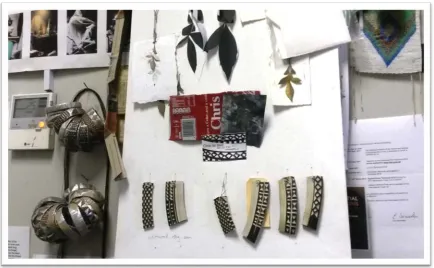
I collected numerous off-cuts of the various patterns whenever I visited Mr Dlamini, the
traditional sandal maker, which I then displayed in my office as inspiration for future work
(figure 9). This is amongst all the other design reference material on display.
Figure 9: Off cuts from the patterned rubber strips, amongst other reference material
Rock rock, 123, 123. / or 1 ... 2, rock rock rock, back side close
These rhymes arose in my mind when I contemplated the mezzotint rocker, and the need to
perform the poem. I am starting to realise that the various aspects of my life; my interests and
activities, are all intertwined, as I suppose, they should be.
These are the rhythms of the Jive and the Tango as called out by my ballroom teacher
during our dancing lessons. The Jive has become our favourite dance; it was too fast for us, but
now, having mastered the basic steps, we find it a dance that allows us to get carried away by
the music. The Tango intrigues us; we saw the Argentinian tango being danced and it feels like
the dance I wish to master. It is my ballroom goal.
We started dancing as an activity to enrich our relationship and it is not always easy, but
helps with revealing dynamics within our relationship. It is as if I have become aware of the
dance-of-life that we are negotiating. Part of the negotiation is to make sure that our weekly
routines are coordinated, and I realise that, now that I am older, I have a need for certain anchors
in my week, around which I organise the rest of my life. I feel the need to have certainties
106 Rocker/rocking
The rocker was made from an old file (see Figure 10). I cut the bottom section with the tang
(the bit that goes into the handle) off, forged it flat and sharp, filed the little teeth in, and then
hardened and tempered it so it would be a tool that lasts several years. It is an intriguing object
to hold, with a comfortable weight and an interesting twist on the handle, which serves no
purpose. Then again, the whole object’s purpose is obscure to someone that is not familiar with
the mezzotint process.
Figure 10: A mezzotint rocker, made from an old file
I collect old tools made from carbon steel, so that I can use the steel to make punches, chisels
and, in this case, a rocker. Having said that, I collect all sorts of materials that might come in
handy in the creative production of jewellery and other artefacts. I collect foil chocolate
107
aluminium cans, and lately, empty plastic milk bottles, as they are made from high-density
polyethylene (HDPE), which seems relatively easy to recycle and has interesting tactile
qualities, and might be useful for making jewellery?
The rocking motion used to raise the burr is quite tiring and meditative. According to the
lecturer that taught me, the plate has to be rocked in 32 directions to produce a solid deep black
print. The number 32 has stuck with me, and sounds quite professional, which I suppose, is
what an aspiring art student wants to sound like. When rocking the plate, 32 directions become
a muddle, and about 20 directions cause the right amount of burr anyway.
I seem to appreciate this amount of work, and the effect it achieves, now that I am older.
I wonder whether I should bother with imparting this appreciation to my students. I sometimes
get the feeling they are bemused by my willingness to do all that extra work for an effect that
is not quite so noticeable.
Scraper/burnish
The burrs that were raised by the rocker are removed with a triangular scraper, and the scraped
areas are then polished smooth with a burnisher. I make my own scrapers and burnishers from
broken drill bits (all the old, broken tools I collect, remember?) If I could encourage the students
to make and use burnishers, we might be able to address the hegemony of a polished and clean
surface. It seems to be one of the aims of current commercial jewellery; to be as shiny as
possible. This shininess obscures the fact that the design is very similar to most of the other
pieces of jewellery in the same showcase.
Such a shiny and polished surface on a jewel is not natural: it starts showing wear as soon
as it is worn and then acquires the patina of use. But maybe that is what a piece of jewellery
offers ‒ a new beginning.
Jewellery that is handmade is often characterised by slight imperfections; it shows another
person was involved in the making of the piece. There are so many other types of surface
finishes that can be imparted to a piece of jewellery, once the hegemony of the polished surface
is tackled.
Plate with natural edges / what it looks like is what it looks like
I made the copper plate used for the mezzotints. This required me to melt copper scraps into an
ingot that I then rolled flat to produce the sheet. The edges of this sheet are not perfectly straight
(Figure 11), but it suits me. At the beginning of a jewellery manufacture programme the
108
technical exercises are aimed at developing goldsmithing skills, and usually culminate in
objects that are straight or square or ‘perfect’ in a technical way.
When I was an undergraduate jewellery design student I continually clashed with my
lecturers regarding their insistence on ‘perfection’. I became aware of the hegemony of this
quest for apparent flawlessness. I found it impeded playfulness and exploration and I therefore
started gravitating towards a more natural and organic aesthetic. I began searching for ways to
encourage apparent imperfection in my creative work. After a number of years, I feel I have
acquired the mind-set and level of skills that allows me to work spontaneously and to
acknowledge serendipity in its many guises.
My performance of the poem at SAERA followed this approach. I gave it some thought
and established a general outline of what I would do, but then I performed it off the cuff and
made things up as I progressed; I improvised, knowing that what was going to happen would
turn out to be fine.
Figure 11: Copper plates, on either side of a silver plate, all with 'natural' edges
DISCOVERIES AND CONCLUSION
109
was under the impression that the visual journal (or reflective sketchbook) plays a crucial role
in the creative design process. However, on examining the circumstances that surrounded the
generation of my creative poetic performance, I realised that the idea for the poem was
generated while I was seated in my office, surrounded by the various artefacts on my office
walls, not from my visual journal. These artefacts included the mezzotints and patterned strips
of rubber that the form of the poem and the nature of the performance was based on.
The types of material that played a role in the development of my creative practice were
of an explicit, and of a tacit nature. The explicit materials included objects I had made and
found, and digital images on my phone and computer. The tacit materials were memories,
attitudes I had developed over a number of years, and proficiencies I had acquired through
practice.
I have become aware that I do not reflect in my visual journal; I use it to capture ideas I
have and plans I make. If there are reflections, they deal with pedagogical implications, not my
creative work. I do, however, use my journal to facilitate discussions with colleagues and
students.
When I examined my own creative process, I noticed I had relied on a visual journal only
when I planned the shape of the poem for my poetic performance. The inspiration for the poem
and its performance came from the collection of artefacts in my office/studio, and tacit
knowledge that related to my technical skills, social life and aesthetic philosophy. I now realise
it is not possible to capture all these sources of inspiration in a visual journal.
The visual journal I expect from my students does have a role to play, albeit a pedagogical
role, not a creative role as such. In future, I would still require students to document their
process and record sources of interest that might inspire and develop ideas, but the journal
would primarily function as a prompt for conversations that reflect on their development as
creative designers.
I made sense of my creative journaling practice in two ways; by doing it with my students
in a manufactured situation and doing it by myself for myself. It was only after the second
incident that the true nature of my creative journaling made itself manifest. During the initial
journaling activity; the art exhibition and the associated expected journaling, I was focused on
what the students were doing. After the second creative activity; the poetic performance, I
examined my own creative process, and where the impetus came from, and realised the extent
to which I did not rely on a visual journal. I examined my own propensity for visual journaling
only when I wrote this article.
110
implications in what I would unearth, that led to this back and forth gaze, or the shift between
the ‘ethnographic wide-angle lens’ (Ellis and Bochner 2003, quoted in Mitchell 2016) and the
inward look.
The influence of positionality manifested when my roles changed from director to
performer (Mitchell 2016). My perception of what influences creative practice shifted when I
changed from a co-producer/director for the art exhibition to a performer of a pattern poem at
SAERA. In addition, this exploration raised issues regarding the journaling process when being
creative, as well as the impact I have on the creative development of my students.
I therefore find myself responding to Mitchell’s (2016, 186) call to arms in ‘recognising
the place of looking-inward stories in influencing the wide-angle lens’. I recognise the value of
examining the nature of my own creative practice, and how it could influence the creative
development of my students.
NOTE
1. When blogging, one can add a tag/label to the post to categorise it. All the tags show as a cloud of words in the side bar of the blog, and the more often a specific tag is used, the larger the word representing that tag grows, showing the frequency of usage.
2. A mezzotint is a type of print that is produced by roughening a metal plate mechanically, then scraping and polishing the surface to reproduce areas of light and shade. It is then inked up and printed on to paper (see Figure 6).
3. I have coined these two terms to show the difference between the two selves that are manifesting. The Guiding self shows a denotative self and the Seeking self a connotative self. These terms are based on Riggins’ (1994) categories of ‘mapping’ and ‘referencing’ information.
REFERENCES
Anderson, Leon and Bonnie Glass-Coffin. 2013. I learn by going: Autoethnographic modes of enquiry. In Handbook of autoethnography, ed. Stacy Linn Holman Jones, Tony E. Adams and Carolyn Ellis, 57‒83. Walnut Creek: Left Coast Press.
Beghetto, Ronald A. and James C. Kaufman. 2010. Broadening conceptions of creativity in the classroom. In Nurturing creativity in the classroom, ed. Ronald A. Beghetto and James C. Kaufman, 191‒205. Cambridge: Cambridge University Press.
Bernard, Russell. 2011. Research methods in anthropology ‒ Qualitative and quantitative approaches. 5th Edition. Plymouth: Altamira Press (Walnut Creek ‒ Lanham ‒ New York ‒ Oxford).
Chang, Heewon, Faith Wambura Ngunjiri and Kathy-Ann C. Hernandez. 2016. Collaborative autoethnography. London: Routledge.
Coia, Leslie and Monica Taylor. 2010. Co/autoethnography: Exploring our teaching selves collaboratively. In Research methods for the self-study of practice, ed. Deborah L. Tidwell, Melissa L. Heston and Linda May Fitzgerald, 3‒16. Dordrecht: Springer.
Ellis, Carolyn, Tony Adams and Art Bochner. 2011. Autoethnography: An overview. Forum Qualitative Sozialforschung / Forum: Qualitative Social Research. http://nbn-resolving.de/urn:nbn:de:0114-fqs1101108
111
Yvonna S. Lincoln, Norman K. and Ed Denzin, 143‒168. Oxford: Alta Mira Press.
Holman Jones, Stacy, Tony E. Adams and Carolyn Ellis. (Eds.). 2016. Handbook of autoethnography. Walnut Creek: Left Coast Press.
Holtham, Clive, Allan Owens and Mariana Bogdanova. 2008. M Level inquiry across disciplinary boundaries: Using reflective sketchbooks. Paper presented at the British Educational Research Association Annual Conference, Heriot-Watt University, Edinburgh, 3‒6 September.
Meskin, Tamar, Lorraine Singh and Tanya van der Walt. 2014. Putting the self in the hot seat: Enacting reflexivity through dramatic strategies. Educational Research for Social Change 3(2): 5‒20.
doi:10.17159/2221-4070/2016/v5i1a1.
Messenger, Hazel. 2016. Drawing out ideas: Visual journaling as a knowledge creating medium during doctoral research. Creative Approaches to Research 9(1): 129‒149. doi:10.3316/car0101054. Mishler, Elliot. 1990. Validation in inquiry-guided research: The role of exemplars in narrative studies.
Harvard Educational Review 60(4): 415‒443. doi:10.17763/haer.60.4.n4405243p6635752. Mitchell, Claudia. 2016. Autoethnography as a wide-angle lens on looking (inward and outward): What
difference can this make to our teaching? In Academic autoethnographies: Inside teaching in higher education, ed. Daisy Pillay, Inbanathan Naicker and Kathleen Pithouse-Morgan, 175‒190. Rotterdam: Sense.
Mizzi, Robert. 2010. Unraveling research subjectivity through multivocality in autoethnography.
Journal of Research Practice 6(1): M3. http://jrp.icaap.org/index.php/jrp/article/view/201/185 New, Jennifer. 2005. Drawing from life: The journal as art. New York: Princeton Architectural Press. Olver, Elizabeth. 2001. The art of jewellery design: From idea to reality. London: A&C Black Limited. Quickenden, Kenneth. 2000. Virtual gallery of contemporary jewellery: Introduction. Birmingham, UK:
Birmingham Institute of Art and Design. CD-ROM.
Reed-Danahay, Deborah. 1997. Introduction. In Auto/Ethnography: Rewriting the self and the social, ed. Deborah Reed-Danahay, 1‒17. New York: Berg.
Riggins, Stephen, H. 1994. Fieldwork in the living room: An autoethnographic essay. In The socialness of things: Essays on the socio-semiotics of objects, ed. Stephen H. Riggins, 101‒148. Berlin: Mouton de Gruyter.
Schön, Donald, A. 2008. The reflective practitioner: How professionals think in action. New York: Basic Books.
Scott Shields, Sara. 2016. How I learned to swim: The visual journal as a companion to creative enquiry.
International Journal of Education & the Arts 17(8): 1‒25. http://ijea.org/v17n8
Singh, Lorraine. 2012. Strutting and fretting, a drama education retrospective. Journal of Education 54: 85‒102.