FLORIDA FINANCIAL MANAGEMENT
INFORMATION SYSTEM
ENTERPRISE RESOURCE PLANNING
INTEGRATION TASK FORCE
SECOND QUARTERLY REPORT
“…to facilitate the successful and efficient integration of the central
administrative and financial management information systems...”
TABLE OF CONTENTS
1. EXECUTIVE SUMMARY... 2
2. PURPOSE ... 4
3. STATUS OF EFFORTS ADOPTED BY THE FMIB ... 4
3.1 INFORMATION NEEDS ANALYSIS (ADOPTED NOVEMBER 25, 2003) ... 4
3.2 MODIFYING MEMBERSHIP OF THE FMIB AND TASK FORCE (ADOPTED NOVEMBER 25, 2003) ... 5
4. PROBLEMS, ISSUES OR RISKS REQUIRING EXECUTIVE LEVEL ACTION... 6
4.1 PURCHASING FUNCTIONALITY AND INTEGRATION OF ASPIRE AND MYFLORIDA MARKETPLACE... 6
4.2 MULTIPLE ERP VENDOR TABLES... 6
4.3 PCARD DATA COLLECTION, USAGE POLICY AND TECHNOLOGY SUPPORT... 6
4.4 ERP EXECUTIVE INFORMATION SYSTEM NEEDS... 7
4.5 REQUESTS FOR SINGLE SIGN-ON AND SINGLE SYSTEM-VIEW... 7
5. ISSUES RESOLVED BY WORKGROUPS OR THE TASK FORCE ... 8
5.1 AGENCY CAPABILITY TO CONTINUE LABOR COST DISTRIBUTION... 8
5.2 DEVELOPMENT OF A TRAVEL EXPENSE MANAGEMENT SYSTEM... 8
6. ACTUAL COSTS OF TASK FORCE OPERATIONS ... 8
7. TASK FORCE VISION STATEMENT... 9
8. ERP SUBSYSTEM PROJECT STATUS ... 10
8.1 INTEGRATED SCHEDULE & TIMELINE... 10
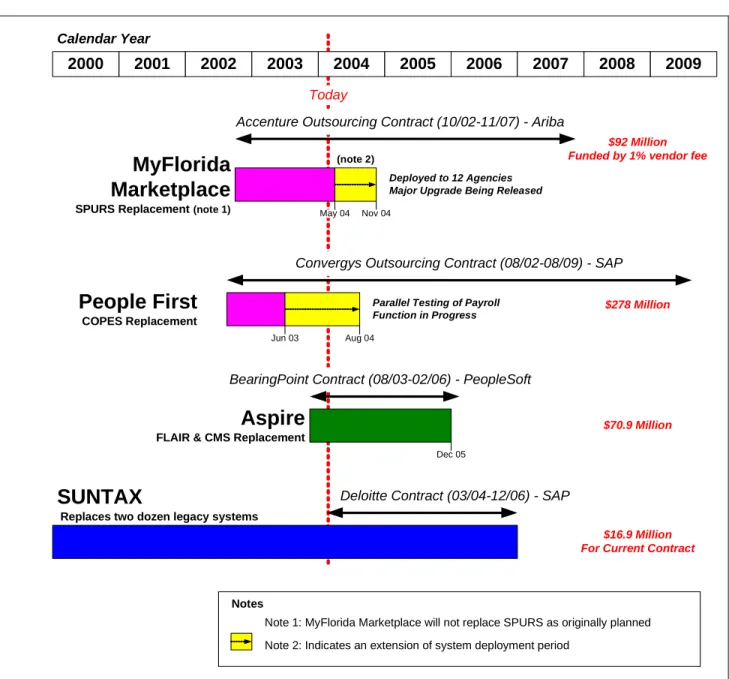
Figure 1. Composite Integration Plan and Timeline ...10
8.2 STATUS OF MYFLORIDA MARKETPLACE (PURCHASING OUTSOURCING) PROJECT... 11
Figure 2. MyFlorida Marketplace Timeline ...11
8.3 STATUS OF PEOPLE FIRST (HR OUTSOURCING) PROJECT... 12
Figure 3. People First Timeline...12
8.4 STATUS OF PROJECT ASPIRE (FLAIR & CMS REPLACEMENT) PROJECT... 13
Figure 4. Project Aspire Timeline ...13
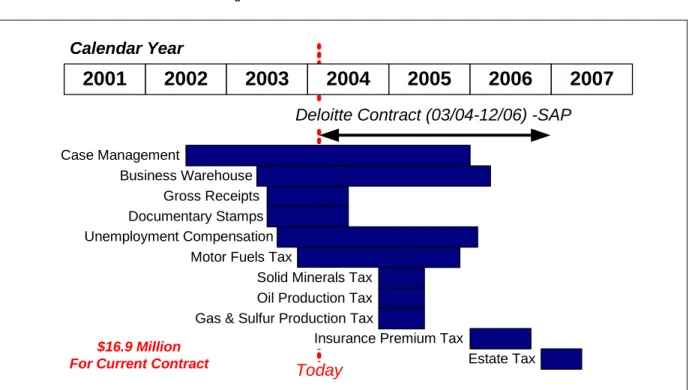
8.5 STATUS OF THE SUNTAX PROJECT... 14
Figure 5. SUNTAX Project Timeline ...14
1. E
XECUTIVES
UMMARYThis is the second Quarterly Report of the Enterprise Resource Planning Integration Task Force (Task Force). The Task Force is charged by statute to support the Financial Management
Information Board (FMIB) in its efforts to facilitate the successful and efficient integration of the central administrative and financial management information systems, referred to collectively as the ERP1 subsystems.
Status of the ERP Information Needs Analysis Project
The Information Needs Analysis Project is an effort to better understand the enterprise information needs of a segment of ERP subsystem users. The study looks at the kinds of questions these users would like to be able to answer through the combined data gathering and reporting capabilities of the integrated ERP subsystems. A key premise is that better information supports better decision making.
This project is on schedule and will conclude in May 2004. It has already provided both tactical and strategic integration information to the Task Force Staff (Staff). The results of the analysis will be summarized in the next Quarterly Report.
Status of the Modification of the Membership of the FMIB and Task Force
The Department of Financial Services (DFS) has taken the lead to initiate a change to the FFMIS Legislation to add the Commissioner of Agriculture to the FMIB and his designee to the ERP Integration Task Force. The outcome of this recommendation will depend on actions taken by DFS and the legislature.
Problems, Issues or Risks
There are no problems, issues or risks that currently require executive level action. Resolution of the following issues could involve future FMIB action:
• Purchasing Functionality and the Integration of Aspire and MyFlorida Marketplace
• Multiple ERP Vendor Tables
• PCard Data Collection, Usage Policy and Technology Support
• ERP Executive Information System Needs
• Requests for Single Sign-On and Single System View
1
All references to the “ERP subsystems” in documents prepared by the ERP Integration Task Force refer, collectively, to the FLAIR/CMS Replacement project (now called “ASPIRE”), SPURS and MyFlorida Marketplace project, COPES and the PeopleFirst project, the payroll system, LAS/PBS, and SUNTAX system.
These issues are described more fully in Section 4 and a more complete listing of ERP integration issues is provided in Section 9.
Issues Resolved By Workgroups Or The Task Force
Several issues have been resolved simply by bringing the Project Teams together to discuss integration concerns. Two issues resolved at the workgroup level and approved by the Task Force are:
• Agency Capability to Continue Labor Cost Distribution
• Development of a Travel Expense Management System
These issues are summarized in this report and require no further consideration at present. The Task Force will reconsider both of these issues once the Aspire Project is further along in development.
Actual costs related to the Task Force
The Task Force has expended a total of $79,436.00 and encumbered an additional $207,000.00 for the completion of the Information Needs Analysis Project.
2. P
URPOSEThe ERPI Task Force prepares and submits quarterly reports to the Executive Office of the Governor, the chairs of the Senate Appropriations Committee and the House Appropriations Committee, and the Financial Management Information Board.
Each quarterly report identifies and describes the following:
• Technical, procedural, policy, and process requirements and changes proposed and
adopted by the FMIB and the status of the implementation of these integration efforts • Problems, issues, or risks that require executive-level action
• Actual costs related to the Task Force
3. S
TATUS OFE
FFORTSA
DOPTED BY THEFMIB
3.1 Information Needs Analysis (Adopted November 25, 2003)
One of the first efforts undertaken by the Task Force and adopted by the FMIB was an Enterprise Information Needs Analysis. The results of this analysis were expected to capture at a high level:
• Data and informational needs of several primary ERP subsystem user groups
• Data that is (or is not) currently captured in support of providing these informational
needs – presented in an enterprise data map
• A transition plan to determine if any of the ERP subsystems, or a combination of them,
could be crafted to better meet users informational needs in the future
The Task Force Staff also anticipated that the study would reveal basic, tactical systems integration concerns and provide additional direction in making the final ERP solution a useful source of strategic enterprise information.
A request for quote for the study was distributed in December, a vendor (Infinity Software Development, Inc.) was selected in January, and work began on February 2, 2004. At the time of this report, the analysis has been underway for 6 weeks and has already provided insight into the enterprise information needs of users responsible for many central administrative and financial management functions.
Exploratory workshops have been held with Senate and House Appropriations staff, the Governor’s Office of Planning and Budgeting staff and representatives from both the Florida Association of State Agency Administrative Services Directors (FASAAD) and the Florida Association of State Budget Officers (FASBO). These efforts produced a matrix of strategic
enterprise related questions and data needs. Based on a review of this matrix by their functional owners, the ERP subsystems’ ability to meet these needs in the future can be appraised.
The Information Needs Analysis should be completed during May 2004 and the results will summarized in the next Quarterly Report.
3.2 Modifying Membership of the FMIB and Task Force (Adopted November 25, 2003)
The Department of Financial Services (DFS) has taken the lead to initiate a change to the FFMIS Legislation to add the Commissioner of Agriculture to the FMIB and his designee to the ERP Integration Task Force. The outcome of this recommendation will depend on actions taken by DFS and the legislature.
4. P
ROBLEMS, I
SSUES ORR
ISKSR
EQUIRINGE
XECUTIVEL
EVELA
CTIONWhile there are currently no items requiring executive level action, the following issues are being studied and have the potential to require future FMIB action.
4.1 Purchasing Functionality and Integration of Aspire and MyFlorida Marketplace
It has been asserted that certain provisions of the State Constitution and Statutes will be satisfied only if purchasing functionality that is very similar to that already developed in MyFlorida Marketplace is duplicated - or replaced - by new functionality in Aspire. The Task Force, the MyFlorida Marketplace project team and the Aspire project teams are together evaluating other options.
4.2 Multiple ERP Vendor Tables
The State currently has multiple databases containing vendor information. These databases are loosely coordinated so redundancies and inconsistencies exist between them.
• Each database was crafted for a specific - and often unique - purpose so that, even when vendors are listed in more than one system, the kinds of information retained about them frequently are different.
• From the State’s perspective this redundancy is inefficient and could result in the kinds of errors that are common whenever the “same” information is contained in more than one place. Any enterprise view of vendors of the State will have to address this issue.
• The ASPIRE project has an operating assumption that all vendor data not created directly
in ASPIRE will come from MyFlorida Marketplace.
• MyFlorida Marketplace has registered approximately 35,000 vendors since June 2003.
However, not all payees are vendors. Currently, agencies use SPURS to maintain payee information used in FLAIR for entities that are not always vendors. It will not be possible to retire the SPURS system until an alternative approach to payee data maintenance is implemented. Until then, SPURS will remain a primary repository for non-vendor remittance information.
The Task Force is working with the project teams to craft an effective solution to the Vendor table issue.
4.3 PCard Data Collection, Usage Policy and Technology Support
Purchasing Cards (PCards) are both an effective and efficient means of purchasing goods and services. However, when PCards are used, valuable enterprise data is not captured.
Furthermore, auditing Pcard usage is a labor-intensive process that would benefit greatly from automated data processing that applies business rules and workflow logic. The Task Force will consider this issue and may recommend that PCard usage policy and ERP subsystem support be revised.
4.4 ERP Executive Information System Needs
At the March 2004 meeting, the Task Force asked the Staff to arrange for presentations from PeopleSoft and SAP to demonstrate how those systems have been employed in government and other large enterprises to deliver enterprise executive information solutions.
This request is timely in that one of the early conclusions from the Information Needs Analysis is that there is a requirement for much greater visibility into sources and uses of funds throughout the fiscal lifecycle.
The Information Needs Analysis will be a first step in identifying executive level information requirements. Investigating the capabilities of off-the-shelf ERP executive information solutions will provide greater insight into how best to provide information needed to manage an enterprise.
4.5 Requests for Single Sign-On and Single System-View
Single Sign-On
Single sign-on refers to system features and methods that allow users to satisfy authentication and authorization requirements (log-on) for multiple ERP subsystems using a single user ID and password combination. Consideration of this issue by the Task Force is a common request from ERP subsystem users. During preliminary investigation, however, it became evident that this issue often relates to more than just single sign-on. There is a similar issue called, “single system view.”
Implementation of a true single sign-on environment is complex, challenging, and sometimes overwhelming. Achieving it will require significant time and effort. Consequently, initiating a single sign-on effort in the near future could dilute focus and resources, resulting in significant risk to the success of the active ERP subsystem projects. The Task Force Staff will continue to analyze this issue and make recommendations regarding any future implementation.
Single System View
Single system view refers to the desire to have one system gather or store information from the various subsystems and present it to users. Users would need to log on only once to obtain and analyze enterprise data. A single system view of data would eliminate the need for users to know where data is stored or learn how to manipulate several different systems. The staff believes that single system view is what many users are requesting when they ask about single sign on.
There are several technical solutions to achieve a single system view of enterprise data, but it is likely that any of these would require something like an Executive Information Support System or Executive Management Information System to be effective (see discussion in Section 4.4).
5. I
SSUESR
ESOLVED BYW
ORKGROUPS OR THET
ASKF
ORCETwo noteworthy enterprise issues that have been resolved are summarized below.
5.1 Agency Capability to Continue Labor Cost Distribution
As the new ERP subsystems are deployed, there is a concern that the capability for certain critical agency-specific business processes might be disrupted. One such process (of great interest to the Legislature and the agencies) is the ability to manage and record the distribution of labor costs among various fund sources. Proper labor cost distribution is frequently a condition for continued receipt of funds.
The Task Force has investigated and confirmed through the Secretary of DMS that the Human Resources management system will continue to support labor cost distribution as the State progresses toward the new ERP environment.
Aspire is still in the requirements confirmation phase and the project team is not yet able to state definitively that it will be able to support or supply agencies with the ability to conduct labor cost distribution. The Aspire team is now studying this requirement and will report back to the Task Force when their analysis is complete.
5.2 Development of a Travel Expense Management System
A travel expense management solution was eliminated from the scope of the MyFlorida Marketplace project.
The ERP Integration Task Force has approved the following staff recommendations:
The implementation of a travel expense management system be undertaken by DFS as a future development of the ASPIRE System.
The Treasurer and the Secretary for DMS formally agree that DFS should take the lead – at least initially – to undertake this project.
The Task Force will take no action beyond these initial steps, for the time being, but will continue to monitor the progress toward establishing an integrated travel expense management system and actively re-engage in the process once a project gets underway.
6. A
CTUALC
OSTS OFT
ASKF
ORCEO
PERATIONSAs of March 15, 2004, the Task Force has expended a total of $79,436.00 for OPS salaries, partial payment for the Information Needs Analysis Project, miscellaneous office supplies, public-meeting announcements and its pro rata share of Cabinet Meeting transcription costs. Another $207,000.00 has been encumbered to complete the Information Needs Analysis Project.
7.
T
ASKF
ORCEV
ISIONS
TATEMENTTo provide the necessary planning, implementation and integration policies, coordination procedures and reporting processes to facilitate the successful and efficient integration of Florida’s seven central administrative and financial management business systems.
Integration is the process of reengineering business systems to enable more seamless delivery of business services and information to the internal and external customers of State of Florida government.
The successful and efficient integration of these systems will consist of steady, deliberate progress toward the following:
- Recasting of business policies, operating rules or statutes - first to permit, and later to promote – enterprise business integration.
- The creation and management of business information that transcends organizational
boundaries, reducing the need for reconciliation or manual intervention to get timely answers to important business questions.
- Management information needed by the Governor, Legislature, Judiciary, Cabinet
Agencies and other managers for use in: setting priorities, evaluating the effectiveness of government activities and making resource decisions.
- Operating information to support Agency heads, their principal assistants and line workers to do their jobs while cutting costs, raising productivity and improving service deliveries.
- A structured and progressive realignment of some agency responsibilities along natural
breaks in government service groups, eliminating – wherever feasible – redundancies and stand-alone implementations of functions as suitable enterprise-wide solutions become available.
- Reducing ownership costs (provisioning, updating, maintaining) of multiple
heterogeneous systems by migrating over time, as technology evolves and following State Technology Office recommendations, to a single technical ERP system solution that best serves the enterprise needs of the State.
- Establishment of an enterprise business architecture, which will then be implemented in concert with the enterprise technical architecture being developed by the State
8. ERP S
UBSYSTEMP
ROJECTS
TATUSThis section describes, at a high level, the current status of the four active ERP subsystem projects that are currently underway.
8.1 Integrated Schedule & Timeline
The following is an integrated high-level schedule of the active ERP subsystem projects.
Today
Accenture Outsourcing Contract (10/02-11/07) - Ariba
Calendar Year
MyFlorida
Marketplace
SPURS Replacement (note 1)
Deployed to 12 Agencies Major Upgrade Being Released
People First
COPES Replacement
Convergys Outsourcing Contract (08/02-08/09) - SAP
Aspire
FLAIR & CMS Replacement
BearingPoint Contract (08/03-02/06) - PeopleSoft
Parallel Testing of Payroll Function in Progress May 04 Nov 04
Aug 04 Jun 03
SUNTAX
Replaces two dozen legacy systems
Deloitte Contract (03/04-12/06) - SAP
2002 2003 2004 2005
2000 2001 2006 2007 2008
(note 2)
Note 1: MyFlorida Marketplace will not replace SPURS as originally planned Note 2: Indicates an extension of system deployment period
Notes
2009
Dec 05
$92 Million Funded by 1% vendor fee
$278 Million
$70.9 Million
$16.9 Million For Current Contract
8.2 Status of MyFlorida Marketplace (Purchasing Outsourcing) Project
Accenture Outsourcing Contract (10/02-11/07) - Ariba Calendar Year
2002
2003
2004
2005
2006
2007
Operations & Maintenance
Mobilization
Development May 04 Nov 04
Deployment Deployment extended six months
Today
$92 Million
Funded by 1% Vendor Fee
Figure 2. MyFlorida Marketplace Timeline
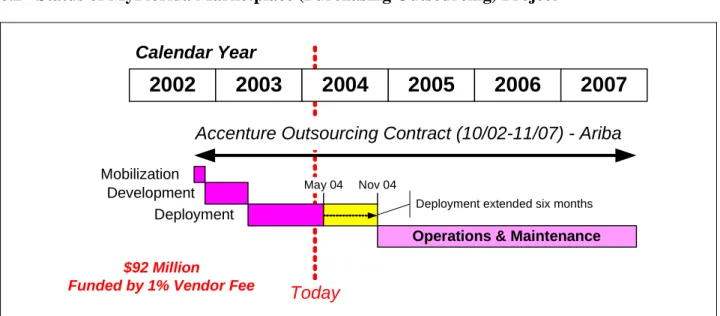
Schedule: Modifications to core functions have resulted in a six-month extension to the
deployment phase. Twelve more agencies will transition to MyFlorida Marketplace between July 2004 and November 2004.
Status: A major application upgrade, based upon feedback from the 12 agencies that have already completed transition, is planned for March 2004 (now).
Cost: This contract is funded through a one-percent fee on nearly all purchases made using the new system. The total contract value is $92,000,000 over five years. Accenture’s revenue has been far below projections. Slower than expected deployment to the agencies has reduced the volume purchased using MyFlorida Marketplace. In addition, many vendors who have multiyear contracts are exempt from the 1% fee until the contracts are up for renewal. To date, MyFlorida Marketplace has been used to purchase $140 million in goods and services, but this amount is only 7% of the $2 billion estimate used to calculate the service provider’s (Accenture) projected revenue.
Legacy System Replacement: In the original contract, the MyFlorida Marketplace system was expected to replace the Statewide Purchasing Subsystem (SPURS). SPURS was developed in the Cobol programming language during the period 1987 to 1990 with modifications made through 1994. SPURS is a primary repository for vendor/payee information used by the State accounting subsystem (FLAIR). DMS has decided not to migrate all SPURS data into
MyFlorida Marketplace because it contains data from payees who are not vendors. SPURS will remain in service until a different migration plan is devised.
8.3 Status of People First (HR Outsourcing) Project
Calendar Year
Convergys Outsourcing Contract (08/02-08/09) -SAP
Jan 04
2002 2003 2004 2005 2006 2007 2008 2009
Payroll Admin “go live” delayed 14 months (June 2003 to August 2004)
Parallel testing is progressing
Staffing Admin Payroll Admin HR Admin Benefits Admin
Completed May 03
HR and Benefits Admin deployment delayed until Payroll Admin is ready to go live Jun 03
Today
Operations & Maintenance
$278 Million
Figure 3. People First Timeline
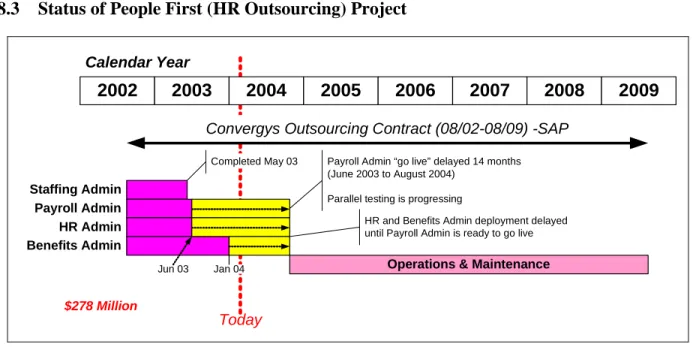
Schedule: The completion of all remaining phases of the People First subsystem is now scheduled for August 2004, or 14 months after the original date.
Status: The People First Payroll function is undergoing parallel testing of its ability to generate accurate payroll production instructions to the Bureau of State Payrolls system. Testing was originally scheduled for a three-week period in January 2004 but is still ongoing. Following final acceptance by DFS, a phased rollout to the agencies will begin with completion expected by August 2004.
Cost: The contract to outsource the four human resource management areas shown in the figure
above, including the development of the People First subsystem, is $278,600,000 for the seven-year life of the contract.
Legacy System Replacement: The People First subsystem is intended to replace a number of legacy systems. Foremost among these is the Cooperative Personnel Employment System (COPES) and its inquiry tool, COPESview. COPES was developed and extensively modified by state employees over a period spanning more than twenty years. Until the People First
subsystem goes live, COPES will continue to be the system of record for key human resource functions and state employee payroll preparation. COPES, in conjunction with the Time Direct attendance and leave management system, is also a key element in labor cost distribution allocation and management for AHCA, AWI, DEP, STO, FWCC and PSC.
Integration Issues: Labor cost distribution, payroll production, travel expense management and position, salary & rate management.
8.4 Status of Project Aspire (FLAIR & CMS Replacement) Project
BearingPoint Contract (09/03-02/06) - PeopleSoft
Calendar Year
2002
2003
2004
2005
2006
Mobilization
Configuration & Implementation
Today
Phased Rollout Post Implementation Support Requirements Confirmation
$70.9 Million
Figure 4. Project Aspire Timeline
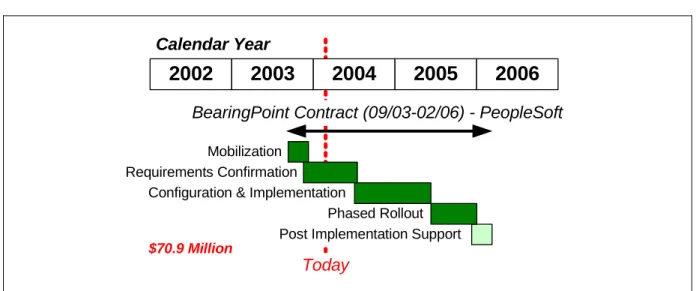
Schedule: Configuration and implementation of the Aspire subsystem is scheduled to
commence in May 2004 and will take a year. Phased rollout is scheduled to begin in May 2005 and will continue to December 2005. Post implementation support will be provided from December 2005 to February 2006. The duration of the contract is 29 months.
Status: The Aspire Project is in the requirements confirmation phase. A conceptual design is scheduled for delivery on April 30, 2004.
Cost: The total cost of the Aspire Project contract is $70.9 million. Expenditures to date total $27.6 million (39%). Seven months of the contract period (29%) have elapsed.
Legacy System Replacement: The Aspire subsystem will replace the Florida Accounting Information Resource System (FLAIR) system and the Cash Management System (CMS). Integration Issues: There are several integration issues with Project Aspire. This subsystem has multiple – and often complex – integration points with all other ERP subsystems. The Task Force has adopted several of these integration issues for review and resolution. For a list, see Section 10. Likewise, the Aspire Project Team has initiated an external system integration review and analysis effort.
8.5 Status of the SUNTAX Project
Deloitte Contract (03/04-12/06) -SAP
Calendar Year
2002 2003 2004 2005 2006
Motor Fuels Tax Unemployment Compensation
Today
Documentary Stamps Gross Receipts
Solid Minerals Tax Oil Production Tax Gas & Sulfur Production Tax
Insurance Premium Tax
Estate Tax Business Warehouse Case Management 2007 2001 $16.9 Million For Current Contract
Figure 5. SUNTAX Project Timeline
Schedule: The SUNTAX Project will complete the Gross Receipts and Documentary Stamps components this summer. In all, 13 broad categories of taxes will be managed by the SUNTAX subsystem.
Status: The SUNTAX Project is approximately midway through a decade long process and system reengineering effort. Three tax components have been fully developed and are already in production: Corporate Income Tax, Communications Services Tax and Sales & Use Tax.
Cost: The SUNTAX Project began in 1999 and has been funded primarily through a recurring
$5.8 million appropriation in the Department of Revenue (DOR) base budget. State employees built some of the components while Deloitte Consulting, Inc. developed others in a series of short duration contract engagements. In March 2004 DOR executed the long-term contract that extends until the end of 2006 and has a value of $16.9 million.
Legacy System Replacement: The SUNTAX Project is replacing dozens of legacy systems that were crafted over time using a variety of programming languages and platforms. These are being retired as new components of SUNTAX are deployed.
Integration Issues: At present, FLAIR has the only ERP subsystem interface with SUNTAX. This interface is used to produce tax refund checks. In the future, increased integration with SUNTAX could be used to electronically record deposits, compare estimated with actual revenues, etc. When the Aspire System deploys it will contain and use an entirely new chart of accounts. SUNTAX, like all ERP subsystems, will have to be modified accordingly.
9. ERP I
NTEGRATIONT
ASKF
ORCEI
SSUESL
ISTIntegration Issue Status & Resolution Tracking Report ERP Integration Task Force
Integration Center of Competence
Monitoring - The issue has ERP subsystem integration implications but is already being adequately addressed by another group or activity. The Staff will monitor these issues, lend its support wherever possible, and periodically report on progress to the Task Force.
Initiated - The issue has been suggested for Task Force action but has not yet been evaluated to any extent. The problem statement has not been crafted and the Task Force has not yet deliberated on whether or not to adopt the issue for resolution.
Adopted - The issue has been reviewed and approved by the Task Force and, concurrently, the Staff is authorized to commit its resources to pursuing a resolution. An adopted issue may not become active immediately if the Staff is fully committed to completing previous tasking.
Complete - All planned actions are completed and approved by the Task Force. No further action is planned but may be taken if warranted by new information or a change in circumstances.
Active - The issue has been adopted by the Task Force for resolution and the Staff, along with the ICC or other subject matter or technical experts, are conducting an ongoing effort to arrive at a resolution. Active issues have a complete problem statement and a plan of action.
Status Keyword Descriptions
Issue #
Last Action
Date Title SBI Description Status
Action Group Issue Paper TF Recom FMIB Recom
03 4-Mar-04 Travel Does the state need a travel management
system? Where will it be built?
Complete ICC Final Yes No
02 4-Mar-04 Labor Cost Distribution Will People First and ASPIRE provide the data needed for agencies to manage the distribution / allocation of labor costs among various funds?
Complete ICC Final No No
01 4-Mar-04 Vendor/Payee Issue 10 How many vendor/payees files does the state need to maintain? What are the options?
Active ICC Draft
18 4-Mar-04 ERP Information management and reporting solution
Information Needs Analysis Project is underway. Active Staff No Yes Yes
09 4-Mar-04 Single Sign-on system access Some users regularly require access to multiple ERP subsystems - each requiring an ID and password. Password resets make up ~30% of help desk calls. Is there a better way?
Issue #
Last Action
Date Title SBI Description Status
Action Group Issue Paper TF Recom FMIB Recom
06 4-Mar-04 Asset Management What kind of asset management solution does
Florida need? Is it just what ASPIRE intends to provide or is something else also needed?
Adopted ICC No
07 1-Apr-04 Pcard Usage, tracking and integration
12 Decentralizing purchasing authority using P-cards has raised a number of issues regarding policy, auditing, information management and technical infrastructure.
Adopted ICC Draft
04 3-Mar-04 Chart of Accounts /Appropriation Codes
Being addressed in the ASPIRE project Monitoring DFS No
17 3-Mar-04 Revised Financial Policy Needed
DFS staff lead Monitoring DFS No
10 3-Mar-04 Certified Forward 6 Florida's certified forward process is not modeled in People Soft and the need for it may change when ASPIRE comes on line.
Monitoring DFS No
11 30-Mar-04 New Governance Structure for FMIB
DFS Legislative Affairs has lead Monitoring DFS No Yes Yes
19 3-Mar-04 Tracking Appropriations to Expense
Monitoring Staff No
08 11-Nov-03 1% Administrative Fee Collection by DMS
Initiated Staff No
13 11-Nov-03 Electronic Records Initiated Staff No
14 11-Nov-03 Employee Benefits Initiated Staff No
15 11-Nov-03 Activity Based Budgeting Initiated Staff No
16 11-Nov-03 Employee Payroll Production/distribution
Initiated Staff No
21 3-Mar-04 Single system view Initiated Staff No
05 3-Mar-04 Shadow Systems Does the state need a policy concerning shadow
systems? Who? When?
Initiated Staff No
12 3-Mar-04 Revision of the FFMIS Legislation
Issue #
Last Action
Date Title SBI Description Status
Action Group Issue Paper TF Recom FMIB Recom
22 Budget Execution 23 Initiated Staff No
23 FLAIR/LAS PBS Linkage 26 Initiated Staff No
24 E-commerece 11 Initiated Staff No
25 MFMP/Aspire Boundary Initiated Staff No
26 Shared Finance and Accounting
Services
39 Initiated Staff No
27 Revenue Management 2 Initiated Staff No
28 Rate Initiated Staff No