Introduction to Dynamic Models.
Slide set #1 (Ch 1.1-1.6 in IDM).
Ragnar Nymoen
University of Oslo, Department of Economics
January 13, 2005
1
1
Introduction
We observe that economic agents take time to adjust their behaviour to changes in circumstances.
Instantaneous adjustment is the exception in economics. Adjustment lag is the rule.
Dynamic behaviour is therefore pervasive in economics. Models with a dynamic formulation are therefore needed.
And we need a methodology for understanding and analyzing dynamic models.
2
The importance of dynamics is recognized by policy decision makers:.
Norges Bank [The Norwegian Central Bank] is typical of many central banks’ view:
A substantial share of the effects on inflation of an interest rate change will occur within two years. Two years is therefore a reasonable time horizon for achieving the inflation target of 212 per cent1
One important aim of this course is to learn enough about dynamic modeling to be able to understand the economic meaning of a statement like this, and to start forming an opinion about its realism (or lack thereof).
1http://www.norges-bank.no/english/monetary policy/in norway.html.
Similar statements can be found on the web pages of the central banks in e.g., Autralia,
Dynamic models often include bothflow andstock variables.
• Flow: in unit of (for example) million kronerper year
• Stock: in units of (for example) million of kroner at a particular period in time (for example start or end of the year).
In this course an important class of stock variables will be price indices. For examplePtmay represent the value of the Norwegian CPI in periodt(a month,
a quarter or a year).
As you know, the values ofP will beindex numbers. The number 100 (often 1 is used instead) refers to the base period of the index. IfPt>100 it means
Starting from a stock variable like Pt, a flow variable results from obtaining
the change, hence
xt=Pt−Pt−1, the (absolute) change
yt=
Pt−Pt−1
Pt−1
, the relative change, and
zt= lnPt−lnPt−1 the approximate relative change
are examples offlow variables. Note that:
• yt×100 is inflation in percentage points. In this course we often stick to
the rate formulation (hence, we omit the scaling by 100)
• zt ≈ yt by the properties of the (natural) logarithmic function, see for
example the appendix of IDM, if in doubt.
5 1760 1780 1800 1820 200 400 600 CPI_Norway 1760 1780 1800 1820 1000 1500 CPI_UK 1760 1780 1800 1820 -0.5 0.0 0.5 1.0 1.5 Inflation_Norway 1760 1780 1800 1820 -0.2 0.0 0.2 0.4 Inflation_UK
Figure 1: Consumer price indices (stock variables), and their rate of change (flow). Norway and UK
6
An typical empirical trait ofstock variables are that they change gradually, as a result offinite growth rates.
Sometimes however, stock variablesjump from one value in period tto quite another in periodt+ 1.
Empirically, the rate of change then becomes very large. Norwegian “price history” at the breakdown of the union with Denmark is an example.
In economics, when stock variables change gradually, we need explicit dynamic models to account for their evolution.
Sometimes though, stock variables can be treated theoretically as if the are jump-variables. An example of such a theory in this course is the portfolio model of the foreign exchange market. That model is static.
In the light of the pervasiveness of dynamics in real world phenomena: what is the rationale and interpetation of static model?
1. as afirst approximation to actual behaviour, whenthe speed of adjustment is fast (although a dynamic model would give better understanding). The portfolio model is an example.
2. as steady-state relationships, derived from and consistent with dynamic models.
We will use both interpretations in our course, and need to distinguish between them.
As noted economic dynamics often arise from the combination of flow and stock variables.
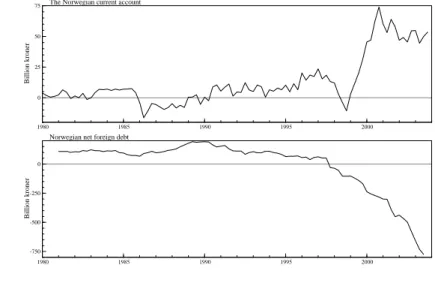
For example, the dynamic behaviour of debt (a stock) is linked to the value of the current account (flow) in the following way
debt=−current account + last periods debt + corrections.
For example: If there is a primary account surplus for some time (and ignoring
correctionsfor simplicity), this will lead to a gradual reduction of debt–or an
increase in the nation’s net wealth. Conversely, a consistent current account deficit raises a nation’s debt.
9
1980 1985 1990 1995 2000
0 25 50
75 The Norwegian current account
Billion kroner 1980 1985 1990 1995 2000 -750 -500 -250 0
Norwegian net foreign debt
Billion kroner
Figure 2: The Norwegian current account (upper panel) and net foreign deb (lower panel)t. Quarterly data 1980(1)-2003(4)
10
In the lecture notes, Introductory Dynamic Macroeconomics (IDM) further examples of dynamics are given in Chapter 1.1:
• Capital stock dynamics (economic growth)
• Dynamics of consumption and income (flows) and private household wealth. Chapter 1.2 provides a detailed example (see below)
2
Static and dynamic models an example
The textbook consumption function, i.e., the relationship between real private consumption expenditure (C) and real households’ disposable income (IN C) is an example of astatic equation
Ct=f(IN Ct),f0>0. (1)
Two examples of specified functional forms for the static consumption function:
Ct=β0+β1IN Ct+et, (linear)
lnCt=β0+β1lnIN Ct+et, (log-linear) (2)
If this is unfamiliar, read inIDM about the properties of these two functional forms. For example for the interpretation ofβ.
Textbooks usually omit the termetin equation (2), but for applications of the
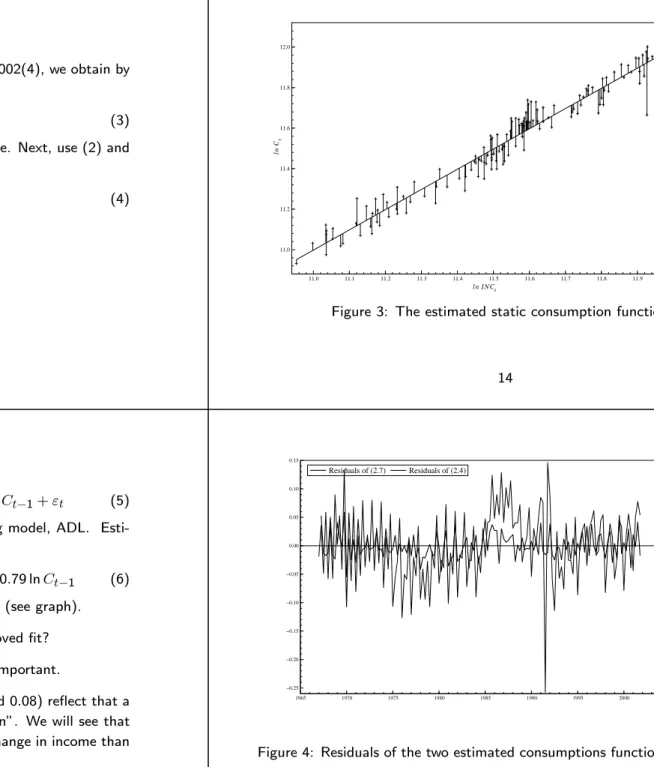
Using quarterly data for Norway, for the period 1967(1)-2002(4), we obtain by using the method of least squares method:
ln ˆCt= 0.02 + 0.99 lnIN Ct (3)
where the “hat” in ˆCtis used to symbolize thefitted value. Next, use (2) and
(3) to define the residual ˆet:
ˆ
et= lnCt−ln ˆCt, (4)
which is theempirical counterpart to et.
13 11.0 11.1 11.2 11.3 11.4 11.5 11.6 11.7 11.8 11.9 12.0 11.0 11.2 11.4 11.6 11.8 12.0 ln Ct lnINCt
Figure 3: The estimated static consumption function.
14
Thedynamic consumption function:
lnCt=β0+β1lnIN Ct+β2lnIN Ct−1+αlnCt−1+εt (5)
is an example of a so calledautoregressive distributedlag model, ADL. Esti-mated:
ln ˆCt= 0.04 + 0.13 lnIN Ct+ 0.08 lnIN Ct−1+ 0.79 lnCt−1 (6)
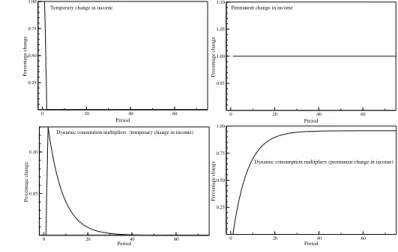
Compare residuals ˆεtand ˆetto judge which model is best (see graph).
Which explanatory variables contribute most to the improvedfit? lnCt−1 itself! Illustrates that the dynamic framework is important.
The rather low values of the income elasticities (0.130 and 0.08) reflect that a single quarterly change in income is “too little to build on”. We will see that the results imply a much higher impact of a permanent change in income than of a temporary rise. 1965 1970 1975 1980 1985 1990 1995 2000 −0.25 −0.20 −0.15 −0.10 −0.05 0.00 0.05 0.10 0.15 Residuals of (2.7) Residuals of (2.4)
3
Dynamic multipliers
“A substantial share of the effects on inflation of an interest rate change will occur within two years. Two years is therefore a reasonable time horizon for achieving the inflation target of 212 per cent”
This may mean that the effect is building up gradually over 8 quarters and then dies away quite quickly, but other interpretations are also possible.
In order to inform the public more fully about its view on the monetary policy transmission mechanism (see topic 5 in our course), the Bank would have to give a more detailed picture of the dynamic effects of a change in the interest rate.
To make progress we need to understand fully a concept called thedynamic
multiplier. In order to explain dynamic multipliers, we first show what our
estimated consumption function implies about the dynamic effect of a change in income (Ch 1.3 of IDM). Next, we derive the dynamic multipliers using a general notation, see Ch 1.4 of IDM.
17
3.1
Dynamic effects of income on consumption
Simplify equation (6) by settingεt= 0, hence we can drop the ˆ aboveCt.
Assume that income rises by 1% in period t, so instead of IN Ct we have IN Ct0=IN Ct(1 + 0.01).
Using (6), we have
ln(Ct(1+δc,0) = 0.04+0.13 ln(IN Ct(1+0.01))+0.08 lnIN Ct−1+0.79 lnCt−1
where δc,0 denotes the relative increase in consumption in period t, the first period of the income increase. Since ln(1 +δc,0)≈δc,0 when −1< δc,0 <1, and noting that
lnCt−0.04−0.13 lnIN Ct−0.08 lnIN Ct−1−0.79 lnCt−1= 0
we obtain δc,0 = 0.0013, meaning that in percentage terms the immediate effect is a 0.13% rise in consumption.
18
What about the second period after the shock? Notefirst that the estimated model also holds for periodt+ 1, hence
ln(Ct+1(1 +δc,1)) = 0.04 + 0.13 ln(IN Ct+1(1 + 0.01))
+ 0.08(lnIN Ct(1 + 0.01)) + 0.79 ln(Ct(1 +δc,0),
after the shock. The relative increase inCtin periodt+ 1 becomes δc,1= 0.0013 + 0.0008 + 0.79×0.0013 = 0.003125,
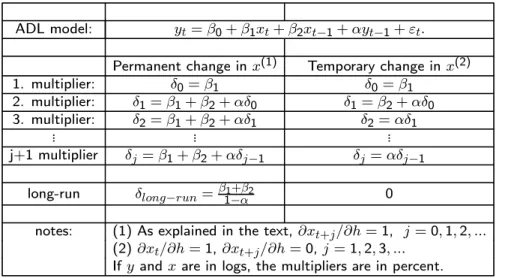
or 0.3%. By following the same way of reasoning, wefind that the percentage increase in consumption in periodt+ 2 is 0.46% (formallyδc,2×100).
Sinceδc,0measures the direct effect of a change inIN C, it is usually called the impact multiplier, and is defined by taking the partial derivative∂lnCt/∂lnIN Ct
in equation (6). The dynamic multipliers δc,1, δc,2, ...δc,∞ are in their turn
linked by the dynamics of equation (6), namely
δc,j= 0.13δinc,j+ 0.08δinc,j−1+ 0.79δc,j−1, for j= 1,2, ....∞. (7)
For example, forj = 3, and settingδinc,3=δinc,= 0.01, a permanent rise in income, we obtain
δc,3= 0.0013 + 0.0008 + 0.79×0.0046 = 0.005734
or 0.57% in percentage terms. The long-run multiplier: Set δc,j =δc,j−1 =
δc,long−run we obtain
δc,long−run=0.0013 + 0.0008
1−0.79 = 0.01,
Permanent 1% change Temporary 1% change
Impact period 0.13 0.13
1. period after shock 0.31 0.18
2. period after shock 0.46 0.14
... ... ...
long-run multiplier 1.00 0.00
Table 2: Dynamic multipliers of the estimated consumption function in (6), percentage change in consumption after a 1 percent rise in income.
21
0 20 40 60 0.05
0.10
Dynamic consumtion multipliers (temporary change in income)
Percentage change Period 0 20 40 60 0.25 0.50 0.75 1.00
Temporary change in income
Percentage change Period 0 20 40 60 0.25 0.50 0.75 1.00
Dynamic consumption multipliers (permanent change in income)
Percentage change Period 0 20 40 60 0.95 1.00 1.05 1.10
Permanent change in income
Percentage change
Period
Figure 5: Temporary and permanent 1 percent changes in income with associ-ated dynamic multipliers of the consumption function in (6).
22
The distinction between short and long-run multipliers permeates modern macro-economics, and so is not special to the consumption function!
B&W:
Chapter 8, on money demand, Table 8.4.
Chapter 12, where short and long-run supply curves are derived.
For example, the slopes of the short-run curves infigure 12.6 correspond to the impact multipliers of the respective models, while the vertical long-run curve suggest that the long-run multipliers are infinite (we’ll return to this)
Norges Bank on inflation targeting – and many, more examples.
4
General notation of the ADL model
ADL model: ytis the endogenous variable while the xtandxt−1 make up the
distributed lag part of the model:
yt=β0+β1xt+β2xt−1+αyt−1+εt. (8)
Definext, xt+1, xt+2, , .... as functions of a continuous variable h. When h
changes permanently, starting in periodt: ∂xt/∂h >0.
Sincextis a function of h, so is yt, and the effect ofytof the change in his
found as
∂yt ∂h =β1
∂xt ∂h.
It is customary to consider “unit changes” in the explanatory variable, which means that we let∂xt/∂h= 1. Hence thefirst multiplier is
∂yt
The second multiplier is found by considering the equation for periodt+ 1, i.e.,
yt+1=β0+β1xt+1+β2xt+αyt+εt+1.
and calculating the derivative∂yt+1/∂h:
∂yt+1 ∂h =β1 ∂xt+1 ∂h +β2 ∂xt ∂h +α ∂yt ∂h (10)
Again, considering a unit change, and using (9),
∂yt+1
∂h =β1+β2+αβ1=β1(1 +α) +β2 (11)
The pattern in (10) repeats itself for higher order multipliers, hence: multiplier numberj+ 1 is given as
δj=β1+β2+αδj−1, forj = 1,2,3, . . . (12)
where we use the notation:
δj =∂yt+j
∂h ,j= 1,2, ...
25
The long run multiplier is defined by setting δj = δj−1 = δlong−run. Using
(12),δlong−run is found to be
δlong−run=β1+β2
1−α , if −1< α <1. (13)
Clearly, if α = 1, the expression does not make sense mathematically, since the denominator is zero. Economically, it doesn’t make sense either since the long run effect of a permanent unit change inx is an infinitely large increase in y (if β1+β2 > 0). The case of α = −1, may at first sight seem to be acceptable since the denominator is 2, not zero. However, as explained below, the dynamics is essentially unstable also in this case meaning that the long run multiplier is not well defined for the case of α=−1.
26
Table 3: Dynamic multipliers of the general autoregressive distributed lag model.
ADL model: yt=β0+β1xt+β2xt−1+αyt−1+εt.
Permanent change inx(1) Temporary change inx(2)
1. multiplier: δ0=β1 δ0=β1
2. multiplier: δ1=β1+β2+αδ0 δ1=β2+αδ0
3. multiplier: δ2=β1+β2+αδ1 δ2=αδ1
... ... ...
j+1 multiplier δj=β1+β2+αδj−1 δj =αδj−1
long-run δlong−run=β1+β2
1−α 0
notes: (1) As explained in the text,∂xt+j/∂h= 1, j= 0,1,2, ...
(2)∂xt/∂h= 1,∂xt+j/∂h= 0,j= 1,2,3, ...
5
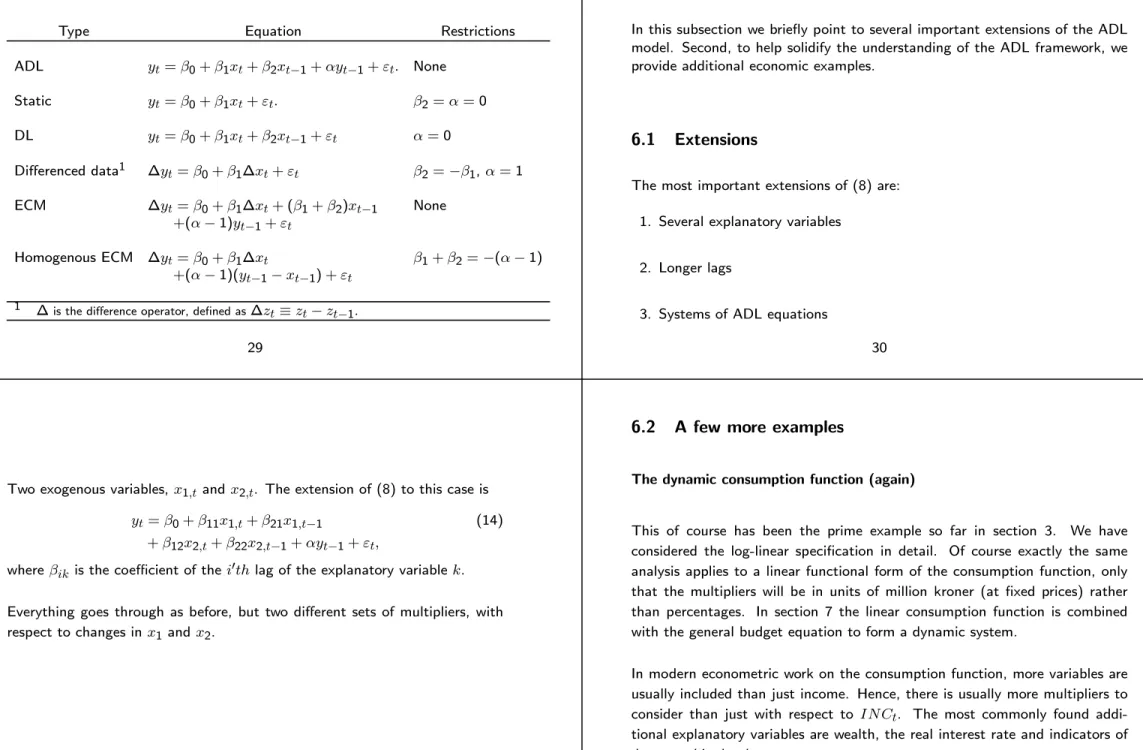
A typology of linear models
The discussion at the end of the last section suggests that if the coefficientα
in the ADL model is restricted to for example 1 or to 0, quite different dynamic behaviour of yt is implied. In fact the resulting models are special cases of
the unrestricted ADL model. For reference, this section gives a typology of models that are encompassed by the ADL model. Some of these model we have already mentioned, while others will appear later in the book.
Table 4: A model typology.
Type Equation Restrictions
ADL yt=β0+β1xt+β2xt−1+αyt−1+εt. None
Static yt=β0+β1xt+εt. β2=α= 0 DL yt=β0+β1xt+β2xt−1+εt α= 0 Differenced data1 ∆yt=β0+β1∆xt+εt β2=−β1,α= 1 ECM ∆yt=β0+β1∆xt+ (β1+β2)xt−1 None +(α−1)yt−1+εt Homogenous ECM ∆yt=β0+β1∆xt β1+β2=−(α−1) +(α−1)(yt−1−xt−1) +εt
1 ∆is the difference operator, defined as∆z
t≡zt−zt−1.
29
6
Extensions and examples
In this subsection we briefly point to several important extensions of the ADL model. Second, to help solidify the understanding of the ADL framework, we provide additional economic examples.
6.1
Extensions
The most important extensions of (8) are: 1. Several explanatory variables
2. Longer lags
3. Systems of ADL equations
30
Two exogenous variables,x1,t andx2,t. The extension of (8) to this case is
yt=β0+β11x1,t+β21x1,t−1 (14) +β12x2,t+β22x2,t−1+αyt−1+εt,
whereβik is the coefficient of thei0thlag of the explanatory variablek. Everything goes through as before, but two different sets of multipliers, with respect to changes inx1 andx2.
6.2
A few more examples
The dynamic consumption function (again)
This of course has been the prime example so far in section 3. We have considered the log-linear specification in detail. Of course exactly the same analysis applies to a linear functional form of the consumption function, only that the multipliers will be in units of million kroner (at fixed prices) rather than percentages. In section 7 the linear consumption function is combined with the general budget equation to form a dynamic system.
In modern econometric work on the consumption function, more variables are usually included than just income. Hence, there is usually more multipliers to consider than just with respect to IN Ct. The most commonly found
addi-tional explanatory variables are wealth, the real interest rate and indicators of demographic developments.
The Phillips curve
In Chapter 2 of IDM, and several times later in the course, we will consider the Phillips curve:
πt=β0+β11ut+β12ut−1+β21πet+1+εt. (15) πt is the rate of inflation, hence πt = ln(Pt/Pt−1) where Pt is an index of
the price level of the economy. ut is the rate of unemployment, or its log. Finally,πet+1 denotes the expected rate of inflation one period ahead, so (15) is formally an ADL with 2 explanatory variables. Moreover, if
πte+1=τ πt−1 (16)
(15) can be reduced to the single variable ADL equation (8),
πt=β0+β11ut+β12ut−1+απt−1+εt. (17)
withα=β21τ.
33
πte+1=τ πt−1
is just one out of many hypotheses of expectations formation. Alternative specifications give rise to different dynamic models of the rate of inflation. Consider an explicit inflation target, ¯π. In this case,we may set
πet+1= ¯π (18)
As an exercise, convince yourself that equations (15) and (18) imply an equation for inflation which is a distributed lag model (DL model).
More generally,firms and households take into consideration the possibility that future inflation is not exactly on target. Hence they may adopt a more robust forecasting rule, for example
πet+1= (1−τ)¯π+τ πt−1, 0< τ ≤1. (19)
In this case, the derived dynamic equation for inflation again takes the form of an ADL model.