
General
Specifications
[Release 3]
ProSafe-RS
Outline of I/O Modules
GS 32Q06K20-31E
GENERAL
This GS describes the specifications of I/O modules to be mounted on the safety control unit or the safety node unit of the ProSafe-RS system.
An example of a system configuration is shown below.
F01E.ai
Safety node unit Safety node unit
I/O signal connection Dual-redundant ESB Bus
Dual-redundant Control Network
Dual-redundant Fiber-optic cable Safety control unit
All Rights Reserved. Copyright © 2011, Yokogawa Electric Corporation GS 32Q06K20-31E
COMMON SPECIFICATIONS
l
Installation Environment
Item Specifications Remarks
Temperature Normal operationTransportation/storage –20 to 70 °C (*1)–40 to 85 °C (*2)
Humidity Normal operation 5 to 95 % RH (non-condensing) 5 to 85 % RH when the SRM53D/SRM54D/ SBM54D is mounted. Transportation/storage 5 to 95 % RH (non-condensing)
Temperature change
During operation Within ±10 °C/h Transportation/storage Within ±20 °C/h
Power supply
Voltage range 100 to 120 V AC –15 %, +10 % 220 to 240 V AC –15 %, +10 % 24 V DC: –10 % to +20 %
Frequency 50/60 Hz ± 3 Hz
Distortion factor 10 % or less
Crest factor 100 V system: 118 V or larger220 V system : 258 V or larger
Momentary failure 20 ms or less (when receiving the rated AC voltage) DC power supply ripple rate 1 % p-p maximum
Withstanding voltage 1500 V AC for 1 minute (for 100 to 120/220 to 240 V AC) Between power & ground terminals Insulation resistance 20 M ohms at 500 V DC Between power & ground terminals Grounding Apply the grounding system which is defined by the rules and standards of the country or the region.
Dust Maximum of 0.3 mg/m3
Corrosive gas ANSI/ISA S71.04 G3 (standard) Excluding SRM53D/SRM54D/SBM54D Noise
Electric field 10 V/m maximum (80 MHz to 1 GHz) Static electricity 4 kV or less (direct discharge) 8 kV or less (aerial discharge)
Vibration
Continuous vibration Amplitude: 1.75 mm (5 Hz to 9 Hz)Acceleration: 4.9 m/s2 (9 Hz to 150 Hz)
Non-continuous vibration Amplitude: 3.5 mm (5 Hz to 9 Hz)Acceleration: 9.8 m/s2 (9 Hz to 150 Hz)
Seismic Acceleration: 4.9 m/s2 or less
Transportation Horizontal: 4.9 m/svertical: 9.8 m/s2 or less 2 or less when packaged
Impact 147 m/s2or less, 11 ms
Altitude 2000 m above sea level or less
*1: 60 to 70 °C: Refer to “NODE UNIT MOUNTING RESTRICTIONS” section.
*2: When ALR111-S1/ALR121-S1 is installed, the ambient temperature should range from 0 to 60 °C. When ALE111-S1 is installed, the ambient temperature should range from 0 to 60 °C.
l
ESB Bus
ApplicationESB Bus is a communication bus that connects a safety control unit with a safety node unit. Communication specifications
Up to 13 safety node units can be connected to ESB bus via SEC402 ESB bus coupler module on SSC60S/ SSC60D safety control unit, and up to 9 safety node units to ESB bus via SEC401 ESB bus coupler module on SSC50S/SSC50D/SSC10S/SSC10D safety control unit.
Transmission route specifications Network structure: bus
Transmission channel redundancy: dual-redundant Network speed: 128 Mbits/second
Network cable: Dedicated communication cable (YCB301)
Transmission distance: 10 m maximum (*1) *1: Length of ESB buses must be 10 m or shorter
each from upper and lower port of SEC402.
l
Applicable Standards
Refer to “ProSafe-RS Safety Instrumented System Overview (GS 32Q01B10-31E, GS 32Q01B20-31E).”
STANDARD SPECIFICATIONS
l
Safety Control Unit
A CPU module, two power supply modules, and two ESB Bus coupler modules, along with I/O modules, are mounted on the safety control unit.
There are 12 types of safety control units: SSC60S-S: Safety control unit for Vnet/IP
(standard (-20 to 40 °C) type) SSC60S-F: Safety control unit for Vnet/IP
(wide range temperature (-20 to 70 °C) type) SSC60D-S: Duplexed safety control unit for Vnet/IP
(standard (-20 to 40 °C) type)
SSC60D-F: Duplexed safety control unit for Vnet/IP (wide range temperature (-20 to 70 °C) type) SSC50S-S: Safety control unit for Vnet/IP
(standard (-20 to 40 °C) type) SSC50S-F: Safety control unit for Vnet/IP
(wide range temperature (-20 to 70 °C) type) SSC50D-S: Duplexed safety control unit for Vnet/IP
(standard (-20 to 40 °C) type)
SSC50D-F: Duplexed safety control unit for Vnet/IP (wide range temperature (-20 to 70 °C) type) SSC10S-S: Safety control unit
(standard (-20 to 50 °C) type) SSC10S-F: Safety control unit
(wide range temperature (-20 to 70 °C) type) SSC10D-S: Duplexed safety control unit
(standard (-20 to 50 °C) type) SSC10D-F: Duplexed safety control unit
(wide range temperature (-20 to 70 °C) type) For more details, refer to Safety Control Unit (GS 32Q06D10-31E, GS 32Q06D20-31E and GS 32Q06D30-31E).
l
Safety Node Unit
Two power supply modules, two ESB Bus interface modules, and I/O modules are mounted on the safety node unit.
SNB10D: Safety node unit
(wide range temperature (-20 to 70 °C) type, Rack Mountable Type)
For more details, refer to Safety Node Unit (GS 32Q06K10-31E).
l
Unit for Optical Bus Repeater Module
Optical ESB Bus Repeater Modules are installed in Unit for Optical Bus Repeater Module.SNT10D: Unit for Optical Bus Repeater Module (Rack Mountable Type)
For details, refer to Unit for Optical Bus Repeater Module (GS 32Q06K11-31E).
All Rights Reserved. Copyright © 2011, Yokogawa Electric Corporation GS 32Q06K20-31E
l
I/O Module
There are three types of I/O modules: an analog I/O module, a digital I/O module, and a communication module. Table Mountability of I/O Module on Node Unit
Model Module type SSC60SSC50
SSC10 SNB10D SNT10D Redundancy
Temperature adaptability (*1) and
G3 compatibility
– Analog I/O modules
SAI143 Analog input module (4 to 20 mA, 16-channel, module isolation) X X – X X SAV144 Analog input module (1 to 5 V/1 to 10 V, 16-channel, module isolation) X X – X X SAI533 Analog output module (4 to 20 mA, 8-channel, module isolation) X X – X X
SAT145 TC/mV input module(16-channel, Isolated Channels) X X – X X
SAR145 RTD input module(16-channel, Isolated Channels) X X – X X
– Digital I/O modules
SDV144 Digital input module (16-channel, dry contact, module isolation) (*2) X X – X X SDV521 Digital output module (4-channel, 24 V DC/2 A, module isolation) (*3) X X – X X SDV526 Digital output module (4-channel, 100 to 120 V AC, module isolation) X X – X X SDV531 Digital output module (8-channel, 24 V DC, module isolation) (*3) X X – X X SDV53A Digital output module (8-channel, 48 V DC, module isolation) (*3) X X – X X SDV541 Digital output module (16-channel, 24 V DC, module isolation) (*3) X X – X X
– Communication modules
ALR111 Serial communications module (RS-232C) (*4) X X – X G3 compatibility only
ALR121 Serial communications module (RS-422/RS-485) (*4) X X – X X
ALE111 Ethernet communication module (*4) (*8) X (*7) X – X X
– Bus interface modules
SEC402 ESB bus coupler module (for SSC60) X (*5) – – X (*6) X
SEC401 ESB bus coupler module X – – X (*6) X
SNT401 Optical ESB bus repeater master module X X X X (*6) X
SNT501 Optical ESB bus repeater slave module X X X X (*6) X
SNT411 Optical ESB bus repeater master module (for SSC60/SSC50) X (*7) X X X (*6) X SNT511 Optical ESB bus repeater slave module (for SSC60/SSC50) X (*7) X X X (*6) X
X: Acceptable –: Not acceptable
*1: Temperature-adaptability is possible only when the I/O module is mounted on SSC-F or SNB10D.
*2: Where a pulse test is enabled for field wiring diagnostic functions, diagnostic pulse (ON pulse) appears on the input channel periodically.
Pulse Interval: about 0.5 s, Pulse width: about 400 µs (style code S3) or about 200 µs (style code S1 and S2) Use the devices that work appropriately even if there is the diagnostic pulse.
*3: Where a pulse test is enabled for field wiring diagnostic functions, diagnostic pulse (ON or OFF pulse) appears on the output channel periodically.
Pulse Interval: about 0.5 s, Pulse width: about 200 µs
Use the devices that work appropriately even if there is the diagnostic pulse. *4: Interference-free module.
*5: Applicable to SSC60 only *6: Applicable to dual redundancy only. *7: Applicable to SSC60 and SSC50.
*8: ALE111 style code S1 and unit revision U:2 or later must be used.
For more details on the I/O module specifications, refer to the I/O module specifications.
l
Terminal Blocks
For wiring between an I/O module and field equipment, a signal cable interface adapter or a pressure clamp terminal block is available. MIL cables provided by the user may be used with a connector cover for MIL cable.
For a signal interface adapter, dedicated signal cable is used to connect with terminal board or relay board. There is option to prevent wrong type I/O module insertion. Option codes for this mechanism must be specified for I/O module and signal cables respectively. The I/O module and the signal interface adapter is the set purchase.
A pressure clamp terminal can be directly wired to field equipment. A signal cable interface adapter can be wired to field equipment via a terminal board.
There are two types of pressure clamp terminal blocks: a single configuration type and a dual-redundant configuration type. An I/O module can be made dual redundant on the terminal block.
An MIL cable can be directly connected to an I/O module without a terminal block. This cable is provided to customers by option. To prevent it from being disconnected from the I/O module, cable connector covers (SCCC01 and SCCC02) are available for the use with the MIL cable.
Table “Connection between I/O Module and Terminal Block” presents how an I/O module is connected with a terminal block and a connector cable.
Dedicated signal cable connection
Pressure clamp terminal connection
MIL cable connection
I/O module
Connector cover for MIL cable Pressure clamp terminal block
Dedicated signal cable
Dedicated signal cable with prevention pin of false insertion (optional)
All Rights Reserved. Copyright © 2011, Yokogawa Electric Corporation GS 32Q06K20-31E Table I/O Module and Signal Connection
Model Module type points channels Number of I/O
per module
Signal connection
Pressure
clamp terminal Dedicated cable (*1) MIL cable
– Analog I/O modules
SAI143 Analog input module (4 to 20 mA, module isolation) (*2) 16 X X X
SAV144 Analog input module (1 to 5 V/ 1 to 10 V, module isolation) (*2) 16 X X X
SAI533 Analog output module (4 to 20 mA, module isolation) (*2) 8 X X X
SAT145 TC/mV input module(isolated channels) 16 – X –
SAR145 RTD input module(isolated channels) 16 – X –
– Digital I/O modules
SDV144 Digital input module (contact input, module isolation) (*2) 16 X X X
SDV521 Digital output module (24 V DC/2 A, module isolation) (*2) 4 – X –
SDV526 Digital output module (100 to 120 V AC, module isolation) (*2) 4 – X –
SDV531 Digital output module (24 V DC, module isolation) (*2) 8 X X X
SDV53A Digital output module (48 V DC, module isolation) (*2) 8 – X –
SDV541 Digital output module (24 V DC, module isolation) (*2) 16 X X X
– Communication modules
ALR111 Serial communication module 2 ports – (D-sub 9-pin) (*3)X –
ALR121 Serial communication module 2 ports – (M4 terminal block X
10-pole) (*3) –
ALE111 Ethernet communication module 1 port – (RJ-45) (*3)X –
X: Connectable –: Not connectable
*1: This cable for connecting I/O modules with terminal boards, and relay boards, is a Yokogawa Electric Corporation dedicated cable.
*2: Depending on the I/O module’s connection configuration, there are restrictions regarding current, cable length, and the like. *3: The dedicated signal cable can be connected directly to the I/O module without the terminal block.
Table Connection between I/O Module and Terminal Block
Model Moduletype
Field wiring Connection connection means for field wiring Pressure clamp
terminal (pressure clamp
terminal block)
Terminal board/Relay board, dedicated cable Upper : 19-inch Rack Mountable Type
Lower : DIN Rail Mount Type MIL cable
Single redundantDual- Single Dual-redundant Single redundant
Dual-SAI143 Analog input
STA4S STA4D
SEA4D (1 port),
KS1 (1 unit) SEA4D (2 ports),KS1 (2 units)
MIL connector MIL connector(2 units) SBA4D (1 port),
KS1 (1 unit) SBA4D (2 ports),KS1 (2 units)
SAV144 STA4S STA4D
SEA4D (1 port),
KS1 (1 unit) SEA4D (2 ports),KS1 (2 units) MIL connector MIL connector (2 units) SBA4D (1 port),
KS1 (1 unit) SBA4D (2 ports),KS1 (2 units) SAI533 Analogoutput STA4S STA4D
SEA4D (1 port),
KS1 (1 unit) SEA4D (2 ports),KS1 (2 units)
MIL connector MIL connector(2 units) SBA4D (1 port),
KS1 (1 unit) SBA4D (2 ports),KS1 (2 units)
SAT145 TC/mVinput ― ― SBT4D (1 port),― ― ― ―
AKB331 (1 unit) (*2) SBT4D (2 ports),AKB331 (2 units) (*2)
SAR145 RTDinput ― ― SBR4D (1 port),― ― ― ―
AKB611 (1 unit) SBR4D (2 ports),AKB611 (2 units) SDV144 Digitalinput STB4S STB4D SED4D/SRM53D (*1)/ SRM54D (1 port), AKB331 (1 unit) (*2) SED4D/SRM53D (*1)/ SRM54D (2 ports),
AKB331 (2 units) (*2) MIL connector MIL connector(2 units) SBD4D (1 port),
AKB331 (1 unit) (*2) SBD4D (2 ports),AKB331 (2 units) (*2) SDV521
Digital output
― ―
SED2D (1 port),
AKB651 (1 unit) (*4) SED2D (2 ports),AKB651 (2 units) (*4) ― ― SBD2D (1 port),
AKB651 (1 unit) (*4) SBD2D (2 ports),AKB651 (2 units) (*4)
SDV526 ― ― SWD2D (1 port),AKB652 (1 unit) SWD2D (2 ports),AKB652 (2 units) ― ―
― ―
SDV531 STB4S STB4D
SED4D/SRM53D (1 port),
AKB331 (1 unit) (*2) SED4D/SRM53D (2 ports),AKB331 (2 units) (*2)
MIL connector MIL connector(2 units) SBD3D (1 port), AKB331/AKB651 (1 unit) (*2) (*4) (*5) SBD3D (2 ports), AKB331/AKB651 (2 units) (*2) (*4) (*5) SDV53A ― ― SED3D (1 port),
AKB331 (1 unit) (*2) SED3D (2 ports),AKB331 (2 units) (*2)
― ― SBD3D (1 port), AKB331/AKB651 (1 unit) (*2) (*4) SBD3D (2 ports), AKB331/AKB651 (2 units) (*2) (*4) SDV541 (*3) STB4S STB4D SED4D/SRM54D (1 port),
AKB331 (1 unit) (*2) SED4D/SRM54D (2 ports),AKB331 (2 units) (*2)
MIL connector MIL connector(2 units) SBD4D/SBM54D (1 port), AKB331/AKB651 (1 unit) (*2) (*4) SBD4D/SBM54D (2 ports), AKB331/AKB651 (2 units) (*2) (*4)
Note: A dual-redundant terminal block is used for connecting two adjacent I/O modules.
Note: Cable connection covers (SCCC01 and SCCC02) are available for MIL connector connection. *1: SDV144 to be connected with SRM53D or SRM54D is for relay read back.
*2: Use AKB331 style code S3 or later when connecting to SED3D, SBD3D or SBD4D.
*3: Use SDV541 style code S3 and firmware revision numbers F1:1 F2:1 or later when connecting to SBM54D. *4: AKB651 can be used for connecting with SED2D, SBD2D, SBD3D or SBD4D.
All Rights Reserved. Copyright © 2011, Yokogawa Electric Corporation GS 32Q06K20-31E Table Connection between Communication Module, Bus Interface, and Communication Cable
Module type Model Communication cable
Communication module ALR111 AKB131 AKB132 AKB135 AKB136 Other (prepared by customers) ALR121 AKB161AKB162 Other
(prepared by customers) ALE111 Ethernet Cable (*2)(prepared by customers)
Bus Interface
SNT401 Fiber-optic Cable(prepared by customers) (*1) SNT501 Fiber-optic Cable(prepared by customers) (*1) SNT411 Fiber-optic Cable(prepared by customers) (*1) SNT511 Fiber-optic Cable(prepared by customers) (*1)
*1: For a fiber-optic cable, refer to ProSafe-RS Safety Instrumented System Overview (GS 32Q01B10-31E, GS 32Q01B20-31E).
*2: Refer to Ethernet Communication Module (GS 32Q06K51-31E).
l
Current Consumption of I/O Modules
Table Current Consumption of I/O Modules
Model Module type Maximum current consumption at
5 V DC (mA)
Maximum current consumption at
24 V DC (mA)
– Analog I/O modules
SAI143 Analog input module (16-channel, 4 to 20 mA, module isolation) 320 550 SAV144 Analog input module (16-channel, 1 to 5 V/ 1 to 10 V, module isolation) 300 140 SAI533 Analog output module (8-channel, 4 to 20 mA, module isolation) 320 300
SAT145 TC/mV input module(16-channel, isolated channels) 400 200
SAR145 RTD input module(16-channel, isolated channels) 500 200
– Digital I/O modules
SDV144 Digital input module (16-channel, contact input, module isolation) 290 140 SDV521 Digital output module (4-channel, 24 V DC/2 A, module isolation) 280 140 SDV526 Digital output module (4-channel, 100 to 120 V AC, module isolation) 500 50 SDV531 Digital output module (8-channel, 24 V DC, module isolation) 280 140 SDV53A Digital output module (8-channel, 48 V DC, module isolation) 290 150 SDV541 Digital output module (24 V DC, 16-channel, module isolation) 300 150
– Communication modules
ALR111 Serial communication module (RS-232C, 2-port) 500 –
ALR121 Serial communication module(RS-422/RS-485, 2-port) 500 –
ALE111 Ethernet communication module (1-port) 500 –
– Bus interface module
SEC402 ESB bus coupler module 500 –
SEC401 ESB bus coupler module 500 –
SNT401 Optical ESB bus repeater master module 500 –
SNT501 Optical ESB bus repeater slave module 500 –
SNT411 Optical ESB bus repeater master module 5 km to 50 km (for SSC60, SSC50) 500 – SNT511 Optical ESB bus repeater slave module 5 km to 50 km (for SSC60, SSC50) 500 –
All Rights Reserved. Copyright © 2011, Yokogawa Electric Corporation GS 32Q06K20-31E
NODE UNIT MOUNTING RESTRICTIONS
(FOR AMBIENT TEMPERATURE 60 °C OR LOWER)
Power supply capacity limitation
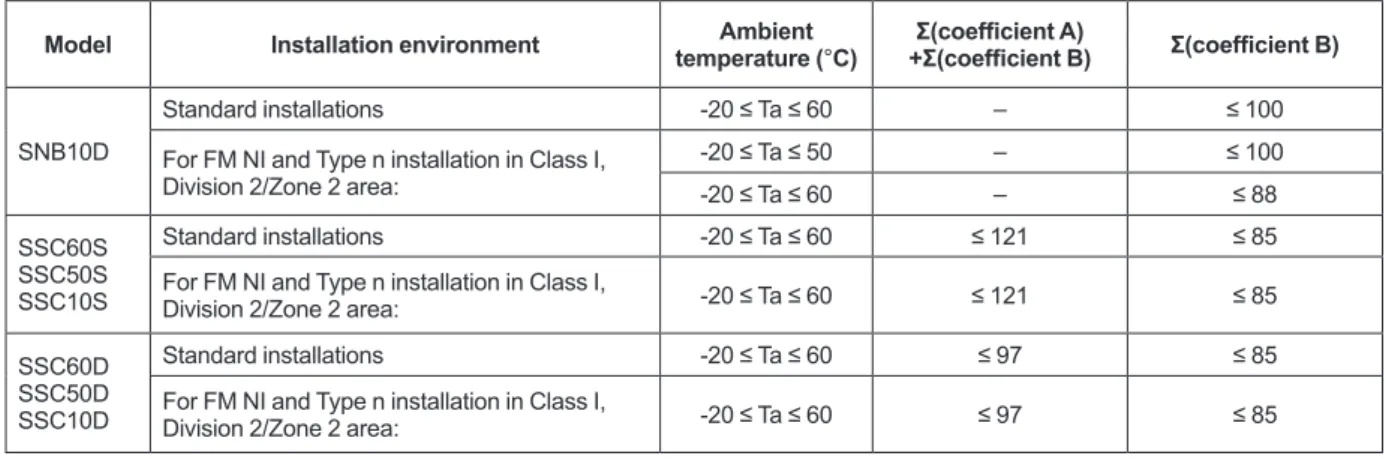
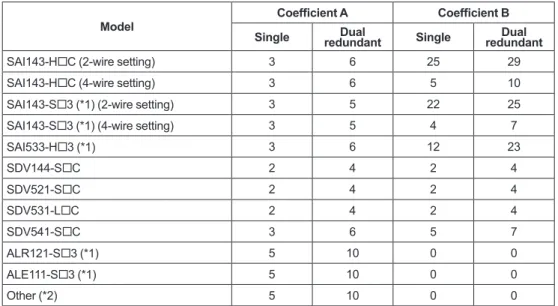
Up to eight modules per unit can be mounted on SNB10D safety node unit and SSC60/SSC50/SSC10 safety control unit; however, the number differs by power supply capacity. Use the Table “Coefficients of Module (temperature type)” to calculate the sum of Coefficient A and B, and figure out the number that both ∑(coefficient A) + ∑(coefficient B) and ∑(coefficient B) are satisfied within the value shown in the Table “ Power Supply Capacity Limitation (temperature type, 60°C or lower)”. The values shown in the Table “Power Supply Capacity Limitation (temperature type, 60°C or lower)” differ by the installation environments such as for standard installation and explosion protection.
Table Coefficients of Module (temperature type)
Model Coefficient A Coefficient B
Single Dual redundant Single Dual redundant
SAI143-H3 (2-wire setting) 3 6 25 29
SAI143-H3 (4-wire setting) 3 6 5 10
SAI143-S3 (2-wire setting) 3 5 22 25
SAI143-S3 (4-wire setting) 3 5 4 7
SAI533-H3 3 6 12 23 SAV144-S3 3 5 2 4 SAT145-S3 5 8 8 16 SAR145-S3 5 9 8 16 SDV144-S3 2 4 2 4 SDV521-S3 2 4 2 4 SDV526-S33 5 10 3 5 SDV531-L3 2 4 2 4 SDV53A-S3 2 4 3 5 SDV541-S3 3 6 5 7 Other (*1) 5 10 0 0
*1: SEC401, SEC402, SNT401, SNT501, SNT411, SNT511, ALR111, ALR121, ALE111
Table Power Supply Capacity Limitation (temperature type, 60°C or lower)
Model Installation environment temperature (°C)Ambient +Σ(coefficient B)Σ(coefficient A) Σ(coefficient B)
SNB10D
Standard installations -20 ≤ Ta ≤ 60 – ≤ 100
For FM NI and Type n installation in Class I, Division 2/Zone 2 area:
-20 ≤ Ta ≤ 50 – ≤ 100 -20 ≤ Ta ≤ 60 – ≤ 88 SSC60S SSC50S SSC10S Standard installations -20 ≤ Ta ≤ 60 ≤ 121 ≤ 85
For FM NI and Type n installation in Class I,
Division 2/Zone 2 area: -20 ≤ Ta ≤ 60 ≤ 121 ≤ 85
SSC60D SSC50D SSC10D
Standard installations -20 ≤ Ta ≤ 60 ≤ 97 ≤ 85
For FM NI and Type n installation in Class I,
Division 2/Zone 2 area: -20 ≤ Ta ≤ 60 ≤ 97 ≤ 85
Example)
When the following I/O modules are mounted on SNB10D. (Standard installation, ambient temperature 40°C)
F03E.ai SAI143-S(S) SAI143-S(S) SAI143-S(D) SAI143-S(D) SDV531(D) SDV531(D) SDV144(S) SDV144(S) SSB401 SSB401 SPW48
SPW48 Dual-Redundant Dual-Redundant < Calculation method > Σ (coefficient B) = 22+22+25+4+2+2
= 77 (mountable because ≤ 100 is satisfied) Example)
When the following I/O modules are mounted on SSC10D. (Standard installation, ambient temperature 40°C)
F04E.ai SAI143-S(D) SAI143-S(D) SAI143-S(D) SAI143-S(D) SDV531(D) SDV531(D) SDV144(S) SDV144(S) SCP401 SCP401 SPW48
SPW48 Dual-Redundant Dual-Redundant Dual-Redundant < Calculation method > Σ (coefficient A) + Σ (coefficient B) = (5+5+4+2+2) + (25+25+4+2+2) = 18+58
= 76 (mountable because the sum of the coefficient A and the coefficient B ≤ 97 and the coefficient B ≤ 85 are satisfied)
Channel availability maximum load current, and external power supply voltage No specific conditions. Also refer to the I/O module specifications.
Mounting rules No specific conditions.
All Rights Reserved. Copyright © 2011, Yokogawa Electric Corporation GS 32Q06K20-31E
NODE UNIT MOUNTING RESTRICTIONS
(FOR AMBIENT TEMPERATURE MORE THAN 60 °C)
When SNB10D safety node unit and SSC60-F /SSC50-F/SSC10-F safety control unit for wide range
temperature type are used in the ambient temperature of more than 60 °C, available channel of I/O module, maximum load current, external power supply voltage, and mounting location are also restricted as shown below, in addition to the power supply capacity.
There are two types I/O module available - “ISA Standard G3 and temperature” type and “ISA Standard G3 and high-density installation” type. For example, the maximum of eight modules can be mounted on a safety node unit for ISA Standard G3 and high-density installation type and four for ISA Standard G3 and temperature type per unit. ISA Standard G3 and high-density installation type improves the installation efficiency.
l
For ISA Standard G3 and High-density Installation Type
By selecting the ISA Standard G3 and high-density installation type listed on the Table “Coefficients of Module (high-density installation type)”, I/O module can be installed side by side without leaving an empty slot. SAI143-S3, SAI533-H3, ALR121-S3 and ALE111-S3 allow usages of ISA Standard G3 and temperature type in the same situation as ISA Standard G3 and high-density installation type. Do not mixedly install I/O modules other than listed on the Table “Coefficients of Module (high-density installation type)” on the same node unit. If different types of modules are mounted together, apply the installation conditions of the ISA Standard G3 and temperature type. Power supply capacity limitation
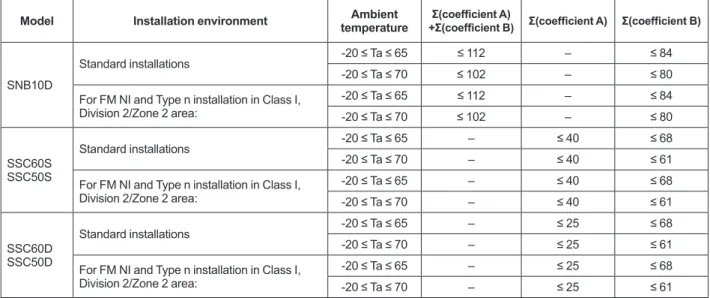
When ISA Standard G3 and high-density installation type is used at the ambient temperature of more than 60 °C, make sure that Σ (coefficient A) + Σ (coefficient B), Σ (coefficient A) and Σ (coefficient B) must fall within the value shown on the Table “Power Supply Capacity Limitation (high-density installation type)”.
Table Coefficients of Module (high-density installation type)
Model Coefficient A Coefficient B
Single redundantDual Single redundantDual
SAI143-HC (2-wire setting) 3 6 25 29
SAI143-HC (4-wire setting) 3 6 5 10
SAI143-S3 (*1) (2-wire setting) 3 5 22 25
SAI143-S3 (*1) (4-wire setting) 3 5 4 7
SAI533-H3 (*1) 3 6 12 23 SDV144-SC 2 4 2 4 SDV521-SC 2 4 2 4 SDV531-LC 2 4 2 4 SDV541-SC 3 6 5 7 ALR121-S3 (*1) 5 10 0 0 ALE111-S3 (*1) 5 10 0 0 Other (*2) 5 10 0 0
*1: The usage of ISA Standard G3 and temperature type is allowed in the same situation as ISA Standard G3 and high-density installation type.
*2: SEC401, SEC402
Table Power Supply Capacity Limitation (high-density installation type)
Model Installation environment temperatureAmbient +Σ(coefficient B) Σ(coefficient A) Σ(coefficient B)Σ(coefficient A)
SNB10D
Standard installations -20 ≤ Ta ≤ 65 ≤ 112 – ≤ 84
-20 ≤ Ta ≤ 70 ≤ 102 – ≤ 80
For FM NI and Type n installation in Class I, Division 2/Zone 2 area:
-20 ≤ Ta ≤ 65 ≤ 112 – ≤ 84 -20 ≤ Ta ≤ 70 ≤ 102 – ≤ 80 SSC60S SSC50S Standard installations -20 ≤ Ta ≤ 65 – ≤ 40 ≤ 68 -20 ≤ Ta ≤ 70 – ≤ 40 ≤ 61
For FM NI and Type n installation in Class I, Division 2/Zone 2 area:
-20 ≤ Ta ≤ 65 – ≤ 40 ≤ 68 -20 ≤ Ta ≤ 70 – ≤ 40 ≤ 61 SSC60D SSC50D Standard installations -20 ≤ Ta ≤ 65 – ≤ 25 ≤ 68 -20 ≤ Ta ≤ 70 – ≤ 25 ≤ 61
For FM NI and Type n installation in Class I, Division 2/Zone 2 area:
-20 ≤ Ta ≤ 65 – ≤ 25 ≤ 68
-20 ≤ Ta ≤ 70 – ≤ 25 ≤ 61
Channel availability, maximum load current, and external power supply voltage
When ISA Standard G3 and high-density installation type is used at the ambient temperature of more than 60°C, the channel availability, maximum load current, and external power supply voltage are restricted as in the tables below.
•SAI143-HC
Model temperatureAmbient Channel Numbers
1 2 3 4 5 6 7 8 9 10 11 12 13 14 15 16
SAI143-HC
2-wired setting -20 °C ≤ Ta ≤ 65 °C-20 °C ≤ Ta ≤ 70 °C XX XX XX XX XX XX XX XX X– X– X– X– X– X– –– –– SAI143-HC
4-wired setting -20 °C ≤ Ta ≤ 65 °C-20 °C ≤ Ta ≤ 70 °C XX XX XX XX XX XX XX XX XX XX XX XX X– X– X– X– X: Connectable –: Not connectable
•SAI143-S3
Model temperatureAmbient Channel Numbers
1 2 3 4 5 6 7 8 9 10 11 12 13 14 15 16
SAI143-S3
2-wired setting -20 °C ≤ Ta ≤ 65 °C-20 °C ≤ Ta ≤ 70 °C XX XX XX XX XX XX XX XX XX XX X– X– X– X– –– –– SAI143-S3
4-wired setting -20 °C ≤ Ta ≤ 70 °C X X X X X X X X X X X X X X X X
X: Connectable –: Not connectable
Note: The usage of ISA Standard G3 and temperature type is allowed in the same situation as ISA Standard G3 and high-density installation type. When the ambient temperature is 60 °C or lower, all channels are connectable.
•SAI533-H3
Model temperatureAmbient Channel Numbers
1 2 3 4 5 6 7 8
SAI533-H3 -20 °C ≤ Ta ≤ 65 °C X X X X X X – –
-20 °C ≤ Ta ≤ 70 °C X X X X – – – –
X: Connectable –: Not connectable
Note: The usage of ISA Standard G3 and temperature type is allowed in the same situation as ISA Standard G3 and high-density installation type. When the ambient temperature is 60 °C or lower, all channels are connectable.
All Rights Reserved. Copyright © 2011, Yokogawa Electric Corporation GS 32Q06K20-31E •SDV144-SC
Model temperatureAmbient
Channel Numbers 24 V DC External power supply 1 2 3 4 5 6 7 8 9 10 11 12 13 14 15 16 SDV144-SC -20 °C ≤ Ta ≤ 65 °C X X X X X X X X X X X X X X X X +10%,- 10% -20 °C ≤ Ta ≤ 70 °C X X X X X X X X X X X X – – – –
X: Connectable –: Not connectable •SDV521-SC Model (Maximum load current) Ambient temperature Channel Numbers 24 V DC External power supply 1 2 3 4 SDV521-SC (2 A/CH) -20 °C ≤ Ta ≤ 65 °C X X X – +20%, - 10% -20 °C ≤ Ta ≤ 70 °C – – – – SDV521-SC (1.5 A/CH) -20 °C ≤ Ta ≤ 65 °C-20 °C ≤ Ta ≤ 70 °C XX XX X– X– SDV521-SC (1 A/CH) -20 °C ≤ Ta ≤ 70 °C X X X X X: Connectable –: Not connectable
•SDV531-LC Model (Maximum load current) Ambient temperature
Channel Numbers 24 V DC External
power supply 1 2 3 4 5 6 7 8 SDV531-LC (0.6 A/CH) -20 °C ≤ Ta ≤ 65 °C X X X X X X – – +20%, - 10% -20 °C ≤ Ta ≤ 70 °C X X X X – – – – SDV531-LC (0.45 A/CH) -20 °C ≤ Ta ≤ 65 °C-20 °C ≤ Ta ≤ 70 °C XX XX XX XX X– –X X– X– SDV531-LC (0.4 A/CH) -20 °C ≤ Ta ≤ 70 °C X X X X X X X X
X: Connectable –: Not connectable •SDV541-SC Model (Maximum load current) Ambient temperature Channel Numbers 24 V DC External power supply 1 2 3 4 5 6 7 8 9 10 11 12 13 14 15 16 SDV541-SC (0.2 A/CH) -20 °C ≤ Ta ≤ 65 °C X X X X X X X X X X X X – – – – +20%, - 10% -20 °C ≤ Ta ≤ 70 °C X X X X X X X X X X – – – – – – SDV541-SC (0.15 A/CH) -20 °C ≤ Ta ≤ 70 °C X X X X X X X X X X X X X X X X
X: Connectable –: Not connectable
Mounting rules
Modules can be mounted on Slots No. 1 to 8 of SNB10D Safety Node Unit.
F18E.ai
IOM IOM IOM IOM IOM IOM IOM IOM SSB401 SSB401 SPW48
SPW48
Applicable modules
1 2 3 4 5 6 7 8
Figure Mounting examples on a safety node unit
Modules can be mounted on the slots No. 1 to 7 of SSC60-F and SSC50-F Safety Control Unit where ESB bus coupler module is not mounted.
F19E.ai IOM IOM IOM IOM IOM IOM IOM SCP4
1 SCP4 1 SPW48 SPW48 Applicable modules 1 2 3 4 5 6 7 8 Empty
Figure Mounting examples of a safety control unit (without ESB bus coupler)
Modules can be mounted on the slots No. 1 to 6 of SSC60-F and SSC50-F Safety Control Unit with ESB bus coupler.
F20E.ai
IOM IOM IOM IOM IOM IOM SEC40
SCP4 1 SEC40 SCP4 1 SPW48 SPW48 Applicable modules 1 2 3 4 5 6 7 8
All Rights Reserved. Copyright © 2011, Yokogawa Electric Corporation GS 32Q06K20-31E
When mounting I/O modules (ISA Standard G3 and high-density installation type) to a Safety Node Unit or a Safety Control unit at the ambient temperature more than 60 °C, mount them in order of DIO (Digital Input/Output module) → AI (Analog Input module) → AO (Analog Output module) from left to right. (Example 1)
In Addition, the following conditions must be met:
• AI cannot be mounted on the immediate right slot of AO. (Example 2)
(When an empty slot or communication module such as ALR is inserted between AO and AI, the order of the modules is acceptable.) (Example 3)
• DIO cannot be mounted on the immediate right slot of AI or AO. (Example 4)
(When an empty slot or communication module such as ALR is inserted between AI and DIO, or between AO and DIO, the order of the modules is acceptable.) (Example 5)
See the following examples.
F21E.ai
IOM IOM IOM IOM IOM IOM IOM IOM SSB401 SSB401 SPW48
SPW48 AI ALR AO AO AO AI AI DIO AI AI AI DIO AO DIO or or DIO DIO
Aligning either to left or right is acceptable. Inserting an empty slot in between the modules is recommended to prevent thermal interference among modules. ---Not Valid ---Valid ---Not Valid ---Valid ---Valid Example 1 Example 2 Example 3 Example 4 Example 5 Example 6 DIO AO Empty Empty Empty Empty Figure Examples of SNB10D Oct. 1, 2014-00
l
For ISA Standard G3 and Temperature Type
When using I/O modules other than the ones listed on the Table “Coefficients of Module (high-density installation type)”, select ISA Standard G3 and temperature type which meets the following conditions.
Power supply capacity limitation
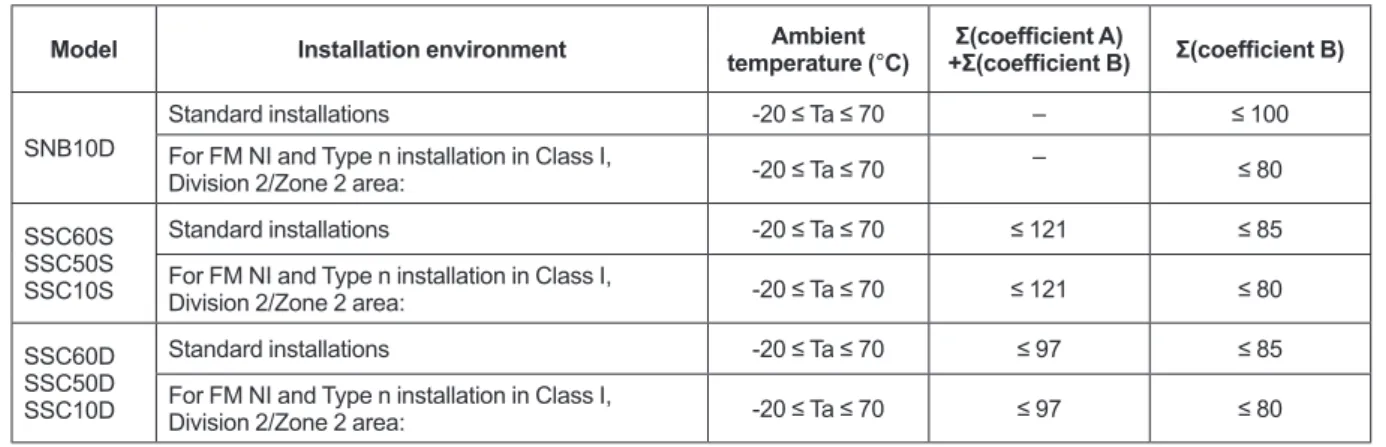
Refer to the Table “Coefficients of Module (temperature type)” to find the sum of Coefficient A and B assigned to the module and then make sure that Σ (coefficient A) + Σ (coefficient B) and Σ (coefficient B) satisfy the value on the Table “Power Supply Capacity Limitation (temperature type, more than 60°C)”.
Table Power Supply Capacity Limitation (temperature type, more than 60°C)
Model Installation environment temperature (°C)Ambient +Σ(coefficient B)Σ(coefficient A) Σ(coefficient B)
SNB10D
Standard installations -20 ≤ Ta ≤ 70 – ≤ 100
For FM NI and Type n installation in Class I,
Division 2/Zone 2 area: -20 ≤ Ta ≤ 70 – ≤ 80
SSC60S SSC50S SSC10S
Standard installations -20 ≤ Ta ≤ 70 ≤ 121 ≤ 85
For FM NI and Type n installation in Class I,
Division 2/Zone 2 area: -20 ≤ Ta ≤ 70 ≤ 121 ≤ 80
SSC60D SSC50D SSC10D
Standard installations -20 ≤ Ta ≤ 70 ≤ 97 ≤ 85
For FM NI and Type n installation in Class I,
Division 2/Zone 2 area: -20 ≤ Ta ≤ 70 ≤ 97 ≤ 80
Channel availability, maximum load current, and external power supply voltage No specific conditions. Also refer to the I/O module specifications.
Mounting rules
When using SNB10D safety node unit or SSC60-F/SSC50-F/SSC10-F wide range temperature type of safety control unit at the ambient temperature more than 60°C, the following rules must be met:
• The maximum of four I/O modules per unit can be mounted. However, it of the safety control unit becomes three per unit when the safety node is extended with SSC60-F, SSC50-F or SSC10-F, because SEC40 are mounted on slots 7 and 8.
• Leave at least one slot empty in between an I/O module and SEC40, SNT1, SSB401, and SCP41. • Leave at least one slot empty between I/O modules.
Leave the slots annexed to the dual-redundant modules empty.
• As for SNT1, leave two slots empty for every dual-redundant module between the modules such as SEC40, SNT1, SSB401, and SPW48.
F05E.ai
IOM IOM IOM IOM SSB401 SSB401 SPW48
SPW48
At least one empty slot is required between SSB401 and I/O module
Dual-redundant
Empty Empty Empty Empty
Figure Example Mounting of I/O Module on Safety Node Unit
NODE UNIT MOUNTING RESTRICTIONS (MISCELLANEOUS)
l
For ALR111, ALR121 and ALE111
The maximum number of ALR111, ALR121 and ALE111 modules mountable:
All Rights Reserved. Copyright © 2011, Yokogawa Electric Corporation GS 32Q06K20-31E
CAUTIONS FOR MOUNTING
l
Terminal board and relay board mounting directions
Mount a terminal board and a relay board in the directions as shown in the below figure. When mounting SBD2D in the direction of b or c, the following conditions must be met.
• When the ambient temperature is 60 °C or lower, the total load current of the SBD2D must be kept within the specified value of 8 A or lower.
• When the ambient temperature is at 70 °C, the total load current must be 6 A or less.
• In case the ambient temperature is in between 60 and 70 °C, reduce the total load current from 8 A maximum by the rate of 0.2 A/°C.
F14E.ai
DIN rail
Direction a Direction b Direction c
l
Mounting an SAT145 module with SBT4D terminal board
Prevent the terminal board from being influenced by the ambient temperature in order to keep the reference junction compensation accuracy, as detailed conditions are shown below.
The reference junction compensation accuracy is specified when the ambient temperature is stable. When the temperature fluctuates, the accuracy may vary until it becomes stable.
Mounting a terminal board by itself
Install all the heat sources above the terminal board or terminal board wiring. Provide a heat shield in case installation of the heat sources below or sideway of the terminal board is unavoidable.
Installing terminal board in a cabinet
Install all the heat sources above the terminal board or terminal board wiring when those are mounted in a cabinet.
Provide a heat shield in case installation of the heat sources below or sideway of the terminal board is unavoidable.
l
Cautions of the power source for the loads of SBM54D
In the case of using multiple power sources for the loads of SBM54D, there are cautions of the load voltage. When the load voltage is different between loads.
All of the load voltages must be in either the range below. • Load voltages =< 100 V
• 50 V < Load voltages =< 150 V
l
Cautions of the Digital I/O module when SBM54D is used.
The functions of Disconnection diagnosis, ON Pulse diagnosis and OFF Pulse diagnosis for SDV541 must be disabled when SBM54D is used.
l
Mounting I/O Modules for Dual Redundancy
For dual redundancy, I/O modules should be mounted on Slot No. IO1-IO2, IO3-IO4, IO5-IO6, or IO7-IO8, as shown in the figure below.
IO1
IOM IOM IOM IOM IOM IOM IOM IOM SCP451 or SCP401 SCP451 or SCP401 SPW481 or SPW482 or SPW484 SPW481 or SPW482 or SPW484 IO2 IO3 IO4 IO5 IO6 IO7 IO8 C1 C2 P1 P2
F07E.ai
Slot number
For the Safety Control Unit
IO1
IOM IOM IOM IOM IOM IOM IOM IOMSSB401SSB401SPW481 or SPW482 or SPW484 SPW481 or SPW482 or SPW484 IO2 IO3 IO4 IO5 IO6 IO7 IO8 B1 B2 P1 P2
F06E.ai
Slot number
For the Safety Node Unit
l
Empty Slot Protection
All Rights Reserved. Copyright © 2011, Yokogawa Electric Corporation GS 32Q06K20-31E
LIMITATIONS ON DIGITAL INPUT MODULE CONNECTIONS
Digital input incorporates input wiring diagnostic functions. Where a pulse test is enabled, it is necessary to take into account the following conditions for the length of the field wiring cable.
l
If Pulse Test is Used
The total value of the capacitance of the field devices connected to the digital input modules and their wiring cable capacitance should be:
Total capacitance < 0.1 µF (100000 pF)
Note: Wiring capacitance from pressure clamp terminal block or terminal board to the field device depends on the cable type such as Discrete wire or Multi-core cable. Make sure the specification of cable.
Note: Calculate the total capacitance of an AKB331 cable with a capacitance of 60 pF/m.
Note: It is not necessary to take into account the capacitance of pressure clamp terminal block, terminal boards, or signal cable adapters.
[References]
For terminal board connections, if the AKB331 cable is 15 m long, the distance between the terminal board and field device is 500 m, the capacitance of the cables is 100 pF/m, and the capacitance of the field devices is 0 pF then
the total wiring capacitance = 15 (m) × 60 (pF/m) + 500 (m) × 100 (pF/m) + 0 (pF) = 50900 (pF) < 100000 (pF)
From this calculation, pulse test can work properly.
l
If SCB110 Wiring Check Adapters are Used
To get digital input modules to recognize an ON input signal correctly, the total resistance of field devices and their wiring cables is no greater than 132 Ω.
If no SCB110 wiring check adapters are used, the cables connecting the digital input module and the field devices should be limited in length so that the total resistance of all the connected field devices and cables is no greater than 1 kΩ.
Note: It is not necessary to take into account the resistance of pressure clamp terminals, terminal boards, signal cable adapters, and wiring check adapters (SCB100/SCB110).
The following table shows AKB331 cable lengths and allowable resistance on the field side if AKB331 cables are used.
AKB331 cable length, m Resistance allowed on the field side, Ω
0 132 10 120 20 109 30 98 40 87 50 75 [References]
For example, if the AKB331 cable length is 10 meters and the resistance of field device ON is 20 Ω, the allowable wiring resistance is then:
120 Ω – 20 Ω = 100 Ω
The cable length, both from and to field devices if the cables have a wiring resistance of 58 Ω/km (AWG22 equivalent), is:
100 Ω / 0.058 Ω/m ≈ 1724 (m)
Hence, the distance to the field devices is: 1724 (m) / 2 = 862 (m)
Note: For cable resistances, refer to the cable manufacturer’s specifications.
LIMITATIONS ON DIGITAL OUTPUT MODULE CONNECTIONS
Digital output modules incorporate output wiring diagnostic functions. Where a pulse test is enabled, it is necessary to take into account the following conditions for the length of the field wiring cable.
The total value of the capacitance of the field devices connected to the digital input and output modules and their wiring cable capacitance should be:
Total capacitance < 0.1 µF (100000 pF)
Note: Wiring capacitance from pressure clamp terminal block or terminal board to the field device depends on the cable type such as Discrete wire or Multi-core cable. Make sure the specification of cable.
Note: Calculate the total capacitance of an AKB331 cable with a capacitance of 60 pF/m. Note: Calculate the total capacitance of an AKB651 cable with a capacitance of 200 pF/m.
Note: It is not necessary to take into account the capacitance of pressure clamp terminal block, terminal boards, or signal cable adapters.
[References]
For terminal board connections, if the AKB331 cable is 15 m long, the distance between the terminal board and field device is 500 m, the capacitance of the cables is 100 pF/m, and the capacitance of the field devices is 0 pF then
the total wiring capacitance = 15 (m) × 60 (pF/m) + 500 (m) × 100 (pF/m) + 0 (pF) = 50900 (pF) < 100000 (pF)
From this calculation, pulse test can work properly.
When digital output modules are connected with terminal boards, MIL connecters or pressure clamp terminals, due to the voltage drop on the field wirings, the length of field wirings have restrictions as follows.
All Rights Reserved. Copyright © 2011, Yokogawa Electric Corporation GS 32Q06K20-31E
l
SDV531
Terminal Board is Connected
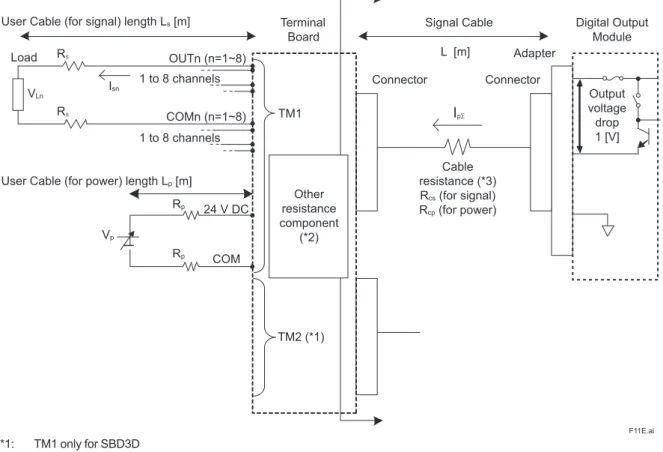
The SDV531 digital output module can respectively handle a maximum of 0.6 A load currents per channel. However, this can cause the generation of a voltage drop due to connected cable and adapter resistance components, etc. Therefore, it is necessary to take account of the limitations on the magnitude of load current and connected cable length as given below.
In case of short circuits detection is enabled, the possible cable length may be limited.
Output voltage drop 1 [V] F11E.ai Digital Output Module Terminal
Board Signal Cable
Adapter Connector TM1 TM2 (*1) 24 V DC COM User Cable (for power) length Lp [m]
Rp Rp Vp Load OUTn (n=1~8) COMn (n=1~8) VLn RS RS
User Cable (for signal) length Ls [m]
1 to 8 channels Isn Other resistance component (*2) Cable resistance (*3) Rcs (for signal) Rcp (for power) Ip∑ Connector L [m] 1 to 8 channels *1: TM1 only for SBD3D
*2: Other resistance component is given below:
Table Other resistance component vs. Terminal board Terminal board
model No. Connectionmodule model No.
Other resistance component [mΩ] (By 1 channel)
Signal Power
SED4D SDV531 202.8 56.36
SBD3D SDV531 222.1 34.72
*3: Cable resistance is given below:
Table Signal cable vs. Cable resistance Signal cable
model No. R Cable resistance [mΩ/m]
cs (for signal) Rcp (for power)
AKB331 446.0 63.71
AKB651 118.6 16.94
If the digital output module connection is configured with a terminal board, signal cable, and adapter for signal cable, observe the following preconditions:
the external power supply voltage is expressed as Vp [V],
user cable (power) length as Lp [m],
user cable (power) resistance value as Rp [Ω/m],
user cable (signal) length as Ls [m],
user cable (signal) resistance value as Rs [Ω/m],
signal cable length as L [m],
signal cable (signal) resistance value as Rcs [Ω/m],
signal cable (power) resistance value as Rcp [Ω/m],
total value of current flowing through channel 1 to channel 8 as Ip∑ [A],
current flowing through n-channel as Isn [A] and
voltage supplied to loads connected to n-channel as VLn [V].
For SED4D
The voltage drop from the external power supply (Vp) to the output channel load is a total voltage drop of ∆V1 in the
power line, ∆V2 in the signal line and ∆V3 in the circuit inside Digital Output Module. Therefore, the voltage supplied to the load connected to a channel is expressed by:
VLn = Vp – (∆V1 + ∆V2 + ∆V3)
= Vp – (Rp x Lp x 2 + Rcp x L + 0.05636) x Ip∑ – (Rs x Ls x 2 + Rcs x L + 0.2028) x Isn – 1
[References]
The following shows a possible user signal cable length Ls [m] when changing the length, L [m],of a AKB331 signal
cable and the current, Isn [A], flowing through n-channel as in the table below.
Other parameters are given below:
Lp [m] 0.5 User cable (power) length
Rp [Ω/m] 0.0096 User cable (power) resistance value (when using AWG14)
Rs [Ω/m] 0.0096 User cable (signal) resistance value (when using AWG14)
VLn [V] 21.6 Voltage supplied to loads connected to n-channel
Ip [A] (Isn×8) Total value of current flowing through channel 1 to channel 8
The capacitance of an AKB331 cable 60 [pF/m]
Wiring capacitance of User cable is calculated with the parameters given below: User cable (signal) wiring capacitance 50 [pF/m]
Field devices capacitance 0 [pF]
• In case the external power supply voltage (Vp [V]) is 28.8 V.
Table Possible Cable Length, Ls [m], (when Using AWG14) from the Terminal Board to Loads
Current value
(Isn) per
channel, [A]
AKB331 cable length
15 m 10 m 7 m 5 m 3 m 2 m 1 m 0.6 m 0.1 415.0 555.0 639.0 695.0 751.0 779.0 807.0 818.2 0.2 391.8 539.0 627.4 686.3 745.2 774.6 804.1 815.8 0.3 291.7 523.0 615.7 677.5 739.3 770.2 801.1 813.5 0.4 22.6 271.5 420.8 520.4 619.9 669.7 719.5 739.4 0.5 applicableNot 110.0 259.4 358.9 458.5 508.2 558.0 577.9 0.6 applicableNot 2.4 151.7 251.3 350.8 400.6 450.4 470.3
Note: In addition to the influence of voltage drop and wiring capacitance, possible cable length may be shorter when the short circuit detection during output OFF is needed. The above table shows the case that short circuit detection is taken into account. Columns grey in the above table are the area influenced by the short circuit detection.
All Rights Reserved. Copyright © 2011, Yokogawa Electric Corporation GS 32Q06K20-31E
For SBD3D
SBD3D has parallel diode inside in order to use dual-redundant configuration power supply.
The voltage drop of this diode shows 0.55 V. An external power supply shall be specified as additional 0.55 V within the applicable voltage range 28.8 V maximum of the SBD3D.
The voltage drop from the external power supply (Vp) to the output channel load is a total voltage drop of ∆V1 in the
power line, ∆V2 in the signal line and ∆V3 in the circuit inside Digital Output Module. Therefore, the voltage supplied to the load connected to a channel is expressed by:
VLn = Vp – (∆V1 + ∆V2 + ∆V3)
= Vp – (Rp x Lp x 2 + Rcp x L + 0.03472) x Ip∑ – 0.55 – (Rs x Ls x 2 + Rcs x L + 0.22212) x Isn – 1
[References]
The following shows a possible user signal cable length Ls [m] when changing the length, L [m],of a signal cable and
the current, Isn [A], flowing through n-channel as in the table below.
Other parameters are given below:
Lp [m] 0.5 User cable (power) length
Rp [Ω/m] 0.00798 User cable (power) resistance value (when using 2.5 mm2)
Rs [Ω/m] 0.00798 User cable (signal) resistance value (when using 2.5 mm2)
VLn [V] 21.6 Voltage supplied to loads connected to n-channel
Ip [A] (Isn×8) Total value of current flowing through channel 1 to channel 8
The capacitance of an AKB331 cable 60 [pF/m] The capacitance of an AKB651 cable 200 [pF/m]
Wiring capacitance of User cable is calculated with the parameters given below: User cable (signal) wiring capacitance 50 [pF/m]
Field devices capacitance 0 [pF]
• In case AKB331 cable is used at the external power supply voltage (Vp [V]) of 28.8 V.
Table Possible cable Length, Ls [m], (when Using 2.5 mm2) from the Terminal Board to Loads
Current value
(Isn) per
channel, [A]
AKB331 cable length
15 m 10 m 7 m 5 m 3 m 2 m 1 m 0.6 m 0.1 478.6 647.0 748.1 815.5 882.8 916.5 950.2 963.7 0.2 451.3 628.4 734.7 805.6 876.4 911.9 947.3 961.5 0.3 246.5 545.9 721.3 795.7 870.0 907.2 944.4 959.2 0.4 applicableNot 250.9 430.5 550.3 670.1 729.9 789.8 813.8 0.5 applicableNot 73.9 253.5 373.3 493.1 552.9 612.8 636.8
0.6 applicableNot applicableNot 135.5 255.3 375.1 434.9 494.8 518.8
Note: In addition to the influence of voltage drop and wiring capacitance, possible cable length may be shorter when the short circuit detection during output OFF is needed. The above table shows the case that short circuit detection is taken into account. Columns grey in the above table are the area influenced by the short circuit detection.
• In case AKB651 cable is used at the external power supply voltage (Vp [V]) of 28.8 V.
Table Possible cable Length, Ls [m], (when Using 2.5 mm2) from the Terminal Board to Loads
Current value
(Isn) per
channel, [A]
AKB651 cable length
30 m 25 m 20 m 15 m 10 m 7 m 5 m 3 m 2 m 0.1 715.2 760.0 804.7 849.5 894.3 921.2 939.1 957.0 966.0 0.2 700.1 747.2 794.3 841.4 888.5 916.8 935.6 954.4 963.9 0.3 667.0 734.4 783.8 833.3 882.7 912.3 932.1 951.9 961.8 0.4 372.0 451.6 531.3 610.9 690.5 738.2 770.1 801.9 817.9 0.5 195.0 274.6 354.3 433.9 513.5 561.2 593.1 624.9 640.9 0.6 77.0 156.6 236.2 315.9 395.5 443.2 475.1 506.9 522.9
Note: In addition to the influence of voltage drop and wiring capacitance, possible cable length may be shorter when the short circuit detection during output OFF is needed. The above table shows the case that short circuit detection is taken into account. Columns grey in the above table are the area influenced by the short circuit detection.
MIL Connector is Connected
F08E.ai
24 V DC COM User Cable (for power) length
Load OUTn (n=1~8)
COMn (n=1~8) VLn
User Cable (for signal) length
Rs Rs Isn Ls [m] Lp [m] Rp Rp Vp Digital Output Module MIL Connector Other resistance component Signal 20.0 [mΩ] Power 2.86 [mΩ] 1 to 8 channels 1 to 8 channels Output voltage drop 1 [V]
Where a MIL connector is used, assuming that:
the external power supply voltage is expressed as Vp [V],
user cable (power) length as Lp [m],
user cable (power) resistance value as Rp [Ω/m],
user cable (signal) length as Ls [m],
user cable (signal) resistance value Rs [Ω/m],
total value of current flowing through channel 1 to channel 8 as Ip∑,
current flowing through n-channel as Isn [A], and
voltage supplied to loads connected to n-channel as VLn [V].
The voltage drop from the external power supply (Vp) to the output channel load is a total voltage drop of ∆V1 in the
power line, ∆V2 in the signal line and ∆V3 in the circuit inside Digital Output Module. Therefore, the voltage supplied to the load connected to a channel is expressed by:
VLn = Vp – (∆V1 + ∆V2 + ∆V3)
All Rights Reserved. Copyright © 2011, Yokogawa Electric Corporation GS 32Q06K20-31E [References]
The following shows a possible user signal cable length Ls [m] when changing the length, Lp [m], of the power supply
cable and the value of the current, Isn [A], flowing through n-channel as in the table below.
Other parameters are given below:
Rp [Ω/m] 0.058 User cable (power) resistance value (when using AWG22)
Rs [Ω/m] 0.058 User cable (signal) resistance value (when using AWG22)
VLn [V] 21.6 Voltage supplied to loads connected to n-channel
Ip∑ [A] (Isn × 8) Total value of current flowing through channel 1 to channel 8
Wiring capacitance of User cable is calculated with the parameters given below: User cable (signal) wiring capacitance 50 [pF/m]
Field devices capacitance 0 [pF]
• In case the external power supply voltage (Vp [V]) is 28.8 V.
Table Possible Cable Length, Ls [m], (when Using AWG22) from MIL Connector to Loads
Current value
(Isn) per
channel, [A]
Power Supply cable length Lp
15 m 10 m 7 m 5 m 3 m 2 m 1 m 0.6 m 0.1 137.5 138.5 139.1 139.5 140.0 140.2 140.4 140.4 0.2 136.5 137.9 138.7 139.2 139.8 140.0 140.3 140.4 0.3 135.6 137.2 138.2 138.9 139.6 139.9 140.2 140.3 0.4 116.1 121.8 125.3 127.5 129.8 131.0 132.1 132.6 0.5 89.4 95.1 98.5 100.8 103.1 104.2 105.4 105.8 0.6 71.6 77.3 80.7 83.0 85.3 86.4 87.6 88.0
Note: In addition to the influence of voltage drop and wiring capacitance, possible cable length may be shorter when the short circuit detection during output OFF is needed. The above table shows the case that short circuit detection is taken into account. Columns grey in the above table are the area influenced by the short circuit detection.
Pressure Clamp Terminal Block is Connected F09E.ai Other resistance component Signal 145.6[mΩ] Power 24.06[mΩ] Other resistance component Signal 323.4[mΩ] Power 220.26[mΩ] 24 V DC COM User Cable (for power) length
Rp
Rp
Load VLn
User Cable (for signal) length
Rs Rs Isn Vp Ls [m] Lp [m]
Single module Dual-redundant module Digital Output
Module Digital Output Module Pressure Clamp Terminal block Pressure Clamp Terminal block 24 V DC COM OUTn COMn 1 to 8 channels 1 to 8 channels OUTn (n=1~8) COMn (n=1~8) 1 to 8 channels 1 to 8 channels Output voltage drop 1 [V] Output voltage drop 1 [V]
If the digital output module connection is configured with a pressure clamp terminal block, observe the following preconditions:
the external power supply voltage is expressed as Vp [V],
user cable (power) length as Lp [m],
user cable (power) resistance value as Rp [Ω/m],
user cable (signal) length as Ls [m],
user cable (signal) resistance value Rs [Ω/m],
total value of current flowing through channel 1 to channel 8 as Ip∑
current flowing through n-channel as Isn [A], and
voltage supplied to loads connected to n-channel as VLn [V].
The voltage drop from the external power supply (Vp) to the output channel load is a total voltage drop of ∆V1 in the
power line, ∆V2 in the signal line and ∆V3 in the circuit inside Digital Output Module. Therefore, the voltage supplied to the load connected to a channel is expressed by:
• Single Module VLn = Vp – (∆V1 + ∆V2 + ∆V3) = Vp – (Rp × Lp × 2 + 0.02406) × Ip∑ – (Rs × Ls × 2 + 0.1456) × Isn – 1 • Dual-redundant Module VLn = Vp – (∆V1 + ∆V2 + ∆V3) = Vp – (Rp × Lp × 2 + 0.22026) × Ip∑ – (Rs × Ls × 2 + 0.3234) × Isn – 1
All Rights Reserved. Copyright © 2011, Yokogawa Electric Corporation GS 32Q06K20-31E [References]
The following shows a possible user signal cable length Ls [m] when changing the length, Lp [m], of a power supply
cable and the current, Isn [A], flowing through n-channel as in the table below.
Other parameters are given below:
Rp [Ω/m] 0.0096 User cable (power) resistance value (when using AWG14)
Rs [Ω/m] 0.0096 User cable (signal) resistance value (when using AWG14)
VLn [V] 21.6 Voltage supplied to loads connected to n-channel
Ip∑ [A] (Isn × 8) Total value of current flowing through channel 1 to channel 8
Wiring capacitance of User cable is calculated with the parameters given below: User cable (signal) wiring capacitance 50 [pF/m]
Field devices capacitance 0 [pF]
• In case the single module is used at the external power supply voltage (Vp [V]) of 28.8 V.
Table Possible Cable Length, Ls [m], (when Using AWG14) from Pressure Clamp Terminal Block to Loads
Current value
(Isn) per
channel, [A]
Power Supply cable length Lp
15 m 10 m 7 m 5 m 3 m 2 m 1 m 0.6 m 0.1 819.6 826.8 831.1 833.9 836.8 838.3 839.7 840.3 0.2 812.5 821.8 827.5 831.2 835.0 836.8 838.7 839.5 0.3 805.4 816.9 823.9 828.5 833.1 835.4 837.7 838.7 0.4 669.7 709.7 733.7 749.7 765.7 773.7 781.7 784.9 0.5 508.2 548.2 572.2 588.2 604.2 612.2 620.2 623.4 0.6 400.6 440.6 464.6 480.6 496.6 504.6 512.6 515.8
Note: In addition to the influence of voltage drop and wiring capacitance, possible cable length may be shorter when the short circuit detection during output OFF is needed. The above table shows the case that short circuit detection is taken into account. Columns grey in the above table are the area influenced by the short circuit detection.
• In case the dual-redundant module is used at the external power supply voltage (Vp [V]) of 28.8 V.
Table Possible Cable Length, Ls [m], (when Using AWG14) from Pressure Clamp Terminal Block to Loads
Current value
(Isn) per
channel, [A]
Power Supply cable length Lp
15 m 10 m 7 m 5 m 3 m 2 m 1 m 0.6 m 0.1 795.6 802.8 807.1 810.0 812.9 814.3 815.7 816.3 0.2 784.0 793.4 799.0 802.8 806.5 808.4 810.3 811.0 0.3 772.5 784.0 791.0 795.6 800.2 802.5 804.8 805.8 0.4 578.7 618.7 642.7 658.7 674.7 682.7 690.7 693.9 0.5 417.2 457.2 481.2 497.2 513.2 521.2 529.2 552.4 0.6 309.6 349.6 373.6 389.6 405.6 413.6 421.6 424.8
Note: In addition to the influence of voltage drop and wiring capacitance, possible cable length may be shorter when the short circuit detection during output OFF is needed. The above table shows the case that short circuit detection is taken into account. Columns grey in the above table are the area influenced by the short circuit detection.
l
SDV541
Terminal Board is Connected
The SDV541 digital output module can respectively handle a maximum of 0.2 A load currents per channel. However, this can cause the generation of a voltage drop due to connected cable and adapter resistance components, etc. Therefore, it is necessary to take account of the limitations on the magnitude of load current and connected cable length as given below.
In case of short circuits detection is enabled, the possible cable length may be limited.
F15E.ai
Digital Output Module Terminal
Board Signal Cable
Adapter Connector TM1 TM2 (*1) 24 V DC COM User Cable (for power) length Lp [m]
Rp Rp Vp Load OUTn (n=1~16) COMn (n=1~16) VLn RS RS
User Cable (for signal) length Ls [m]
1 to 16 channels Isn Other resistance component (*2) Ip∑ Connector L [m] 1 to 16 channels Cable resistance (*3) Rcs (for signal) Rcp (for power) Output voltage drop 1 [V] *1: TM1 only for SBD4D
*2: Other resistance component is given below:
Table Other resistance component vs. Terminal board Terminal board
model No. Connectionmodule model No. Other resistance component [mΩ] (By 1 channel)Signal Power
SED4D SDV541 202.8 56.36
SBD4D SDV541 222.1 34.72
*3: Cable resistance is given below:
Table Signal cable vs. Cable resistance Signal cable
model No. R Cable resistance [mΩ/m]
cs (for signal) Rcp (for power)
AKB331 446.0 63.71
All Rights Reserved. Copyright © 2011, Yokogawa Electric Corporation GS 32Q06K20-31E
If the digital output module connection is configured with a terminal board, signal cable, and adapter for signal cable, observe the following preconditions:
the external power supply voltage is expressed as Vp [V],
user cable (power) length as Lp [m],
user cable (power) resistance value as Rp [Ω/m],
user cable (signal) length as Ls [m],
user cable (signal) resistance value as Rs [Ω/m],
signal cable length as L [m],
signal cable (signal) resistance value as Rcs [Ω/m],
signal cable (power) resistance value as Rcp [Ω/m],
total value of current flowing through channel 1 to channel 16 as Ip∑ [A],
current flowing through n-channel as Isn [A] and
voltage supplied to loads connected to n-channel as VLn [V].
For SED4D
The voltage drop from the external power supply (Vp) to the output channel load is a total voltage drop of ∆V1 in the
power line, ∆V2 in the signal line and ∆V3 in the circuit inside Digital Output Module. Therefore, the voltage supplied to the load connected to a channel is expressed by:
VLn = Vp – (∆V1 + ∆V2 + ∆V3)
= Vp – (Rp x Lp x 2 + Rcp x L + 0.05636) x Ip∑
– (Rs x Ls x 2 + Rcs x L + 0.2028) x Isn – 1
[References]
The following shows a possible user signal cable length Ls [m] when changing the length, L [m],of a AKB331 signal
cable and the current, Isn [A], flowing through n-channel as in the table below.
Other parameters are given below:
Lp [m] 0.5 User cable (power) length
Rp [Ω/m] 0.0096 User cable (power) resistance value (when using AWG14)
Rs [Ω/m] 0.0096 User cable (signal) resistance value (when using AWG14)
VLn [V] 21.6 Voltage supplied to loads connected to n-channel
Ip [A] (Isn×16) Total value of current flowing through channel 1 to channel 16
The capacitance of an AKB331 cable 60 [pF/m]
Wiring capacitance of User cable is calculated with the parameters given below: User cable (signal) wiring capacitance 50 [pF/m]
Field devices capacitance 0 [pF]
• In case the external power supply voltage (Vp [V]) is 28.8 V.
Table Possible Cable Length, Ls [m], (when Using AWG14) from the Terminal Board to Loads
Current value
(Isn) per
channel, [A]
AKB331 cable length
15 m 10 m 7 m 5 m 3 m 2 m 1 m 0.6 m
0.1 1694.4 1868.6 1973.1 1994.0 1996.4 1997.6 1998.8 1999.3
0.2 404.2 785.8 1014.8 1167.5 1320.1 1396.4 1472.7 1503.3
Note: In addition to the influence of voltage drop and wiring capacitance, possible cable length may be shorter when the short circuit detection during output OFF is needed. The above table shows the case that short circuit detection is taken into account.
AKB331 Cable length is from 0.6 to 5 m:
Columns grey in the above table are the area influenced by the wiring capacitance. AKB331 Cable length is from 7 to 15 m:
Columns grey in the above table are the area influenced by the short circuit detection.
For SBD4D
SBD4D has parallel diode inside in order to use dual-redundant configuration power supply.
The voltage drop of this diode shows 0.55 V. An external power supply shall be specified as additional 0.55 V within the applicable voltage range 28.8 V maximum of the SBD4D.
The voltage drop from the external power supply (Vp) to the output channel load is a total voltage drop of ∆V1 in the
power line, ∆V2 in the signal line and ∆V3 in the circuit inside Digital Output Module. Therefore, the voltage supplied to the load connected to a channel is expressed by:
VLn = Vp – (∆V1 + ∆V2 + ∆V3)
= Vp – (Rp x Lp x 2 + Rcp x L + 0.03472) x Ip∑ – 0.55 – (Rs x Ls x 2 + Rcs x L + 0.22212) x Isn – 1
[References]
The following shows a possible user signal cable length Ls [m] when changing the length, L [m],of a signal cable and
the current, Isn [A], flowing through n-channel as in the table below.
Other parameters are given below:
Lp [m] 0.5 User cable (power) length
Rp [Ω/m] 0.00798 User cable (power) resistance value (when using 2.5 mm2)
Rs [Ω/m] 0.00798 User cable (signal) resistance value (when using 2.5 mm2)
VLn [V] 21.6 Voltage supplied to loads connected to n-channel
Ip [A] (Isn×16) Total value of current flowing through channel 1 to channel 16
The capacitance of an AKB331 cable 60 [pF/m] The capacitance of an AKB651 cable 200 [pF/m]
Wiring capacitance of User cable is calculated with the parameters given below: User cable (signal) wiring capacitance 50 [pF/m]
Field devices capacitance 0 [pF]
• In case AKB331 cable is used at the external power supply voltage (Vp [V]) of 28.8 V.
Table Possible cable Length, Ls [m], (when Using 2.5 mm2) from the Terminal Board to Loads
Current value
(Isn) per
channel, [A]
AKB331 cable length
15 m 10 m 7 m 5 m 3 m 2 m 1 m 0.6 m
0.1 1982.0 1988.0 1991.6 1994.0 1996.4 1997.6 1998.8 1999.3
0.2 336.1 795.2 1070.6 1254.3 1437.9 1529.7 1621.5 1658.2
Note: In addition to the influence of voltage drop and wiring capacitance, possible cable length may be shorter when the short circuit detection during output OFF is needed. The above table shows the case that short circuit detection is taken into account. Columns grey in the above table are the area influenced by the wiring capacitance.
• In case AKB651 cable is used at the external power supply voltage (Vp [V]) of 28.8 V.
Table Possible cable Length, Ls [m], (when Using 2.5 mm2) from the Terminal Board to Loads
Current value
(Isn) per
channel, [A]
AKB651 cable length
30 m 25 m 20 m 15 m 10 m 7 m 5 m 3 m 2 m
0.1 1880.0 1900.0 1920.0 1940.0 1960.0 1972.0 1980.0 1988.0 1992.0
0.2 980.9 1103.0 1225.1 1347.1 1469.2 1542.4 1591.3 1640.1 1664.5
Note: In addition to the influence of voltage drop and wiring capacitance, possible cable length may be shorter when the short circuit detection during output OFF is needed. The above table shows the case that short circuit detection is taken into account. Columns grey in the above table are the area influenced by the wiring capacitance.


![Table Possible Cable Length, L s [m], (when Using AWG14) from the Terminal Board to Loads Current value](https://thumb-us.123doks.com/thumbv2/123dok_us/8750772.2373011/23.892.91.804.745.947/table-possible-cable-length-using-terminal-board-current.webp)
![Table Possible cable Length, L s [m], (when Using 2.5 mm 2 ) from the Terminal Board to Loads Current value](https://thumb-us.123doks.com/thumbv2/123dok_us/8750772.2373011/24.892.94.800.918.1090/table-possible-length-using-terminal-board-loads-current.webp)
![Table Possible Cable Length, L s [m], (when Using AWG22) from MIL Connector to Loads Current value](https://thumb-us.123doks.com/thumbv2/123dok_us/8750772.2373011/26.892.91.803.376.551/table-possible-cable-length-using-connector-loads-current.webp)
