L
EGAL
,
OPERATIONAL AND
TECHNICAL STANDARDS
FOR E
-
VOTING
Recommendation Rec(2004)11
adopted by the Committee of Ministers
of the Council of Europe
on 30 September 2004
Council of Europe Publishing F-67075 Strasbourg Cedex
ISBN 92-871-5635-2
© Council of Europe, April 2005 Printed at the Council of Europe
All rights reserved. No part of this publication may be reproduced or transmitted in any form or by any means, electronic (CD-Rom, Internet, etc.) or mechanical, including photocopying, recording or any information storage or retrieval system, without permission in writing from the Publishing Division, Communication and Research Directorate.
Edition française:
Les normes juridiques, opérationnelles et techniques relatives au vote électro-nique
1.
Recommendation Rec(2004)11, adopted by the Committee of
Ministers of the Council of Europe on 30 September 2004, was prepared
by the Multidisciplinary Ad hoc Group of Specialists on legal, operational
and technical standards for e-voting (IP1-S-EE).
2.
The publication contains the texte of Recommendation
Rec(2004)11 and the explonatory memorandum thereto.
Recommendation Rec(2004)11
of the Committee of Ministers to member states
on legal, operational and technical standards for e-voting
(Adopted by the Committee of Ministers on 30 September 2004
at the 898th meeting of the Ministers’ Deputies)
The Committee of Ministers, under the terms of Article 15.b of the
Statute of the Council of Europe,
Considering that the aim of the Council of Europe is to achieve a greater
unity between its members for the purpose of safeguarding and
pro-moting the ideals and principles, which are their common heritage;
Reaffirming its belief that representative and direct democracy are part
of that common heritage and are the basis of the participation of citizens
in political life at the level of the European Union and at national,
regional and local levels;
Respecting the obligations and commitments as undertaken within
existing international instruments and documents, such as:
– the Universal Declaration on Human Rights;
– the International Covenant on Civil and Political Rights;
– the United Nations Convention on the Elimination of All Forms of
Racial Discrimination;
– the United Nations Convention on the Elimination of All Forms of
Discrimination against Women;
– the Convention for the Protection of Human Rights and
Fundamental Freedoms (ETS No. 5), in particular its Protocol No. 1 (ETS
No. 9);
– the Convention on Cybercrime (ETS No. 185);
– the Convention for the Protection of Individuals with Regard to
Automatic Processing of Personal Data (ETS No. 108);
– Committee of Ministers Recommendation No. R (99) 5 on the
protection of privacy on the Internet;
– the document of the Copenhagen Meeting of the Conference on
the Human Dimension of the OSCE;
– the Charter of Fundamental Rights of the European Union;
– the Code of Good Practice in Electoral Matters, adopted by the
Council for Democratic Elections of the Council of Europe and the
European Commission for Democracy through Law;
Bearing in mind that the right to vote is one of the primary foundations
of democracy, and that, consequently, e-voting system procedures shall
comply with the principles of democratic elections and referendums;
Recognising that as new information and communication technologies
are increasingly being used in day-to-day life, member states need to
take account of these developments in their democratic practice;
Noting that participation in elections and referendums at local, regional
and national levels in some member states is characterised by low, and
in some cases steadily decreasing, turnouts;
Noting that some member states are already using, or are considering
using e-voting for a number of purposes, including:
– enabling voters to cast their votes from a place other than the
polling station in their voting district;
– facilitating the casting of the vote by the voter;
– facilitating the participation in elections and referendums of all
those who are entitled to vote, and particularly of citizens residing or
staying abroad;
– widening access to the voting process for voters with disabilities
or those having other difficulties in being physically present at a polling
station and using the devices available there;
– increasing voter turnout by providing additional voting channels;
6
– bringing voting in line with new developments in society and the
increasing use of new technologies as a medium for communication and
civic engagement in pursuit of democracy;
– reducing, over time, the overall cost to the electoral authorities of
conducting an election or referendum;
– delivering voting results reliably and more quickly; and
– providing the electorate with a better service, by offering a
vari-ety of voting channels;
Aware of concerns about certain security and reliability problems
possi-bly inherent in specific e-voting systems;
Conscious, therefore, that only those e-voting systems which are secure,
reliable, efficient, technically robust, open to independent verification
and easily accessible to voters will build the public confidence which is a
pre-requisite for holding e-voting,
Recommends that the governments of member states, where they are
already using, or are considering using, e-voting comply, subject to
para-graph iv. below, with parapara-graphs i. to iii. below, and the standards and
requirements on the legal, operational and technical aspects of e-voting,
as set out in the appendices to the present Recommendation:
i.
e-voting shall respect all the principles of democratic elections and
referendums. E-voting shall be as reliable and secure as democratic
elec-tions and referendums which do not involve the use of electronic means.
This general principle encompasses all electoral matters, whether
men-tioned or not in the appendices;
ii.
the interconnection between the legal, operational and technical
aspects of e-voting, as set out in the appendices, has to be taken into
account when applying the Recommendation;
iii.
member states should consider reviewing their relevant domestic
legislation in the light of this Recommendation;
iv.
the principles and provisions contained in the appendices to this
Recommendation do not, however, require individual member states to
change their own domestic voting procedures which may exist at the
time of the adoption of this Recommendation, and which can be
main-tained by those member states when e-voting is used, as long as these
domestic voting procedures comply with all the principles of democratic
elections and referendums;
v.
in order to provide the Council of Europe with a basis for
possi-ble further action on e-voting within two years after the adoption of this
Recommendation, the Committee of Ministers recommends that
mem-ber states:
– keep under review their policy on, and experience of, e-voting,
and in particular the implementation of the provisions of this
Recommendation; and
– report to the Council of Europe Secretariat the results of their
reviews, who will forward them to member states and follow up the
issue of e-voting.
In this Recommendation the following terms are used with the following
meanings:
– authentication: the provision of assurance of the claimed identity
of a person or data;
– ballot: the legally recognised means by which the voter can
express his or her choice of voting option;
– candidate: a voting option consisting of a person and/or a group
of persons and/or a political party;
– casting of the vote: entering the vote in the ballot box;
– e-election or e-referendum: a political election or referendum in
which electronic means are used in one or more stages;
– electronic ballot box: the electronic means by which the votes are
stored pending being counted;
– e-voting: an e-election or e-referendum that involves the use of
electronic means in at least the casting of the vote;
– remote e-voting: e-voting where the casting of the vote is done
by a device not controlled by an election official;
– sealing: protecting information so that it cannot be used or
inter-preted without the help of other information or means available only to
specific persons or authorities;
– vote: the expression of the choice of voting option;
8
– voter: a person who is entitled to cast a vote in a particular
elec-tion or referendum;
– voting channel: the way by which the voter can cast a vote;
– voting options: the range of possibilities from which a choice can
be made through the casting of the vote in an election or referendum;
– voters’ register: a list of persons entitled to vote (electors).
Appendix I
Legal standards A. Principles I. Universal suffrage
1. The voter interface of an e-voting system shall be understandable and eas-ily usable.
2. Possible registration requirements for e-voting shall not pose an impedi-ment to the voter participating in e-voting.
3. E-voting systems shall be designed, as far as it is practicable, to maximise the opportunities that such systems can provide for persons with disabilities. 4. Unless channels of remote e-voting are universally accessible, they shall be only an additional and optional means of voting.
II. Equal suffrage
5. In relation to any election or referendum, a voter shall be prevented from inserting more than one ballot into the electronic ballot box. A voter shall be authorised to vote only if it has been established that his/her ballot has not yet been inserted into the ballot box.
6. The e-voting system shall prevent any voter from casting a vote by more than one voting channel.
7. Every vote deposited in an electronic ballot box shall be counted, and each vote cast in the election or referendum shall be counted only once.
8. Where electronic and non-electronic voting channels are used in the same election or referendum, there shall be a secure and reliable method to aggregate all votes and to calculate the correct result.
III. Free suffrage
9. The organisation of e-voting shall secure the free formation and expres-sion of the voter’s opinion and, where required, the personal exercise of the right to vote.
10. The way in which voters are guided through the e-voting process shall be such as to prevent their voting precipitately or without reflection.
11. Voters shall be able to alter their choice at any point in the e-voting pro-cess before casting their vote, or to break off the procedure, without their previ-ous choices being recorded or made available to any other person.
12. The e-voting system shall not permit any manipulative influence to be exercised over the voter during the voting.
13. The e-voting system shall provide the voter with a means of participating in an election or referendum without the voter exercising a preference for any of the voting options, for example, by casting a blank vote.
14. The e-voting system shall indicate clearly to the voter when the vote has been cast successfully and when the whole voting procedure has been com-pleted.
15. The e-voting system shall prevent the changing of a vote once that vote has been cast.
IV. Secret suffrage
16. E-voting shall be organised in such a way as to exclude at any stage of the voting procedure and, in particular, at voter authentication, anything that would endanger the secrecy of the vote.
17. The e-voting system shall guarantee that votes in the electronic ballot box and votes being counted are, and will remain, anonymous, and that it is not pos-sible to reconstruct a link between the vote and the voter.
18. The e-voting system shall be so designed that the expected number of votes in any electronic ballot box will not allow the result to be linked to individ-ual voters.
19. Measures shall be taken to ensure that the information needed during electronic processing cannot be used to breach the secrecy of the vote.
B. Procedural safeguards I. Transparency
20. Member states shall take steps to ensure that voters understand and have confidence in the e-voting system in use.
21. Information on the functioning of an e-voting system shall be made pub-licly available.
22. Voters shall be provided with an opportunity to practise any new method of e-voting before, and separately from, the moment of casting an electronic vote.
23. Any observers, to the extent permitted by law, shall be able to be present to observe and comment on the e-elections, including the establishing of the results.
II. Verifiability and accountability
24. The components of the e-voting system shall be disclosed, at least to the competent electoral authorities, as required for verification and certification pur-poses.
25. Before any e-voting system is introduced, and at appropriate intervals thereafter, and in particular after any changes are made to the system, an independent body, appointed by the electoral authorities, shall verify that the e-voting system is working correctly and that all the necessary security measures have been taken.
26. There shall be the possibility for a recount. Other features of the e-voting system that may influence the correctness of the results shall be verifiable. 27. The e-voting system shall not prevent the partial or complete re-run of an election or a referendum.
III. Reliability and security
28. The member state’s authorities shall ensure the reliability and security of the e-voting system.
29. All possible steps shall be taken to avoid the possibility of fraud or un-authorised intervention affecting the system during the whole voting process. 30. The e-voting system shall contain measures to preserve the availability of its services during the e-voting process. It shall resist, in particular, malfunction, breakdowns or denial of service attacks.
31. Before any e-election or e-referendum takes place, the competent elec-toral authority shall satisfy itself that the e-voting system is genuine and oper-ates correctly.
32. Only persons appointed by the electoral authority shall have access to the central infrastructure, the servers and the election data. There shall be clear rules established for such appointments. Critical technical activities shall be carried out by teams of at least two people. The composition of the teams shall be regularly changed. As far as possible, such activities shall be carried out outside election periods.
33. While an electronic ballot box is open, any authorised intervention affect-ing the system shall be carried out by teams of at least two people, be the sub-ject of a report, be monitored by representatives of the competent electoral authority and any election observers.
34. The e-voting system shall maintain the availability and integrity of the votes. It shall also maintain the confidentiality of the votes and keep them sealed until the counting process. If stored or communicated outside controlled envi-ronments, the votes shall be encrypted.
35. Votes and voter information shall remain sealed as long as the data is held in a manner where they can be associated. Authentication information shall be separated from the voter’s decision at a prdefined stage in the election or e-referendum.
Appendix II
Operational standards I. Notification
36. Domestic legal provisions governing an e-election or e-referendum shall provide for clear timetables concerning all stages of the election or referendum, both before and after the election or referendum.
37. The period in which an electronic vote can be cast shall not begin before the notification of an election or a referendum. Particularly with regard to remote e-voting, the period shall be defined and made known to the public well in advance of the start of voting.
38. The voters shall be informed, well in advance of the start of voting, in clear and simple language, of the way in which the e-voting will be organised, and any steps a voter may have to take in order to participate and vote.
II. Voters
39. There shall be a voters’ register which is regularly updated. The voter shall be able to check, as a minimum, the information which is held about him/her on the register, and request corrections.
40. The possibility of creating an electronic register and introducing a mecha-nism allowing online application for voter registration and, if applicable, for application to use e-voting, shall be considered. If participation in e-voting requires a separate application by the voter and/or additional steps, an elec-tronic, and, where possible, interactive procedure shall be considered.
41. In cases where there is an overlap between the period for voter registra-tion and the voting period, provision for appropriate voter authenticaregistra-tion shall be made.
III. Candidates
42. The possibility of introducing online candidate nomination may be consid-ered.
43. A list of candidates that is generated and made available electronically shall also be publicly available by other means.
IV. Voting
44. It is particularly important, where remote e-voting takes place while polling stations are open, that the system shall be so designed that it prevents any voter from voting more than once.
45. Remote e-voting may start and/or end at an earlier time than the opening of any polling station. Remote e-voting shall not continue after the end of the voting period at polling stations.
46. For every e-voting channel, support and guidance arrangements on voting procedures shall be set up for, and be available to, the voter. In the case of remote e-voting, such arrangements shall also be available through a different, widely available communication channel.
47. There shall be equality in the manner of presentation of all voting options on the device used for casting an electronic vote.
48. The electronic ballot by which an electronic vote is cast shall be free from any information about voting options, other than that strictly required for cast-ing the vote. The e-votcast-ing system shall avoid the display of other messages that may influence the voters’ choice.
49. If it is decided that information about voting options will be accessible from the e-voting site, this information shall be presented with equality.
50. Before casting a vote using a remote e-voting system, voters’ attention shall be explicitly drawn to the fact that the e-election or e-referendum in which they are submitting their decision by electronic means is a real election or refer-endum. In case of tests, participants shall have their attention drawn explicitly to the fact that they are not participating in a real election or referendum and shall – when tests are continued at election times – at the same time be invited to cast their ballot by the voting channel(s) available for that purpose.
51. A remote e-voting system shall not enable the voter to be in possession of a proof of the content of the vote cast.
52. In a supervised environment, the information on the vote shall disappear from the visual, audio or tactile display used by the voter to cast the vote as soon as it has been cast. Where a paper proof of the electronic vote is provided to the voter at a polling station, the voter shall not be able to show it to any other per-son, or take this proof outside of the polling station.
V. Results
53. The e-voting system shall not allow the disclosure of the number of votes cast for any voting option until after the closure of the electronic ballot box. This information shall not be disclosed to the public until after the end of the voting period.
54. The e-voting system shall prevent processing information on votes cast within deliberately chosen sub-units that could reveal individual voters’ choices.
55. Any decoding required for the counting of the votes shall be carried out as soon as practicable after the closure of the voting period.
56. When counting the votes, representatives of the competent electoral authority shall be able to participate in, and any observers able to observe, the count.
57. A record of the counting process of the electronic votes shall be kept, including information about the start and end of, and the persons involved in, the count.
58. In the event of any irregularity affecting the integrity of votes, the affected votes shall be recorded as such.
VI. Audit
59. The e-voting system shall be auditable.
60. The conclusions drawn from the audit process shall be applied in future elections and referendums.
Appendix III
Technical requirements
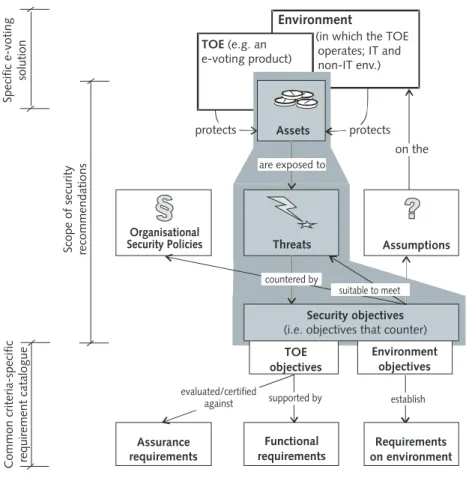
The design of an e-voting system shall be underpinned by a comprehensive assessment of the risks involved in the successful completion of the particular election or referendum. The e-voting system shall include the appropriate safe-guards, based on this risk assessment, to manage the specific risks identified. Service failure or service degradation shall be kept within pre-defined limits.
A. Accessibility
61. Measures shall be taken to ensure that the relevant software and services can be used by all voters and, if necessary, provide access to alternative ways of voting.
62. Users shall be involved in the design of e-voting systems, particularly to identify constraints and test ease of use at each main stage of the development process.
63. Users shall be supplied, whenever required and possible, with additional facilities, such as special interfaces or other equivalent resources, such as per-sonal assistance. User facilities shall comply as much as possible with the guide-lines set out in the Web Accessibility Initiative (WAI).
64. Consideration shall be given, when developing new products, to their compatibility with existing ones, including those using technologies designed to help people with disabilities.
65. The presentation of the voting options shall be optimised for the voter.
B. Interoperability
66. Open standards shall be used to ensure that the various technical compo-nents or services of an e-voting system, possibly derived from a variety of sources, interoperate.
67. At present, the Election Markup Language (EML) standard is such an open standard and in order to guarantee interoperability, EML shall be used whenever possible for e-election and e-referendum applications. The decision of when to adopt EML is a matter for member states. The EML standard valid at the time of adoption of this recommendation, and supporting documentation are available on the Council of Europe website.
68. In cases which imply specific election or referendum data requirements, a localisation procedure shall be used to accommodate these needs. This would allow for extending or restricting the information to be provided, whilst still remaining compatible with the generic version of EML. The recommended pro-cedure is to use structured schema languages and pattern languages.
C. Systems operation
(for the central infrastructure and clients in controlled environments)
69. The competent electoral authorities shall publish an official list of the soft-ware used in an e-election or e-referendum. Member states may exclude from this list data protection software for security reasons. At the very least it shall indicate the software used, the versions, its date of installation and a brief description. A procedure shall be established for regularly installing updated ver-sions and corrections of the relevant protection software. It shall be possible to check the state of protection of the voting equipment at any time.
70. Those responsible for operating the equipment shall draw up a contin-gency procedure. Any backup system shall conform to the same standards and requirements as the original system.
71. Sufficient backup arrangements shall be in place and be permanently available to ensure that voting proceeds smoothly. The staff concerned shall be ready to intervene rapidly according to a procedure drawn up by the competent electoral authorities.
72. Those responsible for the equipment shall use special procedures to ensure that during the polling period the voting equipment and its use satisfy require-ments. The backup services shall be regularly supplied with monitoring protocols. 73. Before each election or referendum, the equipment shall be checked and approved in accordance with a protocol drawn up by the competent electoral authorities. The equipment shall be checked to ensure that it complies with tech-nical specifications. The findings shall be submitted to the competent electoral authorities.
74. All technical operations shall be subject to a formal control procedure. Any substantial changes to key equipment shall be notified.
75. Key e-election or e-referendum equipment shall be located in a secure area and that area shall, throughout the election or referendum period, be guarded against interference of any sort and from any person. During the elec-tion or referendum period a physical disaster recovery plan shall be in place. Furthermore, any data retained after the election or referendum period shall be stored securely.
76. Where incidents that could threaten the integrity of the system occur, those responsible for operating the equipment shall immediately inform the competent electoral authorities, who will take the necessary steps to mitigate the effects of the incident. The level of incident which shall be reported shall be specified in advance by the electoral authorities.
D. Security
I. General requirements
(referring to pre-voting, voting, and post-voting stages)
77. Technical and organisational measures shall be taken to ensure that no data will be permanently lost in the event of a breakdown or a fault affecting the e-voting system.
78. The e-voting system shall maintain the privacy of individuals. Confidentiality of voters’ registers stored in or communicated by the e-voting system shall be maintained.
79. The e-voting system shall perform regular checks to ensure that its com-ponents operate in accordance with its technical specifications and that its ser-vices are available.
80. The e-voting system shall restrict access to its services, depending on the user identity or the user role, to those services explicitly assigned to this user or role. User authentication shall be effective before any action can be carried out. 81. The e-voting system shall protect authentication data so that unauthorised entities cannot misuse, intercept, modify, or otherwise gain knowledge of all or some of this data. In uncontrolled environments, authentication based on cryp-tographic mechanisms is advisable.
82. Identification of voters and candidates in a way that they can unmistak-ably be distinguished from other persons (unique identification) shall be ensured.
83. E-voting systems shall generate reliable and sufficiently detailed observa-tion data so that elecobserva-tion observaobserva-tion can be carried out. The time at which an
event generated observation data shall be reliably determinable. The authentic-ity, availability and integrity of the data shall be maintained.
84. The e-voting system shall maintain reliable synchronised time sources. The accuracy of the time source shall be sufficient to maintain time marks for audit trails and observations data, as well as for maintaining the time limits for regis-tration, nomination, voting, or counting.
85. Electoral authorities have overall responsibility for compliance with these security requirements, which shall be assessed by independent bodies.
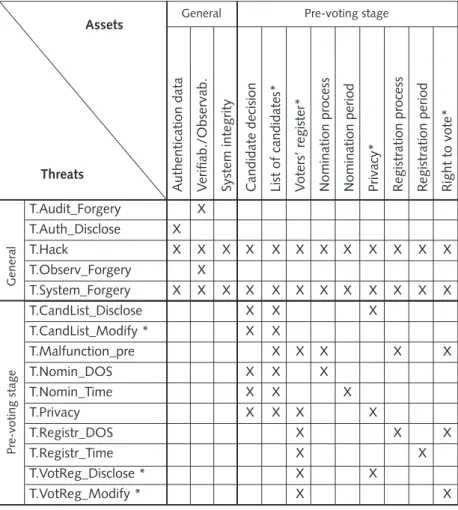
II. Requirements in pre-voting stages
(and for data communicated to the voting stage)
86. The authenticity, availability and integrity of the voters’ registers and lists of candidates shall be maintained. The source of the data shall be authenticated. Provisions on data protection shall be respected.
87. The fact that candidate nomination and, if required, the decision of the candidate and/or the competent electoral authority to accept a nomination has happened within the prescribed time limits shall be ascertainable.
88. The fact that voter registration has happened within the prescribed time limits shall be ascertainable.
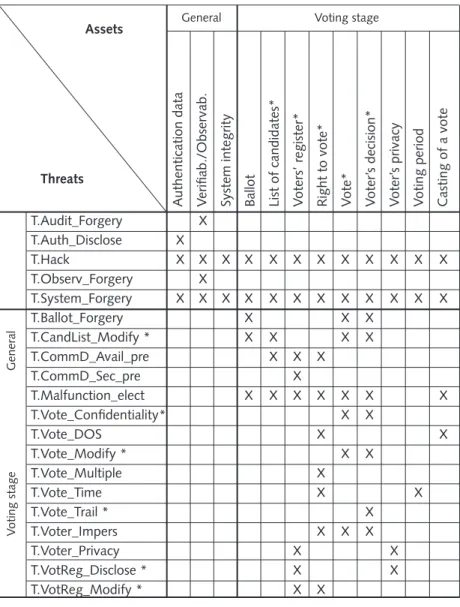
III. Requirements in the voting stage
(and for data communicated during post-election stages)
89. The integrity of data communicated from the pre-voting stage (e.g. vot-ers’ registers and lists of candidates) shall be maintained. Data-origin authenti-cation shall be carried out.
90. It shall be ensured that the e-voting system presents an authentic ballot to the voter. In the case of remote e-voting, the voter shall be informed about the means to verify that a connection to the official server has been established and that the authentic ballot has been presented.
91. The fact that a vote has been cast within the prescribed time limits shall be ascertainable.
92. Sufficient means shall be provided to ensure that the systems that are used by the voters to cast the vote can be protected against influence that could mod-ify the vote.
93. Residual information holding the voter’s decision or the display of the voter’s choice shall be destroyed after the vote has been cast. In the case of
remote e-voting, the voter shall be provided with information on how to delete, where that is possible, traces of the vote from the device used to cast the vote. 94. The e-voting system shall at first ensure that a user who tries to vote is eli-gible to vote. The e-voting system shall authenticate the voter and shall ensure that only the appropriate number of votes per voter is cast and stored in the electronic ballot box.
95. The e-voting system shall ensure that the voter’s choice is accurately rep-resented in the vote and that the sealed vote enters the electronic ballot box. 96. After the end of the e-voting period, no voter shall be allowed to gain access to the e-voting system. However, the acceptance of electronic votes into the electronic ballot box shall remain open for a sufficient period of time to allow for any delays in the passing of messages over the e-voting channel.
IV. Requirements in post-voting stages
97. The integrity of data communicated during the voting stage (e.g. votes, voters’ registers, lists of candidates) shall be maintained. Data-origin authentica-tion shall be carried out.
98. The counting process shall accurately count the votes. The counting of votes shall be reproducible.
99. The e-voting system shall maintain the availability and integrity of the electronic ballot box and the output of the counting process as long as required.
E. Audit I. General
100. The audit system shall be designed and implemented as part of the e-voting system. Audit facilities shall be present on different levels of the system: logical, technical and application.
101. End-to-end auditing of an e-voting system shall include recording, provid-ing monitorprovid-ing facilities and providprovid-ing verification facilities. Audit systems with the features set out in sections II – V below shall therefore be used to meet these requirements.
II. Recording
102. The audit system shall be open and comprehensive, and actively report on potential issues and threats.
20
103. The audit system shall record times, events and actions, including:
a. all voting-related information, including the number of eligible voters, the number of votes cast, the number of invalid votes, the counts and recounts, etc.;
b. any attacks on the operation of the e-voting system and its communica-tions infrastructure;
c. system failures, malfunctions and other threats to the system.
III. Monitoring
104. The audit system shall provide the ability to oversee the election or refer-endum and to verify that the results and procedures are in accordance with the applicable legal provisions.
105. Disclosure of the audit information to unauthorised persons shall be pre-vented.
106. The audit system shall maintain voter anonymity at all times.
IV. Verifiability
107. The audit system shall provide the ability to cross-check and verify the cor-rect operation of the e-voting system and the accuracy of the result, to detect voter fraud and to prove that all counted votes are authentic and that all votes have been counted.
108. The audit system shall provide the ability to verify that an election or e-referendum has complied with the applicable legal provisions, the aim being to verify that the results are an accurate representation of the authentic votes.
V. Other
109. The audit system shall be protected against attacks which may corrupt, alter or lose records in the audit system.
110. Member states shall take adequate steps to ensure that the confidentiality of any information obtained by any person while carrying out auditing functions is guaranteed.
F. Certification
111. Member states shall introduce certification processes that allow for any ICT (Information and Communication Technology) component to be tested and certified as being in conformity with the technical requirements described in this recommendation.
112. In order to enhance international co-operation and avoid duplication of work, member states shall consider whether their respective agencies shall join, if they have not done so already, relevant international mutual recognition arrangements such as the European Co-operation for Accreditation (EA), the International Laboratory Accreditation Co-operation (ILAC), the International Accreditation Forum (IAF) and other bodies of a similar nature.
Explanatory memorandum
Background
1.
Common standards on e-voting, which reflect and apply the
prin-ciples of democratic elections and referendums to the specificities of
e-voting, are key to guaranteeing that all the principles of democratic
elections and referendums are respected when using e-voting, and thus
to building trust and confidence in domestic e-voting schemes.
2.
Such common standards are also important for the interoperability
of e-voting systems in order to ensure the development of secure and
effective e-voting systems. While interoperability across borders in
Europe may not seem necessary from a purely legal and operational
point of view – at the time of adoption of the recommendation there
were no cross-border common electoral procedures in place
(notwith-standing data exchange procedures with respect to a limited group
within the electorate for the European Parliament) – interoperable and
open technical standards within and across member states’ borders can
both ensure the combined and continued use of e-voting systems
sup-plied by different providers and reduce procurement costs for domestic
authorities.
3.
This set of standards consists of the legal, operational (mainly
relat-ing to organisational and procedural matters) and core technical
require-ments for e-voting. The legal standards are intended to apply the
principles of existing Council of Europe and other international
instru-ments relating to elections, to e-voting.
4.
The recommendation has been developed by the Multidisciplinary
Ad hoc Group of Specialists on legal, operational and technical standards
for e-voting (IP1-S-EE). This intergovernmental group of all member
states was set up by the Committee of Ministers and was entrusted with
the task of developing a set of standards for e-voting that reflect the
differing circumstances of Council of Europe member states and should
be followed by the information and computer technology (ICT) industry.
Scope of the recommendation
5.
The recommendation covers political elections and referendums,
both of which are part of the European democratic heritage and require
standards. Elections and referendums are held at different levels; in some
countries no referendums are held, and in some countries not all the
lev-els mentioned in the recommendation are affected.
Reasons for introducing or considering the introduction of e-voting
6.
The reasons for introducing or considering the introduction of
e-voting in one or more stages of a political election or referendum can
differ from country to country. In each country, the reasons depend on
the specific domestic context.
Competence of member states
7.
The competence of the member states of the Council of Europe in
electoral matters and regarding referendums is not affected by this
recommendation. Where reference is made to the European Union level,
the purpose is to include reference to elections to the European
Parliament.
Principles of democratic elections and referendums
8.
Democracy is inconceivable without elections and referendums
held in accordance with certain principles that lend them their
demo-cratic status. In 2002, the European Commission for Democracy through
Law (Venice Commission) adopted a non-binding Code of Good
Practice in Electoral Matters
1in which five such principles are identified
as fundamental: universal, equal, free, secret and direct suffrage. These
24
1. Code of good practice in electoral matters: (Venice Commission – Opinion 190/2002_el), endorsed by Parliamentary Assembly Resolution 1320 (2003) and CLRAE Resolution 148 (2003), subject of a Declaration by the Committee of Ministers (114th session, 13 May 2004)).
five principles reflect Europe’s democratic heritage
1and are equally
applicable to e-elections and e-referendums as to traditional elections
and referendums.
9.
Although no generally agreed definitions of these principles exist,
their meaning can for the purposes of this explanatory memorandum be
summarised as follows:
– universal suffrage: all human beings have the right to vote and to
stand for election subject to certain conditions, for example age and
nationality;
– equal suffrage: each voter has the same number of votes;
– free suffrage: the voter has the right to form and to express his or
her opinion in a free manner, without any coercion or undue influence;
– secret suffrage: the voter has the right to vote secretly as an
indi-vidual, and the state has the duty to protect that right;
– direct suffrage: the ballots cast by the voters directly determine
the person(s) elected.
10. Although these principles are generally accepted, their
implemen-tation in the context of e-voting raises a number of questions that call
for close scrutiny. However, specificities of e-voting do not give rise to
such questions to the same extent in relation to all of the five principles.
Whereas for the principles of universal, equal, free and secret suffrage
special provisions with regard to e-voting are necessary, the principle of
1. Point 7 of the Document of the Copenhagen Meeting of the Conference on the Human Dimension of the OSCE of 29 June 1990 clearly speaks of free, universal, equal and secret suffrage; point 6 of direct suffrage, albeit in a qualified form; Article 25(b) of the International Covenant on Civil and Political Rights expressly provides for all these princi-ples except direct suffrage, although the latter is implied (Article 21 of the Universal Declaration of Human Rights); Article 3 of the Additional Protocol to the European Convention on Human Rights explicitly provides for the right to periodic elections by free and secret suffrage; the other principles have also been recognised in human rights case-law (universality: ECHR No. 9267/81, judgment in Mathieu-Mohin and Clerfayt v. Belgium, 2 March 1997, Series A vol. 113, p. 23; judgment in Gitonas and Others v. Greece, 1 July 1997, No. 18747/91, 19376/92; 19379/92, 28208/95 and 27755/95, Reports of Judgments and Decisions, 1997-IV, p. 1233; re. equality: aforementioned judg-ment in Mathieu-Mohin and Clerfayt, p. 23). The right to direct elections has been admit-ted by the Strasbourg Court implicitly (ECHR No. 24833/94, judgment in Matthews v. The United Kingdom, 18 February 1999, Reports of Judgments and Decisions 1999-I, para-graph 64).
direct suffrage does not call for special attention and is therefore not
addressed in the recommendation.
11. The standards in the recommendation address only those matters
that are of specific relevance to e-voting. The general principles of
democratic elections and referendums are not repeated.
Legal, operational and technical standards
12. Appendices I to III of the recommendation contain a set of legal,
operational and technical standards. This set consists of minimum
stan-dards, which, if followed in an e-voting system, would facilitate
compli-ance with the principles of democratic elections and referendums.
However, compliance with these standards alone does not guarantee
the democratic quality of the e-election or e-referendum. The e-election
or e-referendum has to be judged as a whole and in detail, in the
spe-cific context. But compliance with the standards is an important element
in enhancing the democratic quality of the e-voting system.
13. There is a close interconnection between the three categories of
standards which need to be taken into account when applying the
rec-ommendation:
– the legal standards relate to the legal context in which e-voting
is permitted;
– the operational standards relate to the manner in which e-voting
hardware and software should be operated and maintained;
– the technical requirements relate to the construction and
opera-tion of e-voting hardware and software. The adopopera-tion of the technical
requirements will ensure the technical security, accessibility and
interop-erability of e-voting systems.
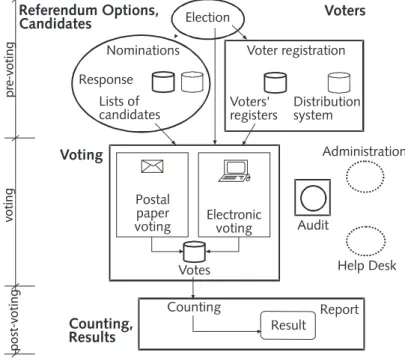
The three categories of standards all include provisions relating to all
stages of elections and referendums (that is, the pre-voting stage, the
actual casting of the vote, and the post-voting stage). The
interconnec-tion can relate to one, two, or all stages.
i. Introductory statement (“e-voting shall respect ...”)
14. This introductory statement covers a number of issues that are of
general relevance in relation to e-elections and e-referendums.
15. Existing non-electronic voting systems have been developed in a
way that ensures that the principles required for democratic elections
and referendums are met. It is essential that these principles are not
undermined by the introduction of new voting methods and,
accord-ingly, e-voting systems must be designed and operated so as to ensure
the reliability and security of the voting process, as is the case with the
non-electronic voting systems in the state concerned.
16. In order to ensure that an e-voting system delivers an election or
referendum that satisfies the principles overall, it may be necessary to
give more attention to the application of one principle than to that of
another. However, the result must still be to ensure that overall the
prin-ciples are met.
17. The comparison with the non-electronic voting system in the state
concerned does not imply that e-voting has to be as secure and reliable
as all the non-electronic voting channels together. The underpinning
principle of the recommendation is that a remote e-voting channel has
to be – overall – as secure as an unsupervised remote non-electronic
vot-ing channel and a non-remote e-votvot-ing channel has to be as secure as a
non-remote non-electronic voting channel.
18. Furthermore the comparison with non-electronic voting channels is
not intended to prevent a state changing its non-electronic voting
sys-tem, as long as the changes are in compliance with all the principles of
democratic elections and referendums.
19. Comparing levels of reliability and security or other parameters, at
the time when e-voting is introduced, with levels of non-electronic
vot-ing methods is not intended to freeze non-electronic votvot-ing levels, in
particular when improvements in implementing the principles of
demo-cratic elections and referendums are possible and necessary.
ii. Review of domestic legislation
20. The recommendation indicates that member states should consider
reviewing their relevant domestic legislation when introducing e-voting.
Careful thought needs to be given to aspects of law other than those
relating simply to the electronic equipment needed and its use. The
extent of the review advisable will depend upon the existing laws of
the member state in question and it is not possible to set these out in a
comprehensive manner here. Examples include criminal laws relating to
election matters, specific data protection laws and laws relating to
elec-tion observaelec-tion.
iii. Localisation
21. The purpose of this recommendation is to provide for common
standards on e-voting. In some states holding elections and referendums
involves certain procedures which are very specific to the state
con-cerned. Where such specific procedures are applicable only in one or a
very small number of member states, those procedures were identified
as “localisms” and therefore not included in the recommendation, but
referred to in the explanatory memorandum. States concerned can
retain their “localisms” and, if they so wish, adapt them in the future,
and are not expected to abandon or change their “localisms” as a
con-sequence of the recommendation, as long as these are in compliance
with the principles of democratic elections and referendums and any
obligations and commitments undertaken by member states.
iv. Sustainability
22. E-voting is a new and rapidly developing area of policy and
tech-nology. Standards and requirements need to keep abreast of, and where
possible anticipate, new developments. In recognition of this, paragraph
v. recommends that each member state keep its own policy on e-voting
under review and report back to the Council of Europe the results of any
review that it has conducted. The Council of Europe may look again at
this issue two years after the adoption of this recommendation and
member states may bear this timing in mind when deciding whether,
and if so when, a review is appropriate in their particular circumstances.
23. As part of the follow-up, a review of the recommendation may be
considered as soon as member states have gained further experience
with e-elections or e-referendums.
24. Technological developments, unforeseeable at the time of the
adoption of the recommendation, cannot exclude that any system valid
at that time, including Election Markup Language (EML), may one day
not be the most appropriate system for e-elections or e-referendums,
and thus not be recommended by individual, or groups of, countries.
Interpretation
25. The interpretation paragraph contains definitions of terms used
throughout the recommendation, including its appendices. The
defini-tions should also be consulted when the recommendation or parts of it
are translated into other languages. In Appendix 3 there is a separate
technical glossary which contains additional definitions of terms used in
that appendix.
Definition of remote e-voting
26. E-voting can be conducted in remote and non-remote ways. Many
electoral systems already include both non-remote and remote voting.
Remote voting can be conducted in both supervised (for example voting
at embassies or consulates, voting at post offices or municipal offices)
and unsupervised (that is unsupervised by officials) environments (for
example voting by mail). Each member state has its own established
practice concerning the types of voting channels available to voters.
1For
the purpose of this recommendation, however, remote e-voting means
exclusively e-voting where the casting of the vote is via a device not
controlled by election officials.
1. The European Commission for Democracy through Law (Venice Commission) has pro-vided a report on the compatibility of remote voting and electronic voting with the requirements of the documents of the Council of Europe (adopted by the Venice Commission at its 58th Plenary Session (Venice, 12-13 March 2004). Study No. 260, 2003, Strasbourg, 18 March 2004, CDL-AD (2004)012 Or. Fr.). The conclusion by the Venice Commission is that remote voting is compatible with the Council of Europe’s standards, provided that certain preventative measures are observed in the procedures for either postal voting or electronic voting.
Appendix I
Legal standards A. Principles I. Universal suffrage
Standard No. 1. “The voter interface of an e-voting system ...”
27. No single voting system may ever be understandable and usable by every possible voter; for example, people with visual impairments may not be able to use a visual-only system. In order to ensure democratic elections and referen-dums, member states have to try to ensure that the voter interfaces of e-voting systems are usable and understandable by as many people as possible.
Standard No. 2. “Possible registration requirements for e-voting ...”
28. The purpose of this provision is to ensure that no voter is prevented from using e-voting because of difficult registration procedures.
Standard No. 3. “E-Voting systems shall be designed ...”
29. E-voting systems should be made accessible as far as possible and used in conjunction with other voting channels that together with the e-voting system provide accessibility for as many voters as possible. Not all persons with disabil-ities may be able to use e-voting. The design of the e-voting systems should, however, aim to maximise the potential of accessibility that these voting chan-nels provide for disabled persons.
Standard No. 4. “Unless channels of remote e-voting are ...”
30. Adding additional electronic voting channels to traditional forms of voting may make elections and referendums more accessible, strengthening the princi-ple of universality. However, using a single remote electronic voting channel in isolation restricts accessibility. This provision is to protect the voter from a situa-tion where the only means offered for voting is one that is not effectively avail-able to him or her.
31. In the case of non-remote e-voting it has to be left to member states to decide whether they want to offer other options of voting. As is the case with all non-remote voting, places where voting takes place and the e-voting system should comply with standards of accessibility.
II. Equal suffrage
Standards Nos. 5 and 6. “In relation to any election or referendum ...” and “The e-voting system …”
32. The whole voting system should prevent multiple votes being cast by any one person. This principle is consistent with voting systems that allow voters to choose more than one option, such as systems that allow preferential votes, or one vote for a national list and one vote for a regional list. The concept of mul-tiple votes relates to the risk that there might be an attempt to cast more votes than a particular voter has a right to cast. This might arise if the voter tried to cast multiple votes him or herself or if another person tried to use the voter’s identity in order to vote in the voter’s name and the voter also voted.
33. In some member states practices are in force where it may appear that a voter is allowed to vote more than once. However, in these systems the voter may cast only one vote that is finally counted. Examples of this include:
a. In the case of Denmark and Sweden, the voting systems provide the legal opportunity for voters to submit an advance vote and change it later. In Denmark, several advance votes may be submitted. In Sweden, only one advance vote may be submitted. In both systems only the last vote is inserted into the ballot box and thus is the vote cast.
b. In the case of the United Kingdom, if a person enters a polling station to vote and finds that somebody else has already voted in that person’s name, that person is entitled to cast a special vote – a tendered ballot. This ballot is sealed in an envelope, is not placed in the ballot box, and is only looked at in the case of an election petition and in accordance with a direc-tion of a court. A similar provision applies where two postal votes are received for the same voter.
Standard No. 7. “Every vote deposited ...”
34. It is important that all votes cast by either electronic or non-electronic vot-ing channels are counted.
III. Free suffrage
Standard No. 9. “The organisation of e-voting ...”
35. Personal suffrage – the personal exercise of the right to vote – is a funda-mental principle in many member states. As it is particularly vulnerable in the context of remote e-voting, special attention is drawn to this fact in the recom-mendation. However, this standard does not prevent remote e-voting.
36. There are some member states that allow for voting procedures where, in order to ensure accessibility, the principle of universality is given priority over the principle of personal suffrage and therefore, for example, proxy voting is allowed. This is also possible within the e-voting standards.
37. Where remote e-voting channels are provided, special attention has to be given to the provision of facilities that allow the voter to exercise the right to cast a vote in a supervised environment.
Standard No. 10. “The way in which voters ...”
38. “Without reflection” means without having had enough time to think about it.
Standard No. 11. “Voters shall be able ...”
39. Only the voter must have access to the vote. For example, the e-voting facilities should not enable the completed ballot to be stored on the voter’s device and the vote cast later. No one other than the voter should have access to the vote, either on the device or during the transmission to the ballot box.
Standard No. 12. “The e-voting system shall not permit ...”
40. The e-voting system should be designed and operated in a way that ensures that all forms of manipulative influence are excluded. For example, sounds which can be associated with a candidate or an option, pop-up screens promoting a particular choice and similar devices should be prevented, as far as possible.
Standard No. 13. “The e-voting system shall provide the voter ...”
41. In non-electronic voting systems voters are able to cast a blank vote, that is, not to express a preference for the proposed choices. This standard provides that the possibility of leaving the ballot blank is maintained with e-voting. 42. It is a matter for each member state’s domestic policy whether the intended spoiling of a ballot paper or intentional casting of a non-blank invalid vote is possible with e-voting as well.
Standard No. 14. “The e-voting system shall indicate clearly ...”
43. Generally speaking, the voting procedure is completed successfully when the electronic vote is deposited in the electronic ballot box. In the context of remote e-voting this means that the voting procedure is completed successfully only when the vote has been sent from the voter’s voting device (PC, telephone,
etc.), over the Internet or another network and has reached its destination, that is the ballot box server.
44. The message confirms to the voter that his or her vote is deposited in the ballot box and thus will be counted. The voter then knows that he or she has cast his or her vote, which is important from the point of view of trusting the sys-tem and because of the principle that every vote cast has to be taken into account. Furthermore, the voter must be able to know at what moment the whole voting procedure is completed successfully and he or she can safely end the connection. Both messages (the successful casting of the ballot and the com-pletion of the procedure) could be combined in one, if both events coincide.
IV. Secret suffrage
45. All international obligations and commitments pertaining to secret suf-frage that bind a member state need to be implemented with any e-voting sys-tem used by that state.
Standard No. 16. “E-voting shall be organised in such a way ...”
46. Secrecy must apply to the entire procedure: in the pre-voting stage (for example, the transmitting of PINs or electronic tokens to voters), during the completion of the ballot paper, the casting and transmission of the ballot and during counting and any recounting of the votes.
Standard No. 17. “The e-voting system shall guarantee that votes ...”
47. This standard provides that it must never be possible to reconstruct the content of any voter’s vote and link it to the voter who cast it.
48. In the context of (remote) e-voting special attention has to be given to the principles of free and secret suffrage. Only entitled voters are allowed to cast a vote, which means that every voter has to be authenticated and his/her right to vote has to be checked. Domestic legislation may vary on the extent of identifi-cation (indiidentifi-cation of the voter’s name, showing of an ID card, etc.), but the basic principle remains the same: in order to prevent multiple votes being cast or other misuse, the voter has to be authenticated and a record must be made and checked in order to establish whether he or she has already cast a vote.
49. At a certain stage in the remote voting process the voter’s identity and the voter’s vote may be connected in some way. If the content of the vote were to be made known at that stage, or if the connection between voter and vote were
to be kept and the content of the vote made known at a later stage, the secrecy of the vote would be breached. In traditional voting systems the separation of voter identification and vote is made by physical separation. This physical sepa-ration can easily be controlled by election officials and election observers. In non-remote e-voting processes the voter authentication and the vote could also be separated physically, as is the case if the e-voting system is used only for the casting of the vote. With a remote electronic voting system this separation has to be made electronically. The electronic separation requires specific technical solutions. This fact has to be taken into account when introducing e-voting.
50. In voting systems that provide a legal opportunity for voters to submit an advance vote and change it later (for example, Sweden), it must be possible to identify a specific person’s sealed vote to be able to retract that specific vote. The identification and retraction of such a vote must be done without jeopardising the secrecy of the vote; in other words, a vote must be completely sealed throughout the voting, storage and retraction processes. But the sealed vote must still be linked to a specific voter.
51. The moment of inserting a vote into the electronic ballot box is the latest point in time at which the vote must be separated from the information on who has cast it – without any possibility of ever reconstructing this link.
52. In some cases domestic law requires a permanent link between the voter and the vote to exist and to be maintained during the election or referendum and for a specific period thereafter (for example, in the United Kingdom). In such cases, it has to be assured that the link between a voter and his or her bal-lot paper is sufficiently protected throughout the period in order to ensure the secrecy of the vote. This is only revealed pursuant to an order of a competent judicial authority and it must be ensured, that even where the link is so revealed, no voter is compelled to reveal how he or she has voted.
Standard No. 19. “Measures shall be taken to ensure ...”
53. The necessary measures would include, for example, that the votes cast must be stored randomly in the electronic ballot box. The order in which they are stored must not make it possible to reconstruct the order in which they arrived.
B. Procedural safeguards
54. The procedural safeguards ensure that all principles of democratic elec-tions and referendums are implemented and maintained in an e-voting context.
I. Transparency
Standard No. 20. “Member states shall take steps to ensure that ...”
55. Confidence by voters and candidates in the voting system(s) used is essen-tial, not only to participation but also to the democratic system of the member state. Full understanding of the e-voting system(s) in use is the basis for this con-fidence.
56. Traditional voting methods are simple and well tried and tested in member states. Voters are familiar with voting systems using ballot papers and ballot boxes and understand the general rules that govern how they should vote and how their vote is collected and counted unaltered. The introduction of e-voting produces a new situation in which voters will be less familiar with the electoral process and perhaps less able to understand the safeguards built into the e-voting system. Accordingly, as e-e-voting systems are introduced, it is likely that, in order to maintain voter understanding and confidence, steps will have to be taken to introduce the system to voters. Over time, it may be necessary to continue to take such steps in order to secure the understanding and confidence of voters who are unfamiliar with e-voting.
57. Confidence can be enhanced by providing voters with as much informa-tion as possible about the method of e-voting being used.
Standard No. 22. “Voters shall be provided with an opportunity to practise ...”
58. A new e-voting system may cause voters anxieties of different kinds. In order to promote understanding and confidence in any new e-voting system, including in its transparency, opportunities to try out the system should be pro-vided before, and separately from, the moment of casting an electronic vote. Special attention should be paid to any voters who are not familiar with the new e-voting method, for example the elderly.
Standard No. 23. “Any observers, to the extent permitted by law ...”
59. There are various international and domestic obligations on election obser-vation: by representatives of candidates, as well as by independent domestic and/or international observers. All member states are bound to the commit-ments of the Document of the Copenhagen Meeting of the Conference on the Human Dimension of the OSCE of 29 June 1990 to “invite observers from any other OSCE participating state and any appropriate private institution and organisation who may wish to do so to observe the course of their national
election proceedings [… and …] facilitate similar access for election proceedings held below the national level”.
60. Observers should be able to verify that the e-voting system itself is designed and operated in a way which respects the fundamental principles of democratic elections and referendums. Therefore, member states should have clear legal provisions on observers’ access to the e-voting system documentation and audit data.
61. E-elections/e-referendums pose special challenges to observers, inherent in the electronic method of the election or referendum. Observers will thus have to be provided with an opportunity, in particular, to have access to relevant soft-ware information, to see physical and electronic safety measures for servers, to inspect and test certified devices, to have access to and test sites and informa-tion provided for remote e-voting, and to observe cast electronic votes entering the electronic ballot box and that votes are being counted. Security measures for telephone or Internet voting may, however, make it necessary not to allow the presence of observers in the computer room itself. In that case measures should be taken in order to give the observers the opportunity to monitor the activities.
II. Verifiability and accountability
Standard No. 24. “The components of the e-voting system …”
62. Assessment that e-voting systems function correctly and that security is maintained is essential. This can be done by the independent evaluation or cer-tification of the system as a whole or of its components, which requires disclo-sure of the critical system elements. The assessment can be carried out through, for example, disclosure of the system design, inspection of detailed documenta-tion, source code disclosure, inspection of component evaluation and certifica-tion reports, in-depth penetracertifica-tion testing, etc. The actual level of disclosure of the system elements needed to achieve appropriate assurance depends on the specific features of the system, its components and the services provided.
Standard No. 26. “There shall be the possibility for a recount.”
63. The recount is a procedure that verifies election and referendum results that have already been established. There are different possibilities for recounts in the case of e-voting, which differ in their complexity and in their contribution to accountability. A very simple method of recounting can be produced by instructing the e-voting system to perform a second count. A second option is to transfer the electronic ballot box to a similar but distinct e-voting system and perform the second count on that system. A third option is to let the recount be
carried out by a different system, which is interoperable with the e-voting sys-tem. A fourth option is to produce, at some stage of the voting process, paper ballots and to use these for recounting.
64. To verify the result, it may not be sufficient only to conduct a recount. Depending on the architecture of the system used, there may be further ele-ments that contribute to the correctness of the result. The confirmation that all votes cast have been considered is an example.
Standard No. 27. “The e-voting system shall …”
65. If a run of an e-election or e-referendum becomes necessary, that re-run may not be possible without the support of the e-voting system that was used in the original election or referendum, even if that e-voting system is not to be used in the re-run itself. This may be the case if the persons who are entitled to vote can be identified only by using information that is available by means of that the original e-voting system.
III. Reliability and security
Standard No. 28. “The member state’s authorities shall ensure ...”
66. The new voting channels need to be as reliable and secure as traditional voting methods. The member state has to guarantee that this is the case; the final responsibility can never be delegated to a voting system supplier.
Standard No. 29. “All possible steps shall be taken ...”
67. Throughout the whole electronic voting process, there must be no inter-vention unrelated to the voting which affects either the ballot and election or referendum server or the electronic ballot box server. The recommendation is not intended to suggest that every possible method of protection available must be used in every case. In each case a judgment will have to be made as to the nature and extent of the protection measures to be applied. This judgment will require a proper balance to be struck between different factors. For example, in a particular case a balance may need to be struck between the all-important need for security and the advisability of having systems that are easily usable by voters. In such a case usability must not override the need for high levels of secu-rity but may be a factor in determining which secusecu-rity measures should be adopted. A similar position might apply were a very small additional security benefit to be achievable but only at an excessively high cost.