Revised Version 3.0
Technical Recommendations from the E-TRACK II project
Deliverable 1
1
of the IEE project
„A European Tracking System for Electricity – Phase II (E-TRACK II)”
(IEE) programme (contract no. EIE/07/102//SI2.467611).
The sole responsibility for the content of this report lies with the authors. It does not represent the opinion of the European Communities. The European Commission is not responsible for any use that may be made of the information contained therein.
Written by
Christof Timpe, Öko-Institut e.V.
Based on contributions from
Dominik Seebach, Liv Becker, Andrea Effinger (Öko-Institut e.V.)
Mark Draeck (IT Power Ltd)
Jaap Jansen, Koen Schoots
(Energy Research Centre of the Netherlands – ECN) Diane Lescot
(Observatoire des énergies renouvelables – Observ’ER) Ervin Seršen, Gorazd Škerbinek, Andrej Špec
(Energy Agency of the Republic of Slovenia – AGEN-RS) Thomas Esdaile-Bouquet
(The European Association for the Promotion of Cogeneration vzw – Cogen Europe) Christina Heilig, Helmut Sprongl
(Energie-Control GmbH – E-Control) Matthias Koch
(BET Office for Energy Economy and Technical Planning GmbH) Inga Konstantinaviciute, Dalius Tarvydas
(Lithuanian Energy Institute – LEI)
Content
1 Introduction... 5
1.1 The E-TRACK II Project ... 5
1.2 Scope of this Report... 5
2 Basics of the E-TRACK Standard... 6
2.1 Tracking Standard vs. Tracking Systems ... 6
2.2 Tracking Purposes ... 6
2.3 Domains – Geographical Entities for Tracking ... 8
2.4 Competent Bodies ... 8
2.5 Attributes – Information to be Tracked... 8
2.6 Explicit and Implicit Tracking... 9
3 Technical Recommendations... 12
3.1 Explicit Tracking Based on Guarantees of Origin ... 12
3.2 Other Reliable Tracking Systems ... 14
3.3 Residual Mix for Implicit Tracking ... 16
3.4 Cross-border Transfer of Attributes... 19
3.5 Accounting Periods... 20
3.6 Support Certificates ... 22
4 Additional Regulations of the Standard... 23
4.1 Actors ... 23
4.2 Set of Electricity Attributes... 24
4.3 Registries for Explicit Tracking ... 24
4.4 Network Losses and Balancing Power... 25
4.5 Data Issues for Explicit Tracking ... 25
4.5.1 Communication between Registries... 25
4.5.2 Sources and Availability of Data... 25
4.5.3 Data Collection Requirements ... 26
4.6 Multi-Certificate Systems ... 27
5 Governance of the Tracking Standard... 27
5.1 Governance at the Domain Level ... 27
5.2 Governance at the Inter-Domain Level ... 27
6 References... 29
Annex 1: Proposal for a set of electricity attributes... 30
Annex 2: E-TRACK Glossary ... 33
List of Tables
Table 1: Concrete Steps for Determining Residual Mixes in Europe ... 21
List of Figures
1
Introduction
1.1
The E-TRACK II Project
Phase I of the E-TRACK project has investigated the feasibility of a harmonised stan-dard for tracking of electricity generation attributes in Europe. Such tracking is required by electricity disclosure (also called labelling) and can also be used for support schemes and – in a wider sense of tracking – also for accounting for the national targets of EU Member States regarding renewable energy. Phase II of the project has continued the process of harmonisation of tracking systems across Europe, including the new Guaran-tees of Origin for high-efficient cogeneration. It also focused on the specific situation of New Member States in the implementation of tracking systems and supported consum-ers and their organisations to define their requirements on tracking systems and the re-lated policies. Based on intensive discussions with stakeholders across the EU, Norway and Switzerland, the project gives recommendations for the design of tracking schemes and for measures to be taken at European and national levels.
1.2
Scope of this Report
This report is a technical summary of the most relevant recommendations of the E-TRACK II project. It is based on the first version of the E-TRACK standard (Timpe et al 2007) and should be seen as a supplement to the project’s final report “Best Prac-tice for the Tracking of Electricity” (Timpe, Seebach 2009). The final report contains the full set of policy recommendations from the E-TRACK II project and the results of the analysis supporting them, whereas this report condenses the recommendations and points out some more technical issues related to the proposed tracking systems. It should be noted that this report does not focus on the interim steps of the phased ap-proach towards a consolidated tracking system which was described in the project’s final report. The description of the technical issues focuses on the medium-term per-spective of this approach. Additional background information is provided in the E-TRACK II Work Package reports, which are available on the project website.1
The term “standard” is used in this report in an informal way. It denotes a set of rules which can be applied in European countries in order to implement tracking systems. If required, additional national regulations can be added. The standard is not meant as a formal standard, e.g. under CEN/Cenelec rules.
As it is important to understand the terms correctly which are used in this document, a glossary of the most relevant terms has been added in Annex 2 and a list of the abbre-viations used can be found in Annex 3.
1
2
Basics of the E-TRACK Standard
This document uses the term “tracking” as a synonym for any kind of accounting of electricity generation attributes. It is a principle of the E-TRACK standard that informa-tion should be separated from physical energy at the point of generainforma-tion, and therefore the accounting mechanism (the tracking system) should exist separately from the elec-tricity flows. In many cases, the tracking system will also be separated from elecelec-tricity trading activities.
2.1
Tracking Standard vs. Tracking Systems
The objective of the E-TRACK standard is to support the coordination between ad-vanced tracking systems used across Europe. It is not aiming for one uniform tracking system in all countries, but rather to allow for a certain variety of national or regional tracking systems, which reflects existing variations in regulatory and market framework conditions. As long as the individual tracking systems developed by these actors comply with the standard, they will deliver a reliable and cost-efficient service to the electricity industry, consumers, governments and regulators. Existing tracking systems, which do not comply with the standard, should be developed further to meet the standard in the future or they should be phased out. It must be emphasised that the use of any tracking systems outside of the standard could lead to multiple counting and therefore should be avoided.
2.2
Tracking Purposes
There are different purposes for which results of tracking can be used:
· Disclosure (Labelling): Based on Directive 2003/54/EC and its successor Direc-tive 2009/72/EC electricity retailers must disclose to their customers the origin of their electricity and related emissions. In order to determine this information, an accounting system must be installed which allows to keep track of generated and consumed volumes of electricity, and to create linkages between generation and supply. This is the most comprehensive tracking requirement, because it covers the whole electricity market.
The Guarantees of Origin (GO) for electricity from renewable energy sources (RES-E) and electricity from high-efficient cogeneration (HE-CHP-E), which were introduced based on Directives 2001/77/EC and 2004/8/EC are not for-mally linked to the disclosure requirement. However, the new RES Directive 2009/28/EC has established this clear link and based on this, RES-GO and CHP-GO should be regarded as tracking systems for disclosure. RES-GO and CHP-GO should in fact become part of a more comprehensive system of Guar-antees of Origin for all kinds of electricity generation. In a broader sense, the term “Guarantee of Origin” is therefore also used for standardised “disclosure certificates”. The GO in a broader sense are not (yet) regulated by European
leg-islation, whereas RES-GO and CHP-GO retain their specific legal status, which is stipulated by the respective Directives.
The market for green power, which has emerged in Europe over the last decade, and which allows consumers to subscribe to electricity produced in a sustainable way, e.g. from renewable energy sources, can also be seen as part of the electric-ity disclosure system. More generally, different types of product differentiation regarding the origin of electricity and its generation attributes (energy sources, CO2 emissions and radioactive waste produced) should be possible and should
be supported by the tracking system.
· Support: Systems for financial support of certain technologies for electricity production, e.g. from renewable energy sources (RES-E) or high-efficient co-generation (HE-CHP-E) are implemented in most European countries. Some support systems require a proof of generation to receive support. In this case a “support certificate” can be used. Others define an allocation of supported elec-tricity to certain consumers (e.g. on a pro rata basis). In order to avoid over-subsidisation, it is necessary to record whether certain instances of electricity generation have already received support or not. This information can be in-cluded in the GO.
· National targets: European governments have committed themselves to fulfil quantitative targets for the share of renewable energy in overall energy con-sumption. Such targets apply for RES-E in the year 2010 under the “old” RES Directive 2007/77/EC and more generally for renewable energy for the years 2011 to 2020 under the “new” RES Directive 2009/28/EC. The compliance with these targets is usually verified based on statistics on the renewable energy pro-duction in each country, but certain transfers of renewable energy between the countries are possible in order to add flexibility to the national targets. The 2009 RES Directive defines certain so-called Cooperation Mechanisms on the level of Member States which can be used in order to add flexibility to the targets up to 2020.
In contrast to the three tracking purposes listed above, the European Carbon Emissions Trading system (ETS) is not related to electricity tracking. This is due to the fact that the ETS is an allowance scheme which is upstream of the electricity market, and elec-tricity consumers are not required to deal with the emission allowances themselves. However, there might be synergies with regards to emissions information from the ETS which could be used by the disclosure scheme.
It is the intention of the E-TRACK standard to provide a consistent framework for tracking. The most relevant tracking purpose is electricity disclosure, because this re-quirement covers all electricity produced and consumed in Europe. Tracking for pur-poses of facilitating support schemes is relevant mostly in those countries which have chosen a quota obligation support scheme. After the year 2010, when the 2009 RES Directive governs the national targets for renewable energy, the accounting for these
targets will only be done by statistical instruments and thus further tracking instruments will not be required.
2.3
Domains – Geographical Entities for Tracking
Within the E-TRACK standard, all tracking activities are organised in domains. A main consists of a geographical area. Usually each country in Europe forms one do-main. However, there may be several domains in one country, like it is the case in Bel-gium. In principle, a tracking domain could in the future also encompass several coun-tries with a fully homogenous framework for tracking of electricity. Such an approach might be feasible sooner or later in the Nordic area, where the electricity market is al-ready largely integrated.
All domains in the E-TRACK standard should be defined clearly. Within a domain, the tracking of electricity should be regulated in a harmonised and consistent way.
With the further progress of the integration of the electricity market in Europe, the do-mains should gradually be merged to larger regional dodo-mains with consistent tracking rules. In the longer run there might be just one single domain for all of Europe.
2.4
Competent Bodies
In each domain, the tracking systems should be supervised by one Competent Body. The 2001 RES Directive and the CHP Directive allow Member States to designate more than one Competent Body for the supervision of each GO system. However, based on the experience made in the meantime, the 2009 RES Directive allows only one Compe-tent Body for RES-GO in each domain. It is recommended that this new rule is also applied to the CHP-GO, although this is not a formal requirement under EU legislation. Still it is possible under the relevant Directives that there are different Competent Bod-ies for RES-GO and CHP-GO systems and the oversight of the electricity disclosure system could be given to a third party. Again, the recommendation is that these roles should be combined in order to allow for the development of one single coordinated system of GO related to electricity disclosure in each domain.
2.5
Attributes – Information to be Tracked
The different schemes define the information which needs to be tracked. This informa-tion is called the attributes, which usually relate to electricity generainforma-tion. For disclosure purposes, the typical attributes are the energy source and technology used for power production, the related CO2 emissions and radioactive waste produced. For RES-GO and CHP-GO, the respective Directives have defined additional information which needs to be added to the set of attributes.
In order to reduce the barriers for cross-border tracking of attributes, all countries should agree on common (minimum) sets of information, which are provided by the tracking systems in all domains. The E-TRACK standard proposes a list of attributes
(see section 4.2 and Annex 1). If required, this list can be expanded for certain national purposes. However, any tracking information based on the minimum list of attributes should be accepted within all countries which are using the proposed standard.
2.6
Explicit and Implicit Tracking
The E-TRACK standard distinguishes two generic options for tracking, explicit and implicit tracking.
· Explicit tracking is based on a mechanism, which uses or creates a link between generation and consumption of electricity for a bilateral allocation of electricity attributes from a generator to a supplier or final consumer.. There are two op-tions for explicit tracking:
o Contract-based tracking: In this case, electricity generation attributes are allocated to consumers based on bilateral contracts concluded in the electricity market. This tracking option is used in many countries as the basic method for tracking of disclosure information. Although this track-ing option can work well in case of generation owned by retailers and bi-lateral long-term contracts between generators and retailers, it is difficult to implement this option in the framework of liquid electricity markets. The reason for this is that in such markets, electricity is seen as a com-modity (without attributes) and it is usually traded several times before it is actually produced. In this framework, contract-based tracking of at-tributes would be complex and, even more important, would split up the electricity market into several sub-markets, which would reduce market liquidity. More specifically, trading on power exchanges can not easily be covered with contract-based tracking, because in this case there are no bilateral links between two market participants.
However, at least in case of long-term bilateral contracts, contract-based tracking is quite common. In addition to this, Germany for example has implemented an “ex post contract-based tracking system” (VDEW 2005). In this system the generators, traders and suppliers of electricity allocate the generation attributes between each other based on their contractual relationships in the physical electricity market. This allocation is made ex post, in retrospective of the total net sales between individual market participants of the preceding calendar year. This approach allows to use the contracts which have been concluded in the electricity market for the allocation of attributes. However, because the attributes of each trading counterpart are only determined after the end of the year, this tracking system does not support a choice of trading partners based on their dis-closure attributes. Thus, in order to enable such choice, the ex-post con-tract based tracking system should be complemented by other
mecha-nisms for transferring attributes, such as de-linked tracking, which sup-port a market differentiation based on fuel mix and emissions.
o De-linked tracking is using transferable certificates for purposes of tracking. With these certificates, it is possible to allocate attributes from generators to consumers independently from the physical electricity mar-ket. Certificates are issued based on the volumes and attributes of elec-tricity generation. After issuing, they can be transferred independently from the physical energy market. The attributes represented in a certifi-cate are used by cancelling the certificertifi-cate, which is then removed from circulation in the market.
The most comprehensive certificate system for electricity in Europe is the European Energy Certificate System (EECS).2
On the national level, several European countries have introduced certifi-cate systems for purposes of implementing support schemes based on quota obligations. Examples for such schemes are the “Elcert” system for renewable electricity in Sweden and the Renewable Energy Obligation Certificates in the UK.
· In contrast to these two options for explicit tracking, implicit tracking is using a default set of attributes for purposes of electricity disclosure. Here, the electric-ity attributes from a group of generators are allocated to a large group of suppli-ers or final consumsuppli-ers. In this case, no bilateral link is created between genera-tion and consumpgenera-tion of electricity. Implicit tracking is being used widely by providing a default set of electricity attributes for the disclosure of electricity of unknown origin. This mechanism is actually vital for disclosure systems, be-cause it has proven practically impossible to cover 100% of any electricity mar-ket with explicit tracking.
In many disclosure schemes, the generation statistics of the respective country or of the larger UCTE or NORDEL systems3 are used as the basis for determining the default set of attributes for implicit tracking. However, in this case the coex-istence of explicit and implicit tracking inevitably leads to double counting of at-tributes. For the correction of generation statistics into a Residual Mix see sec-tion 3.3.
Another effect of using implicit tracking for electricity disclosure is that all re-tailers who rely on the default attributes will display the same disclosure
infor-2
See the website of the Association of Issuing Bodies:http://www.aib-net.org.
3
In July 2009, the new organisation ENTSO-E has been formed by the members of six separate organi-sations of Transmission System Operators, ATSOI (Ireland), BALTSO (Baltic region), NORDEL (Nordic region), UCTE (western continental Europe), UKTSOA (UK) and ETSO.
mation to their customers (fuel mix and emissions). This prevents consumers from choosing between retailers on the basis of the electricity attributes. Because of this effect, the E-TRACK standard aims at limiting the market share of im-plicit tracking to the necessary level and offers other tracking mechanisms for use by the market participants. Implicit information should therefore be used only where explicit evidence is not available.
The E-TRACK standard requires all domains to provide facilities for explicit and also for implicit tracking of the attributes of electricity generation. Implicit tracking has been introduced in order to reduce the burden of tracking for those parts of the market, where explicit tracking information is not available.
The E-TRACK standard is compatible both with contract-based tracking and de-linked tracking. Technically, the E-TRACK standard requires setting up a registry system for handling of electronic GO, which are implemented as certificates. However, this techni-cal infrastructure can also be used for the allocation of attributes along the contracts in the physical market. For this, contracts about delivery of physical electricity are simply extended by a commitment of the seller to transfer a number of GO to the account of the buyer, which corresponds to the volume of electricity under the contract. Therefore, both explicit tracking options (contract based and de-linked) can be implemented based on the same technical infrastructure, which supports a proper accounting of attributes.
3
Technical Recommendations
The following recommendations focus on the use of tracking systems for electricity disclosure. This includes differentiated products such as green power.
The recommended set-up for a tracking system consists of up to three elements:
· Guarantees of Origin
· A Domain Residual Mix (adjusted by attributes from a European Attribute Mix)
· Other Reliable Tracking Systems (if required in a domain) An additional section in this chapter addresses support certificates.
3.1
Explicit Tracking Based on Guarantees of Origin
Guarantees of Origin for RES-E and HE-CHP-E should be implemented in the form of electronic certificates, which are held in registries and which can be used for disclosure purposes. The use of GO for disclosure was specified explicitly just recently in the 2009 RES Directive. Although this Directive does not apply to CHP-GO, it can also be con-cluded from the definition of GO in the CHP Directive that disclosure is also the main (if not even the only) purpose of CHP-GO.
Besides RES-GO and CHP-GO, disclosure certificates should also be available for any type of electricity generation. This means that a comprehensive system of GO should be established which facilitates tracking of all types of electricity generation if there is de-mand for it. In technical terms, GO for RES-E and CHP-E should be fully integrated in this system. However, they retain their specific legal status.
Other existing explicit tracking systems, such as individual accounting schemes of ac-tors in the electricity market and quality labels for green power operated by private or public entities, should be transformed and be based exclusively on GO in order to avoid double counting of attributes.
However, there might be independent explicit tracking systems which are allowed to exist alongside with the GO under the E-TRACK standard. See section 3.2 for more information on these Reliable Tracking Systems.
GO should be handled exclusively in electronic registries, which allow the ownership of attributes to be tracked and which support transfers of GO both within a registry and to registries in other domains under the tracking standard. Issuing of the GO is based on information on the production devices, which is held permanently in the registries, and additional information about individual generation episodes. (For more details, see sec-tion 4.3.) The life cycle of a certificate consists of the three steps: Issuing, transfer and cancellation.
Generally, the issuing of certificates should be voluntary for plant owners and operators. They can decide whether to register their plants in the GO registry or not. After
registra-tion, they can take a decision for each generation episode to issue GO for all electricity produced or for only part of it. They can also abstain from issuing GO. In advanced tracking systems most large power plants are issuing GO automatically for each MWh of electricity produced.
The attributes represented in a GO may only be used by its current owner. Conse-quently, transfers of GO within the E-TRACK standard must be initiated by the seller. The action which triggers a transfer is outside of the scope of the standard, but besides manual transfer orders via a secure internet-based user interface it would also be possi-ble to create direct interfaces between trading platforms and the registries if appropriate and economic.
In order to make use of a GO, the owner must cancel the certificate. This removes the GO from circulation in the market. The owner must specify for which retailer, which electricity product, if applicable, and for which disclosure period the GO is cancelled. After cancellation, the registry operator will produce a cancellation statement, which gives proof of the volume of electricity generation and attributes represented by the cancelled certificates, and of the cancellation purpose specified by the owner. This can-cellation statement should be regarded as a receipt and it can be used by the owner to prove the origin of electricity under the disclosure scheme.
The cancellation of GO should always be related to electricity disclosure information given to consumers which are located in the respective domain. It should not be possible to cancel a GO for disclosure of electricity which is consumed in another domain. Ex-ceptions from this rule should only be made for a limited time in case that it is techni-cally not possible to transfer GO into the domain where a consumer is located. In this case, the “ex-domain cancellation” should be made based on an agreement between the Competent Bodies in both domains affected and the related attributes should be ac-counted for in all statistics and the Residual Mix calculations as if they had been used in the domain where the related consumption took place. Similarly, no GO should be is-sued by any other actor than the Competent Body of the domain where a production device is located.
In order to support electricity disclosure, GO should be capable of transferring informa-tion not only about the energy source used for power producinforma-tion, but also about the two environmental indicators for electricity disclosure, the specific emission of CO2 and the
specific production of radioactive waste.
Currently, CO2 data used for electricity disclosure in all European countries is based on
direct emissions, excluding the emissions of previous steps in the life cycle of fuels or power plants. The only exception is that biomass power plants, which emit CO2, are
typically regarded as CO2 neutral. This very rough approach could be developed further
into a pragmatic Life Cycle Analysis (LCA) approach. However, this requires an agree-ment on the LCA methodology to be used across Europe and thus should be deferred to a later stage.
The compliance of bioenergy used for electricity generation with the sustainability crite-ria defined under the EU RES Directive should be included in the GO as soon as the related accreditation procedures are available and introduced into the market.
Furthermore, GO should record whether the production device and/or the underlying volume of electricity have benefitted from a support scheme. This is explicitly required for RES-GO by the 2009 RES Directive, but it should apply to CHP-GO in the same way. It is recommended that Competent Bodies record on the GO the identity of any investment support given to the production device and of any production support given to the ongoing generation. This information should be listed on the GO itself. Explana-tory information regarding the level of support given to production devices or to their ongoing generation under all relevant support schemes should be provided by publicly accessible sources such as websites. This allows users of the GO to interpret the infor-mation regarding support which is contained on the GO. See Annex 1 for a list of elec-tricity attributes.
The typical use of a GO is by an electricity supplier which intends to include the attrib-utes represented by the GO in its disclosure statement to final consumers. However, it is also possible that final consumers of electricity acquire and cancel GO in order to shape the attributes of their own energy consumption. In case that these consumers have pur-chased their electric energy directly from the wholesale market, then this is fully in line with the concept of electricity disclosure. However, in case that the consumer has pur-chased its electricity from a supplier, which has already applied attributes to this volume of energy, then the energy volume in question would actually be allocated with two separate sets of attributes. This means that the balance of physical energy and disclosure attributes is disturbed and some disclosure information is lost.
In order to manage this problem, Competent Bodies should require the users of GO to indicate in their order for the cancellation of GO whether the related attributes will be used in order to replace an already existing set of attributes which have been allocated by a supplier. This information can then be reflected in the Residual Mix calculations.
3.2
Other Reliable Tracking Systems
Under the E-TRACK standard, two types of additional tracking systems besides GO can be accepted for explicit tracking under certain criteria. This can be mechanisms for the allocation of attributes of electricity which has been supported e.g. by a feed-in schemes and certain “ex-post contract-based tracking” systems.
The E-TRACK standard requires that all support schemes clarify how the supported energy is allocated to consumers in terms of electricity disclosure. If the support scheme fully compensates the generator for the reasonable costs of eligible generation, which is typically the case for feed-in schemes, then it is recommended that the support scheme defines an allocation to part of or all final consumers in the respective domain, e.g. on a pro-rata basis. This might be different for other support systems, e.g. bonus systems or
quota obligations, where the generator might be entitled to use a GO and to sell its elec-tricity as green power.
Contract-based tracking systems are in use in all disclosure systems in Europe. Market actors are arguing that this is not feasible for all energy which is going through power exchanges, because the contract-based approach requires a distinction in the market regarding where the electricity came from and this would deteriorate the liquidity in electricity markets. Thus it was proposed that electricity which was traded in power exchanges should either use de-linked tracking (by certificates which are not connected to the contracts in the electricity market) or by implicit tracking (by applying a default set of attributes for energy with unknown origin). Still, contract based tracking is being used widely in the electricity market in cases of bilateral contracts, which are not going through power exchanges.
In a more advanced scheme which has been developed in Germany, but might be used in similar form in other countries as well, the participants in the electricity market make up the balances of their contracts with each of their counterparts in the electricity market after the end of each year (VDEW 2005). (Financial contracts, which are not fulfilled by a physical delivery, are not taken into account.) Based on these net trading balances, the generation attributes of generating companies can be allocated to the net buyers. Such an ex-post contract-based tracking scheme allows to reflect the physical contracts in the electricity market in the disclosure information and at the same time does not require the traders in the electricity market to bother about generation attributes when they make their trades. The major advantage of an ex-post contract-based tracking scheme is that it allows the use of available information from the electricity market for the allocation of attributes and thus reduces the market share of the Residual Mix which is used for im-plicit tracking.
Under the E-TRACK standard, GO should be used for all transactions which will be used for product differentiation towards the final consumer. Thus, the current practice of contract based tracking in the green power market should be modified by using GO. Still, these GO can be transferred along the contractual relationships in the electricity market (it is not necessary to de-link the transfer of GO from the contracts).
Besides this mechanism, contract based tracking should only be possible under the framework of an ex-post contract-based tracking scheme as outlined above. The Com-petent Bodies should decide whether such a scheme should be established in their do-main or not.
All Reliable Tracking Systems (RTS) in a domain have to fulfil three criteria in order to be acceptable under the E-TRACK standard:
· Added value: The tracking system in question delivers a method for the alloca-tion of generaalloca-tion attributes which can not be implemented based on GO or the Residual Mix. This criterion can be met for example by pro-rata allocation
mechanisms related to support schemes and by an ex-post contract-based track-ing system.
· Reliability: The tracking system ensures that no attributes are double-counted within the system and that no attribute information is lost. If interfaces exist for the transfer of attributes between the RTS and any other tracking system these are clearly defined.
· Transparency: The tracking system clearly identifies the power plants and gen-eration volumes which it is covering and thus allows to avoid double-counting between the attributes it is covering and any other tracking system in place. This information must be available within a few weeks’ time after the end of a year in order to allow for the timely calculation of the Residual Mix.
If any of these criteria is not met, then the system in question should not be accepted and should rather be replaced wither by GO or by using the Residual Mix.
Typically, RTS are only operated in a single tracking domain. However, under certain conditions, RTS may also span across several domains. This could for example apply to a future Joint Support System under the 2009 RES Directive. A pre-condition for this is that the tracking systems in these domains are very well harmonised and that the alloca-tion of attributes under the RTS to each of the domains is clearly regulated.
3.3
Residual Mix for Implicit Tracking
Implicit tracking should not just be based on production statistics from a certain region, such as those provided by national electricity statistics, UCTE or NORDEL.4 This is important because at least part of the overall production in each domain will be covered by GO or by Reliable Tracking Systems as defined in the previous chapter. In order to avoid multiple counting, a Residual Mix should be used, which corrects the generation statistics in a certain geographic region by all attributes, which have been allocated based on GO or RTS. The Residual Mix also has to take into account the exports and imports of electricity and attributes. Thus the Residual Mix represents all attributes in a certain domain, which have not been allocated to final consumption of electricity based on other elements of the E-TRACK standard.
The following steps should be undertaken in each domain to determine the Residual Mix (see also the final report of the E-TRACK II project, Timpe, Seebach 2009). All steps refer to attributes relating to electricity generation in a certain disclosure period, which is assumed to be a calendar year (see chapter 3.5 for further details).
4
See footnote 3 on the merger of UCTE, NORDEL and other associations into the new organisation ENTSO-E.
· The calculations start out with the statistics of net electricity generation in the domain in question.
· All attributes of GO which have been imported into the domain are added to the generation statistics.
· Following this, all attributes which have been allocated based on cancelled GO in the domain are deducted. This applies both to GO issued in the domain or im-ported from other domains.
· Also, all attributes of GO are deducted which have been exported to other do-mains.
· Furthermore, all attributes are deducted which have been allocated based on Re-liable Tracking Systems. In order to perform this correction the responsible bod-ies for the Reliable Tracking Systems should be required to provide the related information to the Competent Body.
· Based on these steps the Competent Body determines a preliminary Residual Mix for its domain.
The next steps reflect the need for a balance between the total volumes of physical elec-tricity available for final consumption in a domain and the attributes available in the tracking system of this domain. This balance is being distorted by physical flows of electricity between domains and by cross-border transfers of attributes based on GO (and possibly also on cross-border RTS). In order to manage this distortion, a European Attribute Mix is created.
· After the end of the disclosure period, the Competent Body determines the total final consumption of electricity5 and the volume of all attributes available for disclosure in its domain. This volume is calculated as follows:
+ –
Volume of electricity generated in the domain Guarantees of Origin imported6
Guarantees of Origin exported6
= Volume of attributes available for disclosure
· In case that the volume of attributes available for disclosure is larger than the fi-nal consumption of electricity, then a corresponding volume of attributes should
5
For the treatment of losses and balancing power see chapter 4.4.
6
In case that the domain in question is operating a Reliable Tracking System which spans across sev-eral domains, the import and export of attributes based on this mechanism must be accounted for as well.
be transferred from the preliminary Residual Mix of the domain to the European Attribute Mix.
· In case that the volume of attributes available for disclosure is smaller than the final consumption of electricity, then a corresponding volume of attributes should be claimed from the European Attribute Mix and should be added to the preliminary Residual Mix of the domain.
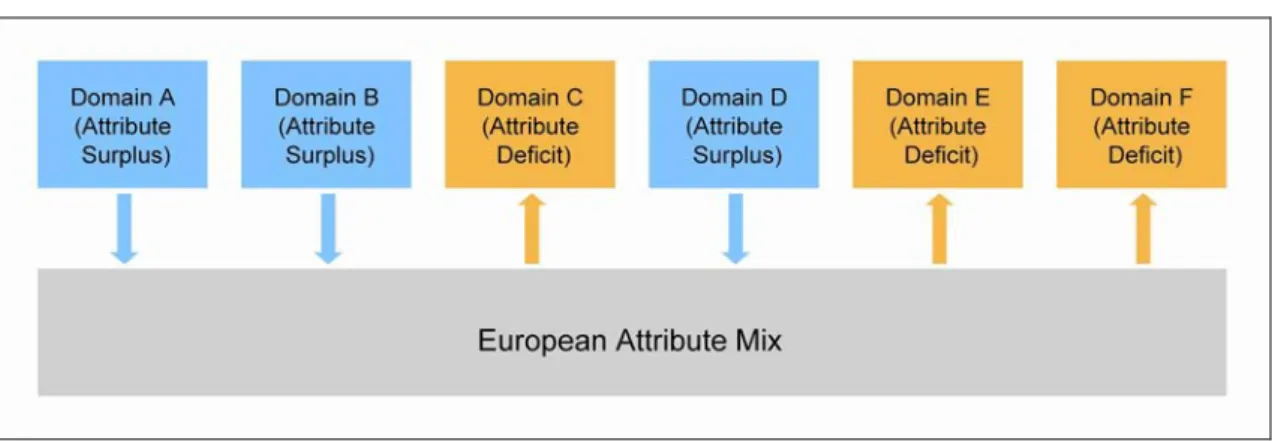
The European Attribute Mix is thus created as a mechanism for the balancing of the tracking domains in Europe regarding their deficits and surpluses in attrib-utes for disclosure purposes. This is also shown in Figure 1.
Figure 1: European Attribute Mix
Source: Timpe 2007.
This modification of the preliminary Residual Mix yields the final Residual Mix for the domain in question. This mix should then be allocated to all electricity consumption in the domain, for which no attribute information is available based on GO or RTS.
An additional correction of the Residual Mix might be necessary in case that a signifi-cant volume of GO is being used by final consumers of electricity which have pur-chased their electricity from a supplier, which has already applied attributes to this vol-ume of energy (see chapter 3.1). In case that the volvol-ume of such “double disclosure” becomes significant, it will be noticeable in the calculation of the volume of all attrib-utes available for disclosure in its domain. If this effect is being ignored, it will lead to an expansion of the Residual Mix to more electricity consumption than it actually stands for. Advanced measures to handle this effect could be to identify the attributes of the electricity disclosed to the consumers in questions and adding them to the Residual Mix. However, this would be a very complex task and does not seem adequate from today’s perspective.
Explicit tracking based on GO ort RTS should be used where possible. The reason for this preference is that if the Residual Mix is used extensively, then this will make the disclosure statements of many suppliers uniform and thus would be contrary to the
ob-jective of enabling consumer choice based on disclosure attributes. However, if no in-formation from explicit tracking is available for certain electricity volumes, the use of the Residual Mix for disclosure should be binding.
Usually the Residual Mix is calculated for disclosure in a single domain. Following the further integration of electricity markets in to a single market, the Residual Mix could also be calculated jointly for several domains, e.g. in the Nordic region.
3.4
Cross-border Transfer of Attributes
One of the major purposes of the tracking standard is to make explicit and implicit transfers between domains possible. E.g. a GO issued in one domain can be transferred to another domain and can be cancelled there. It is a principle that cancellations of GO must take place in the domain where the consumption of the electricity is located to which the attributes of the GO shall be allocated. This rule is necessary in order to en-sure the control of the relevant Competent Body over the discloen-sure scheme in their domain and to enable correct Residual Mix calculations.
Under certain conditions, there may also be Reliable Tracking Systems which span across the borders of domains and thus can transfer attributes between domains, see chapter 3.2. Finally, the determination of the Residual Mix also implies a cross-border transfer of attributes through the European Attribute Mix, see chapter 3.3.
However, the E-TRACK standard also needs to deal with transfers of electricity and attributes with other countries which have not established comparable tracking systems. For example, there are transfers of electricity between Finland and Russia and also be-tween some central European countries and their neighbours outside of the EU.
Generally, if electricity is imported into the group of countries which operate advanced tracking systems, then this import should be associated with the national generation mix of the exporting country. This mix should however not be available for contract based tracking by the importer, it should rather be integrated into the Residual Mix calcula-tions. If an importer wishes to import electricity with specific attributes from a country, then this country would first have to establish at least a GO system plus a Residual Mix calculation. If these two elements are established, the difference between the net imports of electricity and the imports of GO from this country should be associated with the Residual Mix of the country in question.
If electricity is exported to a country which does not have a full tracking system in place, then usually this export should be using the Residual Mix of the exporting coun-try. Competent Bodies might also provide for the option to allow a cancellation of GO for purposes of explicit tracking for exports to such countries, but this should be han-dled with care as such a mechanism could be misused by market actors for disposing of certain undesired attributes in a domain’s Residual Mix.
3.5
Accounting Periods
Disclosure information is always related to average values for one year. In order to al-low for a harmonised market framework and to enable the procedures for the Residual Mix calculation, the E-TRACK standard is defining the calendar year as the disclosure period for all domains. This will require modifications of the accounting periods in some domains such as the UK and Austria, where financial years are used which are different from the calendar year. However, if the disclosure periods and related dead-lines would not be harmonised this would create opportunities for arbitrage deals in the GO market and would make it impossible to calculate a proper European Attribute Mix. Actually, the only clear alternative to a single harmonised annual disclosure period would be that all tracking would be structured in quarterly disclosure periods across Europe. This would leave the definition of the reference period for disclosure to the domains and these could apply definitions which are starting at any quarter of a year. However, the additional transaction costs for this approach would be significant. Fur-thermore, the annual variations in hydro and wind production across Europe would need to allow for certain banking of GO, which would make the system even more complex. As a principle, the total volume of attributes used for disclosure in a domain should match the total volume of electricity consumption in any disclosure period.7 In order to not distort this balance, Competent Bodies should only accept attributes which relate to electricity generation in the disclosure period for the disclosure information related to consumption in this period. It should therefore not be allowed to use a GO which has been issued based on electricity production in one year in order to comply with the dis-closure requirement in another year.
In order to comply with this principle, the lifetime of GO must be limited. Only after the end of the lifetime of GO relating to generation in a disclosure period, the Residual Mix calculation can be started. All GO, which have been issued, but not redeemed until the end of their lifetime, will expire and their attributes will become part of the Residual Mix.
According to the 2009 RES Directive, the use of GO should be limited to a period of twelve months after the production of the underlying electricity. The E-TRACK stan-dard recommends to restrict the lifetime of most GO even further in order to allow for a proper Residual Mix calculation.
Exemptions from this recommendation are required for those production devices whose meter readings are taken only on an annual basis, and not necessarily at the end of a disclosure period. In these cases some GO relating to production in a certain disclosure period should be allowed for use in the following disclosure period, but not later than
7
twelve months after the end of the production period. As large power plants usually have automated meter readings, this problem will mostly relate to small plants and thus the margin of error in the disclosure information will be limited.
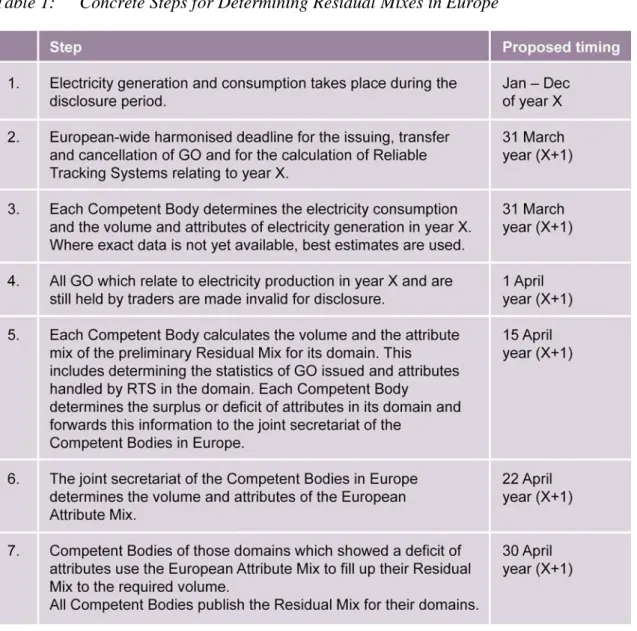
Table 1 presents the proposed timelines for the coordinated steps undertaken by Compe-tent Bodies in determining the Residual Mixes in their domains.
Table 1: Concrete Steps for Determining Residual Mixes in Europe
Source: Author’s own compilation.
This schedule allows for sufficient time for the handling of GO by market actors and the management of RTS within the first quarter of the year following the disclosure period. All relevant steps for the calculation of the Residual Mix are then undertaken in April of the year following the disclosure period. This enables the suppliers of electricity to pre-pare their disclosure statements during May and to publish their disclosure information in June or July of the year following the disclosure period.
3.6
Support Certificates
Whereas the previous chapters have focused on tracking systems supporting electricity disclosure, this chapter briefly looks at the requirements of certificate systems facilitat-ing support schemes such as quota obligations. Such support certificates are issued to the generators of eligible electricity generation and all obliged parties are required to purchase and cancel a certain number of support certificates.
In principle, Member States can use GO not only for disclosure purposes, but also as support certificates in the context of a domestic support scheme.8 This could be seen as a simple approach, because it would require the operation of only one certificate system. However, in practice, the introduction of one certificate system for two separate pur-poses can have complex implications and might be difficult to understand for the actors involved. Thus the E-TRACK Standard provides for support certificates which are le-gally separate from GO. They can be used by those domains which are using a certifi-cate-based support scheme. If decision-makers in a domain prefer that GO and support certificates remain bundled when being transferred between market actors, then they can stipulate such “technical” linkage of the legally separated certificates in the regulations of the support scheme.
If support certificates and GO coexist in a domain, they should be clearly distinguish-able and their misuse for other purposes than those they were issued for should be pre-vented. This requires adequate definitions and regulations in primary or secondary legis-lation.
It should be noticed that the compliance period of certificate-based support schemes does not have to be restricted to calendar years. Quota obligations might define a life-time of support certificates of several years in order to stabilise the certificate market and to make them less dependent from annual variations in hydro and wind power gen-eration.
If Competent Bodies want to allow for imports and exports of support certificates, then the definition of the support certificate must be fully harmonised between the domains involved.
8
A separation of the functions of GO and support certificates is not required by European Directives, unless they are being used in a Joint Support Scheme which has effect on the national targets for re-newable energy under Directive 2009/28/EC.
4
Additional Regulations of the Standard
4.1
Actors
A number of functions have been identified in providing a tracking system. These are:
· Governmental authority – responsible for the definition of electricity disclosure or support schemes in a domain and so controls eligibility for a scheme as well as determining compliance with that scheme.
· Competent Body – usually responsible for the overall operation of the tracking systems in a Domain. Responsible for examining the evidence collected about electricity generation and controlling the issuing, transfer and redemption of GO and of Reliable Tracking Systems if applicable. Calculates the Residual Mix for its domain.
· Issuing Body – the body actually processing applications of production devices and information related to the evidence about electricity generation and issuing of GO. In many cases the Competent Body is also acting as the Issuing Body. However, there may also be different Issuing Bodies working for different GO schemes, e.g. for electricity and for heating and cooling from renewable energy sources, under the supervision of one Competent Body.
· Registry Operator – maintains a registry and the data contained within it. He is also responsible for ensuring the secure and timely transfer of data into and out of that registry. In many cases the Competent Body is also acting as the Registry Operator. However, the Competent Body might also delegate the operation of the registry to another body, e.g. a private supplier. If several GO systems with several Issuing Bodies exist in a domain, these might all work together with a single registry operated by a single operator.
· Accreditation Body – performs the verification of the plant registration details on behalf of a Competent Body.
· Data Collector – responsible for obtaining the evidence of generation episodes. In addition to these roles within a domain, there is also a need for a European-wide coordination of the Competent Bodies. This organisation should ensure the harmonisa-tion of the tracking systems used in different domains and should define the interfaces for the transfers of GO (and possibly also support certificates) across domain borders. It should also facilitate the calculation of the European Attribute Mix. This organisation would own the E-TRACK standard and would develop it further as appropriate.
Given the current status in Europe, the role of this coordinating body could be formed by the umbrella organisations of the European regulators (CEER/ERGEG), of the Transmission System Operators (ENTSO-E) or by the Association of Issuing Bodies. These organisations should agree where the coordination of Competent Bodies in Europe would be placed in the best way.
The issuing body, registry operator, accreditation body and data collector are jointly called the agents of the Competent Body. In order to ensure the reliability and credibil-ity of the tracking system, all Competent Bodies and their agents should be independent from market actors and should not have any own interests in the markets for electricity and GO. They should also be bound to strictly ensure the confidentiality of all tracking information, unless their publication is required by the scheme regulations.
4.2
Set of Electricity Attributes
It is important to define a joint European standard for the minimum information content of GO as well as of other tracking information crossing the borders of domains. All countries should agree to accept tracking information based on this standard for electric-ity disclosure. See Annex 1 for an indicative list of attribute information for disclosure purposes.
If domains allow for imports of support certificates, then a related definition should be agreed as well.
4.3
Registries for Explicit Tracking
The registries are able to issue GO based on information on power generation, to track ownership of the GO, and to facilitate their transfer to any other registry within the E-TRACK standard. The registries also support cancellation of the GO, which means that the value of the GO is realised and credited to the current owner, and that the GO cannot be transferred any more. Each registry handling GO will need to supply input to the procedure for the calculation of the Residual Mix in the respective domain.
The operation of the registry in a domain can be seen as a natural monopoly. This means that it would incur inadequate additional effort to coordinate the operation of several registries in a domain in order to exclude double counting of attributes. Thus the Competent Bodies should ensure that there is only one registry in each domain.9
A registry should provide as much open access as possible in order to provide transpar-ency and support user assurance in the system and the accuracy of reported information. This suggests a web-enabled registry would be the most efficient solution offering a suitably broad coverage.
There are already a number of operational registries for GO and also for support certifi-cates and RECS certificertifi-cates in Member States and non EU-members. Most of those reg-istries are connected to the EECS system. Many of those systems would satisfy most of the requirements and specifications set out in this document.
9
It would be possible though to establish different registries in a domain for different types of electric-ity generation which are not overlapping. However, as the registry operation has significant econo-mies of scale, this would most likely increase the total costs of tracking and thus should be avoided.
4.4
Network Losses and Balancing Power
The previous chapters have neglected the impact of network losses and balancing power on the tracking system. However, these two factors will in fact have a noticeable impact on the balance between the attributes available for disclosure in a domain, which are determined based on net electricity generation, and the demand for attributes for disclo-sure purposes, which is related to final electricity consumption. In order to manage these effects, the following recommendations are given:
· Losses in the electricity networks should be treated like consumption and thus should be covered by attributes as well. Unless specified otherwise by national legislation,10 they should be covered with attributes from the Residual Mix.
· Production of balancing power should be treated like any other power produc-tion and thus should be eligible to issuing of GO or alternatively become part of the Residual Mix.
4.5
Data Issues for Explicit Tracking
4.5.1
Communication between Registries
Transfers of GO between registries require a common approach to the data format and identifiers in order to facilitate the infrastructure and to ensure uniqueness. As GO are held in the form of electronic certificates, electronic transfer should be the standard method of transferring records between registries. The transfer process should be con-ducted using a common transfer protocol to ensure safe operation.
Inter-registry transfers as well as provision of joint information for all registries should be provided by a centralised hub (as opposed to a peer-to peer-system with dispersed information). This significantly reduces the number of bilateral interfaces between the registries and therefore cuts back the costs of tracking. For reasons of cost and availabil-ity, the transfer medium should be the internet using a commonly available XML based file format. Transfer security should be achieved using a commonly available security method.
4.5.2
Sources and Availability of Data
The E-TRACK standard aims at using already existing data sources where possible. In Member States where GO for RES-E and CHP-E are implemented, many data availabil-ity issues are already addressed and in a number of domains, electronic GO are already in operation for RES-E and HE-CHP-E.
10
The data required to extend GO to all electricity sources already exists in many coun-tries and would be feasible to collect without incurring substantial costs. However, in other countries it might be necessary to set up new collection systems for parts of the required data, in order to obtain consistent information.
In some cases, data from different sources could be combined to provide a full set of evidence. Use of existing sources will avoid costs and inconvenience of duplicated data provision and collection. However, the first phase of the E-TRACK project has identi-fied a number of instances where data exists, but cannot be accessed for tracking pur-poses without changes in legislation.
4.5.3
Data Collection Requirements
A production plant must only be allowed to register with a Competent Body or its agents for the domain in which the plant is located. Metered output data must be con-tinuous throughout the period of registration to facilitate reasonableness checks. Pro-ducers must also warrant that their data is only presented to the tracking system at one entry point. These requirements reduce the scope for erroneous or fraudulent claims by generators.
Issuing must be based on net electricity generation throughout the E-TRACK standard. The reason for this is that for purposes of disclosure, the attributes of electricity must be displayed at the point of electricity consumption.11 The metering data reference point should be such that auxiliary generator data and station consumption can be identified. Difference metering against grid connection meters should be used where necessary to achieve this.
Data collected must be verified by an independent organisation. In the case of genera-tion identifiable through central energy settlement, meter data from that settlement process should be acceptable as independent. Data collection should also be automated wherever economic to do so.
Issuing of GO should normally be based on full Megawatt-hours produced. Rounding up of part units of evidence should not be used as this discriminates in favour of small plant. Any remaining part units should be carried forward into the subsequent genera-tion episode.
The attributes from multi-fuelled production devices should be allocated according to energy source factors calculated using the mass and calorific values of each fuel used.
11
This requires an adaptation of the current regulations in the CHP Directive 2004/8/EC, which require GO for CHP-E to be issued for gross generation. Until this is achieved, CHP operators should be obliged to redeem a number of GO for CHP-E which corresponds to the volume of electricity con-sumed by the auxiliaries of their production devices.
4.6
Multi-Certificate Systems
If a single certificate would be allowed to carry attributes which are eligible for several purposes, e.g. disclosure and support for RES-E production, then the regulations of these schemes might require the cancellation of the certificate by different actors and/or at different points in time. In order to manage this problem, the E-TRACK Standard defines a “multi-certificate” system, which introduces several transferable certificates based on the same instance of electricity generation, but carrying different associations to the individual schemes.
This problem is only relevant in domains which operate support systems using a certifi-cate-based evidence for their compliance mechanism. In this case the E-TRACK stan-dard provides for the separation of support certificates from the GO. Thus, two certifi-cates can be issued from a single instance of generation, which have clearly distinct purposes. The separated certificates must both be managed in tracking systems under the E-TRACK standard. Also, the Competent Body of the domain in question must make sure that the individual certificates are distinguished clearly so that they can not be cancelled for other purposes than they were issued for. Other countries might require the re-bundling of support certificates and the related GO before accepting their import. (See also chapter 3.6.)
5
Governance of the Tracking Standard
It must be noted that although this document uses the term “standard”, this does not imply that the E-TRACK standard is intended to become a formal standard following the rules of international standardisation organisations like CEN/Cenelec.
5.1
Governance at the Domain Level
Each tracking domain will be managed by the respective Competent Body. The Compe-tent Body will usually be appointed by the government or by national legislation. In this context regulations should be made how the cost for the Competent Body and its agents are to be covered and how the Competent Body should supervise the operations of its agents.
It is certainly useful to incorporate the experience and expertise of market players in the design and management of tracking domains. The Competent Body should lay down rules for participation of stakeholders in the system design and further development.
5.2
Governance at the Inter-Domain Level
The E-TRACK standard will not be static; it will rather have to be adapted to develop-ments in the markets for electricity and attributes and to the changing requiredevelop-ments from governments of countries participating in the standard, and of new members. Therefore a body on the European level is required which governs the standard and develops it further as appropriate. This coordinating body could for example be an independent not
for profit organisation under a code of practice recognised by national electricity regula-tors and governments, in which all Competent Bodies are members.
As stated in chapter 4.1, the coordinating body could be formed by the associations of the European regulators (CEER/ERGEG), of the Transmission System Operators (ENTSO-E) and/or by the Association of Issuing Bodies.
The admission of domains into the joint standard, and the ongoing quality control of the operations in the cooperating domains are additional tasks which need to be fulfilled by the European coordinating body. Furthermore, the following responsibilities should be placed on this organisation:
· Operation of the central hub, which facilitates the exchange of GO and man-agement of joint information for all domains.
· Support for the determination of the Residual Mixes in all domains through the management of the European Attribute Mix.
The relationship between the coordinating body and the Commission, national govern-ments, regulators and industry trade associations should be established as part of the implementation of the E-TRACK standard.
Possible funding arrangements for the organisation will need to be equitable and have some relationship to the volume of use. Funding of service providers can be on an en-terprise basis (paid by the users of the service) and not necessarily through the coordi-nating body.
6
References
Draeck, Mark (2009): The state of implementation of electricity disclosure and Guaran-tees of Origin across Europe. A report from the E-TRACK II project, June 2009. Available for download from the E-TRACK website:
http://www.e-track-project.org/docs.php.
Jansen, Jaap, Seebach, Dominik (2009): Requirements of electricity end-users on track-ing of electricity generation attributes and related policies. A report from the E-TRACK II project, September 2009. Available for download from the E-TRACK website:http://www.e-track-project.org/docs.php.
Pooley, Chris (2007): Technical Requirements for the European Tracking System. A report from the E-TRACK project, August 2007. Available for download from the E-TRACK website:http://www.e-track-project.org/documents.php.
Schoots, Koen (2009): CHP-GO implementation and their integration with other poli-cies, including policy recommendations. A report from the E-TRACK II project, September 2009. Available for download from the E-TRACK website:
http://www.e-track-project.org/docs.php.
Seršen, Ervin, Škerbinek, Gorazd, Špec, Andrej (2009) Situation in the twelve New Member States with regard to tracking and related policies. A report from the E-TRACK II project, February 2009. Available for download from the E-TRACK website:http://www.e-track-project.org/docs.php.
Timpe, Christof (2007): A European Standard for the Tracking of Electricity. Final re-port from the E-TRACK project, August 2007. Available for download from the E-TRACK website: http://www.e-track-project.org/documents.php.
Timpe, Christof, Ritter, Herbert, Pooley, Chris, Seebach, Dominik, Lescot, Diane, Sand-ford, Mike (2007) The E-TRACK Standard, Version 2.0. A report from the E-TRACK project, August 2007. Available for download from the E-TRACK website: http://www.e-track-project.org/documents.php.
Timpe, Christof, Seebach, Dominik (2009): Best Practice for the Tracking of Electric-ity. Recommendations from the E-TRACK II project. A report from the E-TRACK II project, November 2009. Available for download from the E-TRACK website:http://www.e-track-project.org/docs.php.
Verband der Elektrizitätswirtschaft e.V. (VDEW) (2005): „Electricity labelling“ Guide-lines. Implementation guide for power supply companies, electricity producers and suppliers as to the provisions on electricity labelling. Translation of the final German version dated 14 October 2005. See the BDEW website:
http://www.bdew.de/bdew.nsf/id/DE_Datenplattform_Stromkennzeichnung ) (Note: In 2007 VDEW has been merged into Bundesverband der Energie- und Wasserwirtschaft (BDEW). An English translation of the revised German version dated 3. November 2009 is not available.)
Annex 1: Proposal for a set of electricity attributes
The following list if attributes for purposes of electricity disclosure is illustrative only. Details must be agreed in the course of the technical implementation of the tracking standard. Note that part of the information is only required for certain types of electric-ity generation. Type “M” means a mandatory element, and “O” means an optional ele-ment of the set of attributes under the E-TRACK standard.
Attribute Example for data content Type Comment
Basic set of information for all certificates:
Face value 1 MWh M Volume of electricity genera-tion, whose attributes are represented
ID code of produc-tion device
[alphanumeric code] M Each production device must be provided with a unique identifier
Issuing Body Certiq (NL) M Can also be encoded Start date of
genera-tion period
1.01.2009 M
End date of genera-tion period
31.01.2009 M
Date of issuing 10.02.2009 M The actual day when the cer-tificate has been issued Certificate
qualification
GO for RES-E M Entries must be based on au-thorisation of the relevant Competent Bodies
Support eligibility Code(s) of support scheme(s) or “no”
M Entries must be based on au-thorisation of the relevant Competent Bodies
Support provided Code(s) of support scheme(s) used (if any) or “none”
M If one or more support schemes are used, their codes must be entered. This also applies if separate support certificates have been issued. Note: “M”: Mandatory; “O”: Optional.
Attribute Example for data content Type Comment
Disclosure specifications (applicable to all Guarantees of Origin):
Energy source [list to be agreed, e.g. coal, natural gas, nuclear, re-newable energy sources, other energy sources]
M Energy source used for elec-tricity generation
CO2 emission factor X g/kWh O Plant-specific emissions
Radioactive waste production factor
X µg/kWh O Plant-specific waste production
Additional RES specifications (only applicable for RES-E):
Detailed energy sources
[list to be agreed] M An entry in this field indi-cates RES-E production Detailed technologies [list to be agreed] M RES-E conversion
technol-ogy Compliance of
bio-energy with sustain-ability criteria
[list to be agreed] M This can comprise the certifi-cation under the RES Direc-tive as well as selected pri-vate schemes.
Additional RES-E GO information
[to be agreed] M Requirements set by EU Di-rective or by national legisla-tion
Attribute Example for data content Type Comment
Additional CHP specifications (only applicable for GO for high-efficiency CHP-E):
Detailed energy sources
[list to be agreed] M An entry in this fields indi-cates high-efficiency CHP production
Detailed technologies [list to be agreed] M CHP-E conversion technol-ogy
Type of use of the CHP heat
[list to be agreed] M List must include the items from the list in the CHP Directive
Lower calorific value of the fuel source
X MJ/kg M
Primary Energy sav-ings
X% M
Additional CHP-E GO information
[to be agreed] M Requirements set by EU Di-rective or by national legisla-tion
Other information (applicable to all certificates):
Eligibility for quality labels
Code(s) of quality label(s) O Optional information, which refers to a specific quality standard (e.g. Bra Miljöval, ok-power, naturemade), and can also include additional specifications, e.g. the level of additionality.