INTRODUCTION TO LIFE INSURANCE
8
Learning Objectives
An understanding of the material in this chapter should enable the student to 1. Identify the family and business purposes of life insurance.
2. Explain the methods of providing life insurance protection. 3. Describe the three traditional types of life insurance.
4. Describe variations on the traditional types of life insurance. 5. Describe the life insurance provided by employers and other types
of groups.
A human life has value for religious, relational, and social reasons that defy measurement. From a religious standpoint, for example, human life is regarded as immortal and endowed with a value beyond the comprehension of mortal man. In a person's relationship with other human beings, a set of emotional and sentimental attachments is created that cannot be measured in monetary terms or supplanted by material things. A human may be capable of artistic achievements that contribute in a unique way to the culture of a society.
human life value Life insurance, however, is primarily concerned with the economic value of human life, which can be measured to some degree in financial terms. A person's human life value is derived from earning capacity and the financial dependence of other lives on that earning capacity. More precisely, a person's human life value can be measured in terms of the present value of that portion of estimated future earnings, which, if he or she lives long enough to achieve all of the earnings, will be used to support dependents. Financial planners must understand the concept of human life value in order to evaluate their clients' life insurance needs.
EXAMPLE 1
Vance is a 30-year-old male whose estimated average earnings will be $50,000 per year until he retires at age 65. If we assume that one-half his income will be used to support dependents, his economic value to dependents is $25,000 per year for 35 years or $875,000 ($25,000 × 35 = $875,000). However, at age 30 his human life value is not this $875,000 total, but the present value of a stream of income in the amount of $25,000 for 35 years. Using a rate of 6 percent compound interest, the present value of this cash flow is calculated at $362,456.
Stated differently, if Vance's dependents had $362,456 today and invested it at 6 percent compound interest, they could withdraw $25,000 per year for the next 35 years before running out of money. Based on these assumptions, Vance's current human life value is $362,456.
Although this simple example illustrates the human life value concept that equates the value of a person's life with the income stream that person generates, the human life value concept has many obvious flaws that limit its usefulness as a financial planning tool. Perhaps most obvious is the assumption that income will be level over a number of years. This basic concept can be refined.
Life insurance is a valued contract, not a contract of indemnity. When an insured person dies, the beneficiaries of his or her life insurance receive the face amount of the policy or some other benefit that depends on provisions within the insurance contract. The amount paid by the insurer does not depend on any external measure of the insured's worth but rather on the life insurance benefit that was purchased. Financial planners need to help their clients understand what type and amount of life insurance will provide a benefit that compensates survivors for the economic loss associated with the death of an insured.
Because the human life value may arise out of a family or a business relationship, it is important to understand the purposes of life insurance for families and businesses, the basic methods of providing life insurance protection, and the types of individual life insurance policies. Three traditional types of life insurance are term insurance, whole life insurance, and endowment policies. Some of the newer variations of life insurance policies include current assumption whole life insurance, variable life insurance, universal life insurance, variable universal life insurance, indexed universal life insurance, joint-life insurance, and group insurance, a marketing variation.
PURPOSES OF LIFE INSURANCE
When measured in terms of his or her lifetime earning capacity, an individual's life may be worth millions of dollars. However, earning power alone does not create a need for life insurance. The financial value of any human life lies in the purposes for which the individual's earnings might be used.
A person's life clearly has an economic value if some other person or organization expects to benefit financially from the person's existence. Most income producers either have dependents or expect to acquire some during their lifetimes. People without legal dependents often intend to voluntarily provide financial support to relatives, friends, and charitable or religious organizations. Whether provided during one's lifetime or through an inheritance, this support may come from income earned during the person's lifetime or through life insurance proceeds payable upon the person's death. Life insurance also serves a wide variety of purposes in the business world. The primary purposes of life insurance in business are key person indemnification, business continuation, and protection for employees and executives.
METHODS TO PROVIDE LIFE INSURANCE
PROTECTION
There are two basic approaches to life insurance: • term insurance, which is temporary
• cash value insurance, which provides permanent protection and involves a reserve or savings component
Premiums are usually guaranteed for the duration of the policy, but some policy types offer flexible premiums.
Term Insurance Approach
yearly renewableterm insurance
Yearly renewable term insurance is the simplest form of life insurance. Yearly renewable term insurance provides protection for a period of 1 year and permits the policyowner to renew the policy for successive 1-year periods without furnishing a medical examination or other evidence of insurability. Term life insurance can also be written for longer periods, such as 5 or 10 years. A 10-year renewable term life insurance policy has a level premium for 10
years and may then be renewed for another 10 years at a higher premium. However, the right to renew is usually limited to a stated number of years or up to a specified age. If the insured dies while the term policy is in force, the face amount is paid to the designated beneficiary. If the insured does not die during the period of protection, no benefits are payable at the expiration of the policy or on the insured's subsequent death.
To clarify the term insurance approach, the following discussion deals only with the net premium and ignores the insurer's operating expenses. The net premium for term insurance is determined by the death rate for the attained age of the individual involved. Subject to minor exceptions, death rates increase with age, so the term insurance policy's net premium needed to pay death claims increases at the start of each new term. Moreover, because death rates rise at an increasing rate as ages increase, the net premium also rises at an increasing rate, much like a flight of stairs with successively higher risers.
If the surviving members of the insured group continue to renew their term insurance, the steadily rising premiums necessary to cover death claims become increasingly unaffordable. As premiums increase, healthy individuals will tend to give up their protection, while those in poor health may sacrifice to renew their policies, regardless of cost. This is a type of adverse selection. The withdrawal of the healthy members accelerates the increase in the death rate among the continuing members, and it can produce death claims in excess of premiums unless the insurance company's net premium rates provide ample margins. An insurer cannot adjust its term insurance rates if they prove to be inadequate, because the rates at which the policy can be renewed are usually guaranteed for the entire period of renewability. For these reasons, companies that offer term insurance on an individual basis limit the time during which the insurance can be renewed, such as up to age 65.
At older ages, the premium rates for term insurance are extremely high. However, many individuals need coverage that extends throughout their lifetime. This need led to the development of cash value or permanent life insurance.
Cash Value Approach
cash value lifeinsurance
Withcash value life insurance, premiums are sufficient not only to pay the insurer's mortality costs (death claims) and expenses but also to build a cash value (or savings
fund) within the policy. That fund's growth depends in part on the premiums paid, and it is designed to equal the face amount of the policy at some point, such as age 100 or 120.
Life insurance calculations are based on mortality tables. Until recently, these mortality tables assumed that few people would live past the age of 100. If the insured is still alive at age 100, the policy’s maturity date, the face amount is paid to the policyowner. Many insurance policies based on this assumption remain in force. However, currently issued policies are based on the 2001 Commissioners Standard Ordinary (CSO) mortality table, which is a mandatory minimum standard insurers must use for all policies issued on or after January 1, 2009. Reflecting improvements in longevity, this table runs to age 120. Newly issued cash value life insurance policies have a maturity date of 121; in the event an insured survives to age 121, the face amount is paid. In many cash value policies, the annual premium does not increase from year to year but remains level throughout the premium-paying period. This does not mean that the policyowner must pay premiums as long as insurance protection is in force, but only that all required premiums will be the same amount.
Net premiums tend to rise as a result of increasing death rates. If premiums are leveled out, those paid in the early years of the contract must be more than sufficient to meet current death claims, while those paid in the later years generally will be less than adequate to meet incurred claims. The net premiums beyond those needed for death claims in the early years of the contract create an accumulation that is held in trust35by the insurance
company for the benefit of, and to the credit of, the policyowners. This accumulation is usually called a legal reserve. The legal reserve is an amount that, augmented by premium payments under outstanding contracts and interest earnings, is sufficient to enable the life insurer to meet its expected future obligations. These obligations include death benefits and nonforfeiture benefits such as policy loans and surrender values. Because the 2001 CSO mortality table assumes premiums may be paid over a longer period of time, use of the later table reduces statutory legal reserve requirements by approximately 20 percent.
The manner in which the reserve fund is accumulated and invested is strictly regulated by law. Technically, the reserve is a liability account on the insurer's balance sheet. The reserve is not allocated to individual policies, but it may be viewed as an aggregate of individual savings accounts established for the benefit of the policyowners.36
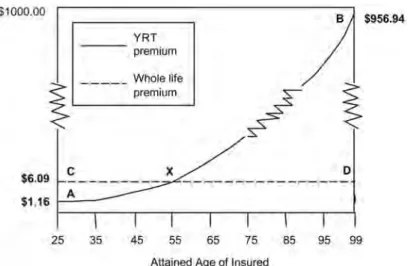
Figure 8-1 compares the net level premium for a type of cash value policy known as whole life with the net premium that would be required for a yearly renewable term policy. The age of issue in both cases is 25. Assume that an annual net level premium of $6.09 per $1,000 of insurance is paid for the whole life policy as long as the insured lives. This premium is the actuarial equivalent of a series of increasing net premiums on the yearly renewable term basis, ranging from $1.16 per $1,000 of insurance at age 25 to $956.94 at age 99.
Figure 8-1
Annual Net Premium Comparison per $1,000 of Coverage— Whole Life and Yearly Renewable Term (YRT)
The mortality table used in this example assumes that everyone who survives to age 99 will die during the following year, producing a net premium at age 99 on the yearly renewable term basis equal to the face of the policy, minus
36. In practice, each policy is credited with a cash value or surrender value, which is not the same as the reserve but also has its basis in the redundant premiums of the early years.
the interest earned on the premium during the year. New policies use a mortality table that extends through age 120.
InFigure 8-1, line CD, the net level premium for the whole life policy, bisects the curve AB, the rising net premiums for the term policy, between the ages of 53 and 54. The disparity between the areas bounded by AXC and BXD shows that excess net premiums (AXC) in the early years of a whole life contract (or, for that matter, any type of insurance contract except term) will offset the deficiency in the net premiums of the later years when the term insurance net premium is in the hundreds of dollars. In addition, with the aid of compound interest, the excess premium will accumulate a reserve equal to the face of the policy by the time the insured reaches age 100 or 121. In contrast, a yearly renewable term contract will have no reserve at the expiration of the contract. So long as premiums are paid, a permanent or cash value life insurance contract must provide for a death claim that is certain to occur, the only uncertainty being the time of its occurrence.
net amount at risk Under a cash value contract, the accumulated reserve becomes part of the face amount payable at the insured's death. From the standpoint of the insurance company, the effective amount of insurance is the difference between the face amount of the policy and the reserve. This amount is called the net amount at risk. As the reserve increases, the net amount at riskdecreases if the face amount remains constant.
A cash value life insurance policy does not provide pure insurance but a combination of protection and cash values, the sum of which is always equal to the face amount of the policy. This is illustrated in the figure below for a level-premium whole life policy of $1,000 issued at age 25. Because of the accumulated reserve, a $1,000 permanent life insurance policy does not provide $1,000 of pure insurance, and the company is not "at risk" for the face amount of the policy. The amount of actual insurance is always the face amount, minus the policyowner's total excess net premium payments, plus interest. From the insurance company's perspective, the accumulation is the reserve, and from the policyowner's perspective, it is the cash value, which is slightly less than the reserve in the early years. Because the policyowner can withdraw the excess net premium payments in the form of the cash value at virtually any time, these excess net premium payments can be regarded as a savings or accumulation account.
The area below the curve represents the reserve under the contract or, as mentioned above, the policyowner's equity in the contract. The area above the curve represents the company's net amount at risk and the policyowner's amount of protection. As the reserve increases, the amount of pure protection decreases. At any given age, the two combined will equal the face amount of the policy. By the insured's age 95, the protection element of the contract has become relatively minor, and by age 100—frequently, the end of the contract—it has completely disappeared. At age 100, the policyowner will receive $1,000, composed entirely of the policy's cash value element. The illustrations here are based on an in-force policy with a maturity date of 100. The same principles apply to a policy with a maturity date of 121 except that the accumulated reserve builds more slowly.
Figure 8-2
Proportion of Protection and Savings Elements per $1,000 of Coverage in Ordinary Whole Life Contract, Issued at Age 25
This combination of protection and accumulated cash values is characteristic of all permanent life insurance. Fundamentally, one contract differs from another only by the proportions in which they combine the two elements. Yearly renewable term insurance is all protection with no cash value, while single-premium life insurance is at the other end of the spectrum, with the highest cash values and the lowest net amount at risk. Accumulated cash values should be thought of as a degree of prefunding. Single-premium policies are fully prefunded, and lower-premium policies that develop cash
values are only partially prefunded. The shorter the premium-paying period, the higher the relative proportion of cash value to death benefit.
Nearly all operations of a life insurance company feel the effect of cash value or permanent life insurance plans. The reserve accounts for a major portion of the aggregate assets of life insurance companies. The need to invest funds presents the life insurance institution with a challenge but also enables it to materially contribute to economic expansion. The cash value makes a life insurance contract one of the most flexible and valuable contracts in existence, and one of the most acceptable forms of collateral for credit purposes. A cash value or permanent life insurance plan provides the only practical arrangement to provide insurance protection for an individual's entire life span, without the possibility that the cost will become prohibitive.
Effect of the Cash Value
•Serves as a major source of an insurer's investable funds •Adds to the flexibility of the life insurance policy •Is useful as collateral for credit purposes
•Makes permanent death protection possible
Guaranteed Premiums
modified wholelife insurance
With most types of life insurance policies, the periodic premiums to be paid throughout the premium-paying period of coverage are known in advance and guaranteed by the insurance company. However, these premiums are not necessarily level over time. For example, in a yearly renewable term policy, the annual premium increases are usually guaranteed by the insurer at the issue of the contract. A similar guarantee is provided with respect to the renewal premiums for 5-year, 10-year, and other renewable term policies. Even in cash value policies, the annual premiums can be both nonlevel and guaranteed. An example would bemodified whole life insurance. Modified whole life insurance guarantees a level premium for the first few policy years, with a higher guaranteed level premium thereafter.
Flexible Premiums
In several types of life insurance policies the premium is flexible, at the option of either the policyowner or the insurance company.
• With universal life insurance, the policyowner can elect to pay, within limits, more or less than the target premium established at the issue of the contract.
• With current assumption whole life insurance, the insurer
periodically redetermines the premium, based on experience and assumptions for mortality, expenses, and interest.
Flexible premiums naturally affect the cash value of permanent insurance.
TRADITIONAL TYPES OF LIFE INSURANCE
There are three traditional types of life insurance: • term insurance
• whole life insurance • endowments
Term Insurance
Term life insurance provides life insurance protection for a limited period only. The face amount of the policy is payable if the insured dies during the specified period, and the insurer pays nothing if the insured survives.
Like most property and liability insurance contracts, term insurance provides temporary insurance. A person who buys a 1-year property insurance policy pays for 1 year of insurance coverage. The insurer pays for any covered claims that occur during that year. At the conclusion of that 1-year period, the insurer has no further obligation unless the policy is renewed for another year. Likewise, if a person insures his or her life under a 5-year term contract, no obligation is incurred by the insurance company unless the death of the insured occurs within the term. The company considers all premiums paid for the term protection to be fully earned by the end of the term, whether or not a loss has occurred, and the policy has no further value.
return of premium term insurance
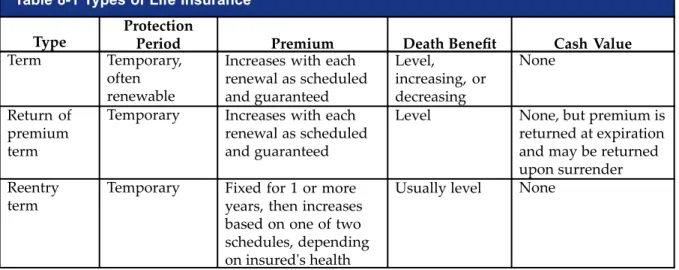
A variation on traditional term insurance, known asreturn of premium term insurance, returns all premiums if the insured is still alive at the end of the policy term. A portion of the premium may also be returned if the policy is surrendered during the policy term after some minimum time period has elapsed. To many people return of premium term insurance feels like free insurance but this view, of course, ignores the time value of money.
The premium for term insurance is initially relatively low, even though it includes a relatively high expense loading and an allowance for adverse selection. Premiums can be low because most term contracts do not cover the period of old age when death is most probable and the pure cost of insurance is high. Depending in part on the age of the insured and the length of the term, return of premium insurance can cost 25 to 50 percent more than traditional term insurance.
Renewability
Many term insurance contracts contain an option to renew for a limited number of additional periods, usually of the same length. The simplest policy of this type is the yearly renewable term policy, which is a 1-year term contract renewable for successive periods of 1 year each. Longer term contracts, such as 10-year term, may also be renewable.
renewability Renewability refers to the right to renew the contract without a medical examination or other evidence of insurability. The renewability feature protects the insurability of the insured. When a term policy contains no renewal privilege, or when it can be renewed only upon evidence of insurability satisfactory to the company, the insured may find that he or she cannot continue coverage as long as needed. Because of poor health, a hazardous occupation, or some other reason, the insured might be unable to secure a renewal of the contract or to obtain any other form of life insurance.
reentry term insurance
A variation is known asreentry term insurance. Reentry term insurance permits the insurer to use one schedule of renewal premiums if the insured can prove his or her continuing insurability and a higher schedule of renewal premiums if the insured's health has declined.
Under a term insurance policy, the premium increases based on the insured's attained age at the time of each renewal. Within each contract period, however, the premium is level. The schedule of renewal rates is included in the original contract, and the company cannot change these rates while the contract remains in force. As a safeguard against adverse selection, companies historically did not permit renewals beyond a specified age, such as 65. Renewals that continue the coverage to later ages are now commonly available.
Convertibility
convertibility Convertibility is the policyowner's right to replace term coverage with permanent individual coverage, within a specified time frame, without having to show evidence of insurability. Convertible term insurance enables a policyowner to obtain temporary insurance with the option to purchase permanent insurance. This feature serves the needs of those who want permanent insurance but are temporarily unable to afford the higher premiums that whole life and other types of cash value life insurance require. Convertibility is also useful when the policyowner desires to postpone the final decision as to the type of permanent insurance until a later date when, for some reason, it may be possible to make a more informed choice.
The conversion from term to permanent insurance may be effective as of the date of the conversion or as of the original date of the term policy. If the term policy is converted as of the current date, conversion is usually referred to as theattained age methodbecause the current age determines the premium rate. A conversion using the original date of the term policy is referred to as theoriginal age methodor aretroactive conversion. When the conversion is effective as of the original date, the premium rate for the permanent contract is the lower rate that would have been paid had the new contract been taken out originally, and the policy form is that which would have been issued originally. The advantage of the lower premium is obvious, and in many cases, the contract issued at the original date contains actuarial assumptions or other features that are more favorable than those incorporated in current policies.
Attained Age versus Retroactive Method
•Attained age method of conversion: New premium is based on insured's age at time of conversion; policy form is one that the insurer issues at that time. •Retroactive (original age) method of conversion: New premium is based on
the insured's age when the term insurance was first taken out; policyowner must make a lump-sum payment equal to the difference in the reserves or premiums plus interest on the old and new policies; policy form is one that the insurer issued when the term insurance was first taken out.
Offsetting the advantages of the original age method, however, is the financial adjustment—a payment by the policyowner to the company—which may be quite substantial if the term policy has been in force for several years.
The financial adjustment can be computed on a variety of bases, but many companies specify that the payment will be the larger of (1) the difference in the reserves under the policies being exchanged or (2) the difference in the premiums paid on the term policy and those that would have been paid on the permanent plan, with interest on the difference at a stipulated rate. The purpose of the financial adjustment, regardless of how it is computed, is to place the insurance company in the same financial position that it would have been in had the permanent contract been issued originally.
Nonlevel Term Insurance decreasing term
insurance
Normally, the amount of term insurance is level or uniform throughout the term of the policy. The amount of insurance, however, may increase or decrease throughout the period of protection. This is referred to as nonlevel term life insurance. Some term insurance provides systematic decreases in the amount of insurance from year to year. This type of term is appropriately called
decreasing term insurance. Decreasing term insurance is often used to provide the funds necessary to pay off a mortgage loan if the insured dies, and it is mainly sold through mortgage lenders.
EXAMPLE
Jonathan, aged 34, and his wife Laura, aged 30, buy a house with the aid of a 20-year $200,000 mortgage. Jonathan is the primary breadwinner, and they qualified for the mortgage based on his salary. They plan to begin a family, and it would be unmanageable for Laura to be burdened with the mortgage payments if Jonathan were to die. To address this specific need, Jonathan purchases a 20-year decreasing term insurance policy through the mortgage company.
It might have been more cost-effective for Jonathan to purchase level death benefit term life insurance to meet this temporary need. The decreasing term insurance issued through lenders tends to be relatively expensive, because the rates anticipate a substantial amount of adverse selection.
increasing term insurance
Increasing term insurance is occasionally provided in a rider to another policy. Increasing term insurance is intended to increase insurance protection in order to keep pace with inflation or to meet additional future responsibilities which the insured expects to have.
• The need for protection is purely temporary. Term insurance is the complete answer to a temporary need, but it should berenewable
in case the temporary need lasts longer than originally expected. • The need for protection is permanent, but the policyowner
temporarily cannot afford the premium for permanent insurance. In this case, the policy should beconvertible. By enabling the policyowner to convert the term policy to a permanent policy, the conversion privilege spans the gap between the need for permanent insurance and the financial ability to meet the need. Renewability and convertibility serve quite different functions, and it might be appropriate for a term policy to include both features.
Term Insurance
•Protection during the term of the policy (for example, 1 year, 5 years) •Premium that covers current mortality and expenses (no cash value) •Renewability
– "Renewable term," which may be renewed for subsequent terms, without evidence of insurability, at a higher premium
♦ Premium based on attained age
♦ Becomes expensive at higher ages
♦ Common to have age limit, such as 65, on renewals – Level premium for each term
•Convertibility (option to convert to permanent insurance) – Attained age—premium based on age at conversion – Retroactive (original age)—lump-sum catch-up premium •Nonlevel term
– Decreasing term (for example, to pay off mortgage) – Increasing term (for example, to keep pace with inflation)
Whole Life Insurance
whole lifeinsurance
In contrast with traditional term insurance, which pays benefits only if the insured dies during a specified period of years,whole life insuranceprovides for the payment of the policy's face amount at the death of the insured, regardless of when death occurs. This characteristic—protection for the whole of life—gives the
insurance its name. Whole life insurance offers permanent protection, and it accumulates a cash value. Some whole life policies also pay a dividend; these are known as participating policies. Whole life insurance may be subdivided into two categories that depend on the length of time during which premiums are paid:
• Ordinary lifepremiums are paid throughout the insured's lifetime. • Limited-payment lifepremiums are paid only during a specified
period.
Characteristics of Whole Life Insurance Whole life insurance has two key characteristics:
• It offers permanent protection. • It accumulates a cash value.
A whole life policy can be either participating or nonparticipating.
Permanent Protection. A whole life contract provides permanent
protection that never expires in a policy that never has to be renewed or converted. As long as the policyowner continues to pay premiums when they are due, protection lasts for as long as the insured lives, regardless of his or her health; eventually, the policy's face amount will be paid as a death benefit. Most people need some life insurance until their death, if only to pay for last-illness and funeral expenses.
Cash Value or Accumulation Element. As level-premium permanent
insurance, whole life insurance accumulates a reserve that gradually reaches a substantial level and eventually equals the face amount of the policy. The contract emphasizes protection, but it also accumulates a cash value that can be used to accomplish a variety of purposes.
Cash values are not generally available during the first year or two of the insurance contract because of the insurer's cost of putting the business on the books. Common exceptions are single-premium policies and some durations of limited-payment whole life policies where initial premiums exceed all first-year expenses incurred to create the policy and maintain policy reserves. The cash values that accumulate under a whole life policy can provide the basis for a policy loan, or they can be used to support one of the nonforfeiture options.
participating policy
nonparticipating policy
Participating versus Nonparticipating. Aparticipating policyis a life insurance policy that may pay dividends. A
nonparticipatingpolicy does not pay dividends. Dividends, which are not guaranteed, enable the policyowners to participate in the insurance company's favorable experience.
Historically, stock life insurance companies did not pay dividends to policyholders but shared gains only with their shareholders. Participating policies had their origin with mutual life insurance companies, which were owned by their policyholders.
Whole life policies issued as participating policies anticipate charging a small extra margin in the fixed premium with the intention of returning part of the premium later in the form of policyowner dividends. This approach allows the insurance company to maintain a stronger contingency margin and still adjust the ultimate cost to policyowners downward after periods of coverage have been evaluated. Policyowner dividends are based on favorable experience, such as higher-than-expected investment returns or lower-than-expected mortality and/or expenses for operations.
Although participating policies were originally offered by mutual life insurers, the consumer appeal of policyowner dividends prompted stock life insurance companies to offer participating policies. Many stock life insurance
companies now offer a choice of both participating and nonparticipating policies. Most of the policies mutual companies sell are participating policies. Policyowner dividends are generally declared annually, based on the insurance company's experience. Investment results usually account for the largest portion of dividends. The policyowner chooses among several dividend options for the use of his or her dividends.
The amount of dividends cannot be guaranteed, and it is illegal for an agent to present projections of future dividends as if they were guaranteed or certain. If insurance company experience turns unfavorable, policyowner dividends may decline or cease.
Types of Whole Life Insurance
There are two types of whole life insurance: ordinary life insurance and limited-payment life insurance.
ordinary life insurance
Ordinary Life Insurance. Ordinary life insurance(also calledcontinuous-premium whole life) is a type of whole life insurance with premiums that are assumed to be paid until the insured's death. We define ordinary life insurance this way because, in an increasing number of cases, policyowners purchase life insurance without intending to pay premiums for the duration of the insured's life. In many cases, they purchase the insurance intending to use dividends to pay up the insurance before the insured reaches his or her normal life expectancy. In other cases, they plan to eventually surrender the insurance for an annuity or for a reduced amount of paid-up insurance. Ordinary life should not be envisioned as insurance on which the policyowner must pay premiums for a lifetime, or even into the insured's extreme old age. Rather, it should be viewed as a contract that provides permanent protection along with some flexibility to meet changing needs and circumstances for both long-lived persons and those with average-duration life spans. Ordinary life is the most basic lifelong coverage any life insurance company offers.
Basing the premium rate for an ordinary life contract on the assumption that premiums will be payable throughout the insured's life produces the lowest premium rate for any type of whole life policy. Naturally, the longer the period over which the premium payment is spread, the lower each periodic premium will be. However, lower premiums also result in lower cash values than other types of whole life policies. Nevertheless, many financial advisors believe that an ordinary life contract offers the optimal combination of protection and savings.
If the objective is to secure the maximum amount of permanent insurance protection per dollar of premium outlay, then an ordinary life contract is the best choice. Its moderate cost can bring the policy within reach of most purchasers except those in the older age brackets. However, limited-payment insurance contracts provide benefits that justify the higher premium rates.
limited-payment life insurance
Limited-Payment Life Insurance. Limited-payment
life insuranceis a type of whole life insurance for which premiums must only be paid for a specified number of years, as specified in the contract. The extreme end of the limited-payment life insurance policies spectrum is the single-premium whole life policy.
single-premium whole life policy
As the name suggests, asingle-premium whole life policy
is fully paid up upon the payment of a single, substantial premium. However, few people can afford the premium
required by a single-premium whole life policy, and even fewer are willing to pay that much in advance.
The limitation in limited-payment policies can be expressed in terms of the number of annual premiums or the age beyond which premiums will not be required. Policies with premiums limited by number usually stipulate 1, 5, 7, 10, 15, 20, 25, or 30 annual payments. These policies are usually referred to as, for example, 20-pay life. The greater the number of premiums payable, naturally, the more closely the contract approaches the ordinary life design. For those who prefer to limit their premium payments to a period measured by a terminal age, companies make policies available that are paid up at a specified age—typically, 60, 65, or 70. These policies are often referred to, for example, aslife paid up at 65, or more simply, life at 65. The objective of these age-related premium horizons is to confine premium payments to the insured's working years.
Because the value of a limited-payment whole life contract at the date of issue is precisely the same as that of a contract purchased on an ordinary life basis, and it is presumed that there will be fewer premium payments under the limited-payment policy, it follows that each premium must be larger than the comparable premium under an ordinary life contract. Moreover, the fewer the premiums specified or the shorter the premium-paying period, the higher each premium will be. The higher premiums, however, are offset by greater cash values. Thus, a limited-payment policy will provide a larger fund for use in an emergency and will accumulate a larger fund for retirement purposes than will an ordinary life contract issued at the same age. On the other hand, if the insured dies during the first several years after a limited-payment policy is issued, the policyowner will have paid more in premiums than under an ordinary life contract that provides the same death benefit. However, the total premiums required to cover a comparatively long-lived insured will be considerably less under a limited-payment plan than on an ordinary life basis. The limited-payment policy contains the same types of surrender options, dividend options, settlement options, and other features as ordinary life policies.
vanishing premium
It is important to differentiate between a limited-payment policy, which guarantees paid-up status at the end of the premium-paying period, and a vanishing premium
approach, which uses policyowner dividends to pay all the remaining premiums as soon as the dividends are adequate to do so. Vanishing
premium approaches were popular during the early 1980s when the high interest rates insurers could earn made possible a rapid buildup in cash values. However, dividends are not guaranteed. By the early 1990s, customers who had purchased policies expecting the premiums to vanish found that they had to make continuing premium payments to keep these policies in force. It is important to remember that dividends are not guaranteed and may decline in the future, and if dividends are inadequate to pay the premiums under the vanishing premium approach, the policyowner will have to resume actual premium payments out of pocket or let the policy lapse. There is no guarantee that so-called vanishing premiums will actually vanish or, if they do vanish, that they will never reappear.
Whole Life Insurance
•Permanent protection—never expires if premium is paid •Level premium—does not increase with age
•Premium in early years that exceeds current mortality and expenses •Accumulation of cash value
•Participating versus nonparticipating
– Participating—extra premium returned as dividend – Nonparticipating—no dividends
•Ordinary life insurance (continuous-premium whole life)—premiums paid until insured's death
– Lowest premium for permanent insurance – Lower cash values than other types •Limited-payment life insurance
– Premiums paid for a specified number of years or to a specified age – Goal—premiums confined to working years
Endowment Policies
endowment lifeinsurance
Endowment life insurancepolicies are a variation of cash value life insurance. They not only provide level death benefits and cash values that increase with duration so that a policy's cash value equals its death benefit at maturity, but they also allow the purchaser to specify the policy's maturity date. Among the wide variety of endowments available are 10-, 15-, 20-, 25-, 30-, 35-, and 40-year endowments (or longer), or the maturity date can be a specific age of the
insured, such as 55, 65, 70, or older. Whole life insurance is identical in design to an endowment at age 100 or 121, when the cash value equals the death benefit.
Endowment life insurance contracts were designed with a target accumulation amount that would equal the death benefit at the end of the specified
accumulation period. An endowment policy with a face amount equal to the desired accumulation amount ensures that the policy's face amount will be available whether or not the insured survives to the target date. In the past, endowment policies were popular for policyowners who were beyond the chronological midpoint of their careers and sought accumulation for retirement or other objectives.
Although endowment contracts were readily available, sales were declining in the United States even before a 1984 federal income tax law change eliminated the tax-advantaged buildup of most endowment policies' cash values. Congress was concerned that life insurance policies (especially endowments) with high cash values relative to their death benefit amounts were being used as tax-advantaged accumulation vehicles by the wealthy. Since 1984, sales of new endowment contracts have been very limited. Although contracts are still available from a few insurers, most new sales are for policies used in tax-qualified retirement plans where other factors control the tax treatment.
Outside the United States, especially in countries with high savings rates, endowment policies are still quite successful and widely purchased to accumulate funds for a variety of purposes, including to fund retirement or children's higher education.
VARIATIONS OF TRADITIONAL POLICIES
Numerous variations of traditional life insurance policies have developed, including
• current assumption whole life insurance • variable life insurance
• universal life insurance
• variable universal life insurance • indexed universal life insurance • joint-life insurance
Current Assumption Whole Life Insurance
currentassumption whole life insurance
A current assumption whole life insurance(CAWL) policy is a whole life policy with a premium charge that varies with changes in the insurer's actual or anticipated mortality, expense, and investment earnings experience. The insurer makes actuarialassumptions regarding the policy's mortality, investment returns, and expenses. If the insurer's assumptions are accurate, the policy performs as expected. If the insurer's results exceed the assumptions, the premiums drop, or the cash value or the death benefit increases. The opposite occurs if the insurer's results are worse than it assumed. Whatever the premium charge is at a given time, that premium is a fixed obligation for the policyowner. If the premium is not paid, the policy will lapse after the grace period. CAWL policies are usually issued on a nonparticipating basis. As each premium is paid, it is added to the policyowner's accumulation account. An expense charge and a mortality charge to cover the policy's share of current death claims are deducted. Also, an interest credit is added to the account. These charges and the credit are based on current mortality, expense, and interest assumptions, subject to a guaranteed maximum charge for mortality and expenses and a guaranteed minimum interest rate credit. The cash surrender value of the policy at any point is equal to the value of the accumulation account minus a surrender charge that gradually reduces to zero after a specified time, such as after the first 15 or 20 years of the policy's life. A surrender chargeis a fee imposed on the owners of certain types of life insurance policies and annuities at the time they surrender their contracts. CAWL policies have been marketed in low-premium and high-premium designs. Both reflect the general features described above.
Low-Premium Design
With the low-premium design, sometimes called interest-sensitive whole life insurance or indeterminate-premium whole life insurance, the policyowner initially pays a low-level premium in comparison to that paid for a traditional nonparticipating whole life policy. This premium is guaranteed for the first few (generally 3 or 5) policy years. At the end of the guarantee period, the insurer redetermines the premium required to keep the CAWL policy in force under then-current assumptions, given the amount already available in the accumulation account. Redetermination of the required premium will again occur on specified policy anniversary dates or at specified intervals, such as every 5 years.
If, on a particular redetermination date, the premium charge increases because the insurer's experience has been worse than the assumptions anticipated, the policyowner has the option of paying the new, higher premium and keeping the policy's death benefit unchanged. Alternatively, he or she may continue to pay the old, lower premium and accept a reduction in the death benefit.
If the premium charge is reduced because assumptions were too conservative, the policyowner may pay the new, lower premium with no change to the death benefit. Alternatively, he or she may elect to continue to pay the old, higher premium with the same death benefit as formerly but with a more rapid buildup of the accumulation account. The policyowner may even have the option, if he or she can provide satisfactory evidence of insurability, to continue to pay the old, higher premium and increase the policy's death benefit. Therefore, with a low-premium CAWL policy, changes in current mortality, expense, and, especially, interest assumptions can affect the policy's premium, cash value, and death benefit.
Distinctive Features of Current Assumption Whole Life Insurance
•Usually nonparticipating, but favorable experience may reduce or eliminate premium charges
•Guaranteed maximum premium based on maximum mortality and expense charges and minimum interest rate credit
•Premiums that must be paid when due, or policy lapses
•Low-premium design—premiums redetermined periodically as current conditions warrant
•High-premium design—policy may reach paid-up status for a time, perhaps even permanently
High-Premium Design
With the high-premium design of CAWL insurance, the policyowner pays a relatively high level premium compared to that of traditional whole life insurance. The high premium charge causes a much more rapid buildup of the accumulation account than would occur in the low-premium design. If the insurer's mortality, expense, and investment results are favorable enough, the accumulation account will grow to an amount that eventually equals or exceeds the net single premium needed to pay up the policy under then-current assumptions. At that time, the policyowner can elect to stop paying premiums. However, unlike a traditional paid-up whole life policy,
which guarantees that premiums will never have to be paid again, the CAWL does not guarantee that premiums will not have to be resumed if experience and assumptions worsen sufficiently. Indeed, the CAWL policy does not guarantee that premiums will ever completely vanish.
Variable Life Insurance
variable lifeinsurance
With avariable life insurance(VLI) policy, the policyowner directs how the cash value will be invested, the policyowner bears the investment risk, and the death benefit is linked to the policy's investment performance. Variable life insurance was the first type of life insurance designed to shift the uncertainty of investment gains or losses to policyowners. This product had a long and expensive gestation period. It not only had to run the gauntlet of state insurance department approvals but also needed, and finally acquired after many years of negotiations, approval by the Securities and Exchange Commission (SEC). The premium in a variable life policy is fixed and guaranteed not to increase. A variable life insurance policy provides no guarantee of either interest rate or minimum cash value. Theoretically, the cash value can go down to zero, and if it does, the policy will terminate. As the SEC pointed out, in order for policyowners to gain the additional benefit of better-than-expected investment returns, they also must assume all the risk of investment losses. Consequently, the SEC requires that variable life policies be registered and that all sales be subject to the requirements imposed on other registered securities. In other words, policy sales may be made only after the prospective purchaser has been given the policy prospectus. The SEC also requires that the insurance company be registered as an investment company and that all sales agents be registered with the SEC for the specific purpose of variable life insurance policy sales. Agents who sell variable life insurance policies must be licensed both as life insurance agents and as securities agents.
Investment Choices
A variable life insurance policy gives the policyowner several investment options into which the cash value can be directed. The policyowner is free to put all of the funds into one of these choices or to distribute the funds among the options in whatever proportions he or she desires. Some insurance companies have more than a dozen funds from which to choose. There are usually a variety of stock funds, including growth stock funds,
income stock funds, balanced stock funds, and international stock funds. Bond fund offerings include different durations and different types of issuers (large corporations, small corporations, state governments, and the federal government).
In addition, many insurance companies offer a managed fund as one of the portfolio choices. The policyowner can put all of the policy funds into a managed portfolio fund and have a professional money manager working for the insurance company make the investment allocation decision. This option appeals to policyowners who do not want to spend a lot of time learning about the market and making investment decisions.
Some insurance companies have allied with large mutual fund groups that make their entire range of mutual funds available. These agreements enable smaller life insurance companies to gain access to the administrative services already in place in these large mutual fund family groups.
With variable life insurance, the policyowner benefits directly from better-than-expected results and bears the risk of poor investment
performance. The results of the investment performance are credited directly to the policy's cash values.
Ability to Tolerate Investment Fluctuations. Individuals who are already experienced in equity investments are generally comfortable with a variable life insurance policy. However, the policy is subject to daily portfolio fluctuations that can provoke great anxiety in individuals who are not accustomed to or risk tolerant enough to be comfortable with market value fluctuations.
A variable life policy is a market-driven product, and its popularity, to some extent, is influenced by general investment market conditions. This type of policy becomes more acceptable to consumers after a long period of market increases and falls out of favor when the market experiences a general price decline.
Insurance Charges
Variable life insurance contracts are not exclusively investments. They are, in fact, life insurance contracts, and they include mortality charges for the death benefits. Consequently, the return on the invested funds within a variable life insurance contract will never equal the return on a separate investment
fund that invests in assets of a similar type and quality but does not provide a death benefit.
Variable life insurance is not a short-term investment vehicle. The combination of sales load, mortality charges, and surrender charges significantly limits any potential gains in the policy's early years.
Distinctive Features of Variable Life Insurance
•The policyowner selects the types of investments into which the savings element will be directed.
•Premiums are fixed.
•Policies can be sold only with a prospectus.
•The death benefit depends on the investment performance of the policyowner-selected separate account(s).
•Policy loans are allowed, but to a smaller percentage of the cash value than in traditional contracts.
•Contracts contain the usual range of nonforfeiture options.
Policy Cash Values
Premiums paid under variable life insurance contracts are often subject to an administrative charge. The balance of the premium payment goes into the cash value account, from which mortality charges are deducted. The actual value of the cash component is determined by the net asset value of the separate account funds that make up the policy portfolio. The cash value of a variable life policy fluctuates daily. Each day's net asset value is based on the closing price for the investments in the portfolio on that trading day. As with traditional life insurance contracts, the policyowner has access to the cash value via policy loans. Variable life insurance policies usually limit maximum policy loans to a slightly smaller percentage of the total cash value than is traditionally available in whole life policies. Policy loans may be repaid at any time in part or in full, but there is no requirement that policy loans be repaid at any time during the existence of the life insurance contract. Interest accrues on any unpaid loan balance. As with other types of whole life insurance, policy loans under a variable life insurance policy reduce the death benefit payable. The policy loan is always fully secured by the remaining cash value in the policy. Whenever the outstanding loans plus accrued interest equal the remaining cash value, the net cash value becomes
zero and the policy terminates. Variable life insurance contracts provide the same range of nonforfeiture options as do traditional whole life policies. Prospectus
Variable life insurance policies must be sold with an accompanying
prospectus. The prospectus the SEC mandates is similar in many respects to the prospectus required for new stock issues. This prospectus contains a full and accurate disclosure of all the contract provisions, including expenses, surrender charges, and investment options. Although the prospectus is a long and detailed document that most purchasers are reluctant to read, it is an important source of information not available elsewhere.
Expense Information. The prospectus has very detailed information
about all the expense charges the insurance company levies against variable life insurance contracts. These charges include commissions paid to soliciting agents, state premium taxes, administrative charges, collection charges, and any fees for specific future transactions.
In addition, the prospectus sets forth the manner in which charges are made against the asset account to cover the cost of insurance under the contract. This is usually referred to in the prospectus as the cost-of-insurance charge. The prospectus specifies exactly what rate will be used to determine cost-of-insurance charges and explicitly specifies if there is any maximum rate above the intended rate. The prospectus also explains the manner in which charges are levied against the separate account itself—essentially the fees associated with managing the various investment accounts from which the policyowner may choose. Part of that charge is always some specified percentage (usually less than 1 percent) of the assets in the separate accounts themselves. There also may be specific charges to establish and maintain the trusts necessary for managing those assets.
Surrender Charges. The prospectus clearly spells out the charge
applicable to policy surrenders. In most cases, this information is set forth in a schedule, listing each policy year with its applicable percentage surrender charge. Surrender charges are applicable only if the policy is surrendered for its cash value, allowed to lapse, or (under some contracts) adjusted to provide a lower death benefit. Surrender charges are commonly levied during the first 10 to 15 years of the contract.
Investment Portfolio Information. The prospectus sets forth the objectives of each of the available investment funds and a record of their historical performance. There is detailed information on the current holdings of each of the available portfolios, usually supplemented by information about trades of equities or debt instruments over the previous 12 months. It gives further information about earnings during that same period of time and usually for longer intervals of prior performance if those portfolio funds have been in existence for 5 or 10 years. The prospectus fully discloses any investment restrictions applicable to these portfolios as indicated in the trust instruments themselves.
The prospectus also includes projections of future performance under the contract if portfolio funds generate an assumed level of investment earnings over the projected interval. Under SEC regulations, the permissible rates of return that can be projected are the gross annual rates after tax charges but before any other deductions at 0, 4, 6, 8, 10, or 12 percent. The insurer decides which of those permissible rates to project.
Universal Life Insurance
universal lifeinsurance
Universal life insurancepolicies are characterized by the following features:
• flexible premiums
• shift of some investment risk to the policyowner even though the policyowner does not direct the investment portfolio
• ability to withdraw part of the cash value without having the withdrawal treated as a policy loan
• choice of level or increasing death benefit designs
The universal life policyowner receives detailed periodic reports from the insurer that generally include current information concerning each of the following:
• the death benefit • the cash value
• the cash surrender value, if different from the cash value • the amount of interest earned on the cash value
• mortality charges deducted • expense charges deducted
• outstanding policy loans • any cash value withdrawals
The open disclosure associated with universal life policies eliminates some of the doubts about fair treatment sometimes directed at whole life insurance policies.
Flexible Premiums
Universal life insurance has the unusual feature of completely flexible premiums after the first year—the only time a minimum level of premium payments for a universal life policy is rigidly required. As usual, the first year's premium can be arranged on a monthly, quarterly, semiannual, or annual basis. The insurance company requires only that the premium equal or exceed a minimum specified level of first-year premium payments. After the first policy year, the policyowner can determine how much premium to pay and even whether or not to pay premiums—with one constraint. The one constraint regarding premium payments is that the aggregate premiums paid, regardless of their timing, must be adequate to cover the costs of maintaining the policy. Consider the analogy of an auto's gas tank, where premium payments are like filling the tank. Premium payments (tank refills) can be made frequently to keep the tank nearly full at all times. With that approach, the auto is never likely to run out of gas. The same auto, however, can operate on a just-in-time philosophy, where premium payments (additional fuel) of minimal amounts are made only as frequently as necessary to keep the policy (the car) from running out of gas.
Under a universal life insurance policy, if the policy's cash value is allowed to drop too low (the cash value is inadequate to cover the next 60 days of expense and mortality charges and any surrender charge), the policy will lapse. If an additional premium payment is made soon enough, the policy may be restarted without a formal reinstatement process. However, if an injection of additional funds comes after the end of the grace period, the insurance company may force the policyowner to request a formal reinstatement before accepting any further premium payments.
Prefunding
The higher the amount or proportion of prefunding through premium
payments, the more investment earnings will be credited to the policy where they can be utilized to cover mortality and administrative costs. All premium
suggestions are based on some assumed level of investment earnings, and the policyowner must accept the possibility that actual investment earnings might be less than necessary to support the suggested premium. Even though investment earnings cannot go below the guaranteed rate, a long-term shortfall may eventually necessitate either an increase in premiums or a reduction in coverage.
Under traditional contracts with cash values, policyowner dividends provide the only mechanism for returning policy overfunding in the early years. With universal life policies, however, the accumulations from prefunding are credited to the policy's cash value. The earnings rates applied to those accumulations are also clearly visible in the policy's periodic reports, and they fluctuate with current economic conditions.
Withdrawal Feature
Universal life policies permit the policyowner to make partial withdrawals from the policy's cash value without incurring any indebtedness. In other words, money can be taken out of the policy's cash value just like a withdrawal from a savings account. There is no obligation to repay those funds, nor is interest incurred on the amount withdrawn. Withdrawals do affect the policy's future earnings because the fund still intact to earn interest for future crediting periods is reduced by the amount of the withdrawal. The extent to which the withdrawal reduces the death benefit depends on the type of death benefit. Target Premium Amount
Nearly every universal life policy is issued with a target premium amount. The target amount is the suggested premium to be paid on a level basis throughout the contract's duration or for a shorter period of time if a
limited-payment approach is intended to fund the policy. The target premium amount is merely a suggestion, and there is no guarantee it will be adequate to maintain the contract.
In some insurance companies, the target premium is actually sufficient to keep the policy in force (under relatively conservative investment return assumptions) through age 95 or 100 and to pay the cash value equivalent to the death benefit amount if the insured survives either to age 95 or 100. On the other hand, some companies with a more aggressive marketing stance have chosen lower target premiums, which may not be adequate to carry the policy in force to advanced ages even under more generous (if questionable) assumptions of higher investment returns over future policy years. If, in fact,
the investment return credited to the policy's cash value falls short of the amount assumed to derive the target premium, the policy may essentially run out of gas before age 95 or 100. In these cases, the policyowner will be faced with two options: (1) to increase the premium level or (2) to reduce the death benefit amount. Neither one of these options is necessarily desirable, but they are the only acceptable ways under the contract's provisions to correct for unfulfilled optimistic assumptions about investment returns in the contract's early years.
Some insurance companies have introduced a secondary guarantee
associated with their target premium. These companies have pledged contractually to keep the policy in force for, say, 15 to 20 years and to pay the full death benefit as long as the premium has been paid in an amount equal to or greater than the target premium amount at each suggested premium-payment interval. These guarantees ensure that the premium suggested as a target will be adequate to provide the coverage for at least as long as the guarantee period.
The flexible features of universal life premiums allow policyowners to make additional premium payments above any target premium amount at any time and without prior negotiation or agreement with the insurance company. The only limitation on paying excess premiums is associated with the income tax definition of life insurance. However, the insurance company reserves the right to refuse additional premium payments under a universal life policy if the policy's cash value is large enough to encroach on the legal upper limit (Sec. 7702) allowed for cash values relative to the level of death benefit granted in the policy.
The premium flexibility also allows the policyowner to skip premium payments, again without any prior negotiation or notification, or to pay premium amounts lower than the target premium suggested at the time of purchase. The lower limitations on premium payments have two constraints. The first is that nearly every company specifies a minimum acceptable amount for any single payment. The second is that there must be enough cash value in the contract to meet the mortality and administrative charges for the next 60 days. In other words, if the tank is running on empty, more premium is required.
Distinctive Features of Universal Life Insurance •Premium flexibility
•Market rates of interest credited •Unbundling of cost elements •Partial withdrawals allowed
•Differential interest crediting rates if policy loans are outstanding •"Back-end" expense loads in case of surrender
•Choice of death benefit designs (level or increasing)
Death Benefit Type
Universal life insurance gives policyowners a choice between level death benefits and increasing death benefits.
The level death benefit design(also referred to as option A or option 1) is much like the traditional whole life design. When the death benefit stays constant and the cash value increases over the duration of the contract, the net amount at risk—the protection element—decreases. The one new aspect of a level death benefit design under universal life policies is not really a function of universal life itself but a function of the tax law definition of life insurance (Sec. 7702) requiring that a specified proportion of the death benefit be derived from the net amount at risk. Whenever the cash value in the contract gets high enough that this proportion is no longer satisfied, the universal life policy starts increasing the death benefit, even though the contract is called a level death benefit contract. This phenomenon, illustrated below, does not occur until ages beyond normal retirement, and it is not a significant aspect of this design.
Figure 8-3
Universal Life Insurance—Level Death Benefit Design
Theincreasing death benefit design, also known as option B or option 2, was introduced with universal life policies. Under this approach, illustrated below, there is always a constant net amount at risk that is superimposed over the policy's cash value. As the cash value increases, so does the total death benefit payable under the contract. A reduction in the cash value will reduce the death benefit. This design pays the policy's stated face amount plus its cash value at the insured's death. Policies with an increasing death benefit design overcome the criticism of whole life policies that the death benefit consists partially of the contract's cash value. By selecting the increasing death benefit option under a universal life policy, the policyowner is ensuring that the death benefit will be composed of the cash value and an at-risk portion equal to the original face value of the contract.
Figure 8-4
Universal Life Insurance—Increasing Death Benefit Design
Effect of Policy Loans
Another aspect of policy design in universal life policies is the differential crediting rate on the cash value, depending on whether there are policy loans outstanding. Most insurance companies credit current interest rates on the cash value as long as there are no policy loans outstanding. Once the policyowner borrows funds from the cash value, the insurance company usually credits a lower interest rate or earnings rate to the portion of the cash value associated with the policy loan.
Internal Funds Flow
Universal life insurance policy designs constantly evolve in response to the economy, competitive pressures, and market demand.
Most of the first generation of universal life policies were heavily front-end loaded products. They consumed a significant proportion of each premium dollar as administrative expenses, and the remaining portion was then credited to the policy's cash value account. In most insurance companies, the mortality rate then charged against the cash value for the amount at risk was often about 50 percent of the guaranteed maximum mortality rate set forth in the policy contract for the insured's attained age. The difference between the mortality rate actually charged and the maximum permitted mortality
rate published in the policy represents the safety margin the life insurance company holds in reserve. If future mortality costs for the block of policies turn out to be more than initially assumed, the insurance company can increase the mortality charge, as long as it does not exceed the guaranteed maximum rates specified in the contract.
From each premium dollar paid for universal life insurance, deductions are made for expenses and mortality. In addition, the universal life cash value account is increased at the current crediting rate to reflect investment earnings on that cash value. These dollars help to reduce the policyowner's current and future out-of-pocket premium expenses. The actual rate credited is discretionary on the part of the insurance company, and it tends to
fluctuate, reflecting current market conditions. Cash Value Account for a Universal Life Policy
plus minus minus plus minus
Ending account balance, previous period Flexible premium paid
Current expense charge (guaranteed maximum) Current mortality charge (guaranteed maximum) Interest credit at current rate (guaranteed minimum) Partial withdrawal (if any)
equals Ending account balance, current period
Interest crediting rates have been the focal point of most of the competition among companies that sell universal life policies. There has been very little emphasis on the mortality rates charged or the expense charges levied against incoming premiums. In reality, all three factors constitute the total cost of insurance. Interest rates can be (and have been) intentionally elevated to a level above what the investment portfolio actually supports, but they are still viable for the company because of compensating higher levels of mortality charges and expense deductions. When consumers choose to focus on only one of the three elements, it is not surprising that marketing efforts zero in on that element. Assessment of overall policy efficiency requires that all factors be considered in concert.
Most universal life insurance policies are now based on a back-end loading design. In other words, they lower or eliminate up-front charges levied against incoming premium amounts and, instead, impose new or increased surrender charges applicable to the cash value of a policy surrendered during the contract's first 7 to 15 years. The dollar amount of any surrender charges usually increases during the first policy years and then decreases