THE DATABASE QUERY SUPPORT PROCESSOR (QSP) Patrick K McCabe
Rome Laboratory Rome, NY 13441
ABSTRACT
The number and diversity of databases available to users continues to increase dramatically. Currently, the mend is tow%& decentralized, client server architectures that (on the surface) are less expensive to acquire, operate and mainuin than information architectures based on centralized, monolithic mainframes.
The dalabase query support processor (QSP) effort evaluates the performance of a network level, h e ~ r o g e n m m database access capability. Air Force Material Command's Rome Laboratory has developed an approach, b a e d on ANSI standard X3.138
-
1988, "The Information Resource Dictionary System (IRDS)" to s m l e s s access ilo heterogeneous databases based on extensionsto
data dictionary technology.TO
successfully query a decentralized information system users must know what data are available from which source, or have the knowledge and system privileges necessary to find out. Privacy and securityconsiderations prohibit free and open access to every information system in every network. Even in completely open syskms,
dme
required to locate relevant data (in systems of any appreciable size) would be better spent analyzing the $am, asuming the original question was not forgotten.Extensions to data dictionary technology have the potential to more fully automate the search and retrieval for rekvant data in a decentralized environment. Substantial amounts of time and money could be saved by not having to teach users what data resides in which systems and how to access each of those systems. Information describing
&a
and how to get it could be removed from the application and placed in a dedicated repository where it belongs, The result simplified applications that are less brittle and less expensive to build and maintain. Software t ~ h n o l o g y providing the required functionality is off the shelf. The key difficulty is in defining the rnetadata squkcd 10 support the process.The database query support processor effort will provide quantitative data on the amount of effort required to implement an extended data dictionary at the network level, add new systems, adapt to changing user needs, and provide sound estimates on operations and maintenance costs and savings.
THE DATABASE QUERY SUPPORT PROCESSOR (QSP)
The Database Query Support Processor (QSP) is the culmination of research and development that k g m
with a particularly complex database conversion effort. In the early 1980's, Strategic Air Command (SAC) decidd to migrate their entire intelligence support database to
a
completely different environment. Originally, S A C mwas
supported by a unique, home grown database management system developed specifically for SACin
the mid 1970's. In terms of maintainability this was intolerably expensive. To decrease maintenance costs, it was deeidd to migrate to a commercial product.The database management system (DBMS) for the new system was the Cullinet DBMS. 'We Cu11het DBMS (called the Integrated Data Management System or IDMS) was considered by many to be h e best DBMS at the time. IDMS was based on the network data model1, which was consistent with SAC'S existing data schik~twe,
Although the network data model was common to both databases, the hardware platforms md DBMS internals were completely different. The hardware platform in use was a Honeywell 6080; 4 CPU's, 1 MByte main memory (36 bit), and 3.8 GBytes (36 bit) disk storage. The target architecture was an IBM 3081; 4 CPVs, 32 MBytes (32 bit) main memory, 8.8 GBytes (32 bit) disk storage.
The conversion process was intensely manual. Software tools to assist this process were not available m d
had to be developed from scratch and on the fly. Change control procedures were lengthy and complicated. There were four distinct partitions constituting the development system at HQ SAC; one for development, one for integration, one for final testing, and a fourth for operational use. Physically moving the applications md data from one partition to the next was tedious. Many test errors were traced to missing pieces of software or incorrect versions of software modules being ported from one partition
to
the next.Another requirement of the transition process was to provide simultaneous access to both systems. The sheer magnitude of the transition, with its inherently high technical risk, made a "knife switch" cutover approach an unacceptably high operational risk. The databases on both old and new systems had to be synchronizd, and both systems required cognizance of what portions of the "operational configuration" were on which system. The exisdng user interface had to be maintained to the maximum extent possible. Users had to be insulated from the
idiosyncrasies of each individual system2.
NETWORK RESIDENT TRANSITION SUPPORT
The transition could have been orders of magnitude more difficult but for a unique element of SACS architecture, the Micro-Programmable Controller (MPC). The MPC was
an
array of asynchronously operating microprocessors that shared a common backplane bus3. Developed originally to normalize the physical inkrfaces between quasi-intelligent workstations of various vendors and the Honeywell mainframe, the MPC: evolved intoa
sophisticated distributed computing environment that was well ahead of its time.Software was developed within the MPC to support simultaneous system access, minimizing s h d a a o.es
m
the user interface. Host resident software on the Honeywell system did not require modification and there was
no
need to develop throw away code on the IBM system. Software implemented on the MPC was essentially an1 Most aspects of data models are extremely well covered in ZMAR771. Cullinet was absorbed by co;inpukr Associates in the late eighties.
2 Additional information on the transition effort is provided in [RAD85].
3 The MPC predated general acceptance of local area networks. It still provides some network services, but has mostly been supplanted by a local area network. The local area network consists of clusters of
IEEE
802.3 LANS connected by an FDDI backbone. Additional details pertaining to the MPC may be found in [WAD86J.extension of h e network support functions already provided. Unfortunately, this software was essentially throw- away since it would have no purpose once the transition phase was complete.
The &fficulties encountered during the transition effort made it clear that automated tools were required for f u t w &&a- msitions. It was also clear that simultaneous access to multiple databases would be a required capabiliity "Sor fume systems. The network itself was the logical provider of these capabilities. What exactly these s e ~ c e s should be and how the network should provide them was the primary question. Some sort of
~ c ~ o w / & e ~ r m y would be required that provided database access support services, but what was required beyond that waw't clew.
DESIGN CONCEPTS FOR DATABASE UTILITIES
As a result, a study effort entitled "Design Concepts for Database Utilities" was initiated to betten: define: 69%
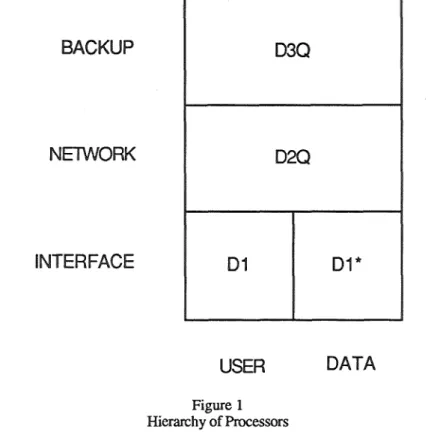
characteristics of network level database access utilities. An architecture for an "Integrated Data Network @DMaS)"' was developed4. The architecme consisted of a three level hierarchy of six types of processors, four of which
wem
specific to the IDN (see figure 1 .)
BACKUP
INTERFACE
USER
DATA
Figure 1 Hierarchy of Processors
The user node corresponds to the processor at which the application or user requesting data resides:s. Data nodes are the physical repositories of the requested data. User nodes and data nodes are considered oulside the scope of the IDN.
At the interface level of the IDN architecture are Dl nodes and Dl* nodes. Dl type nodes inkdace user nodes to the network, accept queries, perform first order validation of the queries, and assemble query responses. Dl* type nodes interface data nodes to the network, receive subqueries directed to specific data nodes, accept sesmnses from the data nodes, and compose aggregate responses for transmission to Dl nodes.
At the network level of the IDN architecture are the D2Q nodes. The D2Q nodes complete queeqd valihdon, dispatch subqueries, and control query execution. These nodes are core to the IDN architectural concept providing the actual dictionary, directory, and query support services required.
The D3Q node is at the backup level and serves to provide backup facilities for all other types of node, except the user node. Additionally, contents of data nodes can be replicated on D3Q nodes. Replicating &O (in h e long haul network environment) can improve performance by balancing communication load and supponing fault
4 See mAD86.11 for more details. It is also important to realize that the context of this effort was a wide area (if not global) information network. Performance and fault tolerance were critical design considerations.
mlemr opm&ions. Data node failures won't halt query activity. The resultant network architecture is depicted in figwe
2,
k l s w 5 .5 The xchirecture was developed deliberately
to
maximize functional redundancy. The figure illustrates this concept by showing multiple paths between each node. At least on of these redundant paths connects to a shadow node, a node capable of acting as a hot backup for a similar node.DATABASE QUERY SUPPORT PROCESSOR
During the effort it was realized that the same technology applied to local area networks as well.
Implementation details would differ due to differing bandwidth, topological, and fault recovery charac@fiseics of wide area networks versus local area networks. Within the local area network environment, the functiondity of the D l node would be absorbed by the user's workstation, the functionality of the Dl* node would be absorbed1 by the data node, and the D3Q node would constitute the QSP. Since the D3Q provides all the functionality of the D2Q, with the addition of replicated data from selected data nodes, the D2Q can be eliminated
as
a separate device(see
figwe 3* Notional QSP Architecture).I
Dl*
Figure 3
Notional QSP Architecture
For the proposed solution to be effective, it had to have the characteristics of an active, in-line &.ta dictionary at the network level6. This meant that all activity against the databases in the network, including application development, database modification and maintenance, and routine database access had to utilize sewices provided by the utility. The methodology for operation of the IDN and subsequently the QSP, was based on the emerging Information Resource Dictionary System (IRDS) standard7. In other words, the functiona1ii.j of the D2Q or D3Q nodes discussed above, was based on the IRDS standard.
THE INFORMATION RESOURCE DICTIONARY STANDARD
The motivation for the development of the IRDS standard, ANSI X3.138
-
1988, was the proliferation of redundant and inconsistent data. The data dictionary system was seen as a key tool for the effective mawageme,nt of information resources and reduction of inconsistent, redundant data. A number of incompatible, stand done data6 Detailed discussion of the philosophy behind data dictionaries and their characteristics is provided in [ROS81].
7 There were two efforts initiated about the same time to develop standards in this area. The Amefican National Standards Committee for Information Systems (X3) began work on a standard for an "Infomalion Resource Dictionary System." The National Institute of Standards and Technology (NIST, formerly the National Bureau of Standards) effort focused on the development of a Federal Information Processing Standard for Data D i c ~ a n q Systems. Both groups had identical goals and similar approaches [QED85]. Both efforts were merged in
1983
and the result was the IRDS [ANS88].d i c d o w sys&ms were on the market, and each database management system had closed, internal implementations of data d c a i i o ~ e s (if they had any). It was perceived as necessary to develop a standard for data dictionary software8.
The RDS standard describes a four level information architecture, level 2 and 3 of which constitute Federal Ilnfomaa-ioaa Processing Standard (FIPS) 156
(see
figure 4, IRDS Architecture), Each level describes and controls the lower level, The fist level, Information Resources, is the data in your database. The standard does not apply at this level, alhihough it must accommodate i t The second level, the Information Resource Dictionary (IRD), is the data in the data dic~onary, which describe the data in the database. One likely extension of the IRDS approach is to extend the eonmol function from level 2 to level 1. As you might expect, the data dictionary is itself a database that consisB of elements and relationships. Deftnitions of the data elements and relationships that constitute the data & c ~ o n q mwt be managed. The third level of the IRDS Standard, the Information Resource Dictionary Schema, consis& of the &finitions of the data elements and relationships contained by the data dictionary. The fourth layer iscam&
the Infomation Resource Dictionary Schema Description, and consists of data that describes the IRD Schema (level 3).I
SCHEMA
IRDS
I
DESCRIBESv
INFORMATION
RESOURCES
Figure 4 IRDS Architecture8
See CQED851. The standards committee took the approach that the standard should specify thec h a a c t e ~ s ~ c s of an interface to a data dictionary and the functionality that a data dictionary should provide. They wisely avoided the mistake of trying to dictate how to implement the dictionary itself.
Key to the concept of levels of description is the corollary that the higher the level, the simpler the model required to describe it. What is left is a mechanism that anyone can use to retrieve data relevant to a apcific query. Services provided at each level take care of details such as how to determine what data is available, how to locate it, how to request it, how to navigate the database to get it, and how to put it together into a usable prducs..
The results of the Design Concepts for Database Utilities work were used by the performing conwactm
t
o
develop a commercial product in this area. They were successful in obtaining SBIR phase I and phase n[ funding, and did build a prototype9. Rome Laboratory became aware at this time that several organizations were working on similar capabilities.By 1990 it was apparent that the technology required to support network level database s u p p o ~ utilities was mature. The last set of questions requiring answers prior to operational implementation of the
techno lo^
grmiraed to performance and policy. More specifically, how much overhead would be introduced into operatiom] systemsto
achieve what degree of benefit (in terms of flexibility, operations and maintenance savings, etc.). Additiondly, simultaneous access to multiple databases adds a new dimension to security policies and procedures, which must be fully understood before implementation.QSP STATUS
In 1991, the Database Query Support Processor (QSP) effort was initiated to answer these quesfiows. The effort presupposes the availability of network level database support systems with the following capabilities;
a. To retrieve data from multiple databases irregardless of data location, database archiwtue, 618-
database navigation constraints.
b. To support the definition, modification, administration, and maintenance of:
(1) A network level schema describing the totality of information available from dl dahbaqes in the network.
(2) Network level subschemas, which are logical subsets of the network level schema and assigned to specific classes of operational users.
c. Provide tools to assist database administrators in defining specific database views for inclusion in the network level schema.
d. Manage and control the definitions of, inter-relationships among, and definitions of inter- relationships of: data elements, data structures, applications, products, user descriptions, and infoma~on requirements.
During 1992 and 1993, the QSP effort will focus on collecting quantitative data such
as:
a. Volume, patterns, and types of network traffic generated by the QSP.b. Volume, patterns, and types of network acccsscs to the QSP.
c. Elapsed time from issuance of a query at a workstation to its receipt by the QSP. d Elapsed time from receipt of a query by the QSP to generation of all subqueries. e. Elapsed time from subquery generation to subquery issuance by the QSP.
f. Elapsed time from issuance of a subqucry to receipt by host resident QSP interface softwax. g
.
Elapsed time from issuance of data request by the host resident QSP interface software ~ i a that software's receipt of the host's response.h. Elapsed time from issuance of subqucry response by the host resident QSP interface saftwxe to
receipt of the response by the QSP.
i. Elapsed time from receipt of all subquery responses to the issuance of a query response by the OSP.
-
j. Elapsed time from issuance of query response by the QSP to receipt of the response by the workstation.
9
The
Small Business Innovative Research (SBIR) program provides up to $50,000 for phaseH
effiasr~ md results in a specification for phase I1 implementation. Phase I1 provides up to $500,000 for implemenQtion of the idea. Phase I11 is usually contractor funded and results ina
commercial product (with some limited Go\ieenl.raent rights). See [RAD90] and FAD90.11 for more informalion on the SBIR efforts.The effort will wrap up in 1993 with a comprchcnsivc analysis of collected data in the context of an
opwe4ond environment Implications to security policy and accreditation, hardware and software short comings, and operafions and maintenance costs will be assessed. Flexibility of the QSP approach will be assessed with respect to the mount of work required to accommodate new databases, changcs to old databases, and to initially implement the
QSP
inan
oprtadonal network. This data will be used to build a spccification for a production version of the QSP. CONCLUSIONThe benefit of the QSP is in the network levcl support scrviccs made possible by the active, in-line repositov at the heart of the device. Knowing the relationships among data elements and applications across system b o u n b e s dlows better control over change. The ripple effcct induccd by modifying data elements or applications can
be
idenhfid in advance and more effectively priced. Additionally, data elements may already exist somewhere in h e network that meet the needs of a proposed developmcnt, minimizing new development.Adddonal benefits could result from adding systcm documentation to he information available in the network. From the QSP's perspective, documentation can bc trct~tctl as just another database. Network level informafisn p e h n i n g to relationships among documcnhtion, data clcmcnts, applications and other elements of the infomarion envkonment could be maintained in the QSP. This capability makes update of relevant system dwaamenhtion an integral part of application or database dcvclopmcnt, rathcr than an dterthought.
Dam element and application standardization arc also supported by the information contained in the QSP repository. The information necessary is already available, all that would remain is to define the rules. Triggers or oher mechmisms provide the vehicles for implemcnlation.
The QSP effort will provide hard data on which to basc future implementation decisions. Specifically, which services to implement and to what extent to implcmcnt thosc scrviccs in operational IDHS systems. Start up costs and the opmdons and maintenance tail required will also bc dctcrmined. In the long run, the QSP should provide red benefits in terms of more flexible and robust inrorn~;~tion systcms, with lower operations and maintenance costs.
[ANS881 American National Standard Informal ion Rcsourcc Dictionarv Svstem, ANSI X3.138-1988 (Federal Information Processing Standard 156), ANSI, Ncw York, 1988.
n, James, Principles of Data-Basc Ormnization, 2nd ed.;Prentice Hall, 1977.
EQED851 AOG Systems Corporation, The Drart Proposcd Amcrican National Standard Information Rcsource Dictionarv System, QED Information Sciences Inc, Wcllcslcy, MA, 1985.
Planning Research Corporation, Anderson, Richard D and Gerald H. Paes, , RADC-TR-85-187, October 198 5 , Sccrct.
BAD861 McCabe, Patrick K., Michael J. Wcssing, and Ernst K. Walge, RADC-TR-86-144, August 1986.
BAD86.11 AOG Systems Corporation, Design Concc,!xs I'or Dalabase Utilities, RADC-TR-8648, April 1986.
CRAD~OI AOG Systems Corporation, Local Arcn Nawork Schema Server, RADC-TR-90-376, Decerr~ber 1990.
CRAD90.11 AOG Systems Corporation, Local Arca Network Schema Server, RADC-TR-90-375, D ~ e m b e r 1990.