NEW DATA ABOUT THE CONTROL OF THE PLANTHOPPER
METCALFA PRUINOSA
(SAY 1830) (
HEMIPTERA
:
FLATIDAE
)
IN THE TOWN OF PITEŞTI (ARGEŞ COUNTY)
BĂRBUCEANU DANIELA, MIHĂESCU CRISTINA FLORINA University of Piteşti, Faculty of Sciences, email: [email protected]
Keywords: biology, green spaces, invasion, chemical control
ABSTRACT
Metcalfa pruinosa (Say 1830), an invasive species mentioned in Romania in 2009, was observed first time in Pitești in 2014, a city located in the central-southern part of Romania. In the favourable climatic conditions of the summer of 2015, high density of the development stages of the pest were seen on many host plants, both woody and herbaceous, in the green areas of the city. The insecticide treatments show the highest effectiveness for the mixture of imidacloprid 75 g/l, deltamethrin 10 g/l, lambda cyhalothrin 50 g/l, associated with pirimiphos methyl 500 g/l, within an interval of 3-5 days. It is important that treatments be applied in combination with 0.1% Silwet to facilitate the action of the active substance. Monitoring and chemical control are required in order to limit the spread of pests in places bordering the city, where there are important vineyards and orchards.
.
INTRODUCTION
Global warming and the increasing trade in plants of economic importance in recent decades have favoured the spread of many species of insects, so that the world is now faced with an increase in the number of invasive species. Such an invasive species, which worries European experts, is Metcalfa pruinosa (Say 1830). This species originated in eastern North America (Mead, 2014) and came in Europe accidentally: it was first mentioned in Italy in 1979 (Zangheri & Donadini 1980). Subsequently, the species spread gradually, being observed in various European countries. Also, the species is observed in 2003 in Turkey (Karsavuran et Guclu 2004).
The expansion of the species continued, and so Gnezdilov & Sunyaev (2009) observed it in the summer of 2009 in Russia, where it probably arrived by sea from Turkey or Bulgaria. Yeyeun et al. (2011) report it on the Asian continent, in the Korean capital, also in 2009.
faster than the parasite (Strauss 2010). Also, pesticides tested were tested for an effective control of populations ofM. pruinosa(Yeyeun et al. 2011; Balakhnina et al., 2014).
Our study presents data about the biology of the species, in the special conditions in Pitești, and about the effectiveness of several pesticides in controlling populations of M. pruinosa on some species of ornamental plants in the public green areas in the town of Pitești.
MATERIAL AND METHOD
The observations in this study were conducted from May to October 2015 in several sites of the city of Pitești. Pitești is located in the central-southern part of Romania, between the Southern Carpathians (or the Transylvanian Alps) and the Danube, in the northwest of Wallachia; the altitude varies between 250 m and 356 m. It should be noted that the months of May to August 2015 were characterized by unusually high temperatures and by a very reduced rainfall regime. M. pruinosa individuals were observed on woody and herbaceous ornamental plant species in the green spaces of Pitești. Specimens were collected and transported to the research laboratory of Entomology to be identified and subjected to observations. Also, the host plants were identified on which M. pruinosa
individuals were found.
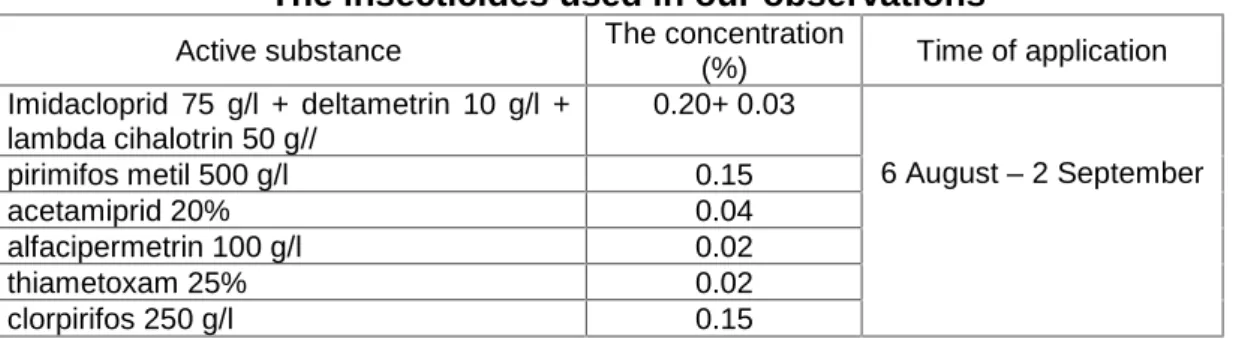
As a result of damage incurred specific treatments have been carried out to control this pest by testing several pesticides (Table 1).
Table 1
The insecticides used in our observations
Active substance The concentration
(%) Time of application Imidacloprid 75 g/l + deltametrin 10 g/l +
lambda cihalotrin 50 g//
0.20+ 0.03
6 August – 2 September
pirimifos metil 500 g/l 0.15
acetamiprid 20% 0.04
alfacipermetrin 100 g/l 0.02
thiametoxam 25% 0.02
clorpirifos 250 g/l 0.15
Figure 1. Metcalfa pruinosa localization in Piteşti
RESULTS AND DISCUSSIONS
Life cycle
Both in the area of origin, and in the areas invaded in Europe and Asia, the species has only one annual generation spends winter in the egg stage under the bark of twigs (Lauterer, 2002; Yeyeun et al., 2011; Mead, 2014). M. pruinosa has five larval instars. In the original area, characterized by a warm climate, such as the state of Texas, egg hatching takes place at the beginning of March, and the first adults appear after 69 days, in June, the species being observed until October (Dean and Bailay, 1961 – in Mead, 2014). On the European continent, characterized by a temperate climate, the activity of the species takes place between the end of May and September (Strauss, 2010).
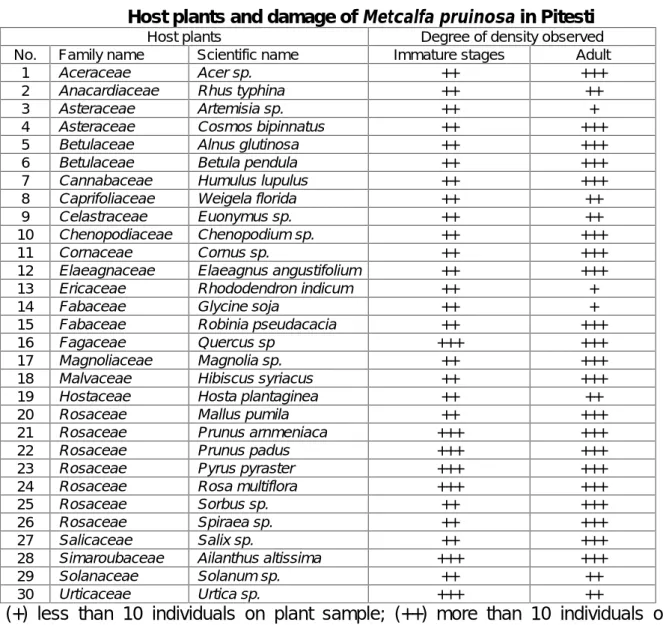
On 14 June 2014, the species is first observed on apple trees in a private garden in the center of Pitești. The rainy weather and low temperatures in the course of the year 2014 make the presence of the species discrete. The climatic conditions of 2015, which was a favourable year for the activity of the species, in the city of Pitești the larvae occur in the second ten-day period of May, and the first adults were observed in the last half of July due to high summer temperatures.
Table 2
Host plants and damage ofMetcalfa pruinosa in Pitesti
Host plants Degree of density observed
No. Family name Scientific name Immature stages Adult
1 Aceraceae Acer sp. ++ +++
2 Anacardiaceae Rhus typhina ++ ++
3 Asteraceae Artemisia sp. ++ +
4 Asteraceae Cosmos bipinnatus ++ +++
5 Betulaceae Alnus glutinosa ++ +++
6 Betulaceae Betula pendula ++ +++
7 Cannabaceae Humulus lupulus ++ +++
8 Caprifoliaceae Weigela florida ++ ++
9 Celastraceae Euonymus sp. ++ ++
10 Chenopodiaceae Chenopodium sp. ++ +++
11 Cornaceae Cornus sp. ++ +++
12 Elaeagnaceae Elaeagnus angustifolium ++ +++
13 Ericaceae Rhododendron indicum ++ +
14 Fabaceae Glycine soja ++ +
15 Fabaceae Robinia pseudacacia ++ +++
16 Fagaceae Quercus sp +++ +++
17 Magnoliaceae Magnolia sp. ++ +++
18 Malvaceae Hibiscus syriacus ++ +++
19 Hostaceae Hosta plantaginea ++ ++
20 Rosaceae Mallus pumila ++ +++
21 Rosaceae Prunus arnmeniaca +++ +++
22 Rosaceae Prunus padus +++ +++
23 Rosaceae Pyrus pyraster +++ +++
24 Rosaceae Rosa multiflora +++ +++
25 Rosaceae Sorbus sp. ++ +++
26 Rosaceae Spiraea sp. ++ +++
27 Salicaceae Salix sp. ++ +++
28 Simaroubaceae Ailanthus altissima +++ +++
29 Solanaceae Solanum sp. ++ ++
30 Urticaceae Urtica sp. +++ ++
(+) less than 10 individuals on plant sample; (++) more than 10 individuals on plant sample; (+++) more than 50 individuals or entire host plant with wax exudate.
Chemical control
The species damages plants both directly, in the process of feeding, and indirectly, as a result of secretion of honey dew, which favours the installation of fungi and the depreciation of the vegetative organs, especially of fruit, leading to considerable economic damage (Karsavuran & Güҫlü, 2004; Souliotis et al., 2008; Strauss, 2010). On the other hand, in the trees and ornamental shrubs in parks and gardens, as well as in ornamental plants with commercial value, the damage is also aesthetic, an aspect mentioned by Lauterer (2002).
Chemical control is often ineffective due to the excessive mobility of the adults, the remarkable polyphagy species and its presence in natural habitats (Strauss, 2010).
The successful use of 0.1% Sumithion in fighting individuals of M. pruinosa is mentioned (Yeyeun et al. 2011), and Balakhnina et al. (2014) found the lack of response of the individuals to yellow sticky traps, while preparations like Actara and Fitoverm are toxic to the immature stages of this pest.
In our case, one can note in Fig. 1 that the pest is present, in the year 2015, in all areas of greenery in Pitești.
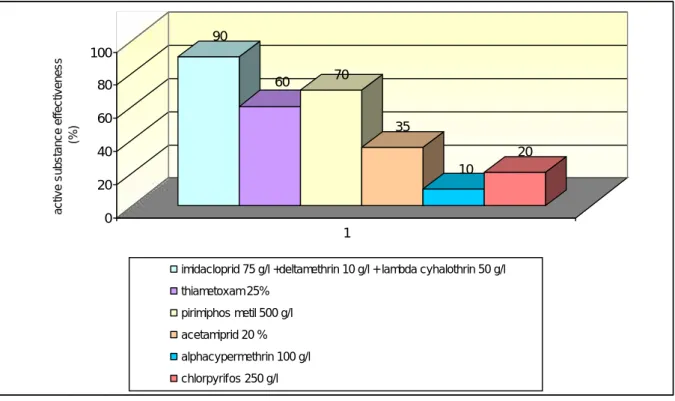
number of colonies with larvae and nymphs of pest on host plants in the green areas of the city, pesticide treatments were applied that were based on the use of a single active substance (acetamiprid 20%, alphacypermethrin 100 g/l, chlorpyrifos 250 g/l). A very small efficiency of these substances on the pest could be noted (Fig. 2).
Therefore it was recommended to use a number of complex phytosanitary treatments, which consisted in the use of several active substances, namely: imidacloprid 75 g/l, deltamethrin 10 g/l, lambda cyhalothrin 50 g/l (the latter can be replaced with thiametoxam 25%). After three to five days, pirimiphos methyl 500 g/l was applied. It should be noted that sometimes the period of application of the phytosanitary treatments is difficult to observe because of unfavourable weather conditions. It appears that the highest effectiveness is that of the mixture of imidacloprid 75 g/l, deltamethrin 10 g/l, lambda cyhalothrin 50 g/l, while alphacypermethrin 100 g/l had very little impact on the pest (Fig. 2). It is important to note that treatments should be applied in combination with 0.1% Silwet to facilitate the action of the active substance.
The phytosanitary treatments are recommended when the first pest colonies are noticed on host plants.
90
60 70
35
10
20
0 20 40 60 80 100
a
c
tiv
e
s
u
b
s
ta
n
c
e
e
ff
e
c
tiv
e
n
e
s
s
(%
)
1
imidacloprid 75 g/l +deltamethrin 10 g/l + lambda cyhalothrin 50 g/l thiametoxam 25%
pirimiphos metil 500 g/l acetamiprid 20 % alphacypermethrin 100 g/l chlorpyrifos 250 g/l
Figure 2. The efficacy of insecticides against Metcalfa pruinosa
CONCLUSIONS
Metcalfa pruinosa (Say 1830), an invasive species first mentioned in Romania in 2009, was observed in Pitești in 2014, a city located in the central-southern part of Romania.
are important vineyards, fruit tree orchards and ornamental plant plots, which are preferred by this species – especially the famous Ștefănești vineyard and the orchards in Mărăcineni.
AKNOWLEDGEMENT
Our gratitude goes to Mrs. Mihaela Oprea, PhD, of SC Salpitflor Green SA Pitești, and Mrs Violeta Boruz, PhD, of Craiova Botanical Garden for their help in determining host plant species.
BIBLIOGRAPHY
1. Balakhnina, V., Pastarnak, I. N., Gnezdilov, V. M., 2014 - Monitoring and control of Metcalfa pruinosa (Say) (Hemiptera, Auchenorrhyncha: Flatidae) in Krasnodar Territory, Entomological Review, 94 (8): 1067-1072.
2. Chireceanu C., Gutue C., 2011 - Metcalfa pruinosa (Say) (Hemiptera: Flatidae)
identified in a new south eastern area of Romania (Bucharest area), Romanian Journal of Plant Protection, 4: 28-34.
3. Gogan, A., Grozea, I., Vîrteiu, A. M., 2010 - Metcalfa pruinosa Say (Insecta:
Homoptera: Flatidae) –first occurrence in western part of Romania. Res. J. Agric. Sci., 42(4): 63-67.
4. Gnezdilov, V.M., Sugonyaev, E.S., 2009 - First record of Metcalfa pruinosa
(Homoptera: Fulgoroidea: Flatidae) from Russia.Zoosystematica Rossica, 18(2): 260-261.
5. Karsavuran, Y., Güҫlü, S., 2004 - A new pest for Turkey, Metcalfa pruinosa (Say, 1830) (Homoptera: Flatidae).Türk Entomol. Derg., 28(3): 209–212.
6. Lauterer, P., 2002 - Citrus flatid planthopper — Metcalfa pruinosa (Hemiptera:
Flatidae), a newpest of ornamental horticulture in the Czech Republic. Plant Prot. Sci. 38 (4): 145–148.
7. Mead, F.W., 2014 - Citrus Flatid Planthopper, Metcalfa pruinosa (Say) (Insecta:
Hemiptera: Flatidae), Florida Department of Agriculture and Consumer Service-Division of Plant Industry: Gainesville FL, online https://edis.ifas.ufl.edu/pdffiles/IN/IN60500.pdf.
8. Preda, C., Skolka, M.,2009 -First record of a new alien invasive species in Constanta
-Metcalfa pruinosa (Homoptera: Fulgoroidea). In: Păltineanu C. (Ed.) Lucrările Simpozionului Mediul si agricultura în regiunile aride; Prima editie. Bucuresti, Estfalia: 141-146.
9. Souliotis, C., Papanikolaou, N. E., Papachristos, D., Fatouros, N., 2008 - Host
plants of the planthopper Metcalfa pruinosa (Say) (Hemiptera: Flatidae) and observation on its phenology in Greece.Hellenic Plant Protection Journal, 1:39–41.
10. Strauss, G., 2010 - Pest risk analysis of Metcalfa pruinosa in Austria. Journal of Pest
Science, 83:381-390.
11. Zangheri, S., Donadini, P., 1980 - Comparsa nel Veneto di un Omottero neartico:
Metcalfa pruinosa (Say) (Homoptera, Flatidae).Redia, Firenze, 63: 301-305.
Yeyeun, K., Minyoung, K., Ki-Jeong, H., Seunghwan, L., 2011 - Outbreak of an exotic