335
A REVIEW OF BIOLOGICAL METHODS TO REMEDIATE CRUDE OIL
POLLUTED SOIL
MARIANA MARINESCU, ANCA LACATUSU, EUGENIA GAMENT, GEORGIANA PLOPEANU, VERA CARABULEA, MARINESCU MIHAI
Keywords: biological methods, remediation, crude oil, polluted soils.
ABSTRACT
Environmental pollution by crude oil can occur naturally through seepage or from anthropogenic sources via spillage, accidents or improper disposal of crude oil and related products. The main characteristic of pollution from refinery and petrochemical plants consists in that the pollution source is active, most often for a short period of time, but has an important intensity, polluting agent consisting generally of petroleum fractions. Also, in most cases of accidental spills of petroleum products, surface soil affected is much smaller than the first surface polluted aquifer pollution front met. Recent research has shown that biological methods to remediate crude oil polluted soil are a superior effective and much cheaper method compared with physicochemical methods. Biological methods are based on the activity of microorganisms to use crude oil as a source of carbon and energy. These methods are considered to be the most effective because it does not have irreversible effects on soil characteristics. Microorganisms such as bacteria, cyanobacteria, yeasts and fungi break down these dangerous chemicals into less toxic or non-toxic compounds.
INTRODUCTION
Recent research has shown that bioremediation is a superior method of remediating soils, effective and much cheaper compared with physicochemical methods. Bioremediation processes has many advantages compared to other soil remediation processes (solvent extraction, adding oxidizing agents, etc.) making it an effective method of treating polluted environments (Gogoi et al., 2003; Morelli et al. 2005).
In-situ bioremediation is based on the activity of microorganisms to use petroleum hydrocarbons as a source of carbon and energy. This method is considered to be the most effective because it does not have irreversible effects on soil characteristics and low cost.
Microorganisms such as bacteria, cyanobacteria, yeasts and fungi break down these
dangerous chemicals into less toxic or non-toxic compounds (Dart and Strestton, 1994). To survive, microorganisms need nutrients (such as nitrogen, phosphorus, potassium, trace elements), carbon and energy source. Microorganisms which are found naturally in soil transforme a number of organic compounds in food and energy for its own ecosystem. For example, many bacterial species from the soil can use petroleum hydrocarbons as a source of energy and food. This natural process transforms petroleum hydrocarbons in less hazardous substances such as carbon dioxide, water and fatty acids. Biodegradation of organic components has become a great way for treatment of polluted soils (Atlas, 1981; Atlas and Bartha, 1992).
336
MATERIAL AND METHOD. RESULTS.
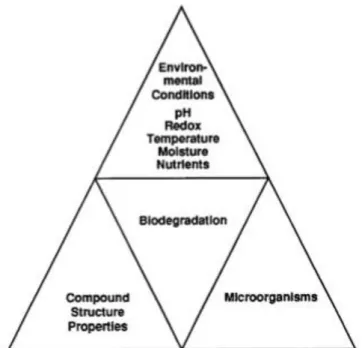
The advantage of this method is inexpensive device that does not have negative effects on the environment. A disadvantage of this problem is the low speed of the degradation process. Figure 1 presents the elements involved in bioremediation, as it was called by Suthersan (1999) "biodegradation triangle ".
Figure 1 Elements involved in bioremediation ("Bioredegradation Triangle") (Suthersan, 1999)
Bacteria involved in biodegradation
Bacteria contain the necessary enzymatic equipment that breakdown petroleum hydrocarbons in soil. Microbial remediation of sites polluted with petroleum products and residues is due to a diverse group of microorganisms, particularly indigenous bacteria from soils affected by pollution (Farinazleen et al., 2004; dell'Abate et al., 2006). For example, the genus Pseudomonas, are a group of gram negative bacteria widely, with a remarkable ability to degrade a wide range of organic pollutants, including polycyclic aromatic hydrocarbons, halogenated and organic waste with recalcitrance molecular outstanding (Voiculescu et al. 2003).
The survival of microorganisms in an environment polluted with petroleum hydrocarbons is a key factor in determining the rate of biodegradability (Ramos et al., 1991 Rippen et al., 1994). Li et al. (2000) conducted a study in which improved microbial existing table by adding biologically active carbon. The soil used in the experiment in-situ is located in the Zihe valley, near the Zibo town, in eastern China and is polluted with
petroleum hydrocarbons at concentrations up to 200 g • kg-1
dry soil. Quantitative
determinations of bacterial microflora values of order 107 cfu • g-1 dry soil. The dominant
species were identified in polluted soil Xanthomonas, Bacillus and Hyphomicrobium.
337
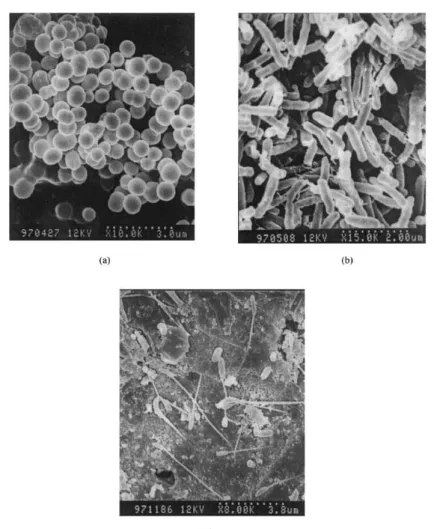
Figure 2 Images provided by electron microscope with different hydrocarbon degrading bacteria (Li et al., 2000)
Verma et al. (2006) conducted a study on the degradation of petroleum hydrocarbons
in the presence of three bacterial species Bacillus, Acinetobacter and Pseudomonas. The
3 bacterial species were isolated from a soil polluted with crude oil in Ankleshwar, India. It was tested the ability to degrade bacterial species complex mixtures of petroleum hydrocarbons containing alkanes, aromatic hydrocarbons, resins and asphaltenes. Following investigations highest rate of biodegradability reached values of 59% in the
presence of Bacillus species, followed by Acinetobacter and Pseudomonas where the
values were 37% and, respectively, 35%.
Bacillus subtilis and Pseudomonas aeruginoasa efficiency on decreasing levels of petroleum hydrocarbons was studied by Das and Mukherjee (2007) on polluted soil from N-E India. The two types have proven very effective and can be used successfully in polluted soils with crude oil.
In Romania, have been conducted studies on the role of heterotrophic bacteria present in deposits of crude oil, the chemical shifts of oil deposits in certain hydrogeological conditions: temperature, pH, depth, oxygen concentration. Following research have been identified a set of 23 taxonomic groups, mostly to the genus level,
belonging to the family Enterobacteriaceae and genera Pseudomonas, Achromobacter,
338
Cyanobacteria involved in the biodegradation
Cyanobacteria are organisms with the simplest needed, as achieve synthesis of
organic matter and fix molecular nitrogen (N2) from the air. They are unicellular beings,
bacillary or spherical, widespread because it can adapt to extremely varied ecological conditions. Rarely live isolated, frequently appear united in mobile filaments, sometimes included in a mucilaginous mass (Voiculescu et al., 2003).
According to research, cyanobacteria involved in the biodegradation of petroleum hydrocarbons are Anabaena, Nostoc, Oscillatoria.
Yeasts involved in the biodegradation
Yeasts are unicellular fungi that reproduce by burgeoning fermentation and the
theoretically work represents an ideal material to elucidate concepts of cell biology, the eukaryotic organisms (Voiculescu et al., 2003). According to research yeasts that occur in the biodegradation of petroleum hydrocarbons are Candida, Rhodotorula, Saccharomyces. Joo et al. (2008) conducted a study of soils polluted with petroleum hydrocarbons using a
yeast Candida catenulata. After 13 days from the inoculation was observed a 84%
decrease of petroleum hydrocarbons from soil polluted with 2% THP.
Filamentous fungi involved in biodegradation
Recent research has shown that a number of filamentous fungi play a key role in the integrated in-situ biodegradation and are able to degrade the fractions of C12-C26 aliphatic hydrocarbons from crude oil (Foght et al., 1999). Also, by growing on culture with the only power source the carbon contained in hydrocarbons it has been proven the ability
to biodegrade crude oil some strains of the genera Aspergillus, Penicillium, Paecilimyces
and Fusarium, Cladosporium, Tricodarma (Lemos et al., 2002, Potin et al., 2004).
Once isolated and purified, fungi were tested for the ability to degrade hydrocarbons from the crude oil. Sensitive removal of mycelium and conidia to each of the strains isolated in the tubes, they were inoculated into the liquid mineral medium where was added a quantity of crude oil as the sole source of carbon and energy. Were selected nine filamentous fungi that have proven the ability to use hidorcarbons from the crude oil to grow. Experiment conclusions was that filamentous fungi actively engaged in crude oil
biodegradation in soil are Aspergillus niveus, A. niger, A. versicolor, A. terreus, A.
fumigatus, Penicillinium corylophilium, Paecilomyces variotti, P. Niveus şi Fusarrium sp. The most active species Aspergillus versicolor had the highest pollutant removal efficiency (10.8%) (Voiculescu et al., 2003).
Filamentous fungi possess a number of attributes that can be very good potential agents of biodegradation. Some fungi were identified in sugarcane and used in inoculum
for soils polluted with polychlorinated biphenyls (Fernández-Sánchez et al., 2001),
phenanthrene (Chávez-Gómez et al., 2003), and benzo (a) pyrene (Dzul-Puc et al., 2004).
Dzul-Puc et al. (2004) reported that filamentous fungus, Penicillium frequentans isolated
from soils polluted with petroleum hydrocarbons, developed sugarcane, added in a soil artificially polluted with 200 ppm phenanthrene, achieved a biodegradability of 74% in 7 days, while Penicillium frequentans and Psedomonas pickettii achieved 73.6% in 18 days.
CONCLUSIONS
339
on the ability of microorganisms to use petroleum hydrocarbons as a source of carbon and energy. It is considered to be the most effective because in addition to lower cost, has irreversible effects on soil characteristics affected pedogenetical (Voiculescu et al., 2003).
ACKNOWLEDGMENT
The financial support provided by the UEFISCDI – Executive Unit for Financing
Education Higher Research Development and Innovative – project no. 91/2014 -
Bioremediation innovative technology of ex-situ soils polluted with crude oil (BIORESOL).
BIBLIOGRAPHY
1. Atlas R.M., 1981 – Microbial degradation of petroleum hydrocarbon, Hydrocarbons: An
environmental perspective, Microbiological Reviews 45, p. 180-209.
2. Atlas R.M., Bartha R., 1992 – Hydrocarbon biodegradation and oil spill,
Bioremediation.In: Advances in Microbial Ecology, Marshall K. C (editor), Vol 12, Plenum.
New York,.USA, p. 287-338.
3. Dart R.K., Stretton R.J., 1994 – Microbiological Aspects of Pollution Control, 2nd edition, Elsevier, 265 p., ISBN 0444415890.
4. Das K., Mukherjee, A.K., 2007 – Crude petroleum-oil biodegradation eYciency of Bacillus subtilis and Pseudomonas aeruginosa strains isolated from a petroleum-oil
contaminated soil from North-East India, Bioresource Technology 98, p. 1339–1345.
5. Dell’Abate M.T., Benedetti A., Poletti P., Pompili L., Mocali S., Dentice A., De
Angelis M., 2006 – Microbial monitoring of a petroleum bioremediation process in soil, Geophysical Research Abstracts, Vol. 8, 1607-7962/gra/EGU06-A-06485.
6. Dzul-Puc J., Esparza-García F., Barajas-Aceves M., Rodríguez-Vázquez R., 2004 –
Benzo[a]pyrene removal from soil by Phanerochaete chrysosporium grown on sugarcane
bagasse and pine sawdust, Chemosphere 58, p. 1–7.
7. Farinazleen M.G., Raja Noor Z.A., Abu B.S., Mahiran B., 2004 – Biodegradation of
hydrocarbons in soil by microbial consortium, International Biodeterioration &
Biodegradation 54, p. 61–67.
8. Fernández-Sánchez J., Rodríguez-Vázquez R., Ruiz-Aguilar G. Álvarez P., 2001 –
PCB biodegradation in age contaminated soil: interactions between exogenous
Phanerochaete chrysosporium and indigenous microorganisms, Journal of Environmental
Science and Health, Part A 36, p. 1145–1162.
9. Foght J., Semple K., Gauthier C., Westlake D., Blenkinsopp S., Sergy G., Wang Z., Fingas M., 1999 – Effect of nitrogen source on biodegradation of crude oil by a defined bacterial consortium incubated under cold, marine conditions, Environmental Technology 20, p. 839-849.
10. Gogoi B.K., Dutta N.N., Goswami P., Mohan, T.R., 2003 – A case study of bioremediation of petroleum-hydrocarbon contaminated soil at a crude oil spill site, Advances in Environmental Research 7, p. 767–782.
11. Harvey S., Elashvili I., Valdes J.J., Kamely D., Chakrabarty A.M., 1990 – Enhanced removal of Exxon Valdez spilled oil from Alaskan gravel by a microbial surfactant, Biotechnology 8, p. 228–230.
12. Joo H.S, Ndegwa P.M., Shoda M., Phae C.G, 2008 – Bioremediation of
oil-contaminated soil using Candida catenulata and food waste, Environmental Pollution, vol.
156(3), p. 891-896.
13. Lemos J.L., Rizzo A.C., Millioli V.S., Soriano A.U., de Moura Sarquis M.I., Santos
R., 2002 – Petroleum degradation by filamentous fungi, http//ipec.utulsa.edu/lpec/
340
14. Li G., Huang W., Lerner D. N., Zhang X., 2000 – Enrichment of degrading microbes
and bioremediation of petrochemical contaminants in polluted soil, Water Research
34(15), p. 3845-3853.
15. Morelli I.S., Del Panno M.T., De Antoni G.L., Painceira M.T., 2005 – Laboratory
study on the bioremediation of petrochemical sludgecontaminated soil, International
Biodeterioration and Biodegradation 55, p. 271–278.
16. Potin O., Rafin C., Veignie E., 2004 – Bioremediation of an agedpolycyclic aromatic
hydrocarbons (PAHs)-contaminated soil by filamentous fungi isolated from the soil,
International Biodeterioration and Biodegradation 54, p. 45–52.
17. Rahman K.S.M., Thahira-Rahman J., Kourkoutas Y., Petsas I., Marchant R., Banat
I.M., 2003 – Enhanced bioremediation of n-alkanes in petroleum sludge using bacterial
consortium amended with rhamnolipid and micronutrients, Bioresource Technology 90, p.
159–168.
18. Ramos J.L., Duque E., Ramos-Gonzalez M.I., 1991 – Survival in soils of an
herbicide-resistant Pseudomonas putida strain bearing a recombinant TOL plasmid,
Applied and Environmental Microbiology 57, p. 260–266.
19. Rippen G., Held T., Ripper P., 1994 – Microbial remediation of waste-oil polluted
soils, Environmental Science and Pollution Resources 1 (3), p. 185-189.
20. Shaw D.G., 1992 – The Exxon-valdez oil-spill-ecology and social consequences, Environ. Conserv. 19, 253–258,.
21. Suthersan, S.S., 1999 – In situ bioremediation, Remediation engineering : design concepts Ed. Suthan S. Suthersan Boca Raton: CRC Press.
22. Verma S., Bhargava R., Pruthi V., 2006 – Oily sludge degradation by bacteria from Ankleshwar, India, International Biodeterioration & Biodegradation 57, 207–213.
23. Voiculescu A.R., Dumitru M., Toti M., 2003 – Decontaminarea Solurilor Poluate cu