218
EFFECTS OF CONTINUOUS FERTILIZATION ON THE CUCUMBER
SEEDLING QUALITY
MORAVČEVIĆ, Đ.1*, GVOZDANOVIĆ VARGA, J.2., DOLIJANOVIĆ, Ž.1, ĆOSIĆ, M.1
,
DELIĆ, D.3, UGRINOVIĆ, M.4
1 University of Belgrade, Faculty of Agriculture, Republic of Serbia 2 Institute of Field and Vegetable Crops, Novi Sad, Republic of Serbia 3 University of Banjaluka, Faculty of Agriculture, Bosnia and Herzegovina 4 Institute for Vegetable Crops, Smederevska Palanka, Republic of Serbia * Corresponding author: [email protected]
Keywords: cucumber, continuous fertilization, seedlings, leaf area
ABSTRACT
The research on the effects of continuous fertilization on the cucumber seedling quality was conducted at the Faculty of Agriculture, University of Belgrade. The examined cucumber plants grew under artificial light (MH 600W). In addition to light, temperature and relative air humidity were also controlled. The research was carried out on the hybrid cucumber Caman RZ. The plants were cultivated in 10.5 cm diameter pots filled with the Terracult TC 10 substrate. The experiment contained three variations. In the first variation (0 – control) the plants grew without fertilization. The plants from the second variation (1) were fertilized only once using the crystal fertilizer Fitofert Kristal (10:40:10), while the plants from the third variation (2) were continuously fertilized using the organic mineral fertilizer Fitofert Humistart (4:12:5). During the nursery period, the development of the examined plants was monitored on a weekly basis. The research lasted for 32 days (sowing/transplanting). There was a significant effect of fertilization on the development of cucumber seedlings. Also, it was proven that there was a positive impact of continuous fertilization on the reduction of the nursery period (economic efficiency).
INTRODUCTION
Cucumber (Cucumis sativus L.) represents a very popular vegetable species. It is cultivated on the area of 2.12 million ha around the world (FAO, 2012). The production of cucumber is conducted in protected areas (glasshouses/greenhouses) and in open fields. Although a cucumber seed is relatively large and easy for hand sowing, the intensive production is performed mostly through seedlings. The production using seedlings enables successful cultivation of this warmth-loving species in the continental climate, since it reduces the time required for the plant growth in the field. Seedlings are cultivated in controlled conditions, so these plants have a normal development.
The basic factors of the successful production of seedlings include temperature, relative air humidity, light, substrate, water, nutrients, and vegetation area. Each plant species has specific requirements regarding these factors (Jankauskiene and Brazaityte, 2008). In order to provide optimal conditions for the growth of young seedlings, a suitable production facility should be ensured, with all the accompanying equipment and automatics. The length of the production cycle primarily depends, apart from the species, on the provided production conditions. The nursery period of cucumber, from the time of sowing to the point of carrying out young plants to the permanent place, lasts from 20 to 35 days. During this period, plants form 3-6 leaves and still have an upright stem of maximum 25 cm height (Lazić, 1997; Moravčević et al, 2007; Đurovka, 2008).
219
process of photosynthesis. There is a strong correlation between the development of the leaf area and the productivity of photosynthesis (Rouzi et al., 2010; Cho et al., 2007; Liang et al., 2015). Phosphorus is a typical nutrient for the early phases of the plant development (Khasawneh et al.,1980; Hu et al., 2010). The balanced nutrition, primarily with phosphorus, in the early phases of cucumber seedlings has a significant impact on the development of the stem, and subsequently on the yield and fruit quality (Ruiz and Romero, 1998; Hodge et al., 2009).
The production of seedlings requires vast financial investment, so the prolongation of the nursery period is not beneficial to producers and results in the increase of total production costs.
The aim of this paper is to present the effects of continuous fertilization of cucumber plants in the nursery phase on their quality and duration of the nursery period.
MATERIALS AND METHOD
The experiment was conducted at the Faculty of Agriculture, University of Belgrade in the plant grow chambers. The length of the day was 14 hours, the day/night air temperature was 23-26/19-21oC, and the relative air humidity was maintained on the level of 65 to 85%. Philips MH light bulbs (600W) were used. The distance between the light bulb and the plants was 1m, and the light intensity was constant and amounted to 13500 lux. The plants were grown in 10.5 cm diameter PE pots (Teku). The commercial substrate Terracult TC 10 was used. The research was conducted on the hybrid cucumber Caman (Rijk Zwaan).
The experiment consisted of three variations, each variation containing 30 plants (pots). The first, controlled variation (0) included plants which grew without fertilization. The plants from the second variation (1) were fertilized by fertigation (0.1%) only once, using the fertilizer Fitofert Kristal (10:40:10+1MgO+me) in the phase of the first true leaf. The third group of plants (2) was fertilized continuously each week using the Fitofert Humistart fertilizer in the concentration of 0.1%. Fitofert Humistart is an organic mineral biostimulating nutrient in the form of the concentrated suspension with a high content of phosphorus (4:12:5), humic, fulvic and amino acids, enriched with the algae extract and microelements. The nursery period (research period) lasted for 32 days. The sprouts appeared 5 days after the sowing of the seeds.
On the sixth day following the sprouting, weekly measurements began (the total number of 4 measurements). The dynamics of plant growth was monitored using the following parameters: plant height (cm), stem diameter (mm), leaf number, relative chlorophyll content (SPAD) and the total leaf area per plant (cm2). A non-destructive method for determining the chlorophyll content in situ was based on the use of the portable Minolta SPAD-502 instrument, which determined the relative chlorophyll content in the leaf on the basis of the measured transmitted light of the red and infrared part of the spectrum (Gratani, 1992: Peterson et al., 1993). The measurements by the SPAD-meter were repeated on the same old leaves but also on the youngest completely developed leaves, as well as on the same places (on the leaf apex, between the primary vein and leaf margin).
220
RESULTS AND DISCUSSION
The plant height represents the most significant and most frequent morphological feature used for evaluating the seedling quality (Đurovka, 2008). Significantly higher plants were obtained in the variations with fertilization than in the controlled variation. Only the final measurement recorded statistically significant differences within all the examined variations for this parameter. In the controlled variation, the plant height was 29.9cm on average, while in the second variation the plants were higher by 2.5cm on average, and in the third by 14.4cm. The plants of cucumber seedlings which are over 20 cm high can be considered prepared for transplanting. This height was reached on the 20th day following the sprouting. During the 4th measurement (the 27th day after sprouting), the plants which had been continuously fertilized (variation 2) had more than 40 cm long stems prone to lodging.
Table 1 Plant height (cm)
Fertilization I Measurement
II Measurement
III Measurement
IV Measurement
0 9,9 13,4 17,5 29,9
1 10,0 15,6 22,1 32,4
2 10,1 16,4 23,8 44,3
Average 10,0 15,1 21,2 35,5
LSD 0,05 1,13 1,13 2,49 3,26
0,01 1,58 1,59 3,49 4,57
The stem diameter, measured below cotyledon leaves, was statistically significantly larger in the variations with fertilization (Table 2). During the fourth measurement the average value of this parameter amounted to 5.7mm. The highest value of this point was recorded in the variation 2 (continuous fertilization) and it amounted to 6mm. This value was statistically significantly much higher than the values in the other two examined variations. The stem thickness represents a parameter which indicates the seedling quality and the stability of the plant (the internode length). Inadequate nutrition and inferior production conditions result in the internode elongation, which directly affects the stem diameter of cucumber seedlings (Jankauskiene and Brazaityte, 2008).
Table 2 Stem diameter (mm)
Fertilization I Measurement
II Measurement
III Measurement
IV Measurement
0 2,5 3,9 4,7 5,3
1 2,8 4,1 5,4 5,7
2 2,1 4,3 5,6 6,0
Average 2,5 4,1 5,2 5,7
LSD 0,05 0,52 0,33 0,32 0,15
0,01 0,73 0,47 0,44 0,21
221
treatments and to monitor the relative food consumption by the plants (particularly the intake of nitrogen), Lemaire et al., 2008.
Table 3 Relative chlorophyll content (SPAD)
Fertilization I Measurement
II Measurement
III Measurement
IV Measurement
0 55,6 54,3 48,9 39,6
1 57,1 53,2 45,2 39,0
2 57,4 50,4 47,3 40,5
Average 56,7 52,6 47,1 39,7
LSD 0,05 2,69 2,99 3,21 2,36
0,01 3,78 4,19 4,50 3,32
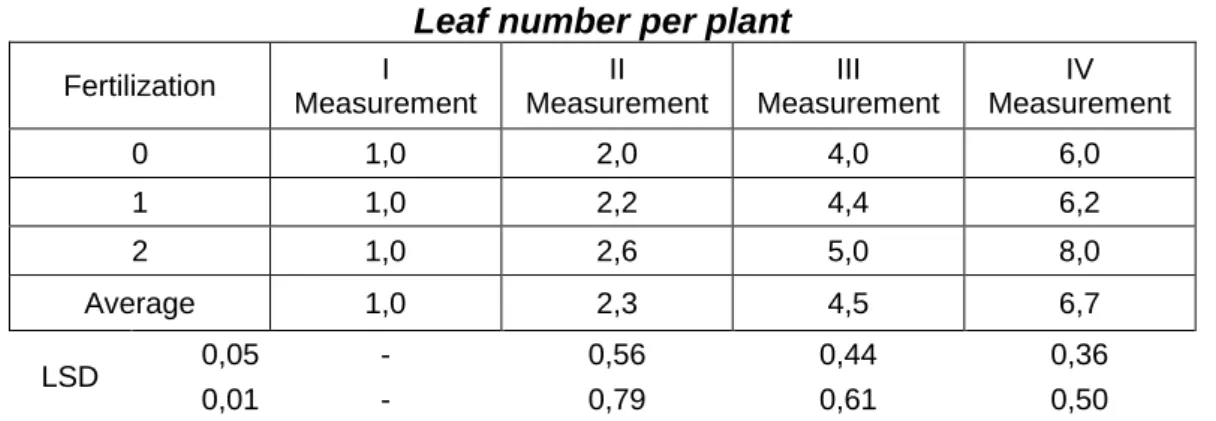
The leaf number per plant differed significantly in all variations as early as in the third measurement. At the end of the experiment the plants in the third variation had 8 leaves per plant on average (the highest value). During the third measurement the leaf number for all treatments amounted to 4.5. The optimum leaf number of cucumber seedlings is 3 to 6 (Lazić, 1997).
Table 4 Leaf number per plant
Fertilization I Measurement
II Measurement
III Measurement
IV Measurement
0 1,0 2,0 4,0 6,0
1 1,0 2,2 4,4 6,2
2 1,0 2,6 5,0 8,0
Average 1,0 2,3 4,5 6,7
LSD 0,05 - 0,56 0,44 0,36
0,01 - 0,79 0,61 0,50
The leaf area per plant registered in the controlled variation during the second measurement (131.44 cm2) was significantly smaller that the values realized in the variations with fertilization. From the third measurement onwards the differences between all variations were significant. The highest value in the final measurement for the leaf area per plant (879.60 cm2) was obtained in the variation with continuous fertilization (Rouzi et al., 2010).
Table 5 Leaf area per plant (cm2)
Fertilization I Measurement
II Measurement
III Measurement
IV Measurement
0 30,12 131,44 338,47 498,12
1 39,51 175,49 463,97 604,26
2 37,94 214,83 541,05 879,60
Average 35,86 173,92 447,83 660,66
LSD 0,05 11,69 51,16 68,98 66,90
222
CONCLUSIONS
The experiment variation with the continuous fertilization of plants using the organic mineral fertilizer Fitofert Humistart provided the cucumber seedlings of the best quality. This was demonstrated by measuring all the examined parameters, particularly in the second part of vegetation. The plants from this variation reached the characteristics of the quality cucumber seedlings significantly faster (in approximately 7 days). The experiment proved the positive effect of continuous fertilization on the reduction of the cucumber nursery period (i.e. its economic efficiency).
BIBLIOGRAPHY
1. Cho, Y. Y., Oh, S., Oh, M. M., Son, J. E., 2007 - Estimation of individual leaf area, fresh weight, and dry weight of hydroponically grown cucumbers (Cucumis sativus L.) using leaf length, width, and SPAD value. Scientia horticulturae, 111(4), 330-334.
2. Đurovka, M., 2008 - Gajenje povrća na otvorenom polju. Poljoprivredni fakultet, Novi Sad, 173-206.
3. FAOstat, 2013 - http://faostat3.fao.org/download/Q/QC/E
4. Gratani, L., 1992 - A non-destructive method to determine chlorophyll content of leaves. Photosynthetica, 26: 469-473.
5. Hodge, A., Berta, G., Doussan, C., Merchan, F., Crespi, M., 2009 - Plant root growth,architecture and function. Plant Soil 321, 153–187.
6. Hu, Y., Ye, X., Shi, L., Duan, H., Xu, F., 2010 - Genotypic differences in root morphologyand phosphorus uptake kinetics in Brassica napus under low phosphorus supply. J. Plant Nutr. 33, 889–901.
7. Jankauskiene, J., Brazaityte, A., 2008 - The influence of various substratum on the quality of cucumber seedlings and photosynthesis parameters. Sodininkystė ir daržininkystė, 27(2), 285-294.
8. Khasawneh, F.E., Sample, E.C., Kamprath, E.J. (Eds.), 1980 - The Role of Phosphorus in Agriculture. American Society of Agronomy, Crop Science Society of America, Soil Science Society of America, Madison, WI, USA, 559–585.
9. Lazić, B., 1997 - Povrtnjak – bašta zelena cele godine. Institut za istraživanja u poljoprivredi „Srbija“, Beograd, 59-83.
10. Lemaire, G., Jeuffroy, M. H., Gastal, F., 2008 - Diagnosis tool for plant and crop N status in vegetative stage: Theory and practices for crop N management. European Journal of agronomy, 28(4):614-624.
11. Liang, L. Z., Qi, H. J., Xu, P., Zhao, X. Q., Dong, X. Y., Shen, R. F., 2015 - High phosphorus at seedling stage decreases the post-transplanting fertiliser requirement of cucumber (Cucumis sativus L.). Scientia Horticulturae, 190, 98-103.
12. Moravčević, Đ., Pavlović, R., Bjelić, R., 2007 - Uticaj supstrata na kvalitet rasada krastavca. XII Savetovanje o biotehnologiji. Zbornik radova, Čačak, 12(13):367 370.
13. Peterson, T.A., Blackmer, T.M. Francis, D.D., Schepers, J.S., 1993 - NebGuide:
Using a Chlorophyll Meter to Improve N Management. Cooperative Extension, Institute of
Agriculture and Natural Resources, University of Nebraska-Lincoln. No. G93-1171-A.
14. Rouzi, M., Qi2zhen, D., Lihong, G.A.O., 2010 - Effect of Different Micro-organism Fertilizers Treatment of Seedling Substrates on Cucumber Seedling Growth and Storage Quality. Northern Horticulture, 15, 037.