EXPERIMENTAL RESEARCHES ON THE WORKING QUALITATIVE
INDEXES OF TECHNICAL EQUIPMENT FOR HARVESTING
MISCANTHUS RHIZOMES
SORICĂ E.1), SORICĂ C.1), ZAICA AL.1), BRĂCĂCESCU C.1), GRIGORE I.1)
1)INMA Bucharest;
E-mail:[email protected]
Keywords:harvesting equipment, work qualitative indexes, rhizomes
ABSTRACT
The article presents the results of experimental research of the technical equipment for harvesting Miscanthus rhizomes, in order to determine the following working qualitative indexes: the percentage of extractedrhizomes, the degree of rhizome damage, rhizome losses at harvesting, the content of impurities in the mass of rhizomes and the degree of separation of extracted rhizomes. The results obtained in the experimental researches help improving the equipment for harvesting Miscanthus rhizomes in order to meet the quality requirements of the work.
Experimental researches were carried out under field conditions, on the experimental plot of INMA Bucharest, the development stage of energy plant Miscanthus being in the 7th year of growing.
INTRODUCTION
Within the renewable energy sources, energy cultures represent one of the most attractive options to replace fossil fuels. Currently, energy from biomass represents 10-12% of total energy consumption for heating and cooking food.
Miscanthus culture plays an important role for the production of heat and bioethanol. A hectare of Miscanthus can produce an average amount of 23 ... 25 tons of biomass with a humidity of 10 ... 16% and a calorific value equivalent to 14 tons of coal and 10 tons of oil. Miscanthus is one of the most efficient cultures. Net calorific value, relative to the dry biomass is 17 MJ/kg or 4.75 kWh/ kg. [1]
Energy plant Miscanthus has a significant potential for our country, taking into account that Romania has an agricultural potential that is not totally exploited and in rural areas the main source of heating during winter is the woody biomass, coming from forest areas under extinction. Rhizome harvesting is a determining factor in terms of quality of the seedling material used for the establishment of a new culture. [1, 3, 5] This operation must ensure obtaining a biological material without mechanical damage for maintaining viability during its transport and storage.
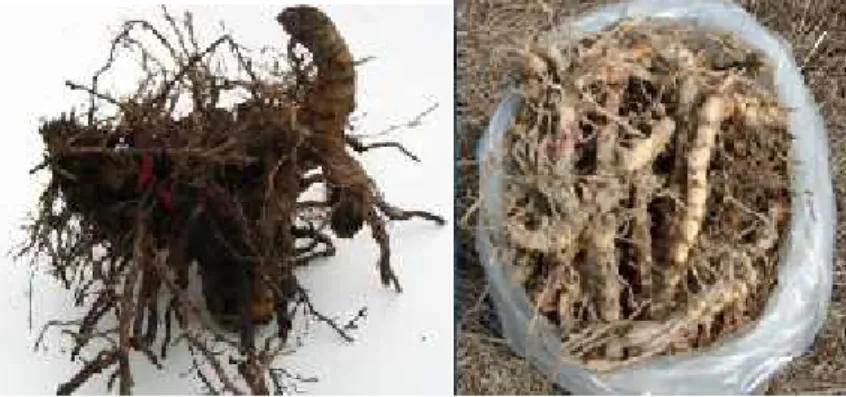
Brown rhizomes (Fig. 1) are irregularly shaped, with protuberances and even pronounced branches, their thickness varying between 7 and 12 mm.
In most cases, for harvesting the seedling material are used other machines destined to harvest other crops such as potatoes and onions by adapting various constructive solutions with less satisfying results in terms of seedling material quality and energy consumption for the harvesting work. However, there are specialized machines to extract the seedlings or other plants that can be successfully used to extract Miscanthus rhizomes. Worldwide, a well-known company is Egedal (Denmark); it produces displacement equipment of RR and SR-2 range, adapted for Miscanthus plant. [1]
MATERIAL AND METHOD
The experiments under field conditions, to determine working qualitative indexes of the technical equipment for harvesting Miscanthus rhizomes, were performed on the experimental plot of INMA Bucharest (fig. 2).
Fig. 2 – ERR equipment used in experiments[3]
ERR technical equipment for harvesting Miscanthus rhizomes (fig. 3) is used within the technology of Miscanthus rhizomes capitalization and works in aggregate with 70 ... 80 HP tractor, consisting of: frame, eccentric separator, displacement ploughshare, two wheels (left and right) and hydraulic motor.
The displacement process consists in deep loosening of soil without turning it over, destruction of the links between soil and rhizomes and pushing them upward toward the oscillating grates which, by sieving, separate the rhizomes of impurities and dirt and leave them on the ground in furrow to be loaded into the transportation means. [2, 3, 4]
Fig. 3 – Technical equipment for harvesting Miscanthus rhizomes ERR
Table 1 [3]
Characteristics of Miscanthus culture UM Value
Stage of development - Miscanthus after the 7th year of growing Distance between rows when culture is
established
cm 80
Height of vegetable remains after harvesting cm 15...20 Maximum depth at the bottom of rhizomes cm 15
Measuring equipment and devices used for testing
Measuring and control equipment and devices used to determine the work qualitative indexes of the technical equipment for harvesting Miscanthus rhizomes are the following:
- for size: 3m measuring tape, 8m measuring tape, 60m measuring tape;
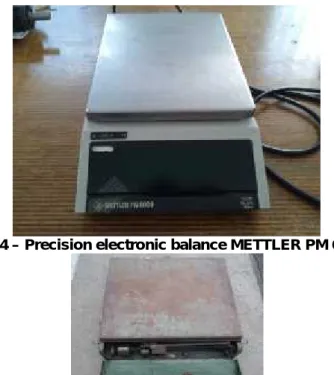
- for weight: METTLER PM 6000 electronic balance (fig. 4), mechanical balance with measuring range from 1 to 150 kg (fig. 5);
Fig. 4 – Precision electronic balance METTLER PM 6000
Fig. 5 – Mechanical balance with measuring range from 1 to 150 kg;
- digital electronic penetrometer with FIELDSCOUT SC 900 cone (fig. 6) measures the resistance force at cone penetration in soil layers (expressed in pressure units kPa) with the help of an electronic force transducer and the depth (position) of cone penetration in the soil by using a position sensor (level sensor) with ultrasound generator.
- soil capacitive humidometer FIELDSCOUT TDR 300 (fig. 7) is designed for monitoring and recording soil humidity and includes “data logger” functions (storage/data processing). It can be used for any type of soil, in any climate conditions.
Fig. 7 – Soil capacitive humidometer FIELDSCOUT TDR 300
RESULTS AND DISCUSSIONS
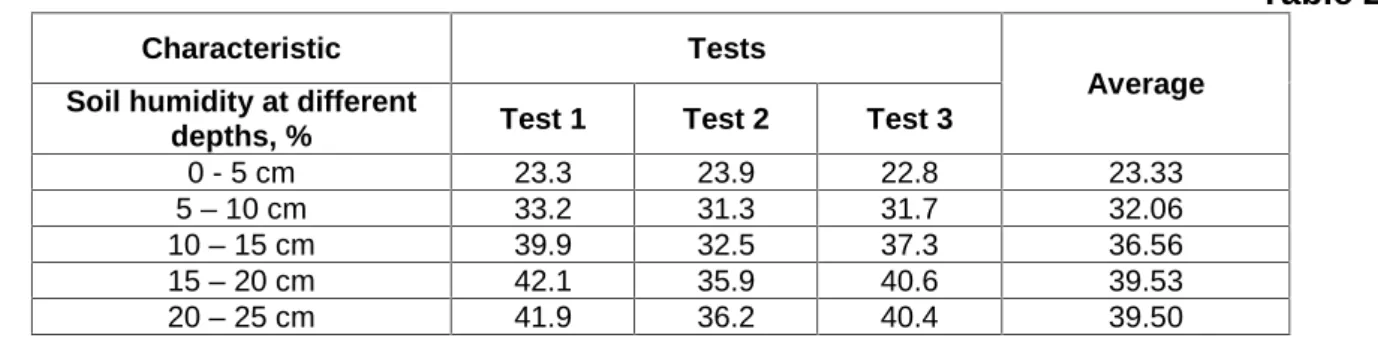
Following the experimental researches to determine soil characteristics and working qualitative indexes, the following results were obtained:
soil humidity(Table 2)
Table 2
Characteristic Tests
Average Soil humidity at different
depths, % Test 1 Test 2 Test 3
0 - 5 cm 23.3 23.9 22.8 23.33
5 – 10 cm 33.2 31.3 31.7 32.06
10 – 15 cm 39.9 32.5 37.3 36.56
15 – 20 cm 42.1 35.9 40.6 39.53
20 – 25 cm 41.9 36.2 40.4 39.50
soil resistance to penetration – penetration tension values, determined by penetrometer, are listed in kPa. Thus, to express penetration resistance force, the following formula is used:
F S where F is the penetration resistance force, in N;
σ – penetration tension, MPa;
S – the area of cone base section mounted at the top of the penetrometer rod, mm2. (cone base area d=12.7 mm,
2
4
d S )
This way the values of penetration resistance force are obtained. They are illustrated in table 3.
Table 3
Characteristic Tests
Average Soil penetration resistance
force at different depths, N Test 1 Test 2 Test 3
5 cm 145.58 115.52 124.52 128.54
10 cm 240.17 249.04 204.58 231.26
15 cm 271.21 244.61 273.42 263.08
20 cm 204.58 177.85 185.55 189.32
25 cm 293.89 301.49 275.64 290.34
together with the rhizomes. On the same surface, the rhizomes remained in the soil are harvested manually. Total displaced mass, the mass of extracted rhizomes (cleaned rhizomes and impurities) and the rhizomes that remained in the soil are weighed.
Total displaced mass is formed of extracted rhizomes mass and the mass of earth, stones and vegetable remains harvested together with the rhizomes
td rd p
m m m where mrdis extracted rhizomes mass;
mp – mass of earth, stones and vegetable remains harvested together with the rhizomes.
rd rc i
m m m
where mrcis cleaned rhizomes mass; mi– impurities mass.
The percentage of extracted rhizomes was determined using the following formula:
100 rc d rc s m P m m [%]
where msis the mass of rhizomes that remained in the soil; damage degree(GV) - was determined using the formula:
100 V V rc m G m
[%], where mV– damaged rhizomes mass
while the percentage of seriously damaged rhizomes was determined using the formula:
100 GV GV rc m P m [%]
rhizomes losses at harvest (P) – of the total rhizome production (extracted rhizomes mrd and rhizomes that remained in the soil ms) were considered as losses the un-extracted rhizomes (remained in the soil) and those seriously damaged during the harvesting process, according to the formula:
100 ) 100 ( S rc GV d m m m P P [%]
content of impurities in harvested rhizomes mass (Ci) – to determine it, clean rhizomes
and the impurities mass (earth, stones and the vegetable remains harvested together with the rhizomes) were weighed. To establish the content of impurities, the test displaced mass (cleaned rhizomes mass and impurities mass) represent 100% and separate fractions report to it.
100 100
i i
i
rd rc i
m m
C
m m m
[%]
extracted rhizomes separation degree (Gs)
100 100
rc rc
s
rd rc i
m m
G
m m m
[%]
Values obtained from measurements are presented in Table 4.
Table 4 Workin g depth, cm Workin g speed [Km/h] Total displac ed mass mtd[kg]
Extracte d rhizome
s mass mrd[kg]
Mass of earth, stones and vegetab le remains
mp[kg]
Cleane d rhizom
es mass mrc[kg]
Impuriti es mass mi[kg]
Damage d rhizome
s mass mv[kg]
Serious ly damage
d mass mgv[kg]
Mass of rhizome s that remaine
d in the soil ms[kg]
Working qualitative indexes are presented in Table 5.
Table 5
Working depth,
cm
Worki ng speed [Km/h]
Percenta ge of extracte
d rhizomes
Pd[%]
Damage degree
GV[%]
Percentag e of seriously damaged rhizomes, PGV[%]
Rhizomes losses at
harvest P [%]
Content of impurities in
extracted rhizomes
mass Ci[%]
Separation degree of extracted rhizomes Gs[%]
15 cm 3.2 98.55 1.76 0.44 1.88 47.28 52.71
CONCLUSIONS
For obtaining a well-established culture, a high quality seedling material is a must. Rhizomes must be taken from the fields cultivated with Miscanthus especially aimed to obtain biologic material and young plants must be harvested, not plants coming from a late, aged crop.
Using specialised harvesting machines reduces rhizomes mechanical damage degree this way ensuring their increased viability.
Natural compaction of field and plants’ root system expanding due to culture mature stage, identified at crops longer than 3 years make the harvest slower, leading to lower qualitative indexes, increased fuel consumption and accelerated wear of active parts of rhizomes harvesting machines. This shortcoming was noticed during the experimental researches, mostly due to the fact that the crops, cultivated on the experimental plot research were performed on, were in their 7th year of growing.
Plants’ root system expanding did not allow a higher working speed during the trialswhich led to a worsening of the separation process during technical equipment technological flow.
BIBLIOGRAPHY
1. Postelnicu, E., Sorică, C., Grigore, I., Ludig, M., Niţu, M., 2012 - Methods for
obtaining seedling material in order to promote energy plant Miscanthus, Annals of University of Craiova, series Agriculture – Mountain Agriculture – Lands and Surveys,
Volume XLII 2012/2, page 419-423,
Craiova,http://cis01.central.ucv.ro/analele_universitatii;
2. Sorică, C., Voicu, E., Manea, D., 2009 –Technology for promotion in Romania of
energy crop Miscanthus, as renewable resource to increase energy competitiveness in independence purposes– in INMATEH Journal. No. 29 (2009-III), page 19-26, Bucharest, ISSN 1583-1019,http://www.inma.ro/inmateh;
3. Sorică, E., (2015), Experimental research on technical equipment for harvesting
Miscanthus rhizomes,Papernr. 5, Doctoral School.
4. Voicu, E., et al., 2009 - Alternative energies based on superior capitalization of
Miscanthus plant and of biomass in Austria,AGRICULTURE MECHANIZATION Journal, No. 1, Bucharest;
5.Voicu, E., Pirnă, I., Ciurel, G., Chiţoiu, M., Brkic, M., 2010 - Researches on harvesting
![Fig. 2 – ERR equipment used in experiments [3]](https://thumb-us.123doks.com/thumbv2/123dok_us/8070540.2137809/2.892.220.674.359.602/fig-err-equipment-used-experiments.webp)