HARVESTING TECHNOLOGIES FOR MEDICINAL AND AROMATIC
PLANTS
MUSCALU A.1), BARSAN M.1), PRUTEANU A.1), VLADUT V.1), BOBIT D.2)
1)National Institute of Research Development for Machines and Installations Designed to
Agriculture and Food Industry,e-mail: [email protected]; 2)Dacia Plant Company; e-mail:[email protected]
Keywords: medicinal and aromatic plants, harvesting, herb, technical equipment;
ABSTRACT
In recent years, the people had more and more the tendency to return to remedies offered by nature. Nowadays, according to W.H.O. data, over 80% out of world population is using the medicinal plants for which a great interest was generated by traditional phytotherapy and especially by the fact that they represent an important source of bioactive substances. Therefore, the fields cultivated with medicinal plants have been extended and the relevant culture technologies have been modernized and adapted to current requirements. In general, mechanized harvesting of medicinal and aromatic plants is an important prerequisite in achieving a good production. Lavender is one of the most valuable aromatic species due to its volatile oil obtained by distillation of fresh inflorescences, being widely used in industry of perfume, cosmetics, pharmaceuticals, aromatherapy, etc. Harvesting technologies of lavender and medicinal plants require specialized equipment designed according to cultivated field size. This paper presents a lavender harvesting technology, based on the utilization of a low-capacity equipment designed to gather the lavender from rather reduced surfaces. At the same time, a technology of harvesting medicnal plants, from which aerial organs (stems, leaves, flowers) are collected, is presented together with the small capacity equipment used for this purpose. This equipment was designed in order to support small farmers, for whom lavender and other medicinal species cultivation (from which the herb is capitalized) represents a real opportunity for obtaining major incomes.
INTRODUCTION
Over the centuries, medicine and natural products have been directly related by the traditional medicines utilization, [2].
Today, the increasingly demand of medicinal plants – either for treatment, or for plant-based cosmetics, or as spices in food industry imposed to extend the fields cultivated with this species, modernize and also adapt the crop technologies to current requirements, [7.8].
Medicinal species have a phyto-therapeutic impact due to the content of bioactive chemical components, also named principia active, having positive effect on human metabolism but also animals’ metabolism (we are referring to livestock sector). Depending on the presence of certain active principles, plants may have specific effects, reinforced by their synergic action, having both therapeutic and preventive qualities, [1]. Many medicinal plants are intensively consumed as food supplements. At the same time, they are used in livestock, as fodder additives for replacing the chemical substances, [5].
According to the useful part harvested, the harvesting methods can be the following:
aerial organs-by cutting; leaves by pinching or turning (they are detached by passing the hand along the branch, without crushing them), flowers by pinching (pulling out),; fruits by individual picking or shaking; underground parts are extracted by means of specialized tools and equipment, [1].
At the same time, medicinal and aromatic plants harvesting may be performed manually, semi-mechanically and mechanically.Mechanized harvesting may be an important prerequisite and sometimes even a guarantee for achieving profitable productions of medicinal and aromatic plants, but certain conditions must be met, namely:
- create new varieties of medicinal and aromatic plants so that the plants belonging to a certain culture should be able to uniformly grow;
- design and manufacture high performance machines based on new harvesting techniques, [4].]
Lavender (Lavandulaangustifolia Mill.) is one of the medicinal and aromatic plants known since the immemorial time. The Romans used it to perfume their bathrooms, and the origin of the word,,lavandula " comes from the Latin,, lavare " that means is to wash. Lavender is cultivated for its inflorescences rich in volatile oil (0.7 – 1.4 % in the fresh inflorescences), used as a strong flavouring agent in the perfumery and cosmetics, but also in the case of damages, [7]. The major bioactive substances from the volatile oil are the linalool (40-60%) and its ester – the linalyl acetate (30-40%), [8].
The Lavandula is a bush which strain highly branched at the base, forms a bush almost globulous, semispherical, 30-70 cm tall or taller. The old strain is brown, with exfoliated bark, and the strains (branches) young are quadrangular, pubescent. The flowers of type of the bobiats, with aromatic smell due to Oleifici glands, are grouped in a speciforme inflorescence.
Lavender blooms in June-July. Is recommended the harvesting at the full flowering (50-75% inflorescences opened),at midday, between the hours 10-14, on sunny and warm weather, with no wind, dew or fog, in order to exist the maximum volatile oil into inflorescences. It is harvested by cutting at not more than 10-12 cm of the last verticil. [8]
There are numerous species of medicinal and aromatic plants which useful part, that is to be collected, is made of aerial organs, respectively stem with flowers and leaves. These parts are harvested by cutting, as a general rule in plants flowering period, but, sometimes stems with leaves may be harvested during the whole growing period [1,3].
Harvesting by cutting refers to plant stem cut at a determined distance from the ground. This operation can be manually (with sickle) or mechanically performed (with cutting apparatus).Sickle harvesting of medicinal and aromatic plants as any manual operation represents a long and expensive process, associated to great losses.
Cutting apparatus used in harvesting medicinal and aromatic plants can be classical such this used in sickles building with cutting by shearing, with simple or double knife. The cutting forces are applied on two distinct parts: knife and counter-knife. The knife is made of a steel plat-band on which are fixed the blades by rivets. The knife performs an oscillating movement (alternative translation) cutting the plants which penetrate the holes between fingers (due to the machine forward movement) and are supported by it during cutting. The cutting process produces when the blade’s cutting edge passes over the edge of counter-knife mounted on finger.
The apparatus is endowed with double knife, the role of fingers and counter-cutting plates is accomplished by the second knife, which moves with a speed equal with and of contrary direction comparing to the first [6].
MATERIALS AND METHODS
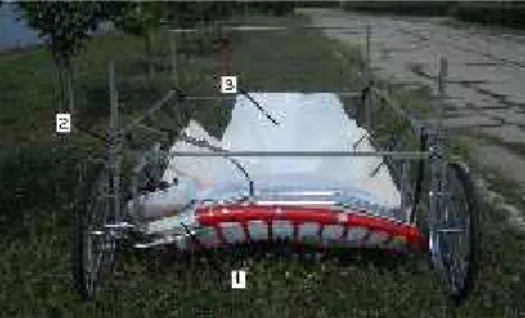
hilly areas, on lands whose slope does not exceed 6º. It consists of the following subassemblies: 1 – mower; 2 - chassis with possibilities of rolling; 3 - sack for the collection of the harvested material, (Figure 1).
The mower is an equipment type SV100, produced by Kawasakicompany for the tea harvesting (Figure 2). It is endowed with a cutting apparatus with double knife with 2 curved blades (pos. 1), of 1 m length. The blades cut the lavender inflorescences due to their oscillating movement performed at equal speed and contrary direction. The cutting blades shape is adapted to lavender bushes shape. Fan (pos. 2) blows the air over the cutting apparatus and pushes the inflorescences cut into the collecting sack. The cutting apparatus and the fan are both driven by a two-stroke spark ignition engine, cooled by air, T320 model, manufactured by Mitsubishi company(pos.3).
Figure 1 - Lavender harvesting equipment ERL-0 Figure 2 - The mower of the lavender harvesting equipment
Besides the engine controls, the mower also owns and controls for working, mounted on a support located above the engine zone (Figure 3). The working controls consist of a "main switch" (pos.1) of the ignition system of the engine, the control of motor coupling with the cutting machine (pos.2) and the control of the engine load ("acceleration") (pos.3), allowing the adaptation of its operation regime with the real needs of the cutting device.
Figure 3 - The working controls of the mower Figure 4 - The chassis with rolling possibilities
The chassis with rolling possibilities (Figure 4) consists of: 1 – front half bridges; 2 – framework; 3 – back half bridges; 4 – driving handle;5 – supporting tarp of the collection bag; 6 – longeron. The frame is a rectangular structure made of steel pipes, assembled with screws and nuts, having in the four corners sliding elements. Sliding of these elements the half bridges pillars allows the adjustment of the chassis height from the ground and implicitly the working height of the cutting device.
The collecting bag is a rectangular bag, made of synthetic material, provided with an elastic cord for tightening at the front side, which is mounted by hooking by the clamps fitted on the rear contour of the mower. The bag lower part is not sewn in order to adjust its useful length by binding with cord in the appropriate section, depending on the quantity of inflorescences to be harvested between two discharging operations. The bag is fitted with a screen mesh for the air exhaust that directs the material cut into its inside.
in the row space and the equipment „steps over” the lavender row, so that the cutting apparatus be located approximately symmetrically comparing to that.
Start the engine and then engage the cutting device. It increases the „engine speed” to about 50% of its capacity and begins advancing on row. Depending on harvest conditions (the desired forward speed, the characteristics of the lavender culture) it acts the control „increasing the engine speed” until it reaches the harvesting regime considered satisfactory.
The main technical and functional characteristics of the equipment:
- Mower manufacturer...Zhejiang Kawasaki Tea MachinaryCo.Ltd (China); - Mower model ...SV 100; - Type of cutting device...with double cutting blade; - Cutting blade...curved, radius of 1150 mm (height of 135mm in the center); - Manufacturer of mower engine:... .Mitsubishi (Japan); - engine model...T320; - Engine type:...monocilindrical, spark ignition and air cooling; - Engine capacity...46 cm3;
- Maximum power engine...2.2 kW; - front track:...1400 mm; - rear track:...1238 mm; - Wheelbase: max...1917 mm (with the swivel wheels to the rear); - Cutting height (at the extremities of the device):...adjustable, 100 ...550 mm; - Cutting width:...900 mm; - Fuel consumption:...0.420...0.950 l/h (depending on operating mode); - Speed of air flow developed by the blower:...15...21m s-1
- Overall dimensions:
-length (with swivel wheels oriented towards rear part):...max. 2370 mm ; -width:...1525 mm; -height:...1300 mm; - Equipment mass:...48 kg; - Serving personal:...1 or 2 operators.
In order to develop a technology suitable to a mechanized harvest of aerial organs of certain species of medicinal and aromatic plants, a technical harvesting equipment was designed, named ERPM-0.
Figure 5 - Equipment of harvesting medicinal and aromatic plants, ERPM-0
The field of utilization of equipment ERPM-0 comprises all the species of medicinal and aromatic plants that should be harvested as stem with leaves and flowers or only the
surfaces. It comprises the following sub-assemblies: 1-mower, 2- chassis with rolling possibility, 3- collecting bag, 4- collecting bag support, (Figure 5).
In this case, the mower used will be of double knife type, but endowed with straight blades and will have a working width of 1.2 m, for harvesting the plants disposed on 3/5 rows (for a distance between rows d=0.5/0.25m), on 2 rows( for 0.625m≤d≤1m) or in strips of1m width.
The functioning principle of the new equipment is always based on plants harvesting by cutting, the operating method being similar to that of equipment previously described. Due to the fact that ERPM-0 is a universal equipment, aiming to harvest a lot of species of medicinal and aromatic plants, annual or perennial (all-saints’-wort, mint, basil, hyssop, etc), its cutting height will largely vary, in order to meet the harvesting conditions.
Technical characteristics provided for ERPM-0:
Cutting height: adjustable, 40 ...500 mm;
Cutting width: 1200 mm;
Front track: 1552 mm;
Rear track: 1370 mm;
Wheelbase: 1832 mm;
Overall dimensions Lxlxh: 2370x1682x1300 mm
Engine:T320, Mitsubishi, Japan;
RESEARCH RESULTS
In this chapter, we intend to present only the experimental results obtained with the lavender harvesting equipment ERL-0, because the equipment for harvesting medicinal and aromatic plants ERPM-0 is only in execution phase.
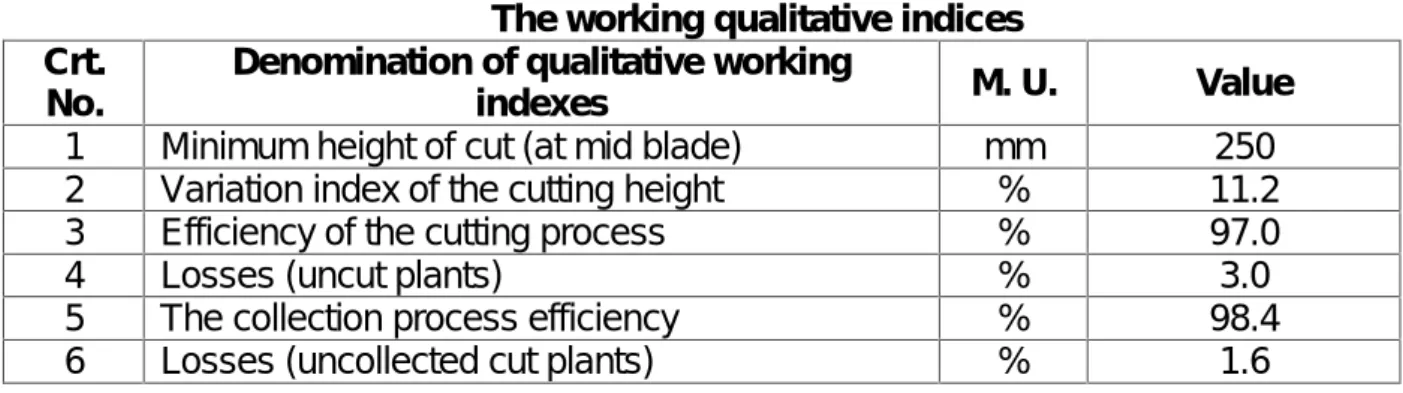
Experimentation of the equipment ERL-0 for determining the working qualitative indices was done in a lavender crop of 2-3 years (Table 1).
Table 1 The working qualitative indices
Crt. No.
Denomination of qualitative working
indexes M. U. Value
1 Minimum height of cut (at mid blade) mm 250 2 Variation index of the cutting height % 11.2 3 Efficiency of the cutting process % 97.0
4 Losses (uncut plants) % 3.0
5 The collection process efficiency % 98.4 6 Losses (uncollected cut plants) % 1.6
CONCLUSIONS
Following the tests of equipment ERL-0, the qualitative indexes achieved have demonstrated the equipment high efficiency in collecting lavender inflorescences.
In latest years, in Romania, small farmers owning agricultural fields cultivated more and more medicinal and aromatic plants and especially lavender , as this species allows to capitalize small surface or less productive lands, as well as to obtain major incomes in a relative short time.
Technology of harvesting the lavender and that designed to medicinal andaromatic plants were designed in order to support small farmers for obtaining high quality productions and respectively ensuring new competitiveness and profitability conditions in market economy.
ACKNOWLEDGEMENT
The work has been funded by Ministry of National Education and Research through the National Agency for Scientific Research and Innovation, within the project entitled „Innovative technology and equipment for increasing the quality of plant raw material obtained from medicinal and aromatic plants, in the view of elaborating competitive organic products”, PN 16 24 03 03.
REFERENCES
1. Dihoru A., Dihoru Gh. Plants used in human and animal digestion, Editura Ars Docendi Publishing, Bucharest, 2008, (ISBN 978-973-558-376-7);
2. Hajjaj G., Bounihi A., Tajani M., Cherrah Y., Zellou A.In vivo analgesic activity of essential oil and aqueous extract of Matricaria Chamomilla L. (Asteraceae),World Journal of Pharmacy and Pharmaceutical Sciences, Volume 3, Issue 5, 2013, (ISSN 2278 – 4357);
3. Hegazi R.A., Molari G., El-Sheikha A.M. Prototype of harvesting system for some aromatic and medicinal plants, International Journal of Agricultural Research 6 (5), 420-428, 2011, (ISSN 1816-4894);
4. Martinov M., Konstantinovic M., Chapter 2, Harvesting by book Medicinal and aromatic crops, Haworth Food &Agricultural Product PressTM, an imprint of The
Haworth Press, Inc. New York, 2007, (ISBN 978-1-56022-974-2);
5. Máthé A. A new look at medicinal and aromatic plants, ISHS Acta Horticulturae 925, XXVIII International Horticultural Congress on Science and Horticulture for People, IHC2010, (ISBN 978-90-66056-44-2);
6. Neculaiasa V., Danila I., Working processes and agricultural harvesting machines, Editura A92 Publishing, Iasi, 1995, ( ISBN 973-96138-5-3);
7. Roman G. şi colabCultivation of medicinal and aromatic plants according to environmental-free agriculture, Editura Ceres Publishing, Bucharest, 2009, (ISBN 978-973-40-0823-0);