245 | P a g e
Decision-Making Style of Educational Administrators
with reference to their Experience
Osia Majid
1, Mohammad Iqbal Mattoo
2Ph.D. Research Scholar, Department of Education and Psychology, J&K, India
1Dean and Head of the Department, School of Education and Behavioural Sciences, University of
Kashmir, J&K, India
2ABSTRACT
The present study was carried out to find and compare the Decision-Making Style of Public and Private Secondary School Administrators with reference to their Experience. A sample of 200 administrators was drawn randomly from the Public and Private Secondary Schools of Kashmir. Decision-Making Scale by N. Ganihar was administered for data collection. Mean, S.D and Test of Significance were used to analyse the data. The results revealed that Public administrators prefer Heuristic Decision-Making Style and Private administrators follow Routine and Compromise Decision-Making Styles in dealing with the academic, administrative, entrepreneurial and personal problems. Furthermore, results showed that senior administrators were found to espouse the Heuristic Decision-Making Style than the junior administrators who take on Routine and Compromise Decision-Making Styles.
KEYWRODS
:
Decision-Making, Public Administrators, Private Administrators, Experience.
1.
INTRODUCTION
Decision-making is a way of life for school administrators. It is a process of generating and assessing the
alternatives and chooses among them [1] (Mondy, 1993). Decision-making is a cognitive process of choosing a
course of action from numerous alternatives. It can be an action or an opinion. It arises when we need to do
something, but we do not know what? Hence decision making is a reasoning process which can be coherent or
illogical and can be based on overt or tacit assumptions. It is a crucial skill in the workplace, and it is mainly
imperative to make an effective leader [2] (Muthulakshmi, 2015). It represents a harmonious judgment and a
commitment to action. Decision- making pervades all administrative actions and is an indispensable component
of the administrative process itself. The success of the school is critically allied to effective decisions by the
administrators. Their primary responsibility lies in making decisions rather than performing routine operations.
The quality of the decisions made is a predominant factor in how the superintendent, for example; views a
principal's performance, or how a principal views a department head or team leader‟s performance. Decision
making affects the performance of a school by looking at the interests of its students, teachers, parents, as well
as the community. Every decision-making process produces a final choice that may or may not prompt action. It
246 | P a g e
conscious process, involving both individual and social phenomena. Literature viewed decision making as theprocess of choosing among alternative courses of action to solve a problem or attaining better situation
regarding the opportunities that exist [4] [5] [6](Carlisle, 1979; Harrison, 1999; Harris, 1980). According to [7]
(Baker et al., 2001) decision-making should start with the identification of the decision makers and stakeholders
in the decision, reducing the possible disagreement about problem definition, requirements, goals, and criteria.
Their primary responsibility lies in making decisions rather than performing routine operations. Decision
making is one of the most critical activities in which school administrators are engaged daily. The success of a
school is critically linked to effective decisions [8] (Lunenburg, 2010).
2.
OBJECTIVES
1. To find and compare the decision-making style of Public and Private administrators of the secondary
schools.
2. To find and compare the decision-making style of Senior and Junior administrators of secondary schools
with respect to their experience.
3.
HYPOTHESIS
1. There is a significant difference between the Public and Private administrators of the secondary schools.
2. There is a significant difference between the Senior and Junior administrators of secondary schools with
respect to their experience.
4.
SAMPLE
The sample of 200 administrators was drawn randomly from the following two types of institutions of the
Kashmir, J&K, India:
a) Secondary Schools run by the Government and b) Secondary schools maintained by the Private management.
5.
TOOL
The following standardized tool was administered by the investigator for data collection:
Decision-Making Style Scale (2005):The scale was developed by Prof. Noorjehan N. Ganihar which covers
four problem areas of decision-making:
i) Entrepreneurial Problems, ii) Administrative Problems, iii) Academic Problems and iv) Personnel Problems
6.
STATISTICAL
TREATMENT
OF
DATA
The data collected was subjected to the statistical treatment by calculating Mean, S.D. and Test of Significance.
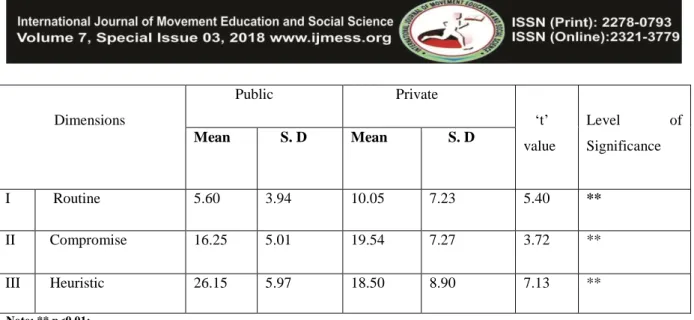
Table No. 1Showing the Significance of Difference Between the Mean Scores of Public and
247 | P a g e
DimensionsPublic Private
„t‟
value
Level of
Significance
Mean S. D Mean S. D
I Routine 5.60 3.94 10.05 7.23 5.40 **
II Compromise 16.25 5.01 19.54 7.27 3.72 **
III Heuristic 26.15 5.97 18.50 8.90 7.13 **
Note: ** p<0.01;
Table No. 2Showing the Significance of Difference between the Mean Scores of Senior and
Junior Secondary School Administrators on Decision-Making Style.
Dimensions
Senior
(N=102)
Junior
(N=98) „t‟
value
Level of
Significance
Mean S. D Mean S. D
I Routine 6.34 4.279 9.37 7.463 3.53 **
II Compromise 16.31 5.82 19.54 6.675 3.64 **
III Heuristic 25.43 6.758 19.09 8.90 5.68 **
Note: ** p<0.01
Senior: >6 years of experience as an administrator Junior: <6 years of experience as an administrator
7. INTERPRETATION AND DISCUSSION
The comparative analysis of Public and Private Secondary School Administrators on different levels of
decision-making style is reflected in Table 1. A quick look at this table shows a significant mean difference
between the Public and the Private secondary school administrators on different dimensions of decision-making
style. The results revealed that both the groups (public and private administrators) differ significantly on
Routine Decision-Making Style. The mean score in case of Private Administrators is reported to be higher
(M=10.05) as compared to the public administrators (M=5.60). The obtained „t‟ value came out to be significant
at 0.01 level of confidence (t=5.40). The results further revealed that both the groups (public and private
administrators) differ significantly on Compromise Decision-Making Style. The mean score in case of Private
Administrators is reported to be higher (M=19.54) as compared to the Public Administrators (M=16.25), and the
248 | P a g e
administrators which means private administrators follow the Routine and Compromise type of decisions. Thetwo groups were further compared on Heuristic Decision-Making Style, and here the mean score in case of the
Public Administrators is observed to be higher (M=26.15) as compared to the private administrators (M=18.50).
The obtained „t‟value came out to be significant at 0.01 level of confidence (t=7.13). The mean difference
favours Public administrators, which indicates that public administrators follow a heuristic type of decisions
while solving the Entrepreneurial, Administrative, Academic and Personal problems. From the results, it is
inferred that private administrators adopt the traditional methods like observation, supervision or circulars in
solving the entrepreneurial problems, and sometimes they seem to conduct seminars and symposia to evaluate
the outcomes. Public administrators, on the other hand, try to identify the problems that thwart the goal
achievement and undertake task group techniques for solving the problems. In serving the community, private
administrators traditionally organise the school programmes according to the rigid syllabus and do not risk
making any changes in it. Whereas, the public administrators consider the needs and demands of the society
first, and then include such aspects in the curriculum so that the teaching would be of practical use. From the
results, Public administrators seem to be committed; they organise the programmes and activities of the
organisation to achieve the objectives within the specified time. They never mix their problems with that of the
administration or academic while as the Private Administrators are observed to mix their problems with that of
the administration and hence fail to improve the quality of work. Therefore, it can be inferred that the private
secondary school administrators give more preference to Routine and Compromise Decision-Making Styles
which do not require much evaluation and analysis. On the other hand, public administrators give more
preference to Heuristic Decision-Making Style to solve a problem or to make a decision. In the light of these
results reported above, the Hypothesis No. 1 which reads as, “There is a significant difference in mean scores of
Decision-making styles of public and private secondary school administrators” is not rejected.
It has been found that both the groups are different with regard to different dimensions of decision-making style.
A host of researchers support the results in the field;
[9] Kundan&Sandeep (2016) found a positive and significant relationship of problem-solving ability and
self-esteem with decision-making styles of secondary school administrators. The researcher claimed that the
infrastructure facilities of private schools are better than that of the public schools which in turn gives freedom
to private administrators in their decision making and hence they adopt the routine type of decision-making
style. [10]Syarif (2014) found that the variation in the principal‟s decision making is affected directly by the
emotional intelligence, leadership style, and interpersonal communication. In contradictory to the above results,
the administrators with the transformational leadership skills employ a restrictive measure that hinders the
teachers from instigating strategies that would foster academic achievement [11] (George & Jones, 2000).
A close look at Table 2 shows a significant mean difference between the senior and junior secondary school
administrators on various dimensions of decision-making style. Both the groups (senior & junior heads) have
been found significantly different on all the dimensions of decision-making style. Analysis of the data reveals
that both the groups differ significantly on Routine Decision-Making Style. The mean score in case of junior
administrators is reported to be higher (M=6.34) as compared to the senior administrators (M=9.37). The
249 | P a g e
the groups differ significantly on Compromise Decision Making Style and, the mean score in case of JuniorAdministrators is reported to be higher (M=19.54) as compared to the Senior Administrators (M=16.31). The
obtained 't‟ value came out to be significant at 0.01 level of confidence (t=3.64). The groups were further
compared on Heuristic Decision-Making Style, and here the mean score in case of the Senior Administrators is
reported to be higher (M=25.43) as compared to the junior administrators (M=19.09). The obtained „t‟ value
came out to be significant at 0.01 level of confidence (t=5.68). From the results, it can be inferred that junior
administrators prefer Routine and Compromise type of decisions and senior administrators prefer a Heuristic
type of decisions while solving administrative, entrepreneurial, academic and personal problems. Senior
administrators are seen to identify the problems that hinder them to the achieve goals and undertake risky works.
They encourage teachers as well as students to take part in seminars, workshops, and conferences, whereas the
junior administrators supervise the records, circulars, at times arrange meetings with staff to see whether the set
goals or primary objectives are achieved or not. Senior administrators indulge teachers to solve the problems
faced by the students and the school by frequently arranging meetings. In anticipating a change in the
organisation to adopt the needs, aspirations, and motivation of the individuals, junior administrators conduct a
meeting to make the teachers understand the importance of the change undertaken and assign them activities
accordingly. On the other hand, the senior administrators implement the change with the help of experts and
willing teachers and then compare the achievements to the already present type of administration. To improve
the overall quality of work, senior administrators arrange discussions, guidance and counselling sessions
occasionally with the help of experts, while the junior administrators direct the teachers to go for the in-service
training programme for up gradation of their knowledge. Hence, it may be analysed that the senior
administrators adopt Heuristic decision-making style and the junior administrators prefer Routine and
Compromise decision-making styles. In the light of above results the Hypothesis No. 2, which reads, “There is a
significant difference between the Senior and Junior administrators of secondary schools with respect to their
experience” is not rejected.
The findings are in conformity with the findings of some researchers in the field: [12] Oluwadare et al. (2011)
suggested that the principals need the leadership qualities like co-operation and supervision for effective
administration. [13] Crum (2009) found that successful leaders provide the capacity for building a shared vision
and help promote the acceptance of group goals within the organization. However, in contrary to the results,
[14] Antoinette & Love (2007)found that teachers' length of service did not have any significant effect on the
principal's perceived leadership effectiveness and decision-making behaviour.
8.
CONCLUSION
1. Private Secondary School Administrators were observed to follow the Routine and Compromise
Decision-Making Style in comparison to the Public Secondary School Administrators who prefer
Heuristic Decision-Making Styles in dealing with the academic, administrative, entrepreneurial and
250 | P a g e
2. Public Secondary School Administrators were observed to be committed to achieving the objectivesand never mix their problems with that of the administrative or academic in comparison to the Private
Secondary School Administrators.
3. On the other hand, Senior Secondary School Administrators were reported to be Heuristic Decision
Makers which led them to be inspiring and encouraging. They are observed to be motivating, and they
always forestall a change to meet the needs of individuals.
REFERENCES
[1] Mondy, R. W., Premeaux, S. R., “Linking Management Behaviour to Ethical Philosophy”, Journal of Business Ethics, Vol. 12, Issue 5, pp. 349 -357, 1993
[2] Muthulakshmi.S., Decision-making Style of the Headmasters in Work Environmentof the Secondary
Schools.International Journal of Teacher Educational Research (IJTER) Vol.4 No.10 October, 2015ISSN: 2319-4642. (2015)
[3] Glueck, W.F. (2006). Decision making: Organization choice. Personnel Psychology.Vol.27, No. 1.Pp. 77- 93.
[4] Carlisle, H. M. (1979). Management Essentials Concepts and Applications.U. S. A Science Research
Associate Inc.
[5] Harrison, E. F. (1999). The Managerial Decision-Making Process.Boston: Houghton Mifflin Comp.
[6] Harris,R.(1980).Introduction to Decision Making, Virtual Salt.
[7] Baker, et. al., (2002).Guidebook to Decision - Making Methods, WSRC-IM, Department of Energy, USA.
[8] Lunenberg, F. C. (2010). The Decision-Making Process.National Forum of Educational Administration and Supervision Journal. Vol. 27, No. 4.
[9] Kundan Singh &SandeepKour (2016).“Decision making styles of the secondary school heads in relation
to their problem solving ability and self-esteem” Man in India96(5):1333-1340 · June 2016
[10] Syarif. H (2014). Analysis of the emotional intelligence influences, leadership style and interpersonal
communication of the decision-making byprincipals of state junior high schools in south Jharkta.
International Journal of Latest Research in Science and Technology. Vol.3, Bo 4:Pp.22-30.
[11] George, J. M., & Jones, G. R. (2000). Essentials of managing organizational behavior. New Jessey:
Prentice Hall.
[12] Oluwadare, A., Bello, A.A., Afamefuna, A. A. and Ngozi, N. ( 2011). Administrative Competency Needs
of Principals for Effective UBE Administration at JSS Level in North West Geo – Political Zone of
Nigeria.Journal of Educational and Social Research Vol. 1 (3).
[13] Crum Karen (2009). Data Based Decision Making (DBDM), the process of gathering, analyzing,
applying, and sharing data in order to promote school improvement. International Electronic Journal for Leadership in Learning, v13 n5 2009.
[14] Antoinette Love (2007).Teacher's perception of the leadership effectiveness of female and male