Nurul Ain
State College for Islamic Studies (STAIN) Kediri, Indonesia
Abstract: The purpose of this study is to develop the stories as the learning sources for teaching character at English lesson. This research was conducted by using research and developmental design (R & D) because the goal is to develop a product, i.e. the translated stories of Prophets. By developing the adapted model of Borg and Gall (1983), some procedures had been carried out. The product of the research is a book consisting of the translated stories of Prophet which were reviewed by experts in terms of its plot, content, language and design. In short, through this story book of Prophets, students and readers can learn the virtuous – worthy character – of Prophets as the good model for them. Besides, they can also learn English Language, especially in increasing their vocabulary in English. The suggestion given to the product of research was related to quantity of Prophet stories. Since this book just contains the story of the outstanding Prophets, it was suggested to cover all the Prophet stories for the next study.
Key words: stories of the Prophets, character education, English lesson
INTRODUCTION
begins with God. What is considered right or wrong is defined by reference to God (James, 2003:45).
Moral education is a matter of the setting by parents or teachers of appropriate examples of good or virtuous deliberation and conduct for the young. Thus, if we are to make virtuous characters of the young, and a precondition of such character in good example, the guardians and teachers of youth need themselves to be models of such good character (Nucci & Narvaez, 2008:115).
As parents raising our children, we have a dual goal. We want to prepare our children to receive the God, Allah, and we want to train them to be proper human being. We do it first by infusing them with knowledge of God and by educating their conscience with the law of the religion, which is a child conductor to bring them to Allah. For the second goal, we as the parent can do it by molding their character and teaching them what is the proper behavior. This is the transmission of our cultural values to our children (James, 2003:45).
Referring to those goals, one of the parents can do is by providing good literature to be consumed by our children. Good literature can supplement our own good examples by giving children an abundance of proper role models. Sometimes literature can make an even stronger impression on the children that we can, because children readily identify the characters in a story.
Nowadays teaching character have been integrated the learning process of all the lessons included the English lesson. The goal of teaching character is to teach the traditional values accepted as the moral attitude. Teaching character in the learning process in the class can be applied by using thematic approach with the targeted values.
them is the research held by Riyadi (2010). His research title is “Teaching English Using story book to improve their reading skill”. It gives the idea for the writer to develop the stories to be the appropriate ones not only to improve the English skills but also to teach the valuable character to the students through the characters in the stories.
Relating to good stories, Islam through the Holy Qur’an has provided a lot of stories of Prophets. These stories consisted many moral virtuous as expressed through the good behavior of Prophets. The stories of Prophets also provide the good value as the moral messages that can be learned and take it as the guidance to get the better life.
God stories can be used as the source in teaching in order that students can get both knowledge as well as good values as reflected through the characters of the story. This goal can also be implemented in teaching English by taking the Prophet stories. There are two goals can be achieved. First it can keep the existence of the religious figures and inherit them to the young generation. Besides that, the students can explore the great value expressed through the character of those stories as the moral message. Hopefully the students can learn from those stories how to have such good characters that are useful for life.
Through some reason above, this research has been conducted and aimed to develop the Prophet stories as learning source that is appropriate with the goal of character education that is building good character for students as young learners. Hopefully they are the ones who will build this country be better.
RESEARCH METHOD Research Design
textbooks, audio visual games, training manuals, story books for reading, etc. It is a process used to develop and validate educational product (Borg & Gall, 1983:772).
Borg and Gall (1983:775) propose 10 steps of R & D cycle research in developing mini course. They are research and information collection, planning, preliminary form of product, preliminary field testing, main product revision, main field testing, final product revision, dissemination, and implementation.
For the purpose of this research, the research and development design proposed by Borg and Gall (1983:775) is adapted. The adaption has been done by modifying the steps of the process based on the objective of the research, to produce a story book consisting moral virtuous, the good behavior of the Prophets. So there are some modification made to reach that objective.. The modification of adapted model includes the omitting the steps related to the field testing and implementing because this research focuses to produce the story book about the Prophets. The result of the modified adapted model is research and information collection, planning, developing preliminary form of product, the first product revision, validating from the expert, the second product revision, and final product.
Procedures of the Development
Referring to the adapted model of R & D, so the procedures of development covers to the steps in that model. For the first step is research and information collection. Here, the writer searched some material such as the English translation of Holy Qur’an (Ali, 2005), the original sources of the Prophets stories in Indonesian Language such as book written by Hamasah (2012) and El-Bantanie (2013), and some others’ comments about the Prophet life (Katheer, 2001). Since it is a product resulted from the process of translation from Indonesian into English texts, so varied dictionaries also become the material of information collecting.
language. After choosing the prophets stories that will be translated, the writer read again to find out the difficult and special terms related with the Prophet life.
Next, the process of translation began. The Prophet stories in Indonesian directly translated into English as the preliminary form of the product. This process was not only translating the texts but also modifying the stories. It had been done by giving the conversations inserted through the story to make it enjoyable to be read, since the modification did not change the main plot of story.
Since the result was the first draft, so it was needed to revise. The writer as the first editor read this result and made notes of some mistakes appear. By consulting the Holy Qur’an, the writer consulted about the real and original plot of the Prophets stories. Besides consulting with the main source, the writer consulted with the varied dictionaries to find out the English words of some special terms.
Then the result of this first product revision was given to the experts to be read and corrected. The experts checked the translated stories of the Prophets and gave some corrections. The corrections were about the content of the stories and also the language used in this product of translation.
Getting the revision from the experts, the writer improved the stories based on the correction given. Then, the result of revision was given again to the experts to confirm the revised mistaken words. To get the final product, the second revision from the experts had been edited for the layout of the product, by giving some ornaments to make it beautiful and can get the readers interest to read it. At last, the translated stories of the Prophets had been finished in the form of a story book.
Types of Data
Research Instrument
The key instrument of this research is the writer herself since she is the one who read the primary source and translate the Prophet stories from Indonesian into English language. The other instrument was the questionnaire given to the experts. It consisted 18 items divided into four aspects; plot, content, language and design. The plot aspect covers the chronological order of the Prophet stories, the clear and original stories. The content aspect covers the available of Surah Al-Qur’an, moral virtues and moral messages of the prophet stories. While language aspect portrays the vocabulary used, the pattern of sentences and also level of language for the targeted readers. The last aspect, design, covers all about letters used, from size, font and also pictures in a cover. All of the questions related to the developed product, the translated stories of Prophets.
Data Analysis Technique
Since this research is research and development, the analysis data done for the data taken from the experts through the questionnaire given each aspect of each experts had been analyzed by calculating in the form of percentage to know the appropriateness of the product, the translated stories of Prophets. Statistic descriptive was employed to calculate the items given in questionnaire can be seen in the following formula (Sugiyono, 2008).
Percentage = (response x weighting on each response) x 100 % ∑ N x weighting the highest response
Note:
∑ = total number
N = the total number of all the questionnaire item\
Table 1 Validity Level Conversion
Percentage Qualification Discussion
90% - 100% Very good No need revision
75% - 89% Good Need revision
65% - 74% Enough Need revision
55% - 64% Poor Need revision
0% - 54% Very poor Need revision
FINDINGS AND DISCUSSION
The draft of the development stories had been edited by the writer herself as the first editor. Then the result of frst revision given to the experts to be edited as the second editors. Besides the data about the correction on stories from the experts, the data was also from the questionare given to the experts about the appropriateness of stories as the learning source to teach character at English xclass.
The Presented Data Based on the Questionare Given to the Experts
The questionare given to the experts to get the idea about some points as the indicators of appropriateness ofnthe stories as the learning source for teaching character at English class. The result of questionnaire presented based on the aspects of a good story. There are four aspects in the questionnaire; they are plot, content, language and design. The content judgment displayed through the figures below.
The result of validation on the aspect of plot presented and analyzed based on the data of each expert.
Percentage = first expert percentage + second expert percentage 2
= 80 % + 80 % / 2 x = 80 %
After the score was converted to validity level, the translated stories of Prophets were categorized on good criteria of plot aspect as the percentage of this aspect is 80 %. It means that the Prophet stories had been told chronologically to build a well plot. It makes these stories will be understood easily by the students as the readers of this story book.
The Validation Result of Questionare on the Aspect of Content
The result combined both from the Questionnaire of the first and second experts
Percentage = first expert percentage + second expert percentage 2
= 100 % + 90 % / 2 x = 95 %
After the score on content had been converted to a validity level, it comes to the very good criteria since the score was 95 %, nearly the perfect score. It indicates that the translated stories of Prophets are appropriate for the students to read. These stories have provided moral virtues and moral messages which are good to teach character to students.
The Validation Result of Questionare on the Aspect of Content
The result combined both from the Questionnaire of the first and second experts
= 76 % + 88 % / 2 = 82 %
The score both from the first and second expert was 82 %. It shows that the level of language aspect was at good criteria. It means that the sentences used are appropriate for the students of junior high school in which most of the sentences in the translated of Prophet stories are familiar ones. So it will be easy for the students to catch the idea of story
The Validation Result of Questionare on the Aspect of Design
The result combined from the Questionnaire between the first and second experts
Percentage = first expert percentage + second expert percentage 2
= 70 %+ 97 % / 2 = 84 %
For the design aspect, the score was 84 % and it showed that this translated stories of Prophets has good criteria. It means that there was a well design and appropriate letters which made this story book be interested to read.
This story book of Prophets was made to fulfill the need of students for the alternative source of learning. This book was the product of translation from the Prophet stories in Indonesian Language. Through the research, the writer translated and developed some sources concerning with the Prophet stories. To make these stories be appropriate for the readers, especially students, the writer had done editing by involving the experts who know more about translation as well as the language. The revisions had been made to improve this product, as the suggestion from the experts and also through self editing based on the sources.
content aspect and the lowest score was on the plot aspect. But all the score were still included to good criteria. It means that these translated stories of Prophets are appropriate to be used as the alternative learning sources for the students to learn English language as well as the characters of righteous people.
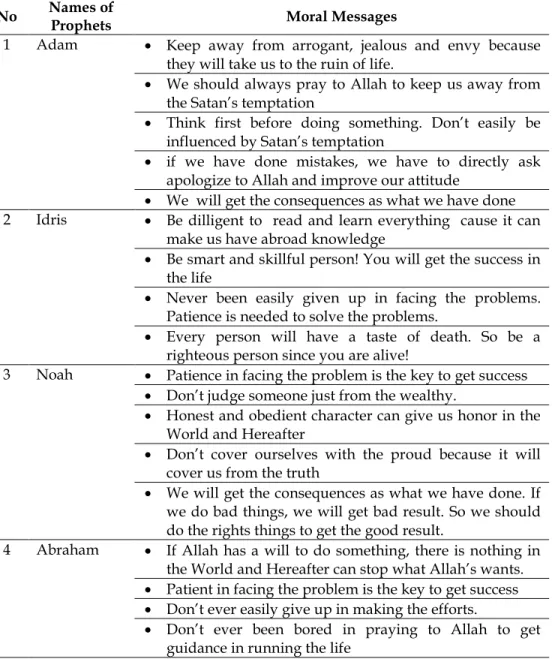
The appropriateness’ the stories of the prophets can also be seen from the moral virtues expressed through the characters and moral messages of the stories as the table below.
Table 2 The Moral Virtues Expressed through the Stories of the Prophets
No Names of
Prophets (Good Character) Moral virtues Evidence in stories
1 Adam Smart He can mention the names of things
which the angels cannot do it
Strong belief He believed that Allah gave the best
life for him though it was not a pleasure one
Obedient He did what Allah’s command when
he should marry his children and to solve Qobil and Habil’s case
Hard worker He diligently worked to fulfill his
family needs though he ever lived at pleasure one in heaven Heaven
Tough He never complained whatever the
life he faced. It happened when he knew that Habil died because of Qabil.
Sportive He admitted that he did a mistake
when he ate the forbidden fruit in Heaven and received whatever the punishment because of that
2 Idris Smart He liked to learn the Mushaf of Adam
He was capable of many languages
He was capable in Science and
Mathematics
He can argue with Izrael to let him get an experience of death
He can also make Izrael let him know
about Hell and come into Heaven
creative He can design buildings (houses)
Tough He never gave up in doing preaching though there were many obstacles from the Unbelievers
Patient He faced all those problems without
complaining and never revenged the ones who hurt him
Brave He punished the guilty one whoever
he was
He was known as As’adul As’ad ( the greatest lion among the lions)
3 Noah Strong Belief He believed every command from
Allah is the best for him so he faced and did all the commands with his deep belief.
Obedient He did whatever Allah’s command;
such as when he should build the ship. When he should sail and when he should stop sailing
Patient He was a patient father. He still
apologizes his son, Kan’an, though his son never heard his preaching death
He have never been angry when he
was mocked by the Unbelievers when he made a ship on land.
Tough He kept preaching though he had just
got few Believers for hundred years
4 Abraham Strong Belief He had a deep belief that Allah would
protest him when he was burnt alive He had strongest belief to Allah. For
every command he had got from Allah. It happened when he should leave his wife and a son in a dessert.
He did what Allah’s command to
slaughter his beloved son, Ismail, as his love to Allah
Smart He thought about the Creator since he
was a child
He gave the best answer when he was
in trial for destroying the idols by putting the axe on the big idol’s neck
He had a smart way to make Haran’s
Patient He received the fact that he had not got the child yet. He never complained about it. He just received is as the fact from Allah.
He gave the belief of Allah to his
parent who was the Unbelievers without making them hurt.
Brave He felt not afraid to destroy the idols
even though he knew that the people would kill him because of it
He was calm when he would be burnt
alive because he believed that Allah would protect and save him from such a danger.
He was brave to say in front of the people that they were stupid to worship the idols (statue).
Tough He kept on praying to Allah for
giving him a blessed child to be his descendant. He did it till he grew too old to have a child.
He kept on preaching and never
complained though he should move from country to the countries.
5 Lut Patient He patiently warned his wife not to
think just about the wealthy though his wife never cared his saying.
He still negotiated to the people who
wanted his handsome guests though they were so angry to him.
He still did preaching to the people though he was rejected his teaching.
Tough He never been despair to ask Sodom’s
people their bad attitudes, even they threatened to kill him
6 Ismail Strong Belief He was a virtuous man who relied
everything to Allah. He received his life as his faith when he should lived just with his mother in the place far away from his father.
He supported his father, Ibrahim, to
Obedient He was an obedient son for Ibrahim. He fulfilled what Ibrahim’s order. It happened when his father would slaughter him as Allah’s command. He just wanted to make his father can fulfill all the commands.
On other occasion, Ismail also showed
his obedience by helping his father to build Ka’bah.
Wise He answered politely to make his
father feel fine in doing Allah’s commands, such as when his father should slaughter him.
7 Moses Brave When he was a child, he pulled
Pharaoh beard till he felt furious with him.
He also a brave to put the fire into his
mouth when he was a baby.
He was brave to defend himself from
Qibthi’s attack and hit him till death
He was dare to preach in front of
Pharaoh to make him worship to Allah.
He bravely accepted Pharaoh’s
challenging to face the attack from the witches.
He was brave to lead his Believers to
run away from Pharaoh’s army through the sea.
Care He felt empathy to Israel man and
defended him from the Qibthi’s man who attacked him.
He directly help the women when he
saw them try to give water for their sheeps.
Tough He had never given up to guide the
people to worship just to Allah, though he had got many threatens
8 David Smart He possessed a wide range of
knowledge
Brave When he was still young, he was
brave to go war.
He offered himself to face Goliath when there was no one brave to face him in a war.
just using Catapult. Finally, he can kill Goliath.
He was able to make the nature –
mountain, hill- to praise in the name of Allah.
Wise He treated his father-in-law well
though he wanted to kill him.
He can solve the [people’s problem in
a wise that make both of the sides satisfied with his decision. The case between a cattle-breeder and a farmer
9 Solomon Smart He can help his father, David, by
giving the best solution in the case of the field when he was still young.
He can communicate the language of
animals, such as ants, birds, etc.
He had a smart way to make Balqis
realized her bad thing, to worship to sun, moon and stars. He finally can make Balqis joined with Solomon to be Believers.
Brave He can conquer all jinns, animal, and
nature and make them be his army.
Wise He can wisely solve the case of his
people without differentiating the wealthy and poor ones.
10 Muhammad Trustworthy He honestly did his work as the sheep
keeper till many Quraish people believed him to keep their sheep.
He carried out Khadeejah’s business
very well till she believed all of her goods to him
Patient All of the bad treatments from the
Unbelievers had been faced calmly and patiently by Muhammad.
He had never been angry to the
people who did bad things to him. Even some of them joined with Islam because of his patience.
Brave He became a brave commander when
he guided his army to the wars.
He was no afraid when he and Abu
Bakar hided in the cave to escape from the Quarish’ army.
Tough Since he was a child, he had work
sheep keeper.
He can handle his misery because
being left by his wife and uncle. He relied on every facts of his life to Allah.
Table 3 The Moral Messages Expressed through the Stories of the Prophets
No Names of Prophets Moral Messages
1 Adam Keep away from arrogant, jealous and envy because
they will take us to the ruin of life.
We should always pray to Allah to keep us away from
the Satan’s temptation
Think first before doing something. Don’t easily be
influenced by Satan’s temptation
if we have done mistakes, we have to directly ask
apologize to Allah and improve our attitude
We will get the consequences as what we have done
2 Idris Be dilligent to read and learn everything cause it can
make us have abroad knowledge
Be smart and skillful person! You will get the success in
the life
Never been easily given up in facing the problems.
Patience is needed to solve the problems.
Every person will have a taste of death. So be a
righteous person since you are alive!
3 Noah Patience in facing the problem is the key to get success
Don’t judge someone just from the wealthy.
Honest and obedient character can give us honor in the
World and Hereafter
Don’t cover ourselves with the proud because it will
cover us from the truth
We will get the consequences as what we have done. If
we do bad things, we will get bad result. So we should do the rights things to get the good result.
4 Abraham If Allah has a will to do something, there is nothing in
the World and Hereafter can stop what Allah’s wants.
Patient in facing the problem is the key to get success
Don’t ever easily give up in making the efforts.
Don’t ever been bored in praying to Allah to get
Don’t be afraid to tell the truth, though it is difficult to say.
5 Lut Obedient to Allah and His Prophet is the safe way in the
world and hereafter
Men just allowed to marry with women. That is the rule
from Allah.
Be a righteous person. It will make you save from the bad things happen to you.
Don’t be greedy because it will ruin you. Wealthy is not
everything but belief to Allah is the important thing.
6 Ismail There is just Allah, the One Almighty God in the World
and Hereafter.
Be patient and tough in every test of the life. Allah loves
the patient and tough one.
Allah never let the righteous people who are obedient to
carry out His commands.
Allah will replace with the goodness of every sacrifice we have given in the name of Allah, the Merciful God.
We should always thank to Allah for whatever blessing
come to us
Be obedient child will give the goodness in the World and Hereafter for himself and people surround him.
7 Moses There is just Allah, the One Almighty God who must be
worshipped
Don’t be too proud of yourself because we are just the
creation of Allah.
Remember! Every wealthy, position, power is from
Allah. So you shouldn’t be proud because of that.
We should always thank to Allah for whatever blessing
come to us
e a tough person in living in this world! There will be a
way if you have a will.
8 David Remember! Someone who is honorable beside Allah is
the one who has good characters, not because of wealthy and position.
Be a good person! Then you will be loved by people
surround you.
A greater thanks we give to Allah, so Allah will give more blessing to us.
Keep your bravery if you think you are right. Allah will
keep and help you.
If you have got the position, do the duty with honest,
fair and wise characters
Don’t ever underestimate someone else based on the
9 Solomon When you have got the position, be the honest, fair and wise leader. Because Allah loves the good and fair leader.
The power and wealthy are the tests from Allah to
know whether we are thankful ones or not
Greater thanks we give to Allah, so Allah will give more
blessing to us.
Remember! The knowledge we have is the blessing
from Allah. So the greater knowledge we have, the more we should believe on Allah’s greatness.
Death is a secret thing which has only been known by
Allah. It cannot be proposed, it cannot be denied.
10 Muhammad Honest, trustworthy and trustful are characters needed
to live successfully in the World and Hereafter.
We have to always pray to Allah to keep us away from
the Satan’s temptation
The toughness in accepting the problems of life can be
done by relying everything just o Allah, the almighty God.
if we have done mistakes, we have to directly ask
apologize to Allah and improve our attitude
We will get the consequences for what we have done.
So think first before doing something. Don’t easily be influenced by Satan’s pursue.
However, this product of the translated stories of Product as the source of learning has not been tested in the field yet since the focus of this research still in producing and improving this product to be the appropriate source of learning. It is planned that this product of the research, the story book of Prophets, will be applied through the experimental research to some schools to know how far it can make the students learn character as well English language.
CONCLUSION AND RECOMMENDATIONS
good behavior – expressed through the life of Prophets and also moral message that can be useful for the readers and students. In short, all the aspects in the questionnaire shows that this product is appropriate as the learning source for teaching character to young learners at English class, there was some revision done to improve the stories. Through this story book of Prophets, students and readers can learn the virtuous – worthy character – of Prophets as the good model for them. Besides, they can also learn English Language, especially in increasing their vocabulary in English.
The suggestion given to the product of research was related to quantity of Prophet stories. Since this book consists of just the outstanding Prophets, it was suggested to cover all the Prophet stories. The researcher has thought about that. So in the future, she will explore the other Prophet stories to be developed into another story book.
REFERECES
Ali, A. Y. (2005). The Holy Qur’an: Text and Translation. Kuala Lumpur: Islamic book Trust.
Arthur, J. (2003). Education with Character: the Moral Economy of Schooling.
New York: RoutledgeFalmer.
Borg, W.R. and Gall, M.D. (1983). Educational Research: An Introduction
(4th edition). New York: Longman.
Darmiyati, Z; Zuhdan K.P. dan Muhsinatun. (2012). Model PendidikanKarakter. Yogyakarta: UNY Press.
El-Bantanie, S. (2013). Kisah Menakjubkan 25 Nabi & Rasul. Jakarta: Wahyu Media.
Gay, L.R. (1992). Educational Research: Competencies for Analysis and Application (4th edition). New York: Macmillan Publishing
Hamasah, I. (2012). Kisah Teladan 25 Nabi & Rasul. Jakarta: Cikal Aksara.
Katheer, I. (2001). Portraits from the Life of Prophet Muhammad. Egypt: Dra Al-Manarah
Nucci, L. P & Darcia Narvaez. (2008). Handbook of Moral and Character Education. New York: RoutledgeFalmer.
Riyadi, W. (2010).Teaching English Using Story Book to Improve Reading Skills.Unpublished Thesis. Bogor: IBN Khadun