293
VARIATION OF CHLOROPHYLLS AND OSMOLYTES CONTENT IN
THREE CULTIVARS OF WHEAT UNDER DROUGHT STRESS
BABEANU CRISTINA1, DODOCIOIU ANA MARIA2, BUZATU DIANA GILDA2* 1 University of Craiova, Faculty of Science, 107i Calea Bucuresti, Craiova, Romania 2 University of Craiova, Faculty of Horticulture, 13 A.I.Cuza Street, Craiova, Romania
*Corresponding author e-mail: [email protected]
Keywords: wheat, drought stress, osmolytes, chlorophyll.
ABSTRACT
Drought is one of the environmental factors that adversely affect the growth and productivity of plants. Plants adapt their metabolism by developing various defensive mechanisms to survive unfavorable conditions. The objective of the present study was to investigate the effect of water stress (50% field capacity) on photosynthetic pigments, protein, soluble sugars, amino acids and proline content in leaves of three varieties of wheat (Dropia, Alex and Boema). The results show that the contents of soluble sugars, amino acids, total carotenoids and proline increase with decreasing water content in soil while the content in chlorophyll and protein decreases in all studied genotypes. The results suggest that the investigated biochemical indices play an active role in regulating osmotic pressure, an important mechanism in plant tolerance to drought stress.
INTRODUCTION
Drought is one of the factors that affect the growth, development, survival and productivity of the plants, the affected regions expanding due to climate change. Drought causes a series of metabolic changes, leads to the closing of
the stomata, decreases stomatal
conductance, decreases CO2 fixation by
decreasing photosynthesis rate, affects
nitrogen fixation, and disrupts
fundamental processes associated with plant growth and development (Rampino, 2006; Reddy et al., 2004). Water stress changes cellular redox status by accumulation of reactive oxygen species (ROS) such as singlet oxygen (1O
2),
superoxide radical (O2-), hydrogen
peroxide (H2O2) and the hydroxyl radical
(HO•). Reactive oxygen species in excess can cause lipid peroxidation, membrane injury, protein degradation, enzyme inactivation, pigment bleaching and disruption of DNA strand .
After perception of stress plants initiate complex signaling of adaptive
strategies and adjusted their metabolism
by developing various defensive
mechanisms to survive adverse
conditions (Badea et al., 2002). These responses are dependent on species, duration and severity of stress. In order to limit drought-induced oxidative damage plants have developed a series of detoxification system that scavenge the reactive oxygen species. The plant antioxidant system is composed of both enzymatic such as superoxide dismutase,
ascorbate peroxidase, glutathione
reductase, catalase (Marinescu et al., 1999) and non-enzymatic components such as reduced glutathione, ascorbic acid, α-tocopherol, phenols, carotenoids (Soare et al., 2015, Babeanu et al., 2010a). Another response mechanism of plants is the synthesis and accumulation of osmo-protectants compounds including certain polyols, organic acids, ions,
quaternary ammonium compounds,
294 (Delauney and Verma, 1993). Osmotic adjustment is a beneficial mechanism that allows stomata to stay open, CO2 fixation
to continue under water deficit, control pH of cytoplasm, maintaining turgor and higher relative water content and stabilizing proteins and cell structures (Rai, 2002, Reddy et al., 2004). In the context of guaranteeing access to a healthy food (Bonciu, 2016; Bonciu, 2017) for a growing population, special attention is given to increasing agricultural production by cultivating drought resistant genotypes (Babeanu et al., 2017, Rosculete et al., 2010a, Iancu et al., 2017).
The objective of the present study was to investigate the effect of water
stress (50% field capacity) on
photosynthetic pigments, protein, soluble sugars, amino acids and proline content in leaves of three varieties of wheat (Dropia, Alex, Boema).
MATERIAL AND METHOD
Three varieties of wheat were studied (Triticum aestivum L.cv. Dropia, Alex, Boema). Experiments were carried out using soil from Agricultural Research and Development Station Caracal in pots containing 10 kg soil. The soil used for experiments is characterized by a slightly alkaline pH, poorly supplied with nitrogen, medium to well supplied with phosphorus and well to very well supplied with potassium (Rosculete and Rosculete, 2018; Rosculete et al., 2010b). Each genotype was conducted in one level soil water treatment: 50% field capacity (50%FC) controlled by weighting method,
and matched with one control
correspondingly. Biochemical analyses were realized on expanding fresh leaves cut at tillering.
The leaf pigments content was
determined spectrophotometrically
(Babeanu et al., 2010b). The absorbance was measured at 653, 666 nm, for chlorophyll a and b and 470 nm for carotene. The results were calculated according to methanol extraction solvent
and expressed as mg/g fw (fresh weight).
Chlorophyll a (mg/mL)= 15.65 A666 – 7.340 A653 ; Chlorophyll b (mg/mL)= 27.05 A653 – 11.21 A666 ; Carotene (mg/mL)= 1000 A470 – 2.860 Chl a – 129.2 Chl b/245
Sample preparation for the estimation of reducing sugars and total free amino acids
Plant material was extracted in 80% aqueous ethanol (1:40 w:v) at 90C 30 min. After cooling the mixture was filtered, evaporated to dryness and re-dissolved in 2mL distilled water. The obtained extract was used for reducing sugars and total free amino acids assays.
Total reducing sugars content were determined colorimetric at 540 nm (Soare et al., 2016). At 1 mL extract, 2 mL of dinitrosalicylic acid reagent (1 g 3,5-dinitrosalicylic acid dissolved in 20 mL of 2M NaOH, 50 mL of distilled water, and 30 g of Na-K- tartrate and the final volume was made up to 100 mL) was added. The mixture was incubated for 10 min at 100˚C, cooled and the absorbance was measured at 540 nm after color development. D-Glucose was used as standard and the results were expressed in mg/g fw (fresh weight).
Total free amino acids content were determined colorimetric at 570 nm (Babeanu et al., 2010b). At 1 mL extract, 1 mL of freshly prepared 2% ninhydrin reagent was added and the mixture was boiled at 100 ˚C in water bath for 20 min. After cooling, the absorbance was recorded at 570 nm. The results were calculated using standard curve with leucine and expressed as μg/g fw (fresh weight).
The proline content was measured spectrophotometrically at 520nm (Matei et al., 2013) . 0.5g of plant material was
homogenized in 10mL of 3%
295 heated to 100°C, 1h. After cooling with ice, 4mL toluene was added and absorbance of the chromophore toluene phase was measured at 520nm. Toluene was used as a blank and the results were calculated using standard curve with L-proline. The proline content was expressed as μg/g f.w. (fresh weight).
The soluble proteins were
extracted in distilled water (1:10 w/V). At 0.8 mL sample extract, 0.2 mL of Bradford reagent (2.5 mg coomassie brilliant blue G 250, 1.25 mL of 95 % ethanol, 2.5 mL of phosphoric acid, and 21.25 mL of distilled water) was added and mixed thoroughly. The absorbance of mixture was recorded at 595 nm after the color development (Matei et al., 2013). The results were calculated using standard curve with bovine serum albumin (BSA) and expressed as mg/g fw (fresh weight). All the spectrophotometric measurements were carried out with Evolution 600 UV-Vis spectrophotometer, Thermo Scientific, England, with VISION PRO software.
RESULTS AND DISCUSSIONS
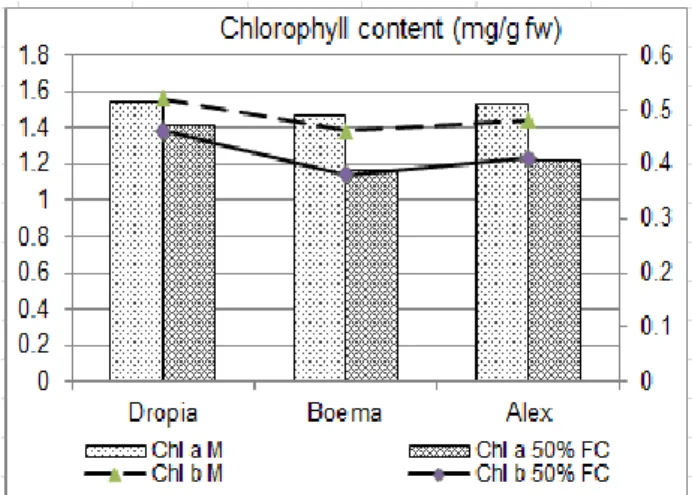
Due to the central role of photosynthesis in plant metabolism, the content of chlorophyll a, b and leaf carotenoids was determined. The results are represented in figures 1 and 2.
The content of foliar pigments varies with the investigated genotype and the level of water supply. In the case of water stress the content in chlorophyll a and chlorophyll b decrease compared to control variants in all studied genotypes. The decrease in chlorophyll a content varies from 8% (Dropia) to 20% (Boema and Alex) and the decrease of chlorophyll b varies from 11% (Dropia) to 17%
(Boema). The highest level of
chlorophylls is recorded to Dropia in both treatment variants. These results suggested that the efficiency of photosynthetic apparatus might be disturbed by changes in pigment content.
Figure 1. Chlorophylls content in studied genotypes
Carotenoid content increases slowly in hydric stress variants compared to control variants from 7% (Dropia and Alex) to 13% (Boema). This increase considered to be an adaptive response to stress can be explained by the antioxidant properties of carotenoids that are involved in neutralizing free radicals and reducing stress-induced oxidative damage.
Figure2. Carotenoids content in studied genotypes
296 Figure 3. Aminoacids and proline
content
Amino acids content varies with genotype and degree of water supply (Figure 3). In the case of control variants, the content in aminoacids varies from 20.62 mg/g (Boema) to 24.08 mg/g (Dropia) and in the case of hydric stress between 30.53 mg/g (Alex) and 32.07 mg/g (Dropia). In all genotypes the content in aminoacids increase in plants subjected to hydric stress 33.62% (Dropia); 53.39% (Boema) and 38.52% (Alex). The increase in level observed for the amino acids in leaves of wheat under water stress is in agreement with other data in literature (Bandurska et al., 2008). The increase in free amino acids could contribute to the tolerance of the plant to water deficit through an increase in osmotic potential, or as a reserve of nitrogen, principally for the synthesis of specific enzymes.
Another important parameter in the response of plants to different types of stress is proline. Proline has several
functions during stress: osmotic
adjustment, osmo-protection, free radical scavenger especially singlet oxygen and antioxidant, stabilisation of proteins, protection of macromolecules from denaturation, regulation of cytosolic acidity, carbon and nitrogen reserve under stress (Delauney and Verma, 1993). Proline can serve as a quick source of available nitrogen, carbon and
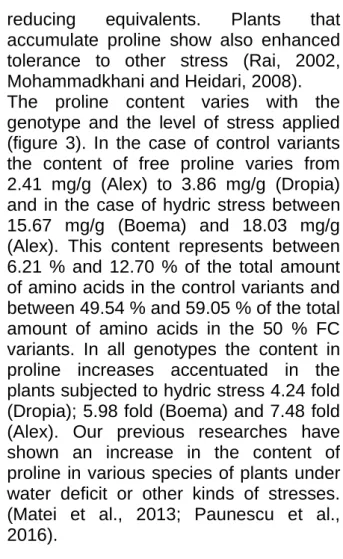
reducing equivalents. Plants that accumulate proline show also enhanced tolerance to other stress (Rai, 2002, Mohammadkhani and Heidari, 2008). The proline content varies with the genotype and the level of stress applied (figure 3). In the case of control variants the content of free proline varies from 2.41 mg/g (Alex) to 3.86 mg/g (Dropia) and in the case of hydric stress between 15.67 mg/g (Boema) and 18.03 mg/g (Alex). This content represents between 6.21 % and 12.70 % of the total amount of amino acids in the control variants and between 49.54 % and 59.05 % of the total amount of amino acids in the 50 % FC variants. In all genotypes the content in proline increases accentuated in the plants subjected to hydric stress 4.24 fold (Dropia); 5.98 fold (Boema) and 7.48 fold (Alex). Our previous researches have shown an increase in the content of proline in various species of plants under water deficit or other kinds of stresses. (Matei et al., 2013; Paunescu et al., 2016).
Figure 4. Reducing sugars and protein content in studied genotypes
297 compared to the control variants. In the case of control variants, reducing sugars content ranges from 198 mg/g (Boema) to 287 mg/g (Alex) and in the case of hydric stress between 333.68 mg/g (Boema) and 459.2 mg/g (Alex). In all genotypes, the reducing sugars content increases in plants subjected to hydric stress 85% (Dropia); 68% (Boema) and 60% (Alex). The accumulation of carbohydrates under conditions of decreased foliar pigment
content leading to diminished
photosynthesis can be explained by
starch hydrolysis. Carbohydrate
accumulation maintains osmotic balance, scavenge reactive oxygen species (ROS) and stabilizes proteins and cellular structures (Bowne et al. 2012, Reddy et al., 2004). The scientific literature shows that the main carbohydrates accumulated under stress are glucose, sucrose and trehalose. Trehalose acts as a stress protector, can stabilize dehydrated biological structures, such as membranes or enzymes and as a carbohydrate reserve (Goddijn and Dun, 1999).
In all investigated genotypes the soluble protein content decreases when applying 50% FC water stress compared to the control variants (Figure 4). In the case of control variants, the soluble proteins content varies from 225 mg/g (Dropia) to 270 mg/g (Boema) and in the case of hydric stress between 172 mg/g (Boema) and 189 mg/g (Alex). The changes of the chlorophylls and of the studied osmolytes content leads to increase of the cellular osmolarity, which is considered an important component of the drought tolerance mechanisms.
CONCLUSIONS
Hydric stress affects plant growth and productivity through complex metabolic changes.
The results show that the contents of soluble sugars, amino acids, total carotenoids and proline increase with decreasing water content in soil while the
content in chlorophyll and protein decreases in all studied genotypes. The results suggest that the investigated biochemical indices play an active role in regulating osmotic pressure, an important mechanism in plant tolerance to drought stress. All studied genotypes show a 50 % hydric deficiency soil tolerance.
BIBLIOGRAPHY
1. Badea, E., Babeanu, C., Marinescu,
G., Corneanu, G.C., Corneanu, M., 2002 - Peroxidases as monitors of very low magnetic field effects, VI International Plant Peroxidase Symposium (3–7, July 2002) S5-P10.
2. Bandurska, H, Górny, A.G.,
Zielezińska, M., 2008 - Effects of water deficit on the relative water content, proline accumulation and injury of cell membranes in leaves of old and modern cultivars of winter wheat. Acta Physiol 524:115–125
3. Babeanu, C., Constantin, C.,
Paunescu, G., Popa, D., 2010 - Effects
of drought stress on some
oxidoreductase enzymes in five varieties of wheat, Journal of Environmental Protection and Ecology, 11(4) 1280–1284
4. Babeanu C., Paunescu G., Popa D.,
Badita A. A, 2010- Variation of
carbohydrates and free aminoacids spectrum from drought tolerant varieties of wheat from Oltenia, Journal of Environmental Protection and Ecology, 11, No 3, 1092-1097
5. Babeanu, C., Matei, G., Dodocioiu
A.M., 2017 - Evaluation of sugar content in stem juice from sweet sorghum hybrids grown in South West of Romania, Annals of the University of Craiova - Agriculture, Montanology, Cadastre Series, vol XLVII (2), 25-29.
298
7. Bonciu, E., 2017 - Food processing, a necessity for the modern world in the context of food safety: a Review. Annals of the University of Craiova - Agriculture, Montanology, Cadastre Series, Vol. 47(1), 391-398.
8. Bowne, J.B, Erwin, T.A, Juttner, J.,
Schnurbusch, T., Langridge, P., Bacic,
A., Roessner, U., 2012 - Drought
responses of leaf tissues from wheat cultivars of differing drought tolerance at the metabolite level. Mol Plant 5, 418–
429
9. Delauney, A., Verma, D.S., 1993 - Proline biosynthesis and osmoregulation in plants, The Plant Journal, 4(2), 215-223
10. Goddijn, O. J. M., Dun, K. V., 1999 -
Trehalose metabolism in plants. Trends in plant science, 4, 315–319.
11. Iancu, P., Soare, M., Bonea, D.,
Panita O., 2016 – Preliminary results concerning the genetic variability of some mutant lines of wheat experimented to ARDS Caracal, Annals of the University of Craiova-Agriculture, Montanology, Cadastre Series, 46(1), 159-164
12. Mohammadkhani, N., Heidari, R.,
2008 - Drought-induced Accumulation of Soluble Sugars and Proline in Two Maize Varieties. World Appl. Sci. 3(3), 448-453.
13. Marinescu, G., Badea, E., Babeanu,
C., Glodeanu E., 1999 – Peroxidase system activity in leaves of cucumber plants as marker of growth stimulant treatment, Plant Peroxidase Newsletter, 14, 9-85
14. Matei, G., Babeanu, C., Soare, M.,
Birzanu, O.F., 2013. The effect of cadmium excess on lipid peroxidation and antioxidant defence system in wheat seedlings, Annals of the University of Craiova - Agriculture, Montanology, Cadastre Series, 43 (1) 211-216
15. Paunescu, A., Babeanu, C.,
Dodocioiu, A.M., Paunescu, G.,
Buzatu, D.G., 2016 -Antioxidant enzyme activities and proline content in maize plants under PEG-induced water stress,
International Multidisciplinary Scientific
GeoConference: SGEM: Surveying
Geology & mining Ecology Management, Vol 1, 413-419.
16. Rai, VK., 2002 - Role of amino acids in plant responses to stresses. Biol. Plant. 45: 481-487
17. Rampino, P., 2006 - Drought stress response in wheat: physiological and molecular analysis of resistant and sensitive genotypes. Plant Cell Environ, 29, 2143–2152.
18. Reddy, A.R., Chaitanya, K.V.,
Vivekanandan, M., 2004 - Drought
induced responses of photosynthesis and antioxidant metabolism in higher plants.
J. Plant Physiol. 161, 1189-1202
19. Rosculete, E., Susinski, M., Soare,
R., Rosculete, C., Matei G., 2010 – The dynamics of the nitric nitrogen from the soil for wheat crop function of irrigation, soil tillage and fertilization, Analele Universitatii din Craiova Seria Agricultură, Montanologie Cadastru, 40 (1) 560-564
20. Rosculete, E., Matei G., Rosculete
C., Soare R., 2010 - The evolution of nitric nitrogen from the soil under the influence of some fertilizers doses.
Research Journal of Agricultural Science, vol. 42(3), 285-288.
21. Rosculete, E., Rosculete, C., 2018- The influence of the interaction of some mineral fertilizers on the accumulation of some nutritive elements in wheat grains,
Scientific Papers. Series A. Agronomy, Vol. LXI (1), 386-390;
22. Soare, R., Babeanu, C., Bonea, D.,
Panita, O., 2015 - The content of total phenols, flavonoids and antioxidant activity in Rosehip from the spontaneous flora from South Romania. Scientific Papers-Series A, Agronomy, 58, 307-314
23. Soare, R., Dinu, M., Babeanu, C.,
Fortofoiu, M., 2016 - Bioactive compounds and antioxidant capacity in some genotypes of white cabbage (Brassica oleracea var. Capitata f. Alba),
International Multidisciplinary Scientific
GeoConference: SGEM: Surveying