8
THROUGHPUT-OPTIMAL CONFIGURATION OF FIXED
WIRELESS MESH NETWORK IN CROSS-WAY DESIGN
1
T.RANJANI DEVI, 2MR.PON PRAKASH.P
1IInd M.E (CSE), Department of Computer Science, SRG Engineering College, Namakkal 2 AssociateProfessor, Department of Computer Science, SRG Engineering College, Namakkal 1
[email protected], [email protected]
Abstract -
A network is defined by a collection of nodes clients, server, and links (routers) between pairs of
client and server.The client edge router sends the test message to all the available routes to get the best path from the list of all possible paths based on the transmission delay time. choose an offline route selection algorithm i.e to select multi path routing algorithm.Data packets are forwarded through the minimum delay router along with next minimum delay priority router from the client to server.Current Network architecture developed for wired networks is not efficient for multihop wireless networks.Transfer the packet from Source to destination by using shortest path algorithm .this algorithm to find the shortest path between Source and Destination and then Transfer the Packet depends upon TTL Value of packet. using Single channel transmission to transfer data so reduce the network speed,Data loss and delay time found to be high while using Single channel and shortest path algorithm. The client edge router sends the test message to all the available routes to get the best path from the list of all possible paths based on the transmission delay time.By using Joint-Routing algorithm, Transfer the packets to all beat selected path Channel so that data transmission will improve the throughput of the network. In Multi-channel wireless network, data will be transferred within the TTL in router.
INTRODUCTION
Although the worldwide success of the Internet is partly due to the simplicity and robustness of its layered network architecture, this architecture, developed for wired networks, is not efficient for multihop wireless networks. Cross-layer approaches have been proposed , to enhance the adaptability and performance of these networks by jointly tuning the parameters of different layers. One of the critical performance metrics in multihop wireless networks is throughput. It is highly dependent on the configuration of routing, medium access, and physical-layer parameter and on their interactions; see, for example, and in the case of a (conflict-free) scheduled network. Configuring a wireless network based on random access is much more difficult, and one might be tempted to simply use a so-called default configuration comprised, for example in the case of slotted ALOHA, of a minimum-hop routing and equal attempt probability. While one would expect that joint configuration of routing, medium access, and physical-layer parameters of a random access network can provide better performance than the default configuration, there is no clear indication so far on how much improvement can be achieved by joint design and how to jointly configure the parameters. In a single-channel wireless network, during a transmission, the interference seen by a receiver is the additive interference from all the other
simultaneous transmissions. As a consequence, it is essential to use a proper interference model when configuring the wireless network. The physical interference model based on signal-to-interference-plus-noise ratio (SINR) is the more realistic interference model for wireless network. cross-layer design in random-access-based fixed wireless multihop networks under a physical interference
model. Due to the complexity of the problem,
consider a simple slotted ALOHA medium access control (MAC) protocol for link-layer operation. Formulate a joint routing, access probability, and rate allocation optimization problem to determine the optimal max-min throughput of the flows and the optimal configuration of the routing, access probability, and transmission rate parameters in a slotted ALOHA system and also adapt this problem to include an XOR-like network coding without opportunistic listening. Both problems are complex nonlinear and non convex .To provide extensive numerical results for both problems for medium-size mesh networks using an iterated optimal search technique via numerical and simulation results.Joint design provides a significant throughput gain over a
9
networks. These heuristics are extensively evaluated via simulation and found to be very efficient.Keyword— joint routing design, medium access
protocol(MAC), slotted ALOHA.
CROSS-LAYER APPROACHES
cross layer approaches which attempt to exploit a richer interaction among communication layers to achieve performance gains have emerged. Cross-layer interactions offer the possibility of dealing with the special properties of Wireless Sensor Network that cannot be handled well by layered architectures. For example, this can be handling the variations in link quality or adjusting the radio strength, which influences the transmission range, the number of collisions, and energy consumption. These parameters can further be used as routing metrics at Network Layer for efficient routing.
Slotted ALOHA
Aloha, also called the Aloha method, refers to a simple communications scheme in which each source (transmitter) in a network sends data whenever there is a frame to send. If the frame successfully reaches the destination (receiver), the next frame is sent. If the frame fails to be received at the destination, it is sent again. Slotted ALOHA was invented to improve the efficiency of pure ALOHA as chances of collision in pure ALOHA are very high.
In slotted ALOHA, the time of the shared channel is divided into discrete intervals called slots. The stations can send a frame only at the beginning of the slot and only one frame is sent in each slot
Routing over Multihop Wireless Network
Multi-hop or ad hoc, wireless networks use two or more wireless hops to convey information from a source to a destination. There are two distinct applications of multi-hop communication, with common features, but different applications. Mobile ad hoc networks (MANETS) a mobile ad hoc network consists of a group of mobile nodes that communicate without requiring a fixed wireless infrastructure.
Figure 1(a) Cross-Layer Approaches
one of the critical performance metrics in multihop wireless networks is throughput. It is highly dependent on the configuration of routing, medium access, and physical-layer parameters and on their interactions; see, for example, and in the case of a (conflict-free) scheduled network. Configuring a wireless network based on random access is much more difficult, and one might be tempted to simply use a so-called default configuration comprised, for example in the case of slotted ALOHA, of a minimum-hop routing and equal attempt probability While one would expect that joint configuration of routing, medium access, and physical-layer parameters of a random access network can provide better performance than the default configuration, there is no clear indication so far on how much improvement can be achieved by joint design and how to jointly configure the parameters.
10
SYSTEM OVERVIEW
The architecture of the proposed system is illustrated in Fig 2. The Project essentially consists of four parts: A. Network Creation, B. Traffic Analysis, C. Router Selection, D.Cooperative Data Forwarding
………..
Select Best response router or node for data transfer
Fig 2: System Overview
A. Network creation
A network is defined by a collection of nodes clients, server, and links (routers) between pairs of client and server. In addition to the type of connectivity, links are also differentiated on the basis of their directionality. In this module the Network Administrator will design the entire network with the node name, node ip address and node port number. The communication between two nodes is performed using the node ip address and the node port number using the socket programming methodology.
B. Traffic Analysis
The first stage of the system is the network creation stage. After the network has been created, various methods of processing can be applied . This module is used to make analysis on all the routers based on the router delay time value. For instance the transmission is initiated from the client system to the server system, the edge router which is the nearest router of the client going to do the route analysis of this communication for data transmission. The client edge router sends the test message to all the available routers to get the best path from the list of all possible paths based on the transmission delay time.
C. Router selection
This serves as a centralized module to decide route selection and assignment. chose an offline route selection algorithm. This is because an online route selection algorithm would require significant monitoring overhead and fast online path calculation to keep pace with client dynamics (clients join and leave applications) and network dynamics (failures and transient network congestion). The offline algorithm assumes the presence of clients at all edge routers. The inputs to the algorithm are the server edge router, network topology, and the transmission delay.
D. Cooperative data forwarding
For instance the router with the best route is identified as congested route in the network then the second fastest route is added with the minimum delay router to make an effective data transmission in client-server interactive applications and the data packets are forwarded through the minimum delay router along with next minimum delay priority router from the client to server.
ALGORITHMS AND METHODOLOGIES
Algorithm1:IteratedOptimalSearchalgorithm
The IOS algorithm finds a sequence of local maxima by starting from different initial values at each iteration. The main feature of this method is that the initial values of a local search are chosen using
Sourc
Router Selection
A
N
Divide the data different size (packet) and
send to all router paths to destination
A
C
D
11
the best solution of the previous iterations. Denote by the total number of iterations of the algorithm.To show that the performance gains obtained by jointly optimizing the configuration of access probability and routing parameters over a default configuration comprising equal access probability at each node and a minimum-hop routing are very significant in slotted ALOHA systems. Specifically find gains on the order of 80%–300%.it shows that: 1) a significant amount of throughput improvement can be achieved by optimizing only the access probability parameters; whereas 2) a small amount of throughput improvement is achieved by optimizing only the routing parameters.
objectives are to provide insights on: 1) The interaction of routing, access probability, network coding, and transmission rate
2) The throughput gains obtained by a joint design over a default design
3) Throughput gains obtained by simple network coding.
Border Gateway Protocol (BGP) routers typically receive multiple paths to the same destination. The BGP best path algorithm decides which is the best path to install in the IP routing table and to use for traffic forwarding. The shortest path problem can be defined for undirected, directed, or mixed. It is defined here for undirected graphs; for directed graphs the definition of path requires that consecutive vertices be connected by an appropriate directed edge. All of these algorithms work in two phases. In the first phase, the graph is preprocessed without knowing the source or target node. This phase may take several days for realistic data and some techniques.
Cross-layer design
The cross-layer design problem with a single rate at all nodes for systems with network coding.
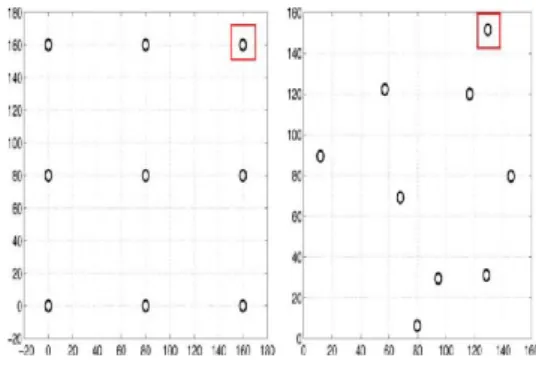
Fig 3 Network topologies of 9-node networks: (left) Grid9 and (right) Rand9
Bidirectional Network Coding Versus Full Network Coding
Two 9-node networks (Grid9 and Rand9) to
compare the performance of bidirectional network coding and full network coding as the computational complexity for full network coding for 16-node networks is too large. The two 9-node networks are shown in Fig.3, where the gateway node is labeled by a rectangle. The total number of flows in each network is 2(N-1), with N-1 uplink flows to the gateway and the other N-1 downlink flows from the gateway.
To compute the relative throughput difference (in percentage) between the JRM-NC-RA and JRM-BiNC-RA designs for the Grid9 and Rand9 networks at and for different transmit power levels as
%Diff=(α JRM-NC-RA- α JRM-BiNC-RA/ α
JRM-NC-RA)*100
To find that the maximum throughput difference is less than 1% and thus concluded that only a small amount of throughput is lost if the bidirectional network coding model is used instead of full network coding, for the networks under consideration and under the assumption that all the uplink flows (resp. downlink flows) have the same weight. in a medium-size network the same is true to some extent. In the following. It is good to use bidirectional network coding instead of full network coding to study two 16-node mesh networks.
Default and Heuristic Configurations
To present how we have adapted our default and heuristic configurations to incorporate network coding. Routing: Consider the same single-path min-hop routing for both heuristic and default configurations. With the restriction to bidirectional network coding, a node has two types of flows, the “local” ones (i.e., the one it generates and the one it receives) and the “relayed” ones (the number of relayed flows depends on the routing). To take full advantage of network coding, assume that the routing paths of corresponding downlink and uplink flows are the same (with the links directed in the opposite direction) and a node always attempts to network code a relayed flow with its bidirectional counterpart. Thus, only the paths of the uplink flow need to be determined. For each uplink flow, a min-hop path.
Medium Access Control:
12
the total rate of each bidirectional flow pair and is the rate of its own generated flow. On the other hand, the gateway transmits all the downlink flows without network coding, as it does not have any opportunity to network code since it does not relay any flow. The amount of traffic transmitted by the gateway.Since node is able to do network coding on each bidirectional flow pair that it relays, it can transmit all the uplink relaying traffic by network coding with the downlink relaying traffic. Thus, effectively, it needs to access the medium for transmitting an amount of traffic. Let denote the effective amount of traffic that node needs to access the medium for, given by Since the gateway transmits all the traffic without any network coding, Then, in heuristic, the attempt probability of node is calculated as To investigate how heuristic is in configuring the parameters , compute the optimal routing and the ’s of the Rand16 network for the JRM-BiNC-RA design and then calculate the heuristic ’s using . The optimal and heuristic values for the Rand16 network. The heuristic attempt probabilities are quite close to the optimal values its transmission probability is high due to the large amount of traffic routed through it.
Fig4-Optimal and heuristic attempt probabilities in the Rand16 network
Flow(s) and Link(s) Selection:
From the routing decision, each node knows the “local flow” and bidirectional flow pairs that it will transmit. The gateway transmits only “local” flows (i.e., downlink flows) while any of the other nodes can transmit one “local” (i.e., its own) as well as bidirectional flows. In the default design, once node has decided to transmit, it selects either one of the bidirectional flow pairs that it relays or its own generated flow with equal probability . On the other hand, for the heuristic, node selects one of the bidirectional flow pairs that it relays with probability and its own flow with probability , given that the effective traffic of a bidirectional flow pair is and the effective traffic of its own flow is . In both designs, the gateway selects each of the downlink flows with
equal probability. Throughput Analysis
To determine the weighted max-min per-node throughput for the two 16-per-node mesh networks by solving the JRM-BiNC-RA problem using the IOS technique. For the default and heuristic configurations, we obtained the results by simulation, taking the minimum of the stable throughputs obtained over 10 simulation runs. The per-node throughputs achieved for the joint, heuristic, and default designs are shown in Fig.4 for the two 16-node networks. Similar results were observed for other network realizations. The results show that 100%–300% and 110%–450% throughput gains can be achieved by joint configuration with respect to the default configuration for and , respectively. The heuristic is found to be efficient. Now, we study the throughput gains achieved by network coding when compared to a case without any network coding (recall that we only study XOR-based network coding without opportunistic listening).
Algorithm 2: Fast collision resolution (FCR) MAC algorithm for wireless local area networks:
Development of efficient medium access control (MAC) protocols is a fundamental research issue in high-speed wireless local area networks (LANs).here focus on the throughput efficiency of medium access algorithms for high-speed wireless LANs which use carrier sense multiple access/collision avoidance (CSMA/CA).I used an efficient distributed contention-based MAC protocol for wireless local area networks, namely, the fast collision resolution (FCR) algorithm, and show that the proposed FCR algorithm provides high throughput and low latency in wireless LANs. The performance of FCR algorithm is compared with that of the IEEE 802.11 MAC algorithm via extensive simulation studies. The results show that FCR algorithm achieves a significantly higher efficiency than the IEEE 802.11 MAC algorithm and is easy to implement in wireless LANs.
CONCLUSION AND FUTURE WORK
13
configuration, the optimal joint configuration of network parameters can improve throughput performance significantly; 2) in terms of throughput, it is better to optimize the MAC access probability parameters than the routing; 3) throughput gains with optimized cross-layer design can be as high as 20% when compared to a design that only optimizes the MAC access probabilities. In addition: 4) we have proposed a heuristic configuration of the transmission probabilities based on the traffic load of the nodes that performs very well; and 5) at low transmit power, a simple XOR network coding without opportunistic listening can yield non negligible throughput gains. when using two rates with respect to the case with one rate (i.e., the highest of the two) depends on the network topology and node transmit power, but is found to be not very significant.REFERENCES
[1] M. F. Uddin, C. Rosenberg, W. Zhuang,
andA.Girard, “Joint configuration of routing and
medium access parameters in wireless networks,” in
Proc. IEEE GLOBECOM, Dec. 2009, pp.
[2] S. Shakkottai, T. S. Rappaport, and P. C.
Karlsson, “Cross-layer design for wireless networks,”
IEEE Commun. Mag., vol. 41, no. 10, pp. 74–80, Oct.
2003.
[3] I. Akyildiz and X. Wang, “Cross-layer design in
wireless mesh networks,” IEEE Trans. Veh. Technol.,
vol. 57, no. 2, pp. 1061–1076,Mar. 2008.
[4] A. Karnik, A. Iyer, and C. Rosenberg,
“Throughput-optimal configuration of fixed wireless
networks,” IEEE/ACM Trans. Netw., vol. 16, no. 5,
pp. 1161–1174, Oct. 2007.
[5] J. Luo, C. Rosenberg, and A. Girard,
“Engineering wireless mesh networks: joint
scheduling, routing, power control and rate
adaptation,” IEEE/ACM Trans. Netw., vol. 8, no. 5,
pp. 1387–1400, Oct. 2010.
[6] A. Iyer, C. Rosenberg, and A. Karnik, “What is
the right model for wireless channel interference?,”
in Proc. 3rd Int. Conf. Qual. Service Heterogenous
Wired/Wireless Netw., 2006, Art. no. 2.
[7] D. Bertsekas and R. G. Gallagher, Data Networks,
2nd ed. Upper Saddle River, NJ, USA: Prentice-Hall,
1992, pp. 524–530.
[8] IEEE 802.11 Working Group, “Wireless LAN
medium access control (MAC) and physical layer
(PHY) specification,” 1997.
[9] N. Abramson, “The Aloha system another
alternative for computer communications,” in Proc.
AFIPS Conf., 1970, vol. 36, pp. 295–298.
[10] A. Kumar, E. Altman, D.Miorandi, andM.
Goyal, “New insights from a fixed point analysis of
single cell IEEE 802.11 WLANs,” IEEE/ACM Trans.
Netw., vol. 15, no. 3, pp. 588–601, Jun. 2007.
[11] R.Ahlswede, N. Cai, S. R. Li, and R.W.Yeung,
“Network information flow,” IEEE Trans. Inf.
Theory, vol. 46, no. 4, pp. 1204–1216, Jul. 2000.
[12] C. Fragouli, J. Widmer, and J.-Y. L. Boudec,
“Network coding: an instant primer,” Comput.
Commun. Rev., vol. 36, pp. 63–68, Jan. 2006.
[13] D. Lun, N. Ratnakar, R. Koetter, M. Médard, E.
Ahmed, and H. Lee, “Achieving minimum-cost
multicast: a decentralized approach based on network
coding,” in Proc. IEEE INFOCOM, Aug. 2005, pp.
1608–1617.
[14] D. S. Lun, M. Médard, and R. Koetter,
“Network coding for efficient wireless unicast,” in
Proc. Int. Zurich Seminar Commun., Feb. 2006, pp.
74–77.
[15] Y.Wu, P. A. Chou, and S.-Y. Kung,
“Information exchange in wireless networks with
network coding and physical-layer broadcast,” in