Understanding
the Difficulties
of
Building
lntersubjectiuitU
among
Illembers
of
an
0rganization
Hom,
City
of Oakland,
California
,lic
Administrationin
Today's Worldof
and Markets, Herbert Simon, the !E[IS Nobel Prize winner in economics, points outfrIlowing:
"t
is the organizational identification of members,ttan any other of their characteristics, that gives
irqtions their remarkable power to secure coordi-behavior of large numbers of people to
accom-rganizational goals" (December 2000).
ftm
der
words, individual members are the buildingof an organization. Assuming that organizations
exist for their goals or missions, the power of
rrymization derives from the collective effort of its
rrmbers of people. But how do these large
num-dpeople in an organization cooperate in order to organizational goals? Jong Jun, in his book on
Philosophy of Administration (1994), provided
irswer
froma
philosophical standpoint: ,.What administration functionalis
the
individual'snt
to
developan
intersubjective, sharedwith other members" (Hun, 1994, p. 8).
Ehs" the power of an organization comes from its and
it
is the commitment to developing ancr' The power of an organization comes from its members and it is the commitment of developing an intersubjective,
uperience with other members that makes the administration functional. To translate the inteisuijectivity concept to
rizaliqn'5 life, it can be interpreted as follows: to be a member of an organization is to think and act in a certain way,
ftht
of particular goals, values, pictures of the world, and to think and act so as to belong to an organization. Inreali-mse organization members have diversified backgrounds fl cultural, sexual, educational, ethnic, and age
-
there arefifficulties in building an intersubjective understanding. To name a few, not recognizing the need for nor being willing m0'n to build intersubjectivity, lack of trust among members, lack of complete information when constructing
intersub-rnmy- ambiguity of language, cultural differences among members of an organization, action being
different from words, 'drecognition of changing condition, and valuing efficiency over long-term commitment. Some tools, such as action
um
be used to overcome these difficulties. Action skills can be acquired through continuous education.intersubjective, shared experience with other members
that makes the administration functional. But what is intersubjectivity? How is it constructed among people?
What difficulties do administrators/members of a large,
complex organization encounter in everyday organiza-tion
life
when constructing intersubjectivity?In
thispaper,
I
will
attempt to answer these questions on thebasis of my research, and over twelve years of public administration practice at the local government level
within the United States.
I
will
also conclude thispaper
with
some recofilmendationsfor
meeting the challenges of building intersubjectivity.lntersubjectiuitg
DefinedAitken and Trevarthen (1997) define intersubjectivity
as follows: "intersubjectivity is the process
in
whichmental
activity
fl
including conscious awareness,motives and intentions, cognitions, and emotions fr is
transferred between
minds."
Richard Zaner definesintersubjectivity beyond the mental activity transfer process: this process builds a common world among
human minds. According to Zanel
it
is a phenomenon that, generally
speak-ing, refers to what is cognitively
com-mon to
various
individuals."Intersubjectivity signifies
an
inter-locking of perspectives, motives, andbehavior fr and ultimately of
meaning-fully
connected actions into a systemof
meaningsthat
constitutes 'the' world as a world corlmon to you and me." (Quotedby
Professor Junin
aCalifornia State University Hayward
lecture, March 2002 from Zaner, R.M., 1970). To translate the
intersubjectivi-ty concept to an organization's life,
it
indiuiduals must
ing come to share the same meaning of the "common world" is intersubjectivity successfully
built.
Challenges
to
ConstructingI
ntersubjectiue
UnderstandingHaving defined intersubjectivity and described how
it
is constructed? Let us examine some difficulties weencounter in everyday organizational life while buil&
ing intersubjectivity and the reasons these difficulties
exist.
I-ack of recognition of the need
for
buildinginter-subjectivity
Before intersubjectivity can take place, individuah
must recognize the need for intersubjectivity, and
willing to build it. Many administrators often assurrE
that members
of
an organization automatically toward the organizational goals based on the members' job descriptions, organization structure, and adminitrative orders. They do not see the need to build
intersubjective understanding among members.
numbers of organization members need to work as team on its goals; all members need to buy in to value
of
its
goals. To operate an organizationeffectively, administrators need to initiate intersubj
tivity building.
As we have discussed above, makes administration functional is the members'mitment to developing shared experience.
Before
intersubjectiuitg
cantake
place,
lecognize
the
needfor
intersubjectiuitu,
and
be
tuitling to buitd
it.
the intersubjective, shared experience
to be formed. However, this does not
mean, they further argue, that
"I
under-stand
the
other adequately.I
mayindeed misunderstand
him" (p.
I29). They offer an examplein
their text:"He is laughing in a
fit
of hysteria, butI
understand his laughter as expressing mirth"(p. 129).
In
other words, theintended meaning
from
one's mind,expressed through language or action,
might not be received as such in
anoth-er's
mind.
Only
whenthe
actorsinvolved in the intersubjectivity
build-can be interpreted as
follows:
to be a member of an organization is to think and act in a certain way, in the lightof
particular goals, values, and picturesof
theworld, and to think and act so as to belong to an
organ-ization (Berlin 1976, p. 195). But how do individuals
with various backgrounds "think and act
in
a certainway"? Let me examine how individuals communicate
their ideas, perspectives, and values.
Constructing lntersubjectiue
UnderstandingHow
is
intersubjective understanding constructed among people? To understand how mental'activitiestransfer between individuals' minds,
*"
-uy
employ Berger and Luckmann's (1966) concept outlined inTheSocial Construction
of
Reality:a
Treatisein
theSociology
of
Knowledge.In
this work, the authors describe how one's idea is expressed through objectiveevents and others perceive the meaning of the idea and
transform their perception into their own subjective
idea. Berger and Luckmann call this process
intemal-ization. Internalization is the immediate apprehension
(i.e., comprehension) or interpretation of an objective
event as expressing meaning, as
a
manifestation ofanother's subjective processes which thereby becomes
subjectively meaningful
to
oneself (pp.129).
This comprehension does not result from autonomouscre-ations of meaning by isolated individuals, but begins when individuals "take over" the world in which others
already live. This internalization makes it possible for
Ld+s
recognizing the need forintenubj ective understanding,
of
an organization must belndiuiduals
comprehend
b
open to each other prior tointenubjectivity. To be
others
based oneuent-0bseruati0n 0r
-
fte
way of communication. Ad
qtenness can existin
variousFor example, members may be
elyto
communicate with theirthrough
language.
supervisor for issues relatingwork.
Such an approachdis-LO
be sincere, truthful. andhon-to set no restrictions or
obsta-information
exchange
to themselves in order to protect them-selves. Bartolome implies that
employ-ees might
be
vulnerable when theyopenly express their opinion/criticism,
especially when the opinion is against or is not
in
alignment with asupervi-sor's views, behavior,
or
values. Theone who raises the opinion/criticism
may be perceived as a challenger to the
superior instead
of a
valuable col-league. The superior may, in turn, takeactions such as eliminating promotions
employees from building intersubjectivity
hor-within the hierarchy of an organization.
IG
of willingness and openness to buildintersub-may be caused
by
not
seeingits
benefits.Hohn (November 2000) presents a discussion
intersubjectivity and leadership style and that clear the necessity for open communication. In
hssion
of intersubjectivity and leadershipmod-l]Irrrn identifies the importance
of
honesty andmmunication.
The benefits, as she describesinclude goals being clear, a focus on
perform-ient team work, and originality.
6tust
ld
of trust is another difficulty faced in building pctivity. AsI
have explainedin
the previous regarding the process of buildingintersubjec-individuals need to express their ideas to each
In many cases, ideas can be unpopular opinions
ism.
It
takes trust for an individual to expressWhy? Fernando Bartolome (1999) puts
it
this*Almost
any organization would operate more
with
completelyopen and
forthright!;rces, but absolute frankness is too much to hope
Candor depends upon trust, and,
in
hierarchical ons, trust has strict natural limits.', By naturalBartolome means "people keep their mouth shut to protect themselves or their subordinates',
,1999, p.79). Bartolome argues that open
ication among members
of
an organizationit to perform effectively, but that this often does because people keep their opinion/criticism
for the "challenger.', The fear of retali_
ation is very real in organizations. The fear may not be
based on reality. However, real or not, with such a lack
of
trust, the buildingof
an intersubjective reality isextremely difficult.
I-ack of complete information
Another difficulty in building intersubjectivity is the
lack of complete information. Individuals comprehend
others based
on
event-observationor
informationexchange through language. ..Being
only
partiallyinformed, the actors run their own programs on the
basis of their perception." (Leydesdorff, L., 2000).
If
individuals make their own assumptions to
fill
in theunknown information,
it
is likely to cause a failure in building intersubjectivity. Let me take the exampleof
an administrator who instructs her staff to develop a
job-training program to help unemployed citizens. Her staff could easily interpret this directive
in
ways that the supervisor did not intend. They may decide that theprogram is to serve "all" unemployed citizens regard_ less of the geographic boundary, whereas the supervi_
sor may have meant the program
to
serve only theunemployed citizens
in
certaincities. In
this case,because the supervisor did not specify the geographic
limits, her staff filled in the all unemployed assump_
tion.
The resources intended for unemployed citizensof
certain cities may not be sufficientfor all
unem_ployed
citizens.
Whenthe limited
resources areexhausted, some of the intended unemployed citizens
will
not have been served. Intersubjectivity requirescareful and thoughtful communication that includes complete information.
Xentandlng the Difftculttes of Bultdtng tntersubJecfiutg
Ambiguity of lnnguage
"Language, which may be defined as a system of vocal signs,
is
the most important sign systemof
human society....
An
understandingof
language isessential for any understanding of the reality of
every-day
life"
(Berger and Luckmann, 1966,p
36).Language also typifies experiences, allowing one to
subsume them under broad categories. As
it
typifiesexperiences,
it
also anonymizes experiences,for
thetypified experience can, in principle, be duplicated by
anyone falling into the category
in
question (Bergerand Luckmann, 1966, p39). For example, a supervisor gives a warning to a staff member who has been con-stantly late to work. This could be typified as
"super-visor-staff-conflict." This typifi cation process, through language, opens the doors for individuals to interpret
the meaning
of
the language with their own experi-ences; Simon Glynn calls this interpretation"imagi-nary free variation" (1998). This process
ofinterpreta-tion can result
in
employees categorizing such dis-parate situations as sexual harassment and tardinessunder the same rubric as "supervisor-staff-conflict." But, indeed, the situations would have very different
implications for an organization's operation.
Let me give another example. In an organization,
one supervisor may evaluate his staff's performance
and rank them between Standard and Above Standard
for
the jobs he perceives as"well done."
Anothersupervisor
in
the same organization ranks her staffOutstanding for jobs that are also "well done." The rationale for the former is that no one should get an Outstanding rating so that his staff
will
work towardimproving performance. As for the other supervisor,
she believes that all staff who do their jobs well should be rated Outstanding; this supervisorbelieves that what the improvement staff should look for is a promotion.
In other words, differing interpretations of words and
concepts can have important implications within an organization.
The above examples show that the ambiguity of lan-guage creates difficulty
in
building intercubjectivity among individualsof
an organization. Individualstransmit the "individual-historico-socio-culturally"
rel-ative instarrce
of
their life-world to the others whenthey
engagein
intersubjectivtitybuilding
(Glynn,August, 1998). Life-world is the total sphere of
expe-rience of an individual, which is circumscribed by the objects, persons, and events encountered in the pursuit of the pragmatic objectives of
living.
It is a "world" inwhich a person
is
"wide-awake," and which assertsitself as the paramount reality of his/trer
life
(SchutaA.,1967).
The receivers interpret ideas from the ers with their own life-world.If
the actors involvedthe intersubjectivity building do not have
a
simi "individual-historico-s ocio-cultural" background,was intended to be expressed might not be the
tion of the receivers. Clandinin and Connelly ( put
it
this way: we are prisoners caught in thework of our theories, our expectations, our past e ence, and our language (p.
39).
This leads us tonext topic discussion, which is cultural differences.
Cultural differenc es among
members of an organization
In the past, most human beings were born, lived,
died
within
a
clearly defined geographical Seldom did they come in contact with people ofraces or cultural backgrounds. Such a world no exists (Samovar, L.A., Portr, R.8., Stefani, L.A.,
I
Six billion of us who occupy this planet are i bly interwoven. Each of us brings our cultural
from family to workplace, from home country to of residence. The same event can be interpreted in ferent ways depending
on
the interpreters'background. For example, individuals who bri
constructive criticism
in
an organization arebe viewed as normal because this behavior
with western up-bringing. In western society,
uals are taught to think critically,
i
creatively; they are also taught
to
freely speakminds.
However, bringing constructive viewed as lack of respect towards authority inof
those with an Asian up bringing.same event
will
be viewed differently cultural nofins.With respect to culture, a common problem
nocentrism. Ethnocentrism is the tendency to that one's own culture and its values are
others. Very often, such tendencies are
by
an unwillingness totry to
understandd
view, and to take the valuesseriously. (Plumber, K.
1998). This prejudice can be
Past
intersubjectiue,
-sadvantageous when buildingivity
among
individualcultural backgrounds.
fierent
from wordsshared
eilpelience
is
certainlu ualuable.
lllembers inuolued in
c0mmunication
do
not
haueto
rebuild
the needed population. They do not
need
to
rebuildthe
consensus theydeveloped in the prior discussion.
Past intersubjective, shared experi-ence
is
certainly valuable. Membersinvolved
in
communicationdo
nothave to rebuild assumptions each time
they communicate. However,
if
theintersubjective, shared understandings
were
built
under certain conditions,they might need to be revisited when
conditions change. Members who are
involved
in
intersubjectivity buildingneed to be sensitive about the changing conditions that are related to the
sub-ject
in
question.
Intersubjectivity building is a constant process, for the social conditionis
ever
changing.I{erbert Simon (December 2000) states 's action. For example,
ffis6n16r
communicates theassumptions
eachtime
customer service to all
mem-n
organization. But when atheg communicate.
walks in and needs services, does not provide the
Grstomer service that he/she told staff to
pro-transmit ideas not only language,
but
also actions. the words communicated Ircrson to another contradictdo-as-I-say, not-as-I-do model). This
admin-rction
communicatesa
different messagetr
he/she told the staff membersin
words.will
infer
whatyou
valuefrom
yourI
(I-arkin, T.J. and Larkin, S., 1999). In build-jectivity, the individual who initiates the ication, either through words 6rr vY vr uD vror
througharrr uuEiumst
unify the idea with his/trer words andOlherwise, room is left for receivers to
inter-rrgning
in multiple ways-
some might takewhile others might interpret the actions. tuognition of changing conditions
ity
is grounded on social conditions.b
say, economic milieu and various lifehisto-raiables when intersubj ecti ve understanding is
|[)trce
it
is constructed, actors involvedin
the share certain meaningsof
realities, and candeeper intersubjectivity based on prior mutual More specifically, a group of members
in the design of a social service program.
lh
first
few discussions, membersof
the group&
consensus of what population this programrrle.
In the following meeting, this groupwill
next level of intersubjectivity
-
how to servethe importance of coping with changing conditions. He
says:
"If
complex systems must operate in a constantlychanging environment, or
in
competition with othersystems that are changing, they must modify their structures at a corresponding pace." Failure to
recog-nize changing conditions could create difficulty in con-structing intersubjectivity among members
of
anorganization.
Short-term efftciency verses long-term commifinent
We have discussed the value of building
intersubjec-tivity among the members of an organization. In a large
organization,
it
takes resources to constructintersub-jective understanding. Many administrators choose a top-down-order approach in their decision-making and
problem solving instead
of
a participatory approach.Giving coercive orders sometimes can achieve the goal
efficiently for the short-term. However,
in
the long run,if
all members of the organization subscribe to theidea that the administrators want
to
sharewith
themembers,
the
members'collective efforts
couldachieve the goal more efficiently. That is,
administra-tors of an organization may choose to adopt a sexual harassment prevention policy (a top-down approach) to
its members. This approach only costs the organization
It
seems efficientfi
a few people at the top make thepolicy, and then pass it down for implementation' But
do individual members understand the policy? Do they
now subscribe to the importance of preventing sexual harassment at the workplace?
If
not, the policy is just a piece of paper. Another approach administrators can take is to conduct training sessions, which convey theharmfulness
of
sexual harassment to an'organization.Through the trainer-trainee communication, the
com-mon understanding between the administrators, who
want to prevent sexual harassment, and the members of the organization, who implement the sexual harassment
policy, can be realized. A common understanding of
the
importanceof
preventing sexual harassment,though more costly than a top-down directive
in
theshort-term, is more likely to avert sexual harassment and reduce costly litigation.
Recommendations
Acquire actinn skills
There are many obstacles to building
intersubjectiv-ity within an organization. However, there are ways to
overcome these difficulties. There are skills that can empower employees in taking conscious and effecti
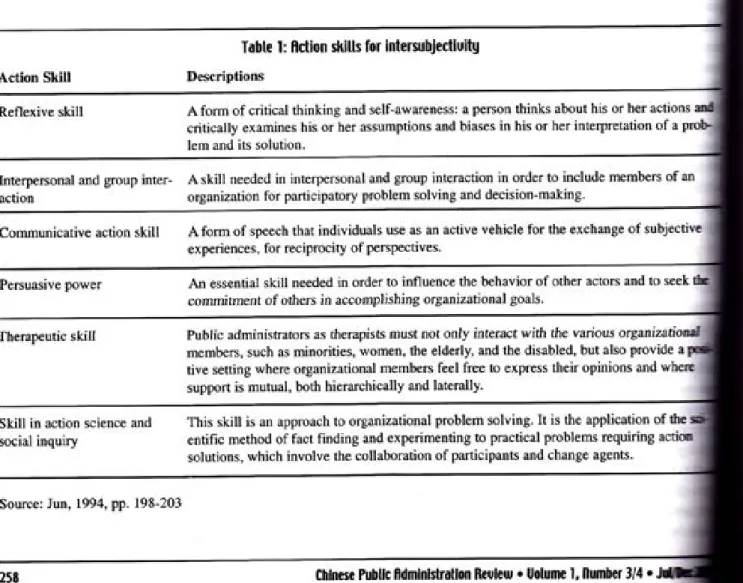
steps toward creating a shared reality. These include (1) reflexive skill, (2) skills in interpersonal and interaction, (3) communicative action skill, (4) sive power, (5) therapeutic skill, and (6) skill rn
science and social inquiry can help (Jun, 1994, pp.1 203). The descriptions of these action skills are marized in Table 1.
The action skills described
self-explanatory. We can easily
above are relate how useful
Reflexive skill Aform ofcritical thinking and self-awareness: a person thinks about his or her actions critically examines his or her assumptions and biases in his or her interpretation of a
lem and its solution.
Interpersonal and group
inter-
A skill needed in interpersonal and group interaction in order to include members of anaction
organization for participatory problem solving and decision-making.Communicative action skill A form of speech that individuals use as an active vehicle for the exchange of experiences, for reciprocity of perspectives.
Persuasive power An essential skill needed in order to influence the behavior of other actors and to seek commitment of others in accomplishtng organizattonal goals.
Therapeutic skill Public administrators as therapists must not only interact with the various orga members, such as minorities, women, the elderly, and the disabled, but also provide a
tive setting where organizational members feel free to express their opinions and support is mutual, both hierarchically and laterally.
This skill is an approach to organizational problem solving. It is the application ofthc
Action Skill
Skill in action science and social inquiry
Source: Jun, 1994, pp. 198-203
Table
l:
flction*ills
for intersubjectiuitu Descriptionsentific method of fact finding and experimenting to practical problems requiring solutions, which involve the collaboration ofparticipants and change agents.
cm
bein
solving someof
the difficultiesdis-it
the prior sections of this paper. For example,tic skill can help actors suspend their own
for the moment when attempting to build with others having different viewpoints. As example, the communicative action skill can [o minimize the ambiguity of language. ffi"re4e convinced that the action skills are some of
for actors to use in building intersubjectivity,
such skills is in order. How? This leads
to the next recommendation fl
continu-education helps us
challenges
[Hulixrously
recognizrng and understanding therg
world
calls
for
continuous learning.and Levin, in their Introduction to Action (1998), pointed out that one
of
the mostand frequent paths leading people into the daction research has been the field
ofeduca-ttfnenwood and Levin, 1998, p. 215). Similarly,
the importance of building
intersubjec-rFptit/ing
the difficulties, and learning skills tothese difficulties in building
intersubjectivi-achieved through continuous education. This
can be in the form of college education,
sem-ndshops,
and on-going trainings conducted byof an organization comes from its members,
hfu
commitment to developing anintersubjec-fuEd
experience that makes the administrationTo be a member
of
an organization is todact
in a certain way, in the light of particularmhs,
pictures of the world; and to think andio belong to an organization (tserlin 1976, p.
h
reality, because organization members have backgrounds fr cultural, sexual, educational,d
age-
there are many difficulties inbuild-ienubjective
understanding. Some of these are as follows: neither recognizing the needfor, nor being willing and open to building
intersubjec-tivity; Iack of trust among members; lack of complete
information when constructing intersubjectivity;
ambi-guity of language; cultural differences among members
of an organization; action being different from words;
lack ofrecognition ofchanging condition; and valuing
efficiency over long-term commitment. Some tools, such as action skills, can be used to overcome these dif-ficulties. Action skills can be acquired through
contin-uous education.
Donna Hom, is an administrative services manager
with the city of Oakland, California.
References
Aitken, K.J. and Trevarthen, 1997. "Self-Other
Orga-nization
in
Human Psychological Development."Development and Psychopathology,
Vol.
9,
pp.65t-675.
Bartolome,
F., 1999.
Harvard Business Review onEffective Communication: Nobody Trusts the Boss Completely
-
Now What? Boston, MA: HarvardBusiness School Press.
Berger, P.L. and Luckmann,
T., 1966.
The SocialConstruction
of
Reality:
A Treatisein
theSociology
of
Knowledge.
New York: AnchorBooks.
Berlin,1.,1976. Vico and Herder London: Hogarth.
Clandinin, D. J. and Connelly, F. M., 2000. Narrative
Inquiry:
Experienceand
Storyin
eualitativeResearch.
San
Francisco,CA:
Jossey-Bass Publisher.Glynn,
S.,
1998.
"Identity, Intersubjectivity andCommunicative
Action."
Paper presented at the20th World Congress
of
Philosophy,in
Boston,Massachusetts.
Greenwood, D. J. and L,evin, M., 1998. Intoduction to
Action Research: Social Researchfor Social Change.
Thousand Oaks,
CA:
Sage Publications,Inc.Hohn, H. D., 2000. "social Dynamics and the Paradox
of Leading an Innovative Team." Paper presented
at C ollaborating Acro s s P rofe s sional B oundarie s :
From
Educationto
Practice.
Chicago, IL.( http : //www. stuart. iit. edu/ipro/p ap er s/e xe c s um/ho
hnsummary.htm)
Jun, J. S., 1994. Philosophy of Administrarion. Seoul,
Korea: Daeyoung Moonhwa International.
Larkin, T. J. and Larkin, S., 1999. Harvard Business
Review
on
Effective Communication: Reaching and Changing Frontline Employees. Boston, MA:Harvard Business School Press.
Leydesdorff, L., 2000. "Luhmann, Habermas, and the
Theory
of
Communication." Systems Researchand Behavioral Science, Vol. 17, No. 3,
pp.273-288.
Plumberg,
K.,
1998. Diversityin
the
Workforce.( http : //ww. emporia. e du/mmfe/j our/j our2 5 ob/plum
berg.htm)
Samovar,
L. A.,
Portr,R.
E.,
Stefani,L.A.,
1998-Communic ation B etvv e en Culture s
-
Belmont, CA:Wadsworth Publishing ComPanY.
Schutz,
A.
1967. The Phenomenology of theWorld
(Walsh,
George,tr.).
Evanston, Northwestern University Press.Simon, H., 2000. "Public Administration in Today
World
of
Organizations and Markets."Science and Politics, Vol. 33m No. 4, pp.749-7