Bindia Darochand Gitika Nagrath Page 374 STUDYING THE RELATIONSHIP BETWEEN EMOTIONAL INTELLIGENCE AND STRESS AMONG TEACHERS
OF PROFESSIONAL INSTITUTES
Bindia Daroch Gitika Nagrath
Assistant Professor, DAV University
Abstract
The study was done on teachers of various professional institutes as they are involved in many activities. Apart from teaching, the teacher is involved in managing assignments, question papers, checking the answer sheets, managing time tables, event organizing etc. As per the previous studies, a person who ismore emotional intelligent is able to manage stress in better way. The study was done using thirty statements to understand the relationship between emotional intelligence and stress and the result showed that there is positive correlation between both. More emotional intelligence can help reduce the stress as well as improve the performance. Moreover, a good organizational culture and healthy relationship between colleagues helps in reduction of stress.
Keywords: Correlation, Emotional Intelligence, Stress, teachers.
Introduction
Education is the most important as it helps in building one’s character, making others responsible, capable and intelligent. It also helps students take rational decisions and develops their personality. Behind all this is an educationist who helps to develop students in complete form. A teacher has to play multiple roles along with teaching he/she is involved in improving communication, makes time table, organize events for students for developing them whether they are educational and cultural events, guide them at each and every step wherever is required, motivate students and sometime become harsh also just to improve their behaviour. Teachers are adopting different pedagogy to make class more interacting and interesting. They not only have to complete their own tasks but they have to show their capabilities to top level by increasing their research profile. Thus, faculty is
expected to possess a multifaceted personality. Not only this, but being part of family he/she has to play a family role as being mother, father, brother, sister or so on. So as there are so much expectation from a teacher it is natural that he will be stressed in completing his responsibilities and which in turn effects his teaching also.
Stress now days is inevitable but being emotional intelligent one may be able to manage stress in better way. Emotional intelligence is defined as “the composite set of capabilities that enable a person to manage himself/herself and others” [1]. “It is more accurate to say that the frequency with which a person demonstrates or uses the constituent capabilities, or competencies, inherent in emotional intelligence determine the ways in which he/she deals with themselves, their life, work and others”[2]. [3] Mayer and Salovey and their colleagues defined emotional intelligence as the ability to perceive emotions, to access and generate emotions so as to assist thought, to understand emotions and emotional knowledge, and to reflectively regulate emotions so as to promote emotional and intellectual growth.
An employee with high emotional intelligence is able to respond appropriately to workplace stress and to emotional behaviour of his co-workers. Theses abilities greatly enhance job satisfaction [4], lead to high job performance, long term mental health, better outcomes in work groups a leadership quality and organizational success protect people from stress.
Review of Literature
Bindia Darochand Gitika Nagrath Page 375 effectiveness. Thus, emotional intelligence was found
to be helpful in reducing occupational stress of teachers and enhancing their effectiveness in teaching [6]. Mousavi, H.S., Yarmohammadi S., Nosrat, B.A., Tarasi, Z studied the relationship between emotional intelligence and its five components and job satisfaction where he found there is a significant positive relationship between emotional intelligence and job satisfaction, between the components of social skills, empathy and motivation and job satisfaction. The study also concluded that the job satisfaction of teachers can be increased by training and improving their emotional intelligence along with providing facilities and satisfying their needs. Emotional Intelligence and locus of control on burnout among the secondary school teachers and has suggested that secondary school teachers should be managed by capable and qualified counsellors for the desired results [7].
Krishnamurthy and Varalakshmi [8] conducted a study to know the emotional intelligence of employees working in educational institution and found that the improvement in emotional intelligence would increase the motivation and effectiveness of the employee.[9] Zahra et.al. (2012) demonstrated a significant relationship between emotional awareness, empathy and self-efficacy. [10] Edannur S, assessed the emotional intelligence level of teachers and educators and investigated group possessed average emotional intelligence. The gender and locality of the teacher educators did not make any differential influence on their emotional intelligence.
The development of emotional intelligence skills is important because it is an area that is generally overlooked when skills development programmes are designed. And yet research shows that emotions, properly managed, can drive trust, loyalty and commitment. [10]Saddam Hussain Rahim found that EI competencies have the profound impact on stress the psychological problems of employees and seeks to the solutions in the light of EI competencies have a positive and strong impact on stress. The emotional intelligence is very important factor for prediction of teachers’ health and also the correlation of emotional intelligence and occupational stress is significant [11]. Naidoo et al. [12] has conducted a survey to gain some understanding of the explanatory factors for stress and an evaluation of the role that emotional intelligence (EI)
plays in the experience of perceived stress (PS). Nina Ogniska[13]confirmed an essential,but not very strong, the role of emotional intelligence in perceiving occupational stress and preventing employees of human services from negative health outcomes. The ability to effectively deal with emotions and emotional information in work place assists employees in coping with occupational stress. Therefore, it should be developed in stress managing trainings. The highly stressed intense but confused participants in particular because they have average emotional intelligence, but don’t appear to use it, presumable because they lack confidence in their emotional ability [14].Kaufhold and Johnson [15] indicated that teachers improving their emotional intelligence emphasized on the values of individual differences and promote the cooperative learning so as to solve problems and guide the students to promote social competence. Befort & Hattrup, Audu, [16] asserted that in order to measure job performance, it requires an observer to make a value judgment as to the extent to which the one being evaluated is behaving in a way that contributes to the organization’s goals. However, Campbell [17] reported that organizational goal is also value judgments made by individuals empowered to establish these goals. EI would have a positive effect on the organizational outcomes of work-group cohesion, congruence between self- and supervisor appraisals of performance, employee performance, organizational commitment, and organizational citizenship [18]Ashkanasy and Hooper examined the perception and management of EI in the workplace. Utilizing the proposition that affective commitment towards workmates is a necessary component of social interaction, they argued that the showing of positive emotions is associated with a high likelihood of success at work.
Bindia Darochand Gitika Nagrath Page 376 that performance is ultimately an individual
phenomenon with environmental variables influencing performance primarily through their effect on the individual determinants of performance – ability and motivation. This implies that job performance involves quantity and quality of outcomes from individual or group effort attainment [22].
Objectives of The Study
To study emotional intelligence among teachers working in the degree colleges.
To identify the relationship between Emotional Intelligence and Stress.
Methodology
Research Design: Research Design of this study was descriptive.
Sources of data: Both primary and secondary data were used.
Primary data: The data has been collected through structured Questionnaire. Questionnaires has been prepared and respondents from degree colleges has been approached to fill up these questionnaires.
Secondary data: The data has been collected through books and internet.
Sampling Technique: Proportionate Stratified Random sampling method has been adopted for this study. 100 questionnaires have been distributed among the teachers of private educational institutions of Jalandhar, Punjab.
Sample Unit: Sample unit consist of teachers who were teaching in degree colleges for both UG and PG classes of Jalandhar.
Sample Size: The total sample size in the present study was 100 teachers who were teaching in degree colleges of Jalandhar, Punjab.
Analysis and Interpretation
To make proper conclusion for a research, the data was collected through the questionnaire comprising of thirty statements.Part A of the questionnaire pertained to the demographic information of the respondents. Part B respectively dealt with the statements to find out the level of emotional intelligence and stress for which five-point Likert scale was chosen, with a neutral option to avoid unanswered items when respondents
had neither a positive nor negative opinion about advertising on social media.
The descriptive analysis included frequencies and means statistics that were carried out to sum up main data of the respondents, to obtain an outline and to support further analysis.
Demographic profile of respondents Table 1: Gender wise description of Teachers
Gender Frequency Percentage
Male 44 44%
Female 56 56%
Total 100 100%
Source: Primary Data
Table 1: Describe about the gender of the teachers of degree colleges. From the above table it reveals that 44 employees were males and 56 employees were female that means participation of female employees were maximum.
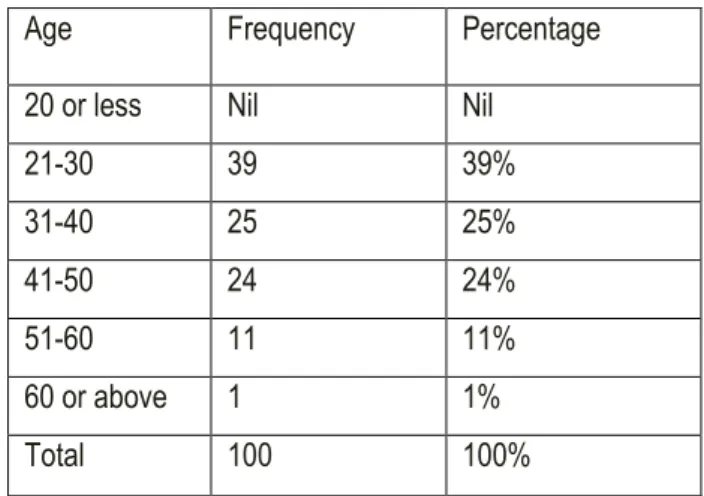
Table 2: Age wise description of Teachers
Age Frequency Percentage
20 or less Nil Nil
21-30 39 39%
31-40 25 25%
41-50 24 24%
51-60 11 11%
60 or above 1 1%
Total 100 100%
Source: Primary Data
Bindia Darochand Gitika Nagrath Page 377 of 51-60. 1 respondent (1%) lies in the age group of 60
or above.
Weighted Average Mean: Weighted average is an average in which each quantity to be averaged is assigned a weight. These weightings determine the relative importance of each quantity on the average. Whereas, weighted mean is an average computed by giving different weights to some of the individual values. Weighted means play an important role in data analysis.
Formula
The weighted mean for given set of non negative data{x1, x2, x3,...xn}with non negative weights{w1, w2, w3,...wn} can be derived from the formula
where
x is the repeating value
w is the number of occurrences of x (weight) x̄ is the weighted mean
Table 3: Descriptive Statistics of Emotional Intelligence
N Minimum Maximum Mean Std. Deviation
S1 100 1 5 3.94 1.090
S2 100 1 5 3.77 1.118
S3 100 2 5 3.91 .975
S4 100 2 5 3.45 1.104
S5 100 1 5 3.72 1.129
S6 100 2 5 4.00 .985
S7 100 1 5 3.88 .868
S8 100 1 5 4.20 .804
S9 100 1 5 3.93 .913
S10 100 1 5 3.39 1.163
S11 100 1 5 3.78 .991
S12 100 2 5 3.98 .943
S13 100 2 5 3.95 .833
S14 100 2 5 3.83 .954
S15 100 1 5 3.26 1.397
S16 100 1 5 3.42 1.139
S17 100 1 5 3.77 .983
Bindia Darochand Gitika Nagrath Page 378 Table 4: Descriptive Statistics of Stress
N Minimum Maximum Mean Std. Deviation
S18 100 2 5 4.23 .941
S19 100 2 5 3.84 .972
S20 100 2 5 3.88 .808
S21 100 1 5 3.59 1.093
S22 100 1 5 3.86 .899
S23 100 1 5 3.26 1.169
S24 100 1 5 3.80 1.092
S25 100 1 5 3.79 1.057
S26 100 2 5 3.42 .976
S27 100 1 5 2.80 1.223
S28 100 1 5 3.04 1.399
S29 100 1 5 3.47 1.150
S30 100 2 5 3.71 .856
Valid N (listwise) 100
Correlation
Correlation is a statistical measure that indicates the extent to which two or more variables fluctuate together. A positive correlation indicates the extent to which those variables increase or decrease in parallel; a negative correlation indicates the extent to which one variable increases as the other decreases. When the fluctuation of one variable reliably predicts a similar fluctuation in another variable, there’s often a tendency to think that means that the change in one causes the
change in the other. In this study, to find out the impact of Emotional intelligence on Stress, Correlation technique has been used. Correlation method has been used on the means of stress and emotional intelligence.
Correlation between Emotional Intelligence and Stress Correlations
EImean Smean
EImean Pearson Correlation 1 .413
Sig. (2-tailed) .161
N 17 13
Smean Pearson Correlation .413 1
Sig. (2-tailed) .161
Bindia Darochand Gitika Nagrath Page 380 Interpretation: Correlation is a statistical measure that
indicates the extent to which two or more variables fluctuate together. Degree of correlation varies from +0.01 to -0.01. When the value is near to 1, that means there is strong relationship between two variables or we can say that changes in one variable are strongly correlated with changes in the second variable. On the other hand, if the value is near to 0, that means there is weak relationship between two variables or variables are not strongly correlated. In the above case, Pearson's r is 0.413. This number is not close to 1 but also not close to 0, that means there is moderate relationship between two variables i.e. Emotional Intelligence and Stress which results in change in one variable moderately affects the second variable. Also Pearson's r value of 0.413 was positive which indicates that if one variable increases in value, the second variable is also increases in value or vice-versa.
Findings
The highest weighted average mean of emotional intelligence is 4.20 which shows that most of the teachers believe in thinking about feelings of others rather than criticising or judging others. The highest weighted average mean of stress is
4.23 which shows that there is a favourable work culture in an organisation.
Where Pearson's r value is 0.413 which shows that there is a moderate relationship between Emotional Intelligence and Stress.
Also, Positive correlation is found between Emotional Intelligence and Stress.
Conclusion
This research was conducted to know about the phenomena related to emotional intelligence among teachers working in degree colleges and to study the factors that causes stress among teachers. Survey was conducted on faculty members of various degree colleges and most of the respondents were at the designation of Assistant professors. Majority of the respondents falls under the age of 21-30 years and female members were more than male members. The data was collected through questionnaires using Likert scale. Weighted Average Mean was used to study Emotional intelligence and stress among teachers. The survey was also conducted to know the relationship
between Emotional Intelligence and Stress with the help of correlation analysis where it states that there is an average relationship between Emotional Intelligence and Stress which indicates that any change in one variable affects second variable up to some extent. Moreover, Pearson's r value is 0.413 which is positive states that if one variable increases in value, the second variable is also increasing or vice-versa.
References
[1] Goleman’s, D. Working with Emotional Intelligence, New York: Bantam Books, 1998.
[2] Mayer, J.D andSalovey,P. The Intelligence of Emotional Intelligence. 17, 433-442,1993.
[3] Mondal, N.K., Paul, P.K and Bandyopadhyay.A,“A study of Emotional Intelligence level between secondary school teachers: A study in Burdwan District in West Bengal,” International Journal of Social Science Tomorrow, Vol.1. No.4. pg 1-6 ISSB: 2277-6168, 2012.
[4] Kauts, A & Saroj, R, “Study of teacher effectiveness and occupational stress in relation to emotional intelligence among teachers at secondary stage,” Journal of history and social sciences. Vol3 issue 2. ISSN 2229-5798, 2012.
[4] Mousavi, H.S., Yarmohammadi, S., Nosrat, B.A., Tarasi, Z, “The relationship between emotional intelligence and job satisfaction of physical education teachers,” Scholars Research library, Annals of Biological Research 3(2) 780788, 2012.
[5] Akomolafe et.al, “Emotional Intelligence and Locus of control as predictors of burnout among secondary school Teachers”, European Journal of Social Sciences- Vol 20 pg 369, 2011.
[6] Kirshnamurthy M & Varalakshmi, S, “Emotional Intelligence- A study with special reference to the employees of salalah college of technology.,” International Journal of Research in Commerce and Management, Vol.No.2, Issue 1 pg 27- 34, ISSN 0976-2183, 2011.
[7] Zahar Abdolvahabi, Sara Bagheri, Firouz Kioumarsi, “Relationship between emotional intelligence and self-efficacy in research among Tehran physical education teachers,” European Journal of Experimental Biology, 2(6) 2337-2343, 2012.
[8] Edannur. S. “Emotional Intelligence of Teacher Educators”, International Journal of Education Science, 2(2), 115-121, 2010.
[9] Mahmoudi, A, “Emotional Intelligence among the B. ED teacher’s trainees,” International Conference on Humanities, Society and Culture, IPEDR Vol. 20., Pg 302-305., IACSIT Press, Singapore, 2011.
[10] Cotton, P. and Hart, P.M. [2003]. Occupational Wellbeing and Performance: A Review of Organizational Health Research. Australian Psychologist, 32 [2], 143-56.
[11] Dong, Q. [2006]. Emotional Intelligence, Employee Trust and Job satisfaction. Competition Forum, 4 [2], 381. www. Proquest.com. Retrieved on 24/06/2010.
[12] Khalili, A, “Gender Differences in Emotional Intelligence among employees of small and medium enterprise: An empirical study,” Journal of International Management Studies, 6(2), 184-193, 2011.
[13] Cooper, R. K., & Sawaf, A, Executive EQ: emotional intelligence in leadership and organizations. New York:Grosset Putnum, 1997.
[14] Ciarrochi, J. and Godsell, C. [2006]. Mindfulness- based Emotional Intelligence: Research and Training. In V. U.
Bindia Darochand Gitika Nagrath Page 381
[16] Chapman, B.P. & Hayslip, H.B [2005] Incremental validity of a measure of Emotional Intelligence. Journal of Personality Assessment, 85 [2], 154-169.
[17] Wechsler, D, “Non intellective factors in general intelligence,” Psychological Bulletin, 37, 444-445, 1940.
[18] Ellis, A. [1999]. Workplace bullying. A project, Ruskin college oxford, U.K. http://www.stress.org.u.k.bullying.htm.
[19] Payne, W. L. A study of emotion: developing emotional intelligence; self-integration; relating to fear, pain and desire. A doctoral dissertation. Cincinnati, OH: the union for experimenting colleges and universities, 1985. [20] Druskat, V. U., Sala, F.A. and Mount, G. [2006]. Linking Emotional Intelligence and performance at work: Current research evidence with individuals and groups. Mahwah, NJ: Erlbaum.
[21] Druskat, F.A Sala and G. Mount [Eds.], Linking Emotional Intelligence and performance at work: Current research evidence with individuals and groups.
[22] Whetten, D.A. and Cameron, K.S. (1998). Developing Management