201 Journal of Business on Hospitality and Tourism
Submitted 25th August 2019 Accepted 16th November 2019
ANALYSIS OF FEASIBILITY OF PARK
KUMBASARI AS ATTRACTION FRIENDLY
TOURISM TO TOURISTS
I Gusti Ketut Purnaya1, I Made Trisna Semara2, I Putu David Adi Saputra3 123Sekolah Tinggi Pariwisata Bali Internasional
ABSTRACT
In the present era should be an attraction of tourism can be reached and friendly to all people of both senior tourist and junior tourists. Kumbasari Park is one of the tourist attractions in the city that has been styled and constructed by the Government of Denpasar to become a new tourist attraction. However, the Kumbasari Park has not been fully accessible to all tourists. The purpose of this research is to identify, analyze eligibility and find the perception of travellers to facilities and infrastructure of the Kumbasari Park as a tourist attraction. This research includes exploratory research with data collection techniques i.e. observation, and questionnaires. Data analysis techniques are done in a qualitative and quantitative descriptive. From the results of the study can be concluded that, as a whole Taman kumbasari already worth visiting by all the tourists, there are some categories especially accessibility and amenities that are not yet fully friendly to tourists. The development and reordering of facilities and infrastructure should be done in Kumbasari Park to provide comfort and security to all travelers.
Keywords: tourist attraction, facilities and infrastructure, Kumbasari Park.
INTRODUCTION
According to the United Nation World Tourism Organization (2016) it states that tourism is an inseparable part of human life. Nowadays, tourism is not only enjoyed by a handful of relatively wealthy people, but has become part of human rights. Nevertheless, there are many tourist attractions that do not provide adequate facilities for all people, especially senior and junior tourists. According to Diarta & Pitana, (2009:81) states that tourism managers should refer to the principles of management that emphasize the sustainability values of the natural environment, community, and social values that enable tourists to enjoy activities and beneficial to the welfare of the local community.
202 Journal of Business on Hospitality and Tourism
10 year 2009). Meanwhile, according to the World Tourism Organization (WTO) states that tourists are individuals residing in a country, regardless of nationality, visiting a place in the same country for a period of more than 24 hours to which the purpose The road can be classified: utilizing free time for recreation, leisure, health, education, religious and sports, or business or visiting family. Tourists are interested to visit the tourist attraction when the attraction meets the conditions such as something to see, something to do, something to buy, something to arrived, and something to stay (Maryani, 1991:11). Factors that encourage the occurrence of tourism activities according to Fandeli (1995) are: 1) the desire to escape from the pressures of everyday life in the city, the desire to change the atmosphere and make use of leisure time, 2) development progress In communication and transportation, 3) the desire to see and gain new experiences of society culture and elsewhere. Yoeti (2002) in Widiarta (2015), stating that there are three main things that tourist destinations must have: attractions, amenities, and accessibility. In addition Yoeti (2008) convey the development of tourism need to pay attention to some aspects that need to be considered, namely tourists (tourist), transportation, tourist attractions, service facilities, information and promotion.
Along with the development of tourism and since the Kumbasari Park became a new tourist attraction Denpasar City, the tour visit to the city denpasarexperiencing an increase. This is based on Euromonitor International to be in the order of the 33 city that most visited tourists and enter Top 100 City Destinations 2018. But the tourists are not yet fully convinced of the facilities and services in Kumbasari Park. Many tourists perceive that Kumbasari Park has a high risk of accidents during the rainy season. The Volume of water at Taman Kumbasari can have a very significant increase that will cause danger to the tourists when activities in the tourism power. According to Khalik (2014) Comfort and safety for tourists is one of the factors that determines the decision to make a trip to a tourism destination. Surely Taman Kumbasari which is a tourist attraction Denpasar City must provide a sense of comfort and safety for the tourists so that tourists decide to travel to Kumbasari Park, and will indirectly impact on Number of traveller visits to Denpasar city. The research aims to identify, analyse the feasibility of Kumbasari Park as a tourist-friendly attraction.
METHODOLOGY
203 Journal of Business on Hospitality and Tourism
RESULTS AND DISCUSSION
The feasibility of Taman Kumbasari as a tourist attraction
Based on questionnaires given to respondents with aksidental sampling techniques found that tourists visiting Kumbesari Park are aimed at recreation, sports, and playing games. Most tourists visit Kumbesari Park as the main destination and there are some who visit Kumbasari Park as a stopover place. The average visiting tourists has been done more than twice and usually visited during weekends and holidays in the morning and evening.
Kumbasari Park as a tourist-friendly attraction to tourists is very interested by all tourists. This is because facilities and quality of service has begun to be improved through the arrangement of the Badung River by the government of Denpasar. According to Anggayana & Sari (2018) on tour is certainly the tourists want to be served and get accommodation that is worthy of what each traveller expected. Based on the research of Ryan (1991) in Pitana (2005), it is said that there are several factors that encourage a person to travel such as escape, relaxtion, play, strengthening family bond, prestige, social interaction, romance, Educational opportunity, self-fulfilment, and wish-fulfilment. This is according to tourist attractions in Taman Kumbasari which has tourism potential in the form of cultural tourism, nature, and artificial.
204 Journal of Business on Hospitality and Tourism
the eligibility standards and refers to the tourism Minister's regulation where the color of the lamp and its height meet the predefined standards. Even lighting or lighting at the Kumbasari Park also has aesthetic functions at night.
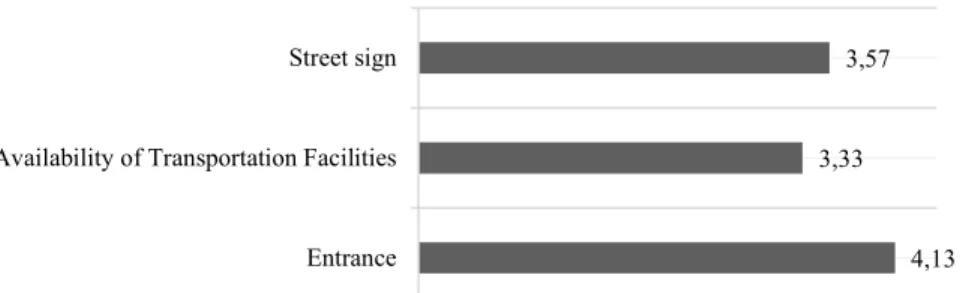
Based on the results of the questionnaire, tourists ' perception of access to Kumbasari Park saw a good catagori with an average assessment based on a questionnaire spread of 3.68. For more details can be seen in Figure 1.
Figure 1. Average rating of Traveller's perception of access to Kumbasari Park
Kumbasari Park already has horizontal and vertical movement. Horizontal movement in the form of pedestrian and Vertical movement in the form of RAM and stairs, will be the material edge of the ladder is easily mossy so slippery during the rainy season. Of course, it could harm tourists in Kumbasari Park. It is therefore necessary to routinely clean or coating rubber to avoid accidents due to slippery access.
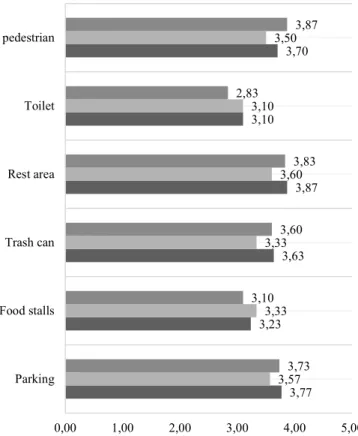
Perception of tourists towards the development of facilities and facility/infrastructure of Taman Kumbasaridi provide comfort, ease and experience of traveling good for all the tourists to be 3 (three) aspects of 1) physical condition, 2) conditions Cleanliness, and 3) the level of satisfaction in use.
a. Physical condition
In the aspect of assessment of physical condition of perception of tourists show good catagori to facilities/infrastructure of Taman Kumbasari with average value is 3.55, although there are two aspects of the Creteria still in the category is good enough that the availability of Food stalls and toilets at Taman Kumbasari.
b. Condition of cleanliness
On the assessment aspect of the condition of the perception of the tourists present a good enough catagori with an average value is 3.41. However, there are three aspects of the Kreteria that reside in the category of parking availability, resting place and footpath in Kumbasari Park.
c. Level of satisfaction in use
While in the assessment aspect of satisfaction in the use of facilities/infrastructure, the perception of tourists showed a good enough catagori with an average value is 3.49. However, there are four aspects of the kreteria that are in the category of good categories of parking, garbage, trash, resting places and footpaths in Kumbasari Park.
4,13 3,33
3,57
0,00 0,50 1,00 1,50 2,00 2,50 3,00 3,50 4,00 4,50 Entrance
205 Journal of Business on Hospitality and Tourism
Figure 2. Average value of perception of tourists to facilities/infrastructure Kumbasari Park
If inferred by the perception of tourists about the facilities and means/infrastructure of Kumbasari Park is in the category is good enough with an average value of 3.48, this is because there are two indicators that are still under the category of good the availability of toilets and Food stalls. In addition, there are several categories that have not maximized to provide comfort services for tourists such as parking area, availability of railing, ram security and stairs, as well as information center. It is necessary to re-study the development of facilities and services in order to provide comfort, ease and experience of traveling well for all travelers.
CONCLUSION
Based on the exposure, it can be concluded that, the condition of tourist attraction in Taman Kumbasari in General is already friendly to tourists. This can be seen from the attractions owned by Taman Kumbasari already in accordance with the preference of tourists, amenities that support the creation of comfort, convenience, and safety of tourists while visiting, as well as accessibility that can easily accessed. But the perception of tourists about the facilities and means/infrastructure of Kumbasari Park is still in the category is quite good with an average value of 3.48 and there are some categories that are not yet fully friendly to tourists such as parking area, availability of railing, ram security and stairs and information center.
3,77 3,23
3,63 3,87 3,10
3,70
3,57 3,33 3,33
3,60 3,10
3,50
3,73 3,10
3,60 3,83 2,83
3,87
0,00 1,00 2,00 3,00 4,00 5,00
Parking Food stalls Trash can Rest area Toilet pedestrian
Level of satisfaction in use
Cleanliness
206 Journal of Business on Hospitality and Tourism
REFERENCES
Anggayana, I. W. A., & Sari, N. L. K. J. P. (2018). Kemampuan Berbicara Bahasa Inggris Mahasiswa Akomodasi Perhotelan: sebuah Kajian Fonologi. Jurnal Manajemen Pelayanan Hotel, 1(1), 8-14
Badan Pusat Statistik Kabupaten Badung. (2016). Data Kunjungan Wisman ke Taman Ayun Kategori Dewasa: BPS Badung
Bagiastra, Ketut. (2016). Hygiene dan Sanitasi WC Umum di Kawasan Objek Wisata Lombok.Jurnal Media Bina Ilmiah, 10(7).
Cooper, et al. (2005). Tourism Priciples and Practice. Essex:Pearson Education Limited
Fandeli, Chafid. 1995. Dasar-dasar Manajemen Kepariwisataan Alam. Liberty.Yogyakarta
Geerts, W. (2018). Top 100 City Destinations 2018. Euromonitor International. Lawton, M.P. (1993). Meanings of activity. In: Kelly, J.R. ed. Activity and aging.
Sage, Newbury Park, California.
Millman, A. (2002). The impact of participation in activities while on vacation on seniors’ psychological well-being: a path model analysis. Journal of Hospitality and Tourism Research 26.
Ismayanti. (2010). Pengantar Pariwisata.Jakarta: PT. Grasindo
Nieamah, Kartika, F. (2014). Persepsi Wisatawan Mancanegara Terhadap Fasilitas dan Pelayanan di Candi Prambanan. Jurnal Nasional Pariwisata UGM, 6(1), 41
Patterson, Ian. (2006). Growing Older: Tourism and Leisure Behavior of Older Adults. School of Tourism and Leisure Management University of Queensland
Peraturan Menteri Kesehatan RI No. 25 tahun 2016 tentang Rencana Aksi Nasional Kesehatan Lanjut Usia 2016 – 2019. Jakarta
Peraturan Menteri Pariwisata Republik Indonesia No. 1 Tahun 2017 tentang Petunjuk Operasional Pengelolaan Dana Alokasi Khusus Fisik Bidang Pariwisata. Sekretariat Kementerian. Jakarta.
Pitana, I Gede dan Diarta, I Ketut Surya. (2009). Pengantar Ilmu Pariwisata. Yogyakarta: Andi.
Republik Indonesia. (2009).Undang – undang No. 10 tahun 2009 tentang Kepariwisataan. Lembaran Negara RI tahun 2009. Sekretariat Negara. Jakarta.
Soekadijo, R.G. (2003). Anatomi Pariwisata. Jakarta: Penerbit PT Gramedia Sugiyono. (2014). Metode Penelitian Kuantitatif, Kualitatif. Bandung: Alfabeta. Suyitno. (2001). Perencanaan Pariwisata. Yogjakarta: Kanisinus
UNWTO. (2016). Tourism Highlight 2016 Edition.
Utama, I Gusti Bagus Rai. (2012). Trend Perilaku Wisatawan Usia Lanjut Dalam Memilih Aktivitas Wisata. Universitas Udayana.
Widiarta, I Nyoman. (2015). Pengelolaan Daya Tarik Wisata Taman Ayun Sebagai Bagian dari Warisan Budaya Dunia. Universitas Udayana.