SUSTAINING
DEBT
REPAYMENTS
Experiences of people in informal repayment
arrangements
Contents
Foreword ... 3 About us ... 5 Executive Summary ... 6 1 Introduction ... 10 1.1 Introduction... 10 1.2 Background ... 10 1.3 Research aims ... 11 1.4 Research methods ... 112 Setting up repayment arrangements... 13
2.1 Triggers for action ... 13
2.2 The decision making process and the role of advice agencies ... 14
2.3 Features of debt repayment arrangements ... 17
2.4 Experiences of setting up debt repayment arrangements ... 18
2.5 The expectations and motivations of people entering debt repayment arrangements ... 22
3 Managing repayment arrangements ... 24
3.1 Managing repayments ... 24
4 Factors influencing the sustainability and outcome of repayment arrangements ... 35
4.1 Reasons why plans were successfully completed or ended ... 35
4.2 What determines whether repayment arrangements are sustained? ... 39
5 Conclusion ... 41
5.1 Implications for Practice ... 41
5.2 Policy recommendations ... 42
References ... 44
Appendix 1 Qualitative Research ... 45
Appendix 2 Regression tables ... 46
Appendix 3 Arrangement types ... 50
Foreword
Should individuals struggling to manage their debts pay for the advice to help them back into financial health, or does the old cliché that the best things in life are free apply to debt advice? What are the best ways for people to work their way out of unmanageable debt and into financial health?
These are questions which have been debated across creditors, not-for-profit advice agencies, government and the private advice sector for many years. Seeking to further understand the thoughts, experiences and opinions of those who have experienced the process of trying to resolve debt problems, Lloyds Banking Group, in partnership with the Money Advice Trust, commissioned the Centre for Research in Social Policy at
Loughborough University to help them find out what made debt repayments sustainable in the longer term and therefore more beneficial to customers and prospective
customers.
Lloyds Banking Group has long provided help and support to those in financial difficulty and along with The Money Advice Trust has held the belief that whilst people should be able to pay for debt advice if they choose, that decision should only be made from a truly informed position. This research suggests that many customers of fee-charging services are not fully aware of the fees they are paying or the free alternatives and it is hoped that this report will be a catalyst for change on this important topic.
The research finds that fee-charging debt management plans are more likely to fail than solutions where no fee is charged. They also take a much more superficial approach to budgeting and evidence suggests that customers therefore end up with repayment amounts they cannot sustain in the long term. Both organisations are also aware and concerned about the risk that some private companies have the potential to become bankrupt or even disappear before monthly payments are passed on to creditors. This report aims to flesh these issues out and bring them to the attention of people in financial difficulty as well as policy makers in the private, public and third sectors. In so doing the report seeks to provide some those most vulnerable in our society with the right level of information to allow them to make informed decisions that will have a wide-reaching impact on their financial wellbeing.
The research raises important concerns about the level of fees paid for debt
management services. In some cases these are exceptionally high: one interviewee with a fee-charging debt management plan (DMP) was paying £400 a month, of which £300 was a fee to the company (a 75 per cent fee).
Why then do people opt for fee-paying plans? Clearly there is an information gap, with people in periods of severe distress unable or unwilling to shop around for the best solution. Our research has found that half of those who were being charged fees for a debt management plan were not aware that such plans could be set up for free.
It is also crucial to ensure that the free sector has the capacity to respond when an individual reaches out for help. Some interviewees using fee-charging plans had been put off from the free sector by long waiting times to see an adviser.
Through the findings in the report, it is clear that the creditor industry, the free advice sector and government need to make the public aware of the free options. It is also necessary that the free sector continues to work together to ensure that clients reach services in a channel that that suits them as quickly as possible.
Lloyds Banking Group and the Money Advice Trust are both determined that anyone who finds themselves in financial difficulty is fully aware of the free support available to help them out of debt and into financial health. Both organisations look forward to discussing the results of this insightful research with key stakeholders to ensure that when people in financial difficulty seek advice, it is provided in the most beneficial way.
Graham Lindsay Joanna Elson
Group Director for Responsible Business Chief Executive
About us
Lloyds Banking Group
Lloyds Banking Group, which funded this research, is the leading provider of current accounts, savings, personal loans, credit cards and mortgages in the UK. We believe we can make a contribution to society by helping families, business and communities prosper, and by doing so in a responsible manner. The Group recognises that many customers find themselves facing financial difficulties at some point in their lives and works to help them find a practical and workable repayment plan. Last year the Group contributed £15 million to UK debt advice and debt charities, to help those facing serious financial problems.
The Money Advice Trust
The Money Advice Trust (MAT) is a charity formed in 1991 to increase the quality and availability of money advice in the UK. We work with government, the private sector and the UK’s leading money advice agencies to:
increase the availability of money advice;
improve its quality; and
improve the efficiency and effectiveness of its delivery.
MAT's key activities are:-Support to the debt advice sector through:
Training;
second tier support;
quality assurance developments, e.g. accreditation;
policy, research and evaluation;
fundraising, facilitation and strategy development; and
direct service provision (National Debtline, Business Debtline and My Money Steps)
Centre for Research in Social Policy,
Loughborough University
The Centre for Research in Social Policy (CRSP) is an independent research centre based at Loughborough University. A main area of CRSP’s work is on poverty and income studies, including studies of debt and financial inclusion and how households experience poverty and exclusion at different times of their lives. The research was conducted by Yvette Hartfree (Senior Research Associate), Matt Padley (Research Associate), Kim Perren (Research Fellow) and Paola Signoretta (Senior Research Associate).
Executive Summary
This report provides insight into the experiences of people in informal debt repayment arrangements and the Scottish Debt Arrangement Scheme, and the factors influencing the sustainability of debt repayments. Drawing on quantitative and qualitative research it seeks to improve understanding of the consumer experience of setting up and managing a debt repayment arrangement, and the key influences on the outcomes of repayment arrangements. The report also provides an account of the similarities and variation across different informal debt repayment arrangements, looking at free and fee-charging Debt Management Plans (DMP), self-negotiated agreements (SNA), and the statutory Debt Arrangement Scheme (DAS) in Scotland.
Key Findings
Sustaining debt repayment arrangements
Drawing on all of the evidence from this research study, the key factor determining whether debt repayments were sustainable or not was affordability.
Analysis of the survey data shows that ease of repayment was linked to:
the size of debt - respondents with the lowest debts levels found managing their repayments easiest;
repayment amount - where repayment amounts were more than £30 per month the difficulty of managing repayments increased; and
work status - households with two adults in full-time work were less likely to find repayments difficult to manage compared to households where there was just one or no adults in full-time work.
Unexpected changes in circumstances made debt repayment arrangements more or less affordable. Positive changes in individuals' circumstances enabled them to increase their regular repayment amount, or to pay off a lump sum and complete their debt
arrangement sooner. Detrimental changes in individuals' circumstances, such as a job loss, relationship breakdown, or household bills going up, made repayment amounts less affordable.
That affordability is a key determinant of whether debt repayments are sustained is not surprising. However, the qualitative research provides new insight into the process of setting up repayment arrangements and the importance of careful budgeting to ensure that repayment amounts are set at an affordable level. Where repayment amounts were set at an affordable level at the outset, on-going repayments were easier to sustain. Affordable repayment levels were achieved when they were: based on a thorough and detailed assessment of individuals' income and outgoings; allowed for a reasonable and realistic level of household expenditure; and were conducted in consultation with the person entering the arrangement. When the repayment amount was set at too high a level repayments were difficult to sustain.
Whether debt repayment arrangements succeeded or failed was also related to whether the right arrangement was entered into in the first place. There was very little evidence from the qualitative research that people were ‘shopping around’ or gathering information to find the best solution to their debt problem. Interviewees were not aware of all of the options available to them and most took the first solution they came across. It was
apparent that some interviewees were in a debt solution that was unsuitable for their circumstances making their arrangement more likely to fail. There were examples in the qualitative research of interviewees who had abandoned their arrangement and instead opted to become bankrupt, take out a Debt Relief Order or an Individual Voluntary Arrangement.
The research shows that the behaviour of creditors and debt management companies also influenced the success of repayment arrangements. Survey respondents who found it easy to manage their debt repayments were significantly more likely to say their creditors had been helpful than those who found repayments difficult. A concern is that the most common reason why repayment levels went up was due to pressure from creditors to increase payments. This pressure on individuals to increase their repayment amount, possibly to levels that are unaffordable, increases the risk that payments will not be sustained. Flexibility by creditors and debt management companies in adjusting repayment levels when circumstances change can help repayments to be sustained. A small proportion of survey respondents failed to complete their repayment
arrangement because creditors stopped accepting offers of payment or their
arrangement was cancelled by the debt management company. From the in-depth interviews we know that in some cases this was action taken by the creditor or debt management company and was not the fault of the debtor. It included: people who entered into arrangements with bogus companies who disappeared; an interviewee whose arrangement was cancelled by their debt management company because their request to reduce their repayment amount fell below the company’s minimum payment threshold; an interviewee whose arrangement was cancelled while she was in hospital because she was unable to make her manual payments; and creditors who sought court intervention, which subsequently resulted in bailiffs being used in an attempt to recover the debts.
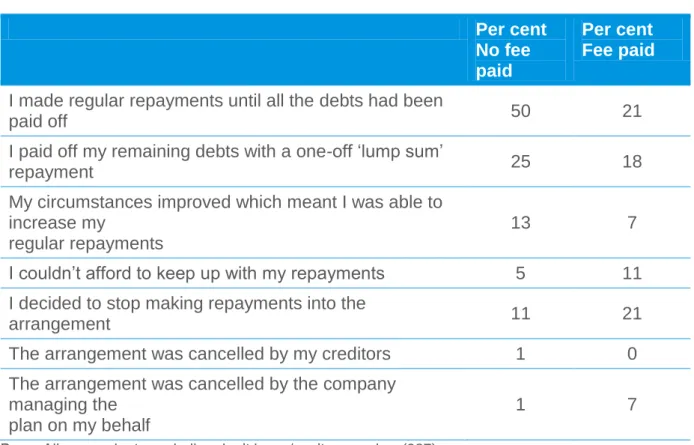
The failure rate of repayment arrangements, although small overall, was twice as high amongst respondents that had paid a fee, compared to those who had not paid a fee. This finding is likely to be reflecting the poorer practices of fee-charging companies (discussed below), as well as the additional cost of fee-charging plans.
The motivation of individuals was not a key factor in whether repayment arrangements were sustained. Interviewees had a strong desire to pay off their debts and see their arrangements through. Even interviewees who were struggling or had failed to sustain their repayments still wanted to pay off their debts. However, the provision of regular statements showing how much debt had been repaid and how much was still
outstanding did help keep people motivated to sustain their repayments. Interviewees who did not receive this information felt disempowered and demotivated.
Differences across arrangement types
Debt Management Plan and Debt Arrangement Scheme
Overall, there was little discernible difference between the experiences of interviewees with a DAS compared to interviewees with a DMP. The only differences found were that interviewees who had taken out a DAS were particularly clear that all interest and
charges on their debts would be frozen and that creditors would not be able to contact them. The option to take a payment holiday had a very positive impact on the ability of
one interviewee to sustain their repayment arrangement following ill-health. The
interviewees we spoke to had very little awareness that they were in a ‘DAS’ and that it was a specific type of debt repayment arrangement.
There was much greater difference between interviewees’ experiences of DMPs/DAS taken out with free providers and those taken out with fee-charging providers:
Both free and fee-charging DMCs provided a very good service to customers in setting up DMPs and DAS – for all interviewees the process was very easy and straightforward.
Free providers conducted a more thorough and detailed assessment of the level of repayments people could afford. Fee-charging companies appeared to use a more surface approach to budgeting with little or no discussion with the individual about affordable levels of repayment.
Interviewees who had arrangements with free providers also had a better
understanding of their repayment arrangements. Interviewees who had taken out arrangements with fee-charging providers were less clear about how much they were paying in fees and how long they would be making repayments to clear their debts. A few interviewees felt they had been misled, only finding out several years into the arrangement how much they were paying in fees.
Free DMCs provided more on-going information, through monthly and annual statements that clearly showed how much debt had been paid off and how much remained. Annual reviews of the affordability of repayment amounts and individuals’ current financial circumstances were also conducted by some providers. In
comparison, not all fee-charging companies provided monthly or annual statements and those that did were less clear in showing how much debt was outstanding, what percentage of payments were being taken in fees and how long it would take to pay off remaining debts. The exception was an interviewee who had a DAS with a fee-charging provider.
Overall, interviewees with free DMCs were generally more positive about their experience than those with fee-charging DMCs.
With fee-charging companies the research found a few examples of interviewees who were being charged very high monthly fees, as well as high upfront charges that had to be paid before DMCs would start making payments to creditors.
Self-negotiated arrangements
By their very nature the experience of interviewees with self-negotiated arrangements was very different to those with DMPs and DAS because they were dealing directly with their creditors. The experience of interviewees with self-negotiated agreements was in part influenced by the amount of money they could afford on a regular basis to service their debts. Where interviewees had very low incomes, generally those who were
dependent on benefits as their major source of income, they were unable to do any more than make small token repayments against often significant debts. In these instances there was an acceptance that they were unlikely to ever repay debts and payments were seen as a means of satisfying demands from creditors. Where interviewees had a greater level of available resource each month with which to repay debts, there was a clear commitment to repaying debts and ultimately being debt free. Access to free online budgeting tools and debt advice helped in negotiations with creditors as people were able to justify their offers of reduced or token payments. Interviewees with self-negotiated arrangements had both good and bad experiences of negotiating with creditors and dealing with their creditors on an on-going basis. Some creditors were
unwilling to negotiate, and demanded higher payments or threatened to take action against them. Others accepted offers of reduced repayments, agreed to freeze charges and interest and undertook annual assessments of individuals’ financial circumstances to ensure that repayments were set at an appropriate level.
1 Introduction
1.1 Introduction
This research sought to provide new evidence on people’s use and experiences of debt management plans (DMP), self-negotiated repayment arrangements (SNA) and the Debt Arrangement Scheme (DAS) in Scotland, and the sustainability of repayments made while in these arrangements.
The research involved a quantitative survey and in-depth follow-up interviews with a small number of survey respondents. The survey collected information on the features of repayment arrangements such as plan length and amount owed, the use of debt advice, reasons for choosing a fee-charging debt management company, the ease of setting up arrangements and the ease of maintaining repayments. Analysis of the survey data explored the factors affecting the sustainability of debt repayments. The qualitative interviews aimed to more fully understand the triggers for seeking help with unmanageable debts and the decision-making process allied to this, people’s
experiences of setting up debt repayment arrangements and managing their repayments on a day to day basis and the reasons why, for some people, repayments arrangements cease to be sustainable.
This research is very timely and follows a recent Government consultation on consumer credit and personal insolvency (Department for Business, Innovation and Skills (BIS), 2011). The Government’s response to the consultation emphasised their commitment to a non-regulatory route to improving practice and standards within the debt management industry and the establishment of a debt management plan protocol which would dovetail with Office of Fair Trading guidance for debt management services (OFT, 2011).
1.2 Background
There are currently a range of debt management options on offer for individuals, the availability of which is dependent on a number of factors, including the type of debt, whether the person in debt has sufficient income to afford repayments and other personal circumstances. If an individual has no money to pay off debts and their circumstances are unlikely to change in the short-tem, they have limited options for dealing with their debts. These include asking creditors to write off the debt, applying for a Debt Relief Order, or applying for bankruptcy (Citizen Advice Service, 2012). If an individual does have sufficient income to repay their debts, then the number of options is wider. Options include: dealing with creditors themselves, using a debt management company to negotiate with creditors to set up a debt management plan, applying for an Administration Order, applying for an Individual Voluntary Arrangement (IVA) or using loan consolidation.
The focus of this study is on informally negotiated debt repayment arrangements
including debt management plans and negotiated arrangements (either using a self-help model or via a third party agency), and the Debt Arrangement Scheme (a formal scheme) that is only available in Scotland. Please see Appendix 3 for definitions of each arrangement type.
1.3 Research aims
The aim of the research was to understand the consumer experience of being in a debt repayment arrangement. More specifically the research sought to understand:
the reasons why some people are successful in maintaining their debt repayments, whilst others fail to keep up their repayment arrangements; and
whether there are any differences between people’s experiences of being in an informal debt repayment arrangement, such as DMP or SNA, compared to the Scottish formal DAS.
The results of the research are intended to inform the policies and behaviour of creditors, debt management companies and the debt advice sector in how best to support their customers through debt repayments to help prevent repayment arrangements from failing. The research also seeks to provide evidence for Government policy in relation to a protocol on best practice and the need for a statutory debt management scheme in England and Wales.
1.4 Research methods
1.4.1 Quantitative survey
In June 2012, an online survey was conducted by TNS UK drawing on its online panel. These panellists were selected initially on the basis of quotas representative of the GB population aged 18+ (for age, gender and household income) derived from the TNS national omnibus. Survey recipients were then asked to complete the questionnaire if they were currently, or had in the past five years, been in an informal repayment arrangement, or on a DAS if in Scotland. People living in Scotland were oversampled (n=200) to increase the number of people with a Debt Arrangement Scheme included in the survey. In total 1,003 survey responses were achieved.
As with any online, panel-based survey, the study excludes people who lack internet access. Whilst the survey is not representative of the UK adult population, the data can be used to explore the characteristics of people with debt repayment arrangements and how these characteristics are associated with particular outcomes.
1.4.2 Qualitative in-depth interviews
From the survey, a sub-sample of respondents was selected to take part in the qualitative research to follow up on their survey responses in more depth. The qualitative sample was selected to include:
a range of geographical areas, including Scotland and England, as well as mix of urban, suburban and rural areas;
people with different types of debt repayment arrangements, including SNA, DMP with both fee-charging and free-to-client providers, and DAS (in Scotland); and
a range of repayment experiences, including people who had failed to maintain their repayments, people who had successfully completed repayment plans, and people who were currently in a repayment arrangements, some of whom were finding making their repayments easy and others who were finding it difficult.
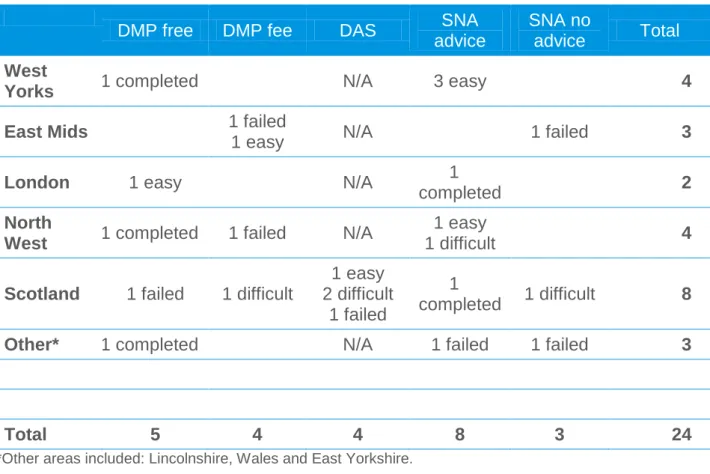
A total of 24 in-depth interviews were conducted. The majority of interviews were conducted face-to-face. Telephone interviews were conducted with people who lived outside of the main fieldwork locations, or who were not available during the fieldwork
visits for a face-to-face interview. Fieldwork took place in July 2012. A more detailed profile of people who were interviewed is provided in Appendix 1. The topic guide used in included in Appendix 4.
2 Setting up repayment
arrangements
Key Findings
The principal causes of people finding themselves in arrangements to repay unmanageable debts were an unforeseen drop in household income, additional household costs, and heavy reliance on credit for day-to-day spending.
People often ‘struggled on’ with unmanageable debts, only seeking a solution when this became unsustainable.
Most people had not accessed independent debt advice through formal channels prior to setting up repayment arrangements.
Many people did not shop around to ensure they found the most appropriate solution for their circumstances both in terms of investigating all possible options and in comparing debt management companies.
The majority of people had found setting up repayment arrangements easy with both fee-charging and free service providers and debt management companies were felt to have offered a professional service.
People with self-negotiated agreements had made use of a range of budgeting tools including online resources and ‘paper’ tools.
People with free DMPs had participated in detailed budgeting processes in contrast to those with fee-charging DMPs, where there was less discussion of affordable levels of repayment.
People with free DMPs were clearer about repayment levels and plan length, and those with DAS were aware of the statutory requirement for creditors to freeze interest and charges. Individuals with fee-charging DMPs generally had a less clear grasp of what their plans entailed.
This chapter examines the experiences of individuals in setting up debt repayment arrangements. It covers the triggers for setting up debt repayment arrangements (drawing on evidence from the in-depth interviews), how people chose their repayment arrangement and the role of debt advice agencies in this decision making process. From the survey results the features of repayment arrangements are presented, including the length of arrangements and the payment of fees. People’s experiences of setting up debt repayment arrangements, their understanding of what they had signed up to and their motivations to repay are also discussed.
2.1 Triggers for action
As outlined in previous research on debt and financial difficulties (Goode and Waring, 2011; Kempson et al., 2004; Kempson, 2002), for most of the in-depth interview participants the cause of unmanageable debts was an unforeseen drop in household income, linked to changes in working hours, the loss of employment, or long term sickness preventing work, the breakdown of relationships or significant life events such as the birth of a child, resulting in additional costs putting strain on household income.
Interviewees reported creditor behaviour, including action or threats of action to recover debts, as a significant trigger for taking action to tackle unmanageable debts and most had experienced demands for payment. While some had managed to maintain debt repayments before entering an arrangement, many had missed payments or found themselves in a cycle of paying a different creditor each month and missing others. There was variation in the frequency and form of creditor contact. Some interviewees had experienced particularly persistent demands from creditors with repeated phone calls, text messages and letters demanding full payment and threatening court proceedings and other action to recover debts. Interviewees reported feelings of
‘drowning’ in debt, experiencing sleepless nights, feeling unable to cope and in extreme cases feeling suicidal because of the combination of unmanageable debt and constant contact from creditors.
Interviewees reported creditor behaviour as a significant
trigger for taking action to tackle unmanageable debts
The in-depth interviews revealed that in general there is not a single isolated trigger for action, but rather the combination of reduction in income, changes in family or personal circumstances, unexpected life events and contact from creditors coalesce to make ‘struggling on’ untenable.
2.2 The decision making process and the role of
advice agencies
It is clear from the in-depth interviews that most participants did not necessarily look for the best or most appropriate solution; they were searching for any solution to address their current circumstances. Interviewees frequently spoke of a desire to do something rather than doing the best thing to address their debt problems. There was little
evidence of ‘shopping around’ for the best deal and for the most part interviewees landed on the first ‘solution’ offered to them. The process for choosing arrangements seems to be as influenced by individual circumstances, prior knowledge of debt repayment options and by support networks (family, friends, work colleagues) rather than advice from debt advice agencies, creditors and debt management companies.
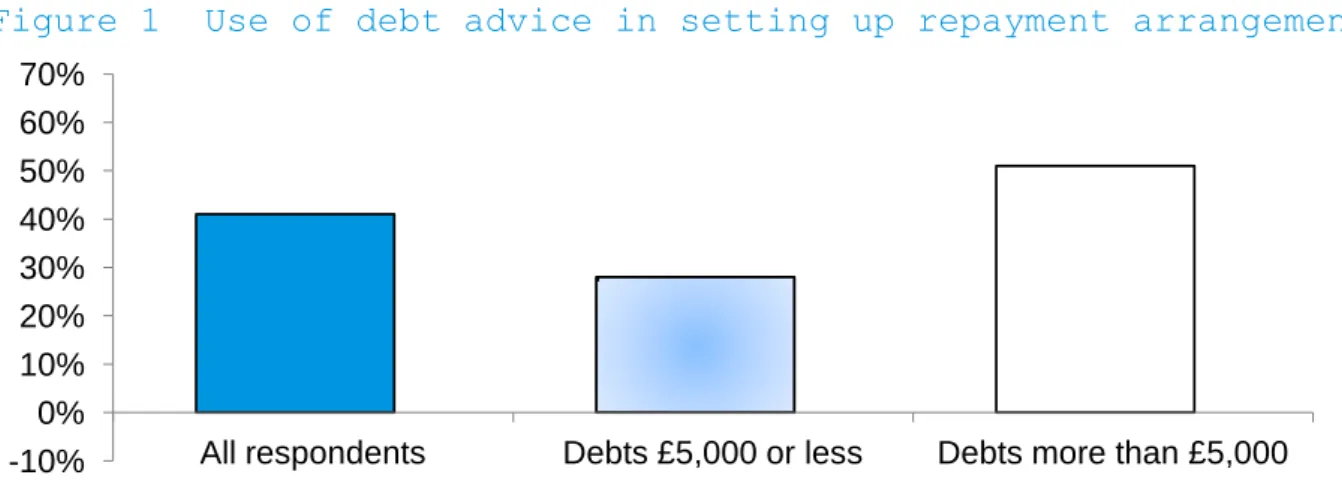
Figure 1 Use of debt advice in setting up repayment arrangements
Base: All respondents (1003)
-10% 0% 10% 20% 30% 40% 50% 60% 70%
Analysis of the survey data showed that debt advice agencies played a role for less than half of respondents in setting up their debt repayment arrangement (41 per cent). The larger the size of the debt the more likely people were to have sought debt advice (Figure 1). However, this still leaves 60 per cent of people overall who did not have any contact with debt advice agencies.
The main reason why debt advice was not sought by survey respondents who set up their own repayment arrangement, was because they felt they did not need it - over a third of respondents (42 per cent) said they had not needed advice. A small number of respondents did not get advice because they did not know where to go (15 per cent).
Fee charging DMPs and DAS
In-depth interviewees in fee-charging DMPs and DAS did not consider they had received advice through any formal channels prior to taking out their arrangements. Other
interviewees with fee-charging DMPs had used the internet to search for debt
management companies, basing decisions about which debt management company (DMC) to go with on customer reviews of different companies. These reviews are often subjective making them a potentially unreliable source of information.
Analysis of the survey data supports the finding that people were not aware of all of the options available to them when they took out their arrangement - of those who were being charged fees, half (50 per cent) were not aware that DMPs could be set up for free. Other reasons why people took out a plan with a fee-charging debt management
The decision making process
One single male with around £15,000 of debts had looked in the telephone directory for debt management companies in the nearby city, selected one and arranged an appointment. In explaining his decision he stated:
‘I signed up because I was desperate … it was just because I don’t really have much family support, it was only me really.’
(Single male, 48, fee-charging DMP) Another interviewee had responded to a leaflet that had been put through his door and he admitted that he had not really been certain of what he was signing up for at the time and had not sought advice from any formal channels. He stressed the attraction of being offered what appeared to be a solution to his mounting debts:
‘I was just hearing what I wanted to hear, you know, it feels so easy and I wondered why I’d never done this before … Personally I just wanted an out you know, I wanted somebody that was wanting to help and I thought that this was the answer to my problems.’
company are shown in Table 1. Some respondents had tried to get advice from a debt advice agency, but could not get help quickly enough. Others had not sought advice because they did not think the debt advice agency would be able to help them quickly enough.
Table 1 Reasons why respondents chose a fee-charging debt management company
Per cent
I wasn’t aware that this type of arrangement could be set up for free
50
I thought the company I chose was the most able to meet my needs
21
I tried to get help from a free advice agency but they couldn’t help me quickly enough
14
I thought I would get a better service if I paid a fee 14 Someone recommended the company to me 13 I did not have time to shop around so I chose one of the first
companies I could find
10
I didn’t think any free advice agency could help me quickly enough
7
Base: Respondents with a fee-charging DMC (101)1
Free DMPs and DAS
Formal advice played a more prominent role in the decision making process for interviewees with a free DMP or DAS, but there was still little evidence of shopping around for the best or most appropriate arrangement. Interviewees with a free DMP had generally been directed to the free-to-client provider by Citizens Advice Bureau (CAB), or had a free-to-client provider recommended by friends, colleagues or creditors.
People with a free DMP or DAS who received advice from CAB were generally positive about the service, but some reported difficulty getting an initial appointment due to high demand or the lack of a local office. Some noted that getting an appointment could take up to three months which they felt was unacceptably long in the context of mounting debts and pressure from creditors. Online searching for debt help also figured in the decision making process for those with DAS.
Self-negotiated arrangements
Interviewees had made use of formal advice agencies, and in particular the CAB. In general CAB were reported to have provided practical assistance such as drafting letters to send to creditors and more emotional support for some experiencing the
overwhelming stress of debt. Interviewees suggested that the service offered by CAB varied across localities. Some reported receiving invaluable advice and support, whilst others felt that they had not been offered advice about all of the available options. Some said that they had not received any support.
1
Some interviewees had also made use of online tools and advice such as those offered by National Debtline (My Money Steps) and Consumer Credit Counselling Service (Debt Remedy).
The role of advice and advice agencies in shaping the decision making process varied significantly across all arrangement types. This reflects the variation amongst individuals in their prior knowledge of debt solutions, emotional and psychological state and
willingness to seek advice. It is also clear that individuals are unsure where to look for information, the absence of any objective or regulated means of comparison makes it difficult to choose between competing debt management companies, and the Citizens Advice Service is struggling to meet demand.
2.3 Features of debt repayment arrangements
The majority of debt repayment arrangements in the survey, including self-negotiated agreements, were for five years or less (63 per cent) with four in ten (43 per cent) having arrangements that were three years or less. A small group of respondents had
arrangements without a set length (17 per cent), and five per cent did not know (or could not remember) how long their arrangement would last.
The overall picture of people’s debt arrangements from the survey was that the majority of people had the interest and charges on their debts frozen by at least some of their creditors (73 per cent), indicating the willingness of many creditors to negotiate on the terms of debt repayments. However, around one in six (17 per cent) were being charged interest and charges by all of their creditors.
Analysis of the survey data showed that the size of debt was a key determinant of whether respondents’ had a plan that was set up by a debt management company on their behalf - the larger the debt, the more likely this was (Table 2). Overall, thirteen per cent of respondents had a plan set up for them by a debt management company, but this increased to 30 per cent of respondents who had a debt of £15,000 or more.
Table 2 Percentage of respondents whose plan was set up by a debt management company, by size of debt
Amount owed to creditors Per cent
Less than £2,000 4
£2,001 - £5,000 5
£5,001 - £10,000 9
£10,001 - £15,000 21
More than £15,000 30
Base: Respondents whose plan was set up by a DMC (134)
Where plans were taken out through debt management companies, 71 per cent of respondents were charged fees. The survey findings showed that over two thirds of these respondents (70 per cent) were paying fees through regular instalments. Nearly one in three (30 per cent) had to pay an upfront fee, most of whom were paying regular instalments as well (Table 3).
Table 3 Percentage of respondents whose plan was set up by a debt management company, by size of debt
Per Cent
Instalments throughout the arrangement 70 Upfront payments and throughout the arrangement 21 An upfront payment only 9
Respondents with a fee-charging DMC, excluding don’t know/can’t remember (97).
2.4 Experiences of setting up debt repayment
arrangements
2.4.1 Ease of setting up arrangements
The survey showed that overall the majority of people (83 per cent) said they had found it easy to set up their arrangement. This is supported by findings from the in-depth interviews. There was significant agreement amongst interviewees (across all arrangement types) regarding the ease of setting up repayment arrangements.
DMP and DAS
Where a debt management company (including both free-to-client and fee charging providers) was involved in setting up debt repayment arrangements most interviewees reported that having made initial contact with the chosen DMC, the process of setting up the plan was very straightforward. For most the process entailed a visit or telephone consultation with a representative of the company during which time details of income and expenditure were taken.
Upfront and monthly fees
Interviewees gave examples of paying very high monthly fees to their DMC; one interviewee with a fee-charging DMP was paying £400 a month, of which £300 was a fee to the company (a 75 per cent fee). There were also examples of high levels of upfront charges. One interviewee with a fee-charging DAS had made two payments of £662 for setting up the plan; another with a fee-charging DMP had paid a £350 fee before he signed up to the arrangement; and another who had experienced two failed fee-charging DMPs paid upfront charges of £1300 and £300 and felt in both instances that nothing had been done by the companies until she had made this payment.
Relief from creditor contact
‘It was an absolute nightmare coming home and there’s a letter through the door from the bank, warning letters and threats, taking court action and all that, so it was through the CCCS they stopped these letters from coming.’
There was a clear sense that DMCs focused on delivering a good service to customers and making the transition from unmanageable debts to debt repayment arrangement as stress-free as possible. A particular feature of fee-charging DMCs was the provision of a very ‘professional’ service with effective salespeople focused on ensuring an easy set up process. Interviewees lacked detailed knowledge about the negotiation process with their creditors undertaken on their behalf, but most received confirmation that their creditors had accepted the plan.
Although interviewees welcomed the uncomplicated set-up process, it was clear that the focus was on repaying debts rather than a broader assessment of the financial needs of individuals; an easy set-up process did not necessarily result in a quality outcome for individuals or mean that the arrangement was the best solution. There was little evidence of discussion of other options for addressing unmanageable debts and little support offered to individuals to improve financial capabilities such as money
management or budgeting. Further, interviewees with both fee-charging and free-to-client arrangements were generally unaware of debt repayment options outside of that which they had selected at the outset.
An easy set-up process did not necessarily result in a quality
outcome for individuals or mean that the arrangement was the
best solution
Self-negotiated arrangements
Where participants had negotiated agreements with creditors, most reported that the process had been straightforward once dialogue with creditors had begun. However, and in contrast to those participants using DMCs, it was clear that those negotiating agreements with creditors on their own behalf (self-help) spent more time and effort than those entering into either a DMP or DAS. As found in previous research (MacDermott, 2008) interviewees with self-negotiated agreements experienced a range of responses from creditors. Most interviewees reported that offers of reduced payments and
requests to freeze interest and charges had eventually been accepted by the majority of creditors. However, some had experienced repeated attempts from creditors to increase repayment amounts (this is discussed further in Section 3.5).
There was little evidence of creditors signposting participants to sources of advice and support. Many interviewees, even where offers of payment had been accepted, had experienced warnings of escalated action against them. In instances where creditors did not accept offers of repayment some interviewees expressed frustration about the
attitudes of creditors.
The rejection of offers of payment resulted for some interviewees in creditors seeking county-court judgments. Where this happened, courts generally reduced debts payable to creditors and ordered interviewees to make token payments.
2.4.2 The budgeting process
The in-depth interviews revealed a clear difference in the budgeting process between fee-charging and free-to-client DMCs. Although most participants who had
arrangements managed by a DMC had undertaken some form of budgeting, free
the context of household spending. Importantly, with free providers, interviewees appear to have played a central role in budgeting either through a face-to-face or telephone consultation, resulting in repayment levels reflecting the needs and circumstances of individuals.
In contrast, fee-charging DMCs adopted a more ‘surface’ approach to budgeting, there had often been little or no discussion about affordable levels of repayment, and
companies had regularly taken paperwork from participants and come back to them with the repayment level. As explored in Chapter 4, the negotiation process over repayment levels may be a key factor influencing the outcome of repayment arrangements.
Most interviewees with an SNA had made use of budget sheets accessed either through an advice agency or through online tools. Where these tools had been used
interviewees were positive about their value. They regarded detailed budgeting as a key factor in negotiating with creditors, enabling the justification of offers of much reduced or token repayments in the face of pressure from creditors to pay more. Even where formal budgeting tools had not been utilised, all interviewees had undertaken some form of listing of income and expenditure. The survey findings showed that one in three (35 per cent) respondents with an SNA did not complete a budget sheet. It could be that these people undertook a rough assessment of their income and expenditure, rather than completing a more formal or detailed budget sheet.
2.4.3 Understanding of repayment arrangements
It was clear from the in-depth interviews that there was substantial variation in
understanding of the detail of what had been signed up for. Interviewees, who used a free-to-client DMC, whether for DAS or DMP, generally had a greater comprehension of what their arrangements entailed, knew how long the arrangement would last and felt that the level of repayment had been reached following a realistic and thorough assessment of what was affordable.
Frustration at creditor attitudes
One 35 year old male had contacted creditors immediately after being made redundant and before he had missed any payments, but had some offers of payment rejected:
‘I was immediately honest with them, I told them my situation, I tried to make them an offer that was the most I could afford, they wouldn’t accept it and there was nothing more I could do.’
Those who had DAS were very clear that once they and their creditors had entered the scheme, there was a statutory requirement for creditors to freeze interest and charges and not make direct contact.
Interviewees using fee-charging DMCs were far less clear in their understanding of what they had signed up for, particularly in terms of the length of arrangements and the level of fees and charges applied by DMCs. Those paying a fee often lacked knowledge, at least at the start, of how much they were paying in monthly fees to the DMC. There was, however, a greater knowledge of the amount of upfront fees being charged.
Although the set up process was described by interviewees as easy, there were clear examples of individuals feeling they had been misled by companies and not fully
understanding the nature of the arrangement they had entered. Some only discovered after several years how long they would be making repayments for and how much they were paying in fees.
There was a sense amongst interviewees that clear information at the commencement of their arrangement would have been beneficial, but also a sense that the lack of clarity was offset by the feeling that they were doing something to tackle debts. Participants with fee-charging DMPs commented:
Well it eases your mind, you’re thinking well at least I’ve sorted this out and you weren’t getting as many letters coming to you from creditors.’
(Single male, 48, fee-charging DMP)
‘Probably didn’t understand it as much as I should have done, but the fact that someone out there was willing to help you, you don’t look too deeply, you feel you’re getting some help and the amount of stress and worry that goes is, you can’t describe.’
(Widowed male, 59, fee-charging DMP)
Understanding of repayment arrangements
‘They always went at the client/customers pace, they didn’t say you have to pay more than what you could, it was a case of you pay what you can pay and if your circumstances change then you could up it.’
(Single female, 47, free DMP) ‘They worked out to leave you enough money to live on but also an
acceptable amount to pay each month.’
It was clear from the in-depth interviews that there are broad similarities between free and fee-charging DMCs in terms of the ease of setting up arrangements, but differences in the level of information and transparency provided to individuals at the outset of arrangements.
2.5 The expectations and motivations of people
entering debt repayment arrangements
Most interview participants reported an initial satisfaction with their debt repayment arrangement, and an expectation that their chosen solution would provide a means by which to reduce their monthly debt repayments, clear debts and halt contact from creditors.
Interviewees spoke of a desire to get back on their feet, get their lives back and exert control over circumstances that had often spiralled out of control. Having made an investment in finding a solution, sometimes financial as well as emotional, there was a clear determination to see arrangements through to completion. For some there was a clearly felt moral obligation to repay debts as well as a resolute desire to avoid
bankruptcy and the stigma associated with this.
Understanding of repayment arrangements
A lone parent reported that there was no great clarity from the DMC about the length of arrangement and how much they were taking in fees each month. She also noted that during the budgeting process the company representative had encouraged her to inflate some of her outgoings in order to lower monthly repayments. While this had resulted in a lower payment and a preferable short term financial situation, she felt that this had, in the long term, not been of benefit in actually repaying her debts. She also felt she had been misled by the DMC about the likelihood of her debts being written off by creditors. The company had informed her:
‘They’d negotiate with the creditors and the creditors would get to the point where they’d turn round and say well oh if she gives us £50 we’ll wipe the debt.”
Now five years into her arrangement, her creditors had not written off her debts, and she was still unaware of how long she had remaining to pay and how much she was paying in fees each month. What she was very aware of, however, was how little of her initial debt had been paid off over this period.
Motivation to repay debts
‘I was hoping ... we would come to an agreement with the credit card companies and the other people, that we would pay a specific amount off per month until it was deemed that it was satisfactory that the debt was cleared.’
(Widowed male, 59, fee-charging DMP) ‘Once I was in it I felt like I was doing something positive, that I was finding a way sort of out of the mess that I felt I wasn’t going to be able to get out of.’
3 Managing repayment
arrangements
Key Findings
The three key factors influencing the ease of managing repayment arrangements were: the affordability of repayment levels agreed at the commencement of the arrangement; positive and negative changes in circumstances; and the response of debt management companies to individuals’ changes in circumstances.
Where detailed budgeting was used to inform repayment levels, people had generally found payments manageable in the context of household spending.
The majority of survey respondents had found it easy to maintain debt repayments and had not missed a payment; around a quarter had found it difficult to keep up with their repayments
Almost two-thirds of survey respondents had experienced no change in repayment levels while in an arrangement; one in five had seen their repayments increase, with slightly fewer reporting a decrease. The most common reason for a rise in
repayments was pressure from creditors to increase payments.
There were a range of experiences of on-going contact with debt management companies. In general people valued effective and regular communication, annual financial reviews and online tracker tools.
The survey showed that overall respondents had found creditors helpful during their repayment arrangement.
This chapter explores the experiences of individuals in managing debt repayment
arrangements. This includes discussion of: how people have managed their repayments on a day-to-day basis and what made it difficult or easy to manage repayments; and the impact of changes in circumstances on sustaining repayment arrangements. The use and role of debt advice during debt repayment arrangements; and on-going contact with debt management companies and creditors is also discussed.
3.1 Managing repayments
Around a quarter of survey respondents (28 per cent) said it had been difficult to
maintain their repayments, but only five per cent described this as being very difficult. Participants in the qualitative interviews initially welcomed the reductions in monthly repayments resulting from entering into an arrangement. Regardless of arrangement type, most reported that at the start payments had generally been manageable.
Following from this initial relief it is people’s longer term experiences of managing these repayments and their ability to sustain them (or not) that this research was most
interested in.
The extent to which interviewees found it easy or difficult to manage their debt repayments could be attributed to three main factors:
1. the affordability of repayment levels agreed at the outset of the arrangement; 2. changes in circumstances – both positive and negative; and
3. the response of debt management companies to changes in circumstances.
3.1.1 Affordability of agreed repayment levels
Interviewees who had free DMPs expressed a high level of satisfaction with the ongoing level of repayment, informed by a detailed and thorough budgeting and review process. These interviewees reported that both initial and longer term repayments were set at an appropriate level, taking into account reasonable levels of household expenditure and other financial commitments.
For some interviewees with self-negotiated agreements, repayments had remained manageable because in their initial negotiations with creditors they had made use of budgeting tools to clearly outline what they could afford to repay. Where detailed budgeting had taken place, and creditors had responded positively to offers of reduced repayments, interviewees found that their monthly repayments were affordable within the context of household spending. This was true for those who were dependent on benefits as their main source of income and for those in full-time employment, suggesting that income level was not a sole factor in determining whether repayments were
manageable.
There were other interviewees with self-negotiated arrangements for whom negotiations with creditors had resulted in repayment levels being set at an unsustainable level. In some instances this had resulted in interviewees being unable to sustain repayments and as a result declaring themselves bankrupt as unmanageable debts continued to grow.
There were interviewees with DAS and fee-charging DMPs who had found the
repayment level set at the start of their arrangement easy to manage and others who had found it difficult. Under DAS, the statutory obligation on creditors to freeze interest and charges was felt to have exerted a degree of control over unmanageable debts, abating the spiral into ever greater indebtedness.
Repayment arrangements set at an unsustainable level… in
some instances resulted in individuals having to declare
themselves bankrupt as unmanageable debts continued to
grow
Interviewees who had found arrangements difficult spoke of the day-to-day difficulty of balancing debt repayments alongside other household spending. For example, one lone parent reported that she was finding it difficult to maintain the DAS repayments and that there was no spare money after paying her mortgage, utility bills, living costs and DAS. She did note though that having only one monthly debt repayment rather than a number of payments to different creditors had made the process of repayment easier to manage. A single male with a DAS who had struggled to manage his repayments acknowledged that he had taken on a higher monthly repayment than recommended by CCCS because he wanted to be debt-free more quickly. Managing his debt repayment alongside
something to address his debts, the level of stress associated with his financial position had not been reduced. However, he hoped that the longer term gain would be worth the short term sacrifice.
3.1.2 Changes in circumstances
Changes in circumstances were a factor in the sustainability of repayment arrangements and were often outside the control of participants. For some interviewees, positive changes in circumstances had resulted in an ability to increase repayment amounts and therefore pay off their debts more quickly, such as new employment or receiving a windfall.
Other interviewees had experienced changes in circumstances that had made it more difficult, and sometimes impossible, to sustain monthly repayments, such as loss of employment, cuts to overtime and long-term sickness.
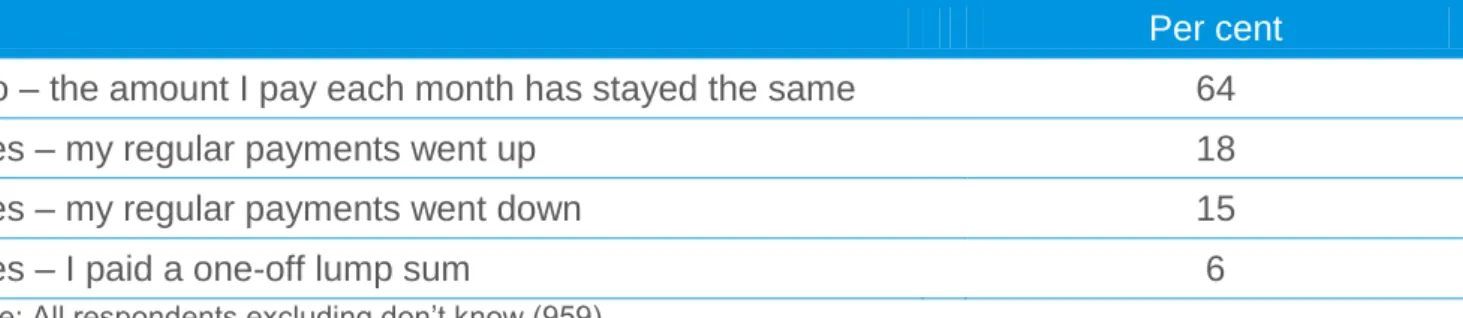
Analysis of the survey data showed that almost two-thirds of respondents (64 per cent) experienced no change in the size of their regular repayments. However, this may not necessarily mean that their circumstances did not change during their repayment arrangement. The remainder (36 per cent) did experience a change in their repayment amount, as shown in Table 4.
The impact of changes in circumstances
A male with £14,000 of debt and a fee-charging DMP had entered into an arrangement in 2001 that initially at least was manageable. At this time both he and his wife were receiving incapacity benefit and while it was often a struggle to balance the budget, making the monthly debt repayments was manageable. Over time it became increasingly difficult to meet repayments as they were on a fixed income that did not rise in line with increases in utility bills and food bills. Over a period of several years, and with the agreement of their DMC they reduced their monthly repayment amounts, from £350 at the start of the plan to £90.
In 2009 his wife died and the household income from benefit receipt more than halved, resulting in even the reduced payment of £90 now being unaffordable. He contacted the DMC to ask for a reduced payment and was told that they would review the situation. Subsequently, without any information or warning from the DMC he discovered that his arrangement had been cancelled and his creditors started contacting him again for the money he owed. He later found out that £90 was the minimum payment level his DMC would accept. His creditors had also recommenced charging interest and fees on his debts.
The result of this was that the amount he owed rose to just short of his debt levels at the start of the plan in 2001. He is currently unable to make any repayments on the debts he owes because of his low income level, but has also been unable to find an alternative debt solution as he cannot afford the fee to declare himself bankrupt.
Table 4 Proportion of respondents who experienced changes to their repayment amount
Per cent
No – the amount I pay each month has stayed the same 64 Yes – my regular payments went up 18 Yes – my regular payments went down 15 Yes – I paid a one-off lump sum 6
Base: All respondents excluding don’t know (959)
The single most common reasons given for repayment levels going up was pressure from creditors to increase payments (32 per cent), wanting to pay off debts sooner (21 per cent) and cutting back on other outgoings (24 per cent). Positive changes in personal circumstances such as getting a new job were also mentioned (Table 5).
Table 5 Reasons why repayment amounts went up
Per cent
I felt pressured by one or more of my creditors to increase payments
32
I wanted to pay the loan off sooner 21 I cut back on other outgoings 24 I paid off other debts 17
I got a new job 13
My benefits went up 9 My partner got a new job 8 Someone left me some money in their will 2 I started a new relationship which helped increase my
household’s income
4
Other 6
Base: Respondents who repayment amounts went up (173)
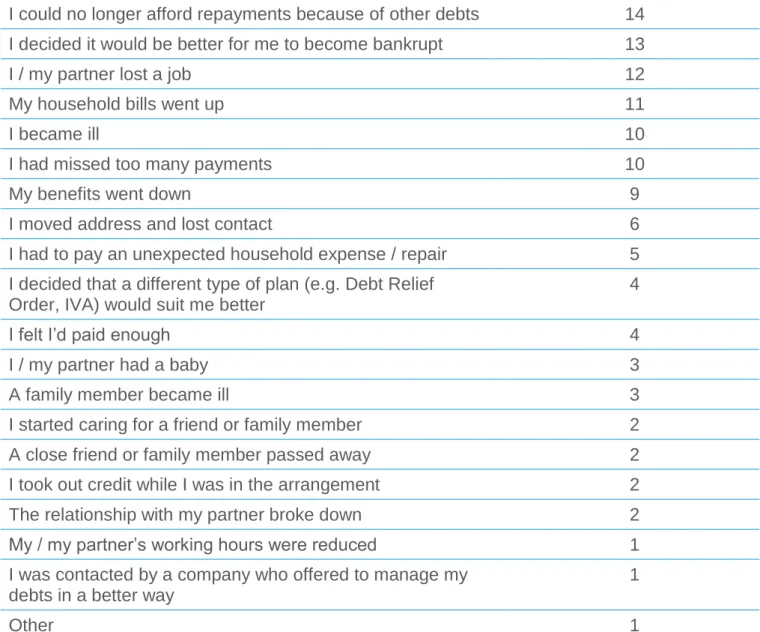
The most common reasons given for repayment levels going down (reported by 32 per cent of respondents) was as a result of household bills going up. Other reasons
included losing a job or reduced working hours, becoming ill, having to pay for an unexpected household expense or repay other debts (Table 6).
Per cent
My households bills went up 32 I could no longer afford my regular payments because of
other debts
16
I / my partner lost a job 16 I had to pay an unexpected household expense / repair 14
I became ill 12
My / my partner’s working hours were reduced 11 My benefits went down 10 The relationship with my partner broke down 10 I / my partner had a baby 9 A family member became ill 7 I started caring for a friend / family member 6 A close friend / family member passed away 3
Other 6
Base: Respondents who repayment amounts went down (140)
Where participants in the in-depth interviews had experienced a negative change in circumstances, there appears to be little that they could have done differently to prepare for or mitigate the impact of these changes. In some instances it might have made a difference if there had been more effective support from DMCs, in terms of payment holidays, adjustments to repayments, or advice about other options. It may also have made a difference if interviewees had made greater use of advice agencies when circumstances began to get difficult.
3.1.3 Responses by debt management companies to changes in circumstances
From the in-depth interviews there were examples of both good and bad practice by debt management companies in supporting and responding to changes in their customers’ ability to manage debt repayments.
Interviewees with DMPs, with both free and fee-charging providers, reported positive experiences of managing debt repayments as a result of their debt management company responding flexibly to changes in circumstances (both positive and negative) and accommodating these by altering repayments. For example, a partnered male welcomed the flexibility offered by his free provider that had enabled him to make additional repayments on top of his regular payment when he could afford to do so. A single female described the helpful attitude of her free provider, as compared to her creditors, as:
‘it was like chalk and cheese, the chalk being [bank] and the cheese being the debt company saying, yes we are here to help you, we’ll go at your pace, we’ll take what you can afford, and if you can pay more if things change we’ll go with you.’
There was one example where an interviewee with a DAS had used the provision within the scheme to take a payment holiday after having a heart attack and being off work for several months. He felt this had been extremely helpful:
‘They stopped the agreement for four months, which was a godsend, you know, because I didn’t know how I was going to be able to pay the DMP, you know, CCCS over the phone spoke to me and said look don’t worry, you know we can cancel these payments for four months until you get back on your feet again … But it just took so much stress off me.’
(Single male, 49, DAS)
Not all providers responded flexibly to changes in the circumstances of their customers. An example was a partnered male with a fee-charging DMP who, after having his
working hours cut, had difficulty managing his repayments. The situation was made worse by the DMC who increased his monthly repayment without any discussion of the changes in his circumstances. As a consequence, and despite significantly cutting back household spending, he had resorted to taking out payday loans to cover everyday expenditure, a course of action that was not, in the long run, sustainable. In spite of the difficulty he had experienced in managing repayments, he remained committed to repaying his debts:
‘I want to pay people back, you know, it’s not as if I’m not wanting to pay them. It’s just going to take longer; if it takes me to the day I die I’ll pay them back. I’m just wanting time you know, a payment that I can handle, without any of these hidden fees that I’ve paid, you know.’
(Partnered male, 50, fee-charging DMP)
3.1.4 Size of debt
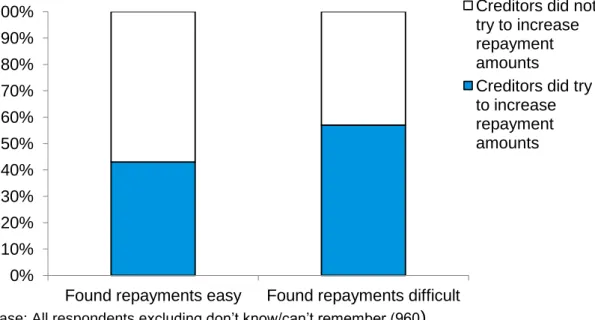
Analysis of the survey data showed that size of debt was significantly associated with whether respondents found it easy or not to keep up their repayments (Figure 2). Respondents who owed their creditors £2,000 or less, were most likely to say that they found it very easy to make repayments (33 per cent) and were least likely to have found it difficult. Those with debts of more than £15,000 were most likely to say they found making payments fairly difficult (29 per cent) or very difficult (seven per cent). This is discussed further in Chapter 4.
Base: All respondents excluding don’t know (987).
The survey data also showed a significant association between ease of repayment and payment method. Most respondents made their repayments on a monthly basis (84 per cent) using either a direct debit or standing order (84 per cent). These respondents were significantly more likely to say that they found it easy to manage repayments (73 per cent) compared to those who made non-automated payments (62 per cent) by cheque, cash, via PayPoint or through their bank.
There are two likely explanations for this. Firstly, respondents with automatic payments found repayments convenient and easy from a practical perspective because once set up they would not have to do anything else, other than ensure they had sufficient money in their bank account. Secondly, it is well documented that many low income
households avoid automatic payment methods such as direct debits to give them greater control over their finances so that they can ensure that they have sufficient funds in their bank account before any payments are made (Hartfree, 2010; Nice, 2010). Paying bills and other payments manually avoids the risk of incurring costly bank charges if
automatic payments leave accounts when there are insufficient funds. Thus, this association between the ease of repayment and payment method may be reflecting the more constrained financial circumstances of respondents who prefer not to make automated repayments.
3.2 Missed payments
The survey showed that the majority of respondents (73 per cent) had not missed any of their regular repayments. Eleven per cent had sought prior agreement with either
creditors or the debt management company, with 16 per cent who had not received authorisation for missing a payment.
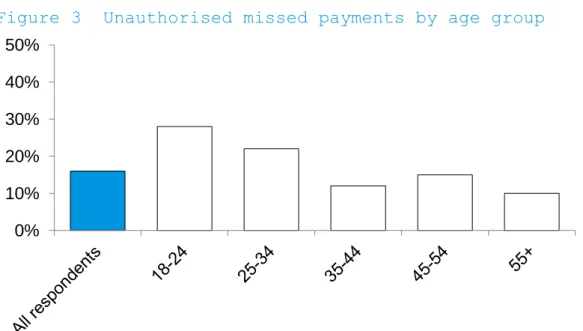
Age was significantly associated with unauthorised missed payments (Figure 3). Younger age groups were more likely to have missed payments compared to
respondents aged 35 and over, with the highest rate of unauthorised missed payments
0% 10% 20% 30% 40% 50% 60% 70% 80% 90% 100% Up to £2,000 £2,001 - £5,000 £5,001 - £10,000 £10,001 - £15,000 More than £15,000 Very difficult Fairly difficult Fairly easy Very easy
amongst 18 to 24 year olds (28 per cent). Regression analysis also identified age as a significant predictor of whether respondents missed a payment without authorisation – younger age groups had a higher likelihood of missed payments (see Appendix 2 for further details). This association between age and missed payments could reflect a higher motivation amongst older people to make repayments, or greater financial resources.
Figure 3 Unauthorised missed payments by age group
The survey analysis also showed that respondents who always made repayments
through manual methods had a higher overall rate of unauthorised missed payments (24 per cent), compared to those who made automatic repayments (14 per cent).
Only one participant in the in-depth interviews had missed a repayment without prior agreement. This was as a result of them having an emergency six week stay in hospital. During this time payments were not being made because they were usually paid
manually. The outcome was that the DMC cancelled the DMP.
3.3 The use of debt advice agencies
Some interviewees had made use of debt advice agencies when they began to struggle with repayment arrangements, but these were in the minority. Other interviewees who were clearly struggling to maintain their repayments had not sought advice and were not aware of the support and advice available to them, nor where to find it.
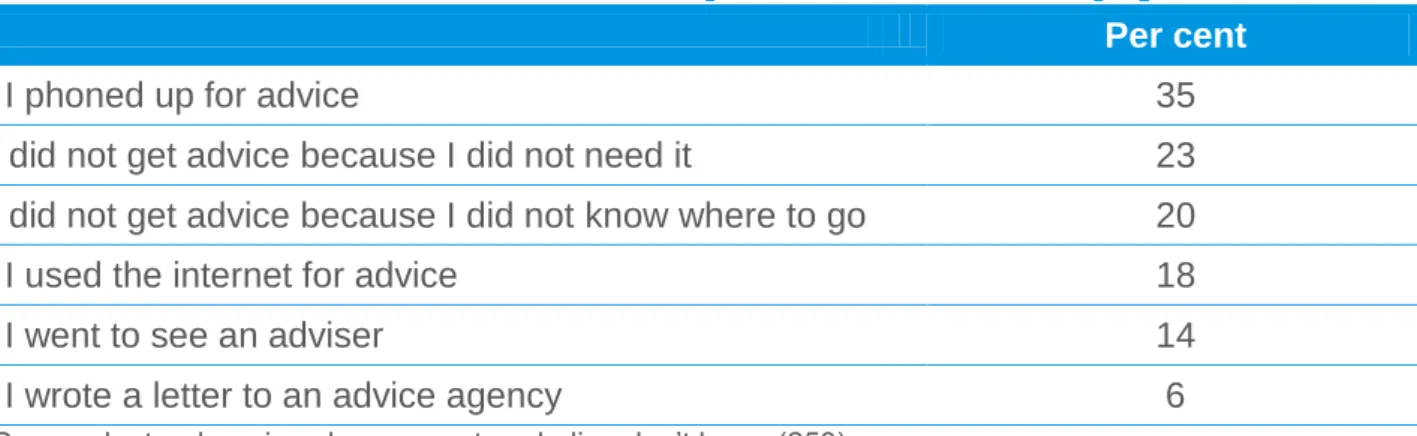
The survey data shows that just under half of respondents who missed a payment got advice from a debt advice agency (44 per cent). Table 7 shows the reasons why respondents said they did not get advice and the channels used by those who did seek advice.
Participants in the in-depth interviews who had contacted debt advice agencies, including CAB, CCCS and local authority based services, reported a range of experiences. Some interviewees had very positive experiences of debt advice and support in seeking alternative debt solutions and completing detailed budgets, while others had felt ‘ashamed’ of decisions they had made regarding their debts.
0% 10% 20% 30% 40% 50%
Table 7 Use of debt advice when respondents missed a payment
Per cent
Yes, I phoned up for advice 35 No, I did not get advice because I did not need it 23 No, I did not get advice because I did not know where to go 20 Yes, I used the internet for advice 18 Yes, I went to see an adviser 14 Yes, I wrote a letter to an advice agency 6
Base: Respondents who missed a payment excluding don’t know (253)
3.4 On-going contact with debt management
companies
Participants in the in-depth interviews who had DMPs with fee-charging DMCs reported mixed experiences of contact with companies. Some had received monthly statements of payments made or phone calls informing them that their creditors had been paid. This contact from DMCs was seen positively in contrast with previous contact from creditors. However, interviewees with fee-charging DMPs also reported that the information that they received lacked clarity, particularly in relation to how much they still owed and what proportion of their payment was being taken as a fee. Others had not received any information from their DMC since taking out their arrangement.
Overall, these interviewees were unaware of: how much was still owed to creditors; the proportion of monthly repayments going to each creditor; and how long was left in their arrangement. Interviewees who expressed frustration at the lack of information from DMCs were generally in agreement that the actions of DMCs were disempowering and they felt no greater control over their financial circumstances than prior to entering the arrangement. Motivation to continue their repayments was undermined by a lack of regular, clear information about current debt levels. There was also a feeling that the fees charged by DMCs did not represent good value for money and that companies were doing little to justify charging a fee. As a female lone parent noted:
‘They don’t really do anything, I mean they did initially obviously because they contacted all the creditors and sorted this plan out, but after that point they’ve not really done anything else other than send me a statement every month.’ (Lone parent female, 37, fee-charging DMP)
Only one interviewee had a DAS with a fee-charging DMC. In comparison they reported a far more positive experience than those with fee-charging DMPs. They had received regular statements from the company showing how much had been paid off and they were very satisfied with the service received from the company. They did, however, note that: ‘for £100 you’d expect their service to be good’.
Interviewees who had free-to-client DMPs and DAS had more positive experiences of contact with DMCs than those in fee-charging arrangements. All reported effective and regular communication through monthly and annual statements. This was seen as