© 2012 Elsevier B.V. All rights reserved
Use of a distributed simulation environment for
training in Supply Chain decision making
Javier Silvente, Miguel Zamarripa and Antonio Espuña
Chemical Engineering Department, Universitat Politècnica de Catalunya, ETSEIB. Av. Diagonal 647, 08028 Barcelona, Spain.
Abstract
Tactical and Operational decision making requires considering a large amount of data, which must be properly stored and interpreted. In this context, an on-line information system has been developed to allow the integration of real time reactive tools, which can constitute a useful operator support in the event of process and/or scenario disturbances. The use of this integrated system as a training tool over a simulated Supply Chain scenario has proved to help the Process Systems Engineering students to improve the information comprehension capabilities, as well as to enhance the way they apply their knowledge to plant and process optimization.
Keywords: Supply Chain Management, dynamic models simulation, web-based
simulation.
1.
Introduction
With the main objective of improving process profitability, the chemical engineer is usually responsible for the continuous development of new processes, products and techniques. Nowadays, this role is usually based on the extensive use of computer simulation and computer control techniques, but on the background of the currently available tools, the very basic function of analysing and interpreting data, what means using all the available information for decision making and adapting this information for a qualitative assessment, is still relying on the human capabilities. In chemical companies, design issues, planning, coordination, cooperation and attention to customer demands are essential to ensure the viability of the company, and should be addressed while simultaneously respecting realistic constraints and rules raise by economic, environmental, social, political, ethical, health and safety, manufacturing and sustainability considerations, including the use of techniques, skills, and modern engineering tools necessary for engineering practice (Noakes et al., 2011; Accreditation Board for Engineering and Technology, ABET, 2008).
The fluctuation in demand, rising customer expectations, competitive markets and other internal and external company problems reduce the reliability of decisions based on static models. Therefore, it is necessary to develop systems able to capture de dynamics of the process and of the whole Supply Chain. This dynamic behaviour must be coordinated in a systematic way in both operation and planning tasks using Supply Chain Management policies/theories, in order to reduce operating costs, increase the productivity of the supply chain, optimize the environmental impact and reduce the energy consumption.
In this framework, in order to train decision making competences, different teaching modules have been developed to help chemical engineering students to understand how to operate a process within a chemical Supply Chain (Bessiris et al., 2011). Students are involved in the decision making processes at different hierarchical levels in cooperative and competitive environments (Zamarripa et al., 2011). This system, which provides a realistic training environment, consists of several data generators, an information repository and several customer interfaces associated to the different roles and positions within the decision making hierarchy.
The introduction of these skills allows students to increase not only their knowledge in tools for modelling, planning, control and optimization of a variety process under constraints and objectives, but also to be introduced to industrial systems and global simulation schemes. This knowledge reflects the current technology and emphasizes process operations and enterprise planning. In other words, this system pretends to connect students with real world. In addition, this methodology provides new views of the Chemical Engineer management roles in complex / hybrid environments.
Therefore, this paper describes the use of this approach to conduct the optimization of a SC network (several plants, raw materials, storage centers, and managing the residues of the plants) using the SCM techniques (tactical and operational decisions) by acquiring integrated information in real time, using dynamic optimization models and tools, including modeling issues like objective function decisions, the different ways of introducing practical constraints and the way of using this support tools to face fluctuations in the SC demand. For this application, a case study based on a polystyrene manufacturing plant has been developed, which takes into account the production of styrene and the management of related services (like wastewater generation).
2.
Methodology
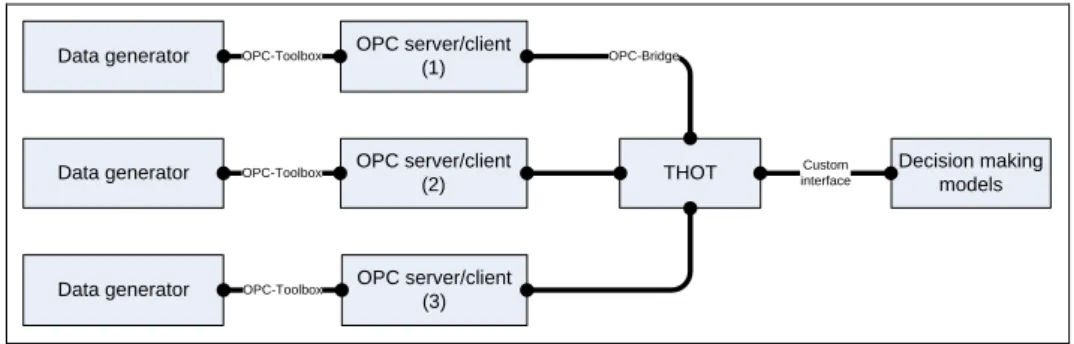
In order to organize all the information available about the process, it has been proposed a system that consists of the following components: a data generator (real or virtual plants), an information repository, a customer interface and a diagnosis module, all of them following a basic model prescribed by ISA standards specification. Figure 1 shows a scheme of the proposed system.
Data generator Data generator Data generator OPC server/client (1) OPC server/client (2) OPC server/client (3) THOT OPC-Bridge Decision making models Custom interface OPC-Toolbox OPC-Toolbox OPC-Toolbox
Figure 1: Proposed system.
Simulation modules representing the several involved production facilities have been developed using general purpose and specific tools (Hysys/Matlab/Simulink). The simulation system provides real-time information (simulated measurements) that is
written and read through the different user interfaces, including all the variables required to describe the process.
The Object Linking and Embedding for Process Control (OPC) standard is used to communicate and distribute the data generated by the simulators. This selection is based on current and commercial practice and tools, permitting the definition of a standard set of objects, interfaces and methods to be used in process control and automated manufacturing applications in order to facilitate interoperability (Soudani et al., 2002). A platform for real-time management and decision making support at the different production levels has been also designed. This platform is based on an information repository, acts as a database of all information of the different processes and plays an important role by sending the appropriate information to the different information clients, where it will be filtered by the customer interface.
Finally, several customer interfaces have been designed and run as Web applications, using applets to graphically display the information that comes from the process simulations. This application is helpful to visualize and understand the evolution of the process and also to understand the decision making consequences.
The purpose of this application is not only academic but also industrial, through the implementation of this open source software in the industry. The system is being evaluated using both educational and industrial feedback. The training process involves also the collaboration with different departments, since it is open to the integration of other topics in the same framework, such as logistics or management.
3.
Supply Chain Management Application and Discussion
In the area of process decision making and optimization, numerous applications can be used for decision making management and business productivity improvement. The application developed around the decisions associated to a Supply Chain (SC) design and management is described.
This specific proposal is based on a polystyrene manufacturing plant: the polymer production system has been simulated to generate both, the dynamic data related to the polystyrene production itself, and its demand forecasting. This production involves the generation of wastewater, so the corresponding treatment process has also been simulated. The choice of the wastewater treatment depends on water pollution and the cost of treatment. The simulation also involves the generation and consumption of energy for this production site. With this integrated system, students will expand their knowledge of industrial process integration.
The SCM system takes into account installation decisions (such as production plants, warehouses, equipment units and production technologies), inventory levels, production plants, distribution and raw material purchases, among other factors.
The students, assigned to different roles, are expected to exploit the use of optimization and simulation tools to enhance the decision-making problems, solving production planning problems (SC planning, which takes the decisions of the optimal production, stock and distribution levels, given production plants, warehouses, distribution centers
and customers). In most cases, the resulting optimization problems can be considered as a hybrid optimizations because the solution approach should be solved as follows:
First of all, the planning problem is to be solved, for a time horizon of months. This time horizon is too high compared with the simulation time, which is about hours, minutes or seconds, but this is the time indicated in the literature (Sung et al., 2007) to solve the problem of production planning (2-12 months). The optimal master recipe is introduced into the simulation. In other words, taking the decisions made in the previous problem, these data are introduced as set points for the simulation of the plant.
In the simulation of a production plant, data from master recipe are introduced into the system, and the problem is optimized in the lowest level (scheduling level), controlling different variables of the plant to reach production levels proposed by the planning problem. This optimization is performed by adjusting the parameters of the dynamic model, optimizing different criteria (such as environmental impact and energetic costs).
In addition, the system generates faults and external events that should be detected and solved. In some cases, these events should be propagated event to the master plan.
With the availability to get data using the proposed methodology, the simulator will compile all available data to validate the optimization problem.
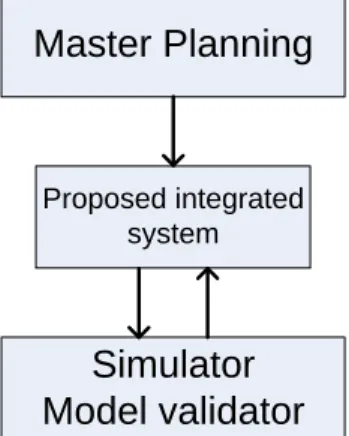
Figure 2 shows the connection between the master planning and the simulator block:
Master Planning
Simulator
Model validator
Proposed integrated system
Figure 2: Connection between the master planning and the simulator.
The use of this and other case studies not only helps students to understand the operational conditions of the production plant, but also to understand the dynamics associated to external fluctuations. One of these fluctuations is associated to the changes in the expected, which determine, for example, the production and the acquisition of raw material and resources. Moreover, students will become familiar the presence of several supply chains in a competitive environment, understanding the market situation.
4.
Conclusions
This work introduces the use of integrated information systems in the training scenario in order to enhance competences in the area of exploitation of on-line available data for decision making. This system is addressed to students, with the objective of increasing
their knowledge in modeling, planning, process control, simulation and optimization of industrial systems, although the application has been developed for both academic and industrial purposes.
These tools are useful to understand current technology and process and planning operations, which make the students feel their learning contextualized on his future work as Chemical Engineers, offering additional opportunities to enhance their professional competences.
Departing from the developed system, new challenges can be addresses, including the fault analysis and eventual closed-loop automatic decision making.
References
1. Noakes, N.; Chow, C.C.L.; Ko, E.; McKay, G. Safety education for chemical engineering students in Hong Kong: Development of HAZOP Study teaching module. Education for Chemical Engineers, 2011, 31-55.
2. Annual Chemical Engineering ABET Report for 2007-2008, http://www.abet.org 3. Bessiris, Y.; Kyriakopoulou, D.; Ghajar, F.; Steuckrath, C. Long Distance
Operator Training. 21st European Symposium on Computer Aided Process Engineering, 2011, 1115-1119.
4. Zamarripa, M.; Aguirre, A.; Méndez, C.; Espuña, A. Improving supply chain management in a competitive environment. 21st European Symposium on Computer Aided Process Engineering, 2011, 1000-1005.
5. Soudani, A.; Nasri, S.; Divoux, T. QoS and network resources management for communication in distributed manufacturing processes. Computers and Industry, 2002, 253-267.
6. Sung, C.; Maravelias, C.T. An attainable region approach for production planning of multiproduct processes. AIChE Journal, 2007, 53, 1298-1315.
Acknowledgements
Authors would like to thank the Ministerio Español de Ciencia e Innovación and the European Regional Development Fund, both supporting the present research under the Project EHMAN (DPI2009-09386). We also appreciate the financial support from Ministerio de Ciencia e Innovación (Subprograma de Formación de Personal Investigador, BES-2010-036099) and from the Mexican Consejo Nacional de Ciencia y Tecnología (CONACyT).