1
The Concept of the Effective Mass Tensor in GR
The Equation of Motion
Mirosław J. Kubiak
Zespół Szkół Technicznych, Grudziądz, Poland
Abstract: In the papers [1, 2] we presented the concept of the effective mass tensor (EMT) in
General Relativity (GR). According to this concept under the influence of the gravitational field the bare mass tensor
m
µνbare becomes the EMT mµν. The concept of the EMT is a new physical interpretation of GR, where the curvature of space-time has been replaced by the EMT.In this paper we consider again the concept of the EMT in the GR but in the aspect of the equa-tion of moequa-tion.
keywords: the effective mass tensor, the equation of motion, Mach’s principle
I. Introduction
In the papers [1, 2] we presented the concept of the effective mass tensor (EMT) in General Relativity (GR). According to this concept under the influence of the gravitational field the bare mass tensor
bare
m
µν becomes the EMT mµν (see Table I). The concept of the EMT is a new physical interpretationof GR, where the curvature of space-time has been replaced by the EMT.
In this paper we again consider the concept of the EMT in the but in the aspect of the equation of mo-tion. In the Table I we compared a few physical features concerning of the space-time curvature with the physical features of the EMT which were discussed in this paper.
As we know from the [1, 2] the metric tensor gµν we can express by the EMT mµν
m
m
g
µν=
µν (1)where: m is the bare mass of the body, the space-time components µ, ν = 0, 1, 2, 3. Therefore the metric
( )
g
µνds
( )
m
µν2
where:
ds
2( )
g
µν=
g
µνdx
µdx
ν and( )
µν µν dxµdxν mm m
ds2 = .
II. The equation of motion
Let us consider the Lagrangian function for the free body in the curved space, which is moving with the small velocity
τ
µ
d dx
(
τ
µ
d dx
<< c), where c is the speed of the light,
τ
is the proper time.τ
τ
ν µ µν
d
dx
d
dx
g
m
L
=
⋅
2
1
(3) If we replace in the eq. (3) the metric tensor gµν with the EMT mµν (see eq. (1)) then we have
τ
τ
ν µ µν
d
dx
d
dx
m
L
2
1
=
(4)The equation of motion for the Lagrangian function (4) have the form (see Appendix)
0
22
=
Γ
+
τ
τ
τ
ν µ β µν β
d
dx
d
dx
d
x
d
*(5) where the term
Γ
µν*β we will call the modified Christoffel symbols of the second kind and
∂
∂
−
∂
∂
+
∂
∂
=
Γ
αµνµ αν ν
αµ βα β
µν
x
m
x
m
x
m
m
2
1
*(6)
In the weak gravitational field we can decompose of the EMT of the body to the simple form: *
µν µν
µν
m
m
m
=
bare+
, where:m
µνbare=
m
⋅
η
µν=
diag(
−
m
,
+
m
,
+
m
,
+
m
)
we will call the bare massten-sor,
η
µν is the Minkowski tensor,m
*µν=
m
⋅
h
µν<<
1
is a small EMT “perturbation” [1] (see also to Table I). Note that in the absence of the gravitational field the EMT becomes the bare mass tensorbare
m
m
µν→
µν . TheΓ
µν*β describes the anisotropy of the EMT. For the bare mass tensorm
bareµν the0
=
Γ
βµν* .
The modified Christoffel symbols (6) (with accuracy to first order) have the form *
00 *
00
2
1
m
j ij i=
∂
Γ
δ
(7)(components i and j are the Roman indices to denote spatial components: i, j = 1, 2, 3) and similarly
(
*)
0 *
0 *
0
2
1
j k k j ik i
j
=
−
∂
m
−
∂
m
Γ
δ
(8)3
(
)
dt
dx
m
m
c
m
c
dt
x
d
jj k k j ik j
ij i
* 0 *
0 *
00 2
2 2
2
1
2
1
∂
−
∂
+
∂
−
=
δ
δ
(9)where we omitted the term
∂
0m
*µν . Now we can interpret this equation in the Newtonian language. The second right term in the eq. (9) is velocity-dependent and is associated with the rotation and theCoriolis acceleration. Let’s assume that the body is not rotate and *0
0
*0
−
∂
=
∂
jm
k km
j . Motion of the body in a weak gravitational field is described by the equation* 00 2
2 2
2
1
m
c
dt
x
d
j ij i
∂
−
=
δ
(10)According to the eq. (10) we can say that the gradient of the time component of the EMT –
∂
jm
00* determines the acceleration 22
dt x
d i
of the tested body in the gravitational field. If the
∂
jm
*00≠
0
(theEMT mµν is an anisotropic1 and
m
µν≠
m
µνbare) then the tested body is moving with an acceleration 02 2
≠
dt x
d i
. But if the
∂
jm
*00=
0
(the EMT mµν is an isotropic andm
µν=
m
bareµν ) then the accelera-tion of the body 2 02 =
dt x
d i
and the test body move takes place at a constant velocity. Eq. (10) deter-mines the first Newton’s law of motion in the EMT framework.
Of course we must remember that our consideration we used for a weak gravitational field in the New-tonian approximation. The more generally condition
Γ
µν*β=
0
in eq. (5) determines the first Newton’s law of motion in EMT framework and is more precise.In the classical mechanics the Newtonian equation of motion have the form
V
dt
x
d
i−∇
=
2 2
(11) where: V is the Newtonian gravitational potential of the source. Both eq. (10) and (11) are equivalent if and only if the time component of the EMT takes the form
r
c
GM
c
V
m
00*=
2
2=
2
2 (12)We can see that the concept of the EMT correctly describes gravitational phenomena in the Newton's law of gravity.
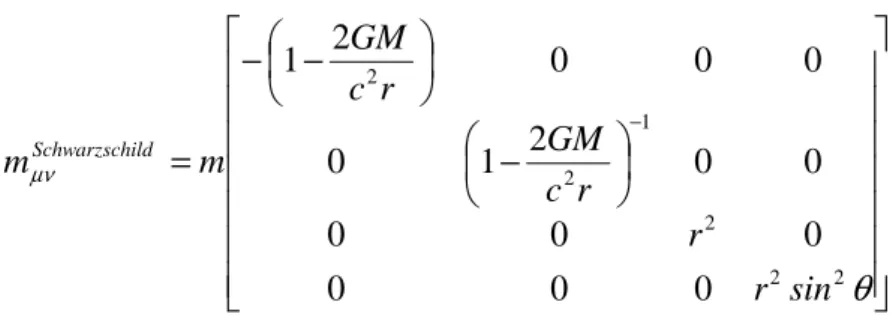
Let us consider the Lagrangian function (eq. (4)) with the Schwarzschild EMT (the EMT in the Schwarzschild metric)
1 The EMT is isotropic if and only if his properties do not depend on the directions in the space-time [2]. So far,
the concept of the mass isotropy was associated only with the 3-dimensional space but not with the 4-dimensional space-time. It is a new paradigm.
4
−
−
−
=
−
θ
µν
2 2 2 1 2 2
0
0
0
0
0
0
0
0
2
1
0
0
0
0
2
1
sin
r
r
r
c
GM
r
c
GM
m
m
Schwarzschild (13)Well known calculations satisfy the classical tests of GR – for example: the perihelion shift, the
de-flection of light by the Sun and the gravitational redshift, but their physical interpretation is different.
The concept of the EMT correctly describes gravitational phenomena known from GR but these phys-ical phenomena are not generated by the curvature of the space-time, but by the effective mass tensor of the body.
Let’s compare a few physical features concerning of the space-time curvature with the physical fea-tures of the EMT discussed in this paper. Results of comparison are presented in Table I below. Table I. The space-time curvature vs. the EMT.
Space-time curvature The EMT
The metric tensor
µν
g
The effective mass tensor µν
µν
m
g
m
=
⋅
The metric
( )
µ νµν
µν
g
dx
dx
g
ds
2=
The metric
( )
µν µ νµν dx dx
m m m
ds2 =
Decomposition of the metric tensor in the weak gravitational field
µν µν
µν
η
h
g
=
+
where:
η
µν = diag(-1, +1, +1, +1) is the Minkow-ski tensor,h
µν<<
1
is a small “perturbation”.Decomposition of the EMT tensor in the weak gravitational field
*
µν µν
µν
m
m
m
=
bare+
where:
m
µνbare=
m
⋅
η
µν=
diag(-m, +m, +m, +m) is the bare mass tensor,m
*µν=
m
⋅
h
µν<<
1
is a small EMT “perturbation”.Lagrangian:
τ
τ
ν µ µν
d
dx
d
dx
g
m
L
=
⋅
2
1
Lagrangian:
τ
τ
ν µ µν
d
dx
d
dx
m
L
2
1
5
The equation of motion (m = 1):
0
2 2=
Γ
+
τ
τ
τ
ν µ β µν βd
dx
d
dx
d
x
d
where the term
Γ
µνβ is the Christoffel symbols and
∂
∂
−
∂
∂
+
∂
∂
=
Γ
µναµ αν ν αµ βα β µν
x
g
x
g
x
g
g
2
1
The equation of motion:
0
2 2=
Γ
+
τ
τ
τ
ν µ β µν βd
dx
d
dx
d
x
d
*where the term
Γ
µν*β we will call the modifiedChristoffel symbols and
∂
∂
−
∂
∂
+
∂
∂
=
Γ
µναµ αν ν αµ βα β µν
x
m
x
m
x
m
m
2
1
*Equation of motion in the Newtonian limit
V
h
c
dt
r
d
jij
∂
=
−∇
−
=
00 2 2 22
1
δ
Equation of motion in the Newtonian limit
V
m
c
dt
d
jij
∂
=
−∇
−
=
* 00 2 2 22
1
r
δ
III. The Foucault's pendulum
There are two different ways of measuring the Earth’s rotation about its polar axis. The first one is astronomical method where we can determine Earth's rotation with respect to the background of dis-tant stars. The second method is dynamically method where Earth's rotation we can determine by means of Foucault's pendulum or the gyroscope. Both methods have the same results. The first method describes Earth’s rotation with respect to the fixed stars. The second one with respect to the absolute space. Is it important coincidence or not? According to E. Mach this coincidence is not trivial and only the mass rotation
(
∂
jm
*0k−
∂
km
0*j)
in equation (8) changes the plane of Foucault's pendulum.IV. Mach’s Principle
Eq. (5) we can rewrite in a slightly different form
0 2 2 = Γ +
τ
τ
τ
ν µ βµν ν βν d dx d dx d x dm * (14)
where the term
Γ
*βµν we will call the modified Christoffel symbols of the first kind expressed by the formula
∂
∂
−
∂
∂
+
∂
∂
=
Γ
µνβν βµ µ βν βµν
x
m
x
m
x
m
*2
1
(15)Now the motion of the body in the gravitational field is described by two interesting expressions: 2 2
τ
ν βν d x dm and
τ
τ
ν µ βµν d dx d dx *Γ . The first term 2
2
τ
ν βν d x dm describes the four–force, where: mβν is the
EMT, 2
2
τ
ν d x d6
second term
Γ
*βµν describes “the four-gradient” of the EMT. Dimension of this term is [kg/m]. While the termτ
τ
ν µ βµν
d dx d dx
*
Γ describes “the four-gradient” of the EMT and four-velocities of the effective masses. Dimension of this term is [N ].
According to eq. (14) we can say that
the effective mass of the body is not an intrinsic property but is a result of interactions between this body and the effective mass other bodies in the Universe.
This is Mach’s Principle in a new sound.
V. Conclusion
In this paper we considered the concept of the EMT in the aspect of the equation of the motion. According to this concept under the influence of the gravitational field the bare mass tensor becomes the EMT. The concept of the EMT is a new physical interpretation of GR, where the curvature of space-time has been replaced by the EMT.
Analyzing the Lagrangian function (4) and the equation of motion (5) we see that: in a weak gravita-tional field the Lagrangian function and the equations of motion for the body with the mass m moving in the space-time curvature with the metric tensor gµν are the same like the Lagrangian function and the equations of motion for the body moving with the EMT mµν in the flat Minkowski space-time. Both descriptions are equivalent (see Table I). In the Newtonian limit the equation of motion (5) gives the equation (11) well known from classical mechanics.
Notice that the motion of the bodies we describe relative to other bodies with the effective or bare mass, but not to the respect to the massless reference frames.
The concept of the EMT is a very attractive because the equation of the motion (5) includes full in-formation about all fields (in this case a weak gravitational field) surrounding the body without their exact analysis. The EMT can be isotropic or anisotropic. Us we known from the solid-state physics the EMT can be positive or negative. Is a negative effective mass can exist in a Universe? It is a very im-portant question.
The concept of the EMT offers Mach’s Principle in a new sound: the effective mass of the body is not an intrinsic property but is a result of interactions between this body and the effective mass other bodies in the Universe.
We believe that the concept of the EMT will help better understand a fascinating gravitational phe-nomena.
Appendix
Let us consider the Lagrangian function with the EMT
m
µν( )
x
β( )
τ
µτ
νβ µν
d dx d dx x m L
2 1
7 The Euler – Lagrangian equations has the form
( )
=0∂ ∂ −
∂
∂
β β
τ
τ
xL
d dx
L d
d (A2)
After well-known calculation we get the equation of motion (5). If EMT mµν does not depends on coordinate xβthen
( )
=0
∂
∂
τ
τ
βd dx
L d
d (A3)
which implies that
( )
dt dx
L β
∂ ∂
is a constant. But
( )
τ
τ
ν µν β
d dx m d dx
L
= ∂
∂
, so we have that the four-momentum pµ is constant. Thus, we obtained a very important relationship between four-momentum
µ
p and EMT mµν and
τ
ν µν µ
d dx m
p = (A4)
Note that this relationship is something different than in GR, where mass is a scalar. Using eq. (A4) we can rewrite eq. (14) in a more general form
0
* =
Γ +
τ
τ
τ
ν µ βµν β
d dx d dx d
dp
(A5)
where:
τ
ν βν β
d dx m
p = is the four-momentum.
Differentiating the four-momentum in eq. (A5) with respect to
τ
d d
we obtain
0 *
2 2
= Γ
+ +
τ
τ
τ
τ
τ
ν µ βµν ν βν ν
βν
d dx d dx d
dx d dm d
x d
m (A6)
Although the mass does not exist explicit in eq. (5) but plays a very important role in the eq. (A6). If we assume that =0
τ
βν d dm
then eq. (A6) becomes the eq. (14). References
[1].M. J. Kubiak, The Concept of the Effective Mass Tensor in the General Relativity,
http://vixra.org/abs/1301.0060 .
[2].M. J. Kubiak, The Concept of the Effective Mass Tensor in GR. Clocks and Rods,