MAGNETORECEPTION AND ITS NEURAL BASIS IN SPINY LOBSTERS
David A. Ernst
A dissertation submitted to the faculty of the University of North Carolina at Chapel Hill in partial fulfillment of the requirements for the degree of Doctor of Philosophy in the
Department of Biology (Evolution, Ecology, and Organismal Biology).
Chapel Hill 2018
Approved by:
Kenneth J. Lohmann
Sönke Johnsen
William M. Kier
Karin S. Pfennig
ii
iii ABSTRACT
David A. Ernst: Magnetoreception and Its Neural Basis in Spiny Lobsters (Under the direction of Kenneth J. Lohmann)
The research presented here investigates magnetoreception (the ability to detect
Earth’s magnetic field) and its underlying mechanisms in the Caribbean spiny lobster,
Panulirus argus. Spiny lobsters are the only invertebrates known to detect and use directional and positional information from Earth’s magnetic field. Despite decades of research, we still
do not know how lobsters, or indeed any animals, are able to perceive magnetic fields. To
shed light on this elusive sensory modality, I examine the behavioral and transcriptomic
responses of lobsters to strong magnetic stimuli.
Behavioral studies revealed that lobsters actively avoid dens with a strong magnetic
anomaly and that lobster size is a predictor of avoidance behavior. On average, lobsters that
chose dens with the anomaly were significantly smaller than those that chose dens with a
non-magnetic weight. These findings are consistent with magnetoreception in lobsters,
suggest ontogenetic variation in the lobster’s response to magnetic fields, and indicate that
magnetic anomalies might affect the movements of lobsters and other animals in the natural
environment.
In additional behavioral studies testing the ‘magnetite hypothesis’ of
magnetoreception, lobsters were subjected to a strong magnetic pulse (a stimulus thought to
iv
their subsequent orientation was tested. In contrast to controls, lobsters exposed to the pulse
displayed directed orientation, consistent with magnetite-based magnetoreception.
Finally, transcriptomic approaches were used to identify candidate genes associated
with magnetoreception and to determine the effects of a magnetic pulse on the lobster central
nervous system. Hundreds of genes were differentially expressed throughout the nervous
system in response to the pulse, many of which were associated with iron regulation and the
oxidative effects of free iron on cells. These findings are consistent with the hypothesis that
iron-based magnetoreceptors in the lobster central nervous system are disrupted or damaged
by pulse magnetization. Furthermore, genes linked to diverse biological functions that are
likely not linked to magnetoreceptors showed altered expression, suggesting that the pulse
treatment had a significant impact on neural physiology. Together, these findings provide
novel and significant insights into the mechanisms underlying magnetoreception and the
v
ACKNOWLEDGEMENTS
Numerous people have provided me with a great deal of support throughout my time
in graduate school. I would first like to thank my advisor, Ken Lohmann, for his guidance
over the years and for allowing me to pursue many new research directions that interested
me. I am especially grateful for all he has taught me, which has undoubtedly made me a
better writer, critical thinker, and scientist. I am grateful to the members of the Lohmann lab
(both past and present), including Nathan Putman, Courtney Endres, Dave Steinberg,
Vanessa Bézy, Lewis Naisbett-Jones, Kayla Goforth, John Haught, and especially Roger
Brothers, for their suggestions on manuscripts, experimental design, help with field work,
and for making the Lohmann lab an enjoyable environment. I am also particularly
appreciative of Bob Fitak’s guidance and patience while I wrestled with transcriptomics and
various bioinformatics analyses. I am indebted to Charles Derby and Manfred Schmidt for
welcoming me into their lab and for their assistance with nervous tissue dissections. I would
like to thank my committee, Sönke Johnsen, Bill Kier, Catherine Lohmann, and Karin
Pfennig, as well as Haven Wiley, for their many helpful comments and suggestions that
certainly made my research much stronger than it would have been otherwise. Finally, I am
grateful for the encouragement of my family and especially the unconditional support of my
vi
TABLE OF CONTENTS
LIST OF TABLES ...x
LIST OF FIGURES ... xi
CHAPTER I: INTRODUCTION ...1
Figures...10
References ...11
CHAPTER II: SIZE-DEPENDENT AVOIDANCE OF A STRONG MAGNETIC ANOMALY IN CARIBBEAN SPINY LOBSTERS ...16
Introduction ...16
Materials and Methods ...18
Animal collection and holding tanks...18
Experimental arena ...19
Preference test ...20
Results ...21
Discussion ...21
What field component(s) do lobsters detect? ...22
Why avoid dens with magnets? ...22
Size-dependent magnetic field avoidance ...23
Natural anomalies versus magnet anomalies ...24
Responses of animals to magnets ...25
vii
Tables ...26
Figures...27
References ...33
CHAPTER III: EFFECT OF MAGNETIC PULSES ON CARIBBEAN SPINY LOBSTERS: IMPLICATIONS FOR MAGNETORECEPTION ...37
Introduction ...37
Materials and Methods ...39
Animals ...39
Magnetic pulse protocol ...40
Orientation trials ...42
Statistical analysis ...43
Results ...44
Discussion ...44
Effect on magnetic map or magnetic compass? ...45
Magnetoreceptor structure ...47
Acknowledgements ...49
Figures...50
References ...53
CHAPTER IV: DE NOVO ASSEMBLY AND ANNOTATION OF A CARIBBEAN SPINY LOBSTER CENTRAL NERVOUS SYSTEM TRANSCRIPTOME ...58
Introduction ...58
Data Description ...59
Animal collection and maintenance ...59
viii
RNA isolation, library preparation, and Illumina sequencing ...61
De novo transcriptome assembly ...62
Functional annotation and GO classification...63
Data Deposition ...64
Acknowledgements ...64
Tables ...65
Figures...67
References ...68
CHAPTER V: THE EFFECTS OF A MAGNETIC PULSE ON THE SPINY LOBSTER CENTRAL NERVOUS SYSTEM: TRANSCRIPTOMIC INSIGHTS FOR MAGNETORECEPTION MECHANISMS ...71
Introduction ...71
Materials and Methods ...74
Animals ...74
Magnetic pulse treatment ...74
RNA extraction, sequencing, and quality trimming ...75
Differential gene expression analysis ...75
Gene ontology enrichment analyses ...76
Results ...77
Altered genes across all tissues ...77
Effects on the brain ...79
Effects on the subesophageal ganglion ...80
Effects on the thoracic ganglia ...81
ix
Effect on iron regulation ...82
Effect on visual proteins...87
Other effects on gene expression ...88
Electric field effects...91
Conclusions ...91
Acknowledgements ...92
Tables ...93
Figures...102
References ...105
CHAPTER VI: CONCLUSIONS ...112
References ...118
x
LIST OF TABLES
Table 2.1 - Logistic regression model statistics, with carapace length
as a predictor of den choice ...26
Table 4.1 - MIxS descriptors for the study ...65
Table 4.2 - RNA-seq and transcriptome assembly statistics ...66
Table 5.1 - Summary of individual lobster characteristics ...93
Table 5.2 - Summary statistics for raw sequence data by tissue ...94
Table 5.3 - List of top significantly enriched GO terms in each tissue ...95
Table 5.4 - List of top 10 ranked GO terms in response to the magnetic pulse treatment ...97
Table 5.5 - Genes associated with oxidative stress in each tissue ...98
xi
LIST OF FIGURES
Figure 1.1 - Schematics of Earth’s magnetic field ...10
Figure 2.1 - Schematic of the experimental arena ...27
Figure 2.2 - Approximate magnetic field strength experienced by lobsters as a function of distance from the magnet’s surface ...28
Figure 2.3 - Total numbers of lobsters that occupied each den type ...29
Figure 2.4 - Mean carapace length of lobsters that occupied each den type ...30
Figure 2.5 - Den choice across 10 mm carapace length bins ...31
Figure 2.6 - Logistic regression curve showing the relationship between carapace length and den choice ...32
Figure 3.1 - Magnetic pulse treatment ...50
Figure 3.2 - Orientation arena ...51
Figure 3.3 - Lobster orientation trial results ...52
Figure 4.1 - Gene ontology term distribution for the de novo transcriptome assembly ...67
Figure 5.1 - Magnetic and sham pulse treatments ...102
Figure 5.2 - MA plot of the expression level (Mean of Normalized Counts) and ratio (log2FC) for each gene in lobster tissues exposed to a magnetic pulse relative to control tissues ...103
1 CHAPTER I
INTRODUCTION
Movement, in some form, is a necessity of life for most animals. Acquiring food,
avoiding predation, locating mates, and finding suitable habitat all require mobility and are
critical for survival. The scale of movements can vary considerably, but traversing only a few
centimeters can be just as significant for one species as traveling hundreds of kilometers is
for another. Nevertheless, few animals move randomly in space; thus it is typically important
to direct movement to at least some degree for it to be maximally beneficial. Given the varied
ecological settings and life histories that exist in different animal species, it is perhaps not
surprising that no single method of orientation, guidance, or navigation is universally
superior across all environments and conditions. Instead, animals have evolved diverse, and
often awe-inspiring, mechanisms and strategies to guide their movements.
One of the most fascinating and elusive sensory modalities linked to animal
orientation and navigation is magnetoreception, or the ability to detect and extract
information from Earth’s magnetic field. Using Earth’s field is a robust orientation strategy,
as the geomagnetic field is present at virtually every location on Earth and is unaffected by
changing environmental variables (Skiles, 1985). The earth’s field resembles a massive
magnetic dipole, with geomagnetic field lines exiting the earth’s southern hemisphere (at the
magnetic north pole) and reentering the planet in the northern hemisphere (at the magnetic
2
known as the inclination angle (Fig. 1.1B), reaches 90⁰ at the magnetic poles and is parallel
to the earth’s surface (i.e., 0⁰) at the magnetic equator. This characteristic pattern provides
animals that can detect inclination angle with a potential way to approximate latitude
(Lohmann and Lohmann, 1994). Earth’s magnetic field also varies in intensity (Fig. 1.1B)
across the surface of the globe, with stronger field intensities toward the magnetic poles and
weaker fields near the magnetic equator. Because both inclination angle and intensity vary in
a predictable fashion across Earth’s surface, most geographical locations are characterized by
unique combinations of these parameters (Lohmann et al., 2007). These attributes reveal
Earth’s field as a source of both directional (i.e., ‘compass’) and positional (i.e., ‘map’)
information for any animal capable of perceiving it (Johnsen and Lohmann, 2005).
An impressively diverse group of species are capable of magnetoreception, ranging
from relatively simple invertebrate models, such as C. elegans (Vidal-Gadea et al., 2015) and
Drosophila (Gegear et al., 2008), to birds (Wiltschko and Wiltschko, 1972, 2003, 2005), turtles (Lohmann and Lohmann, 1994, 1996; Lohmann et al., 2004), and even mammals
(Begall et al., 2014). Amongst these various taxa, crustaceans have played a critical role in
our understanding of the magnetic sense (Lohmann and Ernst, 2014). Crustaceans comprise
an exceptionally large and diverse group of animals, inhabiting a variety of different
terrestrial and aquatic habitats (Martin and Davis, 2007; Ahyong et al., 2011; Schram, 2012).
Of the known extant ~70,000 species, most are mobile and rely on environmental cues to
orient their movements, whether they are simply traversing a short distance to return to a
burrow after a foraging event (Hughes, 1966; Vannini and Cannicci, 1995; Zeil, 1998) or
undertaking long-distance, offshore migrations (Herrnkind and Kanciruk, 1978;
3
The first studies to find evidence for a magnetic compass sense in crustaceans took
advantage of movements by a marine amphipod (Talitrussaltator) that inhabits Dutch beaches (Arendse, 1978, 1980; Arendse and Kruyswijk, 1981). These amphipods display
orientation along the land-sea axis, tracking the tides to avoid desiccation. Researchers found
that canceling the ambient magnetic field around the amphipods abolished this axial
orientation behavior, and shifting the direction of the field elicited comparable shifts in the
preferred axis. Further work with African amphipods (Talorchestia martensii) found that exposure to a null magnetic field also disrupted this species’ axial movements, resulting in
random orientation (Ugolini and Pardi, 1992) and that the magnetic sense is dominant in the
absence of solar cues (Ugolini et al., 1999; Ugolini, 2001, 2002). Similar results were
observed in the marine isopod Idotea baltica; moreover, these isopods could be trained to associate slope with a magnetic axis (Ugolini and Pezzani, 1995).
The Caribbean spiny lobster, Panulirus argus, has become a promising animal for the investigation of magnetic orientation and navigation behavior. In early work with these
lobsters, Creaser and Travis (1950) investigated their ability to home based on displacements
of up to 8 km from capture sites near Bermuda. Impressively, approximately 20% of
displaced lobsters were recaptured at the original capture sites, including some that had been
released in deep water. These findings indicated an unexpected and extraordinary homing
capability in this species. Indeed, additional studies confirmed that homing is a common and
necessary occurrence for these animals, as lobsters embark on extensive nocturnal foraging
bouts, after which they return to their home area to take refuge in a den before sunrise
4
At the onset of autumn storms, lobsters undertake remarkable mass migrations
offshore (Kanciruk and Herrnkind, 1978; Herrnkind, 1980). During these migrations, lobsters
form single-file queues (sometimes in excess of 65 individuals), with each lobster extending
its antennae anteriorly to maintain contact with the tail of the lobster preceding it.
Intriguingly, queues within the same region typically adopt similar migratory headings
(Herrnkind et al., 1973), even in areas devoid of useful visual cues, suggesting the use of
another cue for orientation. Subsequent research showed that lobsters can detect and use
wave surge for orientation (Walton and Herrnkind, 1977; Nevitt et al., 1995), but even in the
absence of reliable wave surge and visual cues, lobsters were able to establish and maintain
bearings consistent with their migration (Herrnkind, 1970; Herrnkind and McLean, 1971),
suggesting the use of additional orientation cues.
Given that numerous animals take advantage of Earth’s magnetic field for orientation
and navigation (Wiltschko and Wiltschko, 1995), researchers hypothesized that lobsters
might use a ‘magnetic sense’ to guide their foraging and migratory excursions. While the
results from initial attempts at testing this hypothesis in the field were not definitive due to
the presence of other confounding sensory cues (Walton and Herrnkind, 1977), Lohmann
(1985) obtained the first evidence for magnetic sensitivity in lobsters by successfully training
lobsters to associate the north-south magnetic axis with a food reward.
Additional work using an undersea magnetic coil system provided even stronger
evidence for magnetoreception in lobsters (Lohmann et al., 1995). In this study, lobsters were
captured from a patch reef in the Florida Keys, fitted with eye caps to obstruct all visual cues,
and tethered so that they could walk on a Plexiglas platform centered inside the coil system
5
subjected to one of two treatments: either no change in the magnetic field (controls) or a
reversal of the horizontal component of Earth’s field (i.e., the direction of north within the
coil was rotated to point toward magnetic south). The lobsters that did not experience a
reversal maintained their initial headings, but lobsters exposed to the reversed field deviated
significantly from their initial course, eventually adopting courses approximately opposite in
direction to their original ones. Furthermore, lobsters subjected to a treatment that inverted
the vertical component of Earth’s field (Fig. 1.1B), a stimulus designed to determine if a
compass is sensitive inclination angle, did not elicit significant deviation in orientation.
Taken together, these results indicate that lobsters possess a magnetic compass sense that is
likely based on the polarity (i.e., direction of the horizontal component) rather than the
inclination angle of the geomagnetic field.
Perhaps the most intriguing evidence for magnetoreception in lobsters comes from
work investigating whether lobsters are capable of true navigation, or the assessment of
position relative to a goal after displacement to a novel location without the use of
information obtained during displacement or cues originating from the home location. In this
set of experiments, Boles and Lohmann (2003) displaced lobsters 12-37 km from their
capture site, while employing techniques to prevent access to inertial, visual, chemical, and
magnetic cues during transport, and tested their orientation within a seawater-filled arena the
following morning. Remarkably, lobsters were able to determine the direction leading back
to the capture location, indicating that they could somehow assess their geographic position
using only cues derived from the testing location. To explore if lobsters were using a
magnetic map sense to accomplish this feat, Boles and Lohmann (2003) conducted further
6
subsequent orientation. In other words, lobsters were subjected to magnetic fields replicating
the fields that exist in locations north and south of the capture location, but were not
physically displaced. In each case, lobsters oriented in directions consistent with the direction
of the capture site, providing strong evidence that they are able to derive positional
information from Earth’s magnetic field and use it to navigate back home.
Intriguingly, how lobsters, or any animal for that matter, perceive Earth’s field is still
unknown. Over the years, many researchers have attempted to localize the elusive
magnetoreceptor, but no study to date has unambiguously identified a receptor. Much of this
work has, however, provided insights into the potential mechanisms that allow animals to
obtain information from the geomagnetic field. Two different mechanisms have been
suggested: (1) the radical pairs hypothesis; and (2) the magnetite hypothesis. The radical
pairs hypothesis suggests that animals might detect Earth’s field through a complex series of
light-induced chemical reactions (Ritz et al., 2000; Maeda et al., 2008; Liedvogel and
Mouritsen, 2010). On the other hand, the magnetite hypothesis proposes that the geomagnetic
field might be detected using microscopic crystals of the ferrimagnetic mineral magnetite
(Fe3O4). In principle, because such crystals tend to align their dipole moments with Earth’s
field lines, information about the field might be transduced through the torque exerted on
these crystals and activation of mechanically-activated receptors or ion channels (Kirschvink
and Gould, 1981; Johnsen and Lohmann, 2005; Winklhofer and Kirschvink, 2010).
Of these two mechanisms, the magnetite hypothesis has accumulated the most
widespread evidence phylogenetically. Magnetic particles have been found in the tissues of a
number of animals, many of which are known to use the geomagnetic field as an orientation
7
to determine if such particles are associated with magnetoreception, pulse magnetization (a
protocol in which animals are subjected to a brief, strong magnetic pulse) has been used
extensively (Kirschvink et al., 2001; Shaw et al., 2015). This stimulus is capable of
realigning the dipole moments of magnetite nanocrystals in magnetotactic bacteria (Kalmijn
and Blakemore, 1978), and is thought to elicit similar effects in animals (Kirschvink, 1983;
Kirschvink et al., 1985). Alternatively, a pulse might lead to disruption or damage of
magnetite-based magnetoreceptors (Davila et al., 2005). In each case, receptor function
should be altered, leading to erroneous perception of the geomagnetic field.
After animals are subjected to the magnetic pulse, researchers typically analyze
subsequent orientation behavior for comparison with control animals (i.e., animals exposed
to a sham pulse); if a difference is observed, this is often considered evidence for the
magnetite hypothesis, as a magnetic pulse is not thought to have a lasting effect on a
cryptochrome-based mechanism (Wiltschko et al., 2002). Numerous studies have used this
technique; for example, effects have been reported in birds (Beason et al., 1995; Wiltschko et
al., 1998, 2002; Holland, 2010; Holland and Helm, 2013), sea turtles (Irwin and Lohmann,
2005), mole rats (Marhold et al., 1997), and bats (Holland et al., 2008). These effects vary
from shifts in migratory headings to induced random orientation in otherwise well-oriented
animals. Nevertheless, although magnetic material has been found in many of the species
shown to be affected by pulse magnetization, nothing is known about the physiological
effects of the magnetic pulse treatment, or precisely how a pulse results in altered magnetic
orientation behavior.
My dissertation focuses on magnetoreception in the Caribbean spiny lobster at
8
sense. To this end, I took an interdisciplinary approach by examining both the behavioral and
transcriptomic responses of spiny lobsters to high-intensity magnetic stimuli. Specifically, I:
(1) examined how lobsters spontaneously respond to a novel magnetic anomaly; (2)
investigated the effect of a strong magnetic pulse on lobster behavior; (3) constructed a de novo transcriptome assembly for the lobster central nervous system; and (4) elucidated how a magnetic pulse affects gene expression throughout the lobster central nervous system.
In the second chapter of my dissertation, “Size-dependent avoidance of a strong
magnetic anomaly in Caribbean spiny lobsters,” I investigate the spontaneous behavioral
response of spiny lobsters to a strong magnetic anomaly. In this work, I demonstrate that
lobsters avoid a strong magnetic anomaly and that lobster size is a significant predictor of
avoidance behavior. These findings provide additional evidence for magnetoreception in
spiny lobsters, raise the possibility of an ontogenetic shift in how lobsters respond to
magnetic fields, and suggest that magnetic anomalies might influence lobster movement in
the natural environment.
In my third chapter, “Effect of magnetic pulses on Caribbean spiny lobsters:
implications for magnetoreception,” I test the ‘magnetite hypothesis’ of magnetoreception by
subjecting lobsters to a brief, strong magnetic pulse and examining their subsequent
orientation behavior. Here, I demonstrate that a magnetic pulse alters subsequent orientation
behavior, consistent with the hypothesis that magnetoreception in spiny lobsters is based at
least partly on magnetite-based magnetoreceptors.
In my fourth chapter, “De novo assembly and annotation of a Caribbean spiny lobster central nervous system transcriptome,” I use RNA-seq to create a transcriptome for analyzing
9
system. This work provides a novel resource for investigating the molecular mechanisms
underlying magnetoreception in lobsters and is a key component of the work conducted in
Chapter V.
In my fifth chapter, “The effects of a magnetic pulse on the spiny lobster central
nervous system: transcriptomic insights for magnetoreception mechanisms,” I identify genes
that show altered expression in response to a magnetic pulse in three different central nervous
system tissues: the brain, subesophageal ganglion, and thoracic ganglia. In this work, I
present evidence consistent with the hypothesis that a magnetic pulse affects iron-based
receptors in the lobster central nervous system and uncover additional effects that suggest
10 Figures
Figure 1.1: Schematics of Earth’s magnetic field (from Lohmann et al., 2007). (A) Diagram showing how the geomagnetic field lines vary with latitude. The inclination angle, or the angle at which the field lines intersect Earth’s surface, is 0⁰ at the magnetic equator (denoted by the curved line) and reaches ± 90⁰ at the magnetic poles. (B) The components of Earth’s magnetic field. The total field intensity vector can be broken down into two vector
11
REFERENCES
1. Adamczewska, A. M. and Morris, S. (1998). Strategies for migration in the terrestrial Christmas Island red crab Gecarcoidea natalis: intermittent versus continuous
locomotion. J. Exp. Biol. 201, 3221-3231.
2. Ahyong, S. T., Lowry, J. K., Alonso, M., Bamber, R. N., Boxshall, G. A., Castro, P., Gerken, S., Karaman, G. S., Goy, J. W., Jones, D. S., et al. (2011). Subphylum Crustacea Brünnich, 1772. Zootaxa 3148:165-191.
3. Arendse, M. C. (1978). Magnetic field detection is distinct from light detection in the invertebrates Tenebrio and Talitrus. Nature 274, 358-362.
4. Arendse, M. C. (1980). Non-visual orientation in the sandhopper Talitrus saltator
(Mont.). Neth. J. Zool. 30, 535-554.
5. Arendse, M. C. and Kruyswijk, C. J. (1981). Orientation of Talitrus saltator to magnetic fields. Neth. J. Sea Res. 15, 23-32.
6. Beason, R. C., Dussourd, N. and Deutschlander, M. E. (1995). Behavioral evidence for the use of magnetic material in magnetoreception by a migratory bird. J. Exp. Biol. 198, 141-146.
7. Begall, S., Burda, H. and Malkemper, E. P. (2014). Chapter two - Magnetoreception in mammals. Adv. Stud. Behav. 46, 45-88.
8. Boles, L. C. and Lohmann, K. J. (2003). True navigation and magnetic maps in spiny lobsters. Nature 421, 60-63.
9. Creaser, E. P. and Travis, D. (1950). Evidence of a homing instinct in the Bermuda spiny lobster. Science 11, 169-170.
10.Davila, A., Winklhofer, M., Shcherbakov, V. and Petersen, N. (2005). Magnetic pulse affects a putative magnetoreceptor mechanism. Biophys. J. 89, 56-63.
11.Diebel, C., Proksch, R., Green, C., Neilson, P. and Walker, M. (2000). Magnetite defines a vertebrate magnetoreceptor. Nature 406, 299-302.
12.Gegear, R. J., Casselman, A., Waddell, S. and Reppert, S. M. (2008). Cryptochrome mediates light-dependent magnetosensitivity in Drosophila. Nature 454, 1014-1018. 13.Herrnkind, W. F. (1970). Migration of the spiny lobster. Natural History 79, 36-43. 14.Herrnkind, W. F. (1980). Spiny lobsters: patterns of movement. In Biology and
12
15.Herrnkind, W. F. and Kanciruk. P. (1978). Mass migration of spiny lobster, Panulirus argus (Crustacea: Palinuridae): synopsis and orientation. In Animal migration,
navigation, and homing (eds. K. Schmidt-Koenig and W.T. Keeton), pp. 430-439. New York, Springer-Verlag.
16.Herrnkind, W. F. and McLean, R. (1971). Field studies of homing, mass emigration and orientation in the spiny lobster, Panulirus argus. Ann. N. Y. Acad. Sci. 188, 359-377. 17.Herrnkind, W. F. and Redig, M. X. (1975). Preliminary study of establishment of den
residency by spiny lobster, Panulirus argus, at Grand Bahama Island. Hydro-Lab J. 3, 96-101.
18.Herrnkind, W. F., Kanciruk, P., Halusky, J. and McLean, R. (1973). Descriptive characterization of mass autumnal migrations of spiny lobster, Panulirus argus. Proc. Gulf Caribb. Fish. Inst. 25, 78-98.
19.Herrnkind, W. F., Van DerWalker, J. A. and Barr, L. (1975). Population dynamics, ecology and behavior of spiny lobsters, Panulirus argus, of St. John, U.S.V.I. IV. Habitation, patterns of movement and general behavior. Nat. Hist. Mus. Los Angel. Cty. Sci. Ser. 20, 31-45.
20.Holland, R. A. (2010). Differential effects of magnetic pulses on the orientation of naturally migrating birds. J. R. Soc. Interface 7, 1617-1625.
21.Holland, R. A. and Helm, B. (2013). A strong magnetic pulse affects the precision of departure direction of naturally migrating adult but not juvenile birds. J. R. Soc. Interface
10, 20121047.
22.Holland, R. A., Kirschvink, J. L., Doak, T. G. and Wikelski, M. (2008). Bats use magnetite to detect the earth’s magnetic field. PLoS ONE 3, e1676.
23.Hughes, D. (1966). Behavioural and ecological investigations of the crab Ocypode ceratophthalmus (Crustacea: Ocypodidae). J. Zool. 150, 129-143.
24.Irwin, W. P. and Lohmann, K. J. (2005). Disruption of magnetic orientation in hatchling loggerhead sea turtles by pulsed magnetic fields. J. Comp. Physiol. A 191, 475-480. 25.Johnsen, S. and Lohmann, K. J. (2005). The physics and neurobiology of
magnetoreception. Nat. Rev. Neurosci. 6, 703-712.
26.Kalmijn, A. J. and Blakemore, R. P. (1978). The magnetic behavior of mud bacteria. In
13
27.Kanciruk, P. and Herrnkind, W. F. (1978). Mass migration of spiny lobster, Panulirus argus (Crustacea: Palinuridae): behavior and environmental correlates. Bull.Mar. Sci. 28, 601-623.
28.Kirschvink, J. L. (1983). Biogenic ferrimagnetism: a new biomagnetism. In
Biomagnetism: An Interdisciplinary Approach (eds. S. J. Williamson, G. L. Romani, L. Kaufman and I. Modena), pp. 501-531. New York: Plenum.
29.Kirschvink, J. L. and Gould, J. L. (1981). Biogenic magnetite as a basis for magnetic field detection in animals. Biosystems 13, 181-201.
30.Kirschvink, J. L., Jones, D. S. and MacFadden, B. J. (1985). Magnetite biomineralization and magnetoreception in organisms. New York: Plenum Press.
31.Kirschvink, J. L., Walker, M. M. and Diebel, C. E. (2001). Magnetite-based magnetoreception. Curr. Opin. Neurobiol. 11, 462-467.
32.Liedvogel, M. and Mouritsen, H. (2010). Cryptochromes—a potential magnetoreceptor: what do we know and what do we want to know? J. R. Soc. Interface 7, S147-S162. 33.Lohmann, K. J. (1984). Magnetic remanence in the western Atlantic spiny lobster,
Panulirus argus. J. Exp. Biol. 113, 29-41.
34.Lohmann, K. J. (1985). Geomagnetic field detection by the western Atlantic spiny lobster, Panulirus argus. Mar. Freshwater Behav. Physiol. 12, 1-17.
35.Lohmann, K. J. and Ernst, D. A. (2014). The geomagnetic sense of crustaceans and its use in orientation and navigation. In The Natural History of the Crustacea: Nervous Systems & Control of Behavior Vol. 3 (eds. C. D. Derby and M. Thiel), pp. 321-336. New York: Oxford University Press.
36.Lohmann, K. J. and Lohmann, C. M. F. (1994). Detection of magnetic inclination angle by sea turtles: a possible mechanism for determining latitude. J. Exp. Biol. 194, 23-32. 37.Lohmann, K. J. and Lohmann, C. M. F. (1996). Detection of magnetic field intensity by
sea turtles. Nature 380, 59-61.
38.Lohmann, K. J., Lohmann, C. M. F. and Putman, N. F. (2007). Magnetic maps in animals: nature’s GPS. J. Exp. Biol. 210, 3697-3705.
39.Lohmann, K. J., Lohmann, C. M. F., Ehrhart, L. M., Bagley, D. A. and Swing, T. (2004). Animal behaviour: geomagnetic map used in sea-turtle navigation. Nature 428, 909-910. 40.Lohmann, K. J., Pentcheff, N. D., Nevitt, G. A., Stetten, G., Zimmer-Faust, R. K.,
14
41.Maeda, K., Henbest, K. B., Cintolesi, F., Kuprov, I., Rodgers, C. T., Liddell, P. A., Gust, D., Timmel, C. R. and Hore, P. J. (2008). Chemical compass model of avian
magnetoreception. Nature 453, 387-390.
42.Mann, S., Sparks, N., Walker, M. and Kirschvink, J. (1988). Ultrastructure, morphology and organization of biogenic magnetite from sockeye salmon, Oncorhynchus nerka - Implications for magnetoreception. J. Exp. Biol. 140, 35-49.
43.Marhold, S., Burda, H., Kreilos, I. and Wiltschko, W. (1997). Magnetic orientation in the common mole-rat from Zambia. In Orientation and Navigation—Birds, Humans and other Animals, p. 5. Oxford: Royal Institute of Navigation.
44.Martin, J. W. and Davis, G. E. (2007). Historical trends in crustacean systematics.
Crustaceana 79, 1347-1368.
45.Nevitt, G. A., Pentcheff, N. D., Lohmann, K. J. and Zimmer-Faust, R. K. (1995). Hydrodynamic orientation by spiny lobsters: field manipulations in a patch reef environment. J. Exp. Biol. 198, 2049-2054.
46.Ritz, T., Adem, S. and Schulten, K. (2000). A model for photoreceptor-based magnetoreception in birds. Biophys. J. 78, 707-718.
47.Schram, F. R. (2012). Comments on crustacean biodiversity and disparity of body forms. In The Natural History of Crustacea. Vol. 1: Functional Morphology and Diversity (eds. L. Watling and M. Thiel), pp. 1-33. New York: Oxford University Press.
48.Shaw, J., Boyd, A., House, M., Woodward, R., Mathes, F., Cowin, G., Saunders, M. and Baer, B. (2015). Magnetic particle-mediated magnetoreception. J. R. Soc. Interface 12, 20150499.
49.Skiles, D. D. (1985). The geomagnetic field: Its nature, history, and biological relevance. In Magnetite Biomineralization and Magnetoreception in Organisms: A New
Biomagnetism (eds. J. L. Kirschvink, D. S. Jones and B. J. MacFadden), pp. 4-102. New York: Plenum Press.
50.Ugolini, A. (2001). Relationship between compass systems of orientation in equatorial sandhoppers. Animal Behav. 62, 193-199.
51.Ugolini, A. (2002). The orientation of equatorial sandhoppers during the zenithal culmination of the sun. Ethol. Ecol. Evol. 14, 269-273.
52.Ugolini, A. and Pardi, L. (1992). Equatorial sandhoppers do not have a good clock.
Naturwissenschaften 79, 279-281.
15
54.Ugolini, A., Vignali, B. and Posso, P. (1999). Talorchestia tricornuta Shoemaker (Amphipoda, Talitridae) from Sandy Shores of Gabon: compass mechanisms of orientation. Ethology 105, 25-36.
55.Vannini, M. and Cannicci, S. (1995). Homing behavior and possible cognitive maps in crustacean decapods. J. Exp. Mar. Biol. Ecol. 193, 67-91.
56.Vidal-Gadea, A., Ward, K., Beron, C., Ghorashian, N., Gokce, S., Russell, J., Truong, N., Parikh, A., Gadea, O., Ben-Yakar, A. and Pierce-Shimomura, J. (2015).
Magnetosensitive neurons mediate geomagnetic orientation in Caenorhabditis elegans.
eLife 4, e07493.
57.Walker, M., Diebel, C., Haugh, C., Pankhurst, P., Montgomery, J. and Green, C. (1997). Structure and function of the vertebrate magnetic sense. Nature 390, 371-376.
58.Walton, A. S. and Herrnkind, W. F. (1977). Hydrodynamic orientation of the spiny lobster, Panulirus argus (Crustacea: Palinuridae): wave surge and unidirectional currents.
Memorial University of Newfoundland Marine Sciences Research Laboratory, Technical Reports 20, 184-211.
59.Wiltschko, R. and Wiltschko, W. (1995). Magnetic orientation in animals. Berlin: Springer.
60.Wiltschko, R. and Wiltschko, W. (2003). Avian navigation: from historical to modern concepts. Animal Behav. 65, 257-272.
61.Wiltschko, W. and Wiltschko, R. (1972). Magnetic compass of European robins. Science
176, 62-64.
62.Wiltschko, W. and Wiltschko, R. (2005). Magnetic orientation and magnetoreception in birds and other animals. J. Comp. Physiol. A Neuroethol. Sens. Neural. Behav. Physiol.
191, 675-693.
63.Wiltschko, W., Munro, U., Ford, H. and Wiltschko, R. (1998). Effect of a magnetic pulse on the orientation of silvereyes, Zosterops l. lateralis, during spring migration. J. Exp. Biol. 201, 3257-3261.
64.Wiltschko, W., Munro, U., Wiltschko, R. and Kirschvink, J. L. (2002). Magnetite-based magnetoreception in birds: the effect of a biasing field and a pulse on migratory behavior.
J. Exp. Biol. 205, 3031-3037.
65.Winklhofer, M. and Kirschvink, J. L. (2010). A quantitative assessment of torque-transducer models for magnetoreception. J. R. Soc. Interface 7, S273-S289. 66.Zeil, J. (1998). Homing in fiddler crabs (Uca lactea annulipes and Uca vomeris:
16 CHAPTER II
SIZE-DEPENDENT AVOIDANCE OF A STRONG MAGNETIC ANOMALY IN CARIBBEAN SPINY LOBSTERS1
Introduction
Animals rely on numerous sources of information for guidance while migrating,
homing and moving around their habitats. Among these, the Earth’s magnetic field is a
particularly pervasive environmental feature, one that exists virtually everywhere on the
planet. It is thus not surprising that diverse organisms, ranging from bacteria to vertebrate
animals, have evolved ways to exploit the geomagnetic field to guide their movements
(Wiltschko and Wiltschko, 1995; Johnsen and Lohmann, 2005).
Most studies on magnetoreception have focused on animals that derive directional or
compass information from the Earth’s field. A magnetic compass sense enables animals to
maintain a consistent bearing, such as north or south. In addition, some animals can derive
positional or ‘map’ information by detecting magnetic parameters such as intensity and
inclination angle (the angle at which field lines intersect the Earth’s surface), both of which
vary predictably across the globe (Lohmann and Lohmann, 1994, 1996; Phillips et al., 2002;
Lohmann et al., 2007).
For long-distance marine migrants such as sea turtles, salmon, and eels, the variation
in Earth’s magnetic field across the surface of the planet is sufficiently predictable that
1 This chapter has been published as:
17
different oceanic regions and coastal locations can be identified by animals on the basis of
distinctive magnetic signatures (Lohmann et al., 2001, 2012; Putman et al., 2013; Brothers
and Lohmann, 2015; Naisbett-Jones et al., 2017). Nevertheless, local irregularities in the
global pattern of geomagnetic variation exist. For example, in some locations,
iron-containing rocks in the Earth’s crust result in steep intensity gradients relative to the
overarching regional magnetic field (Parkinson, 1983; Skiles, 1985; Lanza and Meloni,
2006). These gradients can be significantly stronger than the geomagnetic field; moreover,
the direction of these local field gradients often differs from the overall pattern of the Earth’s
main dipole field (Lohmann et al., 2007).
Relatively little is known about how such magnetic anomalies affect animals. One
possibility is that anomalies interfere with the normal functioning of magnetic compasses or
maps and thus lead to disruptions in orientation and navigation. Consistent with this
hypothesis, homing pigeons and migratory birds released at magnetic anomalies show signs
of impaired orientation under some conditions (Walcott, 1978, 1992; Wiltschko et al., 2009,
2010; Schiffner et al., 2011). Alternatively or additionally, such anomalies might be
exploited by animals as landmarks (Walker et al., 2002) or otherwise incorporated into
navigational strategies. Several methods of navigation that rely at least partly on detecting
naturally occurring magnetic intensity anomalies have been proposed for hammerhead sharks
(Klimley, 1993), pigeons (Walker, 1998; Dennis et al., 2007) and whales (Klinowska, 1985;
Kirschvink et al., 1986).
The Caribbean spiny lobster, Panulirus argus (Latreille 1804), is a benthic marine invertebrate that undertakes mass migrations (Kanciruk and Herrnkind, 1978; Herrnkind,
18
magnetic field for navigation (Lohmann et al., 1995; Boles and Lohmann, 2003; Ernst and
Lohmann, 2016). Although numerous invertebrates extract directional information from the
geomagnetic field, the spiny lobster is the only invertebrate known to also possess a magnetic
map sense (Lohmann and Ernst, 2014). Because of their mobile lifestyle and regular
migrations, spiny lobsters are likely to encounter magnetic anomalies in their environment,
some resulting from natural geological formations and others from anthropogenic sources
(e.g. submerged iron boat wreckage, oil platforms, and underwater cables).
As a first step toward determining whether lobster behavior is influenced by magnetic
anomalies, we conducted a simple laboratory experiment in which lobsters were allowed to
choose between sheltering in artificial dens that were either: (1) below sealed capsules
containing neodymium magnets or (2) below identical capsules containing non-magnetic
weights. Results indicated that lobsters spontaneously avoided strong magnetic anomalies
and that avoidance behavior varied with size, inasmuch as lobsters that selected dens without
magnets were significantly larger than those that occupied the magnet dens.
Materials and Methods
Animal collection and holding tanks
All experiments were conducted in Layton, FL, USA, at the Keys Marine Laboratory
(24.83°N, 80.81°W) in July and August 2014. Lobsters with carapace lengths ranging from
42 to 88 mm were captured in Florida Bay within 350 m of the laboratory by swimmers
using hand-held nets. Each animal was visually inspected for symptoms of Panulirus argus
Virus 1 (PaV1), a viral infection that is prevalent in the Florida Keys and is known to affect
lobster behavior. Animals that exhibited obvious signs of infection were not used in
19
After capture, lobsters were transported to the laboratory, where they were housed in
rectangular, outdoor fiberglass holding tanks (122×67×39 cm) filled with flow-through
seawater from Florida Bay. The ambient magnetic field within both holding tanks was
measured with a triaxial fluxgate magnetometer (model 520A, Applied Physics Systems,
Sunnyvale, CA, USA). The field had an inclination angle of 55.5⁰ and an intensity of 43.7
μT. Each tank was shaded from the sun and contained a cement block that the lobsters used
as a refuge. All lobsters were tested within 48 h of capture. The collection of lobsters was
authorized by the Florida Fish and Wildlife Conservation Commission (permit
SAL-11-1333D-SR).
Experimental arena
Lobsters were tested within a circular fiberglass tank (164 cm in diameter) filled with
seawater to a depth of 23 cm. Measurements with the fluxgate magnetometer indicated that
the ambient magnetic field in the arena had an inclination angle of 55.5⁰ and an intensity of
43.7 μT, the same as in the holding tanks. Within the arena, concrete blocks (19×19×39.5
cm) were positioned to restrict lobsters to a rectangular channel (39.5×109.25 cm) oriented
along the east–west axis within the center of the tank (Fig. 2.1). An additional concrete block
was positioned at each end of the channel and against the wall of the tank, with the block
openings (12×12 cm) oriented toward the center of the tank. This provided two artificial
‘dens’ at each end of the channel. A PVC capsule (2.54 cm diameter×7 cm length) containing
either a cylindrical neodymium magnet (1.27 cm diameter×2.54 cm length; grade=N50;
surface field=703.1 mT; Applied Magnets, Plano, TX, USA) or a nonmagnetic weight of
20
were flush with the edge of the block faces (Fig. 2.1). The capsules were sealed to prevent
olfactory cues from the magnet or weight from entering the water.
Preference test
Lobsters were chosen at random and carefully placed in the center of the arena facing
toward north and away from the person releasing the lobster. Thus, each lobster began its
trial aligned perpendicular to the long axis of the arena and den openings. Lobsters were left
alone in the arena for 15 min, after which time an observer returned to note the den that the
lobster occupied.
After each trial, the water in the arena was thoroughly mixed so that residual odorants
from lobsters tested previously were evenly dispersed throughout the tank. The water in the
tank was completely changed at least once per day. In addition, the locations of the magnet
and weight capsules were alternated between trials, and the north and south pole of the
magnet were randomly oriented toward or away from the center of the channel (see Fig. 2.2
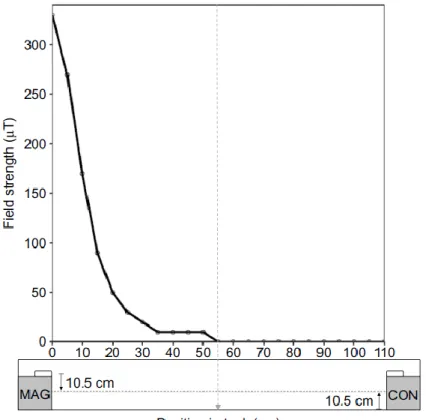
for magnet field intensity versus distance).
Each lobster was tested a single time. Prior to release, individuals were measured and
sexed, and a semicircular notch was removed from one of the uropods. The notch permitted
identification of lobsters that had been tested previously so that none were recaptured and
tested multiple times.
All statistical analyses were conducted using R (Version 3.3.3, R Foundation for
Statistical Computing, Vienna, Austria). Only lobsters that were within a den at the end of
the 15-min trial (49 of 51) were included in the analysis. To investigate the relationship
between size and den preference, I built a logistic regression model with carapace length as a
21 Results
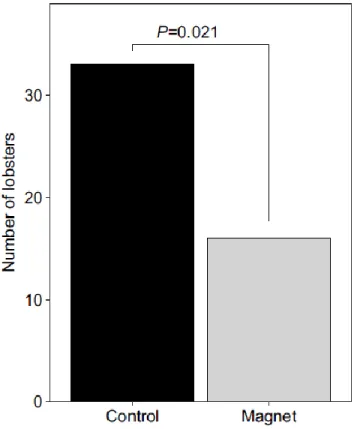
Of the 49 lobsters that occupied a den by the end of the 15-min trial period, 33 (67%)
occupied the control den and 16 (33%) occupied the magnet den (Fig. 2.3). Thus, lobsters
showed a significant preference for the control den (exact binomial test, P=0.021). No relationship existed between sex and den preference (χ² test, χ²=0.085, d.f.=1, P=0.77). In addition, male and female carapace length was not significantly different (Mann–Whitney U -test, U=227, P=0.2).
Lobsters that chose the magnet den were significantly smaller than those that chose
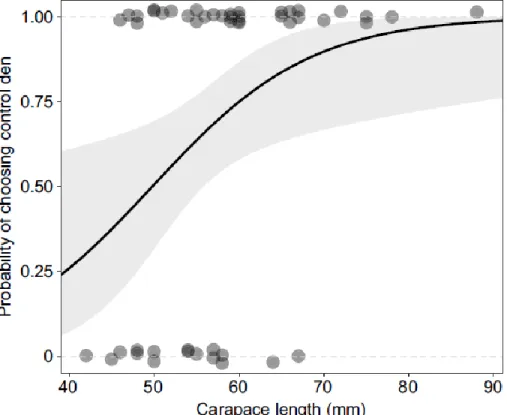
the control den (Mann–Whitney U-test, U=142.5, P=0.0095; Fig. 2.4). Smaller lobsters had no apparent preference for either type of den, but as carapace length increased, the proportion
of lobsters that chose the control den increased (Fig. 2.5). Moreover, a logistic regression
model showed that carapace length is a significant predictor of den choice (P=0.019; Fig. 2.6, Table 2.1).
Discussion
In a two-choice preference test, significantly more lobsters selected the control den
than selected the den associated with the neodymium magnet (Fig. 2.3). The overall aversion
to dens with magnets was driven primarily by the behavior of the larger lobsters, which
showed a strong preference for control dens (Figs 2.4, 2.5, Table 2.1); by contrast, smaller
lobsters as a group lacked a preference for den type. Although previous studies have revealed
that spiny lobsters detect and respond to Earth-strength magnetic fields (Lohmann et al.,
1995; Boles and Lohmann, 2003), these findings are the first to demonstrate that they also
22 What field component(s) do lobsters detect?
The results demonstrate that lobsters detect and avoid the magnetic fields produced
by magnets, but they do not reveal the precise element(s) of the magnetic field that lobsters
detect. The magnetic field that naturally exists at any location on Earth can be described in
terms of total field intensity and inclination angle (Lohmann et al., 1999). The same is true
for the field produced by a magnet, with the caveat that the magnet’s field, unlike the natural
geomagnetic field, has a strong gradient (i.e., both field strength and inclination vary greatly
over a short distance). Thus, in principle, lobsters might detect one or more of the following:
(1) the total intensity of the field produced by the magnet; (2) the inclination angle; (3) the
intensity gradient; (4) the inclination gradient; or (5) the range of field directions within the
horizontal plane when close to the magnet. Additional changes in field components such as
horizontal and vertical intensity also occur close to a magnet, but whether any animal can
resolve the total field into vector components is not known.
Why avoid dens with magnets?
The reason why lobsters avoided dens with magnets is not known, but several
explanations are plausible. Given that lobsters are known to possess ‘magnetic maps’ and can
thus assess their geographic location relative to ‘home’ (Boles and Lohmann, 2003), one
possibility is that lobsters preferred dens with ambient magnetic fields similar to those of
their home area. Because the test arena was located within 350 m of the capture site, the
control den had a magnetic field nearly identical to that of the capture location. As lobsters
approached the magnet den, they might have interpreted the anomalous field to mean that
they were far from home, resulting in exploration that led eventually to the discovery of the
23
Another possibility is that lobsters avoided dens with magnets because the anomalous
field represented an unnatural and unfamiliar magnetic environment. For example, some of
the inclination and intensity values near the magnet were presumably outside the range that a
lobster in Florida would normally encounter; moreover, the magnet created steep gradients in
magnetic parameters, so that as a lobster approached a den with a magnet, the intensity,
inclination, and direction of the field all changed rapidly. Lobsters might thus have found the
magnet’s field to be confusing or disturbing. In addition, the magnetic gradient produced by
the magnet might conceivably have generated unusual or uncomfortable sensations through
effects on the lobster magnetoreceptor system. Magnetic material has been detected in spiny
lobsters (Lohmann, 1984), and experiments with magnetic pulses suggest that this material
might provide the physical basis for magnetoreception (Ernst and Lohmann, 2016). Because
magnetic particles experience a force in a magnetic gradient (Oldenburg et al., 2005), an
interesting speculation is that lobsters approaching magnets experienced unusual or
uncomfortable sensations resulting from forces exerted on magnetite-based
magnetoreceptors, and therefore moved away.
Size-dependent magnetic field avoidance
Interestingly, the behavioral response of lobsters to a strong magnetic anomaly was
size dependent: larger lobsters avoided dens with magnets whereas smaller lobsters appeared
indifferent to magnets when choosing a den. These findings are consistent with the
hypothesis that lobsters undergo a size-dependent shift in their behavioral response to
magnetic fields, although additional studies are needed to confirm or refute this possibility.
The reason for the size-dependent aversion to magnets remains unknown, but an
24
smaller lobsters. Consistent with this idea, the magnetic remanence (a measure of the
quantity of magnetic material present) of the lobster cephalothorax and abdomen increased
with carapace length (Lohmann, 1984), as might be expected if larger, more mature lobsters
have a more developed magnetite-based magnetoreceptor system. An alternative explanation
for the present results, however, is that smaller lobsters are under greater risk of predation
than larger lobsters (Andree, 1981; Eggleston and Lipcius, 1992; Smith and Herrnkind, 1992)
and might therefore be more strongly motivated to take cover, even in suboptimal dens. By
contrast, larger lobsters less vulnerable to predation might be more willing to explore further
until encountering a den with more favorable magnetic conditions. Regardless, further
studies will be needed to investigate the cause of the observed size effect.
Natural anomalies versus magnet anomalies
Although our results provide the first evidence that spiny lobsters detect and respond
to a strong magnetic anomaly, the anomalies used in this study were greater in intensity, and
had stronger gradients, than naturally occurring anomalies caused by geological formations.
For this reason, and because strong fields might hypothetically affect physiological processes
that are unaffected by weaker fields, caution is needed in extrapolating the results to the
natural behavior of lobsters. Nevertheless, if lobsters do indeed generally avoid magnetic
anomalies, then an interesting speculation is that the animals might avoid geographic areas
where the ambient field varies irregularly, perhaps because such conditions make it difficult
for the animals to guide themselves using their magnetic compasses (Lohmann et al., 1995)
and magnetic maps (Boles and Lohmann, 2003). Further studies will be needed to investigate
how lobsters respond to more natural magnetic anomalies and whether they attempt to
25 Responses of animals to magnets
Most studies on animal magnetoreception have involved magnetic fields that closely
resemble the natural field of the Earth. Indeed, an increased emphasis in recent years has
been on developing coil systems that generate highly uniform fields and minimize anomalies
(Kirschvink, 1992), a trend fueled by the belief that animals will not spontaneously respond
to magnetic fields unlike those that exist in nature. However, a growing body of literature
suggests that at least some animals can detect the fields of magnets and respond to them
either spontaneously (Brown et al., 1960a,b; Kremers et al., 2014; O’Connell et al., 2015;
Vidal-Gadea et al., 2015) or after being conditioned to do so (Thalau et al., 2007; Denzau et
al., 2011; Freire et al., 2012). If spontaneous responses similar to those we have observed in
lobsters turn out to be widespread phylogenetically, then exposing animals to the fields of
magnets might provide a new and useful assay of magnetic sensitivity.
Acknowledgements
I thank the Keys Marine Laboratory for use of their facilities, Lein Soltan for
assistance with experiments, and Dr. Catherine Lohmann, J. Roger Brothers, Vanessa Bézy,
Lewis Naisbett-Jones and Kayla Goforth for comments on earlier drafts of the manuscript.
This work was supported in part by grants from the PADI Foundation [to D.A.E.], the
American Museum of Natural History Lerner-Gray Fund for Marine Research [to D.A.E.],
the University of North Carolina Henry Van Peters Wilson Memorial Fund for Marine
Biology [to D.A.E.], the National Science Foundation [IOS-1456923 to K.J.L.], and the Air
26 Tables
Table 2.1: Logistic regression model statistics, with carapace length as a predictor of den choice.
Variable Coefficient s.e.m. Odds ratio 2.5% CI 97.5% CI z P-value
27 Figures
28
Figure 2.2: Approximate magnetic field strength experienced by lobsters as a function of distance from the magnet’s surface. All values were calculated for positions on a horizontal plane that approximated the height of a walking lobster; the plane was 10.5 cm above the floor of the arena and 10.5 cm below the midway point of the magnet positioned on top of the concrete block (see diagram at bottom of figure; MAG, den with magnet; CON, den with nonmagnetic weight; white rectangles on dens indicate PVC capsules). 0 on the x-axis indicates a position 10.5 cm directly below the magnet surface. The gray vertical dashed line at 55 indicates the midpoint of the arena (i.e. the lobster release location). Measurements taken with a DC magnetometer (AlphaLab, Inc., West Salt Lake City, UT, USA) at various distances from the magnet showed good agreement with the calculated values and were used to spot-check the general accuracy of the graph. Both calculations and measurements
29
30
31
Figure 2.5: Den choice across 10 mm carapace length bins. (A) Proportion of lobsters that occupied each den type. (B) Total number of lobsters that chose each den type (n=49).
0.00 0.25 0.50 0.75 1.00
40-49 50-59 60-69 70-79 80-89
Carapace Length (mm)
Pro p o rt io n o f L o b s te rs Treatment Magnet Control
A
0 2 4 6 8 10 12 1440-49 50-59 60-69 70-79 80-89
Carapace Length (mm)
N u m b e r o f L o b s te rs Treatment Magnet Control
B
0.00 0.25 0.50 0.75 1.0040-49 50-59 60-69 70-79 80-89
Carapace Length (mm)
32
33
REFERENCES
1. Andree, S. W. (1981). Locomotory activity patterns and food items of benthic postlarval spiny lobsters, Panulirus argus. MSc thesis, Florida State University, Tallahassee, FL, USA.
2. Boles, L. C. and Lohmann, K. J. (2003). True navigation and magnetic maps in spiny lobsters. Nature 421, 60-63.
3. Brothers, J. R. and Lohmann, K. J. (2015). Evidence for geomagnetic imprinting and magnetic navigation in the natal homing of sea turtles. Curr. Biol. 25, 392-396. 4. Brown, F. A., Brett, W. J., Bennett, M. F. and Barnwell, F. H. (1960a). Magnetic
response of an organism and its solar relationships. Biol. Bull. 118, 367-381.
5. Brown, F. A., Webb, H. M. and Brett, W. J. (1960b). Magnetic response of an organism and its lunar relationships. Biol. Bull. 118, 382-392.
6. Creaser, E. P. and Travis, D. (1950). Evidence of a homing instinct in the Bermuda spiny lobster. Science 112, 169-170.
7. Dennis, T. E., Rayner, M. J. and Walker, M. M. (2007). Evidence that pigeons orient to geomagnetic intensity during homing. Proc. R. Soc. B 274, 1153-1158.
8. Denzau, S., Kuriakose, D., Freire, R., Munro, U. and Wiltschko, W. (2011). Conditioning domestic chickens to a magnetic anomaly. J. Comp. Physiol. A 197, 1137-141.
9. Eggleston, D. B. and Lipcius, R. N. (1992). Shelter selection by spiny lobster under variable predation risk, social conditions, and shelter size. Ecology 73, 992-1011. 10.Ernst, D. A. and Lohmann, K. J. (2016). Effect of magnetic pulses on Caribbean spiny
lobsters: implications for magnetoreception. J. Exp. Biol. 219, 1827-1832.
11.Freire, R., Dunston, E., Fowler, E. M., McKenzie, G. L., Quinn, C. T. and Michelsen, J. (2012). Conditioned response to a magnetic anomaly in the Pekin duck (Anas
platyrhynchos domestica) involves the trigeminal nerve. J. Exp. Biol. 215, 2399-2404. 12.Herrnkind, W. F. (1980). Spiny lobsters: patterns of movement. In Biology and
Management of Lobsters, Vol. 1 (ed. J. S. Cobb and B. J. Phillips), pp. 349-407. New York: Academic Press.
34
14.Kanciruk, P. and Herrnkind, W. (1978). Mass migration of spiny lobster, Panulirus argus
(Crustacea: Palinuridae): behavior and environmental correlates. Bull. Mar. Sci. 28, 601-623.
15.Kirshvink, J. (1992). Uniform magnetic fields and double-wrapped coil systems: Improved techniques for the design of bioelectromagnetic experiments.
Bioelectromagnetics 13, 401-411.
16.Kirschvink, J. L., Dizon, A. E. and Westphal, J. A. (1986). Evidence from strandings for geomagnetic sensitivity in cetaceans. J. Exp. Biol.120, 1-24.
17.Klimley, A. P. (1993). Highly directional swimming by scalloped hammerhead sharks,
Sphyrna lewini, and subsurface irradiance, temperature, bathymetry, and geomagnetic field. Mar. Biol. 117, 1-22.
18.Klinowska, M. (1985). Cetacean live stranding sites relate to geomagnetic topography.
Aquat. Mamm. 1, 27-32.
19.Kremers, D., Marulanda, J. L., Hausberger, M. and Lemasson, A. (2014). Behavioural evidence of magnetoreception in dolphins: detection of experimental magnetic fields.
Naturwissenschaften 101, 907-911.
20.Lanza, R. and Meloni, A. (2006). The Earth’s Magnetism: An Introduction for
Geologists. New York: Springer Berlin Heidelberg.
21.Lohmann, K. J. (1984). Magnetic remanence in the western Atlantic spiny lobster,
Panulirus argus. J. Exp. Biol. 113, 29-41.
22.Lohmann, K. J. and Lohmann, C. M. F. (1994). Detection of magnetic inclination angle by sea turtles: a possible mechanism for determining latitude. J. Exp. Biol. 194, 23-32. 23.Lohmann, K. J. and Lohmann, C. M. F. (1996). Orientation and open-sea navigation in
sea turtles. J. Exp. Biol. 199, 73-81.
24.Lohmann, K. J. and Ernst, D. A. (2014). The geomagnetic sense of crustaceans and its use in orientation and navigation. In Crustacean Nervous Systems and Control of Behavior (ed. C. D. Derby and M. Thiel), pp. 321-336. New York: Oxford University Press.
25.Lohmann, K. J., Pentcheff, N. D., Nevitt, G. A., Stetten, G. D., Zimmer-Faust, R. K., Jarrard, H. E. and Boles, L. C. (1995). Magnetic orientation of spiny lobsters in the ocean: experiments with undersea coil systems. J. Exp. Biol. 198, 2041-2048.
35
27.Lohmann, K. J., Cain, S. D., Dodge, S. A. and Lohmann, C. M. F. (2001). Regional magnetic fields as navigational markers for sea turtles. Science 294, 364-366. 28.Lohmann, K. J., Lohmann, C. M. F. and Putman, N. F. (2007). Magnetic maps in
animals: nature’s GPS. J. Exp. Biol. 210, 3697-3705.
29.Lohmann, K. J., Putman, N. F. and Lohmann, C. M. F. (2012). The magnetic map of hatchling loggerhead sea turtles. Curr. Opin. Neurobiol. 22: 336-342.
30.Naisbett-Jones, L. C., Putman, N. F., Stephenson, J. F., Ladak, S. and Young, K. A. (2017). A magnetic map leads juvenile European eels to the Gulf Stream. Curr. Biol. 27, 1236-1240.
31.O'Connell, C. P., Hyun, S. Y., Gruber, S. H. and He, P. (2015). Effects of barium-ferrite permanent magnets on great hammerhead shark Sphyrna mokarran behavior and
implications for future conservation technologies. Endang. Species Res. 26, 243-256. 32.Oldenburg, A., Toublan, F., Suslick, K., Wei, A. and Boppart, S. (2005). Magnetomotive
contrast for in vivo optical coherence tomography. Opt. Express 13, 6597-6614.
33.Parkinson, W. D. (1983). Introduction to Geomagnetism. Edinbergh: Scottish Academic Press, Ltd.
34.Phillips, J. B., Freake, M. J., Fischer, J. H. and Borland, C. S. (2002). Behavioral titration of a magnetic map coordinate. J. Comp. Phys. A 188, 157-160.
35.Putman, N. F., Lohmann, K. J., Putman, E. M., Quinn, T. P., Klimley, A. P. and Noakes, D. L. G. (2013). Evidence for geomagnetic imprinting as a homing mechanism in Pacific salmon. Curr. Biol. 23, 312-316.
36.Schiffner, I., Fuhrmann, P. and Wiltschko, R. (2011). Tracking pigeons in a magnetic anomaly and in magnetically “quiet” terrain. Naturwissenschaften 98, 575-581.
37.Skiles, D. D. (1985). The geomagnetic field: Its nature, history and biological relevance. In Magnetite Biomineralization and Magnetoreception in Organisms (ed. J. L.
Kirschvink, D. S. Jones, and B. J. MacFadden), pp. 43-102. London, New York: Plenum Press.
38.Smith, K. N. and Herrnkind, W. F. (1992). Predation on juvenile spiny lobsters,
Panulirus argus: influence of size, shelter, and activity period. J. Exp. Mar. Biol. Ecol.
157, 3-18.
39.Thalau, P., Holtkamp-Rözler, E., Gleissner, G. and Wiltschko, W. (2007). Homing pigeons (Columba livia f. domestica) can use magnetic cues for locating food.
36
40.Vidal-Gadea, A., Ward, K., Beron, C., Ghorashian, N., Gokce, S., Russell, J., Truong, N., Parikh, A., Gadea, O., Ben-Yakar, A. and Pierce-Shimomura, J. (2015).
Magnetosensitive neurons mediate geomagnetic orientation in Caenorhabditis elegans.
eLife 4, e07493.
41.Walcott, C. (1978) Anomalies in the earth's magnetic field increase the scatter of pigeons' vanishing bearings. In Animal Migration, Navigation and Homing (ed.
K.Schmidt-Koenig and W. T. Keeton), pp 143-151. Springer, Heidelberg.
42.Walcott, C. (1992). Pigeons at magnetic anomalies: the effects of loft location. J. Exp. Biol.170, 127-141.
43.Walker, M. M. (1998). On a wing and a vector: a model for magnetic navigation by homing pigeons. J. Theor. Biol. 192, 341-349.
44.Walker, M. M., Dennis, T. E. and Kirschvink, J. L. (2002). The magnetic sense and its use in long-distance navigation by animals. Curr. Opin. Neurobiol. 12, 735-744. 45.Wiltschko, R. and Wiltschko, W. (1995). Magnetic Orientation in Animals. Berlin:
Springer.
46.Wiltschko, R., Schiffner, I. and Wiltschko, W. (2009). A strong magnetic anomaly affects pigeon navigation. J. Exp. Biol. 212, 2983-2990.
37 CHAPTER III
EFFECT OF MAGNETIC PULSES ON CARIBBEAN SPINY LOBSTERS:
IMPLICATIONS FOR MAGNETORECEPTION2
Introduction
Earth’s magnetic field plays an important role in guiding the movements of diverse
animals over a wide range of distances (Wiltschko and Wiltschko, 2005; Johnsen and
Lohmann, 2005). The geomagnetic field is among the most pervasive and reliable of
orientation cues, accessible day and night at nearly every location on the planet. Animals can
derive two distinct types of information from the geomagnetic field. Many species use the
field as a source of directional or ‘compass’ information, which enables them to maintain
consistent headings (e.g., toward north or south) (Lohmann, 2010). In addition, Earth’s
magnetic field varies predictably across the surface of the globe, providing a source of
positional or ‘map’ information that some animals use to change direction at appropriate
locations along a migratory route or to navigate toward particular geographic areas
(Lohmann et al., 2001, 2004, 2007, 2012; Phillips et al., 2002; Putman et al., 2014).
Although many species evidently use the geomagnetic field as a compass, map, or
both, the transduction mechanisms that underlie magnetic field detection have not been
clearly established in any animal. Several different hypotheses have been proposed to explain
how animals might detect magnetic fields (Johnsen and Lohmann, 2008). Most recent
2This chapter has been published as:
38
research has focused on two possible biophysical mechanisms: (1) chemically mediated
magnetoreception (Ritz et al., 2000; Maeda et al., 2008; Liedvogel and Mouritsen, 2010); and
(2) magnetite-based magnetoreception (Kirschvink et al., 2001; Walker, 2008; Winklhofer
and Kirschvink, 2010).
The magnetite hypothesis proposes that particles of the mineral magnetite (Fe3O4)
provide the physical basis for the magnetic sense. Theoretical considerations suggest that
single-domain magnetite crystals (crystals of a size that can sustain a permanent magnetic
moment) are particularly well suited to function as magnetoreceptors (Kirschvink et al.,
2001). Such particles might activate secondary receptors (e.g., stretch receptors or hair cells)
as the particles twist into alignment with the geomagnetic field (Kirschvink and Gould, 1981;
Johnsen and Lohmann, 2005; Winklhofer and Kirschvink, 2010). Magnetic particles have
been detected in the tissues of a number of animals, many of which use the geomagnetic field
as an orientation cue (e.g., Lohmann, 1984; Mann et al., 1988; Walker et al., 1997; Shaw et
al., 2015).
One technique that has been used to investigate magnetite-based magnetoreception
involves subjecting organisms to brief, strong magnetic pulses (Kirschvink et al., 2001; Shaw
et al., 2015), a treatment that should have no lasting effect on chemically mediated
magnetoreception (Wiltschko et al., 2002). In principle, a strong magnetic pulse applied in
the right direction can realign the magnetic dipole moment of a single-domain magnetite
crystal (Kirschvink, 1983; Kirschvink et al., 1985). As a consequence, the pulse treatment
might cause incorrect magnetic information to be transduced to the nervous system, resulting
in changes in orientation behavior. Magnetic pulses have been shown to alter the orientation