Exposure to multiple sources of polycyclic aromatic
hydrocarbons and breast cancer incidence
Alexandra J. White1,*, Patrick T. Bradshaw2, Amy H. Herring3, Susan L. Teitelbaum4, Jan Beyea5, Steven D. Stellman6, Susan E. Steck9, Irina Mordukhovich1, Sybil M. Eng6, Lawrence S. Engel1, Kathleen Conway1, Maureen Hatch10, Alfred I. Neugut6,7, Regina M. Santella8, and Marilie D. Gammon1
1Department of Epidemiology, University of North Carolina, Chapel Hill, NC, USA 2Department of Nutrition, University of North Carolina, Chapel Hill, NC, USA 3Department of Biostatistics, University of North Carolina, Chapel Hill, NC, USA
4Department of Preventive Medicine, Ichan School of Medicine at Mt. Sinai, New York, NY, USA 5Consulting in the Public Interest (CIPI), Lambertville, NJ, USA
6Department of Epidemiology, Columbia University, USA 7Department of Medicine, Columbia University, USA
8Department of Environmental Health Sciences, Columbia University, USA
9Department of Epidemiology and Biostatistics, University of South Carolina, Columbia, SC, USA 10Division of Cancer Epidemiology and Genetics, Radiation Epidemiology Branch, National
Cancer Institute, Bethesda, MD, USA
Abstract
Background—Despite studies having consistently linked exposure to single-source polycyclic aromatic hydrocarbons (PAHs) to breast cancer, it is unclear whether single sources or specific groups of PAH sources should be targeted for breast cancer risk reduction.
Objectives—This study considers the impact on breast cancer incidence from multiple PAH exposure sources in a single model, which better reflects exposure to these complex mixtures.
Methods—In a population-based case-control study conducted on Long Island, New York (N=1,508 breast cancer cases/1,556 controls), a Bayesian hierarchical regression approach was used to estimate adjusted posterior means and credible intervals (CrI) for the adjusted odds ratios (ORs) for PAH exposure sources, considered singly and as groups: active smoking; residential
*Corresponding Author: Alexandra J. White, PhD, MSPH; Department of Epidemiology, CB#7435, McGavran-Greenberg Hall,
University of North Carolina, Chapel Hill, NC, 27599-7435 USA, Telephone: (919) 966-7421; Fax: (919) 966-2089; [email protected]. Conflicts of Interest: None declared.
Publisher's Disclaimer: This is a PDF file of an unedited manuscript that has been accepted for publication. As a service to our
HHS Public Access
Author manuscript
Environ Int
. Author manuscript; available in PMC 2017 April 01.Published in final edited form as:
Environ Int. 2016 ; 89-90: 185–192. doi:10.1016/j.envint.2016.02.009.
A
uthor Man
uscr
ipt
A
uthor Man
uscr
ipt
A
uthor Man
uscr
ipt
A
uthor Man
uscr
environmental tobacco smoke (ETS); indoor and outdoor air pollution; and grilled/smoked meat intake.
Results—Most women were exposed to PAHs from multiple sources, and the most common included active/passive smoking and grilled/smoked food intake. In multiple-PAH source models, breast cancer incidence was associated with residential ETS from a spouse (OR=1.20,
95%CrI=1.03, 1.40) and synthetic firelog burning (OR=1.29, 95%CrI=1.06, 1.57); these estimates are similar, but slightly attenuated, to those from single-source models. Additionally when we considered PAH exposure groups, the most pronounced significant associations included total indoor sources (active smoking, ETS from spouse, grilled/smoked meat intake, stove/fireplace use, OR=1.45, 95%CrI=1.02, 2.04).
Conclusions—Groups of PAH sources, particularly indoor sources, were associated with a 30– 50% increase in breast cancer incidence. PAH exposure is ubiquitous and a potentially modifiable breast cancer risk factor.
Introduction
Breast cancer is the most commonly diagnosed cancer among women in the U.S. (American Cancer Society 2014). Experimental research suggests that polycylic aromatic hydrocarbons (PAHs) induce mammary tumors (IARC 2010), but associations in women are understudied. Humans are exposed to PAHs across the life course from multiple sources, including cigarette smoking, environmental tobacco smoke (ETS), diet, indoor and outdoor air
pollution.(Boström et al. 2002) PAHs are formed from the incomplete combustion of organic material and are confirmed carcinogens to the human lung (IARC 2010).
Previous population studies have observed positive associations between short-term PAH biomarker concentrations (i.e., PAH-DNA adducts) and breast cancer incidence (Gammon et al. 2004b; Li et al. 2002; Rundle et al. 2000). However, it is unclear from biomarker studies which PAH sources are the predominant contributors to these associations. As long-term carcinogen exposure is considered to be most relevant, other studies have considered single PAH exposure sources and have found increases in breast cancer risk with active cigarette smoking (Gaudet et al. 2013), long-term residential ETS (Gammon et al. 2004a; Laden and Hunter 1998; Morabia et al. 1996), indoor air pollution from burning synthetic logs (White et al. 2014), outdoor air pollution (Bonner et al. 2005; Crouse et al. 2010; Lewis-Michl et al. 1996; Mordukhovich et al. 2015; Nie et al. 2007; Raaschou-Nielsen et al. 2011), and intake of grilled and smoked foods (Di Maso et al. 2013; Fu et al. 2011; Steck et al. 2007).
Our understanding of the impact of PAHs on breast cancer may be improved if these multiple sources are considered simultaneously (2015). The relative contribution of PAH sources to an individual’s exposure is unknown (Boström et al. 2002). Tobacco smoke is likely the largest contributor (Menzie et al. 1992), but diet is the predominant source among non-smokers (Boström et al. 2002). However, carcinogenic potency is hypothesized to vary by route of exposure (Menzie et al. 1992), metabolic pathway and type of PAH (Boström et al. 2002). Thus, it is unclear whether certain sources, groups of sources, or all PAH sources should be targeted for breast cancer risk reduction.
A
uthor Man
uscr
ipt
A
uthor Man
uscr
ipt
A
uthor Man
uscr
ipt
A
uthor Man
uscr
The study reported here aims to consider, in a single hierarchical regression model, the impact of multiple long-term PAH sources on breast cancer incidence. Variables from the same exposure source (for example, different measures of grilled/smoked meat intake) are highly correlated. A hierarchical regression approach permits the consideration of multiple PAH source exposures in a single multivariable model, while accounting for similar sources of the PAH exposures. Additionally, with a single statistical model we are able to estimate the OR for groups of PAH sources, or PAH exposure profiles, based on contrasting a priori defined exposure groups of interest.
Methods
The study reported here builds upon the population-based case-control resources of the Long Island Breast Cancer Study Project (LIBCSP), for which extensive methods have been previously published (Gammon et al. 2002). IRB approval was obtained from all relevant institutions. Written signed informed consent was obtained from all participants.
Study Population
The cases are English-speaking female residents of Long Island, New York who were
diagnosed with their first primary in situ or invasive breast cancer between August 1st, 1996
and July 31st, 1997. Cases were identified using rapid case ascertainment. Controls were
women without a history of breast cancer who were frequency matched on the expected 5-year age distribution of the cases. Controls were identified using random digit dialing for those less than 65 years of age and by using Health Care Finance Administration Rosters for those 65 years of age and older.
PAH Exposure Sources Assessment
Five binary PAH exposure sources were assessed across the life course. Active smoking, residential ETS, grilled/smoked meat intake, and indoor wood-burning stove/fireplace use were assessed by structured questionnaire (Gammon et al. 2004a; Steck et al. 2007; White et al. 2014) with a trained interviewer, and vehicular traffic exposure was assessed using a validated historical geographic model (Beyea et al. 2006; Mordukhovich et al. 2015). Continuous variables required categorization because associations with breast cancer were neither non-linear nor log-linear and were dichotomized in order to facilitate interpretation and scaling in the hierarchical regression across PAH sources.
Active smoking (ever, never) was defined as smoking at least 1 cigarette per day for 6 months or longer, and current active smoking (yes, no) was defined as smoking within the last 12 months prior to diagnosis or referent date for controls (=date of identification). Smoking prior to first birth (yes, no) was determined by using age at first birth and age at which participant first starting smoking. Participants were asked if they had lived with a smoker to determine ETS exposure (yes, no) and their relationship to that person to evaluate if they lived with a smoking spouse (yes, no). Indoor stove/fireplace use was defined as having used a stove/fireplace in a Long Island residence for at least 3 times per year (yes, no) and whether or not participants burned wood (yes, no) and/or synthetic logs (yes, no).
A
uthor Man
uscr
ipt
A
uthor Man
uscr
ipt
A
uthor Man
uscr
ipt
A
uthor Man
uscr
Continuous variables for the PAH sources were dichotomized using cutpoints that best reflected previous associations observed with breast cancer incidence (Mordukhovich et al. 2015; Steck et al. 2007). Frequency of intake of grilled/smoked meat was assessed for six decades across the life course. Lifetime intake was defined as the average servings consumed per year based on quantile distributions of consumption in the controls, as follows: for total grilled/barbecued and smoked meats (<55 servings/year, 55+ servings/ year); grilled/barbecued beef, pork and lamb (<14, 14+ servings/year); and smoked beef, pork and lamb (<22, 22+ servings/year). The geographic model for vehicular traffic exposure incorporated historical U.S. vehicular PAH emissions data, information on traffic and transportation patterns, Long Island meteorological variables and pollutant dispersion factors to determine vehicular traffic exposure in 1995, the year prior to LIBCSP recruitment
(low risk= <95th percentile, high risk ≥ 95th percentile). Previously, we found the association
with breast cancer to be limited to the top 5% of those exposed to vehicular traffic (Mordukhovich et al. 2015).
Confounder Assessment
A directed acyclic graph was used to identify a minimally sufficient set to control for confounding (Glymour and Greenland 2008) (Supplemental Figure I). .
The odds ratios were adjusted for the following covariates, which were assessed by structured questionnaire (Gammon et al. 2002): age at menarche (≤12, >12 years); parity (nulliparous, parous); lifetime alcohol intake (non-drinkers, <15g/day, 15g–30g/day, ≥30 g/ day); education (high school graduate or less, some college, college or post-college); income (<$34,999, $35,000–$69,999, ≥$70,000); and the frequency matching factor, 5-year age group.
Statistical Analysis
To examine the associations between the main PAH sources and PAH groups and breast cancer risk, 12 binary PAH exposure variables were considered. For our primary analysis, these 12 variables were characterized according to five exposure sources: (1) active smoking: ever active smoking, current active, smoking prior to first pregnancy; (2) residential ETS: any residential ETS, residential ETS from spouse; (3) indoor stove and/or fireplace use: any stove/fireplace use, wood burning, synthetic log burning; (4) diet: total grilled/barbecued and smoked meats, smoked beef, pork and lamb and grilled/ barbecued beef, pork and lamb; and (5) vehicular traffic. Estimating associations with the PAH exposure variables by these five exposure sources facilitates understanding which of these sources to prioritize for reduction from a public health standpoint.
All models were specified in a Bayesian framework and we calculated posterior means for the ORs and corresponding 95% posterior credible intervals (CrI, the Bayesian analog to a confidence interval) (Gelman and Hill 2006). The risk of breast cancer was specified using logistic regression.
A
uthor Man
uscr
ipt
A
uthor Man
uscr
ipt
A
uthor Man
uscr
ipt
A
uthor Man
uscr
where Y is case status, X denotes the individual PAH exposures, and W is a vector of
confounders. The β coefficient represents the association [ln(OR)] of the individual PAH
sources with breast cancer.
Hierarchical regression builds upon this first-level model by specifying a second-level model that incorporates information on the PAH sources that may explain the individual PAH-exposure associations (Gammon et al. 2004a; Mordukhovich et al. 2015; Steck et al. 2007; White et al. 2014). The second level of the hierarchical regression for the logistic coefficient
β is:
where Z is the second-stage design matrix (Supplemental Table I) with each row
corresponding to a β from the first-stage model and each column corresponding to an
exposure source, which encodes our prior information about the PAH exposure variables and
their respective sources. The 4x1 coefficient vector π corresponds to the associations
between the second stage covariates (PAH exposure source) and the log-OR with breast
cancer and δ is assumed to be normally distributed with a mean=0 and a variance=τ2. This
approach accounts for a degree of similarity of PAH exposures that come from similar
sources while allowing some residual variation (δ) associated with these effects. If the PAH
exposure variables were thought to be related to a particular source they were scored as 1, otherwise were coded as 0. As only one variable was available for vehicular traffic, there was no column in the Z-matrix for it and thus, it effectively serves as its own source.
Combining these equations allows for estimation of the association between each PAH variable, according to PAH source, and breast cancer:
where, from this mixed-model specification, the π and γ correspond to fixed effects of the
PAH sources and confounders, respectively, and δ contains the random exposure-level
effects (Gelman and Hill 2006; Greenland 2000; Witte et al. 1994).
For the intercept (α), and covariate coefficients (π and γ), a relatively non-informative
normally-distributed prior was used (mean=0, variance=1000). For τ, a uniform prior from
0.01 to 100 was used. We specified an additional model to account for the approximately 15% of the 1995 vehicular traffic data that were missing. Missing data are accommodated in a Bayesian framework in a method similar to multiple imputation by specifying a
distribution for the variable with missing data (Ibrahim et al. 2005; Ibrahim et al. 2012). In this case, the indicator of high vehicular traffic level was modeled from a logistic regression with covariates income, education, and age, with relatively non-informative normal priors on their coefficients (mean=0, variance=1000). In addition to this hierarchical model, for
comparison, we also estimated single exposure and multivariable models (only estimating α,
β and γ from the first stage model without specifying a second-stage model). For the single
exposure model, each PAH variable was modeled alone; for the multivariable model, all
A
uthor Man
uscr
ipt
A
uthor Man
uscr
ipt
A
uthor Man
uscr
ipt
A
uthor Man
uscr
individual exposures were included simultaneously. These methods correspond to those employed in similar analyses (Bradshaw et al. 2013; Hung et al. 2004).
From the hierarchical model, the posterior mean of the OR and corresponding 95%CrI for PAH exposure profiles of interest relative to women who had low PAH exposure were
estimated by calculating linear combinations of the relevant β coefficients (Supplemental
Table II). These ORs were calculated from the estimates produced by the hierarchical regression model. These profiles, which are not mutually exclusive, were predetermined to facilitate interpretation by considering typical or potentially informative patterns of exposure across the 12 PAH measures. The profiles that span across PAH sources were chosen in part based on classifications that had sufficient numbers of cases and controls to estimate associations. The PAH exposure profiles of interest were defined as: (1) the referent of low PAH exposure (non-smokers, no residential ETS, low intake of grilled/smoked foods (<55 servings/year total grilled/barbecued and smoked meats, <14 servings year of grilled/ barbecued beef, pork and lamb, <22 servings year of smoked beef, pork and lamb), low risk vehicular traffic (<95th percentile), and no stove/fireplace use); (2) tobacco smoke (current, active smokers who started prior to first pregnancy and were exposed to residential ETS from a spouse); (3) ingested PAHs (high intake of overall grilled/smoked foods (55+ servings/year), grilled/barbecued beef, pork and lamb (14+ servings/year), and smoked beef, pork and lamb (22+ servings/year)); (4) indoor stove/fireplace users (indoor stove/fireplace users who burned both wood and synthetic logs); (5) inhaled PAHs (active smokers,
residential ETS, high risk vehicular traffic (top 5th percentile), stove/fireplace users); (6)
indoor source PAHs (active smokers, residential ETS from spouse, high overall grilled/ smoked foods (55+ servings/year), and stove/fireplace users); (7) five PAH sources (active smokers, residential ETS, high overall grilled/smoked foods (55+ servings/year), stove/
fireplace users and high risk vehicular traffic exposure (top 5th percentile)). Sample sizes of
cases and controls that were classified as exposed to each profile were determined to allow for interpretation of the prevalence in the study population of different combinations of PAH exposures. To estimate posterior probabilities, confounders were specified at their modal values (age: 50–54 years; income: $35,000-$69,999; education: high school or less; parity: parous; alcohol intake: <15g/day; age at menarche: >12 years) and PAH sources not specified in the definition of the profiles were set to the referent category.
Sensitivity Analyses
The hierarchical model was also fit 5 times using 5 separate datasets with multiple imputed historical 1960–1990 vehicular traffic estimates (up to 20% missing data imputed) to compare results across the 5 datasets and from the model fit only with the 1995 estimates (Beyea et al. 2013). Another Z-matrix configuration was evaluated, where the second-level model included two routes of exposure, ingestion versus inhalation. This analyses was also repeated, limiting to women who were postmenopausal and had ER+ tumors only.
Posterior means and credible intervals (CrI) of the model parameters were estimated by sampling from their joint posterior distribution through Gibbs sampling (Casella and George 1992) conducted using JAGS (Plummer 2003) and the package R2jags (Su and Yajima 2012) through the R language (R Foundation for Statistical Computing, Vienna, Austria).
A
uthor Man
uscr
ipt
A
uthor Man
uscr
ipt
A
uthor Man
uscr
ipt
A
uthor Man
uscr
The 95% CrI represents the 2.5th and 97.5th percentiles from the estimated posterior distribution for each parameter. R code for the hierarchical Bayes analysis is included in the supplement. The model had 30,000 iterations with a burn-in of 10,000. Trace plots were visually examined to evaluate convergence.
Results
Women in this population-based sample from Long Island NY were heavily exposed to PAHs across multiple sources (Table I). Approximately 20% were current smokers; almost 80% had at one time or another lived in a home with a smoker; over 70% consumed a serving or more per week of grilled/smoked foods and almost half used stove/fireplaces in their home.
ORs for breast cancer incidence were elevated for residential ETS from a spouse (OR=1.20, 95%CrI=1.03, 1.40), total grilled/smoked foods (OR=1.16, 95%CrI=0.97, 1.38), vehicular traffic (OR=1.25, 95%CrI=0.85, 1.76) and synthetic log burning (OR=1.29, 95%CrI=1.06, 1.57) in the hierarchical model (Table II). The hierarchical analyses, incorporating second-stage information about the PAH exposure source, resulted in more precise estimates than the multivariable analyses as demonstrated by the smaller credible limit ratios (CrLRs). These hierarchical results were slightly attenuated from the single exposure estimates when modeling each PAH source individually. Results from the single exposure models are similar to, but differ slightly from results published previously (Gammon et al. 2004a;
Mordukhovich et al. 2015; Steck et al. 2007; White et al. 2014) due to changes in variable characterizations, analytic approach and adjustment set. In the multivariable analysis, there was some evidence of attenuation in comparison to the single exposure estimates.
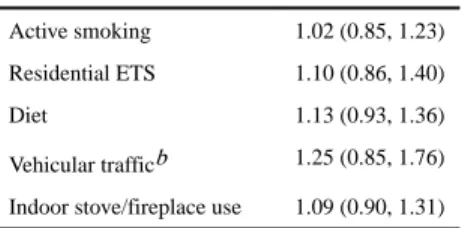
The overall fixed estimates for the PAH sources (2nd level estimates for active smoking,
residential ETS, diet, stove/fireplace use and 1st level estimate of vehicular traffic) from the
hierarchical model showed little evidence of an association with breast cancer incidence, with estimates close to null or imprecise (Table III).
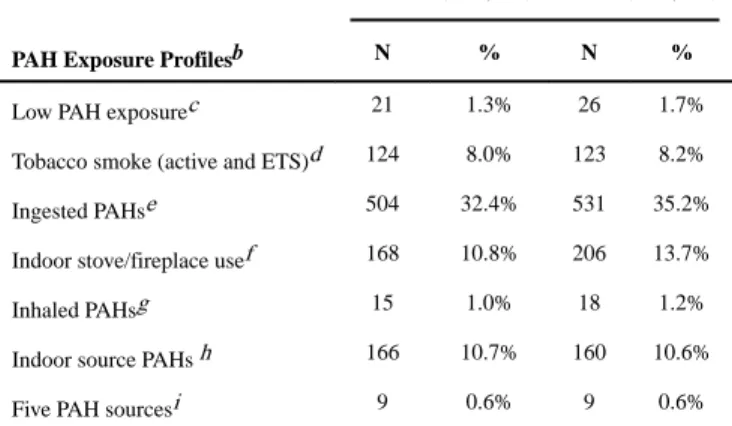
We estimated the prevalence of each exposure profile in the LIBCSP study population. Less than 2% of women were characterized as having a low PAH exposure profile (n=26 cases and n=21 controls) (Table IV). Very few women were considered exposed across all five PAH sources or by all the sources of inhalation (<1%), whereas about 10% of cases and controls were exposed across the indoor sources of PAH (active smoking, residential ETS, high overall grilled/smoked foods and stove/fireplace users).
The OR for the association between breast cancer incidence and the indoor exposure source profile of PAH was elevated by 1.46 (OR=1.45, 95%CrI 1.02, 2.04; CrLR=1.99) (Table IV). Among women who were highly exposed to PAH via ingestion, the effect estimate was elevated by 1.44 (OR=1.44, 95%CrI 1.16, 1.78; CrLR=1.53). Estimates were elevated for women who used stove/fireplaces in their home, burning both wood and synthetic logs (OR=1.29, 95%CrI=1.03, 1.59). Exposure profiles that included vehicular traffic exposure were imprecise due to the small number of people who were classified as highly exposed.
A
uthor Man
uscr
ipt
A
uthor Man
uscr
ipt
A
uthor Man
uscr
ipt
A
uthor Man
uscr
The ORs for these exposure profiles were calculated based on linear combinations from the hierarchical model.
A sensitivity analysis was conducted with long-term exposure to vehicular traffic from 1960–1990 included in the model, as long-term exposure has been found to be more strongly associated with breast cancer incidence in this study population (Mordukhovich et al. 2015). Inclusion of long-term vehicular traffic did not strengthen the fixed-effects for vehicular traffic exposure (data not shown). The large amount of missing data for long-term vehicular traffic precluded this PAH source from being included in the primary analysis. Long-term exposure to vehicular traffic is highly correlated with 1995 exposure and thus, 1995 estimates may be a sufficient proxy for long-term vehicular traffic (Mordukhovich et al. 2015). When considering an alternative Z-matrix specification with a second-level model comprised of ingestion and inhalation, second-level estimates were similar (Supplemental Table III). Results were similar when limiting to postmenopausal women with ER+ tumors only (data not shown), although the estimates of association for grilled/smoked meat intake were slightly more pronounced.
Discussion
Women in this population-based sample from Long Island NY were exposed to PAHs across multiple sources, particularly active/passive smoking and grilled/smoked foods, and very few were classified as having a low PAH exposure profile, underscoring the ubiquitous nature of PAH exposure. We are the first to report that exposure across indoor sources of PAH (active smoking, residential ETS from spouse, grilled/smoked meat intake, stove/ fireplace use) was associated with a 1.46 increase in breast cancer incidence.
The results reported here are consistent with laboratory evidence (Hecht 2002) and the existing epidemiologic literature on PAH sources and breast cancer incidence (Bonner et al. 2005; Crouse et al. 2010; Di Maso et al. 2013; Gaudet et al. 2013; Laden and Hunter 1998; Lewis-Michl et al. 1996; Morabia et al. 1996; Nie et al. 2007). Consideration of all main PAH exposure sources concurrently in a single model provided effect estimates that better reflect the exposure complexity of multiple long-term PAH sources on breast cancer incidence. Tobacco smoke, indoor and outdoor air pollution and diet are modifiable breast cancer risk factors that can be reduced. The findings here suggest that all of the PAH sources considered are relevant; in particular the sources included in the indoor PAH exposure profile. Similar findings were found for PAH profiles of ingestion and inhalation. Thus, one exposure route may not necessarily be more important for breast cancer risk than the other.
Vehicular traffic is often considered to be the largest source of PAHs in outdoor air pollution, particularly in urban locations (Dunbar et al. 2001). Among our population-based sample of women on Long Island NY, vehicular traffic was associated with an elevated, but also very imprecise, OR for breast cancer risk. Despite this, vehicular traffic did not notably increase PAH profile estimates (e.g., when comparing estimates for indoor sources of PAH to all five sources) likely due to the fact that only the top 5% were considered exposed. This may not be the case in geographic locations where vehicular traffic exposure is higher and thus impacts more women.
A
uthor Man
uscr
ipt
A
uthor Man
uscr
ipt
A
uthor Man
uscr
ipt
A
uthor Man
uscr
The lack of associations observed with the fixed effects estimated by the second-level of the hierarchical model demonstrate that when averaging over the different PAH exposure variables, we do not observe a strong association between any of the PAH sources and breast cancer incidence. This finding emphasizes the importance of different exposure
classifications, particularly those that incorporate relevant measures of intensity (for example, residential spouse ETS versus any residential ETS) or variability in exposure (for example, type of material burned in stove/fireplace).
Our study reported here has many strengths, in particular the population-based design. Additionally, this study has uniquely collected information on life course exposure to the main PAH sources. The use of Bayes hierarchical analysis to model these main sources concurrently, and their profile-level associations, is useful to better understand the impact of multiple sources of interest. Our results were only slightly attenuated when comparing single and hierarchical models, thus, these results are encouraging that at least in the case of these PAH sources, modeling them individually may produce similar results.
Several issues may impact interpretation of the study findings reported here. For example, self-reported exposure to the PAH sources could result in bias due to misclassification error in the PAH exposure markers. However, self-reported active cigarette smoking and ETS have been previously found to be a valid measurement (Patrick et al. 1994).Whether cases and controls reported these exposures differentially is unknown; however, at the time of LIBCSP data collection in the mid-1990s, most media attention in the Long Island NY area focused on the potential adverse effects of other environmental contaminants, including exposure to pesticides and electromagnetic fields, but not PAH sources (Gammon et al. 2002).
In a previous study in this population that considered associations with a single PAH exposure source, we did not find an association between wood-burning in the home and breast cancer incidence (White et al. 2014). Reports have been inconsistent on whether burning synthetic or wood logs produce more PAHs (Gullett et al. 2003; Li and Rosenthal 2006; McDonald et al. 2000; Nolan et al. 2006; Rogge et al. 1998; Watson et al. 1998). It is important to note that synthetic logs are designed to be used in open fireplaces, which tend to have higher PAH emissions than wood stoves (Traynor et al. 1987), and this may, at least in part, explain this differential association. However, we cannot rule out the possibility that recall bias may play some role in the association observed here with synthetic logs and breast cancer incidence.
Estimating vehicular traffic exposure was dependent upon each participant recalling her residential history, and the accuracy of the participant reporting this information is unlikely to be associated with her case-control status. Thus, any misclassification error associated with this exposure is likely to be non-differential. Yet, the OR associated with high vehicular traffic exposure was stronger in magnitude but with wide credible intervals in the
hierarchical model. We did not consider occupational ETS exposure, which may have also contributed to PAH exposure.
Importantly, the PAH sources characterized here also contain other non-PAH chemicals, some of which may also be relevant to carcinogenesis (IARC 2010). Although other
A
uthor Man
uscr
ipt
A
uthor Man
uscr
ipt
A
uthor Man
uscr
ipt
A
uthor Man
uscr
chemicals in the PAH sources may be relevant to breast cancer, there is a strong biologic rationale that PAHs have a role in breast carcinogenesis (Brody et al. 2007; Gammon and Santella 2008; Hecht 2002).
Other carcinogens that are prominent in these PAH sources include polychlorinated biphenyls (PCBs)(Gullett et al. 2003), particulate matter (Gullett et al. 2003), aromatic and heterocyclic aromatic amines (Taylor et al. 2009; Terry and Rohan 2002), N-nitrosamines (Terry and Rohan 2002), dioxins (Danjou et al. 2015) and benzene (IOM (Institute of Medicine) 2012). PCBs, which may be released from indoor stove/fireplace use, may have both positive and inverse associations with breast cancer depending on the specific compound (Cohn et al. 2012; Recio-Vega et al. 2011) although evidence is based on few studies and not consistent (Brauner et al. 2014; Brody et al. 2007). The association between dioxins, which has been measured in meat, and breast cancer incidence has been inconsistent (Danjou et al. 2015; Warner et al. 2011). Research on the health effects of the air pollutant benzene has historically focused on occupationally-exposed men (IOM (Institute of
Medicine) 2012). However, a study in New York did find an association among women who were likely to have moderate to high exposure based on job-exposure matrices (Petralia et al. 1999) and an association was observed with ER-PR- tumors in the California Teacher’s Cohort study (Garcia et al. 2015).
Particulate matter is often used as a proxy measure of air pollution, but particulate matter has not been widely hypothesized to be a potential biologic mechanism for the association between air pollution and breast cancer incidence although a few studies have considered a role with survival after breast cancer (Hu et al. 2013; Hung et al. 2012). Occupational exposure to aromatic amines, found in meat and tobacco smoke, has been found to be associated with up to a 10-fold increase in breast cancer incidence (de Vocht et al. 2009). Interactions between smoking and genetic polymorphisms in N-acetyltransferase enzymes, which function to metabolize amines, support the role of these chemicals in breast cancer incidence (Ochs-Balcom et al. 2007). While evidence exists to support possible associations with other carcinogens, particularly PCBs, dioxins, benzene and aromatic amines with breast cancer incidence, findings have not been as consistent as those for PAHs. Additionally, these compounds are not present in all of the environmental exposure sources included in this study; instead, the common thread is PAH.
Due to the large size of the study population and the retrospective nature of assessing many of the PAH exposure sources, we were unable to more thoroughly evaluate patterns of metabolism and distribution across different PAH sources. Studies that evaluate variability in these biologic measures by PAH source are needed for a better understanding of the
differences in carcinogenicity across sources
Residential information was available only for Long Island residences based on the design of the study questionnaire. Therefore, if a woman used a stove/fireplace at any home not on Long Island, information on that would not have been included in this study (White et al. 2014). The small number of women who were classified as low PAH exposure precluded us from considering associations by tumor subtype and potential effect measure modifiers. It is possible that PAH sources may be differentially associated with specific tumor subtypes and
A
uthor Man
uscr
ipt
A
uthor Man
uscr
ipt
A
uthor Man
uscr
ipt
A
uthor Man
uscr
we were unable to address that. Patterns of exposure to the main PAH sources also has likely changed since the time of LIBCSP data collection (1996–1997), most significantly with the general decrease in tobacco use (Agaku et al. 2014). Finally, findings in this Long Island-based study population may not be generalizable to all women, since these women were predominately white and postmenopausal at diagnosis.
Conclusions
This epidemiologic study reports that experiencing a number of common PAH exposure sources is associated with a 30–50% increase in incidence. The indoor sources of exposure (active/passive smoking, grilled/smoked food intake, indoor stove/fireplace use considered together) had the strongest association with breast cancer and are among the most common sources of long-term PAH exposures identified in our population-based sample of women on Long Island, NY. This study provides support for existing public health strategies to reduce cigarette smoking and vehicular traffic exposure, as well as targeting other PAH sources in an effort to reduce a woman’s risk of developing breast cancer.
Supplementary Material
Refer to Web version on PubMed Central for supplementary material.
Acknowledgments
Sources of funding: Supported in part by National Institute of Health grants: CA/ES66572, ES07018, ES10126, ES019459, CA094061 and CA57726.
References
Agaku IT, King BA, Dube SR. Centers for Disease Control Prevention. Current cigarette smoking among adults—United States, 2005–2012. MMWR Morb Mortal Wkly Rep. 2014; 63:29–34. [PubMed: 24430098]
American Cancer Society. Breast Cancer Facts and Figures 2014S. Atlanta, GA: American Cancer Society; 2014.
Beyea J, Hatch M, Stellman SD, Santella RM, Teitelbaum SL, Prokopczyk B, et al. Validation and calibration of a model used to reconstruct historical exposure to polycyclic aromatic hydrocarbons for use in epidemiologic studies. Environ Health Perspect. 2006; 114:1053–1058. [PubMed: 16835058]
Beyea J, Stellman SD, Teitelbaum S, Mordukhovich I, Gammon MD. Imputation method for lifetime exposure assessment in air pollution epidemiologic studies. Environmental health : a global access science source. 2013; 12:62. [PubMed: 23919666]
Bonner MR, Han DW, Nie L, Rogerson P, Vena JE, Muti P, et al. Breast cancer risk and exposure in early life to polycyclic aromatic hydrocarbons using total suspended particulates as a proxy measure. Cancer Epidemiology Biomarkers & Prevention. 2005; 14:53–60.
Boström CE, Gerde P, Hanberg A, Jernstrom B, Johansson C, Kyrklund T, et al. Cancer risk assessment, indicators, and guidelines for polycyclic aromatic hydrocarbons in the ambient air. Environ Health Perspect. 2002; 110(Suppl 3):451–488. [PubMed: 12060843]
Bradshaw PT, Khankari NK, Teitelbaum SL, Xu X, Fink BN, Steck SE, et al. Nutrient pathways and breast cancer risk: the Long Island Breast Cancer Study Project. Nutr Cancer. 2013; 65:345–354. [PubMed: 23530633]
Brauner EV, Loft S, Wellejus A, Autrup H, Tjonneland A, Raaschou-Nielsen O. Adipose tissue PCB levels and CYP1B1 and COMT genotypes in relation to breast cancer risk in postmenopausal
A
uthor Man
uscr
ipt
A
uthor Man
uscr
ipt
A
uthor Man
uscr
ipt
A
uthor Man
uscr
Danish women. International journal of environmental health research. 2014; 24:256–268. [PubMed: 23869875]
Brody JG, Moysich KB, Humblet O, Attfield KR, Beehler GP, Rudel RA. Environmental pollutants and breast cancer: epidemiologic studies. Cancer. 2007; 109:2667–2711. [PubMed: 17503436] Casella G, George EI. Explaining the Gibbs sampler. The American Statistician. 1992; 46:167–174. Cohn BA, Terry MB, Plumb M, Cirillo PM. Exposure to polychlorinated biphenyl (PCB) congeners
measured shortly after giving birth and subsequent risk of maternal breast cancer before age 50. Breast Cancer Res Treat. 2012; 136:267–275. [PubMed: 23053646]
Crouse DL, Goldberg MS, Ross NA, Chen H, Labreche F. Postmenopausal Breast Cancer Is Associated with Exposure to Traffic-Related Air Pollution in Montreal, Canada: A Case-Control Study. Environ Health Perspect. 2010:118.
Danjou AM, Fervers B, Boutron-Ruault M-C, Philip T, Clavel-Chapelon F, Dossus L. Estimated dietary dioxin exposure and breast cancer risk among women from the French E3N prospective cohort. Breast Cancer Res. 2015; 17:39. [PubMed: 25849111]
de Vocht F, Sobala W, Wilczynska U, Kromhout H, Szeszenia-Dabrowska N, Peplonska B. Cancer mortality and occupational exposure to aromatic amines and inhalable aerosols in rubber tire manufacturing in Poland. Cancer Epidemiol. 2009; 33:94–102. [PubMed: 19679054]
Di Maso M, Talamini R, Bosetti C, Montella M, Zucchetto A, Libra M, et al. Red meat and cancer risk in a network of case–control studies focusing on cooking practices. Ann Oncol. 2013; 24:3107– 3112. [PubMed: 24121119]
Dunbar JC, Lin CI, Vergucht I, Wong J, Duran JL. Estimating the contributions of mobile sources of PAH to urban air using real-time PAH monitoring. Sci Total Environ. 2001; 279:1–19. [PubMed: 11712588]
Fu Z, Deming SL, Fair AM, Shrubsole MJ, Wujcik DM, Shu XO, et al. Well-done meat intake and meat-derived mutagen exposures in relation to breast cancer risk: the Nashville Breast Health Study. Breast Cancer Res Treat. 2011; 129:919–928. [PubMed: 21537933]
Gammon MD, Neugut AI, Santella RM, Teitelbaum SL, Britton JA, Terry MB, et al. The Long Island Breast Cancer Study Project: description of a multi-institutional collaboration to identify environmental risk factors for breast cancer. Breast Cancer Res Treat. 2002; 74:235–254. [PubMed: 12206514]
Gammon MD, Eng SM, Teitelbaum SL, Britton JA, Kabat GC, Hatch M, et al. Environmental tobacco smoke and breast cancer incidence. Environ Res. 2004a; 96:176–185. [PubMed: 15325878] Gammon MD, Sagiv SK, Eng SM, Shantakumar S, Gaudet MM, Teitelbaum SL, et al. Polycyclic
aromatic hydrocarbon-DNA adducts and breast cancer: a pooled analysis. Arch Environ Health. 2004b; 59:640–649. [PubMed: 16789472]
Gammon MD, Santella RM. PAH, genetic susceptibility and breast cancer risk: An update from the Long Island breast cancer study project. Eur J Cancer. 2008; 44:636–640. [PubMed: 18314326] Garcia E, Hurley S, Nelson DO, Hertz A, Reynolds P. Hazardous air pollutants and breast cancer risk
in California teachers: a cohort study. Environmental health : a global access science source. 2015; 14:14. [PubMed: 25636809]
Gaudet MM, Gapstur SM, Sun J, Diver WR, Hannan LM, Thun MJ. Active smoking and breast cancer risk: original cohort data and meta-analysis. J Natl Cancer Inst. 2013; 105:515–525. [PubMed: 23449445]
Gelman, A.; Hill, J. Data analysis using regression and multilevel/hierarchical models. Cambridge University Press; 2006.
Glymour, MM.; Greenland, S. Modern Epidemiology. 3. Philadelphia, PA: Lippincott Williams & Wilkins; 2008. Causal Diagrams.
Greenland S. When should epidemiologic regressions use random coefficients? Biometrics. 2000; 56:915–921. [PubMed: 10985237]
Gullett BK, Touati A, Hays MD. PCDD/F, PCB, HxCBz, PAH, and PM emission factors for fireplace and woodstove combustion in the San Francisco Bay region. Environ Sci Technol. 2003; 37:1758– 1765. [PubMed: 12775046]
Hecht SS. Tobacco smoke carcinogens and breast cancer. Environ Mol Mutagen. 2002; 39:119–126. [PubMed: 11921179]
A
uthor Man
uscr
ipt
A
uthor Man
uscr
ipt
A
uthor Man
uscr
ipt
A
uthor Man
uscr
Hu H, Dailey AB, Kan H, Xu X. The effect of atmospheric particulate matter on survival of breast cancer among US females. Breast Cancer Res Treat. 2013; 139:217–226. [PubMed: 23592372] Hung L-J, Tsai S-S, Chen P-S, Yang Y-H, Liou S-H, Wu T-N, et al. Traffic air pollution and risk of death from breast cancer in Taiwan: Fine particulate matter (PM2. 5) as a proxy marker. Aerosol Air Qual Res. 2012; 12:275–282.
Hung RJ, Brennan P, Malaveille C, Porru S, Donato F, Boffetta P, et al. Using hierarchical modeling in genetic association studies with multiple markers: application to a case-control study of bladder cancer. Cancer Epidemiol Biomarkers Prev. 2004; 13:1013–1021. [PubMed: 15184258] IARC. IARC monographs on the evaluation of carcinogenic risks to humans / World Health Organization, International Agency for Research on Cancer. IARC Working Group on the Evaluation of Carcinogenic Risks to Humans; 2010. Some non-heterocyclic polycyclic aromatic hydrocarbons and some related exposures; p. 1017-1606.
Ibrahim JG, Chen M-H, Lipsitz SR, Herring AH. Missing-data methods for generalized linear models: A comparative review. Journal of the American Statistical Association. 2005; 100:332–346. Ibrahim JG, Chu H, Chen MH. Missing data in clinical studies: issues and methods. J Clin Oncol.
2012; 30:3297–3303. [PubMed: 22649133]
IOM (Institute of Medicine). Breast Cancer and the Environment: a Life Course Approach. Washington, DC: The National Academic Press; 2012.
Laden F, Hunter DJ. Environmental risk factors and female breast cancer. Annu Rev Public Health. 1998; 19
Lewis-Michl EL, Melius JM, Kallenbach LR, Ju CL, Talbot TO, Orr MF, et al. Breast cancer risk and residence near industry or traffic in Nassau and Suffolk Counties, Long Island, New York. Arch Environ Health. 1996; 51
Li DH, Walcott FL, Chang P, Zhang WQ, Zhu JJ, Petrulis E, et al. Genetic and environmental determinants on tissue response to in vitro carcinogen exposure and risk of breast cancer. Cancer Res. 2002; 62:4566–4570. [PubMed: 12183407]
Li VS, Rosenthal S. Content and emission characteristics of Artificial Wax Firelogs Omni Environmental Services for EPA Reg 5 / Environment Canada. 2006
McDonald JD, Zielinska B, Fujita EM, Sagebiel JC, Chow JC, Watson JG. Fine particle and gaseous emission rates from residential wood combustion. Environ Sci Technol. 2000; 34:2080–2091. Menzie CA, Potocki BB, Santodonato J. Exposure to carcinogenic PAHs in the environment. Environ
Sci Technol. 1992; 26:1278–1284.
Morabia A, Bernstein M, Heritier S, Khatchatrian N. Relation of breast cancer with passive and active exposure to tobacco smoke. Am J Epidemiol. 1996:143.
Mordukhovich I, Beyea J, Herring AH, Hatch M, Stellman SD, Teitelbaum S, et al. Exposure to Traffic-Related Polycyclic Aromatic Hydrocarbons and Breast Cancer Risk. Environ Health Perspect. 2015
National Insitute of Environmental Health Sciences. [accessed September 26, 2015 2015] Statistical Approaches for Assessing Health Effects of Environmental Chemical Mixtures in Epidemiology Studies. 2015. Available: http://www.niehs.nih.gov/about/visiting/events/pastmtg/2015/statistical/
Nie J, Beyea J, Bonner MR, Han D, Vena JE, Rogerson P, et al. Exposure to traffic emissions throughout life and risk of breast cancer: the Western New York Exposures and Breast Cancer (WEB) study. Cancer Causes Control. 2007; 18:947–955. [PubMed: 17632764]
Nolan, J.; Pitzman, L.; Eagle, B.; Smith, R.; Houck, JE. Dioxin/Furan Air Emissions, General Emissions, and Fuel Composition of Duraflame Firelogs and Douglas Fir Cordwood. 2006. Ochs-Balcom HM, Wiesner G, Elston RC. A meta-analysis of the association of N-acetyltransferase 2
gene (NAT2) variants with breast cancer. Am J Epidemiol. 2007; 166:246–254. [PubMed: 17535831]
Patrick DL, Cheadle A, Thompson DC, Diehr P, Koepsell T, Kinne S. The validity of self-reported smoking: a review and meta-analysis. Am J Public Health. 1994; 84:1086–1093. [PubMed: 8017530]
Petralia SA, Vena JE, Freudenheim JL, Dosemeci M, Michalek A, Goldberg MS, et al. Risk of premenopausal breast cancer in association with occupational exposure to polycyclic aromatic
A
uthor Man
uscr
ipt
A
uthor Man
uscr
ipt
A
uthor Man
uscr
ipt
A
uthor Man
uscr
hydrocarbons and benzene. Scand J Work Environ Health. 1999; 25:215–221. [PubMed: 10450771]
Plummer, M. JAGS: A program for analysis of Bayesian graphical models using Gibbs sampling. Proceedings of the Proceedings of the 3rd international workshop on distributed statistical computing; 2003; Vienna. p. 125
Raaschou-Nielsen O, Andersen ZJ, Hvidberg M, Jensen SS, Ketzel M, Sorensen M, et al. Air pollution from traffic and cancer incidence: a Danish cohort study. Environmental health : a global access science source. 2011; 10:67. [PubMed: 21771295]
Recio-Vega R, Velazco-Rodriguez V, Ocampo-Gomez G, Hernandez-Gonzalez S, Ruiz-Flores P, Lopez-Marquez F. Serum levels of polychlorinated biphenyls in Mexican women and breast cancer risk. J Appl Toxicol. 2011; 31:270–278. [PubMed: 21480306]
Rogge WF, Hildemann LM, Mazurek MA, Cass GR, Simoneit BRT. Sources of fine organic aerosol. 9. Pine, oak and synthetic log combustion in residential fireplaces. Environ Sci Technol. 1998; 32:13–22.
Rundle A, Tang DL, Hibshoosh H, Estabrook A, Schnabel F, Cao WF, et al. The relationship between genetic damage from polycyclic aromatic hydrocarbons in breast tissue and breast cancer. Carcinogenesis. 2000; 21:1281–1289. [PubMed: 10874004]
Steck SE, Gaudet MM, Eng SM, Britton JA, Teitelbaum SL, Neugut AL, et al. Cooked meat and risk of breast cancer - Lifetime versus recent dietary intake. Epidemiology. 2007:18. [PubMed: 17179755]
Su, Y-S.; Yajima, M. R2jags: A Package for Running jags from R. R package version 003–08. 2012. URL http://CRANR-projectorg/package=R2jags
Taylor VH, Misra M, Mukherjee SD. Is red meat intake a risk factor for breast cancer among premenopausal women? Breast Cancer Res Treat. 2009; 117:1–8. [PubMed: 19543971] Terry PD, Rohan TE. Cigarette smoking and the risk of breast cancer in women: A review of the
literature. Cancer Epidemiology Biomarkers & Prevention. 2002; 11
Traynor GW, Apte MG, Carruthers AR, Dillworth JF, Grimsrud DT, Gundel LA. Indoor air pollution due to emissions from wood-burning stoves. Environ Sci Technol. 1987; 21:691–697. [PubMed: 19995046]
Warner M, Mocarelli P, Samuels S, Needham L, Brambilla P, Eskenazi B. Dioxin exposure and cancer risk in the Seveso Women’s Health Study. Environ Health Perspect. 2011
Watson, JG.; Fujita, E.; Chow, JC.; Zielinska, B. Northern Front Range Air Quality Study Final Report. Desert Research Institute; 1998.
White AJ, Teitelbaum S, Stellman SD, Beyea J, Steck SE, Mordukhovich I, et al. Indoor Air Pollution Exposure from Use of Indoor Stoves and Fireplaces in Association with Breast Cancer: A Case-Control Study. Environmental Health. 2014; 13:108. [PubMed: 25495350]
Witte JS, Greenland S, Haile RW, Bird CL. Hierarchical regression analysis applied to a study of multiple dietary exposures and breast cancer. Epidemiology. 1994; 5:612–621. [PubMed: 7841243]
A
uthor Man
uscr
ipt
A
uthor Man
uscr
ipt
A
uthor Man
uscr
ipt
A
uthor Man
uscr
Highlights
• PAH sources include tobacco, diet and indoor and outdoor air pollution
• Women were highly exposed to multiple PAH sources in this study population
• Indoor sources of PAH were most strongly associated with breast cancer
• Groups of PAH sources were associated with a 30–50% higher odds of breast
cancer
A
uthor Man
uscr
ipt
A
uthor Man
uscr
ipt
A
uthor Man
uscr
ipt
A
uthor Man
uscr
A
uthor Man
uscr
ipt
A
uthor Man
uscr
ipt
A
uthor Man
uscr
ipt
A
uthor Man
uscr
ipt
Table I
Distribution of demographic characteristics and PAH exposure measures for study participants, by case-control status, LIBCSP 1996–1997.
Controls Cases
(N=1,556) (N=1,508)
N (%) N (%)
Age Groupa
<35 45 (2.9) 39 (2.6)
35–44 245 (15.7) 181 (12.0)
45–54 423 (27.2) 397 (26.3)
55–64 403 (25.9) 372 (24.7)
65–74 310 (19.9) 365 (24.2)
75–84 112 (7.2) 134 (8.9)
85+ 18 (1.2) 20 (1.3)
Incomea
< $34,999 506 (32.6) 531 (35.3)
$35,000–$69,999 552 (35.6) 495 (32.9)
$70,000+ 496 (31.9) 478 (31.8)
Educationa
High school grad or less 676 (43.6) 721 (48.0)
Some College 415 (26.7) 360 (24.0)
College or Post-college 461 (29.7) 421 (28.0)
Lifetime Alcohol Intakea
Non-drinkers 605 (39.0) 598 (39.7)
lifetime intake <15g/day 735 (47.3) 691 (45.8)
lifetime intake 15–30g/day 119 (7.7) 147 (9.7)
lifetime intake => 30g/day 94 (6.1) 72 (4.8)
Parity
Nulliparous 171 (11.0) 198 (13.1)
Parous 1,385 (89.0) 1,310 (86.9)
Age at menarche
≤12 686 (44.1) 671 (44.5)
>12 870 (55.9) 837 (55.5)
Ever Active Smokingb
Never 698 (44.9) 675 (44.8)
Ever 855 (55.1) 833 (55.2)
Missing 3 0
Current Active Smokingb
No 1262 (81.3) 1218 (80.8)
Yes 291 (18.7) 290 (19.2)
A
uthor Man
uscr
ipt
A
uthor Man
uscr
ipt
A
uthor Man
uscr
ipt
A
uthor Man
uscr
ipt
Controls Cases
(N=1,556) (N=1,508)
N (%) N (%)
Never 328 (21.6) 301 (20.5)
Ever 1188 (78.4) 1170 (79.5)
ETS from spouseb
Never 865 (57.1) 752 (51.2)
Ever 650 (42.9) 716 (48.8)
Smoking before first pregnancyb
No 855 (54.9) 859 (57.0)
Yes 701 (45.1) 649 (43.0)
Grilled/barbecued/smoked meat intakec
≤54 servings/year 500 (34.6) 427 (30.1)
55+ servings/year 944 (65.4) 991 (69.9)
Grilled/barbecued beef, pork and lambc
≤13 servings/year 569 (37.5) 523 (35.2)
14+ servings/year 949 (62.5) 962 (64.8)
Smoked beef, pork and lambc
≤21 servings/year 774 (50.4) 717 (48.4)
22+ servings/year 762 (49.6) 763 (51.6)
Vehicular traffic 1995d
<95th percentile 1267 (95.0) 1197 (94.0)
=>95th percentile 67 (5.0) 77 (6.0)
Fireplace usee
Never 781 (50.4) 757 (50.3)
Ever 768 (49.6) 747 (49.7)
Wood burninge
Never 850 (54.9) 830 (55.2)
Ever 699 (45.1) 674 (44.8)
Synthetic log burninge
Never 1347 (87.0) 1258 (83.6)
Ever 202 (13.0) 246 (16.4)
a
previously published in Gammon et al., 2002
b
previously published in Gammon et al., 2004
c
previously published in Steck et al., 2007
d
previously published in Mordukhovich et al., 2015
e
A
uthor Man
uscr
ipt
A
uthor Man
uscr
ipt
A
uthor Man
uscr
ipt
A
uthor Man
uscr
ipt
T ab le IIAdjusted odds ratios (OR), 95% credible interv
als (CrI) and credible limit ratios (CrLR) for multiple long-term P
AH source e
xposures and breast cancer
risk using single e
xposure, multi
v
ariable and hierarchical analyses, LIBCSP 1996–1997
a. Single Exposur e c Multi v ariable Analysis Hierar chical Analysis P AH Sour ce ( π ) P AH V ariables ( β )b OR (95%CrI) CrLR OR (95%CrI) CrLR
OR (95% CrI)
CrLR Acti v e Smoking Ev er acti v e smoking
1.04 (0.89, 1.22)
1.37
1.03 (0.75, 1.37)
1.83
1.01 (0.83, 1.21)
1.45
Current acti
v
e smoking
1.15 (0.93, 1.40)
1.51
1.15 (0.91, 1.44)
1.57
1.09 (0.91, 1.30)
1.43
Smok
ed before f
irst pre
gnanc
y
1.01 (0.85, 1.18)
1.39
0.94 (0.68, 1.26)
1.85
0.97 (0.79, 1.17)
1.47
Residential ETS
Ev
er residential ETS
1.08 (0.90, 1.30)
1.44
0.92 (0.74, 1.15)
1.55
1.00 (0.82, 1.19)
1.45
Ev
er residential ETS from spouse
1.27 (1.07, 1.48)
1.38
1.28 (1.07, 1.54)
1.44
1.20 (1.03, 1.40)
1.36
Diet
T
otal grilled/bbq and smok
ed meats
1.34 (1.13, 1.59)
1.41
1.21 (0.94, 1.51)
1.61
1.16 (0.97, 1.38)
1.42
Grilled/bbq beef, pork and lamb
1.27 (1.07, 1.49)
1.39
1.13 (0.91, 1.38)
1.51
1.14 (0.96, 1.34)
1.39
Smok
ed beef, pork and lamb
1.19 (1.02, 1.38)
1.35
1.07 (0.89, 1.28)
1.43
1.09 (0.95, 1.26)
1.33 V ehicular traf fic 1995 v ehicular traf fic
1.20 (0.81, 1.70)
2.10
1.26 (0.86, 1.76)
2.06
1.25 (0.85, 1.76)
2.07 Sto v e/f ireplace use Ev er an y sto v e/f ireplace use
1.09 (0.93, 1.27)
1.37
1.06 (0.70, 1.51)
2.16
1.03 (0.85, 1.24)
1.47
Ev
er synthetic log b
urning
1.46 (1.18, 1.82)
1.58
1.47 (1.15, 1.86)
1.62
1.29 (1.06, 1.57)
1.49
Ev
er w
ood b
urning
1.05 (0.90, 1.23)
1.37
0.92 (0.62, 1.31)
2.05
0.98 (0.80, 1.17)
1.47
a adjusted for age at menarche (≤12, >12), parity (nulliparous, parous), lifetime alcohol intak
e (non-drink
ers, <15g/day
, 15g–30g/day
, ≥30 g/day), education (high school graduate or less, some colle
ge,
colle
ge or post-colle
ge), income (<$34,999, $35,000–$69,999, ≥$70,000) and the matching f
actor
, 5-year age group.
b See T
able I for P
AH v
ariable cutpoints
c estimates do not e
xactly conform to pre
viously published results, because of changes in v
ariable def
inition and confounder adjustment (
Gammon et al., 2004
,
Steck et al., 2007
,
White et al., 2014
,
Mordukho
vich et al., 2015
A
uthor Man
uscr
ipt
A
uthor Man
uscr
ipt
A
uthor Man
uscr
ipt
A
uthor Man
uscr
ipt
Table III
Fixed effects odds ratios (OR) and 95% credible intervals (CrI) from hierarchical logistic regression models for the association between long-term PAH exposure, grouped by exposure sources, and breast cancer risk,
LIBCSP 1996–1997a.
PAH Exposure Sources (π) OR (95% CrI)
Active smoking 1.02 (0.85, 1.23)
Residential ETS 1.10 (0.86, 1.40)
Diet 1.13 (0.93, 1.36)
Vehicular trafficb 1.25 (0.85, 1.76)
Indoor stove/fireplace use 1.09 (0.90, 1.31)
a
adjusted for age at menarche (≤12, >12), parity (nulliparous, parous), lifetime alcohol intake (non-drinkers, <15g/day, 15g–30g/day, ≥30 g/day), education (high school graduate or less, some college, college or post-college), income (<$34,999, $35,000–$69,999, ≥$70,000) and the matching factor, 5-year age group.
b
A
uthor Man
uscr
ipt
A
uthor Man
uscr
ipt
A
uthor Man
uscr
ipt
A
uthor Man
uscr
ipt
Table IV
Odds ratios (OR) and 95% credible intervals (CI) from hierarchical regression models for the association
between PAH exposure profiles and breast cancer risk, LIBCSP 1996–1996a
Controls (N=1,556) Cases (N=1,508)
PAH Exposure Profilesb N % N %
Low PAH exposurec 21 1.3% 26 1.7%
Tobacco smoke (active and ETS)d 124 8.0% 123 8.2%
Ingested PAHse 504 32.4% 531 35.2%
Indoor stove/fireplace usef 168 10.8% 206 13.7%
Inhaled PAHsg 15 1.0% 18 1.2%
Indoor source PAHs h 166 10.7% 160 10.6%
Five PAH sourcesi 9 0.6% 9 0.6%
a
adjusted for age at menarche (≤12, >12), parity (nulliparous, parous), lifetime alcohol intake (non-drinkers, <15g/day, 15g–30g/day, ≥30 g/day), education (high school graduate or less, some college, college or post-college), income (<$34,999, $35,000-$69,999, ≥$70,000) and the matching factor, 5-year age group. ORs and 95%CrI are derived as linear combinations of the hierarchical regression estimates.
b
See Table I for PAH variable cutpoints and Supplemental Table II for profile definitions.
c
non-active smoker, no residential ETS, low intake of grilled/smoked foods, low vehicular traffic emissions, no stove/fireplace use
d
current, active smokers who started prior to first pregnancy and were exposed to residential ETS from spouse
e
high intake of overall grilled/smoked foods, grilled/barbecued beef, pork and lamb and smoked ham, pork and lamb
f
indoor stove/fireplace users, burned both wood and synthetic logs
g
active smokers, residential ETS, top 5% of vehicular traffic, stove/fireplace users
h
active smokers, residential ETS spouse, high overall grilled/smoked foods and stove/fireplace users
i