MICHAEL DUNN
A thesis submitted to the faculty at the University of North Carolina Chapel Hill in partial fulfillment of the requirements for the degree of Master of Arts in the Department of Sociology.
Chapel Hill 2014
ABSTRACT
Michael Dunn: Going, Going, Gone: The Online Labor Market and the Global Reverse Auction for Jobs
(Under the direction of Arne Kalleberg)
The online labor market introduces a new spatial restructuring of work that
removes nearly all temporal and spatial constraints. The spatial restructuring of work has created an “international virtual reserve army of labor” that directly contributes to lower wages and an increase in precarious work in the U.S. Given the nature and type of work that can be easily done online - primarily “idea-based” work, the more highly skilled U.S. workers, who have traditionally been more immune to globalization, have seen their “good jobs” at risk. This research analyzes wages in four occupations (software development, network and information systems, administrative support, and customer service) to understand how the online labor market is affecting American workers’ wages.
ACKNOWLEDGEMENTS
I would like to extend my gratitude and appreciation to Sarah Gaby for her help in data
collection. Without her expertise and her generosity, this project would not be possible.
I would like to thank my committee members Arne Kalleberg, Howard Aldrich and Neal
Caren for their valuable guidance and feedback throughout the entire process. I would also like
to thank Holly Straut Eppsteiner and Morgan Macdonald for feedback on previous drafts.
I appreciate the help from Howard Aldrich, Andy Andrews, Anita Crescenzi, Paul
DiMaggio, Teresa Edwards, Erica Jorgenson, Arne Kalleberg, Isaac Nichols, and Jonathan Zittrain
as I worked through defining, understanding and contextualizing the online labor market.
I’d especially like to thank my advisor, Arne Kalleberg, for his encouragement and advice
TABLE OF CONTENTS
List of Tables ... vii
List of Figures ... viii
List of Charts ... ix
INTRODUCTION ... 1
THE EVOLUTION OF WORK: A CATALYST TO THE ONLINE LABOR MARKET ... 2
ONLINE LABOR MARKET: DEFINITION AND BOUNDARIES ... 12
HYPOTHESES ... 23
DATA AND RESEARCH DESIGN ... 25
FINDINGS AND RESULTS... 31
APPENDIX A: Summary of wages, US workers vs. all virtual workers ... 62
APPENDIX B: Online Labor Market Sites ... 63
List of Tables
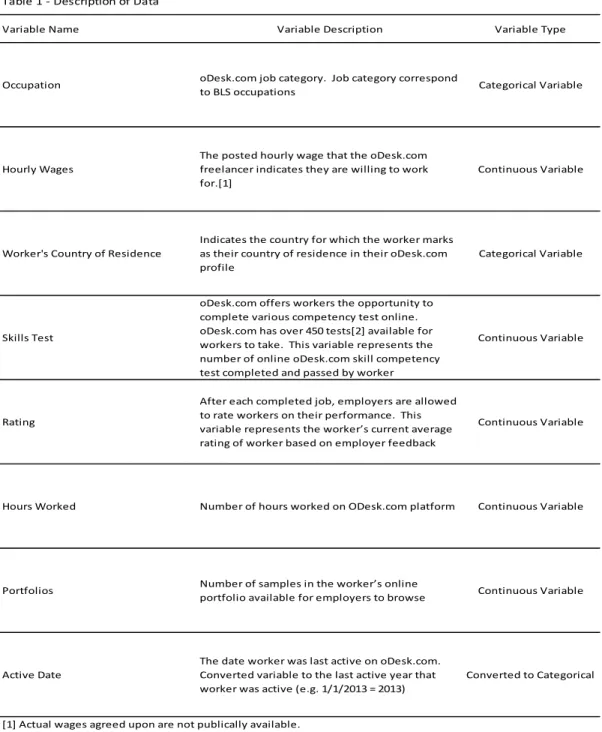
Table 1: Description of Data ... 48
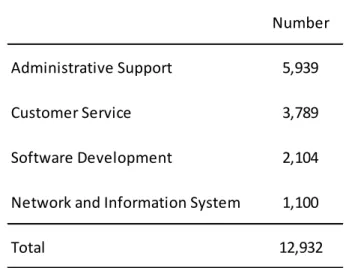
Table 2: oDesk.com Occupational Category ... 49
Table 3: oDesk.com and BLS Occupational Matches ... 50
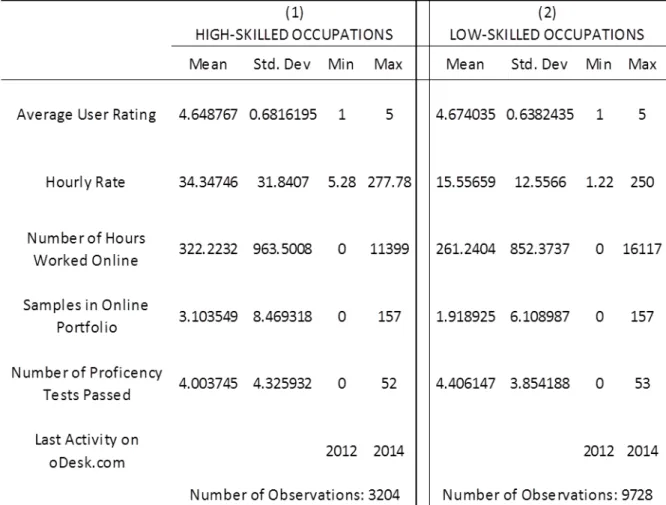
Table 4: Descriptive Results ... 51
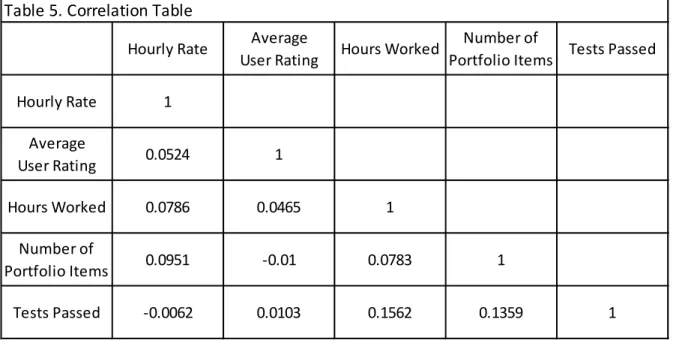
Table 5: Correlation Table ... 52
Table 6: oDesk.com Wages vs. BLS Wages for Specific Occupations ... 53
Table 7: Online Worker Wage Models ... 60
List of Figures
List of Charts
Chart 1: Software Development Wage Distributions ... 54
Chart 2: Customer Service Wage Distributions ... 55
Chart 3: Wage Distributions for Online Software Developers ... 57
Chart 4: Wage Distributions for Online Customer Service Workers ... 58
INTRODUCTION
Technological advancements have always changed both the demand for certain types of
workers and the nature of the employer-employee relationship. In the last decade, the
widespread proliferation of the Internet has led to the creation of the online labor market,
which connects employers with virtual workers. The dramatic increase of work in the online
labor market, and its corresponding non-traditional work arrangements, underscores the
importance of understanding how these changes affect workers and labor market dynamics
globally. In the next two decades, labor scholars have estimated that 20 percent of all work
could be done by contracted virtual workers.1 As the online labor market grows, so do the
social, institutional and economic implications of new work arrangements associated with the
online labor market. However, to date, the online labor market has received little attention
from scholars studying work and occupations.
In this study, I will make the case that online work is not only a natural extension of the
globalization of labor markets, but introduces a new spatial restructuring of work that removes
nearly all temporal and spatial constraints. The spatial restructuring of work has created an
“international virtual reserve army of labor” that drives down the asking wages for workers and
increases the prevalence of precarious work in the U.S. I posit that the nature and type of
service and knowledge-based work that can be done virtually might disproportionately affect
more highly skilled U.S. workers, who have traditionally been more immune from globalization
(Blinder 2006). As the social contract of employment continues to evolve towards more
precarious work, the future growth in the online labor market could further exacerbate the
polarization of wages for more highly skilled US service and knowledge workers.
My contributions will advance both the work and occupations literature and broader
labor market theories in several ways. First, I demonstrate that the structure and institutional
framework of the online labor market is a distinctly different, extension of the broader labor
market. Next, I introduce a new typology that more precisely demarcates the online labor
market within the broader labor market. Lastly, I show that the spatial restructuring of work
has created a new labor framework that allows U.S. employers to more effectively and cheaply
reach workers, regardless of their location, which creates increased competition for jobs and
simultaneously drives down wages within the labor market.
THE EVOLUTION OF WORK: A CATALYST TO THE ONLINE LABOR MARKET
Literature on the online labor market spans many disciplines, from sociology and
communications to economics and information science. The research is as varied as the
disciplines, but this section will demonstrate that current literature has focused on access,
transaction cost of virtual work, and effectiveness of labor, while ignoring the effect of the
online labor market on wages. The sociology research has predominately revolved around
understanding the effects of technology on mobility and inequality. Dimaggio et al. (2004)
explored the digital inequality within the online population in extent and types of use,
autonomy of use, and the effectiveness with which desired information can be retrieved, but
Dimaggio (2008) later examined whether people without Internet access are disadvantaged in
their pursuit of “good jobs and adequate incomes” (2008:2) and found that U.S. workers who
used the Internet increased their earnings at a faster rate than their offline counterparts. He
showed a definite correlation between internet usage and earnings, but his analysis was limited
to workers already employed in a traditional work setting. Other sociological research has
focused on the “digital divide” and found that minorities in all groups had significantly less
access to the Internet (Fairlie 2004), which illustrates the importance of both technical skill and
technology access to economic mobility, but still falls short of addressing the online labor
market.
Examining technological change and labor markets through the inequality and
stratification literature a general consensus is that technological change exacerbates inequality
by putting a premium on skilled workers. Scholars use return to schooling data as evidence. As
technology has increased and changed the labor market, higher educated workers have made
more. Wages of college graduates relative to the wages of high-school graduates increased by
over 25 percent between 1979 and 1995 and the difference in wages between workers in the
90th percentile and the 10th percentile increased from 266 percent to 366 percent during the
same period (Acemoglu 2002). Others have argued a direct causal relationship between
technological changes and inequality (e.g. Krueger 1993, Caselli 1999). Caselli (1999) argues
that technological change causes the “capital-labor ratio” to drop for low skill workers because
employers are devoting more capital to create high-skilled jobs. Others reach the same
increase in the supply of skilled workers that acts as the catalyst for the increase in demand.
They argue that these workers enable firms to introduce more efficient techniques that are
predicated on a supply of skilled workers (Acemoglu 1998). Conversely, inequality scholars
have explained the decrease in wages for low skilled workers through different mechanisms of
technological changes. Galor and Moav (2000) argue that technological change creates an
"erosion effect," because it reduces the productivity low-skilled workers. Caselli (1999) claims
that we are in a “skill-biased” technological revolution that has triggered firms to reallocate
resources from low skilled workers and jobs, to high skilled workers and jobs ultimately leading
to lower wages for low skilled workers.
While changes in technology have played a significant role in increases in wage
inequality, stratification scholars also acknowledge that economic globalization, which exposes
national labor and financial markets to international competition, may increase inequality (e.g.
Lindert and Williamson 2003). One aspect of economic globalization, relevant to this analysis, is
that rising income inequality in many industrial countries has been associated with increasing
number of foreign born workers in these countries. Scholars argue that the immigrant
population increases the supply of low-skill workers, simultaneously driving down wages and
displacing low-skills natives workers (Borjas, Freeman, and Katz 1996; LaLonde and Topel 1991;
Lee 2005).
Summarizing the inequality literature discussed, technological change exacerbates
inequality by putting a premium on skilled workers. Furthermore, one aspect of economic
simultaneously drives down wages and displacing low skilled domestic workers. While this
literature has not explicitly addressed the online labor market, they suggest that the online
labor market would increase inequality by providing opportunities for high skilled workers and
decrease wages for low skilled workers by increasing competition.
Scholars in other disciplines, such as economics, communications, and information
science, have all studied specific components of the online labor market, ranging from the
applicability of experiments using online participants (e.g. Horton, Rand & Zeckhauser 2010) to
the effect of project size on project outcomes (Snir & Hitt 2003). Much of the current work
concentrates on the transactions between worker and employer, particularly the transaction
costs of virtual work and the process for both worker and employer when dealing with
imperfect information. For instance, studies have looked at the use of feedback rating by
employers (e.g., Yoganarasimhan 2013a), the effects verified work experience on worker’s
ability to gain employment (Agarwal et al. 2013), and the increased complexity introduced by
virtual work related to communication, coordination, and culture of labor (e.g., Agerfalk et al.
2008). Other studies have examined the mechanism through which employers and workers are
matched. Research has looked at the differences in auction designs (open vs. sealed bid) for
online platforms (Hong, Wang & Pavlou 2014), the distribution of bids (Yoganarasimhan 2013b)
and the employer’s selection factors (Banker & Hwang 2008). In short, the preponderance of
research has focused on hiring decision factors, the mechanism associated with the
employer/worker transaction costs, and the effectiveness of virtual work for project and
Although current work and employment relations literatures haven’t directly addressed
the online labor market, studying the online labor market, itself, provides a useful context to
begin unraveling how work is changing. Literature shows three key developments since the
1970s that are relevant to the online labor market: 1) macro-structural changes in social,
political, and economic institutions have changed the organization of work, 2) the
internationalization of labor markets has increased access to workers and 3) the nature and
type of work since the 1970s has shifted away from manufacturing to a more service and
knowledge-focused work force.
Macro-structural changes in social, political, and economic institutions
Scholars have argued that since the 1970’s, the macro-structural changes in social,
political and economic institutions have changed the organization of work, replacing stable
employment systems with greater polarized and precarious work systems (Kalleberg 2011).
While other epochs in the U.S. exhibited similar trends, Kalleberg (2011) argues the current
changes “represent long-term structural transformations in employment relations rather than
being simply reflections of short-term business cycles” (Kalleberg 2012: 21). The new social
contract of employment, specifically the increased flexibility for employers, meant the end of
lifelong employment and predictable advancement for workers (Cappelli 1999). Globalization
of production through the internationalization of labor markets heavily influenced the change
in the social contract of employment and was made possible by communication and
information technologies, such as the spread of computerization and the development of the
Internet (Kalleberg 2011: 26). The internationalization of labor profoundly changed the nature
available to employers. When China, India, and the former Soviet bloc countries entered the
global market, the possible global labor pool doubled (Freeman 2007). The redistribution of
labor globally led to a spatial restructuring of work, which liberated employers from
conventional temporal and spatial constraints (Wallace & Brady 2001). Wallace and Brady
(2001) suggested that “spatialization” allowed employers to easily relocate business operations
to optimize production to cheap labor.
Furthermore, the increased access and the corresponding decrease in temporal or
spatial constraints shifted the power and control dynamic towards the employer (Freeman
2007). In its most advanced form, “spatialization involves the decentralization of work activities
across geographic and temporal boundaries while increasing the centralization of managerial
control over the labor process” (Wallace & Junisbai 2003: 393). This “spatialization” relies on
technocratic control, achieved through “computerized technologies” to “coordinate and control
the activities of workers in far-flung corners of the world as if they were under a single roof”
(Wallace & Junisbai 2003: 393). With the nearly non-existent temporal or spatial constraints in
the online labor market, it’s not difficult to imagine further polarized and precarious
employment systems. Employment relations literature has not specifically addressed the online
labor market or the potential of a global labor force that is spatially and temporally
unconstrained. Shifting the focus from the employer, this research will examine what a lack of
spatial and temporal constraints means to workers, occupations, and labor markets.
Internationalization of Labor Markets
The “reserve army of labour,” a concept first introduced by Engels (1845) and further
laborers. Marx also alluded to the need to look beyond borders for cheap labor by suggesting
the pursuit of “an ever extended market” as an “inner necessity” of the capitalist mode of
production (Marx 1867: vol. 3 344). Arthur Lewis (1954) further argued that in third world
countries with vast, seemingly unlimited supplies of labor, capital accumulation could occur at a
high rate. The concept of a more global reserve army of labor was further advanced by Hymer
(1979), who argued that the “latent surplus-population,” or reserve army of labor in the
informal markets of both the developed and underdeveloped economies, creates a continual
movement of surplus population into the labor force (Hymer 1979: 81, 86, 161, 262–69). In the
four decades since Hymer, technological advancement has removed the geographic and spatial
constraints and created a “virtual reserve army of labor” that dwarfs any individual domestic
labor market. With almost three billion Internet users,2 the potential for a “virtual reserve
army of labor” is staggering. The online labor market will likely exert downward pressures on
wages, further exacerbating the global labor arbitrage already introduced with increased
globalization. According to Stephen Roach, economist at Morgan Stanley, global labor arbitrage
occurs when “American companies are replacing high-wage workers here with like-quality,
low-wage workers abroad.”3 Although Roach is referring to replacing domestic laborers with
international workers in their own country, he acknowledges that “with new information
technologies allowing products and now knowledge-based services to flow more easily across
borders, global labor arbitrage is likely to be an enduring feature of the economy.”4 In other
2 http://www.internetlivestats.com/ (accessed 3/30/14)
3 http://www.nytimes.com/2004/07/22/opinion/more-jobs-worse-work.html?pagewanted=2&src=pm
words, the spatial restructuring of work that enables employers to easily and effectively access
the virtual reserve army of labor will exacerbate the global labor arbitrage that was introduced
with globalization in traditional labor markets.
Decentralized Capitalism and the Evolution of Work since the 1970’s
Since the 1970s, because of employers’ search of flexibility and profits, coupled with the
decline of collective power and rights of workers, employment relations have become
increasingly market-mediated. Market-mediated employment relations are based on free
market competitions and are associated with lower institutional protections of workers
(Kalleberg 2011: 83). One of the features of market-mediated employment relations is the
transfer of risk away from the employer towards the employee through flexible work
arrangements. The expansion of non-standard work arrangements is only possible if there is a
surplus of workers who are willing to take a less stable arrangement, and the online labor
market is both increasing the surplus of workers in an environment that is founded and
centered on non-standard work arrangements.
Powell (2001) coined the term "decentralized capitalism" to describe the fundamental
change in the way work is organized, structured, and governed today, the characteristics of
which are quite relevant to the online labor market. First, work is now being organized around
projects, not jobs. Bluntly put, “the new system approaches a form of pay for productivity, with
little recourse to loyalty or seniority” (Powell 2001: 34). The key consequence of the remaking
of the division of labor is that “important tasks no longer need be performed inside the
boundaries of the organization” (Powell 2001: 36). In the traditional labor market, this trend
According to Kalleberg (2011), data from a representative sample of U.S. establishments
showed over half outsourced some of their activities. The data also showed that the temporary
help agency sector has grown 11 percent annually every year from 1972 – 1990. Perhaps most
telling is that “virtually all jobs are vulnerable to it (outsourcing), including high-wage,
white-collar jobs that were once seen safe” (Kalleberg 2011: 89). The growth and trajectory of the
online labor market is not only a natural extension of decentralized capitalism, but also the
labor markets’ response to the new way that work is organized. So, while virtual workers are
able to pick, choose, and leverage multiple online work sites, the “pay for productivity” (Powell
2001: 34) structure of the online labor market magnifies the effects of decentralized capitalism.
On the whole, if employers are taking work from traditional labor markets and moving it online,
work will become even more precarious.
The second characteristic of “decentralized capitalism” is a move from hierarchies to
networks as the basic unit of economic action introducing a “latticework of collaborations with
‘outsiders’ that blurs the boundaries of the firm” (Powell 2001:36). The new structure of
production now relies more on subcontractors, substituting outside procurement for internal
production, which suggests a further shift towards outsourcing/subcontracting within the labor
market because the availability of an on-demand virtual work force is an attractive and cost
effective alternative to traditional work arrangements. The final characteristic of “decentralized
capitalism” is the increase in inter-industry cross-fertilization. This is more of an
organization-level characteristic and is less directly related to workers, but it is important to note that the
idea of leveraging skill and capabilities across industries is changing the way organizations have
obsolete, firms look externally for new capabilities and utilize outsiders for tasks that cannot be
done effectively internally” (Powell 2001: 46).
Lastly, the evolution in the type of work is important to explore so that we may
understand how the online labor market is both a reaction to and a distinct evolution of how
work is completed. Until the 1970s, industrial and manufacturing work had compromised the
lion’s share of the work. A substantial shift in employment began in the 1970s, toward
industries that produced services. The growth has been the driving force of the “knowledge
society,” in which information has become the central source of power and productivity. In
2009, more than 85 percent of people in the U.S. worked in the service sector, up nearly 70
percent since 1970 (Kalleberg 2011: 29). The service sector has also fueled the expansion of
contingent and non-standard work, since service sector jobs tend to be more conducive to
flexible scheduling (Kalleberg 2011). While technology was an essential element to the rise of
the online labor market, the growth in the service sector certainly fueled the growth in the
online labor market because service work can be done virtually, while manufacturing work
cannot. The actual size of the online labor market is unknown, but Horton (2010) estimated
work in the online labor market in 2009 to be around $700 million. More recent estimates have
put work in the online labor market in the billions.5 Some have projected that in the future, the
online labor market could represent 20 percent of all work.6 The continuing evolution in the
nature and type of work since the 1970s to a more service and knowledge industry suggests
5 http://blogs.ft.com/beyond-brics/2012/05/23/virtual-working-takes-off-in-ems/ - Retrieved 10/14/2013
that the online labor market could continue to grow. It is vital, then, that future research in
employment relations account for workers in the online labor market.
In brief, because of the newness and recent proliferation of the online labor market the
research to date falls short in two areas which my research will address. First, current labor
market research is predicated on spatial and geographic constraints, which do not exist in the
online labor market. Secondly, research has not directly addressed the changing organization
of work, the internalization of labor, the shift from manufacturing to service work in the context
of virtual work.
ONLINE LABOR MARKET: DEFINITION AND BOUNDARIES
Current scholarship has taken a narrow view on attempting to define the online labor
market. Kittur et al. (2013) defined it as:
“…performance of tasks online by distributed crowd workers who are financially
compensated by requesters (individuals, groups or organizations). In this sense, crowd work is a sociotechnical work system constituted through a set of relationships that connect
organizations, individuals, technologies and work activities.” p.1301
As the proceeding discussion will illustrate, Kittur defines a narrow segment of the
market. Horton, former staff economist at oDesk.com, provides a broader definition. Horton
(2010) defines the online labor market as having three key attributes:
(1) Labor is exchanged for money,
(2) The product of that labor is delivered “over a wire” and
(3) The allocation of labor and money is determined by a collection of buyers and sellers
I argue that the online labor market has an even greater reach, specifically more than
just labor delivered “over a wire,” and propose the following key attributes:
(1) Labor is exchanged for monetary compensation,
(2) The exchange of information between employers and job seekers about wages, conditions of employment and job attributes are done virtually,
(3) The product of the labor is either delivered “over a wire” or completed by the worker in physical environment but facilitated through virtual means,
(4) The allocation of labor and money is determined by a collection of buyers and sellers operating within a global price system.
Within the framework of the definition above, I argue that online labor market
encompasses three broad spectrums of work – “internet enabled” work, “internet facilitated”
work, and “virtual” work. This new typology fully demarcates the boundaries of the online labor
market. Definitions to date have mostly focused on components of the “virtual” work
spectrum, and because of the narrower scope both the “Internet enabled” work, and “Internet
facilitated” work have been excluded. The following sections will examine in detail, “internet
enabled” work, “internet facilitated” work, and “virtual” work within the defined framework
above.
“Internet Enabled” Work
I define “Internet enabled” work (IEW) as work in which the workers and employees use
the internet as the tool to make the connection, but the internet serves no other function in
this spectrum of the online labor market – the site does not serve as intermediary, the site is
worker and employer not through a third party website or program. The nature of the work is
contractual and short term. IEW is mostly comprised of work that requires a physical presence.
The most popular and well known IEW platform is Craigslist. Started in 1995, Craigslist at
the most basic level is an electronic classified advertisement site. It is localized to specific cities
and at last count boasted over 700 cities in 70 countries. All told, it is estimated that Craigslist
generates over 50 billion page hits a month, with over 2 million new jobs posted monthly. The
“Jobs” section, along with the “Gigs” section received 31.3 million postings in 2011.
Jobs and tasks on Craigslist vary widely and range from the mundane like moving
furniture or landscaping, to the downright bizarre. Posting ad hoc work and tasks has been a
common feature of Craigslist since its inception, but on August 1, 2004, the “Gigs” section was
added to Craigslist, and in the process, officially adding IEW as a service category. I argue that
the online labor market was officially launched on August 1st, 2004.
While the majority of transactions on sites like Craigslist arguably don’t fall under the
umbrella of the online labor market, it is important to include sites like Craigslist in the
discussion for two reasons. First, it was the first widely accepted online site to connect workers
with employers. In this respect, Craigslist marks the beginning of the short history of the online
labor market. More broadly, the incredible reach and penetration of sites like Craigslist move
the online labor market from the periphery to the mainstream. In many ways it legitimized the
idea of the exchange of labor as a virtual transaction. Within that context, it is not surprising to
see the natural evolution from “internet enabled” work to “internet facilitated” work. As the
dependent, “internet facilitated” work, which is squarely within the boundaries of the online
labor market.
“Internet Facilitated” Work
I define “Internet facilitated” work (IFW) as work in which the workers and employers
use the internet as the tool to make the connection, AND the internet serves as intermediary –
connections, arrangements, and financial transactions are facilitated through the internet.
IFW, like IEW, can have a physical presence. The types of work and task are similar to IEW, but
the role of the internet is much more prominent. Appendix B summarizes the prominent IFW
sites currently in the online labor market.
One of the first successful IFW entities was runmyerrand.com, established in Boston in
September 2008. Runmyerrand.com became popular locally and caught wind of venture
capitalist funders and by 2010 it had received venture capitalist funding and was rebranded as
taskrabbit.com. By 2011, it was reported that taskrabbit.com was generating over $4 million in
business each month. It continues to grow and a press release on their website published a
target of reaching 1 million verified workers by the end of 2013. While taskrabbit.com might be
the most prominent player in the IFW arena, there are other sites. CampusBellHops.com is in
47 cities (within proximity of universities) and mainly focuses on “employers” looking for
moving related services and they rely on local students as their labor pool. Thumbtack.com is a
site similar to taskrabbit.com in which jobs are posted for completion. Their website indicates
over 240,000 registered “service providers”. Zaask.com is local to Portugal, but is actively
beginning to build its network of users in the United States, for an anticipated launch in the
someone to help them perform a job, and “Taskers” are workers who are willing to provide the
service.
Regardless of the IFW site the basic model is identical. Potential employers will list the
task they want completed. Then workers go online and bid for the work. The employer then
chooses the worker for the task, usually based on the lowest cost. This tends to create a
downward bidding process in which workers compete with one another to offer potential
employers the lowest rate possible. All of the sites take commissions from the employer, and all
employees are paid via the site (not the employer). The commissions vary between 10-20
percent of the amount bid for the task. Two additional attributes, while not consistent among
all of the sites, are prevalent and important enough to mention. Several of the sites “vet” their
workers, with taskrabbit.com being the most aggressive by requiring a background check and
an online test covering topics in their worker manual. Thus only “pre-approved” workers are
allowed to bid on work. Many of the sites also incorporate rating systems so that employers
are allowed to rate workers which are included in the worker’s profile. While rating systems
aren’t universal across all sites, their prevalence does set a precedence of “disempowering” the
worker in an already extremely precarious work situation. As I discuss later, this problem is
amplified in the remaining component of the online labor market, virtual work, as all
geographical constraints are removed and the worker becomes the anonymous laborer on the
other side of the computer monitor.
Virtual Work – Microtasking and The Virtual Service Industry
Virtual work is third and final component of the online labor market. The following
a) Internet is the tool to make the connection,
b) Internet serves serve as intermediary – connections, arrangements, and financial transactions are facilitated through the internet,
c) All work is done completely online.
Virtual work tends to be the type of work that has traditionally been thought of as the
online labor market. Naturally, because geography is not a consideration, virtual work has the
greatest number of workers in the online labor market. Another key difference of virtual work
versus the other two is the demographic differences in the workers. Virtual work has the
greatest share of international workers and boasts the largest workforces available to
employers in the online labor market. There are dozens of sites offering “virtual work” including
Zhubajie, who reports having 7.6 million workers, Freelancer.com who reports having 6.5
million users, Elance.com who reports 2 million users and Mechanical Turk with over 500,000
workers.
It is important to distinguish the varying jobs and tasks in virtual work as they differ
quite significantly in both skill and pay. The continuum of work available ranges from
“microtask” sites, like Mechanical Turk (mturk.com) that pay workers a few cents (in many
cases) for completion of miniscule tasks, to oDesk.com, which focuses on high-skilled workers
to complete more complex tasks or projects. Because the type of work is so different, and the
wages structure and skill required are so divergent I distinguish virtual work into two categories
- microtasking work and the virtual service industry (VSI).
I will first begin by looking at microtasking work. Microtasking, also known as
“crowdworking”, can be defined as taking a large project and breaking it down into microtasks.
larger result. These tasks are completed on a one-off basis by workers. A worker may complete
hundreds to thousands of micro-tasks in a given week and the worker might complete the
identical task for the same employer numerous times, for example entering an address into a
web form from a picture of a business card. Unfortunately for workers, the microtasks come
with micro sized compensation. Workers’ reported wages vary, but range from $1 to $4 dollars
an hour. My research of workers engaged in micro-tasking suggests that workers are earning
between $1-$2/hr.7
The most well-known microtasking site is Amazon’s Mechanical Turk. The site was
launched publically November 2, 2005 and was initially loaded with tasks by Amazon that asked
workers to look for redundancies on their vast web pages. After the initial launch, the concept
and idea of microtasking didn’t gain traction until 2007. By the end of 2007, Mechanical Turk
had grown to 100,000 workers. This was immediately followed by several years of significant
growth, and by 2011 Mechanical Turk had over 500,000 workers in 190 countries. In addition
to Mechanical Turk, there are several other microtasking sites. Zhubajie.com is a Chinese
microtasking site who reports to have 7.6 million workers. The same company has a US
equivalent website called witmart.com. Cloudcrowd.com has over 125,000 workers and mainly
focuses on microtasks, but does have a variety of low paying jobs available. Microworker.com
is also another large microtask site with over 400,000 workers worldwide. Please see Appendix
B for a summary of microtasking sites described.
Regardless of site, the basic framework is identical: employers post tasks on the site,
workers accept tasks, complete the tasks, and then receive compensation once the work has
been approved by the employer. In microtasking work, unlike both the IEW and IFW, there is no
bidding process on price. Instead the employer sets the price for tasks. Inherent in the
microtasking framework is a severely unbalanced power structure favoring employers. This
happens through two mechanisms. First, workers are only compensated after work has been
completed. This leaves the workers at the mercy of the employer. This is further complicated by
rating of workers by employers. First, workers with poor ratings on many sites are barred from
accepting further tasks. Furthermore, employers are allowed to filter out workers based on
their approval rating and the practice is commonly promoted by the microtasking sites. On
Mechanical Turk for example, the default setting for employers is set to only make tasks
available to workers who have a 95 percent or above approval rating. Unsurprisingly, workers
are left vulnerable to employers who threaten negative approval ratings.
Transitioning away from microtasking, I will now discuss the other large portion of
virtual work – what I refer to as the Virtual Service Industry (VSI). The VSI, like microtasking, is
work in which workers and employees use the internet as the tool to make the connection, the
internet serves serve as intermediary – connections, arrangements, and financial transactions
are facilitated through the internet AND all work is done completely online. Like microtasking,
the labor force is global, and the complete virtual nature of the work lends itself well to a global
labor force. The main difference between microtasking and the VSI is in both the complexity
and duration of the work. Work found in the VSI tends to be “professional” work, and most
likely has an equivalent counterpart in the traditional workplace, but does not require a
physical presence. This is important because it represents the possibility that jobs are being
the VSI. The major categories of work in the VSI include web work and programming, design
and multimedia work, writing and translation, administration support, sales and marketing
work, finance and management, and legal services. The implications of professional and service
work moving to the online labor market is that workers who have been less affected by
globalization will now face many of the same pressures that manufacturing workers and
low-skill workers have historically faced. As I will address later in the paper, a very real possibility
could be lower wages for virtual workers when compared to their counterparts in the
traditional labor market.
The range of sites for workers in the VSI to choose from is greater than in any other
segment of the online labor market. There are a plethora of sites (e.g. 99designs.com,
crowdspring.com, createmytattoo.com, iStockPhoto.com, rentacoder.com,
articleonepartners.com). While there are a fair number of skill specific sites on the VSI, the
majority of the workers and commerce tends to be found on general sites: freelancer.com,
elance.com, odesk.com, and guru.com and the number of workers is significant. Freelancer.com
has a reported 9.3 million users with over 1 billion dollars of projects posted, oDesk.com has
over 2.7 million workers and over 1 million jobs posted in 2012, Elance.com has a reported 2.5
million users, and Guru.com has over 1 million workers. See Appendix B for an overview of VSI
sites discussed.
The workers used in my analysis were collected from oDesk.com. I chose to use workers
on oDesk.com because it represents the largest online marketplace, as measured by worker
workers and 540,000 employers worldwide.8 Workers on oDesk.com create profiles that list
their work experience, expected hourly wage, country of residence, number hours worked on
projects booked through oDesk.com, links to sample portfolios of work, any competency tests
taken, the last date the worker was active, and the worker’s star ratings as evaluated by
employers. Workers come from 157 different countries or territories. Potential employers can
list jobs and projects and workers are allowed to bid on the job or projects. Potential
employers can also contact workers directly about jobs. Work is either done hourly or by fixed
price projects. For virtual workers on hourly jobs, workers are required to log into the
oDesk.com global online platform. This allows oDesk.com to monitor the rate of keystrokes
and mouse activity, and based on this activity, oDesk.com takes “work in progress” snapshots of
the virtual worker’s computer screen and shares it with the employer. It takes snapshots at
random intervals, but for workers with lower keystroke or mouse activity it takes more
frequent desktop snapshots. All financial transactions are completed through the online work
platform, and hourly workers are compensated weekly for their work. oDesk.com charges
employers 10 percent of the hourly rate or fixed price of the project.
There is surprising consistency in the structure of the oDesk.com with the other general
VSI sites. All sites have employers post projects which are then bid on by virtual workers. All
sites allow employers to either post jobs at a fixed rate or as an hourly rate. All sites have
mechanisms in which workers are rated for their work and all sites offer dispute resolution
processes in which the site actively becomes involved in disputes. It is unclear based on the
8 "Virtual offices are altering the future of work". The Globe and Mail. Retrieved October 10, 2014
information available on their respective websites as to the exact dispute resolution process,
but they all offer those services. The most significant difference between the sites concerns the
fee structures. Some of the sites charge the worker, some charge the employer and some
charge both. Guru.com charges the worker (between 7-12 percent), Freelancer.com charges
both (employers 3 percent, workers 10 percent) and Odesk.com and Elance.com charge the
employer (10 percent and 8.75 percent respectively). The premise of charging the worker (or
both) is a major departure from all other segments of the online labor market. While it is not
clear why the sites would choose to charge the worker, one could argue that charging workers
will filter out the less serious workers while simultaneously making the site more attractive to
employers than the other sites on the VSI.
When comparing the sites in the VSI to the other segments of the online labor market
several points warrant mention. First, the VSI tends to have a more heterogeneous employer
base, in part no doubt, because of the diversity of work that is offered. Small businesses use the
VSI to contract work they don’t have the expertise in house to complete; individuals hire
workers for personal projects (e.g. designing wedding invitations); and large corporations
outsource entire responsibilities historically given to salaried employees. This diversity suggests
that the VSI has the biggest potential for growth. Next, many of the jobs moving to the VSI tend
to have come from occupations that have historically been “good jobs”. The significance of this
can’t be understated. The VSI has the potential to replace “good jobs” in traditional labor
markets, with contracted workers in the online labor market. On the flipside, the opportunity
for workers in developing countries could be significant, potentially at the cost of US workers.
could mean a comfortable living for others. I believe the issue of wage differential and the
replacement of “good jobs” is perhaps the biggest social and economic implication of the
proliferation of the online labor market, and warrants further investigation.
HYPOTHESES
Generally, my research examines what the lack of spatial and temporal constraints in
the online labor market means to workers, occupations, and wages. My research will examine
workers in two high-skilled occupations and two low-skilled occupations. The high-skilled
occupations include software development and network and information systems. The
low-skilled occupations include administrative support and customer service. I chose these
occupations based on their attributes and typical education requirements as described by the
Bureau of Labor Statistics Occupational Outlook Handbook.
The first part of my analysis will focus on differences between virtual workers and
traditional workers. I will compare wages between virtual workers and traditional workers in
these four occupations to establish if, in fact, a difference in wages exists. If a difference in
wages is established, I will focus on the differences between virtual and traditional worker
wages in the lower and upper quadrants of the wage distributions to understand if the online
labor market is disproportionally hurting workers in certain parts of the wage distribution.
More specifically, I will compare virtual workers and traditional workers at various locations
along the wage distribution for a high-skilled occupation (software development) and a
low-skilled occupation (customer service). I will measure workers at the 10th, 25th, 50th, 75th, and
virtual and traditional workers will be greater at the 10th and 25th percentile than workers at the
75th and 90th percentiles.
The second part of my analysis will focus on virtual workers. I will examine virtual
workers’ wages along different parts of the wage distribution to understand how the online
labor market is affecting lower paid vs. higher paid virtual workers differently within the same
occupation and between occupations. I will also create multiple virtual worker wage models
that will allow me to identify what drivers within the online labor market might be affecting
wages for virtual workers. Regression analysis will be used to understand the relationship
between workers’ experience, workers’ perceived credibility, and workers’ skills and wages.9
More specifically, I will test the following hypotheses:
Hypothesis #1: For workers in the same occupation, wages for virtual workers will be lower than wages for traditional workers.
Hypothesis #2: Within the same occupations the difference in wages between virtual and traditional workers will be greater for workers in the
lower quadrants (10th and 25th percentile) of the wage distribution.
Hypothesis #3: The difference in wages between virtual and traditional workers will be greater in certain occupations. Virtual workers in high-skilled occupations will have the greatest difference in wages compared to their counterparts in the traditional workplace. Conversely, workers in low-skilled occupations will have the smallest differences in wages.
Hypothesis #4: The difference in wages for virtual workers in the lower
quadrants (10th and 25th percentile) of high-skilled occupations will be
greater than the difference for virtual workers in low-skilled occupations.
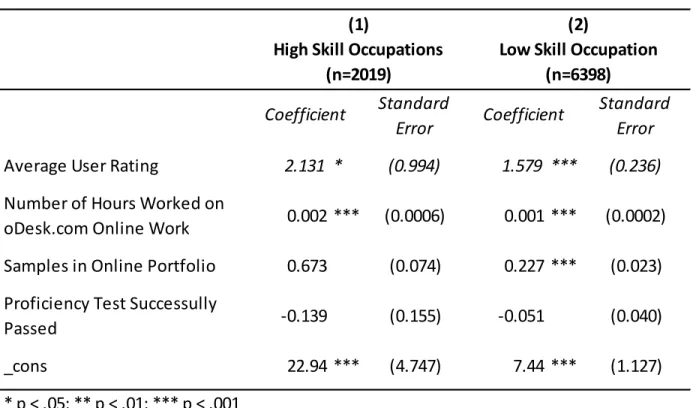
Hypothesis #5: Wages within occupations for virtual workers will vary, based on workers’ experience, workers’ perceived credibility, and
workers’ skills. Variation will be consistent between high-skilled and low-skilled occupations.
DATA AND RESEARCH DESIGN
I will use primary data I collected from worker profiles on oDesk.com for the wages of
virtual workers and I will use BLS wage and occupation data for the workers in the traditional
labor market.
oDesk.com Data
Comprehensive worker data for all workers registered on http://www.oDesk.com were
captured using web extraction data techniques.10 All data were collected for all workers on
oDesk.com and are summarized in Table 1.11 While data were collected from oDesk.com
workers globally12, I will focus on workers residing in the U.S., and analysis will only include
wages from workers who physically reside in the U.S.,13 since the wages and data for the
occupations in the traditional work settings are for workers in the U.S. It is important to note,
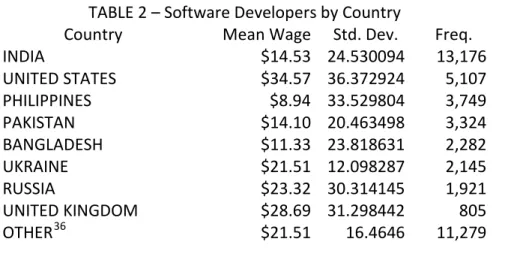
that if my analysis did include workers globally, the mean observed wages for all occupations
10 Data represent workers on oDesk.com on 03/2014.
11 Data represent workers on oDesk.com on 03/2014.
12 Includes the following countries: Albania, Algeria, American Samoa, Antarctica, Antigua And Barbuda, Argentina,
Armenia, Aruba, Australia, Austria, Azerbaijan, Bahamas, Bahrain, Bangladesh, Barbados, Belarus, Belgium, Belize, Bermuda, Bolivia, Bosnia And Herzegovina, Botswana, Brazil, British Virgin Islands, Bulgaria, Burkina Faso,
Cambodia, Cameroon, Canada, Chile, China, Colombia, Costa Rica, Cote De Ivoire, Croatia, Cyprus, Czech Republic, Denmark, Dominica, Dominican Republic, Ecuador, Egypt, El Salvador, Eritrea, Estonia, Ethiopia, Fiji, Finland, France, Gambia, Georgia, Germany, Ghana, Great Britain, Greece, Grenada, Guadeloupe, Guam, Guatemala, Guyana, Haiti, Honduras, Hong Kong, Hungary, Iceland, India Indonesia, Ireland, Israel, Italy, Jamaica, Japan, Jordan, Kazakhstan, Kenya, Kuwait, Kyrgyzstan, Laos, Latvia, Lebanon, Libya, Lithuania, Luxembourg, Macedonia, Madagascar, Malawi, Malaysia, Maldives, Malta, Martinique, Mauritania, Mauritius, Mexico, Moldova, Monaco, Mongolia, Montenegro, Morocco, Mozambique, Namibia, Nepal, Netherlands, New Zealand, Nicaragua, Nigeria, Norfolk Island, Norway, Oman, Pakistan, Palestinian Territories, Panama, Paraguay, Peru, Philippines, Poland, Portugal, Puerto Rico, Qatar, Romania, Russia, Rwanda, Saint Kitts And Nevis, Saint Lucia, Saint Vincent And The Grenadines, Saudi Arabia, Senegal, Serbia, Seychelles, Singapore, Slovakia, Slovenia, South Africa, South Korea, Spain, Sri Lanka, Sweden, Switzerland, Taiwan, Tajikistan, Tanzania, Thailand, Trinidad And Tobago, Tunisia, Turkey, Tuvalu, Ukraine, Uganda, United Arab Emirates, United States, United States Minor Outlying Islands, Uruguay, Uzbekistan, Venezuela, Vietnam, Yemen, Zambia.
would be significantly lower. Data suggest that virtual workers in the U.S. are making between
40-90% more per hour than their virtual counterparts globally.14
Additionally, I excluded worker profiles that seemed suspicious. I believe that many
individuals create a profile to “test drive” oDesk.com without any intention of completing work
on oDesk.com. Any worker who had 0 hours of work on oDesk.com and had not logged into
oDesk.com since 2012 was excluded, as well as any records that displayed suspicious hourly
wages (e.g. $.01, $1.11, $11.11, $111.11, $999.99). 15 In total, approximately 38.8 percent of
the records were excluded.1617
Table 2 shows the total number of cases from oDesk.com that were included for each of
the four occupations: software development, network and information systems, administrative
support and customer service. Those occupations were chosen as they have direct BLS
occupational title matches in the wage and occupation data with titles in oDesk.com, which
allows for a logical wage comparison. Table 3 summarizes the oDesk.com and BLS occupations
that were matched.
14 See Appendix A for summary of wages for US workers compared to all virtual workers.
15 Analysis was completed with all data. When compared to analysis with the exclusions mean wages were similar,
but standard deviations were significantly greater with all data included. See Appendix A for means and standard deviations for all data and data with excluded cases.
16 24,855 workers were excluded from the analysis (prior to excluding workers not active since 2012)
Bureau of Labor Statistics Data
Secondary data from the Bureau of Labor Statistics’ (BLS) wage and occupation data18
will also be used. The BSL data are collected from employers in all industry sectors in
metropolitan and nonmetropolitan areas, in every U.S. state and the District of Columbia. The
BLS compiles the responses captured from the National Compensation Survey, the
Occupational Employment Statistics Survey, and the Current Population Survey. I used the
Standard Occupation Classification System (SOC) to select the four BSL occupation codes that
match the oDesk.com occupational categories (Table 3). My analysis includes the BSL wage
estimates for the four occupations, as well as the wage hourly rate, the wage hourly rate at the
10th, 25th, 75th, and 90th percentile wages, and the employment percent relative standard
error.
Dependent Variable
The key dependent variable will be the hourly wage that the worker posted on their
oDesk.com profile, which represents the worker’s asking wage for work, not necessarily the
actual wage that the worker received for work online.
Within the oDesk.com global worker platform, employers have two ways to hire
workers. They can hire workers for a fixed price or hourly. For fixed priced projects, employers
either post jobs with a fixed price, request proposals for completion of the project or contact
workers directly with a proposal. The second way to hire a worker is hourly. In this case, the
employer can post a job and allow workers to apply for the job, or, the employer contacts the
worker directly to inquire whether s/he is interested in the job.
My data represent the asking hourly rate presented by the worker on their profile. My
data do not include work completed on fixed price projects as the number of hours spend on
these projects is not available so I am unable to approximate an hourly wage. Although the
percentage of work completed on a fixed price project is not publically available, oDesk.com
claims on their site that “most people choose hourly contracts”. It is also important to note
that oDesk.com steers potential employers towards hiring workers hourly through two
mechanisms. First, oDesk.com guarantees work when a worker is hired hourly, and if the
employer is not satisfied with the quality of the work that was completed by the worker,
oDesk.com will refund the employer the cost of those hours. Second, the oDesk.com web
interface has a worker monitoring system that is only available to employers when work is
contracted hourly. In order to log hours, a worker is required to login to oDesk.com, and the
platform monitors the worker’s keystrokes and takes periodic screenshots of the worker’s
computer, which are then available to the employer, so that s/he may monitor the hourly work
of the worker.
While using asking wage is not as ideal as using actual wage, four key points
demonstrate the merit of using asking wage in this analysis. First, I believe it’s less likely that
the worker would adjust his/her hourly asking wage on their profile to accommodate an
employer request, as this new lower asking wage would then be reflected to all other potential
employers. Second, any potential employer has access to all other current job applications for
which the worker has applied. Within the application the employer can see the hourly wage
the worker indicated in the application. So, a worker who might be applying for multiple jobs
lower his wage for a specific job with another employer. Third, once a job is completed, the
employer has the ability to review the worker. If the employer chooses to rate and review the
worker, the review will include the hourly rate for that specific job. This means employers,
through the reviews, can see the hourly rate other employers have been receiving. The
transparency of the worker’s hourly wage in their reviews might discourage workers to accept
jobs that are lower than their asking wage on their profile because they risk the possibility of
future employers negotiating their asking wage down based on their hourly wage history in
their reviews. Lastly, given all the different mechanisms available for employers to see the
hourly wage the worker has worked for, any wage negotiation would likely result in an actual
wage being below the asking wage. Because of this, even if you assume that the asking wage is
not representative of the actual wage earned by the worker, then at worst the findings of my
research are conservative. That is, any findings suggesting that wages are lower for virtual
workers based on my analysis would only be magnified if the measure is not an overestimate of
actual wages of virtual workers.
Independent Variables
Four independent variables will be included in my analysis.
Hours Worked Online. This variable denotes the actual number of hours
logged by workers in the oDesk.com online work platform.19 I see this variable
as representing the worker’s oDesk.com “work experience,” and I expect that workers with greater hours will be able to command higher wages. The assumption is that a worker with a greater number hours logged on the
oDesk.com global work platform demonstrates to potential employers they are dependable, able to complete work online, and in demand. This will allow
workers to command a higher wage. For employers, hours worked on oDesk.com
might alleviate any concern about the worker’s ability to complete work virtually.
Average User Rating. This variable denotes the satisfaction of previous employers with the worker. Once a job is completed, employers are allowed to evaluate the quality of the work and the worker. All reviews are posted in the worker’s profile and available for anybody to peruse. I see this variable as representing the worker’s “credibility” and as a proxy for potential employers to assess the quality of work that can be expected. I expect a positive relationship between a worker’s “average user rating” and hourly wages.
Number of Tests Passed. This variable denotes the number of
oDesk.com skill proficiency tests completed and passed by the worker. Workers
have the opportunity to complete 450 different tests20 in a multitude of different
areas. Potential employers are able to see the number of tests taken, whether the same test has been taken multiple times, and the percentage of questions answered correctly. Furthermore, they are allowed to see how long the worker took to complete the test, and how they rank compared to all other workers on the platform who completed the same test. I see this as a proxy measuring the “worker’s competency,” and I expect a positive relationship with wages.
Number Samples in Online Portfolio. This variable denotes the number of samples in the worker’s online portfolio that are available for employers to browse. Depending on the workers occupation the samples in the online portfolio vary. For a software developer, for example, this might include a
sample wordpress plug-in created by the worker.21 These samples are accessible
to anybody interested in hiring the worker.22 Workers are encouraged to post
materials in their portfolio so potential employers are able to see the type of work they can expect, in essence a “validation” of skills. I expect to see a positive relationship with wages.
20 Number of test as of 10/2014
21 This is an actual example taken from a US Software Developer on oDesk.com
Table 4 summarizes the virtual workers in my data. Not surprisingly, when comparing
the hourly rate between the skilled occupations and the low-skilled occupations, the
high-skilled occupations are earning, on average, about 55 percent more per hour. In general, it also
seems as if employers are happy with the work being completed online. The “average user
rating” for workers is near 4.7 out of 5 for both models. Looking at the “number of samples in
the online portfolios”, it seems as if sample work might be more important to high-skilled
occupations. Workers in high-skilled occupations have, on average, three samples available,
versus two samples for low-skilled workers. Conversely, though, low-skilled workers might put
more importance in showing competency through proficiency tests. The “number of
proficiency tests passed” by workers in the low-skilled occupations is about 10 percent more
than workers in the high-skilled occupations.
FINDINGS AND RESULTS
Mean and Median Differences
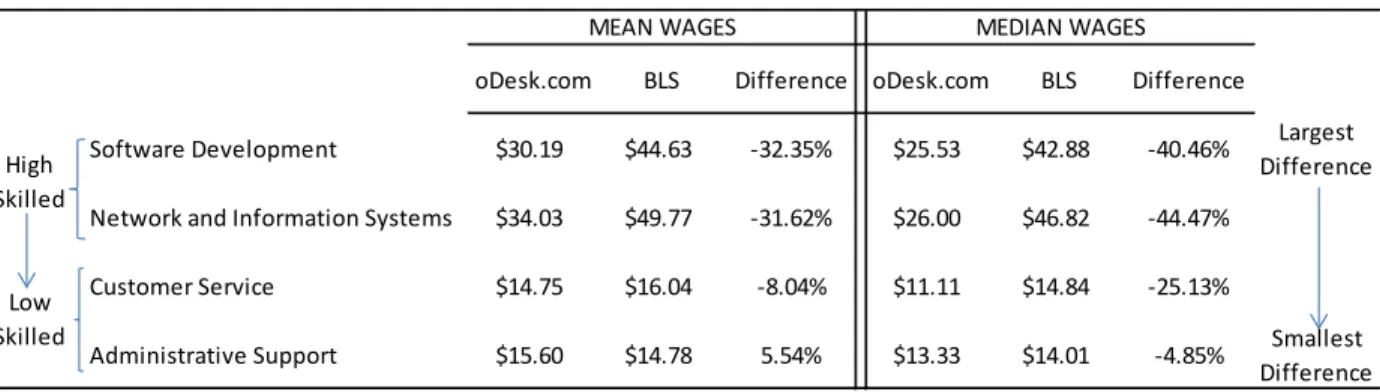
Overall, all of the occupations, except administrative support, showed lower mean
wages for virtual workers. Table 6 summarizes the results. While administrative support
showed about 5 percent higher mean wages for virtual workers, the other occupations showed
mean differences from about 6 percent lower to as large as 35 percent lower. For median
wages, all occupations showed lower wages for virtual workers, ranging from about 4 percent
lower median wages for virtual administrative support to almost 45 percent lower for virtual
network and information system workers. Comparing the mean hourly wages to the median
suggesting that the distribution of wages is skewed (positively).23 As the data become skewed,
the mean loses its ability to provide the best central location, since the skewed data are
dragging it away from the typical value. Also, the mean is susceptible to the influence of
outliers. Therefore, I will compare the differences in median wages, not mean wages, between
oDesk.com and BLS workers.
The difference in median wage between virtual and traditional workers was greater for
the high-skilled occupations (network and information systems and software developers) than
the low-skilled occupations (administrative support and customer service). A comparison of
median wages along the entire wage distribution between oDesk.com and BLS software
developers shows a convergence of wages as earnings increase (see Chart 1). Virtual workers at
the 10th percentile earned 59 percent less than their counterparts in the traditional workplace.
However, as you move up along the curve, the difference shrinks, and the two distributions
converge. At the higher quadrants the virtual workers are actually earning more than their
counterparts in the traditional workplace.
Next, I compared the wage distributions for virtual and traditional customer service
workers (Chart 2). Customer service workers, like software developer, also show a greater
difference in wages for virtual workers in the lower quadrants and a convergent of wages as
you move up the distribution. Virtual workers at the 25th percentile earned, on average, 23
percent less, and as you move up along the curve, the difference shrinks, and the two
distributions converge. Like virtual software developers, virtual customer service workers at
the high end of the distribution are actually earning more than their counterparts in the
traditional workplace. In general, my findings show virtual workers earning less and virtual
workers in high-skilled occupations earning proportionately less than virtual workers in
low-skilled occupations.
My findings raises the question “why is there a greater difference in median (or mean)
wages among high-skilled occupations than among low-skilled occupations and why are virtual
workers in the lower quadrants earning less proportionally than virtual workers in the higher
distribution quadrants?” I propose the answer can be found by looking at both the
characteristics of the worker and of the occupations. First, workers in high-skilled occupations
will, on average, have higher education, and research shows that households with higher levels
of education are increasingly more likely to use computers and have access to the Internet.24
Thus, because high-skilled workers are more likely to have access to the Internet, high-skilled
occupations may have more competition for the jobs because those workers are more likely to
access them. I also suggest that the increasing education of workers, globally, is also partially
responsible for the difference in wages between virtual and traditional workers. As global
workers become more educated, they become viable as workers for high-skilled occupations;
occupations that have traditionally remained in the U.S., due to the scarcity of skills globally.
On the whole, the world is becoming more educated, while the U.S. is lagging behind. Once the
world leader in education, recent research by the Organization for Economic Cooperation and
Development showed the U.S. is 15th of 34 nations studied among higher education outcomes
and below average for students completing high school. This means that international workers
are now, more than they historically have ever been, seen as viable alternatives for workers in
the U.S. Considering that international workers are being paid in U.S. dollars, and their local
economic infrastructure might make their cost of living significantly lower than in the U.S.,
they’re likely able to accept lower wages. This might make low paying high-skill work still
attractive to the international worker. Thus, employers are able to find high-skilled workers
willing to work for less than the typical U.S. worker. Although worker characteristics likely
explain some of the difference, I also contend that specific occupational attributes contribute to
the observed differences in wages.
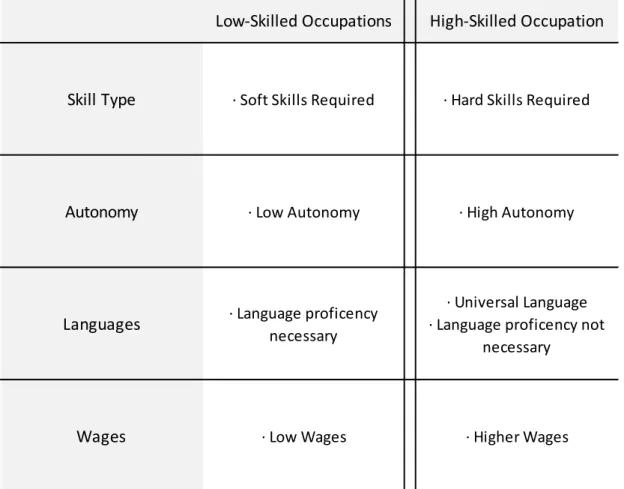
Comparing the general attributes of the low-skilled occupations to the high-skilled
occupations, it seems that they differ in several key ways: skill type, job autonomy, and
language proficiency. High-skilled occupations require hard skills, greater autonomy, and lower
reliance on language proficiency.25 I posit that these three attributes, through different
mechanisms, are partially responsible for the differences. First, employers may be more
comfortable hiring virtual workers for jobs that require hard skills as they are easier to evaluate
and validate. In addition, tasks and projects for high-skilled occupations might tend to be more
knowledge/idea-oriented vs customer-oriented. If this is the case, then the work will also tend
to be more autonomous, and autonomous work is more conducive to being completed
virtually. Generally speaking, work that doesn’t require frequent communication or contact,
substantive collaboration or strict adherence to schedules or protocols are more conducive to
virtual work. According to the US Office of Personal Management federal jobs that are eligible
for virtual work arrangements are jobs that don’t require face-to-face personal contact,
hands-on operatihands-on of assets, direct handling of secure materials and activities dependent hands-on a
physical presence.26 In addition, many knowledge/idea-oriented occupations have universal
technical languages, while, customer-oriented work may require a higher English language
competency. Again, one might expect, then, higher competition for the jobs that either have a
low English proficiency requirement or that share universal technical languages, as potential
employers are able to leverage the lack of spatial and temporal constraints introduced by the
online labor market.
Looking specifically at software developers and customer service workers, these
occupations certainly fit the generic attributes of high-skill and low-skill occupations. According
to the BLS, software developers “are the creative minds behind computer programs. Some
develop the applications that allow people to do specific tasks on a computer or other device.
Others develop the underlying systems that run the devices or control networks.”27 The
minimum education expected for software developers is a bachelor’s degree, and on the job
training is not typical, as workers are expected to have skills up front. With the expectation of
having skills upfront, comes an understanding that common languages are spoken by software
developers, regardless of locale. Coupled with the autonomous nature of computer software
development work, language proficiency is less important. The outlook for software developers
is better than average, with an expected growth of 22 percent in the next decade.28
Conversely, customer service workers’ minimum education requirement is typically a high
26 http://archive.opm.gov/pandemic/agency2a-guide.pdf
27 http://www.bls.gov/ooh/computer-and-information-technology/software-developers.htm