INCARCERATED WOMEN: EXPLORING THE INTERRELATEDNESS OF INTIMATE PARTNER VIOLENCE, DRUG USE, AND HIV RISK BEHAVIORS
Sharon Denise Parker
A dissertation submitted to the faculty of the University of North Carolina at Chapel Hill in partial fulfillment of the requirements for the degree Doctor of Philosophy in the School of Social Work.
Chapel Hill 2012
Approved by:
Catherine Ingram Fogel
Iris Carlton-LaNey
Jamie Crandell
Amelia Roberts-Lewis
ii ©2012
iii ABSTRACT
SHARON PARKER: Incarcerated Women: Exploring the Interrelatedness of Intimate Partner Violence, Drug Use, and HIV Risk Behaviors
(Under the direction of Dr. Catherine Ingram Fogel)
Women prisoners are at greater risk of contracting HIV than non-incarcerated women. The
current study was designed to learn more about the HIV related risk factors that place women
prisoners at greater risk. I examined the HIV risk behaviors of women prisoners with a
history of intimate personal violence (IPV) and/or crack or cocaine use among a sample of
incarcerated women (N = 55). Multiple and logistic regression were used to explore condom
use, multiple sex partners, and the exchange of sex for money or drugs. In addition, I
examined relationship control and decision-making dominance, and perceived risk of HIV as
moderators between HIV-risk behaviors and intimate personal violence. Study findings show
women prisoners with a history of IPV experience barriers to condom use and exchange sex
for money or drugs. As compared with women inmates without substance use histories,
findings show women prisoners who use crack or cocaine exchange sex for money or drugs,
have multiple sex partners, but are more likely to use condoms. Decision-making dominance
moderately influences the relationship between emotional abuse and multiple sex partners.
Similarly, relationship control moderately influences the relationship between forced sex and
iv
DEDICATION
I dedicate this dissertation research to the memory of my father Mr. Wendell Parker
and my loving mother, Mrs. Melrose Parker. The family values, character, and love that you
instilled in me as a child has set the foundation for the woman that I have become today.
More so, your unconditional love, support, and encouragement sustained me throughout my
personal, educational, and professional development. You truly are the wind beneath my
wings.
This dissertation is dedicated to my loving sister Stephanie Ruffin. Thank you for
your love and support that you have shown me throughout my life. I cherish the bond we
share as sisters. Often others refer to our bond as one that is close and uniquely special. It is
through you that I have drawn my inner strength and discipline. Thank you for being my best
friend, mentor, and most of all for being my sister.
Last, I dedicated this dissertation to the countless family and friends who have
supported me in various ways along my journey. Know that I love and truly appreciate you
v
ACKNOWLEDGEMENTS
I would like to express my deepest appreciation to my committee chair Dr. Catherine
Ingram Fogel, who has provided me with guidance, support, patience, and understanding
throughout my journey. Your wisdom, knowledge, and dedication to working with women
prisoners has motivated and inspired my work. I would like to thank my other committee
members Dr. Iris Carlton-LaNey, Dr. Jamie Crandell, Dr. Amelia Roberts-Lewis, and Dr.
Anna Scheyett. Thank you for your commitment and assistance in the completion of my
dissertation. Thank you to Dr. Vicki Behren for your support.
I would like to acknowledge all of my family and friends who provided support,
guidance, and advice along my journey. Next, I acknowledge my mother who stayed up late
at night with me and provided support and encouragement from afar. Most of all, I
acknowledge my Lord and Savior. Thank you for purposefully providing me with invaluable
vi
TABLE OF CONTENTS
LIST OF TABLES ... viii
LIST OF FIGURES ... x
CHAPTER
I. INTRODUCTION ... 14
Statement of the Problem ... 6
8
II. BACKGROUND AND SIGNIFICANCE OF THE PROBLEM ...
Profile of Women Prisoners ...
Women and Substance Abuse ...
Women Who Experience Intimate Partner Violence ...
Women, Relationships, and Sexual Decision Making ...
Condom Use...
Women and the Perception of HIV Risk ... 11
13
17
23
27
27
28
III. THEORETICAL FRAMEWORK ...
Theory of Gender and Power ...
AIDS Risk Reduction Model ...
Combining the Theory of Gender and Power and the AIDS Risk
Reduction Model Profile of Women Prisoners ... 32
32
37
vii
IV. METHODOLOGY ...
Research Aims and Hypotheses ...
Research Design...
Sample Size ...
Instruments ...
Predictor Variables...
Dependent Variables ...
Covariates ...
Data Analysis ... 43 43 44 45 45 46 49 51 51
V. RESULTS ...
Research Aim 1 ...
Research Aim 2 ...
Condom Barrier Total Scale with Multiple Regression ...
Condom Barrier Partner Subscale with Multiple Regression ...
Multiple Sex Partners with Logistic Regression ...
Exchange of Sex or Drugs for Money with Logistic Regression ...
Condom Use...
Research Aim 3 ... 53 53 55 56 58 60 61 64 65
VI. DISCUSSION AND IMPLICATIONS ...
Implications for Social Work ...
viii
LIST OF TABLES Table
1. Model Conceptualizing Influences of the Theory of Gender and Power Pertaining to Women’s HIV Risk ... 36
2. Descriptive Statistics for Study Variables for Incarcerated Women ... 54
3. Descriptive Statistics by Mean for Incarcerated Women ... 55
4. Multiple Regression Analysis Summary of Condom Barrier Total Scale on Forced Sex by and the Covariates ... 57
5. Mulitple Regression Analysis Summary of Condom Barrier Total Scale on Emotional Abuse and the Covariates ... 57
6. Muliple Regression Analysis Summary of Condom Barrier Total Scale on Physcial/Sexual Abuse the Covariates ... 58
7. Multiple Regression Analysis Summary of Condom Barrier Total Scale on Forced Sex, Emotional Abuse, and Crack or Cocaine Use and the Covariates ... 58
8. Multiple Regression Analysis Summary of Condom Barrier Partner Subscale on Forced Sex, and the Covariates ... 59
9. Multiple Regression Analysis on Summary of Condom Barrier Partner
Subscale on Emotional Abuse and the Covariates ... 59
10.Multiple Regression Summary of Condom Barrier Partner Scale on Physical or Sexual Abuse and the Covariates ... 60
11.Multiple Regression Analysis Summary of Condom Barrier Partner Total Sale on Forced Sex, Emotional Abuse, Crack or Cocaine, and the Covariates ... 60
12. Summar of Logistic Regression Analysis Predicting Multiple Sex Partners
with Crack or Cocaine Users and the Covariates ... 61
13. Summary of Logistic Regression Analysis Predicting the Full Model with Multiple Sex Partners with Forced Sex, Physcial/Sexual Abuse, Crack or Cocaine Use and the Covariates ... 61
14. Summary of Logistic Regression Analysis Predicting the Exchange of Sex for Money or Drugs with Forced Sex and the Covariates ... 62
ix
16. Summary of Logistic Regression Analysis Predicting the Exchange of Sex for Money or Drugs with Physical or Sexual Abuse and the Covariates ... 63
17. Summary of Logistic Regression Analysis Predicting the Exchange of Sex for Money or Drugs with Crack or Cocaine Use 30 Days Prior to Incarceration and the Covariates ... 63
18. Summary of Logistic Regression Predictign the Full Model with Multiple Sex Partners with Forced Sex, Emotional Abuse, Crack or Cocaine Use, and the Covariates ... 64
19. Summary of Logistc Regression Predicting Condom Use 30 Days Prior to
Incarceration with Crack or Cocaine Use and the Covariates ... 65
20. Summary of Logistic Regression Analysis Predicting the Condom Use in the Full Model with Forced Sex, Emotional Abuse, Crack or Cocaine Use and the Covariates ... 65
21. Summary of Logistic Regression Analysis Predictign Multiple Sex Partners with Perceived Risk of Contracting HIV and the Covariates ... 66
22. Summary of Logistic Regression Analysis Predicting the Exchange of Sex for Money or Drugs with Perception of HIV Risk and the Covariates ... 67
23. Summary of Logistic Regression Analysis Predicting the Exchange of Sex for Money or Drugs with Decision Making Dominance and the Covariates ... 67
24. Summary of Logistic Regression Analysis Predicting Exchange of Sex for
Money or Drugs with Relationship Control and the Covariates ... 67
25. Summary of Logistic Regression Analysis Predicting Condom Use with
Personal Perceived Risk of HIV and the Covariates ... 69
26. Summary of Logistic Regression with IPV Predictors, Morderators, and HIV Risk Behavior Outcomes ... 70
27. Summary of Decision-Making Dominace as a Moderator of the Relationship Between Emotional Abuse and Condom Use 30 Days Prior to Incarceration and the Covariates ... 70
28. Summary of Decision-Making Dominace as a Moderator of the Relationship Between Emotional Abuse and Having Multiple Partners 30 Days Prior to
Incarceration and the Covariates ... 71
x
LIST OF FIGURES Figure
CHAPTER I INTRODUCTION
In recent decades, the prevalence of IPV, drug use (DU), and HIV among women has
captured the attention of social workers, health care providers, researchers, and correctional
personnel (Han-Zhu, Taylor, Fawal, & Vermund, 2006; McClelland, Teplin, Abram, &
Jacobs, 2002; Teplin, Mericle, McClelland, & Abram, 2003). Although many studies have
examined a subset of the above elements—for example, HIV and IPV (Gielen et al., 2007;
Maman, Campbell, Sweat, & Gielen, 2000; Manfrin-Ledet & Porche, 2003) or HIV and DU
(El-Bassel, N. et al., 2004; Maisto, Carey, Carey, Gordon, & Schum, 2004; Rogers, McGee,
Vann, Thompson, & Williams, 2003)—few empirical studies have examined the
interrelatedness of the three factors with women prisoners. In addition, few researchers have
examined the impact of relationship dynamics and perceived risk of contracting HIV on risky
HIV behaviors among incarcerated women.
The personal histories of incarcerated women often include intimate partner violence
(IPV; i.e., physical, emotional, and sexual abuse), drug involvement, and sexually transmitted
diseases. A recent body of research reveals that incarcerated women are likely to experience
an imbalance of power in their heterosexual relationships (Knudsen et al., 2008;
Staton-Tindall et al., 2007). Moreover, many of these women live with the effects of psychological
stressors, including anxiety, depression, and low self-esteem (Staton-Tindall et al., 2007;
2
Cunningham-William, & Cottler, 2003; Plotzker, Metzger, & Holmes, 2007; Tull et al.,
2009). In addition, incarcerated women are exposed more than non-incarcerated women to a
range of other risk factors including a chaotic lifestyle clustered with mental illness, a history
of abuse, drug abuse, dysfunctional interpersonal relationships, inadequate education and
employment, poverty, homelessness, and involvement in the criminal justice system (CJS;
Covington, 2007; DeGroot & CuUvin, 2005; National Minority AIDS Council [NMAC], nd).
These life events may potentially influence women’s sexual behaviors and perception of their
risk for contracting HIV (Collica, 2002; Klein, Elifson, & Sterk, 2003). For some women,
there is a disconnection between the perception of their HIV risk behaviors versus the actual behaviors in which they engage. Perceived risk entails a woman’s personal beliefs and her
understanding of risky behaviors that may make her susceptible to contracting HIV. A
growing body of literature examining HIV perceptions substantiates that many women
underestimate their HIV risk behaviors and are often unaware of the HIV-related behaviors
of their sex partners, thus possibly increasing the likelihood of these women acquiring HIV
(Cole, Logan, & Shannon, 2008; Collica, 2002; Klein et al., 2003).
In recent decades, the prevalence of IPV, drug use (DU), and HIV among women has
captured the attention of social workers, health care providers, and correctional personnel
(Han-Zhu et al, 2006; McClelland, Teplin, Abram, & Jacobs, 2002; Teplin, Mericle,
McClelland, & Abram, 2003; Zaitzow, 2001). Although many studies have examined a
subset of the above elements—for example, HIV and IPV (Gielen et al., 2007; Maman,
Campbell, Sweat, & Gielen, 2000; Manfrin-Ledet & Porche, 2003) or HIV and DU
(El-Bassel, N. et al., 2004; Maisto, Carey, Carey, Gordon, & Schum, 2004; Rogers, McGee,
3
interrelatedness of the three factors with women prisoners. In addition, few researchers have
examined the impact of relationship dynamics and perceived risk of contracting HIV on risky
HIV behaviors among incarcerated women.
This exploratory study investigates risky HIV behaviors among incarcerated women
living in the Southern United States. The study examines factors associated with risky HIV
behaviors and the interrelatedness of IPV or crack/cocaine use. Further, this study examines
whether the dynamics of heterosexual relationships and the women’s perceptions of their risk
of acquiring HIV serve as moderating factors for risky behaviors among women prisoners.
That is, do women prisoner’s heterosexual relationships and perceptions of HIV-risk
influence behaviors that place them at high risk for contracting HIV, such as condom usage,
number of sex partners, and exchange of sex for money or drugs.
Statement of the Problem
Women represent one of the fastest growing HIV/AIDS populations, with a
worldwide estimate of 17.4 million women living with HIV in 2007 (UNAIDS/WHO, 2007).
During the infancy of HIV and AIDS research in United States, the virus and the disease
were associated primarily with gay men living in major metropolitan centers of California
and New York. The efforts of the medical community, researchers, and service providers
were almost exclusively focused on understanding the progression of HIV in gay men despite
detection of the HIV virus in women just 2 months after the earliest reports of the infection in
men; HIV/AIDS among women has historically received insufficient attention (Fogel &
Black, 2008). The first woman diagnosed with AIDS was reported by the Centers for Disease
Control and Prevention (CDC) in July 1982. During this period, the medical community
4
intravenous drug users, women whose male partners were HIV positive or diagnosed with
AIDS, or women who were hemophiliacs (Belden & Squires, 2008; Fogel & Black, 2008).
At that time, the medical field’s understanding of HIV transmission among women was in an
incipient, incomplete form. Fogel and Black (2008) posit that early misunderstandings of the
disease led the medical community and others to underestimate the number of women
affected by HIV. As a result, women’s HIV infections were often under diagnosed,
misdiagnosed, or left untreated.
Today, there are approximately 280,000 women living with HIV and AIDS (CDC,
2009a) in the United States. However, because many women likely have not been tested for
HIV, this number may not provide an accurate account of the total number of women living
with HIV infection. Currently, 1 in 5 individuals living with HIV do not know their status
(CDC, nd). Moreover, women of color are disproportionately affected by HIV, especially
those living in the Southeastern United States where the rates of HIV infection are higher
than other regions (Adimora et al., 2006; CDC, 2009a; Corneille, Zyzniewski, & Belgrave,
2008; Khan et al., 2008). For example, in 2009, approximately 11,200 women in the United
States were newly diagnosed with HIV (Henry J. Kaiser Family Foundation, 2012), with a
disproportionate percentage of African American women represented among these new
cases. Moreover, during that same year, African American women accounted for 66% of
AIDS cases among females 13 years and older, but represented only 12% of the total U.S.
population (CDC, 2009a). The rate of increase in AIDS cases for African American women
is 22 times greater than that for Caucasian women (CDC, 2009a). HIV is the leading cause of
death among African American women between the ages of 25 to 34 years, and the third
5
Although HIV is a major public health concern for all women, the virus and risk of infection
remain an even larger concern for women involved in the criminal justice system (CJS)
because their life experiences place them at greater risk of HIV infection as compared with
the general population of women in the United States.
Women prisoners are at heightened risk of contracting HIV due to histories of
substance abuse, intimate partner violence, interpersonal relationships with male sex
partners, and perceived risk of contracting HIV. This study contributes to the literature by
increasing awareness of the transmission of HIV for incarcerated women with such histories.
The following five chapters will provide an in depth exploration of crack or cocaine use,
intimate partner violence, relationship dynamics with male sex partners, and perceived risk of
contracting HIV. Chapter 2 provides a succinct discussion of the background and
significance of HIV risk behaviors among women prisoners, followed by the theoretical
framework guiding this study in Chapter 3. In Chapter 4, I describe the methods I employed
to conduct this study. Results from the study are addressed in Chapter 5. Chapter 6 presents
CHAPTER II
BACKGROUND AND SIGNIFICANCE
Women in the criminal justice system (CJS) are at heightened risk of contracting HIV
compared with non-incarcerated women and incarcerated men. Women prisoners are 15 to
36 times more likely to acquire HIV compared with non-incarcerated women, and twice as
likely to acquire HIV as compared with incarcerated men (DeGroot. & Cu Uvin, 2005;
Havens et al., 2009; NMAC, nd). In 2008, 1.9% of the women in federal and state custody
reported that they were HIV positive as compared with 1.5% of men (Maruschak, 2009). Life
circumstances that place women prisoners at higher risk of contracting HIV include lack of
adequate education and financial resources, lack of healthy social support, increased
exposure to violence and abuse, substance abuse, mental illness, and unstable living
conditions (Bloom & Chesney-Lind, 2007; Covington, 2007). Complexities in the lives of
women in the CJS place them in vulnerable predicaments that make it challenging to meet
their daily needs without placing themselves at risk for HIV acquisition. Further, incarcerated
women are more likely to exchange sex for drugs, money, and other resources (Fogel &
Belyea, 1999; Browne, Miller, Maguin, 1999; Willers, 2008; Zust, 2008).
The rapidly growing number of women in U.S. prisons has created multiple
challenges for the CJS and society (Browne & Misra, 2003; Glaze & Bonczar, 2007; Pew
Center on the States [PCS], 2007; van Wormer & Bartollas, 2007; Zust, 2009). Over the past
7
producing one of the largest incarcerated populations among industrialized countries
(Beckwith, Zaller, & Rich, 2006). During 2008, more than 2.3 million adults were in the
United States penal systemequal to one out of every 99 adults (PCS, 2008).
Contributing to the overall growth of the prisoner population is the increasing number
of women incarcerated in state and federal facilities. Women accounted for 7% of all inmates
in 2005, whereas, a decade earlier, women accounted for only 1% of the incarcerated
population (Harrison, & Beck, 2006). Further, the incarceration rate for women has
significantly outpaced that of their male counterparts; in 2005, a 3.4% increase in
incarcerations was observed in women versus a 1.3% increase for men (Harrison & Beck,
2006). At the end of June 2008, there were 115,779 prisoners under the jurisdiction of state
and federal corrections. The federal system incarcerated 13,482 women, while the remaining
102,927 were under state jurisdiction (West & Sabol, 2009).
Although there is value in identifying the importance of gender in relationship to
incarceration, researchers increasingly find benefit in disaggregating prisoner identities,
particularly with regard to race/ethnicity. Interestingly, Caucasian females represented
94,500 members of the inmate population, whereas African American and Hispanic female
inmates accounted for 67,800 and 34,000, respectively (West & Sabol, 2009). This
racial/ethnic composition of the inmate population is largely disproportionate to the U.S.
population of Latina, African American, and Caucasian women. In 2008, three general age
categories were used to help create a racial/ethnic profile of the female prison population.
Younger inmates were those between 18 and 24 years old and middle-age inmates were those
between 25 and 64 years old, and older inmates were those 65 years and older. The majority
8
compared with African American (7.2%, 6.3%, respectively) and Hispanic/Latina women
(8.2%, 6.7% respectively). The oldest group of women prisoners (65 years and older) had a
similar racial/ethnic composition: Caucasian, 46.1%; African American, 5.1%; and
Hispanic/Latina, 3.9%.
As of July 2012, there were approximately 38,839 inmates housed in North Carolina
state prisons. North Carolina prisons housed approximately 36,240 male inmates compared
to 2,599 female inmates. Another 100,143 men and women were on probations and 3,465
were classified as post release or parole (North Carolina Department of Corrections, 2012).
The cost of housing the growing number of inmates may be as much as $27.5 billion (PCS,
2007). Challenges to the CJS in the coming years will be to provide the funds to keep up with
the growing incarcerated population or to turn to the private sector as many states are doing.
Nevertheless, it is essential that programs be designed to meet the unique needs of women
prisoners who have been historically overlooked in the CJS.
Profile of Women Prisoners
The accelerated growth of women offenders, the sparse epistemology regarding
effective responses to their lived experiences and associations with delinquent behavior pose
unique challenges to treating women in the CJS. Women offenders are disproportionately
African American and Latina, are in their early-to-mid-thirties, reside in impoverished and
blighted communities, are largely undereducated and unskilled with sporadic employment
histories, are mothers of young children and have histories of trauma and substance abuse
(Covington, 2007; Glaze & Maruschak, 2008; Guerino, Harrison, & Sabol, 2011).
Nationally, the number of state and federal correctional facilities increased by 9% between
9
North Carolina’s population of women in the state and federal correctional system was
2,794an increase by 6.4% from the previous 6 months (West & Sabol, 2009).
According to Harlow (2003), 44% of female state prisoners have not completed their
high school education nor fulfilled the requirements to earn their general education
development certificate (GED). Employment prior to incarceration varied for women
prisoners. In the Knudsen et al. (2008) study, 54% of women were unemployed while 16%
were employed part-time and 30% had full-time employment. Hanlon, O'Grady,
Bennett-Sears, and Callaman (2005) found that 23% of women were unemployed and 24% worked
part-time, while 54% were employed full-time. Many had a family history of incarceration
and grew up in abusive and dysfunctional homes (Belknap, 2007; Covington, 1998).
Established research indicates that women offenders have challenges with physical health,
mental illness, and substance abuse. Many women prisoners suffer from multiple
co-occurring physical health problems prior to incarceration, such as obesity, diabetes, sexually
transmitted infections, and hypertension (Harrison & Beck, 2005; Hatton, Kleffel, & Fisher,
2006; Staton-Tindall et al., 2011). Studies indicate that women prisoners are less likely to
receive adequate health care prior to incarceration, which makes them more susceptible to
communicable and chronic diseases (Fisher & Hatton, 2010). Once incarcerated, women’s
ability to receive timely and adequate medical care may be compromised by budget cuts in
funding for services and their inability to make co-payments for health care (Fisher &
Hatton, 2010; Moe, 2006). Further, women prisoners suffer from mental illness. When
compared with male inmates, more women were diagnosed with mental health problems in
state prisons and local jails, respectively. Among prison inmates, 73% of women were
10
mental health diagnosis compared with 63% of men (James & Glaze, 2006). Among these
incarcerated women with a mental health diagnosis, 75% also met the criteria for substance
abuse or dependency (James & Glaze, 2006).Further, factors such as childhood abuse,
victimization, and trauma have been strongly linked to delinquency and HIV risk behaviors
among women offenders (Belknap, 2007; NMAC, nd).
Criminality. National Prisoner Statistics Program crime reports from December 2009, indicated that 36% of women prisoners were adjudicated for murder, 30% for property
crimes, and 26% for drug offenses; the remaining 8% of charges were for public disorder and
unspecified offenses (Guerino et al., 2011). A succinct review of the literature posits that
criminality is highly associated with illegal substances for the many female offenders
(Theall, Elifson, Sterk, & Stewart, 2007; van Wormer & Bartollas, 2007). In fact, women are
more likely than men to be under the influence of illegal drugs or alcohol when committing a
criminal act (National Center on Addiction and Abuse at Columbia University [NCAACU],
2006). In 2004, a clear majority of women in state prisons (59.3%) reported using drugs one
month prior to incarceration. Similarly, 48% of women held in federal prisons reported using
drugs in the 30-day period before their incarceration. Further, 60.2% of women in state
custody met the criteria for drug dependency or abuse, compared to 42.8 % of women in
federal custody (Mumola, 2006). However, research has indicated that not all women
convicted of drug or drug-related crimes use illegal substances. Women living in poverty
may choose to obtain money by selling drugs (Belknap, 2007). Moreover, an established
body of literature examining women in the criminal justice system indicates that women tend
to receive shorter sentences than their male counterparts (Lalonde & Cho, 2008). Women in
11
plausible that women living in poverty may choose to engage in risky behavior as a means of
earning money or cope with the challenges presented at reentry (e.g., housing, transportation,
or employment).
Parenthood. As compared with incarcerated fathers, mothers confined to jails or prisons are more likely to have borne primary responsibility for their children before their
imprisonment (Braithwaite, Treadwell, & Arriola, 2005). Seventy percent of incarcerated
mothers provided daily care of children before imprisonment, and two-thirds of incarcerated
women have children under 18 years old (Braithwaite, Treadwell, & Arriola, 2005). In 2007,
65,600 mothers of minor children were imprisoned; mothers included in this group were 48%
Caucasian, 28% African American, and 17% Hispanic. Thirty-six percent of mothers in
federal prisons and 41% of mothers in state prison had more than one minor child. Fifty-five
percent of mothers lived with at least one minor child one month before incarceration and 4
in 10 were head of a single-parent household. Mothers in prison were likely charged with
property, public-order, or drug offenses. Some studies suggest women engage in criminal
behavior as a means to support their children financially. Ferraro and Moe (2003) conducted
qualitative interviews with incarcerated mothers pertaining to their criminal involvement.
Findings from the study indicated that women committed illegal offenses to care for their
children (i.e., sold crack, welfare fraud, and wrote bad checks). It has been estimated that
between 147,000 and 200,000 children in the United States have mothers in prison (Glaze &
Maruschak, 2009; Hanlon et al., 2005).
Mothers in prison, compared to fathers, were more likely to report histories of
homelessness, family violence, physical or sexual abuse, physical health problems, and
12
mothers with histories of substance abuse are more likely to engage in drug abuse treatment
if it is offered while they are in prison, if treatment does not delay reunification with their
children (Robbins, Martin, & Surratt, 2009). In addition, many women prisoners are in need
of counseling, vocational training, and parenting classes. Unfortunately, correctional
facilities lack the services and resources required to meet the needs of many women prisoners
who are more susceptible to criminal activities and increased HIV risk behaviors (Bloom,
Barbara & Chesney-Lind, 2007).
Women and Substance Abuse
Substance abuse among women has grown and warrants increasing attention.
Currently, more than 2 million women use illicit drugs in the United States (NCAACU,
2006, 2010) and this number is on the rise. The Treatment Episode Data Set indicated that in
2007 women aged 25 to 34 years entering substance abuse treatment programs constituted
28% of all females admitted to treatment that year. Female admission to substance abuse
treatment among this age group included White (67%), Black (15%), Hispanic (12%),
American Indian/Alaska Native (3%), and Asian/Pacific Islander and other groups
(3%;Substance Abuse and Mental Health Services Administration, [SAMHSA,2009].
Findings from the study indicated the three primary substances of abuse were alcohol (27%),
cocaine (17%), and methamphetamine (15%). African American women were more likely to
report cocaine as the primary drug of abuse compared to Caucasian and Hispanic women
(i.e., 31%, 16%, and 14%, respectively) and at least, 4 times more likely to use the drug than
Asian/Pacific Islanders and American Indian/Alaska Native women were. Daily drug use by
women is a public health problem. In fact, crack (66%) and heroin (69%) were the two most
13
It is important to address the issue of polysubstance use among women. For example,
78% of women prisoners who used drugs were polysubstance users. It is estimated that
nearly 64.5% of incarcerated women are polysubstance dependent (Lewis, 2006).
Unfortunately, many women do not receive treatment for their addictions. Findings from a
recent study indicated that over 7.4 million women needed substance abuse treatment for the
use of illicit drugs and alcohol, but only 11% received treatment (SAMHSA, 2007).
Information from the Arrestee Drug Abuse Monitoring Program, which measures crack and
cocaine use in women in the CJS from 25 sites across the country, including North Carolina,
reveals that in 73% of the women in the 2003 study tested positive for any drug use, 28%
tested positive for multiple drug use, and 35% tested positive for crack and powder cocaine
use (Zhang, nd).
Researchers have identified a clustering of behaviors associated with the
interconnectedness of drug use and HIV, including injection drug use, poly-substance use,
increased sexual risk taking, multiple sex partners, inconsistent condom use, and exchange of
sex for money and other goods (Atkinson, Williams, Timpson, & Schönnesson, 2010;
DeBeck et al., 2009) especially for cocaine and crack (Gollub, 2008; MacMaster, Rasch,
Kinzly, Cooper, & Adams, 2009; Roberts, Wechsberg, Zule, & Burroughs, 2003; Sterk,
Theall, & Elifson, 2003; Wechsberg et al., 2010). Often the intoxicating effect of drug use
leads to poor impulse control and unsafe behaviors, placing women at higher risk for
contracting HIV (Kopetz, Reynolds, Hart, Kruglanski, & Lejuez, 2010). Women using drugs
have reported great difficulty controlling the urge to engage in high-risk behavior, such as the
injection drug use (DeBeck et al., 2009; Tuchman, 2010). For instance, crack cocaine
14 (Friedman et al., 2003).
Germane to the clustering of behaviors is the co-occurrence of drug use and risky
sexual behaviors. The drug use and risky sexual behaviors are associated with psychosocial
and structural conditions such as posttraumatic stress disorder, depression, trauma,
unemployment, and poverty, all of which affect and shape the lives of marginalized women
(Fawole, 2008; Hutton et al., 2001). Any combination of these behaviors dramatically
increases the risk of HIV infection (Logan, Walker, Cole, & Leukefeld, 2002). A history of
child abuse, family history of substance abuse, inadequate education and employment,
regular alcohol or illicit drug use, and a previous history of drug treatment have been
associated with drug abuse in adulthood (Bloom, Owen, & Covington, 2003; Covington,
2007; Zust, 2009).
Crack and powdered cocaine. Cocaine use is a major public health problem in the United States. In 2010, an estimated one million persons met the criteria for cocaine
dependence or abuse (SAMHSA, 2011). Based on drug rehabilitation and admission to
substance abuse treatment in 2006, the drugs mostly used by women in North Carolina were
methamphetamine (46%), followed by smoked cocaine (40%), and cocaine administered by
other routes (39%) (National Substance Abuse Index, 2006). Cocaine is a powerful, addictive
stimulant that affects the brain by quickly producing pleasurable effects and has been
associated with drug addiction (Staton-Tindall et al., 2011). An established body of research
indicates that the high experienced by taking crack or powder cocaine, or craving to get a high, may affect a woman’s decision-making ability and increase the likelihood that she will
engage in HIV risk behaviors.
15
cocaine represent a critical group on which to focus HIV research and prevention efforts.
Substantial evidence suggests that crack and cocaine are illicit drugs widely used by female
offenders and that these drugs also contribute to risky HIV behaviors (Khan et al., 2011; Millay, Satyanarayana, O’Leary, Crecelius, & Cottler, 2009; Plugge et al., 2009). Women
prisoners are up to 10 times more likely to abuse drugs and are 27 times more likely to use
cocaine than women in the general population (Zlontnick, 2002). In 2006, 66% of women
incarcerated in jails and prisons were identified as having a substance use disorder
(NCAACU, 2010). Drug offenses and related crimes have contributed to the increase in the
female inmate population; about one in every three females are incarcerated for drug-related
offenses (Fazel, Bains, & Doll, 2006; Staton-Tindall et al., 2007). Between October 2004 and
January 2005, women represented 14% of all drug offenders. Within this population, 14%
were adjudicated for powder cocaine and 10% for crack. In 2005, 45% of women prisoners
were charged with drug offenses (U.S. Sentencing Commission, nd).
Scott, Edwards, Lussier, Devine, and Easton (2011) examined the differences in
Caucasian and African American female offenders. Findings indicated 75% of the women
were identified as substance dependent and of those women, 28% reported cocaine or crack
as their primary substance. Of the women who used either cocaine or crack, 24% were
Caucasian and 39% were African American. The study found a statistically significant
difference in education, length of incarceration, and substance use. African American women
in the CJS were given longer sentences compared with Caucasian women (13 months vs. 4
months, p =.035, respectively). Further, Caucasian women were more likely to abuse heroin
(30% vs. 6% of African American women, p=.03) and African American women were more
16
findings may have significant implications regarding substance treatment for both African
American and Caucasian women. Specifically, it is important to acknowledge African
American women may struggle more with addition to crack or cocaine as compared with
Caucasian women who use other drugs such as heroin. Substance abuse treatment plans
should be tailored to address the specific drug or drugs used and the complications those
drugs present in the lives of women.
In a North Carolina study of female inmates, Rosen et al. (2009) documented that
65% of their participants reported a history of cocaine or crack use. Moreover, 42% of the
females were convicted of drug-related offenses. In an ongoing HIV risk-reduction
intervention with women prisoners in North Carolina, 16.5% of the participants reported use
of cocaine and 27.3% reported use of crack one month prior to incarceration (C. Fogel,
personal communication, May 15, 2012). Research has substantiated a relationship between
crack or powder cocaine and an increased propensity of HIV acquisition among women
prisoners (de Carvalho & Seibel, 2009; Maranda, Han, & Rainone, 2004; Roberts et al.,
2003). The association between cocaine (i.e., powder and crack) and among women,
especially women prisoners, is highly correlated with HIV risk behaviors and possible
acquisition.
Research suggests that women typically initiate crack or cocaine use at earlier ages
than men, progress through the stages of addiction quicker than men, and have shorter
periods of abstinence compared with men (Robbins, Ehrman, Childress, & O'Brien, 1999;
Tuchman, 2010). Crack or cocaine substance abusing women are at increased risk of HIV
acquisition due to risk factors associated with injection drug use, multiple sex partners and
17 condom use.
In the powder and crack cocaine subculture, women may be expected and obligated to
exchange sex for drugs or for money, and the power imbalances within this exchange impacts the use of condoms, which is typically left to the man’s discretion (O'Sullivan,
Hoffman, Harrison, & Dolezal, 2006). Jenness et al. (2011) examined the exchange of sex
among women and men who used crack. Findings from the study indicated that women,
compared to men, were more likely to exchange sex (40% and 32%, respectively) and have a
history of sexually transmitted infections (28% and 22.2%, respectively). Factors that have
shown as independently associated with the exchange of sex for drugs or money include the
woman being homeless, the number of sex partners, the number of unprotected sex acts, the
weekly use of non-injectable drugs. Latkin, Hua, and Forman (2003) discovered that
crack-using women whose social networks included other crack users were more likely to trade sex
than women with fewer crack-using associates. In addition, many women in this situation
feel that this exchange is unavoidable (Draus & Carlson, 2009). In some cases, women
regard the exchange of sex for crack or cocaine as a means to an end to satisfy their drug
addiction (Millay et al., 2009).
In many ways, one could argue that the complexities of societal and interpersonal
structures have contributed to women’s addiction to crack and cocaine. Societal mechanisms
that encourage the widespread growth of the crack and cocaine epidemic include the
availability of drugs in low income communities, the increasing number of women living in
poverty - the lack of education and sustainable employment-, the lack of drug treatment
specific to women, and harsh legal policies and penalties (Covington, 2007; Fawole, 2008;
18
crack and cocaine include a history of child abuse; adult physical; emotional; and sexual
abuse; polysubstance use; and risky sexual behaviors (Covington, 2007; Manfrin-Ledet &
Porche, 2003; Shearer, 2003). Women using crack or cocaine may have altered self-images
and may not see themselves as the mothers, children, wives, and persons that they want to be.
Instead, their lived experiences revolve around drug use and other high-risk behaviors that
directly increase the likelihood of HIV transmission.
Women Who Experience Intimate Partner Violence
Intimate partner violence and society’s response to this crisis are a major public
health concern effecting the lives of many women (El-Bassel, Gilbert, Wu, Go, & Hill, 2005;
Josephs & Abel, 2009; Weir, Bard, O'Brien, Casciato, & Stark, 2008; Wingood &
DiClemente, 2000). Intimate partner violence is defined as a threatened, attempted, or completed act of physical, sexual, or emotional abuse; stalking’ or financial abuse inflicted
by a current or former spouse, boyfriend, girlfriend, dating partner, or date (Black et al.,
2011; CDC, 2009b, 2009c; Saltzman, Fanslow, McMahon, & Shelly, 1999). In this study,
IPV refers to violence perpetuated against women by male partners. Violence by husbands or
intimate male partners is one of the most common forms of abuse toward women (World
Health Organization, 2009). Women experience IPV along a continuum, ranging from a
single episode to chronic experiences of abuse (Black et al., 2011; CDC, 2009b). IPV is a
pervasive social problem, affecting women in all socioeconomic and ethnic groups. Research
indicates that women age 18 years or older are more likely to experience higher rates of
intimate partner violence compared to girls age 12 to 17 (Catalano, Smith, Synder, & Rand,
2009). Yearly, 5.3 million American women, ages 18 and older, experience some form of
19 rape (CDC, 2009c).
The 2010 National Intimate Partner and Sexual Violence Survey indicated that nearly
42.4 million women in the United States have experienced IPV in their lifetime (Black et al.,
2011). African American and Hispanic women have a higher lifetime prevalence rates of IPV
compared to Caucasian women (43.7%, 37.1% and 34.6%, respectively) and are more likely
to experience physical violence (40.9%, 35.2%, and 31.7%, respectively). Overall women are
more likely to experience physical violence (35.2%) followed by rape (8.4%) or stalking
(10.6%) over the course of their lives. Approximately 57% of women experienced physical
abuse only and 4.4% experienced rape only during their lifetime (Black et al., 2011). Of the
women who experienced physical abuse, approximately one in three were slapped, pushed,
or shoved and one in four reported severe episodes of abuse. The top three forms of severe
violence experienced by women were: (a) being slammed against something (17.2%), (b)
being hit with a fist or something hard (14.2%), and (c) being beaten (11.2%). Other forms of
severe violence involved women being pulled by their hair, kicked, choked or suffocated,
burned, and use of a knife or gun. Of the women who experienced sexual assault, 6.6%
reported completed forced penetration and 2.5% reported attempted forced penetration.
Nearly 9% of women experienced overlapping episodes of physical violence and rape.
Similarly, women reported lifetime experiences of emotional abuse by an intimate partner.
Catalano (2007) reported that 27% of women experiencing IPV stated their partner
threatened to kill them, and 59% reported other threats of harm by their partner. In 2007,
African American women were twice as likely to be victims of intimate partner homicide by
a spouse and 4 times as likely to be murdered by a boyfriend compared to Caucasian women
20
Half the women in the U.S. experienced psychological abuse by an intimate partner
during their lifetime, which equates to approximately 57.6 million women. The 2010
National Intimate Partner and Sexual Violence Survey measured psychological abuse as
either excessive aggressive or coercive behavior by a male partner. Practically, 1 in 7 women
disclosed experiences of psychological aggression, such as coercive control (10.7%) and
expressive aggression (10.4%), in the year before completing the survey (Black et al., 2011).
Overall, IPV against females declined 53% between 1993 and 2008 (Catalano, et al.,
2009). Nevertheless, more needs to be done to prevent IPV, which is rooted in sexism and a
patriarchal societal structure (Barnett, 2000) where men can misuse their power over women.
Moreover, women often live within a patriarchal society that has failed to adequately protect
them from their abusers (Landenburger & Campbell, 2008). Despite the growing attention to
violence against women as a social issue, IPV is the leading cause of injury to women
(Gillum, 2009; Huang & Gunn, 2001). At the same time, less than 20% of female victims of
IPV will seek medical attention (Catalano, 2007). Yet, in 2003, the medical cost of IPV
exceeded $4.1 billion (CDC, 2009c).
Women prisoners and intimate partner violence. The overlapping and intersecting epidemics of IPV and HIV in the United States have generated an emerging body of
literature specific to the needs of women (Josephs & Abel, 2009; Lichtenstein, 2005) by
contributing to the increased awareness of IPV and the need to develop IPV and HIV
research and interventions with incarcerated women (Carbone-Lopez & Kruttschnitt, 2009;
Weir et al., 2008; Zust, B. L., 2008). Yet, more empirical studies are needed to understand
and address the relationship between IPV and women prisoners. Women in the CJS have
21
such as poor physical and mental health, multiple sex partners, DU, exchange of sex for
money or other goods, and economically deprived communities (DeGroot, 2001; Fogel &
Belyea, 1999; Millay et al., 2009).
The victimization of women prisoners has been well documented (Fogel & Belya,
1999; Raj et al. 2008; Zust, 2008); however, the dearth of empirical research has created gaps
in the literature pertaining to the reduction of IPV and HIV risk behaviors among this
vulnerable population (Weir et al., 2008). Recently researchers have worked diligently to
increase our awareness of IPV and HIV with women through survey and intervention
research (Kim et al., 2002; Weir et al., 2008). In fact, research indicates that incarcerated
women are more likely to become victims of IPV than non-incarcerated women
(Fickenscher, Lapidus, Silk-Walker, & Becker, 2001; Zust, 2008). Kim et al. (2002)
conducted a study with incarcerated women and women whose sex partners had been
incarcerated. Findings from the study revealed that women who were incarcerated or whose
partners were incarcerated were significantly more likely to have a history of forced sex than
non-incarcerated women (39.6% vs. 20.5%). In a study conducted by (Jones, JI, Beck, &
Beck, 2002), women in a maximum-security prison reported a 78% lifetime prevalence of
violence by an intimate partner and 63% reported being sexually coerced.
Weir and colleagues (2008) investigated episodes of violence perpetrated by an
intimate partner or non-intimate partner violence against women in the criminal justice
system. Perpetrators of nonintimate partner violence included friends, strangers, drug using
partners, and sex customers. Episodes of violence were measured 3 months prior to the
interview, with 41% indicating they were victimized during this period. Seventy-six percent
22 nonintimate partner.
The co-occurrence of IPV and HIV risk behaviors are a reality in the lives of many
women prisoners. While either IPV or HIV risk behaviors can have a detrimental impact on
the health of women- the combination of IPV and HIV risk behaviors exponentially increases
risk of acquiring or transmitting HIV (Josephs & Abel, 2009; Logan et al., 2002; Rountree,
Pomeroy, & Marsiglia, 2008).
Women, Relationships and Sexual Decision Making
Power dynamics in heterosexual relationships play a critical role in the transmission
of HIV, since heterosexual contact accounts for the majority of HIV cases for women in the
United States (Knudsen et al., 2008). Undoubtedly, it is important to increase the
understanding of how power dynamics and gender roles contribute to sexual risk behaviors
for women.
Women prisoners and power dynamics. We can begin by understanding that relationships between women prisoners and male partners oftentimes involve
multidimensional constructs. The constructs involve both micro level and macro level
elements. Micro level constructs include low self-esteem, perceptions of male and female
relationships, past partner experiences, dependence on and dominance by male partners, IPV,
and SU. Macro level constructs include gender, social and cultural norms, institutional
imbalances favoring men, and inadequate financial opportunities for women.
Women, violent relationships, and sexual decision-making. Many of the micro-level and macro-micro-level elements are woven into a women’s sexuality and her ability to
negotiate safer sex. Specifically, women who experience threats of violence or acts of
23 Condom Use
Condom use has proven to be an effective method of reducing the transmission of
HIV. However, the use of condoms presents a challenge to safer sex practices in many
nonviolent heterosexual relationships. Women whose lives are affected by sexual abuse and
other forms of violence are significantly less likely to feel empowered to negotiate condom
use and other safe sex practices (El-Bassel et al., 2005; Martin & Curtis, 2004). For these
women, there is legitimate fear of their partner’s anger or reprisal for suggesting the use of
condoms. This complex issue may become magnified among vulnerable populations. As an
example, for women prisoners who are both substance abusers and victims of IPV, the ability
to access and use this form of barrier protection may seem impossible. Whereas, the use of
condoms and safer sex practices means that women care for themselves and have a more
positive self-esteem.
Condom use and safer sex practices. Many issues contribute to condom use and other safer-sex practices. The complexity introduced by a decision to use condoms may
involve consideration of an addiction to alcohol, illegal substances and the exchange or
sharing of needles. An additional concern may be the concurrency and number of lifetime
sex partners. For women this becomes more challenging if the decision to use condoms is
dictated by their male partner as they may have concern of losing the intimate relationship.
Finally, the known and unknown HIV risk behaviors of male sex partners may also lead to
inconsistent condom use.
Women and the Perception of HIV Risk
A multiplicity of issues drives women’s perceptions about whether they are
24
partner- level behaviors. Some structural factors may include social, legal, political, and
cultural constraints. Inadequate knowledge of HIV; substance use; multiple sex partners; the
type of sex partner; inconsistent condom use; exchange of sex for money, drugs, or other
resources; relationship inequality; personal safety; HIV status; and the misperception of
actual behaviors are associated with individual level factors. Moreover, perceptions of
contracting HIV are associated with partner-level behaviors that include substance use, a partner’s willingness to use condoms, multiple sex partners, bisexual behavior, and HIV
status. Systemic structural factors serve as another major contributor, such as gender norms,
culture, poverty, adequate housing, and the impact of racial disparities in the criminal justice
system.
Women, crack cocaine, and the perception of HIV risk. Significant links between HIV and crack/cocaine use among women has been established. Nevertheless, there is
inadequate information that examines women’s perceptions of contracting HIV (MacMaster
et al., 2009). Women who use crack or cocaine are vulnerable to engaging in behaviors such
as the exchange of sex for money, drugs, or injection drug use that may increase their risk of
contracting HIV. MacMaster et al. (2009) conducted a qualitative study with women who
had histories of crack cocaine use. It was found that women provided contradictory responses
regarding their perception of risk behaviors. Responses presented by the women were based
on two categories: perception of awareness and preventive behaviors associated with HIV.
Despite awareness of risky behaviors associated with HIV, women chose to continue risky
behaviors. Other women took active measures to protect themselves, primarily by using
condoms. Wright, McSweeney, Frith, Stewart, and Booth (2009), conducting qualitative
25
cocaine, powder cocaine, or methamphetamine, found that women’s perceptions of risk were
based on gender and power issues in relationships. Women who chose their partners and
sexual activities, and who made decisions about condom use perceived themselves to be at
lower risk and expressed confidences in reducing HIV acquisition.
Women, intimate partner violence, and the perception of HIV risk. Cole et al. (2008) examined self-perceptions of HIV risk behaviors among women who experienced
IPV and who had taken protective orders out against their male partner. This study focused
on the perception of HIV among women with HIV high risk behaviors, particularly those
women with histories of IPV, of crack or cocaine use or of having resided in disadvantaged
communities. According to the researchers, women perceived themselves to be at risk based
on the number of sex partners they had and their illicit drug use. However, lack of condom
use with an abusive partner who had multiple and simultaneous sexual partners was not
perceived to be a risk factor for HIV. This dissonance is only one of the factors related to the
experience of IPV. Given the association between HIV related risk behaviors among this
population (Rountree & Mulraney, 2010; Cole et al 2008) gender specific substance use
treatment and counseling for women may offer important opportunities for intervention.
Women prisoners and the perceived risk of HIV. Of particular concern are the rates of HIV acquisition and transmission among women in the criminal justice systems.
Research posits that the life experiences of women prisoners increase their propensity of
acquiring HIV (i.e. histories of abuse, substance abuse, and unprotected sex), yet there is a
lack of research that examines their perceptions of contracting HIV with this population.
Collica (2002) investigated HIV perceptions of future risk behaviors among women in a
26
Many women were African American (54%) with a mean age of 31 years old, unmarried
(78%), and less than 46% possessed a high school diploma or GED. Women in the study
were asked to disclose their perceived risk of contracting HIV in the future, and their actual
risk behaviors. Twenty-three percent of women were unable to identify their risk behaviors,
another 11% reported no risk, and 51% reported low risk to slight risk. Eighty-nine percent
of women reported substance use: crack/cocaine (66%), marijuana (46%), alcohol (46%), and
heroin (17%). Thirty-seven percent of the women reported they would not insist on a
protective barrier during sex if their partner was uncomfortable. Twenty percent of the
women did not view unprotected sex as a risky behavior if they “really knew” their partner.
In summary, women prisoners lead multifaceted and complex lives that contribute to
increased risk of HIV transmission. Many of those factors include histories of poverty,
unemployment, substance abuse, mental health, physical, mental or emotional abuse,
criminality, exchange of sex and parental responsibilities. Prisons provide a unique
opportunity to increase awareness of these factors that are associated with high HIV risk
CHAPTER III
THEORETICAL FRAMEWORK
The Theory of Gender and Power (TGP) and the AIDS Risk Reduction Model
(ARRM) serve as the underpinnings for this study. Together, the theories provide a useful
framework through which researchers understand the social issues experienced by this
vulnerable population. The TGP is an explanatory theory that identifies tenants that are
central to explaining the unique challenges facing women in society. For example, the TGP
provides an explanation of the sexual division of labor and power, as well as social norms
and affective attachment within a larger social context. In contrast, this research offers the
ARRM as an individual level change theory that describes HIV acquisition among vulnerable
populations including African American women, incarcerated women, substance abusers,
victims of IPV, and adolescent girls (Filson, Ulloa, Runfola, & Hokoda, 2010; Longshore,
Stein, & Chin, 2006; Risser, Padgett, Wolverton, & Risser, 2009). As this paper will later
demonstrate, these theories specifically address challenges associated with risky behaviors
and increased propensity for contracting HIV among women prisoners.
Theory of Gender and Power
Robert Connell (1987) originally developed the Theory of Gender and Power (TGP),
which focused specifically on sexual inequality, gender, and power imbalances favoring men
instead of women. Although a more detailed explanation of the theory is presented below, Connell’s theory broadened the context and understanding of gender imbalances at both the
28
that govern relationships between men and women. First, the sexual division of labor
recognizes economic inequalities that favor men rather than women. Second, the sexual
division of power examines inequalities of power, authority, and control in relationships.
Third, the structure of cathexis identifies sexuality as a social construct that restricts and
shapes emotional attachments. Although each principle remains distinct, they also overlap
while explaining the complex relationship between the gender roles of men and women
based on social beliefs, perceptions, and practices associated with masculinity and femininity
(Connell, 1987; Maharaj, 1995).
Researchers Wingood and DiClemente (2000) applied and extended Connell’s
theoretical framework to address risk factors that increase African American women’s
vulnerability to acquiring or transmitting HIV. While the original focus on the sexual
division of labor and the sexual division of power remained, Wingood and DiClemente added
the sexual division of attachments and social norms in place of Connell’s third tenet,
cathexis. Wingood and DiClemente argued that these tenants are intertwined structures and
as a result examined collectively. The recent variation of the theory is appropriate for
application in this study. Therefore, subsequent discussion of the TGP will refer to the extended theory developed by Wingood and DiClemente, and not Connell’s original theory.
Over the last decade, the TGP has expanded to include Latinas and transgendered
female populations (CDC, 2012). TGP was designed to confront gender-related-social and
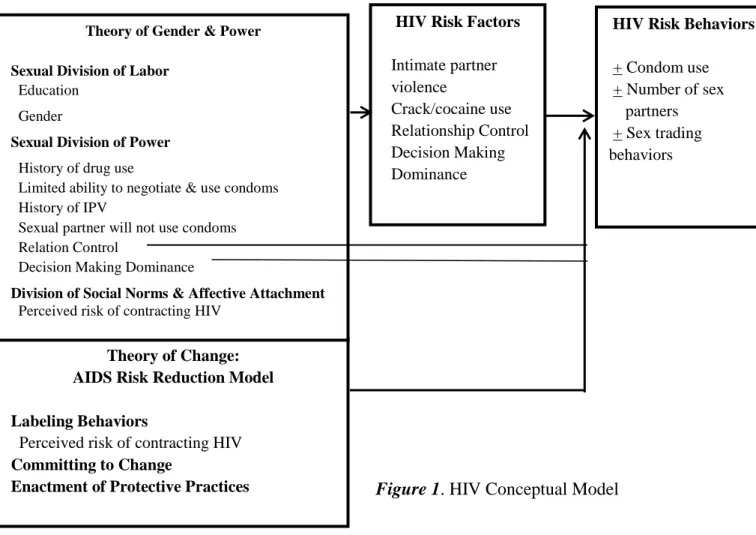
contextual issues pertaining to HIV faced by women (Wingood. & DiClemente, 2010). As shown in Figure 1, Wingood and DiClemente’s conceptual model outlines societal levels,
institutional levels, social mechanisms, exposures, and risk factors related to HIV risk
29
power, and social and affective attachments. Influencing factors for the TGP are illustrated
below in Table 1.
The sexual division of labor refers to employment opportunities for women and men,
who are constrained by occupational inequalities. For example, women face occupational
inequalities, including unequal opportunities for employment and education, and unequal pay
relative to men (Fawole, 2008). According to the National Committee on Pay Equity (2008),
women earn $0.78 for every $1.00 earned by men. The gap for minority women is even
greater, with Latino women earning $0.59 and African American women, $0.69. Economic
disparities may create a continuous relationship between poverty and gender inequalities
(Krishnan et al., 2008). Impoverished women are more likely to be vulnerable to realities of
poverty and therefore are more likely to engage in risky sexual behaviors or to trade sex for
economic gain and survival (Baumeister & Vohs, 2004; Turmen, 2003; Zierler & Krieger, 1997). In fact, the sexual division of labor influences a woman’s financial dependency on her
partner, partner choice, and increases her chances of engaging in risky sexual behavior
(Krishnan et al., 2008; Wingood & DiClemente, 2000). Studies have indicated that a large
portion of incarcerated women are either unemployed or underemployed and experience
difficulties caring for their children and meeting financial obligations prior to incarceration
(Travis, Solomon, & Waul, 2001).
The sexual division of labor is closely associated with Fawole’s (2008) concept of
economic violence, which is a component of interpersonal violence. One illustration of
economic violence could include a heterosexual couple where each partner is employed, yet
the man maintains control of spending and saving, denying the women access to the finances.
30
economic risk factors associated with women’s vulnerability to HIV to be: (a) poverty, (b)
unemployment or underemployment, (c) unequal participation in the workforce, and (d)
inadequate healthcare. In addition, the authors found that being a member of an ethnic
minority group, being younger in age, or having less than a high school education are socioeconomic risk factors that increase a women’s vulnerability for contracting HIV
(Fawole, 2008; Krishnan et al., 2008; Wingood & DiClemente, 2010).
The second structure involves the sexual division of power. Wingood and
DiClemente (2000) defined power as, “…having power to act or change or having power
over others.” (p.543). Imbalances of power, control, authority, and coercion may manifest in
heterosexual relationships that in turn are rooted in a patriarchal society that favors men.
Many studies posit that women are psychologically, economically, and socially dependent on
their male partners (Wingood, & DiClemente, 1999). Male partners tend to bring greater
assets to the relationship, such as money, status, and security (Wingood & DiClemente,
1999). Such assets can create an imbalance of power within a relationship, potentially increasing women’s vulnerability to abuse as well as an inability to negotiate safer sex.
Physical exposure to HIV and behavioral risk are two primary consequences of the
imbalances of sexual power. Physical exposures affect women who have histories of sexual
or physical abuse, high-risk sexual partners, inadequate access to HIV prevention, and
greater exposure to sexually provocative media. Moreover, behavioral risk factors that
increasingly make a woman more vulnerable to HIV include a history of substance abuse, the
inconsistent use of condoms, low self-efficacy, a lack of assertive communication skills, and
a lack of influence over condom use (Wingood et al., 2002).
31
attachments and social norms. This structure refers to sexually “appropriate” behaviors of
women, relating to purity and morality. According to Wingood and DiClemente (1999),
sexuality associated with women is based on the premise of emotional intimacy, sexual
encounters with men, childbearing, and spirituality. They postulate that social exposures increasing a woman’s vulnerability to HIV include (a) older partner(s), (b) desire of either
partner to conceive, (c) conservative cultural and gender norms, (d) religious doctrine on
contraception, (e) strong distrust of the healthcare system, and (f) unsupportive family
regarding HIV prevention (Wingood & DiClemente, 2000). These social exposures are
compounded by personal risk factors, such as inadequate HIV prevention knowledge and
skills, older partner, and limited pool of partners (Williams, Newman, Sakamoto, &
Massaquoi, 2009). Personal risk includes being in a long-term relationship where couples
may be less likely to use condoms (Wingood & DiClemente, 2010). In addition, perceptions
concerning HIV transmission, experiences of depression or psychological distress, and biological factors contribute greatly to women’s intent and ability to practice safer sex (Fogel
& Black, 2008). The TGP provides an understanding of HIV related risk specific to women.
Table 1
Model Conceptualizing Influences of the Theory of Gender and Power Pertaining to Women’s HIV Risk Societal Level Institutional
Level
Social Mechanisms Exposures Risk Factors Disease
Sexual Division of Labor
Neighborhood School Family
Manifested as unequal pay produces economic inequities for women Economic exposures Socioeconomic risk factors Sexual Division of Power Relationships Worksite Manifested as imbalances in control power for women
Physical exposures
Behavioral risk
factor HIV Media
Structure of Cathexis: Social Norms & Affective Attachment Relationships Family Church Manifested as constraints in expectations produces disparities in norms for women
Social exposures
Personal risk factors
32
AIDS Risk Reduction Model
Catania, Gibson, Chitwood, and Coates (1990) advanced the concept of HIV and
AIDS specific theories through the development of the Aids Risk Reduction Model (ARRM).
The AARM is a stage based change theory that addresses high-risk HIV behaviors by
incorporating constructs from the Health Behavioral Model (Rosenstock, 1990), reasoned
action theory (Ajzen & Fishbein, 1980) and self-efficacy theory (Bandura, 1989). The theory
stipulates readiness for behavioral change involving three stages: (a) labeling, (b)
commitment, and (c) enactment. Further, Catania et al. (1990) proposed specific influences
related to particular stages of change. The first two stages of ARRM consist of psychosocial
factors influencing behavioral change (Longshore, Stein, Kowalewski, & Anglin, 1998). The first stage is titled labeling and involves identifying one’s behavior as risky.
Specific influences of labeling behavior include women’s understanding of high-risk sexual
activities or injection drug use associated with HIV transmission, perception of susceptibility
to the virus; desire not to contract the illness, and influences of social norms and networks
(Family Health International, 2002).
In the second stage, the individual makes a commitment to reduce HIV risk
behaviors. Influences on commitment to behavioral change can include cost and benefits,
enjoyment related to changed behavior, response efficacy (e.g. examines whether changes
reduce risk of infection), and self-efficacy and social factors.
The final stage is the enactment of new behavioral changes. This process consists of
three phases: (a) information seeking, (b) obtaining remedies, and (c) implementing
solutions. The previously mentioned stages may occur sequentially or concurrently,