NEW LITERACIES PRACTICES OF EARLY CAREER ENGLISH TEACHERS: FROM DIGITAL SPACES TO THE CLASSROOM
Jonathan T. Bartels
A dissertation submitted to the faculty of the University of North Carolina at Chapel Hill in partial fulfillment of the requirements for the degree of Doctor of Philosophy in the School of Education (Culture, Curriculum, & Change).
Chapel Hill 2013
Approved by:
Cheryl Mason Bolick Julie Justice
ABSTRACT
JONATHAN T. BARTELS: New Literacies Practices of Early Career English Teachers: From Digital Spaces to the Classroom
(Under the direction of Dr. Cheryl Mason Bolick)
Table of Contents
I. Introduction...13
Social Media...13
Push for Rapid Transformation in Education...16
Technology in the English Classroom...18
New Literacies...19
Rationale...20
Research Questions...22
Organization of Dissertation...22
Summary...22
II. Literature Review...24
The State of Social Media...24
Educational Change Models...26
New Literacies...29
New Literacies Studies (NLS)...29
New literacies...31
Defining a new literacies approach...34
A concise, working definition of new literacies...35
What does the new literacies literature tell us?...41
Political Economy of Communication...41
Summary...43
III. Research Methodology...44
Research Approach...44
Participants...46
Carla...48
Laura...48
Kevin...49
Research Sites...50
Ethical Protection of Participants...54
Researcher Positionality...54
Data Collection...56
Classroom observations...56
Digital observations...57
Interviews...58
Data Analysis...58
Summary...59
IV. Case 1 Findings: Carla...61
Carla’s Personal Use of Social Media...61
Themes in Carla’s social media usage...65
Political economy of communication and Carla’s social media usage...72
Physical setting...74
Classroom technology...75
Yearbook class...77
English IV class...79
Themes in Carla’s classroom...84
Political economy of communication and Carla’s classroom...90
Relationship of Social Media and Classroom Practices...91
Summary of Case 1 Findings...92
V. Case 2 Findings: Laura...93
Laura’s Personal Use of Social Media...93
Themes in Laura’s social media usage...96
Political economy of communication and Laura’s social media usage...103
Laura in the Classroom...103
Physical setting...104
Classroom technology...106
Sixth grade English inclusion...107
Themes in Laura’s classroom...110
Political economy of communication and Laura’s classroom...116
Relationship of Social Media and Classroom Practices...117
Summary of Case 2 Findings...119
VI. Case 3 Findings: Kevin...121
Themes in Kevin’s social media usage...122
Political economy of communication and Kevin’s social media usage...127
Kevin in the Classroom...127
Physical setting...128
Classroom technology...129
English II...130
Honors English II...134
Themes in Kevin’s classroom...135
Political economy of communication and Kevin’s classroom...140
Relationship of Social Media and Classroom Practices...141
Summary of Case 3 Findings...142
VII. Discussion...144
Case 1: Carla...144
How does Carla make personal use of social media?...145
How does Carla negotiate the professional practice of teaching?...146
Identifying a relationship...149
Summary...151
Case 2: Laura...151
How does Laura make personal use of social media?...152
How does Laura negotiate the professional practice of teaching?...153
Summary...157
Case 3: Kevin...157
How does Kevin make personal use of social media?...158
How does Kevin negotiate the professional practice of teaching?...158
Identifying a relationship...160
Summary...162
The Echo...162
Refraction...163
Interference...164
Absorption...164
The echo relationship...165
Summary of Discussion...165
VIII. Conclusion...167
Findings...167
How do millennial, early career English teachers make personal use of social media?...167
How do millennial, early career English teachers negotiate the professional practice of teaching? ...168
What is the relationship between millennial, early career English teachers’ personal usage of social media and their daily classroom practices?...168
Theoretical Implications...169
Political economy of new literacies...169
Connected ethnography...169
Technological change agent...171
Future Research...172
Preservice teacher self-study...172
Assessment protocol...172
Limitations...173
Lack of research base...173
Access to research sites...173
Conclusion...174
IX. Appendices...175
List of Tables
Table 1: Participants...47
Table 2: School Demographics...52
Table 3:Social Media Site Demographics...53
Table 4: Sample Artifact Collection Table...57
Table 5: Overview of Carla’s Social Media Usage...63
Table 6: Carla’s Social Media Usage: Sharing...65
Table 7: Carla’s Social Media Usage: Collective Intelligence...68
Table 8: Carla’s Social Media Usage: Multimodality...70
Table 9: Carla’s Yearbook Activities...78
Table 10: Carla’s English IV Activities...80
Table 11: Carla’s Teaching: Practical Flexibility...84
Table 12: Carla’s Teaching: Distributed Authority...87
Table 13: Carla’s Teaching: Collective Intelligence...89
Table 14: Comparison of Case 1 Themes...91
Table 15: Comparison of Case 1 Political Economy of Communication Moments...92
Table 16: Overview of Laura’s Social Media Usage...94
Table 17: Laura’s Social Media Usage: #hashtagging...98
Table 18: #livetweetTWC...100
Table 19: Laura’s Social Media Usage: Multimodality...101
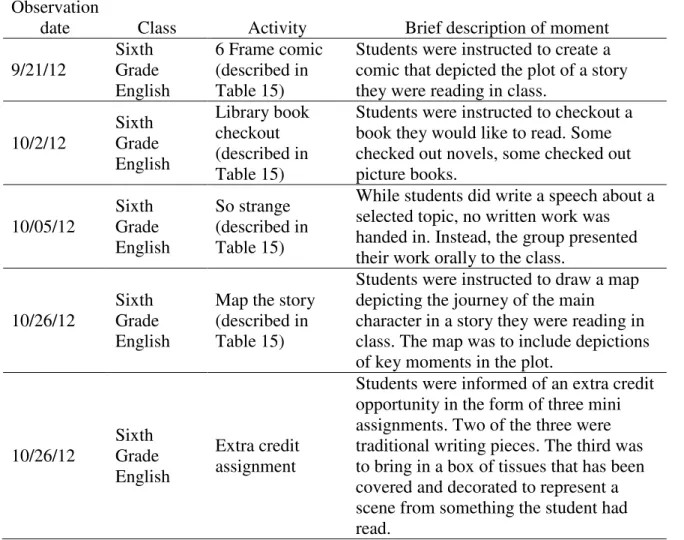
Table 20: Laura’s Sixth Grade English Activities...108
Table 21: Laura’s Teaching: Directive Information...112
Table 23: Comparison of Case 2 Themes...118
Table 24: Comparison of Case 2 Political Economy of Communication Moments...119
Table 25: Overview of Kevin’s Social Media Usage...122
Table 26: Kevin’s Social Media Usage: Broadcasting...123
Table 27: Kevin’s Social Media Usage: Multimodality...125
Table 28: Kevin’s Social Media Usage: Connectivity...126
Table 29: Kevin’s English II Activities...132
Table 30: Kevin’s Teaching: Contextual Framing...136
Table 31: Kevin’s Teaching: Multimodality...137
Table 32: Kevin’s Teaching: Technological Management...138
Table 33: Comparison of Case 3 Themes...141
List of Figures
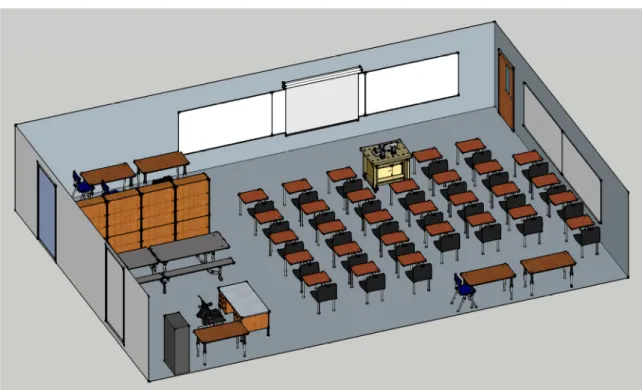
Figure 1: Carla’s Classroom...75
Figure 2:Difference in Laura’s Facebook and Twitter Postings...95
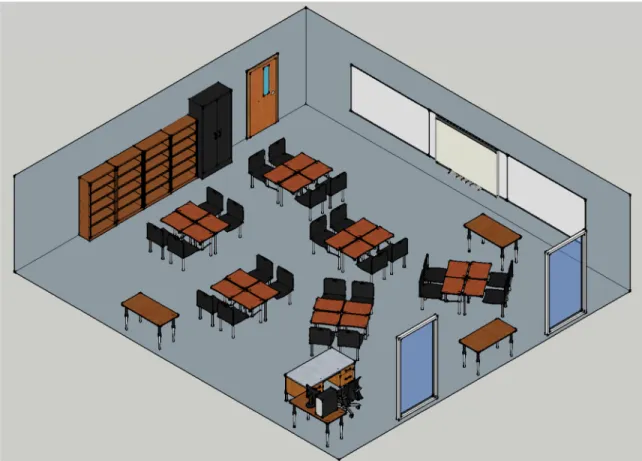
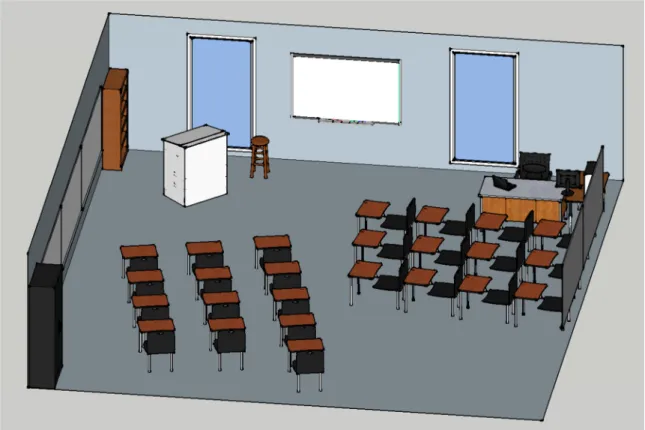
Figure 3: Laura’s Classroom 1...105
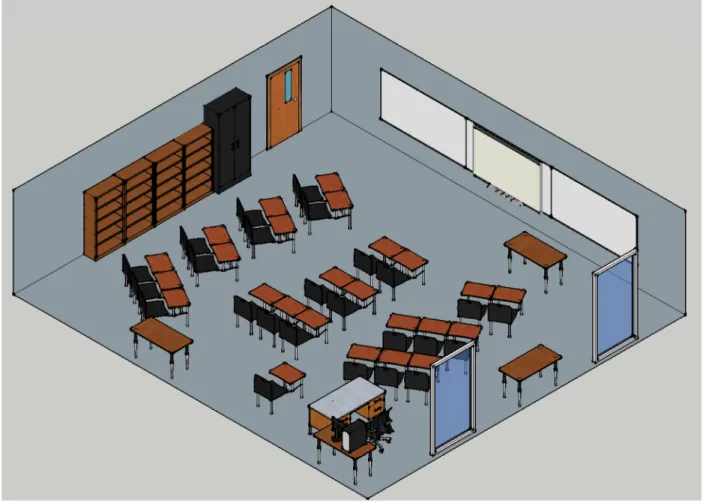
Figure 4: Laura’s Classroom 2...106
Chapter 1: Introduction
New and emerging digital technologies carry with them new sets of literacies and ways of approaching communication; however, little is currently known about the relationship of these literacies and education; very little research exploring the everyday literacies young teachers engage in their usage of these technologies exists today. In order to better understand the perceived gap between personal use of technology and
professional practice, we must gain a better understanding of the literacy practices associated with these ubiquitous immersive technologies. This collective case study was designed to identify and examine the relationship between the literacies associated with early career English teachers’ personal use of social media and their general pedagogical approaches in the classroom.
Social Media
interests (Smith, 2011). The communication that happens over social media environments is different than previously used methods of correspondence because of the multimodal and dynamic nature of the digital environments.
Social media is a particular category of online application which falls under the heading of Web 2.0: a paradigm of web-based technologies which positions the
responsibility of the creation and maintenance of content on the users, not the
programmers (O'Reilly, 2004). While it is characterized by technical markers such as Rich Site Summary (RSS) and script that allows user-generated modifications, Web 2.0 is also centered on a different way of thinking— a collective intelligence (O’Reilly, 2004). “Web 2.0 is primarily interesting from a philosophical standpoint. It’s about relinquishing control, it’s about openness, trust, and authenticity. [The associated coding scripts, such as] APIs, tags, Ajax, mash-ups, and all that are symptoms, outputs, results of this philosophical bent” (Merholz, 2005, para. 5). The functions of Web 2.0 technologies have created a philosophy that is embodied in web-based applications where multiple parties are able to collaborate on content to be consumed and modified by other users, without need of coding knowledge or access to server space (Salz, 2005; Gordon-Murnane, 2006). Instead of providing content or a consumable product, an interface is provided for the consumer to create his or her own content or product. This generation of web-based applications often involves pre-fabricated templates for users to upload and download content of various forms (Macnamara, 2010). Web 2.0 technologies are a naturally collaborative, simple means of sharing multimedia content in an
definitions include similar characteristics: multimodal, networked, digitally interactive, and dialogic (Logan, 2010).
Social media is a specific subset of Web 2.0 the online environments that emphasize the creation and exchange of all types of user-generated media within a digitally-mediated community (Kaplan & Haelein, 2010). Social media platforms often engage mobile technologies in addition to web-based interfaces. This portability is a contributing factor to the massive influence social media has had on the way our society communicates (Kietzmann & Hermkens, 2011). The practices enacted by the users of these technologies are often regarded as participatory culture. Jenkins (2006, p. 7) defines participatory culture as one:
1) with relatively low barriers to artistic expression and civic engagement 2) with strong support for creating and sharing one’s creations
3) with some type of informal mentorship whereby what is known by the most experienced is passed along to novices
4) where members believe their contributions matter.
5) where members feel some degree of social connection with one another. (p. 7)
Instead of it being centered on the page creator sharing or giving information, it is about the collective intelligence and gives agency to the page users. This emphasis on
Push for Rapid Transformation in Education
Since the launch of the personal computer in the early 1980’s, there has been a push on all levels to incorporate more technology into compulsory education. In the 1983
A Nation at Risk report it was indicated that all high school graduates needed to be able to
both understand and use computer technology (National Commission on Excellence in Education, 1983). The No Child Left Behind Act of 2001 continued this emphasis on technology by forwarding the idea that students should be technologically literate by the time they enter high school (Elementary and Secondary Education Act, 2001). In 2010, the bar was raised when the National Education Technology Plan (NETP) issued a call for “revolutionary transformation [of education] rather than evolutionary tinkering” (Office of Educational Technology, 2010, p. ix). This model makes use of “learning powered by technology” (p. x) to enhance learning, assessment, teaching, and
productivity. The call reflects the near ubiquitous state of technology in today’s society. “Just as technology is at the core of virtually every aspect of our daily lives and work, it is central to implementing the model of 21st century learning in this plan” (p. 3).
Koehler and Mishra (2008) identify that earlier technologies that have been successfully integrated into schools (e.g. the pencil, microscope, and overhead projector) are characterized by specificity, stability, and transparency of function. These
technologies have a very clear use, they are very sustainable, and are generally
difficult to sustain in schools. This is a contributing reason why schools have largely neglected to successfully incorporate them (Zhao, 2009).
Some would argue that schools are addressing new technologies; however, they are often incorporating new technologies as new tools to teach the same content in, fundamentally, the same way. Lankshear and Knobel (2006) refer to this practice of wrapping old content and pedagogy in new technology as the “old wine in new bottles syndrome.”
The webpage or slide show stands in for paper, pencil and crayon as medium for presenting stories or recounts. The webquest stands in for the photocopied worksheet where the teacher poses a question or problem and provides a list of resources students are to use in tackling it. The school website stands in for an occasional newsletter or a printed prospectus or parent-teacher information
evening. The blog stands in for homework notebooks. (p. 55)
The keyboard replaces the pencil, the SmartBoard replaces the chalkboard, the MacBook replaces the notebook, but the epistemology of schools remains widely the same. In this, the school is failing to recognize the transformation brought about by the new
technologies (Zhao, 2009). Harris, Mishra, and Koehler (2009) noted that there is often a discrepancy between the visions of transformative uses of technology in the classroom and the actual implementation and support of the uses of the technology in the classroom. They go on to suggest that there are five dominant approaches to integrating technology into education: (a) software-focused initiatives; (b) demonstrations of sample resources, lessons, and projects; (c) technology-based educational reform efforts; (d)
rather than more fundamental issues of how to approach teaching subject matter with these technologies” (Mishra, Koehler, & Kereluik, 2009, p. 49). Unfortunately, these types of approaches do not address the transformative nature of current technologies. Cuban (2001) points out that simply infusing the infrastructure of technology is not the same as using technology in empowering and meaningful ways.
Technology in the English Classroom
In a recent issue of English Journal, Hicks, Young, Kajder, and Hunt (2012) surveyed the complete history of the journal to track themes of preparing students to succeed as writers in the 21st century. Through their review, Hicks, et al. (2012) created a sound synthesis of the influence of new media in English over the past one hundred years. In their analysis, three central themes were identified.
1. Given adequate support, all students write and we should encourage them to
be published writers.
2. Used purposefully, newer technologies and media can influence, support, and
extend writing practices.
3. Despite all the cultural and technological changes in the types of texts we are
able to produce and consume, and the revolutionary predictions we have made, not much has really changed in the teaching of English over the past
100 years. (p. 68)
Digital technologies have become a part of everyday life in our society. The field of education has widely struggled to incorporate these technologies in meaningful ways. This is often a result of technological infrastructure instability (such as outdated hardware or software), unclear or undefined uses of the technology, and/or prioritization of the technology over the pedagogy.
New Literacies
In attempts to address the issues surrounding technology in education, this study engages the theoretical frameworks of new literacies (Lanshear & Knobel, 2011; Corio, Knobel, Lankshear, & Leu, 2008; etc.) in order to gain a better understanding of the relationship of early career English teachers personal usage of social media and their pedagogical practices.
concept of New Literacy is that the individual’s identities that are embedded in
discourses and literacies “mediate and are mediated by the texts they read, write, and talk about” (Moje et al., 2009, p. 416).
The ontological shift of ‘new’ can be seen in the “digital turn” (Mills, 2010, p.246) in literacy work, shifting the focus to the influence of emerging technologies, particularly the Internet, on literacy practices (Corio et al., 2008). Lankshear and Knobel (2011) refer to these technological tools as the ‘stuff’ of new literacies. This ‘stuff’ leads to questions about the possible impact of technologies on literacy (Corio et al., 2008). “The new literacies studies is about studying new types of literacy beyond print literacy, especially digital literacies and literacy practices embedded in popular culture” (Gee, 2010, p. 31). The ‘new literacies,’ unlike ‘New Literacy,’ may focus on psycholinguistic issues based in new and emerging technologies. The new literacies studies are plural in that they are interested in looking at different types of digital literacy practices:
information literacy, ICT literacy, computer literacy, and so on (Corio, et al., 2008). Rationale
While the trope of a digital revolution is widely over used, it cannot be denied that we are currently in a moment of highly visible social change as a result of connective technologies becoming ubiquitous in society. Houle (2008) refers to it as the Shift Age and notes that this shift is being driven by the heightening level of electronic
from being the source of knowledge because of the level of access to information through digital mediums (Collins & Halverson, 2009).
The millennial generation comprises the second largest generation, following the baby-boomer generation, in our society (Jones & Fox, 2009). Millennials are effectively replacing the baby-boomers in the workforce as millennials are now entering the
workforce while baby-boomers are beginning to reach the age of retirement. While the level of connectivity and use of technologies among millennials is widely varied (Jones, Ramanau, Cross, & Healing, 2010), this generation comprises the largest demographic of Internet and social media users. Currently, more than 90% of young adults, ages 18-24, identify themselves as Internet users (Smith, Rainie, & Zickuhr, 2011). Of these users, roughly 75% make use of some sort of social media (Lenhart, Purcell, Smith, & Zickuhr, 2010). While the particular websites and platforms are shifting, the number of users is steadily growing. As a result of this generation being born into a world of personal computers and growing up alongside the Internet, they exhibit a heightened level of connectivity and a shift in engagement style (Savage, 2003).
Research Questions
To help bridge this gap in the literature, this study is seeking to identify the relationship between millennial, early career English teachers’ use of social media and their teaching practice. To address this issue, the follow questions must be answered: (a) How do millennial, early career English teachers make personal use of social media? (b) How do millennial, early career English teachers negotiate their professional practice as classroom teachers? (c) What is the relationship between millennial, early career English teachers’ personal usage of social media and their daily classroom practices?
Organization of Dissertation
Following this introductory chapter, the current state of social media, theories of educational change and new literacies, research on new literacies, and the frame of the political economy of communication will be presented in the literature review. Chapter three describes the methodological approach of this study. Chapters four through six presents the findings from the three cases addressed in this study (chapter four presents the findings of case one, chapter five the findings of case two, and chapter six the findings of case three). The findings are discussed case-by-case in chapter seven along with the mapping of the emerging theory of the echo relationship. Chapter eight
synthesizes the findings and discussions to succinctly answer the research questions and address the implications.
Summary
Chapter 2: Literature Review
The field of new literacies has grown and expanded in the past decade and continues to change along with emerging technologies. New literacies’ many forms can be confusing and sometimes difficult to conceptualize for classroom practice, especially since the current research is fairly thin and often techno-centric. In moving forward with new literacies work, it is imperative to establish a working definition of new literacies to clearly define the paradigm in which one’s research is centered. These components will be addressed while situating the current study amongst the state of social media;
proposed models of educational change; the historical roots of the primary theoretical framework of new literacies; the current state of research efforts in the area of new literacies and secondary English; and the potential use of political economy of communication as a framework for considering power relations.
The State of Social Media
In recent years, smartphones have started to replace laptop and desktop computers (as well as televisions) as a primary tool for accessing information and communicating with peers (Newspaper Association of America & New Media Innovation Lab, 2010). Between 2010 and 2011, the number of people with smartphone subscriptions increased by 45%; an analysis of teenagers cell phone bills indicated they used an average of 320 megabytes of data a month, an increase of 256% from the previous year’s survey. Additionally, teens indicated a preference for texting over voice calling (Nielsen, 2012). With a strong preference for text-based communication, youth and young adults are writing more than any previous generation. However, they do not consider this type of personal writing to have any relationship to writing as it is taught in schools (Lenhart, Arafeh, Smith, & MacGill, 2008).
professional collaboration and communication (PBS, 2009). Schools and school districts are beginning to address the rise of influence of social media in policies and actions.
The uses and policies surrounding social media vary widely. Some school administrations have found social media to be a powerful and effective way to share information with parents and the surrounding communities. Other administrations are working to reconsider their acceptable use policies for technologies (Schachter, 2011). But when it comes to the personal social media use of teachers, there is still a great deal of uncertainty. Kist (2008) points to the fact that there has been apprehension, and even fear, with the introduction of many new forms of media (such as the moving picture, radio, and television), but social media faces so much fear that, in some cases, teachers have been banned from using the medium in their personal lives by their administrations. There are also those who believe that technologies such as social media hold the key to a new generation of education.
Educational Change Models
Promotion of educational reform through technology can be seen widely in academic literature. However, a majority of these assertions position technology as the central agent in the reform. What follows depicts conceptualizations of educational reform that they do not place the technology itself as the central change agent. Instead, these scholars identify key habits embodied in the technologies that can be harnessed in educational settings.
with the modern, high-tech, global world today’s children and teenagers live in than do the theories (and practices) of learning that they sometimes see in school” (p. 5). There are a few key themes that run through Gee’s (2007) principles of learning. First are issues of active and ongoing engagement. Video games are designed in a way that engage the player and keeps the player engaged through rapid, exaggerated feedback; individualized engagement; options for achievement; and scaffolded learning. Second, meaning is made in video games through multiple modes and is directly related to context. Finally, the player is not positioned as a passive consumer; the player has an active role in deciding how the game plays out and how he or she will exist within the game.
Davidson and Goldberg (2009) state that we, as a society, are early in a fast moving moment of development of online collaboration—what they identify as the most meaningful aspect of recent technological advances. Through collaborative work with colleagues to consider the significant impact of technologies on learning, they have come to ten principles they believe to be foundational to rethinking the future of education: (a) self-learning, (b) horizontal structures, (c) from presumed authority to collective
credibility, (d) a de-centered pedagogy, (e) networked learning, (f) open source
Houle and Cobb (2011) suggest that, as a result of the changing generational demographics and skill sets needed in the job market, transformation of the educational system is inevitable. They mapped out four concepts they believe will drive and shape the transformation in the coming decades: (a) community-centric schools, (b) five Cs— creativity, collaboration, critical thinking, content, and context,— (c) shape shifting, and (d) a simple collective choice. Houle and Cobb (2011) noted ways to connect schools to the local and global community in order to enhance “real world” learning. They also discuss the need to be responsive and flexible in our ideas of and approaches to education. The authors’ idea of the five Cs, which they believe need to be added to reading, writing, and arithmetic as core components of the educational process. The ideas of enhancing creativity, expanding collaboration, and developing critical thinking are fairly straightforward. Houle and Cobb (2011) pointed out that the very idea of content is no longer static. Through digital technologies content can be accessed, used and reused, shared, remixed, and created. They challenged traditional ideas of content and argue that it is more important that students become masters of context than masters of content. As a result of the heightened levels of access to so much information and content, a thorough understanding of context allows students to identify the pertinent information and content and understand how to use it in meaningful ways. Houle and Cobb (2011) concluded their recommendations by noting that the tools and knowledge needed to make a
collective will as the three critical components that truly have the power to transform education.
While these three approaches to educational transformation use different approaches, they all come to some strikingly similar recommendations that mirror principles found in Web 2.0 technologies. Gee (2007), Davidson and Goldberg (2008), and Houle and Cobb (2011) all emphasize issues of collaboration, decentering of
authority, reconsidering traditional content, and the significance of context. These themes are also key components for a new literacies stance.
New Literacies
Wikipedia identifies new literacies as “new forms of literacy made possible by digital technology developments, although new literacies do not necessarily have to involve use of digital technologies to be recognized as such” (“New literacies,” 2013, para. 1). While often considered to be a questionable source as a result of the fact that it is open to peer editing (Chen, 2010), Wikipedia is particularly appropriate for defining new literacies because it represents so many of the aspects that are important to the field of new literacies. The following section maps the theoretical history of new literacies and situate how new literacies will be frame within this study.
The way in which Gee (2010) distinguished between cognitive and social literacy is exemplified in his distinction between discourse and Discourse.
Gee (2008) generally identifies discourse (with a little/lowercase d) as the general usage of language. What he defines as a Discourse (with a big/capital D) involves
language usage, but also much more.
A Discourse is a socially accepted association among ways of using language and other symbolic expressions of thinking, feeling, believing, valuing, and acting as well as using various tools, technologies, or props that can be used to identify oneself as a member of a socially meaningful group or “social network,” to signal (that one is playing) a socially meaningful “role,” or to signal that one is
filling a social niche in a distinctively recognizable fashion. (Gee, 2008, p. 161)
In this approach to literacy, the cognitive work of decoding and encoding of alphabetic text is the discourse (little d) and the cultural practices associated with the decoding and encoding many forms of text to create meaning is the Discourse (big D). Big D Discourse also situates an individual’s identity as a way of being through how he or she makes meaning in the world beyond text alone.
Identity, in regards to Discourse (big D), is considered to be “the ability to be recognized as a ‘kind of person’ [...] within a given context” (Black, 2007, p. 118). Further, identity is not situated as a singular or fixed representation.
Each of us is a member of many Discourses, and each Discourse represents one of our ever multiple identities. These Discourses need not, and often don’t, represent consistent and compatible values. There are conflicts among them, and each of us lives and breathes these conflicts as we act out our various Discourses.
(Gee, 2008, p. 4)
New literacies. The study of new literacies builds on the sociocultural approach to literacy and specifically looks at how digital tools are used in, and influence, the creation and interpretation of meanings (Corio et al., 2008; Gee, 2004, 2007, 2010; Kist, 2005; Knobel and Lankshear, 2007; Kress, 2003; Lankshear, 1997; Lankshear and Knobel, 2006). New literacies identifies ‘literacies’ as existing beyond print and dealing with “new digital literacies and literacy practices embedded in contemporary popular culture” (Gee, 2010, p.9). Unlike traditional literacy, new literacies are not confined to the process of decoding written words and encoding in the same format. Instead, literacies are multiple (The New London Group, 1996), multimodal (Hull & Schultz, 2002), semiotic (Baker, 2001; Gee, 2007; Kress, 2003), social (Street, 1998), and are required by the Internet or other emerging, social technologies (Leu, Kinzer, Coiro, & Cammack, 2004). Gee (2010) notes that the study of new literacies is similar to NLS in that new literacies studies also argue that the meanings created with these technologies are determined by social, cultural, historical, and institutional practices which almost always involve more than just technology usage alone.
No previous technology for literacy has been adopted by so many, in so many different places, in such a short period, and with such profound consequences. No previous technology for literacy permits the immediate dissemination of even new technologies of literacy to every person on the Internet by connecting to a single link on a screen. Finally, no previous technology for literacy has provided access to so much information that is so useful, to so many people, in the history of the
world. (Corio, et al., 2008, p. 2-3)
The Internet does not mark a single point of change in the technology of literacies, but that the Internet, as a technology, is a source of immediate and continuous change to literacy technologies. This continuous movement and redefining of literacy positions new literacies as deictic—a linguistic term for words such as here, there, now, today, go, and come (Leu, et al., 2004). This situates new literacies as a highly contextual form of literacy that, by definition, will change and morph within different contexts. In this, new literacies, like the phrase ‘new technologies’, does not simply address one moment in time or a single idea.
While the movement of new literacies is directly related to the affordances of changing technologies, it is important to note that the study of new literacies is not about becoming proficient in a specific technology. Instead, new literacies is identified as “a larger mindset and the ability to continuously adapt to the new literacies required by the new technologies that rapidly and continuously spread” (Corio, et al., 2008, p. 5). For instance, it is not as important that a student understand the technical components needed to support a blogging platform as the student understands the larger conventions of communicating ideas through the medium of blogs.
communication (Leu, et al., 2004). As a result, the definitions researchers and scholars individually ascribe to new literacies are often widely varied and more typically identify how they conceptually approach new literacies.
Leu et. al (2004) note that it is too early to ascribe a defining, comprehensive theory of new literacies, but that these ten characteristics should frame the central principals of new literacies.
1. The Internet and other ICTs [information and communication technologies] are central technologies for literacy within a global community in an information age.
2. The Internet and other ICTs require new literacies to fully access their potential.
3. New literacies are deictic.
4. The relationship between literacy and technology is transactional. 5. New literacies are multiple in nature.
6. Critical literacies are central to the new literacies.
7. New forms of strategic knowledge are central to the new literacies. 8. Speed counts in important ways within the new literacies.
9. Learning often is socially constructed within new literacies.
10. Teachers become more important, though their role changes, within new
literacy classrooms. (p. 1589)
how to enact these needed changes, we must first address how we approach new literacies.
Defining a new literacies approach. Lankshear and Knobel (2006) suggest that new literacies are specifically distinctive because they involve two distinctive aspects: ethos and technos. The ethos of new literacies refers to the “socially recognized ways of generating, communicating and negotiating meaningful content through the medium of encoded texts within contexts of participation in Discourses” (Lankshear & Knobel, 2006, p. 64). Lankshear and Knoble (2006) make use of Gee’s (2008) work on (big D) Discourse. This approach is considered to work across several of the different constructs of new literacies. First, Lankshear and Knobel (2011) build the idea of ‘socially
recognized ways’ from Scribner and Cole’s (1981, as cited in Lankshear & Knobel, 2011) notion of practices—“socially developed and patterned ways of using technology and knowledge to accomplish tasks” (p. 286). Second, they used the term “encoding” to identify more than simply creating words with letters. “Encoding means rendering texts in forms that allow them to be retrieved, worked with, and made available independently of the physical presence of an enunciator” (p. 286). Finally, Lankshear and Knobel (2011) identify that “social practices of literacy are discursive. Discourse can be seen as the underlying principle of meaning and meaningfulness” (Lankshear & Knobel, 2011, p. 286).
forms of text” (Lankshear & Knobel, 2006, p. 25), as opposed to the ‘ethos stuff’ which denotes a shift in mindset from more traditional literacy and depicts new literacies as more participatory, collaborative, and distributed than traditional, print-based literacy. Lankshear and Knobel (2003, 2006, & 2011) consider the ‘ethos stuff’ to be critical in identifying new literacies.
Lankshear and Knobel (2006) place more emphasis on the new ethos stuff than they do on the new technos stuff. “[I]f a literacy does not have what we call new ethos stuff we do not regard it as a new literacy, even if it has new technical stuff” (Knobel & Lankshear, 2007). This is a very important distinction between the use of new
technologies and the use of new literacies. While new literacies are influenced and shaped with new technologies, the simple inclusion of new technologies does not mean that new literacies work is being done. In fact, new literacies work can be done outside of the new technologies for. “[...] New literacies may produce skills that support navigations of old media (i.e., print-on-paper media)” (Moje, 2009, p. 349). However, when
considering the new literacies developed through personal use of new technologies, it can often be challenging to identify transferable applications to the classroom setting (Knobel & Lankshear, 2008).
communication that involves both ‘new technos’ and ‘new ethos’ and are deeply connected within context but that the ‘new technos’ does not necessarily indicate the immediate presence of digital technologies.
New Literacies in the English Classroom
The literature selected in this review was selected in relation to the following criteria. First, that it represented new literacies work dealing with either secondary English classrooms or English education. Second, that it not be focused on a single activity or piece of technology, as Lankshear and Knobel recommend. Third, that it be timely enough to reflect recent changes and influence of social media technologies, which translates into research that reflects activities that have emerged within the last ten years. The following section will present the articles that met these criteria, identify themes amongst the articles, and situate the articles within a new literacies frame.
Different forms of media are very popular as a tool within the genre of new literacies work. Popular media, such as video games and blogs, were used as a jumping-off point for Gerber and Price (2011) in an article describing ways of using new media to engage students in various forms of writing. Gerber and Price (2011) promoted writing video game walk-throughs as a form of expository writing, blog posts about moral or ethical issues brought up in video games as persuasive writing, and writing fan fiction based on games as creative writing. They also argued that the use of popular media created an authentic learning experience for students.
production of “multimodal, technology-infused projects” (Sewell & Denton, 2011, p. 61). The types of multimodal projects identified in their article included a podcasting
assignment as a review of literary terms and an audio public service announcement for further engagement with the tested literary terms. Sewell and Denton (2011) noted that they faced struggles incorporating this type of assignment into their classroom syllabus. These struggles were in the form of needing to learn new software as well as adjusting their teaching styles to the multimodal positioning. Ultimately, the researchers, citing raised test scores among the students, deemed the project a success. Both of these studies would be challenged on their stance within new literacies, as it is defined by Lankshear and Knobel (2006) and defined above. Gerber and Price (2011) were engaging new technologies which require new literacies, but then produced entirely text-based products. Sewell and Denton (2011) were engaging students in new literacies productions, but to support the memorization of vocabulary terms—what some would consider to be “old literacy.” Both examples clearly involve the ‘new technos’ of new literacies, but it is unclear to what level the ‘new ethos’ is actually involved.
different modes worked together. Finally, the preservice teachers were asked to create a lesson involving some form of non-print-based product. In the end, the preservice teachers were able to identify the different modes, but struggled to analyze why using different modes mattered; the non-print texts used in the lessons were only positioned as supplemental rather than central to the lesson plans.
Another challenge to traditional notions of text is presented by Gainer and Lapp (2010) in their descriptions of sample activities that remix old and new literacies as a way to get students personally involved with texts. The activities described include (a)
creating a montage juxtaposing official and unofficial learning spaces in school, (b) creating a comic book-style dialogue between the students and authors, (c) creating a narrative history of an everyday item, and (d) creating poetry that informs its audience of a real-life event. Gainer and Lapp (2010) note that all of these activities “invite students to (1) directly, electronically, or virtually create a social community interface; (2) identify a task concept and plan; and (3) utilize media to physically, electronically, or verbally create, comment, and collaborate” (p. 59). The goal of these activities was to engage the students in the notion that, as readers, they are active creators of meaning. Gainer and Lapp (2010) promoted the expansion of what we generally consider to be a text in classroom spaces.
explored using digital forms of literature instead of printed copies in his teaching. He noted that “[t]eaching the ‘new literacies’ involves not only learning about and taking advantage of new materials, […] but also helping students learn to think carefully and critically about what they read, mass media reports as well as literature” (Webb, 2007, p. 88). Webb highlighted the interactivity possible with digital texts, which were not possible with print texts, such as hyperconnectivity and the ability to manipulate and modify texts. A particular note of interest in Webb’s (2007) article was his explicit and honest remarks on his own teaching, as he was “experimenting” with his class. Within new literacies work, the manipulation of media is commonly referred to as remixing, which has become an increasingly popular and common activity online (Knobel & Lankshear, 2008).
The common practices and literacies students, at both the secondary and post-secondary levels, use in their everyday lives are primarily disconnected from the literacies promoted in classrooms (Alvermann, 2008). “Regardless of how much we, as teachers and teacher educators, might […] admire the writing skills, inventiveness, and social intuitions exhibited by adolescents who create online content, these markers of student expertise are given scant attention in our everyday classroom practices”
(Alvermann, 2008, p. 13). This point is illustrated in a large-scale survey conducted by Dredger, Woods, Beach, and Sagstetter (2010), in which students in grades 7-12 (N=444) were asked about what motivated them to write both in and out of school. The responses indicated that outside of school, most students enjoyed writing when it was for
factor. Armed with this knowledge, the authors recommended that to increase engagement in classroom writing activities, teachers create space within their
instructional time that promotes the types of writing the students use in their personal lives. In order to achieve this, it is necessary to identify how students write when the writing is not assigned and how technology factors into their approaches to writing.
In a case study examining the role of technology in nine high school students’ writing processes, Turner and Katic (2009) found that students were using non-textual representations, developing arguments and organizing writing in non-linear ways, and that the technologies created both affordances as well as interruptions. Ultimately, it was determined that the advantages of the affordances of the technologies far outweighed the interruptions caused by them. The Turner and Katic (2009) recommended that non-linear models of writing and technologies be included in writing instruction. This would allow for the space needed to support and develop the kind of new literacies writing that is needed today.
In attempts to address the bridge between personal use and professional practice Schieble (2010) researched how the literacy practices of fifteen preservice English
are changing how we communicate and what it means to be literate in our society that can also change the ways we engage in professional discourse.
What does the new literacies literature tell us? Currently, the body of literature that addresses new literacies in ways beyond individual activities and/or with a primary focus on singular digital tools is very thin. A vast majority of the literature is heavy on the ‘new technos’ and incredibly light on the ‘new ethos.’ Hicks, et. al (2012) note that this type of techno-centric focus has not advanced the ways we teach English in the past hundred years. Additionally, the employment of ‘new literacies’ activities as a
motivational factor for students is what Kist (2005) refers to as a “spoonful of sugar” approach. Instead of these lessons actually being based in new literacies, a new literacies-esk activity is included to make the traditional literacy lesson more palatable. Hicks, et. al (2012) remind us that we need to stop focusing on and elevating the tool and do what we were hired to do—help our students acquire and develop the literacies needed to navigate the diverse forms of communication they face in the world today and in the future. Political Economy of Communication
A central issue when considering the study of communication is power relations; this is particularly true with the study of communicative technology. While there are many ways to address issues of power, political economy of communication is situated in a way that fits particularly well within the new literacies approach enacted in this study.
distributor, and/or consumer and how power and control shift positions through the processes of production, distribution, and consumption. The producer creates a resource, which has use value. The use value of a resource fills a need. The distributer converts the use value to exchange value, a process referred to as commodification in which a
resource becomes a commodity. The exchange value is the monetary value that is
assigned to the resource. The consumer then makes an exchange for the commodity. This exchange is typically in the form of currency or, when it comes to communication, some form of labor. In a power relationship, the producer and distributor hold the most power while the consumer is relatively powerless.
A simplified example of this can be easily seen in mass media. An individual, the producer of a resource, creates a television show. The television show, the resource, has no real monetary value unto itself. A television company, the distributor, then promotes the show and schedules the show. Part of this promotion may involve merchandising, ad sales, or premium channel subscriptions. The show is now generating monetary revenue and has become a commodity. The audience, the consumers, pay for watching the show by either monetarily paying for a subscription to a premium channel or by laboring in the form of watching commercials and being subjected to product placement. Through this example, the producer has power over the content, the distributor’s power is in
determining the value of the content and identifying what content is of value, and the consumer is forced to accept the terms of payment for the content. Within a situation, it is possible to identify power dynamics by locating the producer, distributor, and consumer.
to Gee’s (2008) concept of Discourses (big D) and the sociolinguistic literacy work that new literacies builds on (Corio, et. al, 2008). Also, recognizing the shifting power dynamics in the processes of production and consumption is essential to the Web 2.0 paradigm because of how Web 2.0 technologies distributes powerful tools of production. This shifting power creates different ways of communicating, similar to the deictic nature of new literacies (Leu, et. al, 2004). For these reasons, identifying the positioning of the producers, distributors, and consumers in this study will help to identify where power is situated within the data in relevant ways to new literacies.
Summary
Chapter 3: Research Methodology
This collective case study was designed to identify the relationship between the new literacy practices of early career English teachers’ use of social media and their teaching practice. To address this issue, the follow questions will be answered: (a) How do millennial, early career English teachers make personal use of social media? (b) How do millennial, early career English teachers negotiate their professional practice as classroom teachers? (c) What is the relationship between millennial, early career English teachers’ personal usage of social media and their daily classroom practices?
Research Approach
Qualitative research is used to explore individual’s experiences with a
phenomenon little is known about. Creswell (2008) identifies qualitative ethnographic research procedures as seeking to “describe, analyze, and interpret a cultural group’s shared patterns of behavior, beliefs, and language that develop over time” (p. 61). Ethnographic research seeks to (a) recognize that understanding phenomena requires observation, (b) maintain openness to new data and new codes in order to understand and interpret the data, and (c) promote the fact that observations and interpretations are connected with time and place (Baszanger & Dodier, 1997). While Leander (2008) notes that the perceived disconnections of virtual worlds and real worlds have created a
ethnography “where notions of the research site are being disrupted and relations are being traced among sociocultural practices and agents” could work better (p. 37).
A distinguishing factor of ethnographic research case studies is that they are framed within a “bounded system” (Creswell, 2008). The notion of the bounded system recognizes that cases are separated in some way for the purpose of research. Using multiple independent cases to explore a central theme or issue is referred to as a collective case study (Stake, 1995). In a collective case study, the researcher moves across the individual cases to describe similarities and differences in efforts to provide insight into the central theme or issue under examination (Yin, 2003). This allows the researcher to make generalizations about the observed practices across cases (Baxter & Jack, 2008).
This collective case study explored three separate cases dealing with the use of new literacies in social media spaces and the classroom. Because each case was unique to its own context, the cases were analyzed independently of one another. Comparisons across cases were only possible once the findings of each case had been established.
Participants
Participants for this study were identified through snowball sampling—a
technique for locating research subjects in which one participant gives the researcher the name of another potential participant who then gives the researcher the name of another potential participant and so on (Atkinson & Flint, 2001). Snowball sampling is
particularly useful for exploratory, qualitative research involving participants who are few in number or otherwise hard to reach (Baltar & Brunet, 2012). This type of recruitment was particularly appealing for this study because of the precarious
positioning of personal usage of social media among educators (Kist, 2008) and the fact that participants for this study needed to meet three criteria. First, they needed to
regularly use social media for personal reasons. It is important to distinguish between personal practices with social media and professional practices. In this situation, the personal use of social media is being distinguished from professional use in order to gain insight to how the participants engage in the social media spaces outside of the structures of their professional work. If the participants did use social media in their professional practice, it would be considered an aspect of their teaching practice. Second, they needed to currently be employed as an English teacher in a middle or high school classroom. English classrooms were particularly used because of my own familiarity with the curriculum and because English curriculum is focused on, in its simplest form, making and decoding meaning in various ways. This works particularly well for studying new literacies since new literacies addresses ways of making meaning. Third, as it is
they fit within this generation as it places them as having grown up amidst digital technologies.
Participant recruitment began in March 2012. Initial recruitment emails were sent to methods instructors with whom I had contact from across the state (at four large, state universities), which included information about the study, the criteria for participants, and a request for referral to potential participants (see Appendix A). By June 2012, no
responses were received; shortly thereafter I began a second round of recruitment in which I contacted my former students from a graduate teaching program and teaching colleagues. The second round of recruitment yielded several potential participants; however, issues with the school district’s regulations on outside research thwarted my efforts. Luckily a few of my other students independently agreed to participate in the research and one of the university contacts put me in touch with a recent graduate who was interested in participating in the study. In the end, three participants participated: two of my former students and one from a referral (as referenced in Table 1). Below is a brief introduction to each participant. More detailed descriptions of each participant are
included in the following chapters (Carla, chapter 4; Laura, chapter 5, and Kevin, chapter 6).
Table 1
Participants
Participant Age
Years Teaching Experience
Social Media Platforms
Years of Social Media Usage
Carla 24 1 Facebook 7+
Laura 24 0 Facebook,
Twitter 7+
Kevin 22 0 Facebook,
Carla.
When I post something on Facebook, it has to be worth something, in a way. It either has to be funny, or it has to have relevance to a few people I know are
going to see it, or it has to have some other value that I attribute to it. (personal
communication, September, 2012)
Carla, a twenty-four year old Caucasian female, was a twenty-four year old high school English teacher who graduated from a large public university 2011 with a
Master’s of Arts in Teaching (MAT) in secondary English. The course of study in her MAT program did not require a technology course, which is important given that new literacies looks at practices related to both ethos and technos, the latter which may have been shaped or culminated in a formal manner during their professional training. After her first year teaching, Carla transferred to a school in an area of the state she found to be more desirable for personal reasons. In her second year of teaching, Carla was in a high school in rural, central North Carolina where she taught two sections of senior English and one section of Yearbook. The school was in its second year of a one-to-one laptop initiative. I first met Carla in the spring of 2011 when I was assigned as her university supervisor for her student teaching experience. We did not have any contact with each other in any social media until she joined this study.
Laura.
I just like to see what other people are saying. I’m sort of voyeuristic I guess, but if I use #5k I can see what everyone else is doing. Like couch to 5K, we’re doing this pseudo-training program, I can see what their tips were. Or if someone was really frustrated with something, I can see that, and then it’s like, it’s ok, it’s not
just you feeling frustrated, everyone else is too (personal communication,
September, 2012).
graduated in 2012 with a MAT in secondary English from the same program as Carla. As there is no time of overlap between MAT cohorts at this institution, Laura and Carla did not know each other. Laura extended her teaching license from grade 9-12 to grades 6-12 upon graduation through taking an additional praxis exam and then began teaching sixth grade inclusion English in a middle school in its first year of implementing a one-to-one laptop initiative. I first met Laura in the summer of 2011 during her first term in the MAT program. Laura was a student in a section of a diversity of education course I was
teaching. At the conclusion of the course, Laura sent me a friend request on Facebook and I accepted it as I occasionally follow up with my former students to see how they are doing and try to be accessible to them in the case that they wish to contact me to discuss educational situation as needed. While we were Facebook friends, we did not have any interactions on Facebook or other forms of social media prior to the start of this study.
Kevin.
Social media keeps me sane, but not consumed (personal communication,
January, 2013).
Kevin, a twenty-two year old Caucasian male, first year high school English teacher, taught in a small, rural high school in eastern North Carolina. Kevin graduated in 2012 with a Bachelor’s of Science in secondary English education. The education
same community he teaches in. I was first introduced to Kevin via email in the summer of 2012 as a part of the recruitment for this study.
Research Sites
The research sites for this study were comprised of both physical and digital sites. The physical sites were the participants’ classrooms: two rural, public high school
English classrooms and one public middle school English classroom in an urban district (See Table 2 for details). Factors that seemed important to take into consideration
Table 2
School Demographics
School Setting Students Technology Faculty
High School State
Averages
Course Size, English I: 18 % students at Grade Level (in reading): 82.9%
# of students per instructional, internet-connected digital learning device: 1.79 % of classrooms constructed to internet: 99.8% 0-3 Years Teaching Experience: 18% Hundred Acre High School Rural Course Size, English I: 24 % students at Grade Level (in reading): 86.4%
# of students per instructional, internet-connected digital learning device: 0.88 % of classrooms constructed to internet: 100%
0-3 Years Teaching
Experience: 16%
Sound High
School Rural
Course Size, English I: 18 % students at Grade Level (in reading): 79.7%
# of students per instructional, internet-connected digital learning device: 0.69 % of classrooms constructed to internet: 100% 0-3 Years Teaching Experience: 18% Middle School State Averages Course Size, English, 6th Grade: 22 % students at Grade Level (in reading): 71.2%
# of students per instructional, internet-connected digital learning device: 1.79 % of classrooms constructed to internet: 99.8% 0-3 Years Teaching Experience: 19% Richard M. Salvador Middle School Urban Course Size, English, 6th Grade: 23 % students at Grade Level (in reading): 81.5%
# of students per instructional, internet-connected digital learning device: 4.76 % of classrooms constructed to internet: 100%
The digital sites observed in this study were the participants’ personal social media sites: Facebook and Twitter (see Table 3). Digital spaces of personal social media usage was exclusively targeted as research sites because this study is specifically interested in the literacy practices millennials engage outside of their teaching practices. This type of usage is of particular interest because millennials, unlike any previous generation, have grown up in the Discourse of digital technologies. The inclusion of teacher and/or education Discourses would yield different and trained literacy practices that are likely not analogous to the literacy practices naturally used in the spaces. However, if the participants are using social media spaces as a part of their classroom practice, data would be collected from that usage but be considered to be a part of the classroom research site.
Table 3
Social Media Site Demographics
Social Networking Site
% of Internet users who
Demographics of Users:
Used in this study by:
Facebook 67% Women, adults ages
18-29 Carla, Kevin, Laura
Twitter 16%
Adults, ages 18-29, African-Americans, urban residents
Laura, Kevin
Note. Demographic information was obtained by the Pew Research Center (Duggan &
Brenner, 2013)
Ethical Protection of Participants
Each participant was given an introductory letter (See Appendix A) along with an informed consent form prior to participating in the study. The informed consent form provided information about (a) the stages of the research, (b) the intent of the research, (c) the data to be collected, (d) the time requirements of participating, (e) the potential risk of identification in the study, and (f) the steps that were be taken to assure the highest level of confidentiality possible. Participants were also made aware that they could withdraw from the study at any time. To protect the participants’ identities, identifiers were removed at the time of data collection and each participant was assigned a code and all subsequent reports of this study used pseudonyms. All efforts were made to allow the data and participants to speak for themselves. This was accomplished through the open sharing of data and member checking, where each participant was given the opportunity to read through and/or discuss data collected to prevent misrepresentation, increasing the validity of the data. Participants were made aware that at any point during the research, they could request to see any and all of the data that had been collected from them. During the data collection, interviews were used to discuss the data and serve as opportunities for member checking.
Researcher Positionality
technology is often the best form.
Whenever I am asked about how I think technology should be used in the classroom, I respond, "In the simplest way possible." In other words, I don't advocate the use of technology for tech's sake. I believe in using the simplest technology possible for the task… In my personal life, I make use of the simplest forms of technology as possible while exploring more complicated technologies. For instance, I have yet to find a reason for a technology more advanced than my composition book for note taking. On the tech side, I am currently exploring a piece of software called Curio that is both complicated and amazing. I can't help but wonder if my own fascination with new tech tools and toys is creating conflict with what I say and how I say it. While I intended to promote the most minimal
use of technology, I seemed to have implied the exclusive use of technology. (Blog
posting, July 8, 2011)
It is important to recognize my own professional motivation in this research as it is, as Strauss and Corbin (1998) pointed out that it is “not possible to be completely free of bias” (p. 97). As a researcher, I came to this particular study out of my own passion for and interest in social technologies and education. My personal passion for these technologies stems from my own use of web-based technologies and how I see their influence in my life. For example, when I first began my post-secondary studies, no one—including myself— expected me to become an English teacher. As a result of chronic inner ear problems as a child, reading and spelling were particularly difficult. While in college, and experiencing constant connectivity for the first time, I fell in love with the written word through online instant messaging. It was through playing with language in this digital medium that I found a passion for language. My developing love of language and an interest in teaching that lead me to an English education program. This love of language and technology continued into my professional career.
my graduate program, one of my assistantships was working for LEARN NC (an online, school of education outreach program), where I worked with the organization’s social media presence (developing strategic plans for the use of digital tools such as Twitter, Facebook, and YouTube as well as regularly posting and moderating the use of these tools) and blogged about practical application of university research in the classroom and educational applications of technology. Dissatisfied with much of the current techno-centric work being done in the field, I became interested in looking past the technical tool to see its true change potential.
I have been a regular user of social media since 2005. My personal use of social media has always to keep in touch with friends who lived in other parts of the county and world: I use Facebook exclusively for personal interactions and check Facebook at least once a day. I have also used social media, primarily Twitter, as a professional tool. My Twitter account is used to share and consume professional resources with various colleagues. I access my Twitter account about once a week, unless I am at a conference; in those cases I am constantly connected to Twitter.
Data Collection
This study used three forms of data: classroom observations, digital observations, and interviews.
observations were conducted in both Laura’s and Carla’s classrooms and four observations were conducted in Kevin’s classroom. The classroom observations in Kevin’s class were limited to four because the point of saturation had been reached and it was not logistically feasible to travel to Kevin’s location for an additional observation.
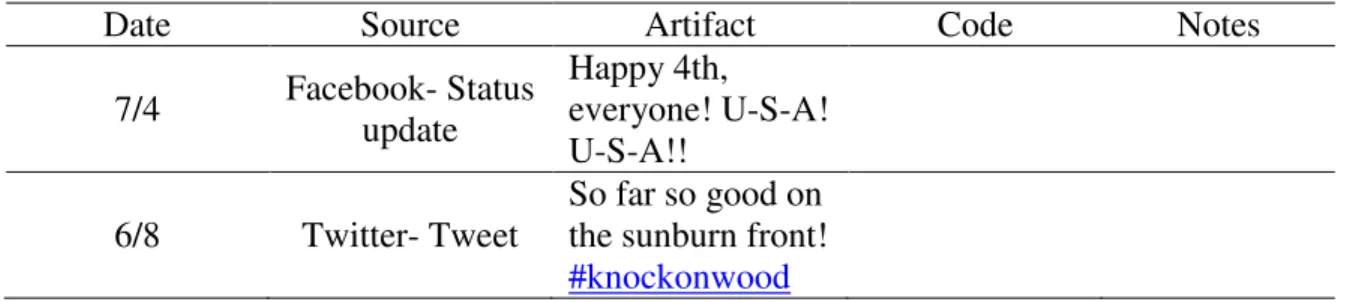
Digital Observation. Ongoing observations and artifact collection within digital spaces took place throughout the participants’ involvement in this study, from June 2012 to November 2012. The purpose of these digital observations was to identify trends in the participants’ digital practices within social media. The artifacts collected were catalogued on a secure digital medium and included items such as images, comments, blog postings, video postings, status updates, and profile modifications. These artifacts included items that were (a) posted by the participants and (b) visible on the participants’ profiles/sites. Data was not collected from the profiles/sites of third parties. All textual artifacts were copied into a table with information about the source and posted date of the artifact. Table 4 depicts how textual artifacts were archive from digital spaces. This was
accomplished with Microsoft Word and allowed for space to include codes and notes as the data was analyzed.
Table 4
Sample Artifact Collection Table
Date Source Artifact Code Notes
7/4 Facebook- Status update
Happy 4th,
everyone! U-S-A! U-S-A!!
6/8 Twitter- Tweet
All non-textual artifacts, images and videos, were saved and organized into digital folders. These artifacts were archived monthly.
Interviews. Three one-on-one interviews, which lasted from thirty to sixty minutes, were conducted with each participant (see Appendix B). The interviews were used to gather information about the participants’ perception about their own
development as a teacher, their usage of social media, and to share and discuss preliminary findings of the study. These interviews were semi-structured to allow for flexibility and enabled me to remain responsive to the interviewees’ needs and responses (Lindolf & Taylor, 2002). Audio recordings and transcripts were used to record each interview, which were then reviewed multiple times to prevent misrepresentation and ensure validity.
Data Analysis
The data collected was first organized in a way to make it more navigable during the coding. The data collected from social media spaces was organized as depicted in Table 4. The field notes from classroom observations were broken down into a collection of bounded moments. These moments had a clear start and end point and included items such as classroom activities, the participants interacting with the classroom environment, and exchanges between the participants and their students.