ROLES OF CATION-MACROCYCLE INTERACTIONS IN MODULATING THE REACTIVITY OF TRANSITION METAL PINCER-CROWN ETHER COMPLEXES
Jacob B. Smith
A dissertation submitted to the faculty at the University of North Carolina at Chapel Hill in partial fulfillment of the requirements for the degree of Doctor of Philosophy in the Department
of Chemistry.
Chapel Hill 2018
Approved by:
ABSTRACT
Jacob B. Smith: Roles of Cation-Macrocycle Interactions in Modulating the Reactivity of Transition Metal Pincer-Crown Ether Complexes
(Under the direction of Alexander J. M. Miller)
Pincer-crown ether ligands were designed to exhibit hemilability and also support cation- macrocycle interactions. These ligands feature strong phosphine and phenyl donors, and a pendent aza-crown ether group that provides hemilabile donors that can bind to the transition metal center and serve as a docking site for cations. Cation-macrocycle interactions can be exploited to directly control the primary coordination sphere of these complexes leading to control over ligand substitution reactions and catalysis. When the macrocycle acts simply as a docking site for cations, bound cation-substrate interactions can be harnessed to modulate reactivity.
In chapter 2, nickel catalysts supported by diethylamine- or aza-crown ether-containing aminophosphinite (NCOP) pincer ligands catalyze the insertion of benzaldehyde into a C−H bond of acetonitrile. Neutral tert-butoxide precatalysts are active without any added base and give good yields of product after 24 h, while the cationic precatalysts require a base cocatalyst and operate much more slowly. In situ spectroscopic studies identified several intermediates and a common deactivated species. The deactivated cationic species is inactive under standard base-free conditions, but catalysis can be reinitiated by the addition of base.
and applied to cation-controlled reversible ligand binding. Cation−crown interactions were examined in the solid-state and in solution (dichloromethane, and acetonitrile). Tridentate-bound pincer complexes bind cations more than 100,000 times more strongly than the tetradentate counterparts with a crown ether oxygen donating to nickel. The newfound thermodynamic insight guided the development of in situ switchable ligand binding and release at nickel using cations.
In Chapter 4, the impact of post-macrocyclization modification of 1-aza-15-crown 5 through synthetic organic and organometallic tuning is discussed. Binding affinities for Li+ and
Na+ salts are reduced substantially moving from the simple organic macrocycle to an
organometallic pincer-crown ether. The selectivity for Li+ over Na+ increases dramatically, by as
much as 30-fold. The impact of transition metal and ligand substitution at the metal center significantly impacts Li+ binding strength. Preliminary heteroditopic binding of LiCl by an
ACKNOWLEDGEMENTS
I would like to thank my advisor Alexander J. M. Miller for giving me the opportunity to join the truly unique and ever-evolving team of talented individuals that make up the Miller group. From my time as a “zero” year, your guidance has had a profoundly positive impact on the way that I approach and solve problems both inside and outside the lab. You entrusted me with a number of responsibilities that helped build my confidence as a chemist and as an individual for which I am sincerely grateful.
I am also thankful to my UNC professors. Thanks Joe Templeton for teaching a phenomenal organometallics course and, perhaps more importantly, for the literature and philosophy lessons that often preceded the lectures. I also thank you for the many cryptic chats on how to successfully graduate with a Ph.D. (I hope I finally figured it out). Thanks Maurice Brookhart for teaching a fantastic NMR course and for always being so happy to chat about chemistry. Thanks Cindy Schauer for the great computational chemistry course and for your expert guidance of our 550L TA team during my first semester at UNC. I also owe a special thanks to the many professors who came out to play for the Honey Badgers Football Club: Alexander Miller, Maurice Brookhart, Simon Meek, Scott Warren, and Frank Leibfarth. Finally, I want to thank Cindy Schauer, Joe Templeton, Frank Leibfarth, and Jeff Johnson for serving on my defense committee.
weekends and some late week nights something to really look forward to. To Javier, from the first day of TA training when the Spanish speaking and soccer discussions started, thanks for being a better friend than anyone could ask for.
TABLE OF CONTENTS
LIST OF TABLES ... x
LIST OF FIGURES ... xi
LIST OF SCHEMES ... xx
LIST OF ABBREVIATIONS AND SYMBOLS ... xxii
CHAPTER 1: INTRODUCTION ... 1
1.1 Controllable Catalysts ... 1
1.2 Controlling Catalysis by Gating Substrate Binding ... 2
1.3 Controlling Catalysis Through Substrate Activation... 14
REFERENCES ... 19
CHAPTER 2: CONNECTING NEUTRAL AND CATIONIC PATHWAYS IN NICKEL-CATALYZED INSERTION OF BENZALDEHYDE INTO A C−H BOND OF ACETONITRILE ... 25
2.1 Introduction ... 25
2.2 Synthesis and Characterization ... 27
2.3 Catalytic Hydrocyanomethylation of Benzaldehyde ... 31
2.4 Mechanistic Studies ... 35
2.5 Conclusions ... 48
2.6 Experimental Section ... 48
General Considerations... 48
Synthetic Procedures ... 50
Synthesis of (15c5NCOPiPr)Ni(Br) (1-15c5) ... 50
Synthesis of (EtNCOPiPr)Ni(OtBu) (2-Et)... 55
Synthesis of [(15c5NCOPiPr)Ni(NCCH3)][PF6] (3-15c5) ... 58
Synthesis of [(EtNCOPiPr)Ni(NCCH3)][PF6] (3-Et) ... 61
Synthesis of (15c5NCOPiPr)Ni(CH 2CN) (4-15c5) ... 64
General Procedure for Nickel-Catalyzed Insertion of Benzaldehyde into a C−H Bond of Acetonitrile ... 66
General Procedure for NMR-Scale Reactions ... 67
REFERENCES ... 68
CHAPTER 3: THERMODYNAMIC STUDIES OF CATION–MACROCYCLE INTERACTIONS IN NICKEL PINCER–CROWN ETHER COMPLEXES ENABLE SWITCHABLE LIGATION ... 71
3.1 Introduction ... 71
3.2 Synthesis and Characterization of Nickel Complexes ... 74
3.3 Cation–Crown Interactions in Dichloromethane ... 83
3.4 Cation–Crown Interactions in Acetonitrile ... 88
3.5 Comparisons with Organic Crown Ethers and Variable Temperature Studies 95 3.6 Cation Switchable Ligand Binding ... 98
3.7 Conclusions ... 105
3.8 Experimental Section ... 107
General Considerations... 107
Synthesis of [k4-(18c6NCOPiPr)Ni][PF
6] (2-18c6) ... 119
Synthesis of [k4-(15c5NCOPiPr)Ni][BArF 4] (3-15c5) ... 122
General Procedure for Titrations in CD2Cl2 ... 124
General Procedure for CD3CN Titrations ... 125
REFERENCES ... 128
CHAPTER 4: ORGANOMETALLIC ELABORATION OF AZA-CROWN ETHERS: POST-MACROCYLIZATION CONTROL OF BINDING AFFINITY AND SELECTIVITY FOR CATIONS AND ION PAIRS ... 132
4.1 Introduction ... 132
4.2 Impact of Ir Metalation on Binding Affinity and Selectivity ... 134
4.3 Central Transition Metal Influence on Affinity and Selectivity ... 136
4.4 Further Organometallic Elaboration ... 140
4.5 Ditopic Binding ... 141
4.6 Conclusions ... 143
4.7 Experimental Section ... 144
General Considerations... 144
Synthetic Procedures ... 145
Synthesis of (15c5NCOPiPr)Ni(Cl) ... 145
Synthesis of (15c5NCOPiPr)Ni(I) ... 147
Synthesis of (15c5NCOPiPr)Pd(Cl) ... 150
Synthesis of (15c5NCOPiPr)Pt(Cl) ... 153
Determining binding affinity by competition with organic macrocycles ... 156
General Procedure for Titrations ... 158
Titration data ... 158
LIST OF TABLES
Table 1.1 Lewis acid induced shifts of 10-methylacridone florescence lmax as a
measure of relative Lewis acidity... 16
Table 2.1 Comparing catalysts and conditions for benzaldehyde insertion into acetonitrilea. ... 32
Table 2.2 Hydrocyanomethylation in the presence of Lewis acidsa. ... 34
Table 2.3 Crystal data and structure refinement for (15c5NCOPiPr)NiBr (1-15c5). ... 52
Table 3.1 Association Constants in CD3CN. ... 95
Table 3.2 Thermodynamic Parameters in CD3CN... 98
Table 3.3 Crystal data and structure refinement for k3-(18c6NCOPiPr)NiBr (1-18c6). ... 116
Table 3.4 Crystal data and structure refinement for [k4-(15c5NCOPiPr)Ni][PF 6] (2-15c5)... 119
Table 3.5 Crystal data and structure refinement for [(Li+@k3 -15c5NCOPiPr)Ni(Br)][PF6] (Li+•1-15c5). ... 125
Table 3.6. Crystal data and structure refinement for [(Li+@k3 -15c5NCOPiPr)Ni(Br)][OTf] (LiOTf•1-15c5). ... 126
Table 3.7. Crystal data and structure refinement for [(Na+@k3 -15c5NCOPiPr)Ni(Br)][BArF4] (Na+•1-15c5). ... 127
Table 4.1 Crystal data and structure refinement for (15c5NCOPiPr)Pd(Cl) (6). ... 152
LIST OF FIGURES
Figure 1.1 Native structure of human isocitrate dehydrogenase before and after citrate and MgADP binding; the major changes are surrounding Tyr126
(green) and Asp230 (blue) residues... 3 Figure 1.2 Selected strategies for in situ control over reactivity and substitution
in small organometallic systems. ... 7 Figure 1.3 Cartoon depiction of ligand hemilability. ... 8 Figure 1.4 Select catalysts featuring ligands with hemilabile ether oxygen
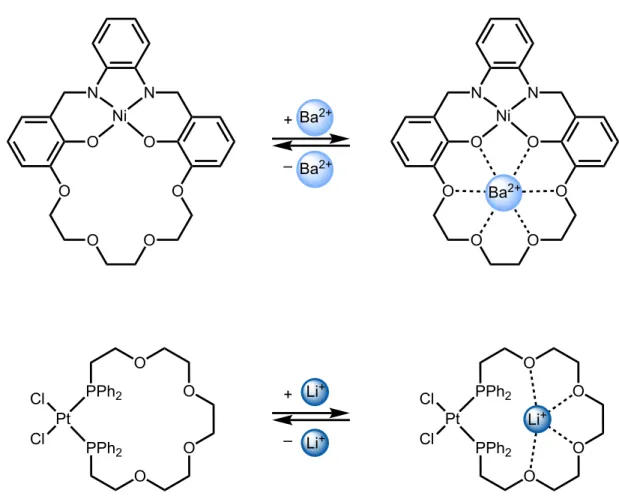
donors. ... 9 Figure 1.5 Metallomacrocycles capable of complexing an additional cation in
the secondary coordination sphere of the complex. ... 10 Figure 1.6 Idealized free energy landscape of cation-modulated substrate
binding and catalysis. ... 13 Figure 1.7 General Lewis acid activation of a variety of organic molecules. ... 15 Figure 1.8 Lewis acid promoted reaction of zirconacyclopentadienes with
isocyanates to form iminocyclopentadienes. ... 17 Figure 1.9 Select examples of macrocycle containing complexes in which a
Lewis acid is proposed to interact with carbonyl or acyl ligands bound to
the metal center. ... 18 Figure 2.1 Structural representation of 1-15c5 with ellipsoids drawn at the 50%
probability level. Hydrogen atoms omitted for clarity. Selected distances (Å) and angles (deg): Ni–P 2.103(2), Ni–N 2.032(4), Ni–Br 2.343(1), Ni–C1 1.844(5), P–Ni–Br 94.40(5), P–Ni–C1 81.98(17), N–Ni–Br
99.38(12), N–Ni–C1 83.9(2). ... 29 Figure 2.2 1H NMR spectra of a CD
2Cl2 solution containing CH3CN and
[(15c5NCOPiPr)Ni(NCCH
3)][PF6] (3-15c5) between 213 K and 298 K ... 31
Figure 2.3 Turnover number (TON) for the insertion of benzaldehyde into acetonitrile catalyzed by 0.5 mol % [(κ3-15c5NCOPiPr)Ni(NCCH
3)][PF6]
(3-15c5) as a function of added DBU. Conditions: 0.5 mol % 3-15c5, 3
mL 1 M benzaldehyde in CH3CN, 25˚ C, 24 h. ... 33
Figure 2.4 (A) Turnover number (TON) for the insertion of benzaldehyde into acetonitrile catalyzed by 2-15c5 alone (filled dark blue circles), 2-15c5 with 0.5 mol % Li+ (empty light blue circles), 2-Et alone (filled dark red
squares), and 2-Et with 0.5 mol % Li+ (empty light red squares). (B)
to catalyst. Conditions: 0.5 mol % catalyst, 3 mL 1 M benzaldehyde, 25˚
C. ... 35 Figure 2.5 1H NMR spectra showing formation of cyanomethyl complex
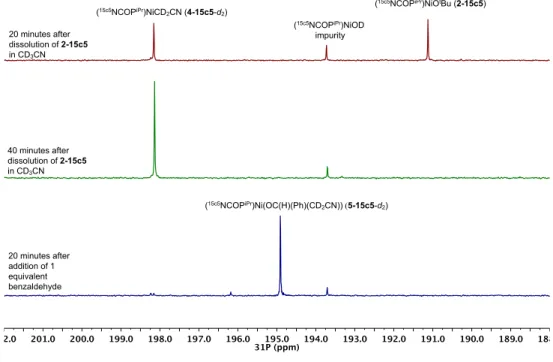
4-15c5-d2 and alkoxide complex 5-15c5-d2. ... 37 Figure 2.7 1H NMR spectrum of (15c5NCOPiPr)Ni(OC(H)(Ph)(CH2CN))
(5-15c5) in CH3CN. Made from 2-15c5 in situ. Capillary containing C6D6
and HMDSO used to lock and shim. ... 39 Figure 2.8 1H-1H COSY NMR spectrum of
(15c5NCOPiPr)Ni(OC(H)(Ph)(CH
2CN)) (5-15c5) in CH3CN. Made from
2-15c5 in situ. Capillary containing C6D6 and HMDSO used to lock and
shim. ... 39 Figure 2.9 TON over time for two parallel reactions containing 0.5 mol %
2-15c5 and 1 M benzaldehyde in CH3CN (C6D6 capillary) assessed by 1H
NMR. The first experiment (filled blue circles) was allowed to continue unabated for 17 h, while the second experiment (empty light-blue
circles) was treated with 0.5 mol % LiPF6 after 2.4 h (red line), resulting
in catalyst deactivation; activity was re-initiated by addition of 1 mol %
DBU (5.2 h, green line). ... 42 Figure 2.10 1H NMR spectra showing equilibrium DBU binding by 3-15c5 and
speciation during turnover. ... 44 Figure 2.11 31P{1H} NMR spectra showing equilibrium DBU binding by 3-15c5
and speciation during turnover. ... 44 Figure 2.12 Subsequent addition of P1 and benzaldehyde to 3-15c5. ... 46 Figure 2.13 1H NMR spectrum of (15c5NCOPiPr)NiBr (1-15c5) in C
6D6. ... 51
Figure 2.14 31P{H} NMR spectrum of (15c5NCOPiPr)NiBr (1-15c5) in C
6D6. ... 51
Figure 2.15 13C{H} NMR spectrum of (15c5NCOPiPr)NiBr (1-15c5) in C6D6. ... 52
Figure 2.16 1H NMR spectrum of (15c5NCOPiPr)NiOtBu (2-15c5) in C
Figure 2.22 1H NMR spectrum of [(15c5NCOPiPr)Ni(NCCH3)][PF6] (3-15c5) in
CD2Cl2. ... 59
Figure 2.23 31P{H} NMR spectrum of [(15c5NCOPiPr)Ni(NCCH
3)][PF6] (3-15c5)
in CD2Cl2. ... 59
Figure 2.24 13C{H} NMR spectrum of [(15c5NCOPiPr)Ni(NCCH3)][PF6]
(3-15c5) in CD2Cl2. ... 60
Figure 2.25 1H NMR spectrum of [(15c5NCOPiPr)Ni(NCCH
3)][PF6] (3-15c5) in
CD3CN. ... 60
Figure 2.26 31P{H} NMR spectrum of [(15c5NCOPiPr)Ni(NCCH
3)][PF6] (3-15c5)
in CD3CN. ... 61
Figure 2.27 1H NMR spectrum of [(EtNCOPiPr)Ni(NCCH3)][PF6] (3-Et) in
CD2Cl2. ... 62
Figure 2.28 31P{H} NMR spectrum of [(EtNCOPiPr)Ni(NCCH
3)][PF6] (3-Et) in
CD2Cl2. ... 63
Figure 2.29 13C{H} NMR spectrum of [(EtNCOPiPr)Ni(NCCH3)][PF6] (3-Et) in
CD2Cl2. ... 63
Figure 2.30 1H NMR spectrum of (15c5NCOPiPr)NiCH
2CN (4-15c5) in CD2Cl2. ... 65
Figure 2.31 31P{H} NMR spectrum of (15c5NCOPiPr)NiCH2CN (4-15c5) in
CD2Cl2. ... 65
Figure 2.32 13C{H} NMR spectrum of (15c5NCOPiPr)NiCH
2CN (4-15c5) in
CH3CN. Capillary containing C6D6 and HMDSO used to lock and shim.
Satellite artifacts near CH3CN/HMDSO peak due to field inhomogeneity
and receiver overflow. ... 66 Figure 3.1 Tunable hemilability approach to controlled ligand substitution. The
pincer-crown ether ligand has a strong donor backbone (blue) and a hemilabile aza-crown ether (orange). If ether dissociation by ligand (green) binding (∆Gº1) is uphill, cation-crown interactions can stabilize
the overall process (∆Gº2). ... 72
Figure 3.2 Structural representation of k3-(18c6NCOPiPr)Ni(Br) (1-18c6) with
ellipsoids drawn at 50% probability level. Hydrogen atoms omitted for clarity. Selected distances (Å) and angles (deg): Ni–P 2.1096(6), Ni–N 2.028(2), Ni–Br 2.3573(6), Ni–C 1.859(2), P–Ni–Br 94.44(2), P–Ni–C
81.47(6), N–Ni–Br 97.87(5), N–Ni–C 85.19(8). ... 75 Figure 3.3 Structural representation of [(Li+@k3-15c5NCOPiPr)Ni(Br)][PF6]
atoms omitted for clarity. Selected distances (Å) and angles (deg): Ni– P1 2.1099(8), Ni–N 2.046(2), Ni–Br 2.3584(8), Ni–C 1.860(3), avg. Li– O 2.05, Li–F1.922(5), P1–Ni–Br 94.76(3), P1–Ni–C 81.61(8), N–Ni–Br
100.87(6), N–Ni–C 83.4(1). ... 77 Figure 3.4 Structural representation of [(Li+@k3-15c5NCOPiPr)Ni(Br)][OTf]
(LiOTf•1-15c5)with ellipsoids drawn at the 50% probability level. Hydrogen atoms omitted for clarity. Selected distances (Å) and angles (deg): Ni–P 2.108(1), Ni–N 2.046(2), Ni–Br 2.360(1), Ni–C 1.857(4), avg. Li–O 2.05, Li–OOTf 1.940(7), P–Ni–Br 94.24(4), P–Ni–C 81.5(2),
N–Ni–Br 100.97(8), N–Ni–C 83.7(1). ... 77 Figure 3.5 Structural representation of [(Na+@k3-15c5NCOPiPr)Ni(Br)][BArF4]
(Na+•1-15c5) with ellipsoids drawn at 50% probability level. Hydrogen
atoms omitted for clarity. Selected distances (Å) and angles (deg): Ni–P 2.1065(8), Ni–N 2.047(2), Ni–Br 2.3572(5), Ni–C 1.862(3), avg. Na– Ocrown 2.41, Na–O2 2.319(2), Na–FBArF4 2.612(2), Na-Br 2.814(1), P–
Ni–Br 92.78(2), P–Ni–C 81.18(8), N–Ni–Br 102.53(6), N–Ni–C
84.6(1). ... 79 Figure 3.6 Structural representation of [k4-(15c5NCOPiPr)Ni][PF6] (2-15c5) with
ellipsoids drawn at the 50% probability level. Hydrogen atoms and PF6
anion omitted for clarity. Selected distances (Å) and angles (deg): Ni–P 2.1427(6), Ni–N 1.966(2), Ni–O 1.965(2), Ni–C 1.848(2), P–Ni–O 110.34(4), P–Ni–C 81.32(6), N–Ni–O1 83.94(6), N–Ni–C1 84.60(8),
C1–Ni–O1 167.36(7). ... 81 Figure 3.7 Variable temperature 1H NMR spectra of [k4-(15c5NCOPiPr)Ni][PF6]
(2-15c5) in CD2Cl2. ... 82
Figure 3.8 Variable temperature 1H NMR spectra of [k4-(18c6NCOPiPr)Ni][PF 6]
(2-18c6) in CD2Cl2. ... 82
Figure 3.9 A) 1H NMR spectra from titration of 5 mM k3-(15c5NCOPiPr)Ni(Br)
(1-15c5) with LiBArF
4 in CD2Cl2 (15 equiv Et2O to Li+). B) Cation
binding isotherm data for the titration of 5 mM 1-15c5 with LiBArF4
Figure 3.12 Addition of 1-3 equivalents of LiBArF
4•3Et2O to [k4
-(15c5NCOPiPr)Ni][BArF
4] (3-15c5) in CD2Cl2. ... 87
Figure 3.13 Job plots for k3-(15c5NCOPiPr)Ni(Br) (1-15c5) with LiOTf (hollow
green circles) and NaBArF
4 (hollow blue triangles), and Job plots for k3
-(18c6NCOPiPr)Ni(Br) (1-18c6) with LiOTf (filled green circles), NaBArF4
(filled blue triangles), and KPF6 (filled orange squares) at 24 ± 1˚C in
CD3CN. Concentrations of 1-15c5 or 1-18c6 and cations were varied
within a total concentration of 12 mM. ... 90 Figure 3.14 A) Cation binding equilibrium in CD3CN. B) 1H NMR spectra from
titration of 10 mM k3-(15c5NCOPiPr)Ni(Br) (1-15c5) with LiOTf in
CD3CN. C) Binding isotherm data for titration of 10 mM k3
-(15c5NCOPiPr)Ni(Br) (1-15c5) with LiPF
6 (green circles), NaBArF4 (blue
triangles), and KPF6 (orange squares) at 24 ± 1˚C in CD3CN. ... 91
Figure 3.15 Binding isotherm data for titration of 10 mM k3
-(15c5NCOPiPr)Ni(Br) (1-15c5) with LiPF6 at 24 ± 1˚C in CD3CN. ... 92
Figure 3.16 Titration of 10 mM k3-(EtNCOPiPr)Ni(Br) with LiPF6 at 24 ± 1˚C in
CD3CN. ... 93
Figure 3.17 Binding isotherm data for titration of 10 mM k3
-(18c6NCOPiPr)Ni(Br) (1-18c6) with LiPF
6 (green circles), NaBArF4 (blue
triangles), and KPF6 (orange squares) at 24 ± 1˚C in CD3CN. ... 94
Figure 3.18 Binding isotherm data for titration of 0.01 M k3
-(15c5NCOPiPr)Ni(Br) (1-15c5) with LiOTf in CD3CN at various
temperatures (left) and binding isotherm data for titration of 0.01 M k3
-(18c6NCOPiPr)Ni(Br) (1-18c6) with NaBArF
4 in CD3CN at various
temperatures (right). ... 96 Figure 3.19 Van ‘t Hoff analysis of LiOTf binding by k3-(15c5NCOPiPr)Ni(Br)
(1-15c5) (green circles) and NaBArF
4 binding by k3-(18c6NCOPiPr)Ni(Br)
(1-18c6) (blue triangles). ... 97 Figure 3.20 1H NMR spectra from sequential addition of 1 equivalent C6F5CN
and [K][B(C6F5)4] to [k4-(15c5NCOPiPr)Ni][BArF4] (3-15c5) in CD2Cl2
(top to bottom)... 100 Figure 3.21 31P NMR spectra from sequential addition of 1 equivalent C
6F5CN
and [K][B(C6F5)4] to [k4-(15c5NCOPiPr)Ni][BArF4] (3-15c5) in CD2Cl2
(top to bottom)... 100 Figure 3.22 19F NMR spectra from sequential addition of one equivalent
C6F5CN and [K][B(C6F5)4] to [k4-(15c5NCOPiPr)Ni][BArF4] (3-15c5) in
Figure 3.23 1H NMR spectra from sequential addition of 1 equivalent C6F5CN,
1 equivalent NaBArF4, and 2 equivalents 12-crown-4 to [k4
-(15c5NCOPiPr)Ni][BArF4] (3-15c5) in CD2Cl2 (15 equivalents Et2O to Na+
added for solubility) (top to bottom). ... 101 Figure 3.24 31P{1H} NMR spectra from sequential addition of 1 equivalent
C6F5CN, 1 equivalent NaBArF4, and 2 equivalents 12-crown-4 to [k4
-(15c5NCOPiPr)Ni][BArF4] (3-15c5) in CD2Cl2 (15 equivalents Et2O to Na+
added for solubility) (top to bottom). ... 102 Figure 3.25 19F NMR spectra from sequential addition of 1 equivalent C
6F5CN,
1 equivalent NaBArF
4, and 2 equivalents 12-crown-4 to [k4
-(15c5NCOPiPr)Ni][BArF4] (3-15c5) in CD2Cl2 (15 equivalents Et2O to Na+
added for solubility) (top to bottom). ... 102 Figure 3.26 1H NMR spectra from sequential addition of 1 equivalent C
6F5CN,
1 equivalent LiBArF4•3Et2O, and 2 equivalents 12-crown-4 to [k4
-(15c5NCOPiPr)Ni][BArF
4] (3-15c5) in CD2Cl2 (top to bottom). ... 103
Figure 3.27 31P NMR spectra from sequential addition of 1 equivalent C6F5CN,
1 equivalent LiBArF4•3Et2O, and 2 equivalents 12-crown-4 to [k4
-(15c5NCOPiPr)Ni][BArF4] (3-15c5) in CD2Cl2 (top to bottom). ... 104
Figure 3.28 19F NMR spectra from sequential addition of 1 equivalent C
6F5CN,
1 equivalent LiBArF
4•3Et2O, and 2 equivalents 12-crown-4 to [k4
-(15c5NCOPiPr)Ni][BArF
4] (3-15c5) in CD2Cl2 (top to bottom). ... 104
Figure 3.29 1H NMR spectrum (600 MHz) of m-(aza-18-crown-6)methylphenol
in CDCl3. ... 110
Figure 3.30 13C {1H} NMR spectrum (151 MHz) of
m-(aza-18-crown-6)methylphenol in CDCl3. ... 110
Figure 3.31 1H NMR spectrum (600 MHz) of (18c6NCOPiPr)H in CDCl3. ... 112
Figure 3.32 31P{1H} NMR spectrum (243 MHz) of (18c6NCOPiPr)H in CDCl
Figure 3.37 1H NMR spectrum (600 MHz) of [k4-(15c5NCOPiPr)Ni][PF 6]
(2-15c5) in CDCl3. ... 117
Figure 3.38 31P{1H} NMR spectrum (162 MHz) of [k4-(15c5NCOPiPr)Ni][PF 6]
(2-15c5) in CDCl3. ... 118
Figure 3.39 13C {1H} NMR spectrum (151 MHz) of [k4-(15c5NCOPiPr)Ni][PF 6]
(2-15c5) in CDCl3. ... 118
Figure 3.40 1H NMR spectrum (600 MHz) of [k4-(18c6NCOPiPr)Ni][PF 6]
(2-18c6) in CD2Cl2. ... 120
Figure 3.41 31P{1H} NMR spectrum (243 MHz) of [k4-(18c6NCOPiPr)Ni][PF 6]
(2-18c6) in CD2Cl2. ... 121
Figure 3.42 13C {1H} NMR spectrum (151 MHz) of [k4-(18c6NCOPiPr)Ni][PF 6]
(2-18c6) in CD2Cl2. ... 121
Figure 3.43 1H NMR spectrum (500 MHz) of [k4-(15c5NCOPiPr)Ni][BArF 4]
(3-15c5) in CD2Cl2. ... 123
Figure 3.44 31P{1H} NMR spectrum (202 MHz) of [k4-(15c5NCOPiPr)Ni][BArF 4]
(3-15c5) in CD2Cl2. ... 123
Figure 3.45 13C {1H} NMR spectrum (151 MHz) of [k4
-(15c5NCOPiPr)Ni][BArF
4] (3-15c5) in CD2Cl2. ... 124
Figure 4.1 Depiction of an iridium pincer-crown ether complex highlighting the macrocyclic cation receptor and the coordination site that offers
tunability through organometallic elaboration. ... 134 Figure 4.2 Metalation of (15c5NCOPiPr)H (2) with Ni, Pd, or Pt and the
corresponding Ka(Li+) for the metalated complexes. ... 137
Figure 4.3 Structural representation of 6 with ellipsoids drawn at the 50% probability level. Hydrogen atoms omitted for clarity. Selected distances (Å) and angles (deg): Pd–P 2.1871(5), Pd–N 2.185(2), Pd–Cl 2.3788(5), Pd–C1 1.959(2), P–Pd–Cl 99.80(2), P–Pd–C1 80.83(6), N–Pd–Cl
97.96(4), N–Pd–C1 81.16(7). ... 138 Figure 4.4 Structural representation of 7 with ellipsoids drawn at the 50%
probability level. Hydrogen atoms omitted for clarity. Selected distances (Å) and angles (deg): Pt–P 2.1717(9), Pt–N 2.183(2), Pt–Cl 2.3825(9), Pt–C1 1.954(3), P–Pt–Cl 101.05(3), P–Pt–C1 81.92(9), N–Pt–Cl
95.94(7), N–Pt–C1 80.9(1). ... 138 Figure 4.5 Correlation of the natural log of Ka(Li+) of 5-Cl, 6, and 7 with
Figure 4.6 Effects of ligand substitution and charge on the Ka(Li+) of nickel and
iridium pincer-crown ether complexes. ... 141 Figure 4.7 1H NMR spectrum (600 MHz) of (κ3-15c5NCOPiPr)Ni(Cl) (5-Cl) in
C6D6. ... 146
Figure 4.8 31P{1H} NMR spectrum (162 MHz) of (κ3-15c5NCOPiPr)Ni(Cl) (5-Cl)
in C6D6. ... 146
Figure 4.9 13C{1H} NMR spectrum (151 MHz) of (κ3-15c5NCOPiPr)Ni(Cl) (5-Cl)
in C6D6. ... 147
Figure 4.10 1H NMR spectrum (600 MHz) of (κ3-15c5NCOPiPr)Ni(I) (5-I) in
C6D6. ... 148
Figure 4.11 31P{1H} NMR spectrum (243 MHz) of (κ3-15c5NCOPiPr)Ni(I) (5-I)
in C6D6. ... 149
Figure 4.12 13C{1H} NMR spectrum (151 MHz) of (κ3-15c5NCOPiPr)Ni(I) (5-I)
in C6D6. ... 149
Figure 4.13 1H NMR spectrum (600 MHz) of (κ3-15c5NCOPiPr)Pd(Cl) (6) in
C6D6. ... 151
Figure 4.14 31P{1H} NMR spectrum (243 MHz) of (κ3-15c5NCOPiPr)Pd(Cl) (6)
in C6D6. ... 151
Figure 4.15 13C{1H} NMR spectrum (151 MHz) of (κ3-15c5NCOPiPr)Pd(Cl) (6)
in C6D6. ... 152
Figure 4.16 1H NMR spectrum (500 MHz) of (κ3-15c5NCOPiPr)Pt(Cl) (7) in
C6D6. ... 154
Figure 4.17 31P{1H} NMR spectrum (202 MHz) of (κ3-15c5NCOPiPr)Pt(Cl) (7) in
C6D6. ... 154
Figure 4.18 13C{1H} NMR spectrum (151 MHz) of (κ3-15c5NCOPiPr)Pt(Cl) (7) in
Figure 4.23 Binding isotherms for the titration of (15c5NCOPiPr)H (2) with
LiOTf. ... 160 Figure 4.24 Binding isotherms for the titration of k3-(15c5NCOPiPr)Ir(H)(CO)(Cl)
(3) with LiOTf. ... 160 Figure 4.25 Binding isotherms for the titration of k3-(15c5NCOPiPr)Ir(H)(CO)(Cl)
(3) with NaBArF
4. ... 161
Figure 4.26 Binding isotherms for the titration of (k3-15c5NCOPiPr)Ir(CO) (4)
with LiOTf. ... 161 Figure 4.27 Binding isotherms for the titration of (15c5NCOPiPr)Pd(Cl) (6) with
LiOTf. ... 162 Figure 4.28 Binding isotherms for the titration of (15c5NCOPiPr)Pt(Cl) (6) with
LiOTf. ... 162 Figure 4.29 Binding isotherms for the titration of [(k3
-15c5NCOPiPr)Ni(NCCD3)][BArF4] (8) with LiBArF4. ... 163
Figure 4.30 Binding isotherms for the titration of [(k3
LIST OF SCHEMES
Scheme 1.1 Supramolecular allosteric regulation via the Weak Link Approach. Blocking groups disrupt substrate access to the Al active site. Chloride displaces the amine donors tethered to the large blocking groups to
enable catalysis... 5 Scheme 1.2 Dual equilibrium for tunable hemilability with pincer-crown ether
complexes. ... 11 Scheme 1.3 Proposed mechanism for the cation-modulated isomerization of
allylbenzene with an Ir hydride pincer-crown ether complex. ... 12 Scheme 2.1 Insertion of benzaldehyde into a C−H bond of acetonitrile. ... 26 Scheme 2.2 A) Base-promoted and B) Base-free nickel catalyzed
hydrocyanomethylation catalytic cycles. ... 27 Scheme 2.3 Synthesis of (k3-15c5NCOPiPr)Ni(Br) (1-15c5). ... 28
Scheme 2.4 Synthesis of (k3-15c5NCOPiPr)Ni(OtBu) (2-15c5 ) and (k3
-EtNCOPiPr)Ni(OtBu) (2-Et). ... 30 Scheme 2.5 Synthesis of [(k3-15c5NCOPiPr)Ni(NCCH
3)][PF6] (3-15c5) and [(k3 -EtNCOPiPr)Ni(NCCH
3)][PF6] (3-Et). ... 30
Scheme 2.6 Hydrocyanomethylation catalysis conditions. ... 32 Scheme 2.7 Independent synthesis of (k3-15c5NCOPiPr)Ni(CH2CN) (4-15c5) and
(k3-15c5NCOPiPr)Ni(OC(H)(Ph)(CH2CN)) (5-15c5). ... 36
Scheme 2.8 Reversibility of benzaldehyde insertion into the C–H or C–D bonds
of CH3CN or CD3CN with catalyst 5-15c5. ... 41
Scheme 2.9 Reaction of 3-15c5 and 3-Et with DBU and tBuP
1. ... 46
Scheme 4.1 Synthetic pathway and association constants for lithium and sodium binding to (pre)ligands and iridium pincer-crown ether complexes. See
Experimental Section for full synthetic details. ... 135 Scheme 4.2 Proposed heteroditopic LiCl binding by (κ4-15c5NCOPiPr)Ir(H)(Cl)
LIST OF ABBREVIATIONS AND SYMBOLS
a Greek alpha: crystallographic angle
b Greek beta: crystallographic angle
g Greek gamma: crystallographic angle
d Greek delta: denotes chemical shift reference scale
k Greek kappa: denotes coordination to metal by x atoms
q Greek theta: general angle
D Greek capital delta: denotes separation between values or applied heat a,b,c crystallographic unit cell parameters
Å angstrom(s)
Ar general aromatic
BArF4 tetrakis(3,5-trifluoromethylphenyl)borate
13C Carbon NMR
C Celsius
o Degree
D Deuterium
d doublet
g Gram
h hour(s)
Hz Hertz
PF6– Hexafluorophosphate
iPr Isopropyl, -CH(CH3)2
IR infrared
xJYZ magnetic coupling between atoms X and Y through a distance of x bonds
K Kelvin
kcal kilocalorie
L general ligand, usually 2 e- donor
M Molar
M general metal atom
µL Microliter
mg Milligram
mL Milliliter
mM Millimolar mmol Millimole
m multiplet
m meta
Me methyl, -CH3
min minute
mol mole
NMR nuclear magnetic resonance
o ortho
OTf– triflate, trifluoromethane sulfonate: CF 3SO3-
31P Phosphorous NMR
p para
Ph phenyl, -C6H5
ppm parts per million
1H Proton NMR
q quartet
R general alkyl group
R, RW crystallographic refinement quality indicators
s singlet (NMR data)
s second
t triplet
tBu tertiary butyl, -C(CH3)3 THF tetrahydrofuran
TON Turnover number
CHAPTER 1: INTRODUCTION
1.1 Controllable Catalysts
Catalysts play a vital role in biology and in the chemical and pharmaceutical industries by providing efficient, low-energy pathways for selectively breaking and making chemical bonds. In biology, enzymes catalyze a wide variety of complex biochemical reactions that are vital to our lives.1-2 In the chemical and pharmaceutical industries, synthetic catalysts have been
employed successfully for over 100 years. They have enabled breakthrough discoveries in chemical synthesis and have lowered the energy needed to operate critical processes on large scales, providing molecular building blocks and chemical compounds that save lives and help continue to increase the standard of living worldwide.3 Over 75% of chemicals from industry are
produced with the aid of catalysts.4 Catalyst development and improvement paves the way for
the discovery of new chemicals, improves the energy efficiency of industrial processes, and aids in the avoidance of the generation of toxic by-products, maximizing social and economic
benefits while minimizing negative environmental impacts.3-4
One class of catalysts that is particularly promising both practically and fundamentally is in situ controllable catalysts. A controllable catalyst is one that exhibits a change in activity or selectivity upon in situ exposure to an external stimulus or a change in experimental conditions. 5-6 Regulating the behavior of catalysts in situ can give these molecules unique properties such as
stimulus allows for temporal control over chemical reactions, a property generally only associated with complex biocatalysts.5-6
Controllable catalysts could find use in a wide array of applications, especially the growing field of tandem catalysis.7-11 For example, tunable catalysts could be optimized to be
kinetically compatible with other processes occurring in a chemical reaction. Switchable catalysts could be switched on to complete a portion of the tandem catalysis and then switched off to a protected state until needed again or until recovery occurs. Controllable catalysts that alter selectivity could be used to generate specific regioisomers or stereoisomers of products based on the stimulus added. Eventually controllable catalysts could be designed to synthesize a variety of different products from a pool of building blocks simply by varying the order and type of stimuli applied. Two promising ways to control catalyst reactivity using this approach rely on controlling substrate binding to the catalyst active site and controlling substrate activation through secondary interactions with an added stimulus.
1.2 Controlling Catalysis by Gating Substrate Binding
Enzymes catalyze a plethora of biochemical reactions in nature through complex
metabolic pathways. These pathways generally consist of several different enzymes that work in concert to form a single product.12 In order to control the amount of product produced by these
There are several modes of action by which allosteric regulation modulates enzyme affinity for a substrate. In some enzymes, access to the active site is physically blocked in the inactive state. A cofactor interacts with the allosteric site of the enzyme and triggers a change in confirmation that unblocks the active site and allows substrate access and catalysis to occur.12
Such a pathway is proposed in human isocitrate dehydrogenase, which oxidatively
decarboxylates isocitrate to a-ketoglutarate.13 Allosteric regulation is achieved through binding
of magnesium adenosine diphosphate (ADP) and citrate to an allosteric portion of the enzyme. This triggers a significant structural rearrangement facilitating isocitrate access to the enzyme active site and catalytic turnover (Figure 1.1).13
Figure 1.1 Native structure of human isocitrate dehydrogenase before and after citrate and MgADP binding; the major changes are surrounding Tyr126 (green) and Asp230 (blue) residues.
Beyond enzymes, artificial allosteric regulation has been achieved using large supramolecular assemblies that undergo structural changes upon addition of an external stimulus.14 These synthetic constructs operate in a manner analogous to many enzymes, with
turnover. Addition of an allosteric regulator, for example ions, small molecules, or other ligands, triggers a structural rearrangement that unblocks the active site and allows substrate access and catalytic turnover.
Mirkin and co-workers have developed sophisticated supramolecular systems based on the “Weak Link Approach” that can be allosterically regulated by chloride and carbon
monoxide.15-17 In these systems, the allosteric regulators trigger structural reorganization through
coordination to a transition metal center in part of the supramolecular scaffold.15 In Scheme 1.1,
a triple-layer catalyst for the switchable polymerization of e-caprolactone is depicted.18 Two
Scheme 1.1 Supramolecular allosteric regulation via the Weak Link Approach. Blocking groups disrupt substrate access to the Al active site. Chloride displaces the amine donors tethered to the large blocking groups to enable catalysis.
Supramolecular machines have also been shown to control catalysis harnessing a similar conformational gating or blocking approach. A molecular rotor with catalyst subunits installed remotely as end groups was reported as a switchable catalyst for Michael addition reactions. The photo- and thermo-isomerizable assembly could be rotated upon light or heat exposure to control both activity and selectivity of the reactions.19 Rotaxanes have also shown promise as
controllable catalysts, with macrocycles as reversible blocking groups, shuttling back and forth depending on protonation states to reveal and conceal active sites.5, 20 Supramolecular cages21-25
and polymer networks26-28 offer control of the environment around the catalyst and can regulate
substrate access into and out of the supramolecular assembly to modulate catalysis.
Rh PPh2 S PPh2 N O N O Al N O Rh
Ph2P S
Ph2P N O
OEt
Ar
Ar
Na+ Cl–
Rh PPh2 S PPh2 Cl N O Al N O Rh
Ph2P S
Ph2P
OEt N Ar O N Ar O Inactive
Ar = O
In situ control over substrate binding and catalysis in small organometallic systems is less developed, particularly in terms of using post-synthetic modifications and non-covalent
interactions to control substrate binding and catalysis.29-31 Select systems capable of some degree
of control over catalysis or ligand substitution are shown in Figure 1.2. In situ modification of a ligand by changing pH to reach different protonation states with varying reactivity has been achieved.32-35 Ligands have also been designed to incorporate receptors for additives such as
Lewis acids where binding of the Lewis acid to the ligand directly affects the electron donating ability of the ligand.36-38 Light- and redox-triggered substitution have also been extensively
Figure 1.2 Selected strategies for in situ control over reactivity and substitution in small organometallic systems.
A major goal of the work described in this thesis was to develop a new way to control substrate binding to small organometallic systems. Hemilabile ligands were identified as
promising candidates for development of controllable catalyst systems. A hemilabile ligand is a chelate that contains a strong donor along with a weaker donor capable of reversible
association/dissociation (Figure 1.3).45 These ligands have unique properties dependent on the
Ru Cl Cl
N N
H2N NH2
PCy3 Ru Cl Cl N N
H3N NH3
PCy3
+ H+
– H+
More Active Less Active
pH Responsive Olefin Metathesis Catalyst
N N N N Pt CF3 CF3
+ B(C6F5)3
Borane-Triggered Reductive Elimination
N N N N Pt CF3 CF3 (C6F5)3B
(C6F5)3B
CF3 CF3 Δ Inert Reactive Fe O O PCy2 PCy2
Rh – e
–, + CH 3CN
+ e–, – CH 3CN Fe O O PCy2 PCy2
Rh NCCH3 H3CCN
identity of the donors and the identity of the linker between the donors and have been shown to support optimization using the traditional synthetic approach to catalyst optimization.46-48
Figure 1.3 Cartoon depiction of ligand hemilability.
A number of remarkable catalysts are constructed using ligands with hemilabile oxygen donors (Figure 1.4). Highly active Hoveyda-Grubbs-type catalysts feature styrenyl ether ligands that impart an extraordinary amount of stability allowing select catalysts to be recovered by column chromatography and recycled after olefin metathesis reactions.49-50 Phosphinoamide
chromium catalysts with hemilabile aryl ether moieties also display increased catalytic
productivity attributed to an increase in stability imparted by the pendent hemilabile donors.51-53
Hemilabile, P,O-donor phosphino-ether ligands have been found to be particularly suitable for various palladium catalyzed cross-coupling reactions.54-55 These ligands stabilize the highly
active catalysts while preventing the coordinative saturation problems that generally plague phosphine-based catalyst systems. Additionally, N,O-chelate amidate ligands are among the
M
Unreactive
Stable
Highly Reactive
Unstable
MKeq
Strong Donor Weak Donor
L L
Figure 1.4 Select catalysts featuring ligands with hemilabile ether oxygen donors.
These ligands impart a unique combination of activity and stability to catalysts that help them outperform and outlast catalysts lacking hemilabile motifs. Unlike the preceding examples of complexes and catalysts that can be tuned in situ, however, synthetic modifications are generally required to alter the properties of this ligand class. These synthetic modifications often shift the activity/stability balance of the catalysts unpredictably, highlighting the need for an easily modifiable and tunable subclass of these highly useful ligands.57-60
In targeting a subclass of tunable hemilabile ligands, inspiration was taken from the rich fields of metallomacrocycle chemistry61 and metallacrown ether chemistry.62 These complexes
incorporate moieties capable of secondary interactions with metal cations or organic guests and have been studied for modulating redox behavior,63 triggering allosteric effects,64-71 forming
Fe P Ph2 O Me Me Pd Ar Br Cr Ar2 P Cl Cl ArP O Cl N Me Me O N iPr iPr Ti L L O N iPr iPr Ru Cl Cl N N Ar Ar O iPr
L = Cl, NR2, OR
Olefin Metathesis Olefin Oligomerization
supramolecular aggregates,72-74 and bimetallic activation and catalysis.75-85 Often these moieties
consist of polyethylene glycol-based bridges or crown ethers synthetically incorporated into a ligand scaffold that positions guests in the secondary coordination sphere of transition metal complexes (Figure 1.5).
Figure 1.5 Metallomacrocycles capable of complexing an additional cation in the secondary coordination sphere of the complex.
We envisioned a system capable of exploiting this type of secondary interaction to
tetradentate (κ4) configuration, dissociation or displacement of the ether oxygen presents an
opportunity for ligand substitution. Additionally, upon dissociation or displacement, the pendent macrocycle becomes available for secondary, non-covalent interactions with cationic guests. These interactions can be harnessed to offset unfavorable ligand substitution using the dual equilibrium approach to tunable hemilability and control substrate access to the metal center.86
Scheme 1.2 Dual equilibrium for tunable hemilability with pincer-crown ether complexes. Using this approach, a wide variety of simple cationic additives can be used to tune ligand substitution and catalysis in situ with pincer-crown ether complexes, all without any synthetic modifications to the complexes. The pentadentate-bound Ir hydride complex [k5
-(15c5NCOPiPr)Ir(H)][BArF4] (ArF = 3,5-bis-(trifluoromethyl)phenyl) was shown to undergo alkali
metal-dependent H2 activation.87 The rate of the reaction could be tuned over two orders of
magnitude based on the identity and amount of cation present. The same Ir hydride cation also catalyzes the isomerization of allylbenzene to β-methylstyrene (Scheme 1.3).88 Catalysis was
again shown to be modulated by alkali metal cations with lithium giving up to 1000-fold rate enhancements for the reaction.
n
M
O PR2
N
O
O O
O O PR2
N O O O O M n n M
O PR2
Scheme 1.3 Proposed mechanism for the cation-modulated isomerization of allylbenzene with an Ir hydride pincer-crown ether complex.
As detailed previously86 as well as in chapter 3, two equilibria govern cation-modulated
ligand substitution and catalytic activity with pincer-crown ether complexes: 1)
association/dissociation of the weak ether donor(s) of the ligand and 2) host-guest interactions between cationic additives and the pendent macrocycle. It should also be noted that for this approach to be successfully applied to reversible, controllable ligand substitution and tunable catalysis, kinetic access to the associated and dissociated forms of the ligand must be facile, and host-guest interactions should be kinetically rapid and reversible.
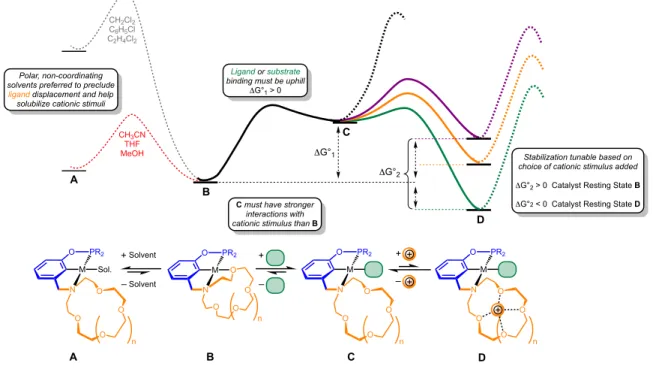
Controlling ligand binding and catalysis using the dual equilibrium approach requires that the system meet several thermodynamic criteria as follows and as depicted in the idealized potential energy surface shown in Figure 1.6. Firstly, solvent displacement of the hemilabile donor must be unfavorable for maximum control. For instance, the binding of a coordinating
Ph
M+
Ir PiPr2
N O O O O O H Ph Ir PiPr2
N O O O O O H + Ph – Ph Ph Ir PiPr2
fully associated form of the catalyst must be weaker than those with the dissociated form. If secondary interactions were strong for both associated and dissociated forms of the catalyst, thermodynamic stabilization of all species would simply shift the entire energy surface lower.
Figure 1.6 Idealized free energy landscape of cation-modulated substrate binding and catalysis. The first equilibrium in the dual equilibrium approach, the dissociation/association of the weak donor(s) of the pincer-crown ether ligand, will vary from catalyst to catalyst based on the metal–oxygen bond strength. The second equilibrium, host-guest interactions between cationic additives and the pendent macrocycle, will vary based on the identity of the macrocycle and the identity and concentration of the additives. A variety of macrocycles can be installed during ligand synthesis.
The true power in this strategy lies in the availability of a wide variety of cationic guests that can be used to tune this second equilibrium. Similarly to organic crowns, pincer-crown ether complexes of a given ligand are expected to show trends in affinity and selectivity for additives. Knowledge of cation-crown association constants will allow for predictions of reactivity and a
n M O PR2
N O
O O
O O PR2
N O O O O M n n M
O PR2
N O O O O – – + + n M O PR2
N O O O O Sol. – +Solvent Solvent Polar, non-coordinating solvents preferred to preclude ligand displacement and help solubilize cationic stimuli
CH2Cl2
C6H5Cl
C2H4Cl2
CH3CN THF MeOH
Ligand or substrate binding must be uphill
ΔG°1 > 0
ΔG°1
ΔG°2
Stabilization tunable based on choice of cationic stimulus added
ΔG°2 > 0 Catalyst Resting State B
ΔG°2 < 0 Catalyst Resting State D
A B C D
D C
B A
high level of control over ligand substitution and catalysis. Additionally, a deeper understanding these interactions will aid in the development of strategies employing pincer-crown ether
catalysts and cationic co-catalysts for alteration of product selectivity and bimetallic catalysis via substrate activation.
1.3 Controlling Catalysis Through Substrate Activation
Further applications of pincer-crown ether complexes can be envisioned based on the ability of the pendent aza-crown ether moiety to dock cations in close proximity to the metal center of the catalyst. Commonly employed alkali metal, alkaline earth, transition metal, and lanthanide cations exhibit varying degrees of Lewis acidity. Lewis acids have a rich history of promoting a wide array of organic transformations through substrate activation and
organization.89 These electron pair acceptors form a donor-acceptor complex upon coordination
Figure 1.7 General Lewis acid activation of a variety of organic molecules.
Convenient metrics of Lewis acidity include the pKa of [M–OH2]n+ complexes and
fluorescence maxima shifts of 10-methylacridone–metal ion salt complexes (Table 1.1).90-91 The
Lewis acidity of these ions varies widely allowing for a wide range of control over substrate activation.
O
R R
O H
R R
R R
O R
O
NR2
R
N R R
R R
S
R O O
R R N
R O Mn+
Mn+
Mn+
Mn+
Mn+
Mn+ M
n+
Table 1.1 Lewis acid induced shifts of 10-methylacridone florescence lmax as a measure of
relative Lewis acidity.91
Lewis Acid lmax Florescence Energy (eV)
Fe(ClO4)3 478 2.59
Sc(OTf)3 474 2.62
Fe(ClO4)2 471 2.63
Cu(ClO4)2 471 2.63
Co(ClO4)2 470 2.64
(C6F5)2SnBr2 470 2.64
Lu(OTf)3 461 2.69
Y(OTf)3 460 2.7
La(OTf)3 458 2.71
Zn(OTf)2 456 2.72
Ph3SnCl 455 2.72
Bu2SnCl2 453 2.74
(C6F5)3SnBr 452 2.74
Mg(ClO4)2 451 2.75
Ca(ClO4)2 449 2.76
Sr(ClO4)2 445 2.79
Ba(ClO4)2 444 2.79
LiClO4 442 2.81
NaClO4 437 2.84
Mn(ClO4)2 435 2.85
10-methylacridone 432 2.87
Cooperation between transition metal catalysts and Lewis acids as substrate or intermediate activators has been realized as a powerful strategy for controlling chemical
reactivity and catalysis in organic synthesis.92-93 In these reactions, generally either the transition
another example, the palladium catalyzed dimerization of vinyl arenes is promoted by an In(OTf)3 Lewis acid cocatalyst.95 The indium trication activates vinyl arenes to nucleophilic
attack by Pd(0) complexes. The resulting proposed zwitterionic Pd+–alkyl–In– intermediate then
inserts an additional vinyl arene and eliminates the product to regenerate the Pd(0) and In3+
cocatalysts.
Figure 1.8 Lewis acid promoted reaction of zirconacyclopentadienes with isocyanates to form iminocyclopentadienes.
Lewis acids can accelerate numerous transition metal-catalyzed reactions. The positive influence of the Lewis acid has, in many cases, been attributed to interactions between the Lewis acid and the metal-bound substrate. For reactions involving carbon monoxide as a substrate, for example, the carbonyl ligand can interact with a Lewis acid during or after C–C bond
formation.96-101 In cases where pendent macrocycles were present as part of a ligand scaffold and
positioned the Lewis acid near the metal center, carbonyl activation or acyl stabilization has been proposed (Figure 1.7).83, 102-103 Pincer-crown ether Ir complexes have previously been shown to
promote lithium- and lanthanum-accelerated migratory insertion and salt-responsive methanol Zr R’N=C=O R R R R No Reaction R’N=C=O LA
Cp2Zr O R R R R NR’ LA
Cp2Zr ’RN R R R R O LA R R R R NR’ O Cp2Zr
LA R R R R R’N
carbonylation catalysis.104-105 Although the role of the Lewis acid in the mechanisms of these
reactions is not fully understood, postulated transition states include those wherein a cation complexed in the pendent crown ether of the molecule interacts with a carbonyl ligand, activating it towards nucleophilic attack by a methyl ligand (Figure 1.7).
Figure 1.9 Select examples of macrocycle containing complexes in which a Lewis acid is proposed to interact with carbonyl or acyl ligands bound to the metal center.
Positioning activated substrates near the active site of a pincer-crown ether complex provides an opportunity for controlling catalysis based on the extent of substrate activation via the Lewis acidity of the cationic additive. If the substrate is involved in the rate-determining steps of the reaction, activation with Lewis acids could lower barriers to make the reactions proceed faster. Additionally, if a given reaction does not proceed with an unactivated substrate, but proceeds in the presence of a Lewis acid additive, switchable bimetallic catalysis or substrate selective reactivity becomes possible.
CO
(OC)4M
O O O O P P Ph2 O R Li+ Ph2 Re CO OC OC I
Ph2P
O N O O O Ca2+ I Ir
REFERENCES
1. Bertini, I., Biological Inorganic Chemistry: Structure and Reactivity. University Science Books: Sausalito, California, 2007.
2. Silva, J. J. R. F. d., The Biological Chemistry of the Elements: The Inorganic Chemistry of Life. 2nd ed.; Oxford University Press: Oxford; New York, 2001.
3. Hagen, J., Industrial Catalysis: A Practical Approach. 3rd ed.; John Wiley & Sons, Inc.: 2015.
4. Hartwig, J. F., Organotransition metal chemistry: from bonding to catalysis. University Science Books: Sausalito, California, 2010.
5. Blanco, V.; Leigh, D. A.; Marcos, V., Chem. Soc. Rev. 2015, 44 (15), 5341-5370. 6. Choudhury, J., Tetrahedron Lett. 2018, 59 (6), 487-495.
7. Camp, J. E., Eur. J. Org. Chem. 2017, 2017 (3), 425-433.
8. Fogg, D. E.; dos Santos, E. N., Coord. Chem. Rev. 2004, 248 (21), 2365-2379. 9. Robert, C.; Thomas, C. M., Chem. Soc. Rev. 2013, 42 (24), 9392-9402.
10. Lohr, T. L.; Marks, T. J., Nat. Chem. 2015, 7, 477.
11. Abou-Shehada, S.; Williams, J. M. J., Nat. Chem. 2013, 6, 12. 12. Traut, T., Allosteric regulatory enzymes. Springer: New York, 2008. 13. Ma, T.; Peng, Y.; Huang, W.; Ding, J., Sci. Rep. 2017, 7, 40921.
14. Vlatković, M.; Collins Beatrice, S. L.; Feringa Ben, L., Chem. Eur. J. 2016, 22 (48), 17080-17111.
15. Wiester, M. J.; Ulmann, P. A.; Mirkin, C. A., Angew. Chem. Int. Ed. 2011, 50 (1), 114-137.
16. Oliveri, C. G.; Ulmann, P. A.; Wiester, M. J.; Mirkin, C. A., Acc. Chem. Res. 2008, 41 (12), 1618-1629.
17. Lifschitz, A. M.; Rosen, M. S.; McGuirk, C. M.; Mirkin, C. A., J. Am. Chem. Soc. 2015,
137 (23), 7252-7261.
20. Cakmak, Y.; Erbas-Cakmak, S.; Leigh, D. A., J. Am. Chem. Soc. 2016, 138 (6), 1749-1751.
21. Fiedler, D.; Leung, D. H.; Bergman, R. G.; Raymond, K. N., Acc. Chem. Res. 2005, 38 (4), 349-358.
22. Yoshizawa, M.; Klosterman Jeremy , K.; Fujita, M., Angew. Chem. Int. Ed. 2009, 48 (19), 3418-3438.
23. Brown, C. J.; Toste, F. D.; Bergman, R. G.; Raymond, K. N., Chem. Rev. 2015, 115 (9), 3012-3035.
24. Meeuwissen, J.; Reek, J. N. H., Nat. Chem. 2010, 2, 615-621.
25. Leenders, S. H. A. M.; Gramage-Doria, R.; de Bruin, B.; Reek, J. N. H., Chem. Soc. Rev.
2015, 44 (2), 433-448.
26. Severin, K., Curr. Opin. Chem. Biol. 2000, 4 (6), 710-714. 27. Wulff, G., Chem. Rev. 2002, 102 (1), 1-28.
28. Becker, J. J.; Gagné, M. R., Acc. Chem. Res. 2004, 37 (10), 798-804. 29. Howell, J. A. S.; Burkinshaw, P. M., Chem. Rev. 1983, 83 (5), 557-599. 30. Julliard, M.; Chanon, M., Chem. Rev. 1983, 83 (4), 425-506.
31. Albers, M. O.; Coville, N. J., Coord. Chem. Rev. 1984, 53, 227-259.
32. Langford, C. H.; Gray, H. B., Ligand substitution processes. WA Benjamin, Inc.: 1966. 33. Himeda, Y.; Onozawa-Komatsuzaki, N.; Sugihara, H.; Kasuga, K., J. Am. Chem. Soc.
2005, 127 (38), 13118-13119.
34. Balof, S. L.; Yu, B.; Lowe, A. B.; Ling, Y.; Zhang, Y.; Schanz, H. J., Eur. J. Inorg. Chem. 2009, 2009 (13), 1717-1722.
39. Neilson, B. M.; Bielawski, C. W., Organometallics 2013, 32 (10), 3121-3128. 40. Broderick, E. M.; Guo, N.; Vogel, C. S.; Xu, C.; Sutter, J.; Miller, J. T.; Meyer, K.;
Mehrkhodavandi, P.; Diaconescu, P. L., J. Am. Chem. Soc. 2011, 133 (24), 9278-9281. 41. Lorkovic, I. M.; Duff, R. R.; Wrighton, M. S., J. Am. Chem. Soc. 1995, 117 (12),
3617-3618.
42. Allgeier, A. M.; Mirkin, C. A., Angew. Chem. Int. Ed. 1998, 37 (7), 894-908.
43. Gregson, C. K. A.; Gibson, V. C.; Long, N. J.; Marshall, E. L.; Oxford, P. J.; White, A. J. P., J. Am. Chem. Soc. 2006, 128 (23), 7410-7411.
44. Baerends, E. J.; Rosa, A., Coord. Chem. Rev. 1998, 177 (1), 97-125. 45. Jeffrey, J. C.; Rauchfuss, T. B., Inorg. Chem. 1979, 18 (10), 2658-2666.
46. Caroline S. Slone, D. A. W., Chad A. Mirkin, The Transition Metal Coordination Chemistry of Hemilabile Ligands. In Prog. Inorg. Chem., Karlin, K. D., Ed. Hoboken, NJ, 1999; Vol. 48.
47. Pierre, B.; Frédéric, N., Angew. Chem. Int. Ed. 2001, 40 (4), 680-699. 48. Bader, A.; Lindner, E., Coord. Chem. Rev. 1991, 108 (1), 27-110.
49. Kingsbury, J. S.; Harrity, J. P. A.; Bonitatebus, P. J.; Hoveyda, A. H., J. Am. Chem. Soc.
1999, 121 (4), 791-799.
50. Hoveyda, A. H.; Gillingham, D. G.; Van Veldhuizen, J. J.; Kataoka, O.; Garber, S. B.; Kingsbury, J. S.; Harrity, J. P. A., Org. Biomol. Chem. 2004, 2 (1), 8-23.
51. Agapie, T., Coord. Chem. Rev. 2011, 255 (7), 861-880. 52. McGuinness, D. S., Chem. Rev. 2011, 111 (3), 2321-2341.
53. Agapie, T.; Day, M. W.; Henling, L. M.; Labinger, J. A.; Bercaw, J. E., Organometallics
2006, 25 (11), 2733-2742.
54. Kwong, F. Y.; Chan, A. S. C., Synlett 2008, (10), 1440-1448.
55. Weng, Z.; Teo, S.; Hor, T. S. A., Acc. Chem. Res. 2007, 40 (8), 676-684. 56. Ryken, S. A.; Schafer, L. L., Acc. Chem. Res. 2015, 48 (9), 2576-2586.
57. Niemeyer, Z. L.; Milo, A.; Hickey, D. P.; Sigman, M. S., Nat. Chem. 2016, 8, 610.
59. Bieniek, M.; Samojłowicz, C.; Sashuk, V.; Bujok, R.; Śledź, P.; Lugan, N.; Lavigne, G.; Arlt, D.; Grela, K., Organometallics 2011, 30 (15), 4144-4158.
60. Bei, X.; Uno, T.; Norris, J.; Turner, H. W.; Weinberg, W. H.; Guram, A. S.; Petersen, J. L., Organometallics 1999, 18 (10), 1840-1853.
61. van Veggel, F. C. J. M.; Verboom, W.; Reinhoudt, D. N., Chem. Rev. 1994, 94 (2), 279-99.
62. Gray, G. M., Comments Inorg. Chem. 1995, 17 (2), 95-114. 63. Beer, P. D., Chem. Soc. Rev. 1989, 18 (0), 409-450.
64. Rebek, J.; Wattley, R. V., J. Heterocycl. Chem. 1980, 17 (4), 749-751.
65. Rebek, J.; Trend, J. E.; Wattley, R. V.; Chakravorti, S., J. Am. Chem. Soc. 1979, 101 (15), 4333-4337.
66. Rebek, J.; Wattley, R. V., J. Am. Chem. Soc. 1980, 102 (14), 4853-4854. 67. Beer, P. D.; Rothin, A. S., Polyhedron 1988, 7 (2), 137-142.
68. Nabeshima, T.; Inaba, T.; Furukawa, N., Tetrahedron Lett. 1987, 28 (49), 6211-6214. 69. Nabeshima, T.; Inaba, T.; Furukawa, N.; Ohshima, S.; Hosoya, T.; Yano, Y.,
Tetrahedron Lett. 1990, 31 (45), 6543-6546.
70. Furukawa, N.; Nabeshima, T.; Inaba, T., Heterocycles 1989, 29 (3), 431-431. 71. Beer, P. D.; Rothin, A. S., J. Chem. Soc., Chem. Commun. 1988, (1), 52-54.
72. Sielcken, O. E.; Schram, J.; Nolte, R. J. M.; Schoonman, J.; Drenth, W., J. Chem. Soc., Chem. Commun. 1988, (2), 108-109.
73. Hendriks, R.; Sielcken, O. E.; Drenth, W.; Nolte, R. J. M., J. Chem. Soc., Chem. Commun. 1986, (19), 1464-1465.
78. Powell, J.; Gregg, M. R.; Kuksis, A.; May, C. J.; Smith, S. J., Organometallics 1989, 8 (12), 2918-2932.
79. Powell, J.; Kuksis, A.; May, C. J.; Meindl, P. E.; Smith, S. J., Organometallics 1989, 8 (12), 2933-2941.
80. Powell, J.; Kuksis, A.; May, C. J.; Nyburg, S. C.; Smith, S. J., J. Am. Chem. Soc. 1981,
103 (19), 5941-5943.
81. Powell, J.; Gregg, M. R.; Meindl, P. E., Organometallics 1989, 8 (12), 2942-2947. 82. Powell, J.; Lough, A.; Wang, F., Organometallics 1992, 11 (6), 2289-2295.
83. McLain, S. J., J. Am. Chem. Soc. 1983, 105 (20), 6355-6357. 84. McLain, S. J., Inorg. Chem. 1986, 25 (18), 3124-3127.
85. Carroy, A.; Lehn, J.-M., J. Chem. Soc., Chem. Commun. 1986, (16), 1232-1234. 86. Miller, A. J. M., Dalton Trans. 2017, 46 (36), 11987-12000.
87. Kita, M. R.; Miller, A. J. M., J. Am. Chem. Soc. 2014, 136 (41), 14519-14529. 88. Kita, M. R.; Miller, A. J. M., Angew. Chem., Int. Ed. 2017, 56 (20), 5498-5502. 89. Carey, F. A., Advanced organic chemistry. Springer: New York, NY, 2008. 90. Perrin, D. D., Pure Appl. Chem. 1969, 20 (2).
91. Fukuzumi, S.; Ohkubo, K., J. Am. Chem. Soc. 2002, 124 (35), 10270-10271. 92. Wang, C.; Xi, Z., Chem. Soc. Rev. 2007, 36 (9), 1395-1406.
93. Organic Synthesis with Bimetallic Systems. In Multimetallic Catalysts in Organic Synthesis.
94. Lu, J.; Mao, G.; Zhang, W.; Xi, Z., Chem. Commun. 2005, (38), 4848-4850. 95. Tsuchimoto, T.; Kamiyama, S.; Negoro, R.; Shirakawa, E.; Kawakami, Y., Chem.
Commun. 2003, (7), 852-853.
96. West, N. M.; Miller, A. J. M.; Labinger, J. A.; Bercaw, J. E., Coord. Chem. Rev. 2011,
255 (7), 881-898.
97. Butts, S. B.; Strauss, S. H.; Holt, E. M.; Stimson, R. E.; Alcock, N. W.; Shriver, D. F., J. Am. Chem. Soc. 1980, 102 (15), 5093-5100.
99. Miller, A. J. M.; Labinger, J. A.; Bercaw, J. E., J. Am. Chem. Soc. 2008, 130 (36), 11874-11875.
100. Collman, J. P.; Finke, R. G.; Cawse, J. N.; Brauman, J. I., J. Am. Chem. Soc. 1978, 100 (15), 4766-4772.
101. Fausto, C., Angew. Chem. Int. Ed. 1977, 16 (5), 299-311.
102. Hazari, A.; Labinger, J. A.; Bercaw, J. E., Angew. Chem. Int. Ed. 2012, 51 (33), 8268-8271.
103. West, N. M.; Labinger, J. A.; Bercaw, J. E., Organometallics 2011, 30 (10), 2690-2700. 104. Gregor, L. C.; Grajeda, J.; Kita, M. R.; White, P. S.; Vetter, A. J.; Miller, A. J. M.,
Organometallics 2016, 35 (17), 3074-3086.
CHAPTER 2: CONNECTING NEUTRAL AND CATIONIC PATHWAYS IN
NICKEL-CATALYZED INSERTION OF BENZALDEHYDE INTO A C−H BOND OF
ACETONITRILE
Reproduced with permission from Smith, J. B.; Miller, A. J. M. “Connecting Neutral and Cationic Pathways in Nickel-Catalyzed Insertion of Benzaldehyde into a C−H Bond of Acetonitrile.” Organometallics 2015, 34, 4669. Copyright American Chemical Society 2015.
2.1 Introduction
Organonickel complexes orchestrate an array of molecular elaborations,1-8 but nickel
catalysts have lagged behind precious metals in the functionalization of C−H bonds.6-8 The
choice of substrate can be a deciding factor in nickel-mediated C−H functionalization: substrates containing a directing group can hold a C−H bond in close proximity to the metal center,9-13 or
substrates containing relatively acidic C−H bonds can facilitate pathways that rely on deprotonation.14-15
Acetonitrile is an attractive substrate for nickel-catalyzed C−C bond-forming reactions because the sp3 C−H bond is relatively acidic (pKa = 25 in H2O)16 and the products would
contain a valuable nitrile functionality. Direct deprotonation of acetonitrile is often impractical or not tolerated by nearby functional groups, motivating the development of catalytic methods that avoid stoichiometric amounts of strong base.
This article describes the insertion of benzaldehyde into a C−H bond of acetonitrile (Scheme 2.1) catalyzed by asymmetric Ni aminophosphinite (NCOP) pincer complexes with little or no base added. Only two nickel catalysts are found among the handful17-22 of
synthetically useful β-hydroxy nitriles.25-27 In 2005, Ozerov and co-workers reported a cationic
Ni catalyst that required stoichiometric base to couple nitriles and aldehydes.23 In 2013, Guan
and co-workers isolated a C-bound cyanomethyl species (Ni−CH2CN) that proved to be a highly
active catalyst for C−H insertion without added base, with a turnover number (TON) of up to 82,000.24
Scheme 2.1 Insertion of benzaldehyde into a C−H bond of acetonitrile.
The two Ni catalysts were proposed to operate through quite different mechanisms, despite the fact that both are supported by pincer ligands. The cationic, base-promoted catalyst was proposed to react through the Lewis acid mechanism shown in Scheme 2.2A: nitrile binding to the Ni catalyst would render the acetonitrile more acidic, facilitating deprotonation by the added base; the resulting N-bound cyanomethyl species would then undergo nucleophilic attack on the aldehyde to form the C−C bond.23 The neutral, base-free catalyst was proposed to react
through the organometallic mechanism shown in Scheme 2.2B: a highly nucleophilic Ni
alkoxide would facilitate C−H bond activation by a “concerted metalation−deprotonation”-type pathway,28 followed by 1,2-insertion of the aldehyde into the resulting C-bound cyanomethyl
species.24
O
H + CH3CN catalyst
Scheme 2.2 A) Base-promoted and B) Base-free nickel catalyzed hydrocyanomethylation catalytic cycles.
Considering the proposed mechanisms in Scheme 2, we hypothesized that a Ni catalyst supported by our pincer-crown ether ligand framework could utilize the aza-crown ether donor to hold a Lewis acidic cation near the Ni center and accelerate the catalytic reaction.29 In addition to
numerous examples of Lewis acid-promoted insertion reactions,30-32 we were also aware that a
related Ru catalyst showed improved aldehyde cyanomethylation yields in the presence of 10% NaPF6.21 With this hypothesis in mind, we set out to synthesize new pincer-crown ether
complexes of nickel and assess their catalytic activity for the insertion of benzaldehyde into a C−H bond of acetonitrile. While the asymmetric NCOP pincer framework can indeed support catalytic insertion of benzaldehyde into acetonitrile, we were surprised to find that lithium salts inhibit the reaction (Na+ and K+ had no effect on the rate). Mechanistic studies to probe the
origin of the cation-triggered deactivation revealed that catalysis could be reinitiated by the addition of base, suggesting a connection between the neutral and cationic precatalysts.
2.2 Synthesis and Characterization
Metalation of the previously reported pincer-crown ether ligand containing an aza-15-crown-5 macrocycle,29 (15c5NCOPiPr)H, was accomplished by heating a toluene solution of the
[Ni] N C CH3 + [Ni] N C CH2
[Ni] N C HO R + HBase+ Base HBase+ Base RCHO
CH3CN
[Ni] O
[Ni] HC2 C N RCHO A B R C N CH3CN




![Figure 2.2 1 H NMR spectra of a CD 2 Cl 2 solution containing CH 3 CN and [( 15c5 NCOP iPr )Ni(NCCH 3 )][PF 6 ] (3-15c5) between 213 K and 298 K 2.3 Catalytic Hydrocyanomethylation of Benzaldehyde](https://thumb-us.123doks.com/thumbv2/123dok_us/8295021.2196695/55.918.152.759.375.822/figure-spectra-solution-containing-ncch-catalytic-hydrocyanomethylation-benzaldehyde.webp)