research highlights
DOI:10.1145/2885252
Learning to Name Objects
By Vicente Ordonez, Wei Liu, Jia Deng, Yejin Choi, Alexander C. Berg, and Tamara L. Berg
Abstract
We have seen remarkable recent progress in compu-tational visual recognition, producing systems that can classify objects into thousands of different categories with incre asing accuracy. However, one question that has received relatively less attention is “what labels should rec-ognition systems output?” This paper looks at the problem of predicting category labels that mimic how human observ-ers would name objects. This goal is related to the concept of entry-level categories first introduced by psychologists in the 1970s and 1980s. We extend these seminal ideas to study human naming at large scale and to learn computa-tional models for predicting entry-level categories. Practical applications of this work include improving human-focused computer vision applications such as automatically gener-ating a natural language description for an image or text-based image search.
1. INTRODUCTION
Computational visual recognition is beginning to work. Although far from solved, algorithms for analyzing images have now advanced to the point where they can recognize or localize thousands of object categories with reasonable accu-racy.3, 14, 24, 25 While we could predict any one of many relevant
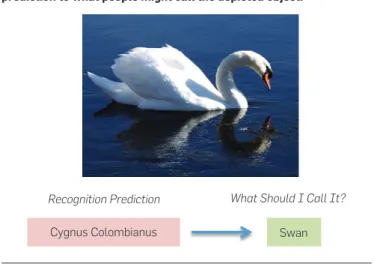
labels for an object, the question of “What should I actually call it?” is becoming important for large-scale visual recognition. For instance, if a classifier were lucky enough to get the exam-ple in Figure 1 correct, it might output Cygnus Colombianus, while most people would probably simply say swan. Our goal is to learn models to map from specific, encyclopedic terms (Cygnus Colombianus) to how people might refer to a given object (swan).
These learned mappings could add a new type of structure to hand-built linguistic resources, such as WordNet.9 WordNet
enumerates a large set of English nouns augmented by rela-tionships, including hyperonymy (is-a connections) linking more general categories, for example, passerine, to more spe-cific categories, for example, firebird (a firebird is a kind of passerine). Our models might learn that an image of a firebird is more likely to be described by the term “bird” instead of a more technical term like “passerine.” When combined with a computer vision system that attempts to recognize many very specific types of objects in a particular image, our models allow mapping to the words people are likely to use for describing the depicted objects. For end-user applications, these types of outputs may be more useful than the outputs of very accurate but overly specific visual categorization systems. This is espe-cially relevant for human computer interaction mediated by text—for instance, in text-based image search.
Our work is inspired by previous research on basic and entry-level categories formulated by psychologists, including Rosch23 and Kosslyn.13 Rosch defines basic-level categories
as those categories at the highest level of generality whose members still share many common attributes and have fewer distinctive attributes. An example of a basic level category is bird where most instances share attributes like having feathers, wings, and beaks. Subordinate, more spe-cific categories, such as American Robin will have members that share even more attributes such as shape, color, and size. Super-ordinate, more general categories, such as ani-mal have members that share fewer attributes and demon-strate more variability. Rosch studied basic level categories through human experiments, for example, asking people to enumerate common attributes for a given category.
The work of Jolicoeur et al.13 further studied the way
people identify categories, defining the notion of entry-level categories. Entry-level categories are essentially the catego-ries that people will naturally use to identify objects. The more prototypical an object the more likely it will have its entry point at the basic-level category. For less typical objects the entry point might be at a lower level of abstraction. For example an American robin or a penguin are both members of the same basic-level bird category. However, the American robin is more prototypical, sharing many features with other birds and thus its entry-level category coincides with its basic-level category of bird, while a penguin would be identi-fied at a lower level of abstraction (see Figure 2).
Thus, while objects are members of many categories—for
The original version of this paper is entitled “From Large Scale Image Categorization to Entry-Level Categories” and was published in International Conference on Com-puter Vision, December 2013, IEEE/CVF. A later version of this paper is entitled “Predicting Entry-Level Categories” and was submitted to International Journal of Computer Vision – Marr Prize Special Issue. November 2014, Springer. Figure 1.Example translation from a WordNet based object category prediction to what people might call the depicted object.
Cygnus Colombianus Swan
example, Mr. Ed is a palomino, but also a horse, an equine, an odd-toed ungulate, a placental mammal, a mammal, and so on—most people looking at Mr. Ed would tend to call him a horse, his entry level category (unless they are fans of the show). Our paper focuses on the problem of object nam-ing in the context of entry-level categories. We consider two related tasks: (1) learning a mapping from fine-grained/ency-clopedic categories—for example, leaf nodes in WordNet9—
to what people are likely to call them (entry-level categories) and (2) learning to map from outputs of thousands of noisy computer vision classifiers/detectors evaluated on an image to what a person is likely to call depicted objects.
Evaluations show that our models can effectively emulate the naming choices of humans. Furthermore, we show that using noisy computer vision estimates for image content, our system can output words that are significantly closer to human annotations than either the raw visual classifier predictions or the results of using a state of the art hierarchical classifica-tion system6 that can output object labels at varying levels of
abstraction, from very specific terms to very general categories.
1.1. Outline
The rest of this paper is organized as follows. Section 2 presents a summary of related work. Section 3 introduces a large-scale image categorization system based on deep con-volutional neural network (CNN) activations. In Section 4, we learn translations between input linguistic concepts and entry-level concepts. In Section 5, we propose two models that can take an image as input and predict entry-level con-cepts for the depicted objects. Finally, in Sections 6 and 7 we provide experimental evaluations and conclusions.
2. RELATED WORK
Questions about entry-level categories are directly relevant to recent work on generating natural language descriptions for images.8, 11, 15, 16, 19, 21 In these papers, the goal is to
auto-matically produce natural language that describes the con-tent of an image or video. We attack one specific facet of this problem, how to name objects in images in a human-like manner. Previous approaches that construct image descrip-tions directly from computer vision predicdescrip-tions often result
choices indirectly by sampling human written text written about other visually similar objects.16, 17
On a technical level, our work is related to recent work from Deng et al.6 that tries to “hedge” predictions of visual content
by optimally backing off in the WordNet semantic hierarchy. For example, given a picture of a dog, a noisy visual predictor might easily mistake this for a cat. Therefore, outputting a more general prediction, for example, animal, may sometimes be better for overall performance in cases of visual ambiguity. One key difference is that our approach uses a reward func-tion over the WordNet hierarchy that is non-monotonic along paths from the root to leaves, as it is based on word usage patterns, rather than perplexity. Another difference is that we make use of recent convolutional neural network based features for our underlying visual classifiers.12 Our approach
also allows mappings to be learned from a WordNet leaf node, l, to natural word choices that are not along a path from l to the root, “entity.” In evaluations, our results significantly out-perform the “hedging” technique6 because although optimal
for maximizing classification accuracy, it is not optimal with respect to how people describe image content.
Our work is also related to the growing challenge of har-nessing the ever increasing number of pre-trained recogni-tion systems, thus avoiding always “starting from scratch” in developing new applications. With the advent of large labeled datasets of images, including ImageNet5 with over 15,000,000
labeled images for a subset of the WordNet hierarchy, a large amount of compute effort has been dedicated to building vision based recognition systems. It would be wasteful not to take advantage of the CPU weeks,10, 14 months,4, 6 or even
mil-lennia18 invested in developing and training such recognition
models. However, for any specific end user application, the categories of objects, scenes, and attributes labeled in a par-ticular dataset may not be the most useful predictions. One benefit of our work can be seen as exploring the problem of translating the outputs of a vision system trained with one vocabulary of labels (WordNet leaf nodes) to labels in a new vocabulary (commonly used visually descriptive nouns).
Our proposed methods take into account several sources of structure and information: the structure of WordNet, fre-quencies of word use on the web,2 outputs of a large-scale
visual recognition system,12 and large amounts of paired
image and text data. In particular, we make use of the SBU Captioned Photo Dataset21 which contains 1 million images
with natural language captions as a source of natural image naming patterns. By incorporating all of these resources, we are able to study entry-level categories at a much larger scale than in previous settings.
2.1. Challenges of predicting entry-level categories At first glance, the task of finding the entry-level categories may seem like a linguistic problem of finding a hypernym of any given word. Although there is a considerable conceptual connection between entry-level categories and hypernyms, there are two notable differences:
1. Although “bird” is a hypernym of both “penguin,” and while for penguin which is a less prototypical example of bird, the
entry-level category is at a lower level of abstraction.
Superordinates: animal, vertebrate Basic Level: bird
Entry Level: bird
Subordinates: American robin
Superordinates: animal, vertebrate Basic Level: bird
Entry Level: penguin
research highlights
“sparrow,” “bird” may be a good entry-level category for “sparrow,” but not for “penguin.” This phenomenon, that some members of a category are more prototypi-cal than others, is discussed in Prototype Theory.23
2. Entry-level categories are not confined by (inherited) hypernyms, in part because encyclopedic knowledge is different from common sense knowledge. For example “rhea” is not a kind of “ostrich” in the strict taxonomi-cal sense. However, due to their visual similarity, peo-ple generally refer to a “rhea” as an “ostrich.” Adding to the challenge is that although extensive, WordNet is neither complete nor practically optimal for our pur-pose. For example, according to WordNet, “kitten” is not a kind of “cat,” and “tulip” is not a kind of “flower.”
In fact, both of the above points have a connection to visual information of objects, as visually similar objects are more likely to belong to the same entry-level category. In this work, we present the first extensive study that (1) char-acterizes entry-level categories in the context of translating encyclopedic visual categories to natural names that people commonly use, and (2) provides approaches that infer entry-level categories from a large-scale image corpus, guided by semantic word knowledge.
3. A LARGE-SCALE IMAGE CATEGORIZATION SYSTEM We take advantage of recent advances in deep learning based visual features for training a large number of visual classifi-ers for leaf-node object categories. In particular, we use the pre-trained CNN model from the Caffe framework12 based on
the model from Krizhevsky et al.,14 trained on 1000 imagenet
categories from the ImageNet Large Scale Visual Recognition Challenge 2012. This model consists of a feed-forward neural network with multiple layers, each with different levels of con-nectivity between units in contiguous layers. The last few lay-ers in the network consist of fully connected laylay-ers, where all the units in a given layer are connected to all the units in the subsequent layer. The output layer of the network consists of 1000 units corresponding to each category for the classifica-tion task. Donahue et al.7 showed that the activations of some
of the intermediate layers, particularly the fully connected lay-ers before the output layer, were a useful generic image repre-sentation for a variety of other recognition tasks.
We similarly compute the 4096 activations in the last fully connected layer of this network and use these as features to train a linear SVM for each of 7404 leaf level categories in ImageNet. We also use a validation set to calibrate the out-put scores of each SVM using Platt scaling.22 These 7404
visual classifiers will be used to predict image content either directly (Section 5.1) or to train entry-level visual predictors (Sections 4.2 and 5.2).
4. TRANSLATING ENCYCLOPEDIC CONCEPTS TO ENTRY-LEVEL CONCEPTS
Our first goal toward understanding how people name objects, is to learn mappings between encyclopedic concepts (ImageNet leaf categories, e.g., Chlorophyllum molybdites) and concepts that are more natural (e.g., mushroom). In Section 4.1, we present an approach that relies on the WordNet
hierarchy and frequencies of words in a web scale corpus. In Section 4.2, we follow an approach that uses visual recogni-tion models learned on a paired image-caprecogni-tion dataset.
4.1. Language-based translation
As a baseline, we first consider a translation approach that relies only on language-based information: the hierarchi-cal semantic tree from WordNet9 and text statistics from the
Google Web 1T corpus.2 We posit that the frequencies of terms
computed from massive amounts of text on the web reflect the “naturalness” of concepts. We use the n-gram counts of the Google Web 1T corpus2 as a proxy for naturalness. Specifically,
for a synset w, we quantify naturalness as, φ(w), the log of the count for the most commonly used synonym in w. As possible translation concepts for a given category, υ, we consider all nodes, w in υ ¢s inherited hypernym structure (all of the syn-sets along the WordNet path from w to the root).
We define a translation function for a category υ, τ(υ, λ), that maps υ to a new node w, such that w maximizes the trade-off between naturalness, φ(w), and semantic proxim-ity, ψ(w, υ), measuring the distance between node υ and node w in the WordNet hypernym structure:
(1)
where Π(υ) is the set of (inherited) hypernyms from υ to the root, including υ. For instance given an input category υ = King pen-guin we consider all categories along its set of inherited hyper-nyms, for example, penguin, seabird, bird, animal (see Figure 3). An ideal prediction for this concept would be penguin. We use line search to find the optimal λ, which controls how much we care about naturalness versus semantic proximity, based on a held out set of subordinate-category, entry-level category pairs D = (xi, yi) collected using crowdsourcing to maximize the num-ber of correct translations predicted by our model:
Φ(D, λ) =
S
i
[τ(xi, λ) = yi], (2)
where [×] is the indicator function. We show the relationship between λ and translation accuracy, Φ(D, λ), in Figure 4, where
Figure 3. Our first categorical translation model uses the WordNet hierarchy to find an hypernym that is close to the leaf node concept (semantic distance) and has a large naturalness score based on its n-gram frequency. The green arrows indicate the ideal category that would correspond to the entry-level category for each leaf-node in this sample semantic hierarchy.
Animal
Seabird
Penguin Cormorant
Cetacean
Whale
Dolphin Sperm whale Mammal
Grampus griseus King
penguin Bird
Semantic Di
st
ance
n-gram Frequency
656M
366M
128M
88M
1.2M
22M
15M
0.9M
55M
30M
6.4M
0.08M
5. PREDICTING ENTRY-LEVEL CONCEPTS FOR IMAGES In Section 4, we proposed models to translate between one linguistic concept, for example, grampus griseus, to a more natural object name, for example, dolphin. Our objective in this section is to explore methods that can take an image as input and predict entry-level labels for the depicted objects. The models we propose are: (1) a method that combines “nat-uralness” measures from text statistics with direct estimates of visual content computed at leaf nodes and inferred for internal nodes (Section 5.1) and (2) a method that learns visual models for entry-level category prediction directly from a large collection of images with associated captions (Section 5.2).
5.1. Linguistically guided naming
In our first image prediction method, we estimate image content for an image, I, using the pre-trained visual mod-els described in Section 3. These modmod-els predict the pres-ence or abspres-ence of 7404 leaf level visual categories in the ImageNet (WordNet) hierarchy. Following the “hedging” approach,6 we compute estimates of visual content for
inter-nal nodes in the hierarchy by accumulating all predictions below a node:
(3)
where Z(υ) is the set of all leaf nodes under node υ and fˆ(υ, I) is the output of a platt-scaled decision value from a linear SVM trained to recognize category υ. Similar to our approach in Section 4.1, we define for every node in the ImageNet hierarchy the red line shows accuracy for predicting the word used by
the most people for a synset, while the cyan line shows the accuracy for predicting any word used by a labeler for the synset. As we increase λ, Φ(D, λ) increases initially and then decreases as too much generalization or specificity reduces the naturalness of the predictions. For example, generalizing from grampus griseus to dolphin is good for “naturalness,” but generalizing all the way to “entity” decreases “naturalness.”
Our experiment also supports the idea that entry-level categories lie at a level of abstraction where there is a dis-continuity. Going beyond this level of abstraction suddenly makes our predictions considerably worse. Rosch23 indeed
argues in the context of basic level categories that basic cuts in categorization happen precisely at these discontinuities where there are bundles of information-rich functional and perceptual attributes.
4.2. Visual-based translation
Next, we try to make use of pre-trained visual classifiers to improve translations between input concepts and entry-level concepts. For a given leaf synset, υ, we sample a set of n = 100 images from ImageNet. For each image, i, we predict some potential entry-level nouns, Ni, using pre-trained visual clas-sifiers that we will further describe in Section 5.2. We use the union of this set of labels N = N1∪ N2 . . . ∪ Nn as keyword anno-tations for synset υ and rank them using a term frequency-inverse document frequency (TFIDF) information retrieval measure. This ranking measure promotes labels that are predicted frequently for our set of 100 images, while decreas-ing the importance of labels that are predicted frequently in all our experiments across different categories. We pick the most highly ranked noun for each node, υ, as its entry-level categorical translation.
We show a comparison of the output of this approach with our Language-based Translation approach and mappings provided by human annotators in Table 1. We explain the collection of human annotations in the evaluation section (Section 6.1).
any human label (cyan).
10 20 30 40 50 60
0.1 0.2 0.3 0.4 0.5
lambda
Φ
(D,
λ
)
Input concept
Language-based translation
Visual-based translation
Human translation
Cactus wren Bird Bird Bird
Buzzard, Buteo buteo
Hawk Hawk Hawk
Whinchat, Saxicola rubetra
Chat Bird Bird
Weimaraner Dog Dog Dog
Numbat, banded anteater, anteater
Anteater Dog Anteater
Rhea, Rhea americana
Bird Grass Ostrich
Conger, conger eel Eel Fish Fish
Merino, merino sheep
Sheep Sheep Sheep
Yellowbelly marmot, rockchuck
Marmot Male Squirrel
Snorkeling, snorkel diving
research highlights
a trade-off function between “naturalness” φ (n-gram counts) and specificity ψ˜ (relative position in the WordNet hierarchy):
(4) where φ(w) is computed as the log counts of the nouns and compound nouns in the text corpus from the SBU Captioned Dataset,21 and ψ˜(w) is an upper bound on ψ(w, υ) from
Equation (1) equal to the maximum height in the WordNet hierarchy for node w. We parameterize this trade- off by ˆ.λ
For entry-level category prediction for images, we would like to maximize both “naturalness” and visual content esti-mates. For example, text based “naturalness” will tell us that both cat and swan are good entry-level categories, but a confident visual prediction for Cygnus Colombianus for an image tells us that swan is a much better entry-level predic-tion than cat for that image.
Therefore, for an input image, we want to output a set of concepts that have a large prediction for both “naturalness” and content estimate score. For our experiments we output the top K WordNet synsets with the highest fnat scores:
(5)
As we change ˆ we expect similar behavior to our concept λ
translations (Section 4.1), tuning ˆ to control the degree of λ
specificity while trying to preserve “naturalness.” We com-pare our framework to the “hedging” technique6 for
differ-ent settings of ˆ. For a side by side comparison we modify λ
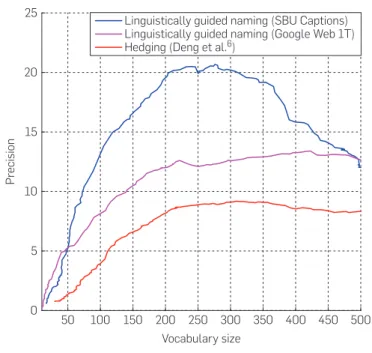
hedging to output the top K synsets based on their scoring function. Here, the working vocabulary is the unique set of predicted labels output for each method on this test set. Results demonstrate (Figure 5) that under different param-eter settings we consistently obtain much higher levels of precision for predicting entry-level categories than hedg-ing.6 We also obtain an additional gain in performance over
our previous work20 by incorporating dataset-specific text-
statistics from the SBU Captioned Dataset rather than the more generic Google Web 1T corpus.
5.2. Visually guided naming
In the previous section, we rely on WordNet structure to compute estimates of image content, especially for inter-nal nodes. However, this is not always a good measure of content prediction because: (1) The WordNet hierarchy doesn’t encode knowledge about some semantic relation-ships between objects (i.e., functional or contextual rela-tionships), (2) Even with the vast coverage of 7404 ImageNet leaf nodes we are missing models for many potentially important entry-level categories that are not at the leaf level.
As one alternative, we can directly train models for entry-level categories from data where people have provided entry-level labels—in the form of nouns present in visually descriptive image captions. We postulate that these nouns represent examples of entry-level labels because they have been naturally annotated by people to describe what is pres-ent in an image. For this task, we leverage the SBU Captioned Photo Dataset21 which contains 1 million captioned images.
We transform this dataset into a set D = {X(i), Y(i) |X(i)∈ X, Y(i)∈ Y},
where X = [0−1]s is a vector of estimates of visual content for
s = 7404 ImageNet leaf node categories and Y = [0, 1]d is a set of binary output labels for d target categories. Input con-tent estimates are provided by the deep learning based SVM predictions (described in Section 3).
For training our d target categories, we obtain labels Y from the million captions by running a POS-tagger1 and
defining Y( j ) = {y
ij} such that:
(6)
The POS-tagger helps clean up some word sense ambigu-ity due to polysemy, by only selecting those instances where a word is used as a noun. The number of target categories, d, is determined experimentally from data by learning models for the most frequent nouns in this dataset. This provides us with a target vocabulary that is both likely to contain entry-level categories (because we expect entry-level category nouns to com-monly occur in our visual descriptions) and to contain suffi-cient images for training effective recognition models. We use up to 10,000 images for training each model. Since we are using human labels from real-world data, the frequency of words in our target vocabulary follows a power-law distribution. Hence we only have a very large amount of training data for a few most commonly occurring noun concepts. Specifically, we learn linear SVMs followed by Platt scaling for each of our tar-get concepts. We keep d = 1169 of the best performing models. Our scoring function fsvm for a target concept υi is then:
(7)
where θi are the model parameters for predicting concept υi, Figure 5. Relationship between average precision agreement and working vocabulary size (on a set of 1000 images) for the hedging method (red) and our Linguistically guided naming method using text statistics from the generic Google Web 1T dataset (magenta) and from the SBU Caption Dataset (Section 5.1). We use K = 5 to generate this plot and a random set of 1000 images from the SBU Captioned Dataset.
50 100 150 200 250 300 350 400 450 500 0
5 10 15 20 25
Vocabulary size
Precision
We show sample results from each of our methods to learn concept translations in Table 1. In some cases linguistics- based translation fails. For example, whinchat (a type of bird) translates to “chat” most likely because of the inflated counts for the most common use of “chat.” Our visual-based translation fails when it learns to weight context words highly, for example “snorkeling” →
“water,” or “African bee” → “flower” even when we try to account for common context words using TFIDF. Finally, even humans are not always correct, for example “Rhea Americana” looks like an ostrich, but is not taxonomi-cally one. Even for categories like “marmot” most people named it “squirrel.” Overall, our language-based trans-lation (Section 4.1) agrees 37% of the time with human supplied translations and the visual-based translation (Section 4.2) agrees 33% of the time, indicating that translation learning is a non-trivial task. This experiment expands on previous studies in psychology.13, 23 Cheap
and easy online crowdsourcing enables us to gather these labels for a much larger set of (500) concepts than previous experiments and to learn generalizations for a substantially larger set of ImageNet synsets.
6.2. Evaluating image entry-level predictions
We measure the accuracy of our proposed entry-level cat-egory image prediction methods by evaluating how well we can predict nouns freely associated with images by users on Amazon Mechanical Turk. Results are evaluated on a test set containing 1000 images selected at random from the million image dataset. We additionally collect annota-tions for another 2000 images so that we can tune trade-off parameters in our models. This test set is completely disjoint from the sets of images used for learning the pre-trained visual models. For each image, we instruct three users on MTurk to write down any nouns that are relevant to the image content. Because these annotations are free associations we observe a large and varied set with 3610 distinct nouns total in our evaluation sets. This makes noun prediction extremely challenging!
(8)
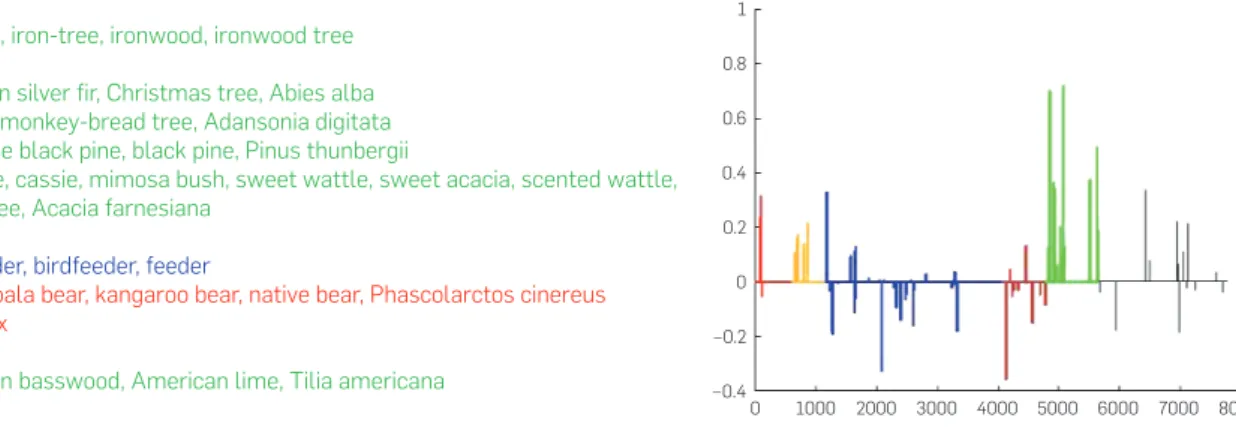
We learn the parameters θi by minimizing the squared hinge-loss with 1 regularization (Equation 8). The latter provides a natural way of modeling the relationships between the input and output label spaces that encourages sparseness (exam-ples in Figure 6). We find c = 0.01 to yield good results for our problem and use this value for training all individual models.
One of the drawbacks of using the ImageNet hierarchy to aggregate estimates of visual concepts (Section 5.1) is that it ignores more complex relationships between concepts. Here, our data-driven approach to the problem implicitly discovers these relationships. For instance a concept like tree has co-occurrence relationships with various types of birds, and other animals that live on trees (see Figure 6).
Given this large dataset of images with noisy visual predictions and text labels, we manage to learn quite good predictors of high-level content, even for categories with rela-tively high intra-class variation (e.g., girl, boy, market, house).
6. EXPERIMENTAL EVALUATION
We evaluate results on our two proposed naming tasks— learning translations from encyclopedic concepts to entry-level concepts (Section 6.1), and predicting entry-entry-level con cepts for objects in images (Section 6.2).
6.1. Evaluating translations
We use Amazon Mechanical Turk to crowd source trans-lations of ImageNet synsets into entry-level categories D = {xi, yi | xi is a leaf node, yi is a word}. Our experiments present users with a 2 × 5 array of images sampled from an ImageNet synset, xi, and users are asked to provide a label, yi, for the depicted concept. Results are obtained for 500 ImageNet synsets and aggregated across 8 users per task. We found agreement (measured as at least 3 of 8 users agree-ing) among users for 447 of the 500 concepts, indicating that even though there are many potential labels for each synset (e.g., Sarcophaga carnaria could conceivably be labeled as fly,
Figure 6. Entry-level category tree with its corresponding top weighted leaf node features after training an SVM on our noisy data, and a visualization of weights grouped by an arbitrary categorization of leaf nodes. Vegetation (green), birds (orange), instruments (blue), structures (brown), mammals (red), and others (black).
tree
0 –0.4 –0.2 0 0.2 0.4 0.6 0.8 1
1000 2000 3000 4000 5000 6000 7000 8000
iron tree, iron-tree, ironwood, ironwood tree snag
European silver fir, Christmas tree, Abies alba baobab, monkey-bread tree, Adansonia digitata Japanese black pine, black pine, Pinus thunbergii
huisache, cassie, mimosa bush, sweet wattle, sweet acacia, scented wattle, flame tree, Acacia farnesiana
feeder
bird feeder, birdfeeder, feeder
koala, koala bear, kangaroo bear, native bear, Phascolarctos cinereus flying fox
damask
research highlights
For evaluation, we measure how well we can predict all nouns associated with an image by Turkers (Figure 7a) and how well we can predict the nouns commonly associated by Turkers (assigned by at least two of three Turkers, Figure 7b). For reference we compute the precision of one human annotator against the other two and found that on our test set humans were able to predict what the previous anno-tators labeled with 0.35 precision when compared to the agreed set of nouns by Turkers.
Results show precision and recall for prediction on our test set, comparing: leaf node classification performance (flat classifier), the outputs of “hedging,”6 and our proposed
entry-level category predictors (Linguistically guided, Section 5.1, and Visually guided, Section 5.2). Performance on the test set is admirable for this challenging task. On the two datasets we find the Visually guided naming model to perform better (Section 5.2) than the Linguistically guided naming (Section 5.1). In addition, we significantly out-perform both leaf node classification and the “hedging”
technique.6 We show an image with sample output from our
methods at K = 5 in Figure 8.
7. CONCLUSION
We have explored models for mapping encyclopedic concepts to entry-level concepts, and for predicting natural names for objects depicted in images. Results indicate that our inferred concept translations are meaningful and that our models provide a first step toward predicting entry-level cat-egories—the nouns people use to name objects—depicted in images. These methods could be helpful for many different end-user applications that require recognition outputs that are useful for human consumption, including tasks related to description generation and image retrieval from complex text queries.
Acknowledgments
This work was partially supported by NSF Career Award #1444234 and NSF Award #1445409.
Figure 7. Precision-recall curve for different entry-level prediction methods when using the top K categorical predictions for K = 1, 3, 5, 10, 15, 20, 50. (a) An evaluation using the union of all human labels as ground truth and (b) using only the set of labels where at least two users agreed.
0 0.05 0.1 0.15 0.2 0.25 0.3 0.35 0.4 0.45 0.5 0
0.05 0.1 0.15 0.2 0.25 0.3 0.35 0.4 0.45 0.5 0.55 0.6
Recall
Precision
Visually guided naming Linguistically guided naming Hedging (Deng et al.6)
Flat classifiers
(a)
0 0.05 0.1 0.15 0.2 0.25 0.3 0.35 0.4 0.45 0.5 0.55 0.6 0.65 0.7 0
0.05 0.1 0.15 0.2 0.25 0.3 0.35 0.4 0.45 0.5
Recall
Precision
Visually guided naming Linguistically guided naming Hedging (Deng et al.6)
Flat classifiers
(b)
Figure 8. Category predictions for an example input image for a large-scale categorization system and our translated outputs using linguistically and visually guided models. The first column contains nouns associated with the image by people. We highlight in green the predicted nouns that were also mentioned by people. Note that oast is a type of farm building for drying hops and a dacha is a type of Russian farm building.
Input image
Human categorization (crowdsourcing)
Large-scale categorization system
Linguistically guided naming
(our work)
Visually guided naming (our work)
barn building fence house tree yard
corncrib oast farmhouse log cabin dacha
building house home tent tree
16. Kuznetsova, P., Ordonez, V., Berg, A., Berg, T.L., Choi, Y. Collective generation of natural image descriptions. In Association for Computational Linguistics (ACL), 2012. 17. Kuznetsova, P., Ordonez, V., Berg, T.,
Choi, Y. Treetalk: Composition and compression of trees for image descriptions. Trans. Assoc. Comput. Linguist. 2, 1 (2014), 351–362. 18. Le, Q., Ranzato, M., Monga, R., Devin, M.,
Chen, K., Corrado, G., Dean, J., Ng, A. Building high-level features using large scale unsupervised learning. In
Proceedings of the 29th International Conference on Machine Learning (ICML12), John Langford and Joelle Pineau, eds. (Edinburgh, Scotland, GB, July 2012), Omnipress, New York, NY, USA, 81–88.
19. Mitchell, M., Han, X., Dodge, J., Mensch, A., Goyal, A., Berg, A., Yamaguchi, K., Berg, T., Stratos, K., Daumé, H. III. Midge: Generating image descriptions from computer vision detections. In
Proceedings of the 13th Conference of the European Chapter of the Association for Computational Linguistics (April 2012), Association for Computational
In 2013 IEEE International Conference on Computer Vision (ICCV) (Dec 2013), 2768–2775.
21. Ordonez, V., Kulkarni, G., Berg, T.L. Im2text: Describing images using 1 million captioned photographs. In Advances in Neural Information Processing Systems 24, J. Shawe-Taylor, R.S. Zemel, P.L. Bartlett, F. Pereira, and K.Q. Weinberger, eds. (2011), Curran Associates, Inc., 1143–1151. 22. Platt, J.C. Probabilistic outputs
for support vector machines and comparisons to regularized likelihood methods. In Advances in Large Margin Classifiers (1999), MIT Press, 61–74. 23. Rosch, E. Principles of categorization. In
Cognition and Categorization, E. Rosch and B.B. Lloyd, eds. (1978), 27–48. 24. Simonyan, K., Zisserman, A. Very deep
convolutional networks for large-scale image recognition, Sept. 2014. arXiv preprint arXiv:1409.1556. 25. Szegedy, C., Liu, W., Jia, Y., Sermanet, P.,
Reed, S., Anguelov, D., Erhan, D., Vanhoucke, V., Rabinovich, A. Going deeper with convolutions, Sept. 2014. arXiv preprint arXiv:1409.4842.
COLING/ACL 2006 Interactive Presentation Sessions (July 2006). Association for Computational Linguistics, Sydney, Australia, 69–72. 2. Brants, T., Franz, A. Web 1t 5-gram
version 1. In Linguistic Data Consortium (LDC) (2006), Linguistic Data Consortium, Philadelphia. 3. Dean, T., Ruzon, M.A., Segal, M., Shlens,
J., Vijayanarasimhan, S., Yagnik, J. Fast, accurate detection of 100,000 object classes on a single machine. In 2013 IEEE Conference on Computer Vision and Pattern Recognition (CVPR) (June 2013), 18141–821.
4. Deng, J., Berg, A.C., Li, K., Li, F.-F. What does classifying more than 10,000 image categories tell us? In
European Conference on Computer Vision (ECCV), Daniilidis, Kostas and Maragos, Petros and Paragios, Nikos, eds. Volume 6315 of Lecture Notes in Computer Science (2010), Springer, Berlin, Heidelberg, 71–84.
5. Deng, J., Dong, W., Socher, R., Li, L.-J., Li, K., Fei-Fei, L. ImageNet: A large-scale hierarchical image database. In IEEE Conference on Computer Vision and Pattern Recognition (CVPR), 2009 (June 2009), 248–255. 6. Deng, J., Krause, J., Berg, A.C.,
Fei-Fei, L. Hedging your bets: Optimizing accuracy-specificity trade-offs in large scale visual recognition. In
IEEE Conference on Computer Vision and Pattern Recognition (CVPR), 2012 (June 2012), 3450–3457. 7. Donahue, J., Jia, Y., Vinyals, O., Hoffman,
J., Zhang, N., Tzeng, E., Darrell, T. Decaf: A deep convolutional activation feature
Young, P., Rashtchian, C., Hockenmaier, J., Forsyth, D. Every picture tells a story: Generating sentences for images. In European Conference on Computer Vision (ECCV), Daniilidis, Kostas and Maragos, Petros and Paragios, Nikos, eds. Volume 6314 of Lecture Notes in Computer Science (2010), Springer, Berlin, Heidelberg, 15–29. 9. Fellbaum, C., ed. WordNet: An
Electronic Lexical Database. MIT Press, Cambridge, Massachusetts, 1998. 10. Felzenszwalb, P., Girshick, R., McAllester,
D., Ramanan, D. Object detection with discriminatively trained part-based models. IEEETrans. Pattern Anal. Mach. Intell. 32, 9 (Sept 2010), 1627–1645. 11. Hodosh, M., Young, P., Hockenmaier, J.
Framing image description as a ranking task: Data, models and evaluation metrics. J. Artif. Int. Res.
47, 1 (May 2013), 853–899. 12. Jia, Y. Caffe: An open source convolutional
architecture for fast feature embedding, 2013. http://caffe.berkeleyvision.org/. 13. Jolicoeur, P., Gluck, M.A., Kosslyn, S.M.
Pictures and names: Making the connection. cognitive psychology. Cogn. Psychol. 16, (1984), 243–275, 1984. 14. Krizhevsky, A., Sutskever, I., Hinton, G.
Imagenet classification with deep convolutional neural networks. In
Advances in Neural Information Processing Systems 25, F. Pereira and C.J.C. Burges and L. Bottou and K.Q. Weinberger, eds. (2012), Curran Associates, Inc., 1097–1105. 15. Kulkarni, G., Premraj, V., Ordonez, V.,
Dhar, S., Li, S., Choi, Y., Berg, A., Copyright held by authors. Publication rights licensed to ACM. $15.00.
Vicente Ordonez ([email protected]), Allen Institute for Artificial Intelligence, Seattle, WA.
Wei Liu, Alexander C. Berg, and Tamara L. Berg ({wliu, aberg, tlberg}@cs.unc.edu), Department of Computer Science, University of North Carolina at Chapel Hill, NC.
Jia Deng ([email protected]), Department of Electrical Engineering and Computer Science, University of Michigan, Ann Arbor, MI.
Yejin Choi ([email protected]), Department of Computer Science and Engineering, University of Washington, Seattle, WA.