Animation, Simulation, and Control of Soft
Characters using Layered Representations and
Simplified Physics-based Methods
Nico Galoppo
A dissertation submitted to the faculty of the University of North Carolina at Chapel Hill in partial fulfillment of the requirements for the degree of Doctor of Philosophy in the Department of Computer Science.
Chapel Hill 2008
Approved by:
Ming C. Lin, Advisor
Miguel A. Otaduy, Reader
Dinesh Manocha, Reader
Markus Gross, Committee Member
c
2008
Nico Galoppo
Abstract
Nico Galoppo: Animation, Simulation, and Control of Soft Characters using Layered Representations and Simplified Physics-based Methods.
(Under the direction of Ming C. Lin.)
Realistic behavior of computer generated characters is key to bringing virtual environ-ments, computer games, and other interactive applications to life. The plausibility of a virtual scene is strongly influenced by the way objects move around and interact with each other. Traditionally, actions are limited to motion capture driven or pre-scripted motion of the characters. Physics enhance the sense of realism: physical simulation is required to make objects act as expected in real life. To make gaming and virtual environments truly immersive, it is crucial to simulate the response of characters to collisions and to produce secondary effects such as skin wrinkling and muscle bulging. Unfortunately, existing techniques cannot generally achieve these effects in real time, do not address the coupled response of a character’s skeleton and skin to collisions nor do they support artistic control.
In this dissertation, I present interactive algorithms that enable physical simulation of deformable characters with high surface detail and support for intuitive deformation control. I propose a novel unified framework for real-time modeling of soft objects with skeletal deformations and surface deformation due to contact, and their interplay for object surfaces with up to tens of thousands of degrees of freedom. I make use of
Acknowledgments
If someone would have told me six years ago that living in North Carolina was going to make a significant change in my life, I would have frowned at first, then I would have needed someone to point out the state on a map, and finally I would have declared that person crazy. But truth be told, the department of Computer Science at the University of North Carolina in Chapel Hill has been a wonderful place to work. Sitterson Hall is filled with friendly and always helpful faculty, staff and fellow students. There are too many too mention, really; but I am thankful for the supportive and stimulative environment that each and every one of them has provided.
I’d like to thank my advisor, Ming Lin for her guidance and for promoting my work at every possible occasion. It really is Ming’s accomplishment that so many people know about my research. I am also grateful to to my committee members Miguel Otaduy, Markus Gross, Dinesh Manocha and Anselmo Lastra for their continuing support, tech-nical guidance, and two incredible summers of research in Z¨urich. The work in this dissertation was published in various papers that would not have been possible without the help of my collaborators Sean Curtis, Paul Mecklenburg, Will Moss, Jason Sewall and Serhat Tekin.
town or out of town: it did not matter, because it is the time with great friends that has made these events always memorable. Miguel, even though you weren’t in North Carolina, I always had the feeling that you were. I will always cherish the moments we had in Switzerland; be it while drinking, chatting, partying in the streets of Z¨urich, or hiking through the Swiss Alps! Jur, Lara, Kat, Chris, Marc, Luv, Monika, Simona, and all the people in the lab in Z¨urich: you are the best friends anyone can imagine.
I would not be who I am now and I would not be where I am now, without the influence of my parents. You have always given me love and support, unconditionally, and no matter how far apart we are. The feeling that I can always depend on you is what brought me this far. Erika en Karolien, my two little sisters, I miss being closer to you. You have probably been the biggest influence on my personality, and I’ve always been able to confide in you!
Table of Contents
List of Tables . . . xii
List of Figures . . . xiii
List of Abbreviations . . . xx
1 Introduction . . . 1
1.1 Deformable Simulation in Computer Graphics . . . 2
1.1.1 Terminology: What is Deformable Simulation? . . . 3
1.1.2 Applications . . . 8
1.1.3 Challenges . . . 12
1.2 Thesis . . . 15
1.3 Main Results . . . 16
1.3.1 Layered Models for Soft-body Simulation . . . 17
1.3.2 Pose-space Skin Dynamics . . . 18
1.3.3 Parallelization and Physically-based Simplification . . . 19
1.3.4 Two-stage Hierarchical Collision Queries . . . 22
1.3.5 Fast Contact Response for Soft Articulated Characters . . . 23
1.3.6 Control of Deformations with Dynamic Morph Targets . . . 24
1.4 Organization . . . 26
2 Related Work . . . 27
2.1 Simulation of Deformable Bodies . . . 27
2.1.2 Finite Element Method . . . 29
2.1.3 Reduced Models . . . 33
2.1.4 Surface Oriented Methods . . . 35
2.1.5 Layered Deformable Models . . . 36
2.1.6 Regular Grids and Texture-based Approaches . . . 37
2.2 Character Animation and Simulation . . . 38
2.2.1 Procedural Methods . . . 38
2.2.2 Example-based Methods . . . 40
2.2.3 Physically-based Methods . . . 41
2.3 Contact Handling . . . 42
2.3.1 Collision Detection . . . 42
2.3.2 Contact Response . . . 45
2.4 Control of Deformations . . . 47
2.4.1 Data-driven methods . . . 47
2.4.2 Kinematic methods . . . 47
2.4.3 Combined methods . . . 48
2.4.4 Physically-based methods . . . 48
3 Soft Body Simulation with Dynamic Deformation Textures . . . . 51
3.1 Dynamic Deformation Textures . . . 52
3.1.1 Parameterization of Layered Deformable Objects . . . 53
3.1.2 Discretization and Generalized Coordinates . . . 54
3.2 Layered Dynamic Deformations . . . 56
3.2.1 Equations of Motion . . . 56
3.2.2 Efficient Decoupled Implicit Integration . . . 58
3.4 Contact Resolution . . . 62
3.4.1 Efficient Decoupled Contact Resolution . . . 63
3.5 Algorithm and Parallel Implementation . . . 65
3.5.1 Dynamic Deformation Textures . . . 67
3.5.2 Basic Rendering Blocks . . . 69
3.5.3 Simulation of Surface Deformations . . . 71
3.5.4 Texture-Based Collision Detection . . . 74
3.5.5 Rendering . . . 77
3.6 Benchmarks . . . 78
3.7 Comparisons and Discussion . . . 81
3.8 Advantages and Summary . . . 83
3.9 Limitations and Future Work . . . 84
4 Articulated Soft Character Simulation with Fast Contact Handling 85 4.1 Layered Articulated Soft Characters . . . 87
4.1.1 Pose-Space Deformation . . . 87
4.1.2 Discretization and Meshing . . . 88
4.2 Layered Dynamics with Contact Constraints . . . 90
4.2.1 Coupled Layered Dynamics in Free Motion . . . 91
4.2.2 Joint Constraints . . . 93
4.2.3 Contact Constraints . . . 94
4.3 Condensed Solution of Constraints . . . 96
4.3.1 Condensed Skeleton Dynamics . . . 97
4.3.2 Solving Collision-Free Velocities . . . 98
4.3.3 Hierarchical Pruning and Collision Queries . . . 99
4.3.5 Solving Collision Response . . . 102
4.3.6 Run-time Algorithm . . . 103
4.4 Results and Discussion . . . 103
4.4.1 Benchmarks . . . 103
4.4.2 Comparisons and Limitations . . . 106
4.5 Advantages and Summary . . . 108
4.6 Limitations and Future Work . . . 109
5 Deformation Control with Dynamic Morph Targets . . . 111
5.1 Method . . . 112
5.1.1 Dynamic Morph Targets . . . 112
5.1.2 Pose-dependent Elastic Model . . . 114
5.1.3 Interpolating Force Polynomials in Pose Space . . . 117
5.1.4 Reduced Equations of Motion . . . 119
5.2 Model Construction and Kinematic Constraints . . . 121
5.3 Reduced Modal Subspace Construction . . . 122
5.4 Results . . . 125
5.5 Advantages and Summary . . . 131
5.6 Limitations and Future Work . . . 132
6 Conclusion . . . 135
6.1 Summary of Results . . . 135
6.2 Future Work . . . 138
6.2.1 Limitations . . . 138
6.2.2 Relaxing Design Assumptions . . . 140
6.2.3 Beyond Current Applications . . . 142
A Kinematic Relationships . . . 145
A.1 Non-articulated (Single-Core) Objects . . . 145
A.2 Articulated Characters . . . 146
B Lagrangian Motion Equations with Finite Element Method . . . . 148
B.1 Lagrangian Formulation . . . 148
B.2 Elastic Energy . . . 148
B.3 Motion Equations . . . 149
B.4 External Forces . . . 150
B.5 Mass Matrix . . . 151
B.5.1 Quadratic Velocity Vector . . . 151
C Joint Compliance for Hinge Joint . . . 152
D Transformation of Multivariate Cubic Polynomials . . . 154
E Code Snippets . . . 156
List of Tables
3.1 Models and Statistics.. . . 79 3.2 Approximate Performance Data Benchmark. Extrapolated
perfor-mance data from [BNC96], [ZC99], [PPG04], [MG04] shown with mine,
D2T. . . 81
4.1 Benchmark Statistics. The soft characters for the benchmarks are a deer model with three different skin resolutions, a snake model, and tubes with different numbers of bones. All timings (in msec.) are averages over the course of a simulation. The last two columns indicate the average time per frame in (1) non-colliding and (2) colliding situations. . . 104
List of Figures
1.1 Comparison of linear blend skinning to our approach. Left: The fish touches the body of the snake, creating global response and skin deformations. Right: We turn off local skin deformations to show the importance of handling both global and surface response. Notice the highlighted interpenetrations, clearly visible through the fish’s mouth. . . 5 1.2 Animation and Simulation systems. On the left, the diagram
illus-trates a traditional character animation system. The deformation engine maps skeletal controls (such as joint angles) and abstract controls (such assmile) to the output shape. Animation is achieved by varying the con-trols over time. The diagram on the right illustrates the work of [Cap04]. Instead of a geometric deformation engine, the system is based on a dy-namic elastic simulation. This introduces an explicit time dependence, so the final shape is guided by the input controls, but also varies over time according to the laws of elastic dynamics. . . 6 1.3 Snapshots of deformable dynamics in current game engines,
compared to methods from this thesis. From left to right, de-formable tires with mydynamic deformation textures method (2006, Chap-ter 3), deformable tires in the PhysX engine (2007), deformable torii with the open-source Bullet engine (2008). . . 8 1.4 Snapshots from Pixar’s Ratatouille. Dough rolling effect (top),
requiring shape control in combination with physical deformation simu-lation. Several stages of the egg during the cracking (bottom). The tech-niques in Chapter 5 can be used to achieve deformation control. cDisney / Pixar. All rights reserved. . . 10 1.5 The Co-Me Project. The technologies in this thesis have been
bene-ficial to the development of interactive methods for generalized surgery simulation and training. . . 11 1.6 Deformation Detail. The Shape Matching algorithm [MHTG05], here
1.7 Responsive Contact Handling. The figure shows what can go wrong when contact handling is not responsive for the entire model. On the left, the outer surface layer, drawn with white dots, is prevented from violating the ground plane constraint, but the object as a whole, with the blue inner core layer is not. The figure on the right shows the correct behavior, simulated with my system. . . 14 1.8 Dynamic Morph Targets Pipeline. To support artistic deformation
control, I propose dynamic morph targets (Chapter 5) to complement the traditional animation and simulation pipelines. Dynamic morph targets are created from artist-provided examples (pairs of example shapes and associated skeletal poses) and enhance the runtime dynamic simulation. . 16 1.9 Simulation of Heterogeneous Materials and Examples of
De-tailed Deformations. . . 18 1.10 Interactive Deformation of an Articulated Deer. The deer,
con-sisting of 34 bones and 2 755 deformable surface vertices is being deformed interactively (almost 10 fps on average) by a rigid bird model. The inter-play between small-scale contact deformations and the skeletal contact response is successfully captured. . . 19 1.11 Layered Representation and Collision Detection. From left to
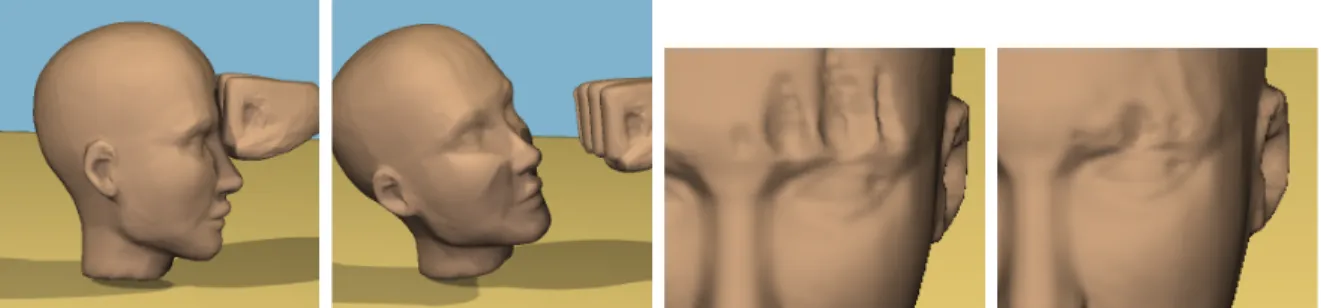
right: Contact between the bird and the deer, with skin deformations on the back of the deer; Proxies used for hierarchical pruning of collision queries, with potentially colliding proxies of the deer highlighted in red; Triangles influenced by the potentially colliding bones (in red) are the only ones passed to the image-based collision detection algorithm; The resulting detail around the contact area. . . 21 1.12 Deformations of a Virtual Head. Left: A fist hits a deformable head
(attached by springs in the neck area), producing both local deformations and global motion. Right: Detail of the deformations produced near the eyebrow by the impact. . . 23 1.13 Skeletal Deformations of a Soft Snake. Simulation sequence with
a fish touching the snake, showing the global deformation of the snake. The last image shows the proxies for collision detection. . . 23
2.2 Stiffness Warping. Linearized elastic forces are only valid for small deformations (left). To solve these artifacts, M¨uller introduces stiffness warping [MDM+02] (right). . . 32 2.3 Local linearization. Capell et al. [CGC+02a] associate each region of
the finite element mesh with the bone of a simple skeleton and then locally linearize the elastic forces in the frame of that bone. . . 33 2.4 Multi-resolution methods. Debunne et al.partition the object in a
non-nested multi-resolution hierarchy of tetrahedral meshes [DDCB01]. . 34 2.5 Modal Reduction. Reduced coordinate methods based on modal
anal-ysis deformations have a low computational cost by describing global de-formations as the combination of a few DoFs. In this figure, the principal modes of deformation of a deformable shell are shown [HSO03]. . . 35 2.6 Surface oriented methods. Boundary Element Methods [JP99] have
been proposed for obtaining elasto-static formulations that reduce the computations to surface nodes. . . 36 2.7 Image-based techniques. The technique illustrated here by Sumner et
al. [SOH99] animates surface deformations induced by contact, but does not handle global motion effects. . . 37 2.8 DyRT. The technique by James and Pai [JP02], animates deformations
excited by global deformation modes using Dynamic Response Textures. . 38 2.9 Skinning Problems. Linear blend skinning has problems deforming
skin near joints due to collapsing geometry (i.e. pinching). Dual quater-nions have been proposed to address this problem [KCˇZC07]. . . 39 2.10 Constraint-based Contact Handling. Using only a small subset of
the contact points in a constraint-based method accelerates contact han-dling, but limits the resolution of deformations and produces smoothened deformations (see Fig. 2.10). . . 46 2.11 Physically Based Rigging. Capell et al.[CBC+05] use force field
tem-plates to control facial expressions. Here, two torus temtem-plates produce dilation and contraction of the nostrils. . . 48 2.12 Directable Animation of Deformable Objects. Kondoet al.[KKA05]
3.1 Deformable Object Representation. Deformable surface S (52K tri-angles) and core C (252 tritri-angles) of a gear, showing the patch partition-ing of its parameterization. The common color codpartition-ing reflects the map-ping g ◦f−1 :C → S. The dynamic deformation texture T (256×256)
stores the displacement field values on the surface. On the right, 2D schematic figure showing a slice of the tetrahedral meshing of the de-formable layer. The gear contains 28K simulation nodes on the surface and 161K tetrahedra, allowing the simulation of highly detailed deforma-tions. . . 53 3.2 Simulation of Heterogeneous Materials. Efficient decoupled implicit
integration enables fast simulation of a heterogeneous cylinder. Notice the large indentations and the resulting large contact area when the soft side collides with the ridged plane. . . 57 3.3 Texture-Based Collision Detection Process. Center: A sphere S
collides with a textured terrain. Left: Contact plane Dfor texture-based collision detection, and mappingφ:D→S. The contact plane shows the penetration depth. Right: Dynamic deformation textureT, and mapping g : T → S. The penetration depth is projected from D to T, and is available for collision response. . . 60 3.4 GPU Algorithm Overview.. . . 67 3.5 D2T Simulation Algorithm . . . 68 3.6 Dynamic deformation texture representation and implicit tesselation. . . 69 3.7 Rendering Blocks. . . 70 3.8 A texel in the D2T defines a simulation node. The figure shows its
neigh-borhood in the FEM mesh. Its 6 neighbors and itself give rise to 7 non-zero blocks per block row in the stiffness matrix, as shown in Fig. 3.9. . . 72 3.9 Sparse matrix multiplies on the GPU using D2T representation. The
ma-trixAhas 7 non-zero blocks per block row (left), which can be represented by 21 RGB textures that use the D2T atlas mapping (right). . . 73 3.10 Schematic overview of the pipeline of my GPU-based collision detection
3.11 Left: The contact camera is set up with an orthogonal projection per-pendicular to the contact plane D. Right: Multiple surface points may map to the same location on D. When texels in the D2T are tagged as colliding, a check is required which triangle (of the two red triangles) the rasterized fragment belongs to, in order to avoid tagging the green surface point as colliding. . . 76 3.12 Rendering pipeline. Note that the RenderMesh (RM) block utilizes the
vertex stream with normals generated as in Fig. 3.13. . . 77 3.13 Normal Generation block. A normals PBO is generated and then copied
to the normal vertex buffer. . . 78 3.14 Deformations of High-Resolution Geometry. Left: Two deformable
pumpkins are dropped on top of each other. Right: Detail view of the rich deformations produced on the top pumpkin during contact. . . 79 3.15 Deformations of High-Resolution Geometry. A dropped cylinder
produces rich dynamic deformations on the ridges of a gear. . . 80 3.16 Deformable Objects Roll and Collide in the Playground. . . 80 3.17 Deformations of a Virtual Head. Top: A fist hits a deformable head
(attached by springs in the neck area), producing both local deformations and global motion. Middle: Detail of the deformations produced near the eyebrow by the impact. Bottom: A softer head is dropped on the floor, resulting in larger deformations. . . 82
4.1 Interactive Deformation of an Articulated Deer. The deer, con-sisting of 34 bones and 2 755 deformable surface vertices is being deformed interactively (almost 10 fps on average) by a rigid bird model. The inter-play between small-scale contact deformations and the skeletal contact re-sponse is successfully captured (below). The interactivity of my approach is demonstrated on the top left picture, where the bird is controlled in real time by a 3-DoF haptic controller. . . 86 4.2 Pose space deformation. Elastic deformations us of the skin are
4.5 Contact between Deformable Tubes with Moving Constraints.
The tubes consist of 3 links each and collide with each other in tangled configurations. The described algorithm can handle such situations seam-lessly with a combination of local deformations and bone motion at 20 fps. . . 104 4.6 Skeletal Deformations of a Soft Snake. . . 105 4.7 Contact Constraints. Left column: The fish touches the body of the
snake, creating global response and skin deformations. Right column: Lo-cal skin deformations are turned off to show the importance of handling both global and surface response. Notice the highlighted interpenetra-tions, clearly visible through the fish’s mouth. . . 107
5.1 Concept of Dynamic Morph Targets: Simple cylinder geometry mimicking an elbow joint with bulging skin, for which two morph targets (out of a total of four) are given in (a). The skin of the bulged morph tar-get was chosen to be stiffer to mimick muscle contraction. On the right, we show runtime snapshots of simulations using our pose-dependent elas-tic model, under influence of idenelas-tical downward forces. (b) was gener-ated with four softmorph targets, whereas (c) has increasingly stiffer
morph targets, to mimic muscle contraction. The dynamic skin behavior is identical for the straight joint (a relaxed muscle), because the elastic properties of the first morph target are identical for (b) and (c). But, for the bent joint, the force clearly causes more skin deformation in (b). This undesirable behavior can be fixed to mimic muscle contraction by making the fourth morph target stiffer, as shown in in (c). This simple example shows a dynamic bulging effect that can only be achieved with dynamic morph targets. . . 114 5.2 When under influence of dynamic events such as jumping from a diving
board or bouncing off a wall, our method using morph targets produces deformations consistent with Herbert’s morph targets defined in (a). The
fat morph target is associated with a crunched pose to mimic a bulging belly (and only for that pose). As shown in (b), the simulation without dynamic morph targets does not show bulging, whereas our method shown in (c) does. . . 123 5.3 Construction of a morph target driven, mass-orthogonal
reduc-tion basis U: For each dynamic morph target i, during LMA the r smallest eigenmodes are selected to construct eigenbases Ui. Mass-PCA combines and compacts the Ui, retaining onlyk most significant modes.
Finally, I explicitly add morph target deformations x0
i to the eigenbasis
5.4 Herbert jumps off on a diving board: Comparison of single (pose-independent) linear elasticity (left column), my method with dynamic morph targets (middle column), and my method with dynamic morph targets and modal reduction applied (right column). When balled up, Herbert’s back (top) and belly (bottom) bulge in correspondence with his morph targets defined in Fig. 5.2. On the bottom left, Herbert’s belly looks very flabby, as if he swallowed a brick. However, Herbert’s ‘fetal pose’ morph target 3 was authored with a stiff belly. My method (bottom right) shows the more desired behavior. . . 127 5.5 Herbert in flight: When under influence of kinematic events such as
flipping and discontinuous velocity changes such as when hitting a wall, my method (right) still produces deformations consistent with Herbert’s morph targets defined in Fig. 5.2. . . 128 5.6 Shoulder Rig Simulation . . . 133 5.7 Chest flex at runtime: On the left, a pose-independent force model
List of Abbreviations
BV . . . Bounding volume
BVH . . . Bounding volume hierarchy
CG . . . Conjugate gradients method
D2T . . . Dynamic deformation texture DMT . . . Dynamic morph target
DoF . . . Degree of Freedom
FEM . . . Finite element method
GJK . . . Gilbert-Johnson-Keerthi algorithm for collision detection GPU . . . Graphics processor unit
LCP . . . Linear complementarity problem LMA . . . Linear modal analysis
PBO . . . Pixel buffer object
PCA . . . Principal component analysis
PCG . . . Preconditioned conjugate gradients method PPU . . . Physics processing unit
PSD . . . Pose-space deformation
RBF . . . Radial basis function
SSD . . . Skeletal-subspace deformation StVK . . . St. Venant-Kirchhoff
VBO . . . Vertex buffer object
Chapter 1
Introduction
Believable animation of deformable, articulated characters is essential to realistic virtual environments, computer games, and other interactive applications. The feeling of being immersed in a virtual experience, such as a game or an animated feature film, is strongly influenced by the way objects move, interact, and react to the environment around them. Although often a tedious task, animators commonly prescribe these actions by animating the bones of a character or by the process of rigging, to set up control of
abstract character traits in time. Smiling or frowning are good examples of such traits. For interactive environments such as games, this approach is not sufficient because the characters have to respond to user-generated or unexpected events in their environment. Many current games resort to simple event-based approaches: most of the action is limited to pre-scripted animations triggered by in-game events. As a result, every enemy that is shot down falls in the same pre-recorded fashion; and very different weapons cause the same damage on every wall. Players are left with a game that looks fine, but lacks the sense of realism and variability necessary to make the experience truly immersive. The addition of physical simulation to virtual scenes increases the sense of realism by making virtual characters behave as expected in real life.
articu-lated objects in the scene. The feature animation industry has also turned to rigid body simulation to remove some of the burden of hand-animating certain actions, from piling food items to chopping vegetables [Sha07]. But, to make the virtual experience truly immersive, it is important to simulate collisions of deformable objects and to generate secondary skin effects. Physical simulation of deformable material allows for the auto-matic synthesis of effects that are difficult to animate or script otherwise, such as the sagging and vibration of tissue caused by gravity and locomotion, skin wrinkling and muscle bulging. Ideally, the animator should be free from designing the motion that is a direct result of physical laws, and concentrate only on the motion that expresses the intent or emotional state of the characters [Cap04].
The scope of this thesis is real-time simulation of soft articulated characters with secondary skin dynamics. I present a framework that supports coupled skeletal and skin contact response, as well as direct shape and tissue behavior control.
1.1
Deformable Simulation in Computer Graphics
Animation of skin and muscular deformations of human characters and other living creatures has long been one of the most important applications of deformable modeling in computer graphics, notably in feature animation and more recently in increasingly realistic computer games and interactive medical and training applications. Realistic deformation is a complex and subtle phenomenon due to the tightly coupled interplay of bones and musculature governing the deformations.
1.1.1
Terminology: What is Deformable Simulation?
At the basis of this work lies the computer generation of motion and deformation ofsoft, articulated characters. While human simulation is certainly one of the major application areas of this work, I will use the termcharacter in a broader sense, referring to any object that undergoes events, motion or deformation in a scene. Examples of such objects can be found across many application fields including molecular dynamics, where molecules undergo docking; robotics and machine assembly, where assembled parts are fit together with moving robotic arms; and computer graphics for video games and feature films, where dynamic objects range from toys and props in a scene, to cartoon-like animals and life-like human characters with realistically deforming skin. A character is said to be
articulated when it has a skeletal structure of bones connected by joints. Most robotic parts and animal-like and human-like creatures with limbs fall into this category. The skeletal motion of an articulated character is primarily governed by the joint constraints which keep the bones together.
While many works have focused on kinematics, inverse kinematics, dynamic simula-tion [Bar96] and control [WTF06] of articulated rigid bodies, this work concentrates on
soft bodies. The term soft usually refers to the fact that the outer surface of an object is deformable, usually because there is some underlying layer of elastic tissue, as with human skin. The terms soft and deformable are very tightly connected, but not equiv-alent. An articulated rigid body (e.g. a robot) is deformable because it can undergo some skeletal deformation along its joints (also called skeletal motion). However, it is not soft, because its surface is infinitely stiff.
shape output. In the case of a human animator, these degrees of freedom can be con-trolled in time through a user interface, for example with free-form deformation tech-niques [Bar84, SP86, Coq90]. The mapping then turns those controls into frames of animation of the final shape. It allows the animator to work much more efficiently, because he can work at a much higher level of abstraction. In the case of a computer simulation, these degrees of freedom could be the modal coordinates of a modal reduc-tion approach [PW89, JP02, HSO03]. The laws of physics turn the modal coordinates into the final shape output. Due to the compactness of the mapping, the variation in possible final shapes is typically limited. This means thatglobal deformation modessuch as bending, twisting and shearing are usually supported, but not highly detailed local
deformations on the surface. In Chapter 3, I present a method that targets fast simu-lation of highly detailed deformations of the surface, enabling effects such as wrinkling
at real-time frame rates. Another example of global deformation is skeletal deforma-tion. Here, the deformation is restricted by the skeletal structure, but the joints allow a limited number degrees of freedom by which an articulated character can deform. As explained later in this section and in Chapter 2, there are many methods available that provide the necessary mapping from skeletal parameters, such as joint angles, to the final shape output.
Animation vs. Simulation There are numerous approaches to generate continuous deformation of a character skin. They can be broadly categorized into two groups: sur-facedeformation models on one side, either algorithmic or data-driven, andskin ortissue
deformation models on the other side, the latter usually physically inspired [LCF00]. In the traditional computer animation pipeline, a common data-driven approach is
Figure 1.1: Comparison of linear blend skinning to our approach. Left: The fish touches the body of the snake, creating global response and skin defor-mations. Right: We turn off local skin deformations to show the importance of handling both global and surface response. Notice the highlighted interpenetra-tions, clearly visible through the fish’s mouth.
each instant in time, the animator does not have to position each vertex of the surface mesh; he only needs to set the values of the control parameters. Once the character has been rigged, shape transformations such as a smiling and frowning can be reused and mixed together through shape interpolation. Unfortunately, the process of rigging is rather complicated and almost impossible to automate. The difficulty is mostly due to the inherent complexity of realistic shape deformation. Changes in the shape of a real character are due to the motion of underlying bones, muscles, tendons, as well as to physical forces. Skeletal-subspace deformation (SSD) [MTLT88], also referred to as linear blend skinning, is another surface deformation model. In this technique, the skin deformation is driven by the pose of the underlying skeleton, and a set of blend weights that associate bone contributions to vertices. Surface contact is difficult to model using traditional skinning techniques because the combination of bone transforms and blend weights completely determine the resulting (deformed) shape (Fig. 1.1).
Alternatively, some computer animation researchers have chosen to use physical laws to simulate the underlying deformable tissue for realistic motion and deformation of a character skin [CHP89, GTT89, BW92, JP99, CGC+02a]. These techniques can also
skeletal controls geometric deformation engine abstract controls shape Inputs
Output controlsskeletal
dynamic elastic simulation abstract controls shape Inputs Output time
Figure 1.2: Animation and Simulation systems. On the left, the diagram il-lustrates a traditional character animation system. The deformation engine maps skeletal controls (such as joint angles) and abstract controls (such as smile) to the output shape. Animation is achieved by varying the controls over time. The diagram on the right illustrates the work of [Cap04]. Instead of a geometric de-formation engine, the system is based on a dynamic elastic simulation. This introduces an explicit time dependence, so the final shape is guided by the input controls, but also varies over time according to the laws of elastic dynamics.
as games, because there is no animator available to respond to the user’s input or to unexpected events in the environment of the character. Physical simulation is also useful for applications where secondary effects are too tedious to animate by hand and should be automatically generated, such as in animated feature films. For these applications, the computer can only respond in a realistic way through automation. Physical simulation is a good example of a model that makes such automation possible. The physical equations are encoded by a programmer, from which the computer can easily generate the appropriate motion. Capell [Cap04] has combined rigged character animation and physical simulation in a unified framework, as is illustrated in Figure 1.2.
Ex-changing accuracy for performance has lead to labeling these methodssimplified physical models. However, the lack of accuracy does not necessarily entail the lack of believable behavior. In deformable simulation for computer graphics, it is often sufficient and sometimes even preferred that a model behaves the way the artist intended, as opposed to exactly in line with physical reality.
Layered Models This work uses a layered representation for soft characters in com-puter animation, as will be elaborated on in Section 1.3.1. The term ‘layered’ simply refers to the fact that multiple deformation models are employed for different parts of a character’s volume, and they are combined through some kind of interface, usually by use of physically inspired forces. For example, Wilhelms [WG97] models several classes of muscles algorithmically with attention to volume conservation; skin is a spring mesh anchored to underlying tissue or bone in appropriate areas. In this dissertation, the layered representation is essentially an integration of articulated body dynamics and skinning with displacement corrections. One of the challenges for modeling soft ar-ticulated characters that has not been well investigated previously is the interplay of skeletal motion and surface contact and the resulting two-way coupling effects. Efficient simulation of such interplay is a key design goal of my simulation framework.
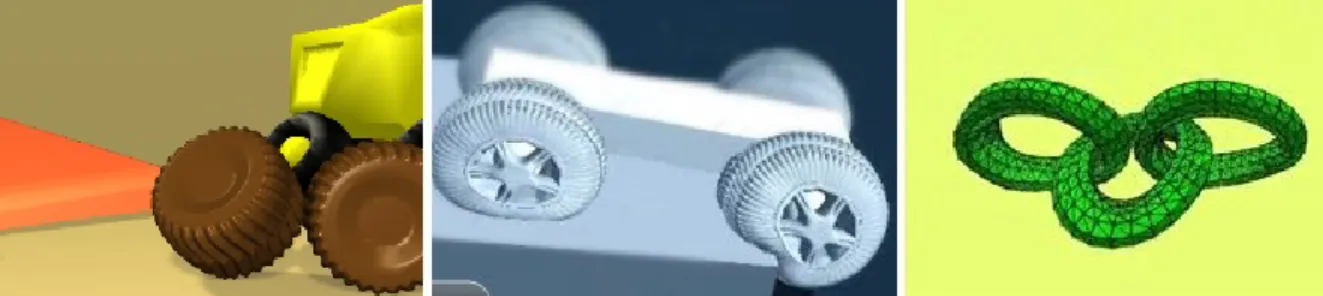
Figure 1.3: Snapshots of deformable dynamics in current game engines, compared to methods from this thesis. From left to right, deformable tires with mydynamic deformation textures method (2006, Chapter 3), deformable tires in the PhysX engine (2007), deformable torii with the open-source Bullet engine (2008).
forces. While methods that control global deformation modes have been around for a while [WW90], providing control of sculpted deformations for simulation of deformable models has only recently gained attention in graphics research. The work in this dis-sertation seeks to bridge the gap between geometric example-based methods that have explicit shape control and physically based approaches. This is the topic of Chapter 5.
1.1.2
Applications
engines, such as the open-source Bullet [Bul08], Intel’s Havok [Hav08] and NVIDIA’s PhysX [Phy08]. The method that I propose in Chapter 3 actually predates some of the support for deformable bodies in the physics engines illustrated in Fig. 1.3. In addition, it is clear that simulation of physical phenomena for games has become a hot topic, judging from the emergence of hardware-based solutions that aid in simulating these phenomena in real-time. For example, GPUs have recently been used to run a 3D Navier-Stokes fluid solver on a 128×64×64 grid at 120 to 180 fps, and NVIDIA’s PhysX hardware solution has been applauded in the gaming industry as a crucial component for achieving real-time explosions with dynamically fracturing debris and complex smoke effects. NVIDIA has also recently added support on the PhysX chip for real-time soft body behavior. It is clear that the industry is quickly developing a growing need for smart and efficient algorithms that enable even more realistic effects such as fast soft character interaction or skin wrinkling. Likewise, there has been a radical move towards parallel architectures geared specifically towards the games market, with examples such as Larrabee [SCS+08] and NVIDIA PhysX. The algorithms in Chapters 3 and 4 are specifically geared towards parallel efficiency, and I demonstrate that they map well to such architectures. Luckily, a lot of effort has been put into supporting higher level programming models such as C++ and CUDA [CUD07] for these novel parallel architectures, which simplifies the task of porting the techniques of this dissertation to these platforms.
An Effects Recipe for Rolling a Dough, Cracking an Egg and Pouring a Sauce
Tolga G. Goktekin
Jon Reisch
Darwyn Peachey
Apurva Shah
Pixar Technical Memo #07-06
Pixar Animation Studios
Creating the digital effects for cooking in
Ratatouille
posed a
num-ber of unique challanges. First we had to adopt efficient
meth-ods for simulating a wide variety of material behaviours. Second
we needed to direct our simulations in order to match the
expres-siveness of the character’s animation, e.g. forming specific shapes
while the character pounds a dough. Finally we had to apply
shad-ing to our simulated surfaces which underwent complex
defortions and topological changes. In this sketch we will focus on
ma-terials ranging from elastoplastic solids to viscous liquids and
illus-trate with several shot examples from the film.
Figure 1:
Dough rolling effect (top) and several stages of the egg during the cracking
(bottom). c
!
Disney / Pixar. All rights reserved.
1
Directable Softbodies
In order to simulate a wide range of materials we had to use
differ-ent techniques for differdiffer-ent parts of the solid to liquids spectrum.
Materials that did not undergo any topological changes such as the
dough and the egg were treated as deformable solids. There are
var-ious methods for simulating deformable solids ranging from mass
spring damper (MSD) systems to finite element methods. We chose
MSD systems for their simplicity, efficiency and relative ease of
in-tegrating them into our existing pipeline. The main difference in our
setup compared to standard Maya softbodies is that we first create
a Delaunay tetrahedralization of our input surface and convert the
internal nodes and edges into internal particles and springs
respec-tively. This creates an internal structure for the softbody, resulting
in an unbiased set of springs that cover the volume efficiently. In
the case of two different MSD systems interacting such as the egg
white and yolk we created extra springs between the interior and
exterior surface particles of the objects.
Creating the dough effect presented two main challanges. First the
dough had to collide physically with the characters hand and the
rolling pin, leaving natural looking dents and bumps. Moreover the
dough had to flatten under and buldge in front of the rolling pin.
Second the dough needed to form specific shapes at specific times
based on creative direction.
Interaction with prescribed animation and controlling the shape of
the dough turned out to be conflicting requirements. Changing
the surface directly from one shape to the other using goal forces
response forces were being overwhelmed by the stiff goal forces.
On the other hand relying purely on the simulation did get the
in-teraction right but the results didn’t go through any of the shapes
we were creatively after. In order to solve these problems we only
directed the internal particles of the dough to match the ”internal”
goal shapes. This made the surface move freely (still connected to
internal nodes with springs) and respond to collisions and changes
to the momentum naturally; and thus produced believable
interac-tion with colliders and other secondary mointerac-tions. Plastic behaviour
is achieved by resetting the rest configuration of the dough to the
goal shapes as it went through them.
We didn’t have to specifically direct the shapes during the egg
crack. However we had to constrain the egg white at several points
and animate the constraints to encourage the natural draping
be-haviour.
2
Viscous Fluids
For viscous liquids such as our sauces and soups we chose a grid
based Eulerian fluid simulator with a levelset surface tracking or a
particle based fluid simulator. To control the timing, the amount and
the shape of our liquid simulations we animateed the gravity, added
sources and sinks and used lattice deformers. We also used extra
Maya particles (either as blobs or as input to our surface extractor)
to augment the regions where we ran out of resolution.
The shading applied to our sauces and soups had multiple
com-ponents such as depth tinting, translucency, subsurface scattering
and layered textures. In order to make these work we needed a
parametrization of our surfaces that was spatially and temporally
coherent. However the simulated surfaces were not consistent
be-tween frames and were undergoing topological changes. These
made applying any shaders that relied on a consistent
parametriza-tion over the surface problematic. To solve this problem we first
initialized a set of particles in a band around the surface on a
”ref-erence” frame and stored the initial point (u,v,w) of each particle as
an attribute. Then we advected these particles with the simulated
velocity field. Finally as a post-process, at each frame we tagged
the vertices with these (u,v,w) values using the method in [Shen
et al. 2007]. We used this per vertex (u,v,w) value as a reference
point to the inital surface during shading.
In some of our chunkier sauces we needed to add suspended bits
that flowed with the sauce. Simulating these bits directly with the
liquid as colliders proved to be inefficient due to the their amount
and their relatively small size. Therefore we added them as
ad-vected instanced geometry particles as a post-process.
Figure 2:
Various sauce effects in
Ratatouille
. c
!
Disney / Pixar. All rights reserved.
References
Figure 1.4: Snapshots from Pixar’s Ratatouille. Dough rolling effect (top), requiring shape control in combination with physical deformation simulation. Sev-eral stages of the egg during the cracking (bottom). The techniques in Chapter 5 can be used to achieve deformation control. cDisney / Pixar. All rights reserved.
higher level of abstraction. Furthermore, this dissertation presents methods to include deformable simulation and control in the modeling layer, supporting animators in a number of ways. First, this enables automatic generation of secondary effects of the animated shapes; when a virtual character with a fat belly is animated through the scene, we would expect to see his belly bounce and sway in correlation with changes in momentum caused by the animated path. Physical simulation is a good way to avoid animating this type of effect by hand and to make it more believable. Second, it enables passive deformable objects in the scene to react when in contact or influenced by explicitly animated characters. In Pixar’s animated featureRatatouille, the deformation of a blob of dough being deformed by an animated rolling pin was computed with physical simulation [GRPS07], as was the deformation of an egg yolk when an egg is cracked
Figure 1.5: The Co-Me Project. The technologies in this thesis have been beneficial to the development of interactive methods for generalized surgery sim-ulation and training.
open (Fig. 1.4). Finally, there seems to be a definite need for deformation control in animated features. In Ratatouille, the dough had to flatten under and bulge in front of the rolling pin, and it needed to form specific shapes at specific times based on creative direction [GRPS07]. The techniques presented in Chapter 5 can be used to provide such control, using intuitive animator controls.
Haptics Haptic rendering of forces and torques between interacting objects, also known as 6 degree-of-freedom (DoF) haptics, has been demonstrated to improve task performance in applications such as molecular docking, nanomanipulation, medical training, and mechanical assembly in virtual prototyping [LO08]. Haptic display of complex interaction between two deformable models is considered especially challeng-ing, due to the computational complexity involved in computing contact response and performing proximity queries, including collision detection, separation distance, and pen-etration depth, between two deformable models at force update rates. The algorithms in this thesis focus on interactive deformations with support for contact and hence they apply to the domain of haptic applications. This was briefly investigated in the context of this thesis [GTO+07].
1.1.3
Challenges
One of the key challenges of deformable simulation is to satisfy the conflicting require-ments of real-time interactivity and physical realism. In order to achieve realism, some-times the first requirement is to achieve sufficientdeformation detail, which then means that real-time collision detection becomes a much harder task, and robust contact re-sponse becomes problematic. Finally, marrying complex simulation algorithms with the needs and wishes of animators requires intuitive control methods. In this section, I will briefly elaborate on these sub-challenges.
(a) (b)
Figure 1.6: Deformation Detail. The Shape Matching algorithm [MHTG05], here illustrated on Fig. (a), can simulate hundreds of deformable elements in real time, but many more are required to show detail such as skin indentations sim-ulated with my framework. The face model in Figure (b) has 40,000 deformable surface vertices.
for example deforming tire threads or generating skin indentations as was done by my system in Figure 1.6(b).
Efficient Collision Detection As the complexity of the models goes up, collision detection tends to take up a considerable chunk of computation time in deformable dy-namics systems because any precomputed acceleration data-structure has to be updated while the objects are deforming [TKH+05]. Therefore, a fast collision detection algo-rithm targeted towards dynamic deformation dynamics is essential to obtain a real-time system. Likewise, handling self-collisions is a significant challenge, as they occur com-monly for deforming articulated characters. Collision detection should be very efficient. Ideally, it should be independent of surface resolution.
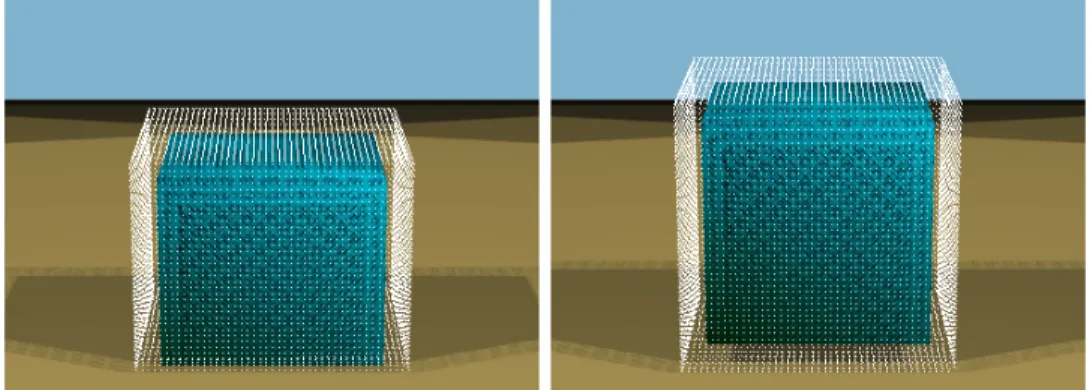
Figure 1.7: Responsive Contact Handling. The figure shows what can go wrong when contact handling is not responsive for the entire model. On the left, the outer surface layer, drawn with white dots, is prevented from violating the ground plane constraint, but the object as a whole, with the blue inner core layer is not. The figure on the right shows the correct behavior, simulated with my system.
influence the global motion of the objects. The overall robustness of a simulation frame-work, such as the one presented here, can only be guaranteed if the contact response algorithm is robust enough to account for these effects simultaneously. The contact han-dling algorithm has to be responsive such that skeletal and global motion are handled simultaneously and naturally with surface deformations. Figure 1.7 shows an example of what can go wrong when contact handling is not responsive for the entire model. With layered model methods, it often happens that the surface layer is prevented from violating the constraint, but the object as a whole is not prevented from doing so.
1.2
Thesis
My thesis is:
Using appropriatelayered representations andsimplified physics-based mod-els, it is possible to generate and control believable articulated soft-body behavior at interactive rates.
In support of this thesis, I present a unified framework for real-time modeling of soft objects with up to tens of thousands of degrees of freedom. This framework complements animated articulated characters with skeletal dynamics and detailed secondary skin effects. My framework also supports combined skeletal and skin contact response, where the coupled nature of (global) skeletal deformations and (local) skin deformations is gracefully captured.
I propose the use oflayered models to reduce the computational complexity. Layered models have been proposed previously, but I introduce novelty on two fronts:
1. The three dimensional deformations in the deformable layer are mapped to a two dimensional domain to reduce complexity even further. A re-parameterized version of this domain onto a regular grid, called dynamic deformation textures
(Chapter 3), is very amenable to parallel computation of the dynamic elasticity equations.
2. I enhance layered models to support simulating the interplay of (global) skele-tal motion and surface contact and the resulting two-way coupling effects. I apply
physically-inspired simplification to drastically reduce the computational complex-ity of previous contact response methods for deformable dynamics.
an-skeletal
controls
dynamic
elastic
simulation
abstractcontrols
shape
Inputs
Output
time example
shapes
dynamic morph targets
Figure 1.8: Dynamic Morph Targets Pipeline. To support artistic de-formation control, I propose dynamic morph targets (Chapter 5) to complement the traditional animation and simulation pipelines. Dynamic morph targets are created from artist-provided examples (pairs of example shapes and associated skeletal poses) and enhance the runtime dynamic simulation.
imated behavior, shape control, and computer-generated secondary skin deformation effects. My approach complements the traditional animation pipeline with intuitive control metaphors to support directable deformations: globally with traditional skeletal animation and locally with dynamic morph targets (presented in Chapter 5). Dynamic morph targets enable animators to express the way material deforms in particular con-figurations. I achieve this by deriving a pose-dependent material model that is able to retarget artist-provided example inputs to unforeseen motions. Figure 1.8 illustrates how I complement the traditional animation and simulation pipelines (Fig. 1.2) to support secondary skin dynamics using dynamic morph targets.
1.3
Main Results
for efficient skin dynamics, hierarchical collision detection, responsive contact handling, and directable deformations.
1.3.1
Layered Models for Soft-body Simulation
I propose the use of layered models to reduce the computational complexity of soft ar-ticulated character simulation. My approach enables interactive simulation of objects with tens of thousands of deformable surface points. I achieve such performance by complementing layered models with several novel methods. First, I proposedynamic de-formation textures, a method that enables fast parallelized computations. I also present physically-based skin dynamics approximations that reduce the complexity to enable interactive frame rates while preserving plausible behavior.
More specifically, I model each deformable object as acorecovered by a layer of (pos-sibly heterogeneous) deformable material. This layered representation enables modeling of:
1. Detailed small scale deformations over large regions of the object’s surface.
2. Global deformations of skeletal nature.
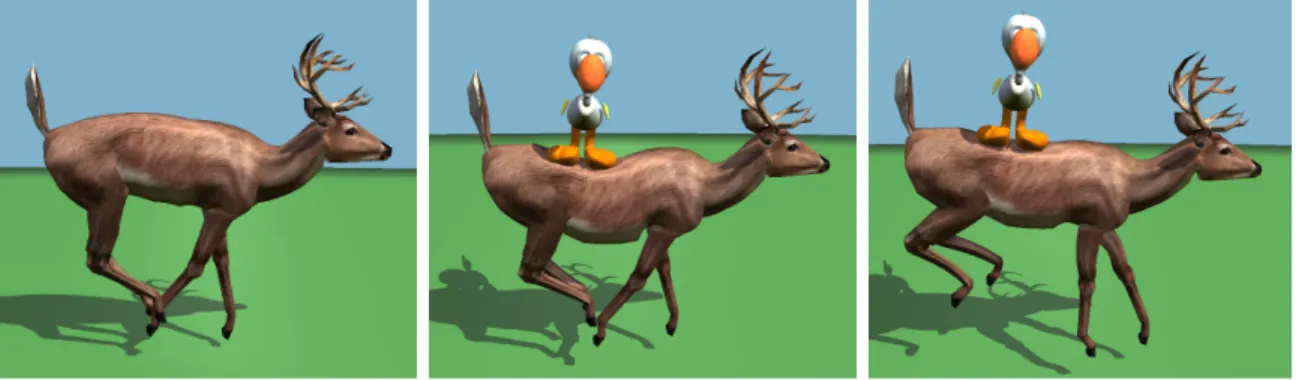
3. During contact response, the dynamic interplay between the (global) skeletal mo-tion of the character and surface deformamo-tions, as shown in Fig. 1.10.
(a) Efficient decoupled implicit integration enables fast simulation of a heterogeneous cylinder. The cylinder has 21,000 de-formable vertices (161,000 tetrahedra).
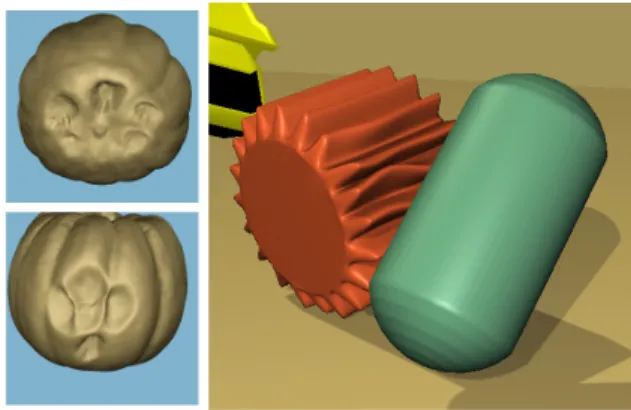
(b) Left: Detail view of the rich deformations produced on the top pumpkin (30,000 ver-tices and 183,000 tetrahedra) during contact. Right: A dropped cylinder produces rich dy-namic deformations on the ridges of a gear (29,000 vertices and 173,000 tetrahedra).
Figure 1.9: Simulation of Heterogeneous Materials and Examples of Detailed Deformations.
1.3.2
Pose-space Skin Dynamics
I present novel formulations of elastic deformations in body space for non-articulated objects (Chapter 3)) and in pose-space for articulated characters (Chapter 4). It is well known that linearization of the elasticity laws does not correctly model large deforma-tions, because linear strain models are not rotation invariant (see Section 2.1.2). Akin to previous co-rotational methods for non-articulted objects [TW88, MG04] and methods using skin displacement corrections [KJP02, JT05] for articulated characters, I solve this problem by expressing skin strain in a floating frame of reference that is aligned with the rest configuration (or pose-space) of the articulated character. I either track the bone state during the simulation to transform bone space deformations to world space, or I derive bone kinematics from a character animation or motion capture sequence. In contrast to previous approaches [MG04, CGC+02a], my model also optionally considers
Figure 1.10: Interactive Deformation of an Articulated Deer. The deer, consisting of 34 bones and 2 755 deformable surface vertices is being deformed in-teractively (almost 10 fps on average) by a rigid bird model. The interplay between small-scale contact deformations and the skeletal contact response is successfully captured.
1.3.3
Parallelization and Physically-based Simplification
A key advantage of my layered model is the reduction of the computational complexity that comes from the simplification of the interior volume dynamics. In fact, by only retaining 6 degrees of freedom (DoFs) per rigid bone, I focus the computational power on the simulation of detailed skin deformations — as opposed to volume deformation — while I still maintain the ability to model global skeletal motion.
Using linear FEM discretization of the displacement field of the deformable skin in pose-space (Section 3.1.1), I map 3-dimensional deformations to a 2-dimensional para-metric domain. This enables a highly parallelized algorithm, called dynamic deforma-tion textures to compute elasticity dynamics of a layer of deformable material. Together with careful approximation of Schur complements (Section 3.2.2), this formulation en-ables efficient decoupled simulation of highly detailed dynamic objects that have tens of thousands of surface elements with two-way coupling of global object motion and surface deformation at interactive rates.
geometry allows for it, this parameterization can correspond to a mapping of the surface deformation field to a regular grid, calleddynamic deformation textures. The regular grid implicitly defines the meshing of the deformable layer, which, after FEM discretization leads to a regular sparse SPD system on the regular data grid. Such systems can be efficiently solved on massively parallel streaming architectures because branching and pointer chasing are eliminated due to the regularity of the system. In Section 3.6, I demonstrate the performance advantage in a fast GPU implementation that employs texture memory to store the parameterization and fragment shaders to compute linear system solver kernels. This implementation is up to an order of magnitude faster than other methods that enable large time steps, for single-bone objects.
Efficient Dynamic Updates by Physically-based Approximation and Parallel-lization As mentioned in Section 1.1.3, one of the key challenges of achieving realistic soft character dynamics is to capture the physical interplay between skeletal dynamics and local skin deformation, leading to a tightly coupled dynamic system. I reformulate the motion equations such that the solution of this coupled and inherently non-parallel problem can be split into a massively parallel subproblem solve, followed by a coupling step to update the global (skeletal) dynamics. Full solution of the skeletal dynamics of a character withk bones and n surface points is known to have brute-force O(nk) com-plexity [Bar96]. A key contribution of this thesis is the reduction of this comcom-plexity to O(n+k) (in practice) while preserving physically plausible global and local deformation effects. I achieve this by:
1. Splitting of parallellizable skin computations from serial skeletal computations by exploiting Schur complements, also known as matrix condensation [BNC96].
2. Employment of a fast approximate inverse of the skin inertia matrix to accelerate computation of Schur complements (see Section 4.3.1).
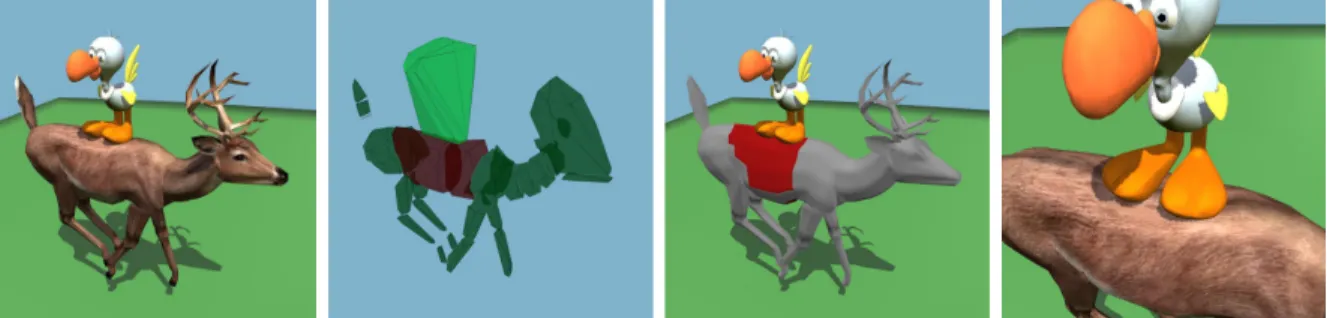
Figure 1.11: Layered Representation and Collision Detection. From left to right: Contact between the bird and the deer, with skin deformations on the back of the deer; Proxies used for hierarchical pruning of collision queries, with potentially colliding proxies of the deer highlighted in red; Triangles influenced by the potentially colliding bones (in red) are the only ones passed to the image-based collision detection algorithm; The resulting detail around the contact area.
off-line pre-computation of its symbolic factorization.
I demonstrate that the elastic and skeletal update can be separated by observing that the elastic energy due to pose-space strain is only dependent on the degrees of freedom of the skin layer. Fast and massively parallel solvers can be exploited to solve the skin update. In Chapter 3, I show that coupled layered dynamics of a rigid core with soft skin can be implemented very efficiently on a parallel architecture such as graphics processing units (GPUs) to simulate highly detailed surfaces at interactive frame rates, while also minimizing costly communication between GPU and CPU host.
1.3.4
Two-stage Hierarchical Collision Queries
I present a two-stage collision detection algorithm that exploits low-resolution acceler-ation data structures. These data structures are constructed from proxy geometry for the character’s bones (Section 4.3.3). They can be efficiently updated at run-time to check for potentially colliding surface patches.
In particular, I adopt a fast image-based algorithm that exploits the layered repre-sentation of soft characters. Collision detection is performed in two steps:
1. Identification of contact patches with object-space techniques using low-resolution proxies [EL00].
2. High-resolution skin surface interference detection and collection of colliding skin vertices using image-space techniques with the aid of graphics hardware.
Figure 1.12: Deformations of a Virtual Head. Left: A fist hits a deformable head (attached by springs in the neck area), producing both local deformations and global motion. Right: Detail of the deformations produced near the eyebrow by the impact.
Figure 1.13: Skeletal Deformations of a Soft Snake. Simulation sequence with a fish touching the snake, showing the global deformation of the snake. The last image shows the proxies for collision detection.
1.3.5
Fast Contact Response for Soft Articulated Characters
Responsiveness In many previous algorithms, contact response is computed by ex-plicitly integrating the constraint forces, which is equivalent to applying an instantaneous change of momentum to the surface nodes at the end of each time step. Unfortunately, with those methods the elastic deformation forces are unable to counteract the momen-tum of the core upon collision, and the core may penetrate the constraints (Fig. 1.7). In Section 3.4, I propose and describe the computation of the collision impulse through implicit integration which produces a robust and responsive reaction of the object’s core with large time steps. In Section 4.2.3, it is shown that the same technique can be applied to ensure responsive contact of the skeleton of a soft articulated character.
Skeleton response anticipation Previous existing methods for solving multi-body dynamics of rigid articulated characters with joint and contact constraints propose the anticipation of contact constraints to resolve contact impulses [Bar96]. However, this approach has a worst-case cost of O(mk) for a scenario with m contacts and k joint constraints. In the context of this thesis, I exploit the use of equality contact constraints, the fact that each colliding surface node yields one constraint, and the approximation of skin force Jacobians. Combining these techniques, I propose anticipation of skeleton response for soft articulated characters. I first solve for the contact impulses while anticipating the skeletal response under influence of the joint constraints. The overall computational cost of expensive contact constraint anticipation is thereby reduced from worst-case O(mnk) complexity to O(m+n+k) in practice. This is demonstrated in Section 4.3.4.
1.3.6
Control of Deformations with Dynamic Morph Targets
targets define the pose-dependent physical state of soft objects, including surface defor-mation and elastic and inertial properties. Given these morph targets, my algorithm then derives a dynamic model that can be simulated in time-pose-space, interpolating the dynamic morph targets at the input poses. My approach seeks to bridge the gap between geometric example-based methods and physically based approaches. It easily integrates with current modeling and animation pipelines: at different poses, an artist simply provides a set of dynamic morph targets. Whether these input states are phys-ically plausible is completely up to the artist. The resulting deformable models expose fully dynamic, pose-dependent behavior, driven by the artist-provided morph targets, complete with inertial effects. The success of dynamic morph targets relies on three key results:
• A pose-space method for interpolation of simple elastic deformation models that allows the artist to author complex nonlinear deformation behavior.
• A compact way of interpolating skin geometry, elastic forces, and their derivatives, all in a unified manner using pose-space polynomial interpolation.
• The extension of the method to support modal reduction, resulting in a very efficient implementation that is linear in the number of coefficients of the force polynomial.
cannot model pose-dependent effects such as bulging and wrinkling. Instead, I guide dynamic simulations with dynamic morph targets — discrete pose-space examples of skin properties and deformations.
The result is an efficient framework for directable physically-based skin deforma-tions that extrapolates well to unforeseen poses. Soft characters that have been comple-mented with dynamic morph targets can be plugged into existing dynamic simulation engines, either forming interactive, deformable content in real-time games or provid-ing secondary dynamic effects for kinematically-driven characters in feature animation films. My method also facilitates certain time-consuming rigging procedures, by pro-viding a physically based approach to resolve co-articulation deficiencies in traditional skinning methods, such as in shoulder regions, fully automatically. These results are demonstrated with my real-time implementation described in Section 5.4.
1.4
Organization
The rest of this dissertation is organized as follows. The next chapter summarizes related work in deformable simulation and control. Chapter 3 presents dynamic deformation textures for fast simulation of soft objects with a rigid core and soft skin, including support for coupled contact handling. Chapter 4 extends my approach tosoft articulated
Chapter 2
Related Work
Creating appealing and realistic animation of deformable characters is a multi-disciplinary problem. In this chapter, I present both related work in the domains of character simu-lation, animation, contact handling and control with emphasis ondeformable characters.
2.1
Simulation of Deformable Bodies
Since Lasseter’s discussion ofsquash and stretch [Las87] and, concurrently, Terzopoulos et. al’s seminal paper on elastically deformable models [TPBF87], numerous researchers have participated in the quest for the visually and physically plausible animation of deformable objects and fluids. This inherently interdisciplinary field elegantly combines Newtonian dynamics, continuum mechanics, numerical computation, differential geom-etry, vector calculus, approximation theory and computer graphics (to name a few). In this section, I will discuss physical simulation of deformable, elasto-plastic material, focusing on previous research that is directly related to this thesis. For comprehensive summaries, I’d like to refer readers to [GM97, NMK+05, TKH+05].
2.1.1
Continuum Elasticity
u(m) m
x(m) rest shape
deformed shape
Figure 2.1: Continuous Displacement Field. Deformation of an object in rest shape causes a material point originally at m to be transformed to a new position x(m) through the continuous displacement field u(m).
how it deforms under applied forces. If we think of the rest shape as a continuous con-nected subsetM of R3, then the coordinates m∈M of a point in the object are called
material coordinates of that point. In the discrete case M is a discrete set of points that sample the rest shape of the object. When forces are applied, the object deforms and a point originally at locationm (i.e. with material coordinates m) moves to a new location x(m), the spatial or world coordinates of that point. Since new locations are defined for all material coordinates m, x is a vector field defined on M. Alternatively, the deformation can also be specified by the displacement vector fieldu(m) =x(m)−m
defined onM (see Fig. 2.1). From u(m) the elastic strain is computed. This quantity is dimensionless; in the (linear) 1D case it is simply ∆l/l. A spatially constant displace-ment field represents a translation of the object with no strain. Therefore, it becomes clear that strain must be measured in terms of spatial variations of the displacement field u=u(m) = (u, v, w)T.
Popular choices in computer graphics are
G =
1
2(∇u+ [∇u]
T + [∇u]T∇u) (2.1)
C =
1
2(∇u+ [∇u]
T
where the symmetric tensorG∈R3×3 is Green’snon-linear strain tensor andC ∈R3×3 its linearized version, Cauchy’s linear strain tensor. The gradient of the displacement field is denoted by the 3 by 3 matrix∇u.
A constitutive law (or also called material law) is used for the computation of the symmetric internal stress tensorσ ∈R3×3 for each material point mbased on the strain
at that point. Most computer graphics papers use Hooke’s linear material law
σ =E·, (2.3)
where E is a rank four tensor which relates the coefficients of the stress tensor linearly to the coefficients of the strain tensor. For isotropic materials (a material which has the same mechanical properties in all directions), the coefficients of E depend only on Young’s modulus and Poisson’s ratio. Two very common elastic models used in computer graphics are:
• The fully linear elastic model, using the linear Cauchy strain tensorC and Hooke’s
linear material law.
• The St. Venant-Kirchoff elastic model, abbreviated as StVK, using the non-linear Green’s strain tensor in combination with Hooke’s linear material law.
The choice of elastic model influences the physical accuracy and also the computational complexity of the resulting elastic model.
2.1.2
Finite Element Method
The accuracy and computational complexity of a method depend on multiple factors in the design of a simulation model. More specifically, they depend mainly on the choice of elastic force model, time integration method and spatial discretization method. Many papers in computer graphics use theexplicit Finite Element Method, where both masses and internal forces are lumped to the vertices [OH99, DDCB01, MDM+02, MG04]. This
choice relates to the spatial integration method, it is not to be confused with explicit time integration. The explicit FEM method can be integrated in time both explicitly or implicitly.
Implicit vs. Explicit Time Integration Numerical time integration of ordinary differential equations is used to advance the state or in other wordssimulate the motion equations that follow from physical laws. The survey paper of Hauthet al.[HES03] is an excellent overview in the context of deformable modeling in computer graphics. Explicit
integration methods are easy to implement but are only conditionally stable because they blindly extrapolate force values into the future. As a consequence, increasingly smaller time steps have to be used for increasingly stiffer materials. This obviously affects the overall computational complexity of such scheme. On the other hand,implicit
schemes express unknown force values implicitly in the equations. In other words, these quantities are implicitly given as the solution of a system of equations. For example, the implicit (or backward) Euler scheme is stable for arbitrarily large time steps. This gain comes with the price of having to solve an algebraic system of equations at each time step, which has a negative effect on the computational complexity of implicit schemes.


![Figure 1.6: Deformation Detail. The Shape Matching algorithm [MHTG05], here illustrated on Fig](https://thumb-us.123doks.com/thumbv2/123dok_us/8291138.2195587/33.918.195.742.122.452/figure-deformation-shape-matching-algorithm-mhtg-illustrated-fig.webp)