TOWARDS A COMMON LANGUAGE: A THEORIZATION OF TEXT, AUDIO, AND IMAGE IN VIDEOGAME NARRATIVE
BY JUSTIN KEEVER
Senior Honors Thesis
University of North Carolina at Chapel Hill Department of Communication Studies
Table of Contents
Introduction – 1 I. Text-Primary – 7
Ia. The Text Adventure – 9
Ib. Developments of the Text-Primary Narrative in the Mainstream – 21 Ic. The Text-Primary in the Modern Avant-Garde – 27
II. Aural-Primary – 32
IIa. Audio-Log and Monologue – 37 IIb. Travel Audio – 41
IIc. Potentially Offscreen Bodies – 45 III. Image-Primary – 48
IIIa. Embedded Narrative – 49 IIIb. Cutscene – 57
Introduction
The mention of the videogame medium in academic disciplines outside the realm of game studies tends (for this writer, anyway) to inspire excitement and dread in equal measure. The former would seem to derive from an appropriately childish desire to sit at the adult’s table of academia, as it were: long has there been discussion of what games have borrowed from the media that have come before, and little of the reverse. The latter feeling is based in the fear that the term “videogame” would appear, as it did for years, in a negative connotation. Not in the archaic media/sociological studies sense (i.e. the tired question of videogame violence and its correlation to aggression in players), but merely in the sense that the videogame medium is perceived either as a lesser art form, or perhaps as not an art form at all. It’s with these
preconceived aspirations and worries I approached Thomas Eslaesser’s Chapter on the “Mind-Game Film” in his book Puzzle Films: Complex Storytelling in Contemporary Cinema, a text that was published in March of 2009. In this Chapter, Elsaesser cites a school of thought in modern film narrative analysis which posits that “mind-game films [are] leftovers of classical
versus Narrative; Ludologists Love Stories), and 5 years after Espen Aarseth’s “Genre Trouble,” game studies still had not offered a definitive answer as to whether or not games can be
understood via narrative theory. This lack of resolution creates the image of a house divided: a medium that persons from outside disciplines can only approach with a measured uncertainty at best. This inconsistency obviously manifests itself in the myriad definitions of videogame: compare, for example, Jesper Juul’s six formal features of the videogame – Rules; Variable, Quantifiable Outcome; Values assigned to possible outcomes; Player Effort; Player attached to outcome; and Negotiable Consequences – to Geoff Howland’s five elements: Graphics, Sound, Interface, Gameplay, Story (Game Player World; 1998). Even the exact spelling of “videogame” is left undecided: is it “video game,” as Mark JP Wolf refers to it in his book The Medium of the Video Game? Or is it the “videogame” that James Newman and Grant Tavinor refer to in their
work? Or is it the medium of the “video-game” that Elsaesser speaks of? These kinds of
inconsistencies are not the growing-pains of a new academic discipline: commercial videogames have existed for over forty years, and scholarship on videogames has been written since before the supposed “Year One” of academic game studies thirteen years ago. This is a problem.
Worse, it’s a problem that is often ignored, or even celebrated. One need not look further then Trammell and Sinnreich’s “Dynamic Ontology” of the game studies field, which, in its attempt to “unite and distinguish the diverse connections, assumptions, and epistemic positions among the various authors within the larger discursive field of game studies,” instead reveals the absurdity of the variance found within a single discipline: “game studies” as defined by
“Media Studies,” despite spearheading the “Platform Studies” movement with Nick Montfort not 4 years prior. Indeed, the proliferation of so many courses of study (often by the same authors!) since Game Studies’ Year One speaks to a discipline-wide lack of focus, a group of academics searching blindly for any and all new perspectives and theories as though the answers for how to best approach the medium of the videogame lie anywhere but their current discipline. What’s even more disconcerting is that this aimlessness is sometimes better than the alternative: the prospect of a book entitled “How to Talk About Videogames1” being written by the same man who once wrote that videogames would be better off without characters2 is nothing short of terrifying: while at the time of this writing the general public can only speculate about the contents of Bogost’s latest book, nothing in the man’s contemporary work would suggest any interest in a meaningful discussion of narrative, despite the fact that many (if not most) videogames have narrative aspirations.
This essay is meant to act as a part of the larger corrective to these damaging impulses of videogame studies, to treat videogames first and foremost as authored narrative texts, and to establish a useful critical vocabulary for approaching games in this manner. It is to this end that this essay has been fashioned as a narratological analysis of the videogame medium, specifically as an analysis of the manifestations of game narrative, both as they have existed in the past, and how those past manifestations exhibit themselves in contemporary videogames. To use the linguistic metaphor of traditional narratological studies, this paper is an examination of parole, the way in which the “narrative emerges from the narrative text” (Fludernik 8). However, in opposition to traditional narratological studies, this close analysis of narrative parole in the context of the videogame will not be limited to strictly to literal text (i.e. “how sentences turn
1
https://twitter.com/ibogost/status/576464559013232640
2
into narrative” as Fludernik suggests [8]): the videogame is a multimodal, composite medium, and thus provides a wealth of possibilities in terms of the manifestation of its narrative. For example, games like Zork or Planetfall work in entirely on the level of text, while games like
System Shock 2 or its spiritual predecessor Bioshock communicate most of their narrative information via snippets of audio; and these different means of communicating each games authored narrative have profoundly different effects on the player’s experience of each game. It is the aim of this essay to assert the importance of these various creative decisions made by videogame developers: to explore how the varying modes by which developers choose to communicate their authored narratives effects the player’s experience of said narrative, and the
time and space of the gameworld he/she is navigating. To that end, this essay will chronicle the lineage of the primary methods by which videogames communicate their authored narratives to players, methods that have been separated into three formal classifications: Text-Primary, Aural-Primary, and Image-Primary. It is important to note that the disaffiliation of these primary
videogame, and the way in which the strategies manipulate the medium’s formal elements of space and time in service of crafting meaningful experiences.
This essay is split into three chapters, one for each narrative genre listed above. The first chapter concerns the Text-Primary Narrative method is approached through the lens of literary scholar Mikhail Bakhtin’s theory of the chronotope, or “time-space.” This chapter begins by attempting to identify a Text-Primary chronotope via a close examination of the text-adventure
Planetfall. As part of this exploration of what constitutes the Text-Primary chronotope, this paper will identify a structure of videogame time called player-action time, which will serve as a recurring concept for the duration of the essay. This analysis of the Text-Primary genre continues by examining the way in which the method was adapted into the mainstream after the
text-adventure began to lose relevance: the narrative mode will be traced through early graphical adventure games and Western Role Playing Games. Given this essay’s strict focus on authored narrative in the videogame form multiplayer text environments like MUDs will be excluded from this conversation. Finally, the first chapter will address the way in which the Text-Primary Narrative emerges in the modern avant-garde, briefly exploring how recent art games have used this narrative mode to recontextualize and present a meta-commentary on the lasting influence of the text-adventure game.
The second chapter, which is focused on the Aural-Primary Narrative, is structured differently, beginning with an exploration of composer and theorist Michel Chion’s notion of the
narrative: Audio-log/Monologue, Travel Audio, and Potentially Offscreen Bodies, which are disparate in terms of their effect on the construction of the game-space, but parallel one another in terms of the player’s experience of time.
I. Text-Primary
In 1937, Russian Scholar Mikhail Bakhtin adapted the term “chronotope” (time-space) from Einstein’s Theory of Relativity to the realm of literary criticism, citing its usefulness as the way in which “it expresses the inseparability of space and time” (84). Bakhtin identifies the literary and artistic chronotope as the “primary means for organizing time and space… a force giving body to an entire novel” – in essence, the chronotope is the set of functions by which time in a novel, or an individualized space within a novel, operates (250). For an example of how the chronotope is used in literary criticism, this turns to Bakhtin’s own analysis of the Greek
Romance. According to Bakhtin, the generic chronotope of the Greek Romance is marked by adventure-time, or, a lack of “natural, everyday cyclicity,” the implication being that between the beginning and ending of the Greek Romance, there is no progression of biographical time. The adventurous events of the Greek Romance’s middle portion leave no evidence of physical nor psychological impact, and due to the lack of natural progression of time, those occurrence of these events is dictated entirely by chance or “fate” (Bakhtin 90-92). Furthermore, the “space” of
the Greek Romance chronotope is that of the alien world: an un-exoticized, wholly foreign area that the protagonists of the novel have no pre-established connection to (Bakhtin 101). Ergo, the formula of the Greek Romance chronotope becomes “an alien world in adventure-time” (Bakhtin 102).
constructions of space-time in one very specific artistic form: the novel. Transferring the chronotope to the function of this essay requires a measure of recontextualization, beginning with an expansion of the term “genre.” As Wolf notes, “video game genre study differs markedly from literary or film genre study due to the direct and active participation of the audience in the form of the surrogate player character.” (114). The player-centricity of videogame genres has given way to genre classifications that operate almost entirely independently of the familiar elements like theme or iconography (two of the three areas where genre elements may emerge in American film, as identified by Ed Buscombe). Instead, genre distinctions are based entirely on the nature of the activity in which the player engages. Despite this departure from normal genre distinctions, it would be inaccurate to say that videogame genres are defined entirely outside the realm of iconography, as a certain level of visual representation is required to give the act of play the context necessary to facilitate genre classification: for example, moving a cursor and clicking takes on a widely different meaning in a First Person Shooter than it does in a point and click adventure game, and the differing contexts of the act of play3 are what delineates these distinctive genres.
All of this is to establish the precedent of a distinct function of the term ‘genre’ when applied to the medium of the videogame: specifically, a precedent of genres that are defined not by iconography and theme, but by mechanical form. It’s with this precedent in mind that I want to contextualize the three narrative methodologies this paper identifies: these are essentially broad genres of videogame, marked by their construction and narrative mechanics. It is with this understanding of these narrative methodologies as genres that this paper will adapt Bahktin’s notion of the novelistic chronotope, and apply it to the medium of the videogame in order to
3 The term “play” can be defined as an act 1) that is not obligatory 2)circumscribed within a certain space and time,
identify the formal tendencies of text-primary, aural-primary, and image-primary videogames in terms of their respective constructions of spatiality and temporality. This application is made possible by acknowledging these narrative methodologies as a form of genre, albeit a conception of the term “genre” that refers to (narrative) mechanical elements rather than aesthetic or
thematic commonalities. However, aesthetics will not go unexplored in the analyses of the three genres in question, as their unique methods of transmitting information would result in distinct visual styles.
Ia. The Text-Adventure
As the name implies, the “text-primary” genre of game narrative can be most identified by the privileging of text as the primary means of transmitting story information to the player. Therefore, the logical place to begin an exploration of this genre is with an early videogame form that would foreground text, and thus serve as the origin point of the text-primary game: the text adventure. The text adventure videogame is perhaps the foremost “narrative” video game genre, insofar as it is the first genre whose act of “play” lacks the tactical or reflexive impulse of its agonistic or aleatory predecessors like Tennis for Two (Higinbotham, 1958) and Computer Space
(Nutting Associates, 1971), and instead offering a focus on the consumption and comprehension of fictional prose; simply put, the text adventure is a genre built around reading comprehension, and as such, functions as the foundation for the “text-primary” genre of videogame story. Playing a text adventure game involves reading a description of an environment, or a transcript of
text adventure involves being able to situate oneself within an space that is realized only through brief descriptions. As such, the narratives of text adventures can be understood in terms of Jenkin’s adaptation of De Certeau’s conception of narrative as “he transformation of place into space: the process by which “places,” which constitute stability, are acted upon by a narrative agent, who transforms those places into “spaces” by exploring and “colonizing” them (Fuller and Jenkins 66). Furthermore, the text adventure most often takes the form of a “tour,” a subjective journey through a space (Fuller and Jenkins).
The genre was first conceived with the creation of the game Colossal Cave Adventure, first developed by William Crowther in 1975, and expanded upon and promulgated by Don Woods in 1976 (Adams). The game was designed “at a time where text input (keyboard) and output (screen or printer) were common” indicating that the favoring of text descriptions over graphical depictions of environments was a practical choice, not an artistic one. A remake, titled
Adventureland, was developed by Scott Adams and released in 1978 for the home computer. This remake would be promoted as a piece of interactive fiction, and would even be featured in
The New York Times Book Review (Veugen and Querette 216). This rebranding of the text-adventure marks an acknowledgement of the narrative-driven impulse the Text Adventure would come to represent: the way in which the text adventure expunges graphical interfaces in favor of descriptive text allows for a greater capability – for the time – of environmental detail and more extensive dialogue, both key for developing more complex narratives (Holmes 28).
A text adventure that would be particularly remembered for taking advantage of these qualities is Planetfall, released by Infocom in 1983. Planetfall tells the story of a janitor
he/she is tasked with finding a cure to a deadly virus that has killed off all life on the planet, lest the player character fall to the disease themselves. Of course, the player is not made aware of the ship’s ill fate immediately, and the game begins with the following description:
“Another routine day of drudgery aboard the Stellar Patrol Ship Feinstein. This morning’s assignment for a certain lowly Ensign Seventh Class: scrubbing the filthy metal deck at the port end of Level Nine. With your patrol-issue self-contained multi-purpose all-weather scrub-brush you shine the floor with a diligence born of the knowledge that at any moment dreaded Ensign First Class Blather, the bane of your shipboard existence, could appear.”
The player is given no objective that clearly indicates forward progress, as there is no action the player can take at this point that moves the story forward. The player must wait for the eventual explosion that signals the Feinstein’s demise which opens the escape pod doors, granting passage to the remainder of the videogame. In the meantime, the player can take incidental, largely meaningless actions, like scrubbing the floor, talking to the occasional passerby, or walking to a different level. Should the player elect to explore the Feinstein in the little time they have, they must input a command to walk in a compass direction (e.g. “walk east”), which will move the player to a new area. This means that each movement, so long as it as a movement that the game allows (e.g. you can’t walk north in an east-west hallway), results in the player moving to an entirely different space, and not a continuation of the space they were in before. Ergo, should the player decide to walk west while in the Feinstein’s Deck Nine, they will arrive in the Reactor Room, and not the westernmost part of Deck Nine.
To examine the chronotopal elements of the text adventure as they are present in
Planetfall, this essay will begin by examining the way in which the act of “waiting” is made
explosion is triggered by the actions of the player: should the player scrub, walk, or speak enough times, the explosion event will finally trigger. Though players are essentially waiting for the game proper to begin, inactivity is not an option, as the plot will not move forward until the player takes enough actions. Interestingly, the player can type “wait” into the input line in order to make the game progress as well, though “waiting” won’t take up any more time than sweeping or moving around. The player could, if they wanted, simply type in “wait” over and over until the Feinstein explodes, which would correspond to complete inactivity on the part of the player-character. This incongruity between player activity and player-character inactivity reveals the way in which Planetfall, and text adventure games in general, operate temporally: the passage of time – and therefore the progression of a plot – are dictated entirely by player interaction. That is, the world and the narrative of the text adventure only react in response to player input, and never appear to act independently.
Mark Wolf identifies three manifestations of stillness in visual media: the photographic slide, the filmic freeze-frame, and the “still shot,” wherein a stationary camera is actively recording a scene with little to no perceptible movement (78). In the cases of these last two cinematic terms, there are indications of non-diegetic time passing in the form of the medium’s signature “grain, hiss, and flicker,” which indicate to the audience that the film is still
progressing, despite the lack of diegetic movement. Because videogames use digitalized
fan blade or moving water. These movements will repeatedly return to their initial positions (or in the case of ambient sounds, the sound clips will repeat), which “combines stillness and movement in a form of cyclical or “looped” time.” (80).
It’s tempting to understand the progression of time, or the lack thereof, in the text
adventure purely in the context of this notion of “looped” time. In a sense, looped time is at play in the text adventure: when waiting on player input, a cursor blinks repeatedly in the input line, a cyclical animation that signals to the player that the game is still running, and therefore, that time is progressing. However, the blinking cursor of the text adventure is not diegetic in the same way that the ambient motion and sound of Myst is; there is no blinking cursor in the world of
Planetfall that awaits typed input from the player-character, making the blinking cursor more analogous to the flicker of film over a freeze-frame rather than a looped fan blade animation, despite the fact that the cursor is a deliberate design choice from the developer, rather than a medium-inherent feature. Due to the lack of a diegetic indicator of the passage of time, there is no reason for the player to conclude that time proceeds within the gameworld whilst the player remains inactive: just as characters in a novel do not linger in a living space when a novel has ceased to be read, the characters in a text adventure do not wait while time passes in the diegesis. Every pause in the text adventure marks a total pause in the progression of time, both in terms of the narrative and the gameworld; progression will only start again once a legitimate command is entered into the input line (phrases like “I don’t understand the word ‘use,’” which Planetfall
displays when the player enters a command to “use” an object, also function as indicators of non-diegetic time passing).
which looped time and the player reactivity that this essay has identified in the text adventure merge in later narrative videogames. Almost all games with graphic interfaces, which readily utilize looped time in the way Wolf describes, have also taken up a reactive model of narrative progression: that is, videogame stories proceed in response to the actions of the player. While the diegetic worlds of visual videogames don’t pause in the way the text adventure worlds do, the model of player input → plot output has remained more or less constant over the medium’s progression. For example, examine the way in which a sequence in the first episode of The Wolf Among Us (Telltale, 2013) parallels the opening waiting sequence of Planetfall: the main character of Telltale’s detective thriller walks into a bar, looking for a patron who is the prime
suspect in a recent murder. The suspect is in the bathroom, a fact which neither the player nor the player-character have any way of knowing. In order for the suspect to leave the bathroom, the player must pass the time. However, the player can’t merely let the character stand in one spot and wait in real time for the suspect to finish in the bathroom – he/she must make the player-character perform a set number of menial actions, like talking to patrons or ordering a drink, in order to make the time actually progress in the game’s plot. The diegetic gameworld may operate on its own terms to some degree, but the story doesn’t proceed until the player takes action.
normally consider reductive) is a useful way to understand the overt input/output functions of the text adventure. Juul’s theory centers on the concept of game time, which consists of “the basic duality of play time (the time the player takes to play) and event time (the time taken in the game world)” (emphasis added). In action-focused real time games, these times are often aligned, and
the actions of the player are temporally matched with the corresponding actions of the player-character; e.g. the way in which the player’s movements of the mouse correspond with the movement of the player-character’s gun in Quake III (Juul, “Game Time”). However, Juul notes that in other real time games like SimCity, the play time is not aligned 1:1 with the event time: instead, in SimCity, the two minutes of play time required to build an in-game power plant corresponds to roughly a year of event time – the time which it would take for a power plant to be built in the real world. This allowance for disparity between play time and event time is where Juul’s model becomes handy, as play time and event time in text-adventures is made almost inherently disparate by genre’s imprecise sense of time. In Planetfall, play time consists of the time the player takes to type in commands and the instantaneous results of those commands; it takes a fraction of a second for the character to walk across a hall after the command “walk east” has been input, for example (the textual descriptions in-game that indicate the character has walked east would most likely [incorrectly!] fall under the label of “cutscene” in Juul’s model, as they are non-interactive elements that interrupt the interactive play time. This facet of Juul’s theory will be ignored, for reasons explained below). Event time consists of the imagined
diegetic time it would take for the player-character to walk down said hall. This time is measured in-game via a “moves” counter (scrubbing a floor is 15 moves, waiting is 40, etc.) but the
functions in such a way that the seconds it takes to type in a command and see an output in play time correspond to an indeterminate event time.
Of course, Juul is not interested in the progression of game narratives, but in game states, so this observation leaves the question of the text-primary chronotope unresolved. In order to apply this model of temporality to narrative, the understanding of “output” needs to be changed. Due to the simple input/output nature of the text adventure, and the imprecise nature by which time is measured in those outputs, one can posit that each output in Planetfall constitutes a narrative sequence: that is, every output in a text adventure corresponds to meaningful story progression, as each move involves the exploration and familiarization with a place, thus transforming it into a “space,” as outlined in Jenkins’ notion of the spatial narrative.
Additionally, Juul’s concept of what constitutes “play” in terms of game temporality can safely be expanded upon in this context; Juul’s assertion that “if you cannot influence the game state in any way… you are not playing a game” discounts time spent absorbing narrative information, i.e. watching cutscenes and reading descriptions in text adventures, which is integral to the experience of “playing” narrative games (“Game Time”). Ergo, the time the player spends reading the text in Planetfall, as well as the inactive time he/she spends mentally solving an in-game puzzle will be included in this discussion’s definition of “play time.”
Juul’s notion of game temporality has now been adapted to the player input → plot output structure of the text-primary game. With play time (i.e. player input) now including player inactivity whilst playing a game, the function of the blinking cursor of Planetfall’s input line
result of the player failing and being forced to re-experience a sequence of in-game events (81). The concept of looped time is useful beyond these applications: the example of the fan that Wolf highlights in Myst and Riven is a gesture toward the way in which looped time functions as a kind of incidental purgatory in narrative games, a means by which the time of the game world is held at a standstill while waiting on player progression, all whilst simulating autonomy. Thus, the freeze-frame that accompanies the blinking cursor in Planetfall functions in the same way as loop of a fan blade in Myst: a means of affecting the gameworld in such a way as to make the progression of the narrative seem natural despite the potential inactivity of the player.
Given this paper’s interest in narrative, a question remains: what effect does this looped time have on the characters within the game’s narrative? To answer this question, one can turn to Bakhtin’s aforesaid notion of adventure-time. Bakhtin identifies adventure-time in his analysis of the Greek Romance, noting the way in which the time of the “improbable number of adventures” the characters endure is “not measured off in the novel and does not add up.” Significantly, “this time… is not registered in the slightest way in the age of the heroes” (90). The Greek Romance
is marked by two biological moments in the lives of the characters – the arousal of passion at the beginning of the novel, and its “satisfaction” at the end (90). Bakhtin’s application of
Player-action time is marked by a structure of looped-time sequences of play with no biological significance, interrupted by plot-progression relevant sequences which have a meaningful biological importance in the development of the game’s characters. This player-action time constitutes one half of the text-primary chronotope, the “time” element of the “time-space.”
The space of the text-primary chronotope is both more abstract, and more easily identifiable. But, before the space can be defined, the way in which space operates in the videogame medium must be briefly examined. Mark Wolf notes the ways in which videogame space differs from that of the visual media that preceded it: First, there is no pro-filmic referent in the construction of videogame space, so “not only the representation of space, but even its
159). Aarseth also identifies a distinction between two spatial representations: “indoors” versus “outdoors,” where indoors refers to labyrinthine, restrictive environments, and outdoors refers to open landscapes (“Allegories of Space” 159). A videogame space can symbolize an outdoor area, but can be sufficiently restrictive as to be considered an “indoor” spatial representation: the
outdoor environments of Myst are an example of this (Newman, Videogames 114). Finally, Aarseth identifies a third distinction of spatiality, based on the level of control the player has over the shape and form of the gameworld itself: simulation games like SimCity offer a high level of control, whereas 3D action games like Doom offer no meaningful influence over their environments (“Allegories of Space” 159).
These prevailing theories of game spatiality provide a solid foundation from which to identify the “space” of the text-primary chronotope. Text adventures such as Planetfall fall under Wolf’s first category of videogame spatial structures: “no visual space; all text based” (53). Wolf submits that the way in which text-adventures describe scenery without the use of images
precludes text adventures from having on-screen space; instead, the entire game consists only of off-screen space. Alternatively, Wolf submits that “that which is currently being described by the text on-screen” constitutes the on-screen space – a statement which Wolf himself seems dubious of (54). It is the opinion of this author that the label “no visual space” is somewhat reductive: the core gameplay of the text adventure is, after all, navigation through (and mastery of) a puzzling environment, which would effectively align the text adventure with the “man versus the
Jenkins identifies – a narrative form that is based around experience in and mastery of an environment. Specifically, playing a text adventure involves the mastery of an “indoor”
environment: the restrictive nature of the compass-direction walk commands commonly used in text adventures ensures that environments are designed as labyrinths. For example, the way in which the input “walk east” in Planetfall takes the player to an entirely different area from where they were last (as long as there is a space to the east) epitomizes the restrictive, indoor nature of the text adventure: space is organized as a series of rooms, rather than an open expanse, even when the textual description of the environment would indicate otherwise. Ergo, the spatial structure of the text adventure can be understood as an “indoor” environment organized into
rooms, presented through a personal perspective. However, this description does not cover the entirety of the text adventure’s spatial structure: as reductive as Wolf’s subcategory is, the lack of visual space does create a more unique spatiality in textual videogames: specifically, a tension arises wherein the organization of each “room” of the text adventure is fixed, creating a concrete organization of a place, but the space in and between these rooms is abstracted. Planetfall
contains descriptions of relatively larger rooms and longer hallways, but these areas can be traversed via a single input, just as with any other space. Thus, diegetic space in Planetfall
that the space of the text-primary genre is presented from a personal perspective, and that the space is, in all actuality, an alien “place” that will be transformed into a “space” via exploration. Hereafter, this kind of space will be referred to as the “textual labyrinth.”
The text-primary narrative chronotope can be defined as “player-action time + textual labyrinth,” an equation which reflects the complex way in which the text-primary videogame abstracts time and space in order to provide a narrative experience that accounts for player inactivity and presents a logical, structured gameworld that isn’t muddled by the desire for exactitude of dimensions. The formulation of this chronotope has been entirely based on an exploration of the text adventure,the foundational genre of the text-primary narrative, and a genre that has fallen out of favor. 1983, the year of Planetfall’s release, would be the final profitable year for Infocom, who would be dissolved by Activision in 1989 (Holmes 36). However, this chronotope would remain relevant, as new games would adapt this chronotope in new contexts, further developing the text-primary narrative genre.
Ib. Developments of the Text-Primary Narrative in the Mainstream
Volition’s comedy-action game Saint’s Row: The Third (2011) features a mission named “http://deckers.die” in which the player-character, the head of a criminal organization ironically called “The Saints” is transported into a Tron-esque cyberspace in order to carry out an attack on a group of hackers called “The Deckers.” This attack is, for the most part, carried out in the way the player-character confronts all of his foes: gun violence. For the majority of the level, the player is tasked with shooting the digitized Decker minions who stand between you and the boss character at the end of the level; that is, until the player reaches the first objective marker. Here, the screen quickly fades to black, and a brief block of text appears on screen, reading:
“You awaken to find yourself on cold flagstone. As you stand up you notice that the small room is lit by two torches. To the north there is a door, to the south a hole in the wall.
>_
Open the door Take a torch Go through the hole Take a nap”
As the player scrolls through these options, the tapping of a keyboard can be heard. The voice of a secondary character can be heard off-screen, saying to the player character: “Ooo, I love these!”
This fun little meta-textual reference to genres past unintentionally serves as an important indicator of the way in which the impulses of the text adventure have been adapted into newer forms of videogame. The player must choose one of the four options listed beneath the question “What do you do?” Should the player choose one of the wrong options, the result is instant death, forcing the player to restart this brief sequence. Thus, what Saint’s Row the Third is doing in this sequence is not just imitating the aesthetic of the text adventure videogame, but also its basic gameplay structure: submit the correct input or die. What’s particularly important, however, is not the way in which Saint’s Row imitates the structure of the text adventure, but how it alters and streamlines it: the gameplay possibilities are made explicit to the player, deemphasizing the trial-and-error experimentation of games like Planetfall in favor of evoking a sense of immediacy and honesty about the limited possibilities of the play-space. Volition is essentially offering a visual interpretation of the inherent limitations of early text adventures: the wide range of actions promised by the ability to input any word or phrase in the input line of the text adventure is undercut by the limited number of responses the game can actually identify. In
possible actions they can take, accelerating the pace of progression while still maintaining the genre’s basic chronotope: this sequence operates on player-action time, and the play involves navigating a (simple) textual labyrinth. Therefore, this sequence exemplifies the way in which the core generic elements of the text adventure can be preserved, even as the form is adapted.
Of course, Saint’s Row the Third is not the first game to adapt the text-adventure’s generic structure, but the way in which it directly cites the text adventure by mirroring its
aesthetic functions as a helpful indicator of exactly how the text-primary narrative genre emerges in non-text adventure videogames. The implicit argument to be drawn from this sequence is that as graphic interfaces became more common, and the text-input gameplay of the traditional text adventure fell out of favor, option-based gameplay became the domain of the text-primary genre. Now, “option-based gameplay,” in the context of this argument, refers specifically gameplay wherein a series of choices are laid before the player in a text-based, menu-like format, and the player is required to pick one of these given options to proceed (without this distinction, one could argue, a là Sid Meier, that all games feature option-based gameplay [Rollings and Morris 38]).
the graphical environment the player wanted to interact with. With this structure, it is
immediately evident how the core gameplay loop of the text adventure is preserved: the basic “verb/object” logic of the text input system is constant, despite the introduction of the graphic interface. However, the preservation of this gameplay construct does not indicate that The Secret of Monkey Island belongs to the text-primary genre: the player’s understanding of the world he/she navigates is situated in its visual representation, not in the text that dictates how the player can interact with said world. However, that very emphasis shifts away from the world as it is graphically represented during the game’s numerous conversations: in these sequences, the normal process of play is literally stripped away, as the menu of potential gameplay actions is replaced with a list of potential lines of dialogue that the character can utter. This kind of interactive dialogue sequence has become commonplace within narrative videogames; the general experience of which is rather succinctly described by a group of Bioware employees in their patent of their own unique graphical interface for interactive videogame conversations:
“Many different types of videogames have been produced, which enable the player to take control of a character in a game situation that involves a storyline. The storyline may progress using simulated conversations. In a role-playing game, the conversations may be held between the player's own character and one or more characters in the game. Using prior art interfaces, typically the conversation progresses through the player making choices between different dialog responses presented as lists of text on-screen. Selection of different responses results in different paths through the conversation or story. Making a dialog choice results in the character “speaking” the chosen line. Some times such videogame dialog is implemented by displaying the character's dialog line in the form of text, and at other times it is
implemented through playback of pre-recorded lines spoken by a voice actor. In either case, when players are presented with a dialog choice, they are usually required to refer to a text-based description or another set of indicators to understand the available choices” (Hudson et. al).
The final line of this description is particularly significant in this essay’s context: interactive conversations, even in graphically oriented videogames, re-orient the player’s focus towards a textual element, privileging text as the primary means by which story information is
This re-privileging of text in interactive conversations allows these sequences to serve as something of a microcosmic iteration of Huizinga’s notion of the magic circle within the
videogame itself: the interactive conversation often provides a sufficiently different play
dynamic, a temporary world within the ordinary world of play, “dedicated to the performance of an act apart” (Huizinga 10). As much is evident when examining The Secret of Monkey Island, as the way in which the normal UI elements are stripped away in favor of the dialogue options of when an interactive conversation is initiated gestures towards this dynamic: the normal gameplay of spatial navigation and puzzle solving is removed entirely, replaced with a static situation that requires little to no spatial awareness beyond what has already been established when the
conversation is first initiated. The focus of the game shifts away from the overarching problem of narrative progression via environmental puzzle solving, offering instead an independent scenario that the player must navigate. In the case of interactive conversations, the “textual labyrinth” of the text-primary chronotope is preserved, albeit metaphorically: differing dialogue options function as different paths for the player to take through a branching map of authored speech. This map (often addressed via the metaphorical term “dialogue tree”) provides the player with a fully textual environment to navigate, which can operate within the context of a graphic-focused game while remaining functionally independent – a performance inside of a performance.
This basic structure of interactive conversation would remain more or less constant as the videogame continued to evolve graphically: the playable dialogue sequences in Western RPGs like Bioware’s Mass Effect (2007) operate in essentially the same manner as conversations in
The Secret of Monkey Island. The demanding shooter/exploration gameplay of Bioware’s
cinematic nature of the game, pushing the player’s attention towards the dialogue wheel that sits at the bottom of the screen during these segments, or the subtitles the player may have opted into. Regardless of the sudden introduction of Hollywood continuity editing and “cinematic” framing (features that will be more readily identifiable in the image-primary narrative genre),
Mass Effect’s conversation sequences provide are prototypical examples of text-primary
narrative: the dialogue tree is maintained (and emphasized via outward-branching dialogue wheel graphic on the screen’s lower half), and, importantly, the conversations occur at player-action time: the time between the player being prompted to respond to an NPC and the actual input of said response does not take up any kind of biographical time, insofar as these
intermittent pauses in conversation are never acknowledged by any of the characters, and conversation will not resume until the player has responded.
required textual elaboration. Role Playing Videogames like Planescape Torment would borrow the divided screen of The Secret of Monkey Island, which, in turn with the more prolix
descriptions, creates an even stronger focus on the textual storytelling.The descriptions of games like Planescape Torment read like meta-ekphrasis, in which the artwork being described is the game itself. The textual descriptions become the primary means by which the player
comprehends the world in which they are placed. The textual labyrinth of the text-primary chronotope is preserved.
Ic. The Text-Primary in the Modern Avant-Garde
As important as it is to understand the way in which the text-primary narrative genre would develop and be adopted by the mainstream, it is equally important to acknowledge how independent art games reflexively acknowledge and/or subvert the standard construction of a text-primary narrative. In doing so, we can observe how game makers at the fringes of the medium have responded to the practices and assumptions the underlie the text-primary narrative as it is described in this essay, and understand how those assumptions inform the creation of these games, in spite of the way the specifics of the text-primary genre have gone undefined until now. Essentially, the text-primary narrative provides the savvy player with an easily identifiable ethos on which a select number of modern independent or avant-garde games are based, and thus provides a deeper understanding of the way in which these games both derive from an
identifiable form whilst destabilizing and/or advancing that same form.
fictionalized DOS screen that serves as the “override terminal” of the spaceship computer where the desired files are located. The player is presented with a list of available commands:
“download, disable_ai, enable_ai, help, su, quit.” A cursor blinks below this list of commands, awaiting player input. Each game that this paper has cited, up to this point, that has made its affordances explicit has also allowed the player to simply pick one of the gameplay options by simply selecting it. This is not the case in Analogue; here, the player is required to type out these commands manually, a là Planetfall. The challenge of this early sequence does not simply derive from picking the right option, but also from understanding the grammar of the override terminal. Progression is not as simple as typing “download” or “enable_ai”: the verb/object logic of the text adventure is utilized in Love’s game (should the player wish to enable an AI, they must also choose which program they wish to activate), with the addendum of understanding how that command should be structured. Essentially, the game is tasking the player with deciphering a deceptively simple, fictional computer code. Furthermore, although Analogue: A Hate Story
becomes the arrangement of the text itself. This sort of play has an interesting effect on the game’s construction of time as well: because there is no differentiation between the actions the player performs and the corresponding actions of the player character, the play time/event time relation, to once again use Juul’s model of game time, is 1:1. However, the narrative still has the appearance of progressing via player-action time, as the actual progression of the game’s story is based in the behavior of the player, with no acknowledgement of any extreme passage of time on the part of the AI characters, even though that passage of time is no longer cyclical. But this change in the nature of game time gestures towards Analogue’s reflexive awareness of the kinds
of play it is drawing on, and the truth of what it is we do as players when we play a text adventure, or any videogame.
effect: the slow fade to black (as opposed to Saint’s Row’s wipe transition) creates the sensation of a slowly loosening grasp on reality, leading to a moment in which these two diametrically opposed realities are superimposed onto one another, creating a vivid sense of uncomfortable dissonance. Not only does the textual description of the trance-world contradict the graphical (there will never be a graphical-world referent in the textual world), the textual descriptions are free from the aesthetic tropes of text adventures, confronting the player with an abstractly
defined sense of place that borders on incomprehensibility. In essence, Nier pulls the player from the comfort of the graphical world by contradicting its own reality with a textually depicted one, confronting the player with the differences of the experience graphical and textual worlds: the latter, which seemed so natural in the videogame’s developmental years, enters the realm of the surreal.
the tape in order to select an option within the art exhibit itself. In doing so Limits and Demonstrations confounds the typical notion of the textual labyrinth, because the
II. Aural Primary
French composer and academic Michel Chion has written that there is an inherent dualism in sound cinema. Due to the physical nature of film, the medium inherently makes an incision between the body and the voice, before attempting to restitch the two together at the seam (Voice in Cinema 125). In film, Chion states, bodies and voices are inscribed onto separate surfaces (the celluloid image and the soundtrack, respectfully), a process which constitutes this inherent dualism: only by the process of synchronizing the images and the soundtrack can cinema create the illusion that the voice and the body are being presented as one singular entity (Voice in Cinema 126-128). It is via this process of synchronization, Chion posits, that voices are grafted onto “a particular body that is assigned symbolically to the voice as its source” (Voice in Cinema 126). This symbolic anchoring of the voice is achieved by showing a mouth: if the filmic voice matches with the movements of a character’s mouth onscreen, than the audience can safely attribute that voice to that visible body – and if there is no visible mouth, than that voice is “offscreen” (Voice in Cinema 127).
1:1 adaptation of our understanding of sound and synchronicity from film to videogames is an imperfect one, because as voice performances became more prevalent in games in the late 90s, the meagre graphical capability of the console era meant that the medium lacked the ability to represent the human body with the sort of fidelity that facilitates the words-to-lips
synchronization of film.
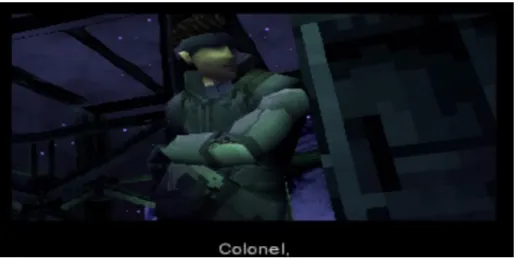
Hideo Kojima’s Metal Gear Solid4(1998) provides a useful example of this issue. As series protagonist Solid Snake enters the Russian compound that comprises the remainder of the game, players are shown a cutscene that depicts Snake hiding behind cover and calling his superior on the radio. In this shot (fig. 1), players see, for the first time, the in-game Solid Snake’s face (as opposed to a stylized facsimile that will be addressed later) as he is speaking. This moment of de-acousmatization is complicated by the three-dimensional model of the character himself: Snake’s sparsely detailed face doesn’t allow for any movement of the mouth, meaning that the Metal Gear Solid is incapable of resolving the source of Snake’s voice in the same way as a film.
Fig. 1. Solid Snake infiltrates Shadow Moses
4
Metal Gear Solid, along with Final Fantasy VII – which was released a year prior – are credited as the beginning of the “cinematic” videogame (i.e. a game with a heavy usage of “cutscenes:” typically non-interactive visual
Given that the mouth-to-word synchronization that Chion identifies as the suture of voice and image in film couldn’t be accomplished in the primitive days of the videogame, the medium is forced to develop without a key capability of representation in audio-visual media.
Videogames approach this problem in two primary ways, the first being the appropriation and acceptance of acousmatic sound as a core storytelling conceit, using voice-over narration and diegetic acousmatic instruments (i.e radio, telephone, etc. [Chion, Audio-Vision 71]). The second way the medium addressed this issue was an expansion of the symbolic source of voices: in videogames, the body itself becomes the symbolic source of the voice, rather than the mouth.
These methods of resolving acousmatic sound require further exploration, both in terms of how this re-definition of the source of the voice functions on a practical level, and how it is indicative of a certain “looseness” of videogame speech that informs how games tell stories aurally. In Metal Gear Solid, Hideo Kojima “sutures” (to use Chion’s term) voices to bodies by
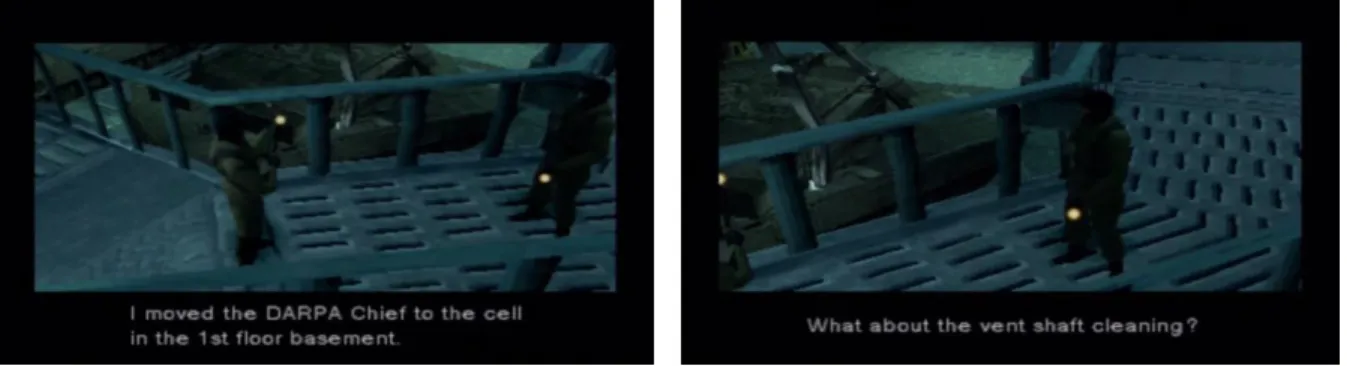
means of two methods that still inform the relationship between voice and body in the medium today: via cinematic framing and synchronous bodily movement. Another early cutscene in MGS
able to implicitly identify the source of the voices without explicitly showing the movement of the character’s mouths. Furthermore, when the in-game cinematic cuts back to Solid Snake, his head visibly moves as he speaks, even though the features of his face remain completely still (figs. 4 & 5). With this motion, the basic logic of audio/visual synchronicity is maintained, insofar as onscreen movement denotes a voice’s source: it is only the exact nature of the
movement that has changed. Snake’s movement of his entire body expands the symbolic source of the voice outward from the lips. The resulting suture is less accurate than that which is typical of film, as this bodily movement ignores the complex process of phonation that is suggested by the movement of lips. As a result, Snake’s voice appears to simply emanate from his body.
Fig. 2 (top left) and Fig. 3 (top right). Two guards speak to one another. These two angles are unbroken by a cut
Fig. 4 (bottom left) and Fig 5 (bottom right). Solid Snake moves his head whilst reacting to the guards’ conversation
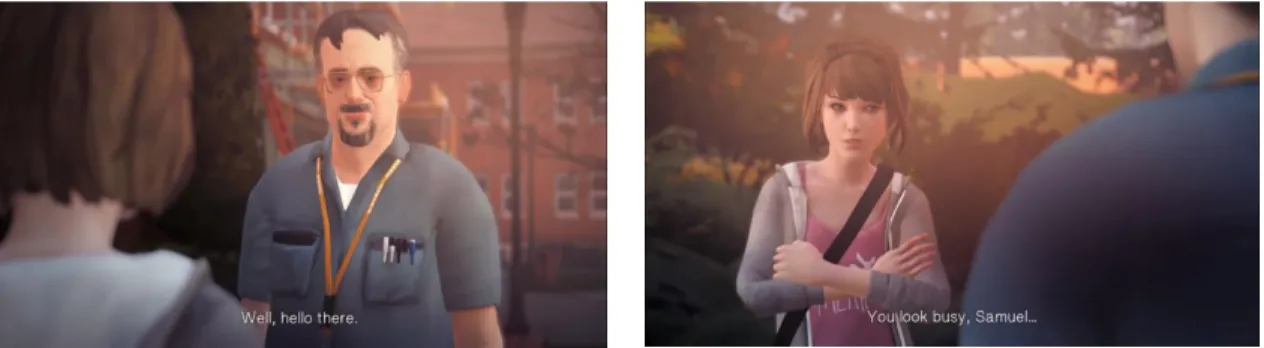
2015) functions as a useful case study in this regard: despite a generally positive critical reception, mainstream outlets have commented on the exceptionally poor quality of the lip synching (journalist Patrick Klepek quite comically expressed his frustration by simply writing “Those mouths aren't really saying the [subtitles] shown at the bottom of the screen, my
friends!”). Despite this shortcoming, Life is Strange is able to successfully stitch voices to their sources because of the way in which videogames were forced to relocate the symbolic source of voice. The game extensively utilizes cinematic shot/countershot sequences in order to position speaking characters in the center of the frame, often asserting their status as the source of
whatever voice is currently being heard (figs. 6 & 7). The game’s lip movements, while failing to
serve a filmic de-acousmatizing function, serve that function in the context of the videogame: while the lip motions are asynchronous with the exact lines being spoken, they are still synchronized with their respective voices on the broader terms of general bodily movement. Because the movement of the character is enough to indicate the source of the voice, Life is Strange is able to effectively stitch together its rendered bodies and voices in such a way as to make its conversations easily comprehendible. Even in the modern videogame, fully
synchronous lip synching is a virtuosic flair rather than a necessity.
Fig 6 (left) and Fig 7 (right). Max talks to Samuel the janitor in a shot/countershot sequence.
fact that these voices have, for all intents and purposes, been successfully de-acousmatized. Having been granted freedom from the constraining focal point of the mouth, voices tend to hang in the air around characters, contributing to a paradoxical situation wherein videogame voices take on a kind of independence whether or not their source has been identified. This creates a lingering sense of artificiality: voices are attached to their sources, but never in such a way as to let the unified “being” feel completely human. But this lingering tension doesn’t simply manifest as an inherent flaw of the videogame medium: rather, this medium-specific aural independence has given game developers the leeway necessary to develop methods of storytelling that
privilege audio, effecting the player’s understanding of time and space in profoundly varied
ways. This essay identifies three primary modes of aural-primary storytelling: the Audio-Log/Monologue, Travel Audio, and Potentially Offscreen Bodies. The distinct dissimilarity between these methods renders an overall chronotopal analysis of the aural-primary genre of videogame narrative essentially impossible (a chronotope that encapsulates all of these methods would prove too broad to be useful). Rather, each of these modes will be addressed separately, with issues of time-space referenced only when relevant.
IIa. Audio-Log and Monologue
The cyberpunk action-role playing game System Shock (Looking Glass Studios, 1994) begins with a hacker being captured whilst attempting to gain access to restricted files
of implanting the neural interface. Six months later, the hacker awakes from the coma to find the Citadel Space Station in a state of decrepitude: lights flicker and dead bodies litter the floor. The player is given control of the hacker, and tasked with finding a way to exit the room the hacker has found himself locked inside. To do so, the player must open a supply closet, where he/she will find the key required to exit the room. More importantly, however, the player will find an item called the Multimedia Data Reader, which allows the player to listen to e-mail messages and audio logs. Upon picking up the data reader, the player receives an audio e-mail from Rebecca Lansing, who explains the basic situation on Citadel Space Station to the hacker, and what must be done to stop SHODAN (Holmes 53).
This initial voice-recorded e-mail is the model by which all interactions with System Shock’s non-player characters occur: that is, every interaction plays out as a one-sided
conversation wherein the player/hacker listens to an email sent by a survivor on the station, or an audio log found within the environment. There are no conversations in System Shock: even the survivors will be killed before the player has a chance to speak to them in person. The entire narrative is communicated via e-mails – which are either presented linearly based on the player’s progress – or via audio recordings found in the environment, all of which predate the waking of the hacker from his coma and are found non-chronologically (Holmes 54). The game’s producer, Warren Spector, has stated that this narrative design developed out of dissatisfaction with the branching conversation options that were typical of System Shock’s contemporaries which,
real-time gameplay), and allowed for a non-linear, non-chronological telling of plot events (Holmes 55).
The two kinds of audio recordings the player could acquire in System Shock would diverge somewhat into their own subgenres within this mode of narrative storytelling: the linear, player-progress based emails would develop into what this paper calls “monologue,” while the non-chronological recordings the player can find within the environment would become the foundation for “audio log” narrative. The former would come to be associated with a particular brand of mechanically minimalist art games, typified by works like Dear Esther
(thechineseroom, 2012) and The Old City: Leviathan (Post Mod Softworks, 2014). In First Person Walkers like these, the player walks through a setting, triggering spoken narration as he/she proceeds through certain points in the game environment. Typically, games like Dear Esther and The Old City have few (or no) NPCs for the player to encounter, and only one narrative voice. The “audio-log” mode of narrative, on the other hand, is now primarily associated with the work of American auteur Ken Levine, who served as the lead writer and designer of the direct sequel to System Shock, as well as the game’s spiritual successor, Bioshock
(2K Boston, 2007). Levine’s work would follow the basic structure of System Shock very closely, often mixing in-perspective, linearly presented cinematics and one-sided radio conversations in conjunction with optional audio-logs.
instruments seeing as they “transmit sounds without showing their emitter” (Chion, Audio-Vison
71). This heavy usage of voices without sources generates a complicated relationship between time, space, and narrative, insofar as the narrative information has very little impact on the construction of a space, and in the case of audio-log narratives, has at best an indirect relationship with the player’s experience of in-game time.
There is, however, a sense in which this essay’s notion of player-action time can be applied to the monologue (and to a lesser extent, the audio-log). Because the monologue narrative is constructed as a series of voice over fragments, with each fragment triggered by reaching a certain area within a largely static game environment, the basic model of player input → plot output that serves as the foundation of player-action time remains more or less intact. However, the way in which monologue narratives do not interrupt the basic flow of gameplay complicates this basic construction of time: there is no segmentation of time, wherein looped-time is interrupted and moved forward for the sake of plot progression. Rather, monologue fragments are presented concurrently with the player’s movement through the world,
unaccompanied by any kind of visual plot event that would serve to interrupt that flow of play by either diverting attention or removing player agency for an extended period of time. This
separation between the aural fragments and the pacing of the player’s movement through the environment essentially surrenders the pace of the narrative wholly to the player, as there is no other diegetic entity in a basic monologue narrative to contest the player’s experience of time.
the recording itself. This simple interaction creates an experience more akin to the player input → plot output foundation of player-action time. However, the actual experience of the the audio-log happens during a moment of unbroken player agency and undirected attention, just as in the monologue. Ergo, what the player experiences between the recoveries of each separate audio log isn’t looped time, as these periods of time are filled with narrative information upon the retrieval of an audio-log. The player’s experience of time in the audio-log narrative is the same as the monologue narrative: a congruous experience of time between player and player-character.
The relationship between the monologue/audio-log mode of aural narrative and the player experience of videogame space is even more ill-defined. Because the voices of the monologue and audio-log remain firmly attached to the player, the aural information takes no part in the construction of the visual space the player is navigating. Thus, the relationship between this mode of narrative and the space it occupies is purely contextual, wherein the narrative fragments the player hears while traversing a space provide some kind of backstory or thematic framework for said space. For example, a winding staircase in The Old City: Leviathan is linked, via
monologue, to the relationship between evil and idiocy, and in Bioshock, two corpses lying on a bed become, thanks to an audio-log left at their side, two bereaved parents who failed to cope with the loss of their daughter. This mode of aural narrative essentially offers additional dramatic context for the space in which the player finds themselves. Monologues and Audio-logs do not construct spaces, but enrich them.
IIb. Travel Audio
In the opening cutscene of Grand Theft Auto IV (Rockstar, 2008), protagonist and player-character Niko Bellic steps off the boat into Liberty City5 for the first time with little more than a suitcase in hand, awaiting the arrival of his cousin Roman, whom he’ll be living with. Niko
5
spends a few moments alone in a dreary industrial dock, the lights of the city obscured by fog and massive tankers quietly floating in the port. Soon enough, the sound of distant Russian pop music pierces the air and a lone car can be seen careening down the dock towards Niko. Upon reaching Niko, the humble cab screeches to a halt, and out of the driver’s seat a drunken Roman
emerges, yelling ecstatically about the arrival of his beloved cousin. The two men share a fond hello and, as Roman stumbles about, Niko offers to drive the pair of them home. The two men enter the car, and the cutscene ends: the game cuts to a long shot behind the car, and the player is given control. As the player presses a button to make the car sputter to life, Roman tells Niko where to go, and a route is outlined on the extradiegetic mini-map in the corner of the screen. As the two men drive off towards Roman’s apartment, they begin to reminisce about the past, and express excitement about their future together in America.
This short sequence serves as a prototypical example of the structure of Travel Audio: a conversation between at least two characters, whose voices have both been previously
de-acousmatized, as they travel between two points in a playable sequence. This kind of sequence is synonymous with Rockstar Games’ open-world titles, which effectively utilize the extensive travel time inherent in the genre in a way most open-world titles fail to do, using these slow moments of transit as an opportunity to further the narrative. Travel audio is distinguished from the other modes of aural-primary narrative identified in this chapter by the way in which
Michel Chion posits that the spatial relationship between the voice and image is largely uncertain: that “in fact the greatest arbitrariness does prevail with regard to space” (Voice In Cinema 129). He suggests that spatial incoherence does not bother the audience, specifically citing the way in which film has normalized presenting characters in long shot while playing their voices as though they were close to the camera (Voice in Cinema 129). Interestingly, it is this exact arrangement of voice and image that defines Travel Audio: characters gather into a vehicle, which is then shown in long shot (by default) during gameplay, while the dialogue is mixed in such a way as to dominate the aural environment making it appear as though the characters are, to borrow a film phrase, miked closely. It is worth calling into question the arbitrariness of this relationship between image and voice, as the nature of the videogame medium raises questions of player identification that may be resolved by examining the closeness of the voice in Travel Audio.
Frank Biocca has posited that when a user interfaces with a virtual environment, his/her sense of presence actually oscillates between three different environments: the physical
the screen body, and the imagined body6(19). Landay suggests that sound has the potential to bridge the gap between these levels of presence in a way that image and action cannot: in an examination of Limbo, Landay identifies how “although we are always visually distant from the [avatar], the sound is immediate” (18). It is the immediacy of this sound (as well as, in the case of Limbo, that sound’s musical quality), Landay suggests, that “connects the player to the physical and emotional experience of the avatar body” (19-20). The closeness of the voices of Travel Audio captures that same sense of immediacy, re-positioning the player within the onscreen space. The close proximity of the voices despite the use of the long shot serves to bridge the gap between the physical body and the screen body, creating a dualism in the imagined body wherein the player is simultaneously positioned within the player-character’s means of transit while still being physically removed from it via the third person perspective. Thus, Travel Audio is able to reconfigure videogame space in such a way as to let the player align him/herself with the screen body, relocating him/herself within an environment and transforming the sense of control over an avatar to a sense of presence within said avatar.
The simplest way to understand the way in which Travel Audio effects the progression of time in videogame narratives is to actually remove the Travel Audio from its own schema. Without the audio component, what remains of the basic narrative structure outlined previously is an uncomplicated example of player-action time: two moments of plot progression (the respective events that occur at points A and B) are separated by bouts of cyclical time (this time is often marked by an inconsequential day-night cycle in open world videogames), wherein the player is able to further the plot by traveling to point B. Travel Audio complicates this basic adherence to player-action time, as it fills the cyclical time with consequential character
6 In my understanding, this terminology deemphasizes the way in which the virtual body, in Boccia’s usage, can
interaction. In these instances, then, the player’s experience of time is comparable to the player-character’s experience of time, meaning that travel audio injects the congruous time of the monologue/audio-log into the basic formula of player-action time. The aural construction of congruous time overrides any visual cues of cyclical time, thus privileging the audio, and reconfiguring the player’s understanding of the progression of in-game time as something approximating the time experienced by the physical body.
IIc. Potentially Offscreen Bodies
to safely travel across a dystopic, 1984-esque cityscape. This conversation features scripted movement of Vance and Kleiner and directly informs what is to come in the game’s narrative, but the player is free to focus on the details of their choosing in the lab.This surrendering of the visual focus to the whim of the player implicitly prioritizes the authored sound over any authored image (as the sound of these authored sequences is designed to be heard whether or not the attention of the player has been diverted), meaning that this kind of narrative sequence is aural primary.
It is this variation of aural narrative that bears the closest relationship to the player’s experience of videogame space. Mark Grimshaw has noted the way in which sound operates in both the physical and virtual environment, because sound “has a real volume and dimensionality that is a 3-dimensional representation of the 2-dimensional representation of the 3-dimensional world of the game” (119). Because of the 3-dimensional nature of sound, says Grimshaw,
videogames “posit the player as a first-person auditor,” insofar as the diegetic sonic environment