A questionnaire to capture students’ perceptions
of research integration in their courses
Gerda J. Visser-Wijnveen1•Roeland M. van der Rijst1•
Jan H. van Driel1
Published online: 2 July 2015
The Author(s) 2015. This article is published with open access at Springerlink.com
Abstract Using a variety of research approaches and instruments, previous research has revealed what university students tend to see as benefits and disadvantages of the inte-gration of research in teaching. In the present study, a questionnaire was developed on the basis of categorizations of the research–teaching nexus in the literature. The aim of the Student Perception of Research Integration Questionnaire (SPRIQ) is to determine the factors that capture the way students perceive research integration in their courses. The questionnaire was administered among 221 students from five different undergraduate courses at a research intensive university in The Netherlands. Data analysis revealed four factors regarding research integration: motivation, reflection, participation, and current research. These factors are correlated with students’ rating of the quality of the course and with their beliefs about the importance of research for their learning. Moreover, courses could be distinguished in terms of research intensiveness, from the student perspective, based on the above-mentioned factors. It is concluded that the SPRIQ helps to understand how students perceive research integration in specific courses and is a promising tool to give feedback to teachers and program managers who aim to strengthen links between research, teaching, and student learning.
Keywords Evaluation of teachingInquiry-based coursesQuestionnaire design
Research–teaching nexusStudent experience
& Gerda J. Visser-Wijnveen [email protected]
1
ICLON Graduate School of Teaching, Leiden University, P.O. Box 905, 2300 AX Leiden, The Netherlands
Introduction
Research and teaching are two of the main tasks of universities. A close link between them is often considered to be at the heart of the institution (Elen and Verburgh2008). This close link is currently not only desired by traditional research universities, but also becomes increasingly important to newer universities and other higher education institutions (Kyvik and Skodvin 2003). Graduate and undergraduate programs typically aim to offer their students educational programs that are linked to academic research, for instance, by having courses taught by academic staff who are involved in research, or by engaging students in research practices. The academic community has studied the research–teaching nexus for decades with varying emphases. Until the 1990s, attention was primarily paid to the correlation between being a good researcher and being a good teacher, generally measured by citation indices and student satisfaction, respectively. However, a meta-analysis (Hattie and Marsh 1996) showed only a marginal correlation between these measures. Many academics were nonetheless convinced of the importance of the relation (Neumann1992). They preferred combining research and teaching (Jensen 1988) and considered linking research and teaching beneficial for their students (Elen et al.2007). Accordingly, a shift occurred to studies in which academics’ views took central ground. In recent years, stu-dents’ perspectives have increasingly come to the foreground. These studies show mostly advantages, but also disadvantages of research integration in university teaching (Turner et al. 2008; Visser-Wijnveen et al. 2012). This paper describes the development and validity of the Student Perception of Research Integration Questionnaire (SPRIQ). The questionnaire is developed to measure students’ perceptions of the integration of research in teaching. A better understanding of the way students perceive research integration in university courses is important for academic staff and program managers who aim to strengthen links between research, teaching, and student learning, as it helps them to identify whether intentions of staff are coherent with students’ experiences.
Previous studies on students’ perceptions of research integration
More recently, several studies used a survey methodology to capture students’ expe-riences of research integration (Breen and Lindsay 1999; Healey et al.2010; Spronken-Smith et al.2014; Turner et al.2008; Verburgh and Elen2011). For example, Breen and Lindsay (1999) conducted a survey study to analyse the relations between student moti-vation and student beliefs about academic research. They distinguished three groups of students: Intrinsic Competent, Extrinsic Social, and Independent Impersonal. The first group consists of students who are intrinsically motivated and feel confident about the course requirements; they value highly research activities of academic staff. The second group consists of externally motivated students whose lives evolve around social inter-action with fellow students and staff. The third group of students prefers to study inde-pendently and has no interest in communication with staff. These two latter groups are, respectively, indifferent and hostile to the inclusion of research in teaching. Most survey studies focused on students’ perceptions of positive or negative impacts of research and their awareness of research conducted by academic staff at their department or the uni-versity as a whole. In the questionnaire designed by Healey and colleagues (Healey et al. 2010; Turner et al. 2008), which was also used by Spronken-Smith et al. (2014) and adapted by Verburgh and Elen (2011), students were asked to identify whether they had experience with various research activities during their studies, whether they were aware of specific research activities taking place at the university and in their department and were asked to score statements about the positive and negative influence of these research activities on their learning. The findings were consistent with results from previous studies: students reported largely positive influences of research activities, especially increased understanding of the subject and stimulated interest and enthusiasm, but also negative influences, such as teachers’ lack of interest in teaching and lack of availability (Healey et al.2010; Spronken-Smith et al. 2014; Turner et al.2008). Verburgh and Elen (2011) found that the integration of research in the classroom was the most important factor in predicting the appreciation of research aspects in the learning environment, next to awareness of research of the own lecturers, year of study, awareness of research at the university, and whether the discipline was hard (one dominant paradigm is present) or soft (several coexisting paradigms are present) (cf. Biglan1973). The above-mentioned studies gave insight into the occurrence of students’ experiences with individual research activi-ties, such as undertaking an independent project, reading a research paper, and attending a research seminar (Healey et al.2010; Spronken-Smith et al.2014; Turner et al.2008), or captured all of their experiences in one measure, called the ‘experienced research inte-gration’ (Verburgh and Elen 2011). However, none of these studies identified students’ perceptions of the different ways in which research can be integrated in teaching. This study addresses that gap by empirically building scales that capture the various distin-guishable features within students’ perceptions. Furthermore, this study differs from pre-vious survey studies in focusing on the course (i.e., module or course unit) level.
Tangible and intangible nexus between research and teaching
nexus, the clearly visible forms of the integration of research and teaching are included, such as the transmission of advanced knowledge and results from recent research, and the explicit teaching of research skills and methodology. Neumann (1992) portrayed the intangible connection between research and teaching as related to students developing approaches and dispositions towards knowledge development and research. In the intan-gible nexus, the more tacit, not directly observable forms of integration of research and teaching are grouped, such as creating an inquisitive research climate, fostering an inno-vative atmosphere, or stimulating the development of students’ research dispositions. Intangible elements have often been denoted by teachers and by educational researchers as relevant elements of learning to do research, but few researchers (McLean and Barker 2004; Elen et al.2007; Elen and Verburgh2008) have addressed the relation between these intangible elements of the research–teaching nexus and students’ experiences of courses.
Model on research and teaching
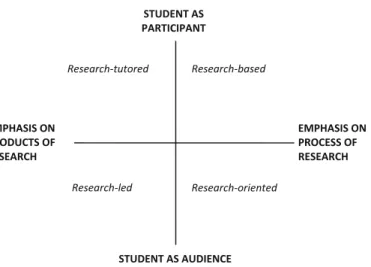
Healey (2005) described a model that distinguishes two dimensions of curricula related to tangible linkages between research and teaching, namely 1) emphasis on research products or emphasis on research processes and problems, and 2) students as participants or as audience (Fig.1).
In this model, four quadrants can be distinguished, which are interpreted as four distinct ways of integrating research and teaching in university curricula. Research-led teaching can be characterized as teaching with an emphasis on the research products or outcomes, without students engaging in inquiry or research activities. In research-oriented teaching, students have no active role in inquiry either, but the learning objectives are focused on the research problems and processes instead of research products, so in this quadrant students focus on learning research methods. In research-based teaching, students actively partic-ipate in research or inquiry with an emphasis on the research processes and problems. In research-tutored teaching, students also play an active role, for instance, by critically analysing and discussing outcomes of academic research; meanwhile, teaching is mostly
Research-tutored Research-based
Research-led Research-oriented
EMPHASIS ON PROCESS OF RESEARCH
STUDENT AS AUDIENCE EMPHASIS ON
PRODUCTS OF RESEARCH
STUDENT AS PARTICIPANT
focused towards research products. In order to illustrate research-tutored ways of teaching, Healey (2005) used the example of the tutor model from Oxford University.
Although this model provides a framework for constructing and evaluating the research integration in curricula from the perspective of the teaching staff, it is not evident that, in their courses, students experience the dimensions described in this model in a similar way. Therefore, in order to evaluate research integration in learning environments from the perspective of the students, we need to explore the factors that capture students’ percep-tions of research integration in university teaching.
Research aims
The present paper describes the development and validity of the Student Perception of Research Integration Questionnaire (SPRIQ). The purpose of this study is twofold. Firstly, our aim is to develop a valid questionnaire that measures students’ perceptions of research integration in courses that can be used to provide feedback to teachers, educational directors, and educational program managers who work towards strengthening linkages between research, teaching, and student learning in their institutions and teaching. Sec-ondly, our aim is to increase our understanding of student perceptions of research in their learning environment. Thus, we focus on the learning environment from the perspective of the students (the attained curriculum; van den Akker2003); however, we are aware that there are multiple ways to evaluate learning environments in higher education.
Method
Instrument
The questionnaire consists of three constructs; ‘research integration’, ‘quality of the course’, and ‘beliefs about research integration’. The construct of ‘research integration’ can be subdivided, including both tangible and intangible themes. The tangible themes were derived from Healey’s above-mentioned model (2005) that consists of two dimen-sions. This resulted in the subscales: focus on ‘research product’, ‘research process’, ‘students as participants’, and two subscales on student as audience: ‘current research’ and ‘teacher’s own research’. Thus, five subscales were based on tangible themes. Three other subscales focused on the intangible aspects (Neumann 1992): ‘integration in research
Table 1 Course descriptions
Course Department Year Credits (EC)a
Students Classes Short description
Introduction to medicine
Medical BA3 4 107 Lectures Concentrates on the diagnostic process on the basis of a case study. Potential cures and the role of clinical research are discussed. Includes practice in the critical reading of research papers Philology 3 Languages BA2 5 55 Lectures and
seminars
Concentrates on the language’s history and variety. Offers introduction to common interdisciplinary research. Practice in the use of databases for research Philology 5 Languages BA3 5 21 Seminars Concentrates on the
language’s history by studying a historic case study to understand the period’s language and learn how to do textual and linguistic analyses and how to interpret research results
Informatics 2 Technology BA2 6 11 Lectures and seminars
Introduction to the theory of computation with emphasis on the relationships between formal languages, automata and abstract models of computation Study methods Technology BA1 6 14 Seminars and
student presentations
The course includes an introduction to the basic aspects of scientific research and offers strategies for studying and aims to enlarge students’ academic skills
a
community’, ‘motivation for research’, and ‘academic disposition’. The scales ‘quality of the course’ and ‘beliefs about research integration’ were also included because students’ opinions on the quality of a course and their beliefs about the importance of research integration in their education in general could influence their scores on ‘research inte-gration’ (cf. Verburgh and Elen2011). All items were scored on a 5-point Likert scale; 36 questions were scored on a frequency scale, ranging from very rarely to very frequently, while the four questions of the beliefs scale were scored on an agreement scale, ranging from strongly disagree to strongly agree.
Procedure
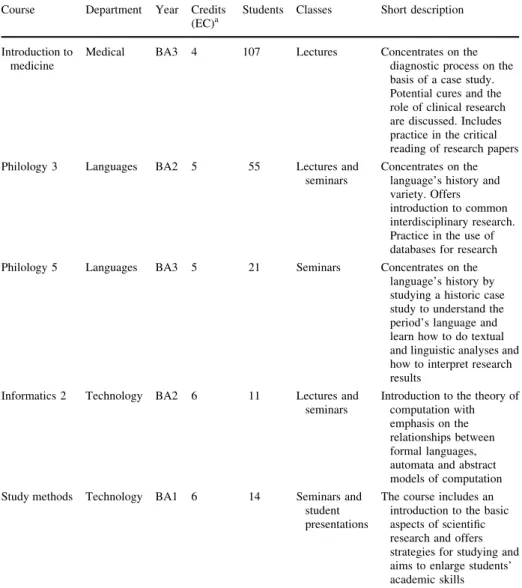
The questionnaire was distributed during the final class of five undergraduate courses within three faculties: medical, science, and humanities of one research intensive uni-versity in The Netherlands. These courses included all three bachelor years (cf. Spronken-Smith et al.2014; Verburgh and Elen2011) and represented both hard and soft disciplines (cf. Biglan1973); this disciplinary distinction was found to be relevant in Verburgh and Elen’s (2011) study about students’ research appreciation. All students present at the final sessions were asked to complete the questionnaire. A total of 221 students completed the questionnaire. Only those students who completed the full questionnaire were included in the analyses. As a result, the final number of respondents was 208. The courses varied in number of hours, type of classes, and in the way they included research in the course. In Table1, additional information on the courses is presented.
Analysis
In order to arrive at a model with an acceptable fit and thus a valid and useful question-naire, exploratory factor analyses were conducted to explore the proposed model and alternative models. Given the expected relatively high correlations between the factors, an oblique rotation was preferred over an orthogonal rotation: Oblimin with Kaiser normal-ization was applied as rotation method. Velicer’s Minimum Average Partial (revised) criterion was used to determine the number of factors. To explore alternative models, only items that loaded at least .50 on a factor were included in further analyses. Additionally, to achieve a more economical questionnaire (i.e., the least possible number of items within a scale), items meeting one of the two following criteria were removed: (1) items with the lowest estimates in the largest scale if internal consistency permitted, in particular if removal of such items resulted in an increase in Cronbach’s alpha; (2) if based on the covariance modification indices, covariates were suggested between an item and another scale. Finally, modification indices were examined to identify any error covariates within scales that would considerably improve the fit of the model.
AFGIare more sensitive to model misspecification thanTLIandCFI, but also more down-ward biased with smaller sample sizes, whileRMSEAis best in terms of model specification (Fan et al.1999). A value equal to or greater than 0.90 is considered a good fit in the case of
GFI,AGFI, TLI,andCFI(Hoe2008; Hoyle1995). ARMSEAvalue equal to or less than 0.05
is used as an indication of a good fit of the data with the assumed model, and less than .08 is considered an acceptable fit (Hoe 2008). Other structural measures included the internal consistency, or reliability, of each scale as measured by Cronbach’s alpha, and the correla-tions between the scales, as measured by the Pearson correlation coefficient.
To examine the content validity, we took a closer look into the five courses included in this study as a first exploration of the potential to distinguish between courses. Therefore, we carried out an ANOVA with Tukey B post hoc test. Additionally, we compared the results of each course to the course content to see whether the different scores could be explained by the different characteristics of the courses.
Results
Structure of the SPRIQ
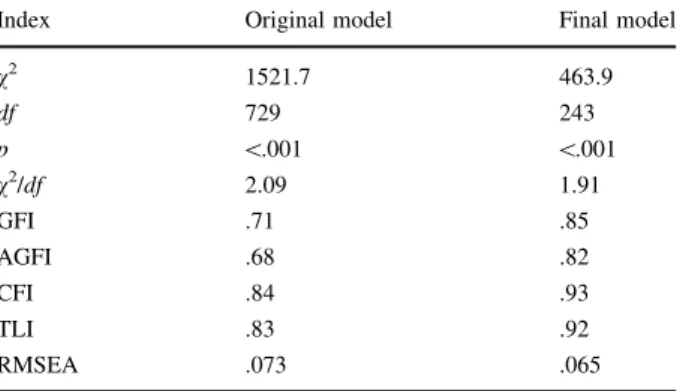
The results of the confirmatory factor analyses are presented in Table2 for the original model (40 items) and the final model (24 items). The original model, consisting of eight subscales of four items that all contributed to oneresearch integrationscale, and separate
qualityandbeliefs scales showed a moderate fit. The exploratory factor analyses clearly
identified the separatequalityandbeliefsscales; however, the eight subscales contributing
to aresearch integrationscale were not supported. Instead, the exploratory factor analysis
suggested four different subscales. None of the items of either ‘integration in research community’ or ‘academic disposition’ were included in these subscales because of low loadings. After removal of low loading items and reduction in the number of items in the
current research scale, the following scores on the various fit indices were attained,
indicating an acceptable fit for the final model.
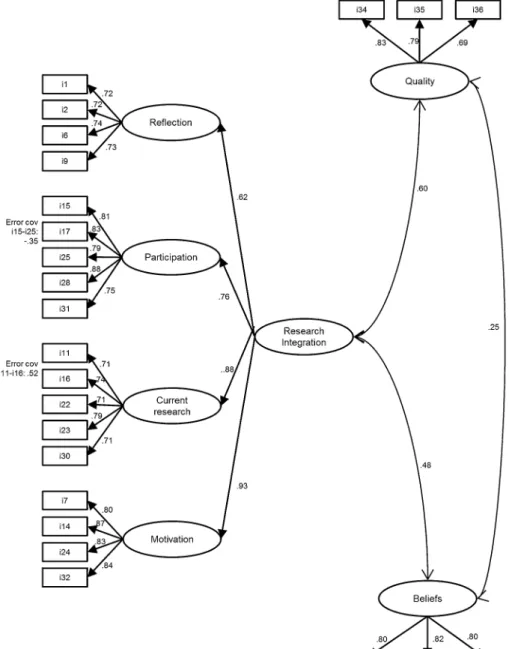
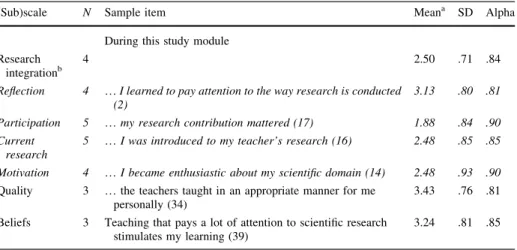
The final model includes three scales: research integration, which consists of four subscales,quality, andbeliefs(each 3 items). The fourresearch integrationsubscales are as follows: reflection(4 items),participation (5 items), current research(5 items), and
motivation(4 items). The subscale reflectionincludes items focusing on attention being
paid to the research process leading to research results. The subscaleparticipationincludes
Table 2 Results of the
confir-matory factor analysis Index Original model Final model
v2
1521.7 463.9
df 729 243
p \.001 \.001
v2/df 2.09 1.91
GFI .71 .85
AGFI .68 .82
CFI .84 .93
TLI .83 .92
items on the involvement of students in and their contribution to scientific research.
Current researchis a combination of items concentrating on getting to know the current
research from their teachers and in general. Motivationconsists of items concerning an increase in student’s enthusiasm and interest for the domain. Quality deals with items related to elements deemed important for good quality teaching, and beliefs captures students’ beliefs about the importance of research integration for their learning (Fig.2).
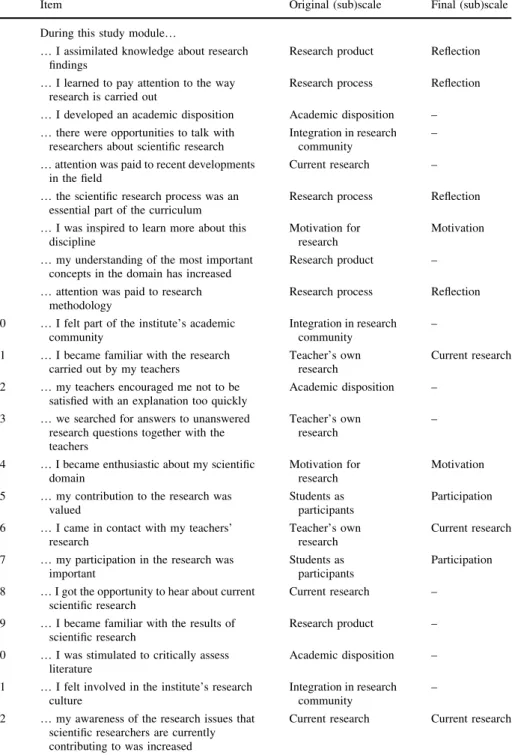
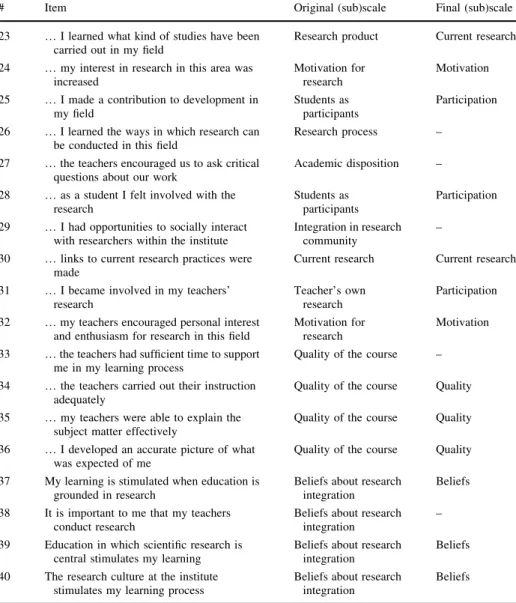
In Table3, we present the Cronbach’s alphas, the means and standard deviations of all (sub)scales. A sample item is given for each (sub)scale. The full questionnaire can be found in the appendix (Table6), including references to the intended (sub)scale and the final (sub)scale. All alpha’s are above .80, and therefore, the internal consistency of each (sub)scale can be considered good. Means vary between 1.88 forparticipationto 3.43 for
quality.
The final structural characteristic we present is the Pearson correlation coefficients between the scales (see Table4). All scales correlate significantly with each other at the .01 level. Relatively high correlations can be found betweencurrent research,motivation,
andparticipation(.70, .67, and .64, respectively).Reflection,beliefs, andqualityshow low
to moderate correlations with the other (sub)scales. All these (sub)scales correlate highest
with motivation(.47, .45, and .53, respectively), although reflection shows comparable
correlations withparticipationandcurrent research.
Content of the SPRIQ
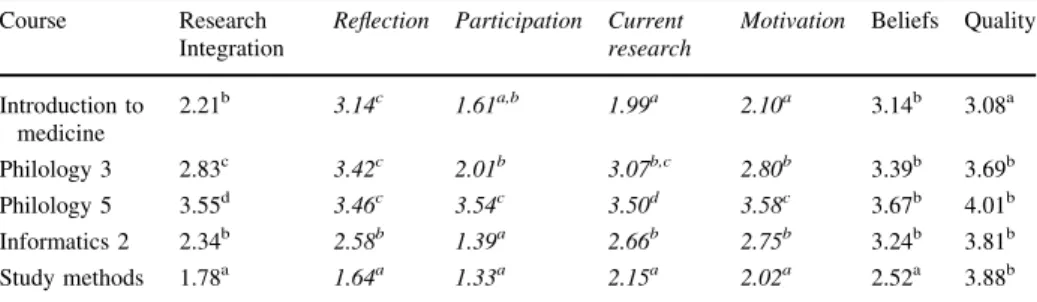
Considerable different scores on the various scales were found between the courses. The results of the post hoc tests are presented in Table5.
First, the four subscales that make up theresearch integrationscale will be discussed; next, the scalesbeliefsandqualitywill be discussed as additional measures.
The subscale reflection includes items that reflect on the way research results are produced. The courses in Medicine and Languages paid significantly more attention to this aspect than both Technology courses. While Informatics 2 concentrated on the current ‘state of the art’ instead of the methodological part, Study methods aimed to introduce research method aspects. However, this course hardly discussed research content, so from that perspective the low score onreflectionmight be explained.
Within the subscaleparticipation, Philology 5 stands out. This corresponds with the teacher’s aim to introduce students to research analysis, including practicing with an
Table 3 Characteristics of the (sub)scales in the final questionnaire
(Sub)scale N Sample item Meana SD Alpha
During this study module Research
integrationb
4 2.50 .71 .84
Reflection 4 …I learned to pay attention to the way research is conducted (2)
3.13 .80 .81
Participation 5 …my research contribution mattered (17) 1.88 .84 .90 Current
research
5 …I was introduced to my teacher’s research (16) 2.48 .85 .85
Motivation 4 …I became enthusiastic about my scientific domain (14) 2.48 .93 .90 Quality 3 …the teachers taught in an appropriate manner for me
personally (34)
3.43 .76 .81
Beliefs 3 Teaching that pays a lot of attention to scientific research stimulates my learning (39)
3.24 .81 .85
a On a response scale of 1–5
authentic research case. Hardly any research participation was expected within Informatics 2, Study methods, and Introduction to medicine, which is reflected by their low scores.
On the subscalecurrent research, Introduction to medicine was scored on the low end, together with Study methods. Both courses concentrated on research methods rather than current research. The ‘state-of-the-art’ character of Informatics 2 resulted in a higher score for this course. The Philology courses were scored highest on this subscale, which is consistent with the aims of these courses.
The subscale motivation relates to students’ increased interest and motivation for research in the discipline of their course. The scores on this subscale can be divided into three groups, with Introduction to medicine and Study methods on the lower end. In these courses, the analytical skills are mainly used as means to an end and not necessarily contributing to research, so the increase in motivation for research is limited. Moderate scores were obtained by Informatics 2 and Philology 3, which focus, among other things, on research content. Philology 5 was scored highest onmotivation, and in fact on all other (sub)scales, and showed to be most motivating for research.
Table 4 Pearson correlation coefficient between the (sub)scales
(Sub)scale Research Integration
Reflection Participation Current research
Motivation Beliefs Quality
Research integration 1.00 .72** .84** .87** .87** .40** .48**
Reflection 1.00 .45** .46** .47** .31** .18**
Participation 1.00 .67** .64** .27** .36**
Current research 1.00 .70** .30** .47**
Motivation 1.00 .45** .53**
Beliefs 1.00 .23**
Quality 1.00
**p\.01 Subscales in italics
Table 5 Comparison of mean scores on the (sub)scales between courses
Course Research Integration
Reflection Participation Current research
Motivation Beliefs Quality
Introduction to medicine
2.21b 3.14c 1.61a,b 1.99a 2.10a 3.14b 3.08a
Philology 3 2.83c 3.42c 2.01b 3.07b,c 2.80b 3.39b 3.69b Philology 5 3.55d 3.46c 3.54c 3.50d 3.58c 3.67b 4.01b Informatics 2 2.34b 2.58b 1.39a 2.66b 2.75b 3.24b 3.81b Study methods 1.78a 1.64a 1.33a 2.15a 2.02a 2.52a 3.88b
The scalebeliefsis not course specific, nonetheless, students in Study methods, the only Bachelor 1 course, award less importance to research for their learning. The four other courses were scored similarly on this scale (i.e., between 3.14 and 3.67).
The scalequalityintends to measure the overall quality of the course and is harder to evaluate based on course description. All courses were scored relatively high onquality; however, Introduction to medicine, which was the only large class, complete lecture-type course, was scored considerably lower.
Discussion and conclusion
This study aimed to improve our understanding of the way in which university students perceive and experience the research–teaching nexus in specific courses. Furthermore, by developing a questionnaire to measure students’ perceptions, the study aimed to create a tool that can be used by academics, for instance, to explore to what extent the intentions of their courses come across to the students. The SPRIQ was based on the literature about the research–teaching nexus, in particular on the distinction between tangible and intangible aspects of the nexus (cf. Neumann 1992) and on the model by Healey (2005) that dis-tinguishes between outcomes of research and the process of research, on the one hand, and between the role of students as either participants or audience, on the other hand. Initially, eight subscales were designed to capture the integration of research in teaching. The SPRIQ was administered in five undergraduate courses that differed in terms of academic content and in their goals with respect to the research–teaching nexus.
Analysis of the data revealed a factor structure which differed from the intended structure. The scale research integrationappeared to consist of four subscales, labelled
reflection,participation, current research, andmotivation.Reflection,participation, and
current researchconcerned tangible aspects, whereas intangible aspects were apparent in
the motivationsubscale. In this way, the distinction made by Neumann (1992) was
con-firmed empirically. Interestingly, two of the envisioned three intangible subscales could not be identified in the students’ responses, nor were any of these items included in other subscales, suggesting that the intangible aspects, such as the development of an academic disposition, are hard to grasp for students. Furthermore, Healey’s (2005) dimension ‘stu-dents as participants versus audience’ was apparent, in particular in the subscales
partic-ipationon the one hand andcurrent researchandreflectionon the other hand. The latter
concerns students’ awareness of the research that is currently done in the course domain, or by their teacher, however, not necessarily with a contribution from the part of the students. This is in contrast to participation in which students’ contributions were required. The other dimension in Healey’s (2005) model, that is, emphasis on the outcomes versus the process of research, did not come up in separate subscales. In contrast, items that initially were grouped in subscales ‘research product’ or ‘research process’ appeared to be com-bined in the final subscales, in particularreflection. In other words, in the way students perceive research integration in their courses, the distinction between the process and the outcomes of research is not fundamental.
high on students’ priority lists (Robertson and Blackler 2006; Buckley2011), and
moti-vationrelates to the inspiring role that research integrated teaching can have (Jenkins et al.
1998; Robertson and Blackler2006).
In addition to theresearch integrationscale, the SPRIQ contained two other scales, one measuring students’ perceptions of the quality of the course, and the other measuring students’ rating of the importance of research integration for their learning (beliefs). As expected, these scales came out as separate factors; however, both were correlated with
research integrationand its subscales. Thus, it is advised to include these two factors when
investigating perceived research integration in courses. If students evaluate the quality of a course as low, or if they would not value research for their learning, this could negatively affect their scores on theresearch integrationscale.
Indications of content validity of the SPRIQ can be derived from the specific scores from five different courses. Given the respective objectives of these courses, it makes sense that Study methods scored relatively low onresearch integration, in particular on
par-ticipation. On the other side of the spectrum, it is encouraging to see that Philology 5,
which aims to be a particular research intensive course, received by far the highest scores on all research integration subscales. Interestingly, thequalityof both these courses was rated similarly. Furthermore, even courses that rated comparably on the overallresearch
integrationscale, for example, Introduction to medicine and Informatics 2, could be
dis-tinguished based on the subscales. While Introduction to medicine received higher scores
on reflection, Informatics 2 scored higher on current research and motivation. Using
subscales, therefore, clearly adds to, amongst other aspects, the feedback function of the questionnaire compared to combining all different research related activities into one overall research integration score (cf. Verburgh and Elen 2011) or ticking individual research activities (cf. Healey et al.2010; Spronken-Smith et al.2014; Turner et al.2008). Additionally, thebeliefsscale was scored similarly for all courses, except for the Bachelor 1 course (i.e., Study methods). The literature is ambiguous on the influence of year of study. Some studies suggest that belief in the benefit of integrating research for students learning increases with years of study (cf. Lindsay et al.2002; Neumann1994), while Verburgh and Elen (2011) found that first-year students indicated more positive aspects. Our small sample did not aim to answer this unresolved question, but given this finding and the ongoing debate, it is recommended to continue including thebeliefsscale in future research.
We conclude that the present study contributed to our understanding of how students perceive the integration of research in specific courses. The factorsmotivation,reflection,
participation, and current research, together capture students’ perception of research
integration accurately. The SPRIQ, in its present form, is a promising tool to provide information about students’ perceptions to teachers and program managers who aim to strengthen links between research, teaching, and student learning in educational practice. Clearly, more studies, including a variety of disciplines and years of study, are needed to further explore the validity of the SPRIQ. Future research may also use this instrument in large-scale studies to explore differences in students’ perceptions of courses in varying disciplines and years of study (cf. Verburgh and Elen2011), or relate students’ perceptions of research integration to their learning (cf. Spronken-Smith et al.2012for inquiry-based learning).
Open Access This article is distributed under the terms of the Creative Commons Attribution 4.0
Appendix
Table 6 Items of the Student Perception of Research Integration Questionnaire (SPRIQ)
# Item Original (sub)scale Final (sub)scale
During this study module…
1 …I assimilated knowledge about research findings
Research product Reflection
2 …I learned to pay attention to the way research is carried out
Research process Reflection
3 …I developed an academic disposition Academic disposition – 4 …there were opportunities to talk with
researchers about scientific research
Integration in research community
–
5 …attention was paid to recent developments in the field
Current research –
6 …the scientific research process was an essential part of the curriculum
Research process Reflection
7 …I was inspired to learn more about this discipline
Motivation for research
Motivation
8 …my understanding of the most important concepts in the domain has increased
Research product –
9 …attention was paid to research methodology
Research process Reflection
10 …I felt part of the institute’s academic community
Integration in research community
–
11 …I became familiar with the research carried out by my teachers
Teacher’s own research
Current research
12 …my teachers encouraged me not to be satisfied with an explanation too quickly
Academic disposition –
13 …we searched for answers to unanswered research questions together with the teachers
Teacher’s own research
–
14 …I became enthusiastic about my scientific domain
Motivation for research
Motivation
15 …my contribution to the research was valued
Students as participants
Participation
16 …I came in contact with my teachers’ research
Teacher’s own research
Current research
17 …my participation in the research was important
Students as participants
Participation
18 …I got the opportunity to hear about current scientific research
Current research –
19 …I became familiar with the results of scientific research
Research product –
20 …I was stimulated to critically assess literature
Academic disposition –
21 …I felt involved in the institute’s research culture
Integration in research community
–
22 …my awareness of the research issues that scientific researchers are currently contributing to was increased
References
Biglan, A. (1973). Characteristics of subject matter in different academic areas.Journal of Applied Psy-chology, 57, 195–203.
Breen, R., & Lindsay, R. (1999). Academic research and student motivation.Studies in Higher Education, 24, 75–93.
Buckley, C. A. (2011). Student and staff perceptions of the research-teaching nexus.Innovations in Edu-cation and Teaching International, 48, 313–322.
Table 6 continued
# Item Original (sub)scale Final (sub)scale
23 …I learned what kind of studies have been carried out in my field
Research product Current research
24 …my interest in research in this area was increased
Motivation for research
Motivation
25 …I made a contribution to development in my field
Students as participants
Participation
26 …I learned the ways in which research can be conducted in this field
Research process –
27 …the teachers encouraged us to ask critical questions about our work
Academic disposition –
28 …as a student I felt involved with the research
Students as participants
Participation
29 …I had opportunities to socially interact with researchers within the institute
Integration in research community
–
30 …links to current research practices were made
Current research Current research
31 …I became involved in my teachers’ research
Teacher’s own research
Participation
32 …my teachers encouraged personal interest and enthusiasm for research in this field
Motivation for research
Motivation
33 …the teachers had sufficient time to support me in my learning process
Quality of the course –
34 …the teachers carried out their instruction adequately
Quality of the course Quality
35 …my teachers were able to explain the subject matter effectively
Quality of the course Quality
36 …I developed an accurate picture of what was expected of me
Quality of the course Quality
37 My learning is stimulated when education is grounded in research
Beliefs about research integration
Beliefs
38 It is important to me that my teachers conduct research
Beliefs about research integration
–
39 Education in which scientific research is central stimulates my learning
Beliefs about research integration
Beliefs
40 The research culture at the institute stimulates my learning process
Beliefs about research integration
Beliefs
Elen, J., Lindblom-Yla¨nne, S., & Clement, M. (2007). Faculty development in research-intensive univer-sities: The role of academics’ conceptions on the relationship between research and teaching. Inter-national Journal for Academic Development, 12, 123–139.
Elen, J., & Verburgh, A. (2008).Bologna in European research universities. Implications for bachelor and master programs. Antwerpen: Garant.
Fan, X., Thompson, B., & Wang, L. (1999). Effects of sample size, estimation method, and model speci-fication on structural equation modeling fit indexes.Structural Equation Modeling, 6, 56–83. Hattie, J., & Marsh, H. W. (1996). The relationship between research and teaching: A meta-analysis.Review
of Educational Research, 66, 507–542.
Healey, M. (2005). Linking research and teaching: Exploring disciplinary spaces and the role of inquiry-based learning. In R. Barnett (Ed.),Reshaping the university: New relationships between research, scholarship and teaching(pp. 67–78). London: McGraw Hill/Open University Press.
Healey, M., Jordan, F., Pell, B., & Short, C. (2010). The research-teaching nexus: A case study of students’ awareness, experiences and perceptions of research.Innovations in Education and Teaching Inter-national, 47, 235–246.
Hoe, S. L. (2008). Issues and procedures in adopting structural equation modeling technique.Journal of Applied Quantitative Methods, 3, 76–83.
Hoyle, R. H. (Ed.). (1995).Structural equation modeling: Concepts, issues, and applications. Thousand Oakes, CA: Sage.
Jenkins, A., Blackman, T., Lindsay, R., & Paton-Saltzberg, R. (1998). Teaching and research: Student perspectives and policy implications.Studies in Higher Education, 23, 127–141.
Jensen, J. (1988). Research and teaching in the universities of Denmark—Does such an interplay really exist.Higher Education, 17, 17–26.
Kyvik, S., & Skodvin, O.-J. (2003). Research in the non-university higher education sector—Tensions and dilemmas.Higher Education, 45, 203–222.
Lindsay, R., Breen, R., & Jenkins, A. (2002). Academic research and teaching quality: The views of undergraduate and postgraduate students.Studies in Higher Education, 27, 309–327.
Marsh, H. W., Rowe, K. J., & Martin, A. (2002). PhD students’ evaluations of research supervision.The Journal of Higher Education, 73, 313–348.
McLean, M., & Barker, H. (2004). Students making progress and the ‘research-teaching nexus’ debate. Teaching in Higher Education, 9, 407–419.
Neumann, R. (1992). Perceptions of the teaching-research nexus: A framework for analysis.Higher Edu-cation, 23, 159–171.
Neumann, R. (1994). The teaching-research nexus: Applying a framework to university students’ learning experiences.European Journal of Education, 29, 323–338.
Prosser, M., & Trigwell, K. (1999).Understanding learning and teaching. The experience in higher edu-cation. Buckingham: SRHE & Open University Press.
Robertson, J., & Blackler, G. (2006). Students’ experiences in learning in a research environment.Higher Education Research and Development, 25, 215–229.
Spronken-Smith, R., Mirosa, R., & Darrou, M. (2014). Learning is an endless journey for anyone: Undergraduate awareness, experiences and perceptions of the research culture in a research-intensive university.Higher Education Research & Development, 33, 355–371.
Spronken-Smith, R., Walker, R., Batchelor, J., O’Steen, B., & Angelo, T. (2012). Evaluating student perceptions of learning processes and intended learning outcomes under inquiry approaches. Assess-ment & Evaluation in Higher Education, 37, 57–72.
Turner, N., Wuetherick, B., & Healey, M. (2008). International perspectives on student awareness, expe-riences and perceptions of research: Implications for academic developers in implementing research-based teaching and learning.International Journal for Academic Development, 13, 199–211. van den Akker, J. J. H. (2003). Curriculum perspectives: An introduction. In J. J. H. van den Akker, W.
Kuiper, & U. Hameyer (Eds.),Curriculum landscapes and trends(pp. 1–10). Dordrecht: Kluwer. van der Rijst, R. M., Visser-Wijnveen, G. J., Verstelle, T., & van Driel, J. H. (2009). Studentbeleving van de
onderzoeksintensiviteit van universitaire onderwijsomgevingen [Student experience of the research intensiveness of learning environments at universities].Pedagogische Studie¨n, 86, 214–229. Verburgh, A. L., & Elen, J. (2011). The role of experienced research integration into teaching upon students’
appreciation of research aspects in the learning environment.International Journal of University Teaching and Faculty Development, 1(4), 1–14.