ASX ANNOUNCEMENT
ASX:PRA |
PROMESA.COM.AU
Page 1
SOUTH AMERICA’S
EMERGING PRECIOUS
AND
BASE METALS EXPLORER
Promesa Limited
Office Address
Suite 7 | 55 Hampden Rd,
Nedlands, WA 6009
Australia
P:
+61 8 9389 8884
F:
+61 8 6389 0576
Contact
Ananda Kathiravelu
Executive Director
E:
[email protected]
M:
+61 412 036 789
Michael Sebbag
Executive Technical Director
E:
[email protected]
M:
+61 407 703 899
26
thFebruary 2014
Updated Field Report and Readiness to Drill
at Alumbre Project
HIGHLIGHTS
Recent field observations further support classic porphyry and
geological model at Alumbre.
Drill platforms positioned to target high chargeability
geophysics zones.
Notification to commence activities has been sent for approval
to the Ministry of Energy and Mines (MEM) in Peru.
Camp facilities and infrastructure support for upcoming drill
program is completed.
Promesa Ltd (“Promesa”, “the Company”) is a Perth based
ASX listed Company, with a substantial portfolio of exploration
concessions in Peru. The Company has six projects in Peru, three
projects in La Libertad, two projects in Ancash and one project in
Huancavelica Departments. The Alumbre project is advanced to
drill-ready stage.
ALUMBRE PROJECT
Background
The Alumbre Project is a potential Au-Cu-Mo porphyry system
located 70km southeast of Trujillo in northern Peru (refer to
Figure 1). The project is serviced by the nearby Pan Americana
Highway and includes good infrastructure to the project area.
The Alumbre Project area consists of approximately 2,200ha
which adjoins a larger regional concession holding area of
approximately 24,600ha. Promesa is has control of the
concessions either through outright ownership of through option
to purchase agreements.
The Company has completed extensive exploration work on the
Alumbre Project. This includes detailed geological mapping, rock
geochemistry, ground magnetics, induced polarisation (IP)
geophysics and alteration mineral mapping. Alteration
mineralogy has been determined using a hand held
spectrometer and thin-section microscopic petrology. Sulphide
mineral identification has been determined using a scanning
ASX:PRA |
PROMESA.COM.AU
Page 2
Figure 1 - Alumbre Project regional view eastward towards Cerro Alumbre (Alumbre Hill) in the centre of the
view.
Various intrusive rocks, subvolcanic rocks and porphyry related hydrothermal alteration exist. The
petrographic study has confirmed the centers of phyllic alteration. This alteration type, containing
quartz, sericite and pyrite, generally carries copper mineralization in economic porphyry systems. The
area exhibits the zoned alteration styles expected in porphyry systems grading from propylitic in the
outer parts of the system to phyllic alteration in the central “hotter” parts of the porphyry system
where the bulk of mineralization would be expected. The rocks are variably stockworked and contain
disseminated sulphide, mostly pyrite, with traces of sphalerite, chalcopyrite, chrysocolla, digenite,
monazite, pyrrhotite and cassiterite.
Alumbre Hill
ASX:PRA |
PROMESA.COM.AU
Page 3
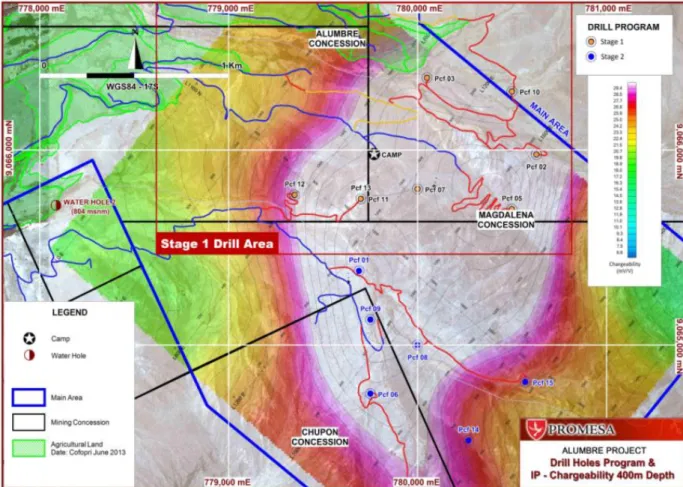
Figure 2 - Alumbre Project showing the very strong Chargeability response at a depth of 400m and the drill
pad location of the 3 stage 5,600m proposed Diamond Drilling Program. The Stage 1 drill program includes 7
platforms with a total 2,200m being drilled.
The Company plans to undertake up to 2,200m of diamond drilling from 7 drill platforms in a first
stage program as illustrated in Figure 2. This is the first part of a larger three stage 5,600 m drill
program. Hole depths vary between 150m and 500m. Drill targets are associated with high
chargeability anomalies at Alumbre with supporting surface geochemistry and alteration mineralogy.
Exploration Update
Recently our Country and Exploration Manager Mr. Dean De Largie has just returned back from Peru.
As part of his visit Dean completed a site visit of the Alumbre Project Area to evaluate the progress of
current exploration field work and preparation of drill platforms, field services and access tracks.
ASX:PRA |
PROMESA.COM.AU
Page 4
Figure 3 – Illustrated deposit model of a porphyry copper deposit (modified* from Lowell and Guilbert,
1970**). (A) Schematic cross section of hydrothermal alteration minerals and types, which include propylitic,
phyllic, argillic, and potassic alteration. (B) Schematic cross section of ores associated with each alteration
type.
During his site visit some new and important observations where documented and photographed with
respect to the project’s porphyry potential that support the company’s geological model at the
project area. Field observations compare favorably to the classic porphyry model system as illustrated
in Figure 3. In the classic porphyry model a broad pyrite shell has within it thinner band of increased Cu
content. The pyritic shell is the key exploration target and from that target, the prospective ore zone
can be targeted for drilling.
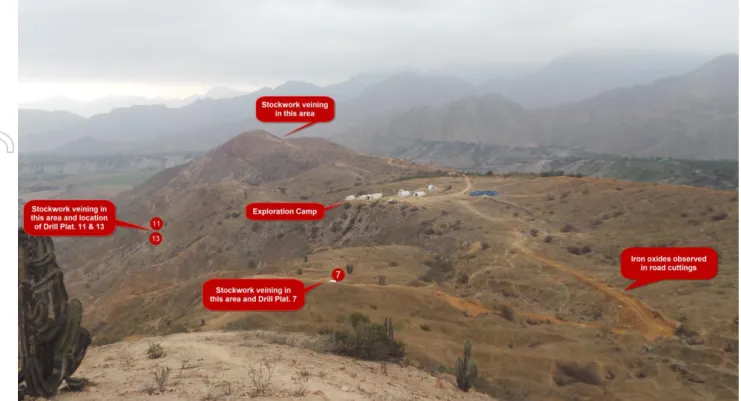
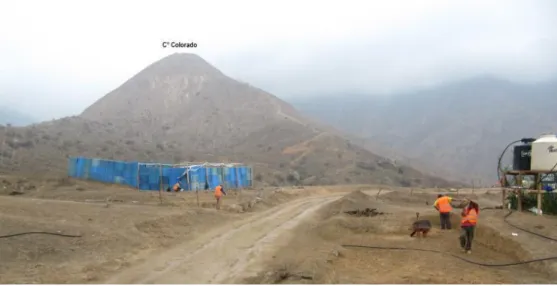
Figure 4 illustrates a regional overview of the project area looking down the hill over platform 7
towards the camp. Of particular interest is the change in colour of the track towards the platform. The
reddish colouration in the track increases between the camp and platform 7. This reflects the increased
iron content from the oxidation of pyrite. Quartz-pyrite stockworking is present on the far side of the
peak of the hill in the distance and at platform 7 and in the region of platforms 11 and 13 (see figure 3
and 4).
* Geosphere May 2006 vol. 2 no. 3 161-186
**Lowell, J.D., and Guilbert, J.M., 1970, Lateral and vertical alteration-mineralization zoning in porphyry ore deposits: Economic Geology, v. 65, p. 373–408
ASX:PRA |
PROMESA.COM.AU
Page 5
Figure 4 – Regional overview of the project area looking down the hill over platform 7 towards the camp
Figure 5 shows moderate to strong quartz stockworking, strong iron oxide development in both the
intrusive rock itself and associated with the stockwork veinlets. The stockworking has been exposed
during access track and drill pad and sump preparation. The drill platforms were positioned to target
highly chargeable areas identified from the induced polarization (IP) geophysics program. The newly
observed stockworking at the drill pad locations further validates the Company’s exploration model.
Deep red hematitic vein borders can be clearly seen. Although the rock is moderately oxidized,
disseminated pyrite can still be seen in the intrusive at this location. The rock has moderate iron oxide
development after pyrite. The location corresponds to the outer western side of the Alumbre
chargeability anomaly in Figure 2.
ASX:PRA |
PROMESA.COM.AU
Page 6
Figure 5 –On the access track going up the Alumbre hill eastward toward the camp.
Figure 6 – Stockwork at drill platform 7 site.
Figure 6 is from the site of drill platform 7 which is our first drill hole site. The area observed shows
strong stockwork development in the intrusive rock, which has undergone multiple vein formation
episodes, fracturing and faulting. Moderate jarosite (a potassium iron oxide) is observed probably
from the oxidation of pyrite. In the bottom right of the figure dark reddish brown goethite and
hematite have developed from the oxidation of pyrite.
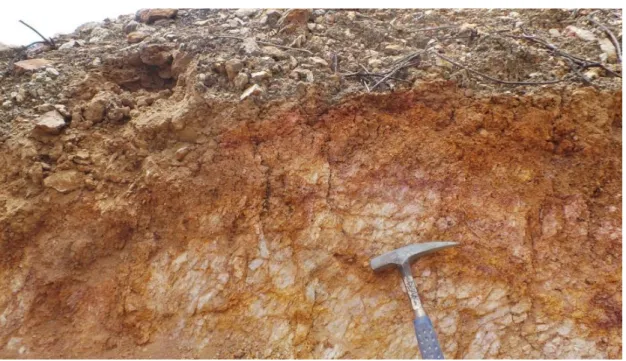
Figure 7 illustrates strong stockworking and the violent emplacement process and gas/fluid emanation
resulting in very a strongly altered intrusive. This area corresponds to the western side of the
chargeability anomaly. The veins exhibit moderate to strong hematite development probably after
pyrite though original sulphides have been destroyed at this location.
ASX:PRA |
PROMESA.COM.AU
Page 7
Figure 7 – Stockwork veining at west side of chargeability anomaly.
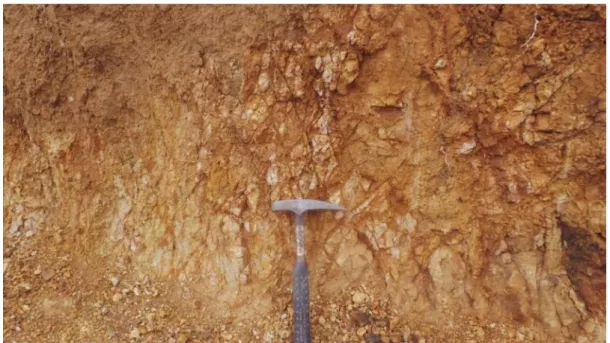
Figure 8 – Strong quartz stockworking at site of Platforms 11 and 13.
This strongly oxidized stockworked intrusive is located of platforms 11 and 13 where abundant jarosite
and haematite is observed associated with the stockworking veinlets as illustrated in Figure 8.
Camp, Services and Facilities
The Alumbre field quarters are ready for use during the upcoming drilling program as illustrated in
Figure 9. Core farm and equipment storage facilities have been prepared and water lines to drill
platforms are currently being laid out (refer to figure 10 to 13).
Figure 9 – Alumbre field quarters
ASX:PRA |
PROMESA.COM.AU
Page 8
Figure 10 – Core trays and equipment storage area
Figure 11 – Preparing waterlines for drilling.
Figure 12 – Core Farm ready for drilling.
ASX:PRA |
PROMESA.COM.AU
Page 9
The Next Steps
Promesa have formally notified the Ministry of Energy and Mines (MEM) in Peru of their intention to
commence drilling activities and will confirm start dates once MEM has processed our commencement
notification.
A drilling contractor has been awarded the first stage drill program. All drill platforms are prepared and
final access preparations are being completed. All social, community and regulatory requirements have
been adhered to and the environmental permit (DIA) has been received.
On behalf of the Board,
Ananda Kathiravelu
Executive Director
Promesa Ltd
Competent Persons Statement
The information in this report that relates to Exploration Results, Mineral Resources or Ore Reserves is based on
information compiled by Mr Dean de Largie, a Fellow of the Australian Institute of Geoscientists. Mr de Largie is a
full-time employee of Promesa Limited. Mr de Largie has sufficient experience which is relevant to the styles of
mineralisation and types of deposits under consideration and to the activity he is undertaking to qualify as a
Competent Person as defined in the 2012 Edition of the "Australasian Code for Reporting of Exploration Results,
Mineral Resources and Ore Reserves". Mr de Largie consents to the inclusion in this report of the matters based
on his information in the form and context in which it appears above
ASX:PRA |
PROMESA.COM.AU
Page
10
Appendix A - JORC Code, 2012 Edition – Table 1
Section 1 Sampling Techniques and Data – Alumbre Project
Criteria JORC Code explanation Commentary
Sampling techniques
Nature and quality of sampling (eg cut
channels, random chips, or specific specialised industry standard measurement tools appropriate to the minerals under investigation, such as down hole gamma sondes, or handheld XRF instruments, etc). These examples should not be taken as limiting the broad meaning of sampling.
Promesa Limited (“Promesa” or “Company”) has completed mapping, geophysics a field rock sampling program of approximately 1,100 samples in the project area. The company has not undertaken any drilling to date in the Alumbre Project area.
Include reference to measures taken to
ensure sample representivity and the
appropriate calibration of any
measurement tools or systems used.
Sampling program is undertaken on a 100m by 100m grid reducing to a 50m by 50m grid where further definition has been warranted. Rock sampling is achieved by the collection 2 metre continuous channel samples or continuous chips in the shape of a cross over a circular area with diameters between 0.5 and 2 metres as appropriate for the sample location using a geological sampling hand tools.
The sample locations are picked up by handheld GPS at the time of sampling. Sampling was carried out under Company’s protocols, management and QAQC procedures as per industry best practice.
Aspects of the determination of
mineralisation that are Material to the Public Report. In cases where ‘industry standard’ work has been done this would be relatively simple (eg ‘reverse circulation drilling was used to obtain 1 m samples from which 3 kg was pulverised to produce a 30 g charge for fire assay’). In other cases more explanation may be required, such as where there is coarse gold that has inherent sampling problems. Unusual commodities or mineralisation types (eg submarine nodules) may warrant disclosure of detailed information.
Field samples are generally between 2 and 3kg per sample. Samples are sent to a certified assay laboratory and are crushed, dried, pulverised using Acme Prep code R200-250. The sample is crushed until 80% passes under a 10 mesh size fraction. This 80% is then split to subsample 250gm which is then pulverised until 85% passes under 200 mesh size fraction. Analysis is by Acme Analysis codes G601 and 1F04. G601 is a fire assay for Au using a 30g subsample followed by ICP for a detection limit of 2ppb. 1F04 is an ultra-trace level analytical method using a hot modified aqua regia digestion with equal parts of nitric acid, hydrochloric acid and water of a 0.5g subsample analysing 53 elements by ICPMS and ICPES as appropriate. Elements and their respective lower and upper detection limits for the primary commodities are Ag 2 ppb-100 ppm;; Au 0.2 ppb-100 ppm;;Cu 0.01 ppm-10000 ppm;; Mo 0.01
ASX:PRA |
PROMESA.COM.AU
Page
11
Criteria JORC Code explanation Commentary
ppm-2000 ppm;
Drilling techniques
Drill type (eg core, reverse circulation,
open-hole hammer, rotary air blast, auger, Bangka, sonic, etc) and details (eg core diameter, triple or standard tube, depth of diamond tails, face-sampling bit or other type, whether core is oriented and if so, by what method, etc).
NA
Drill sample recovery
Method of recording and assessing core
and chip sample recoveries and results assessed.
Measures taken to maximise sample
recovery and ensure representative nature of the samples.
Whether a relationship exists between
sample recovery and grade and whether sample bias may have occurred due to preferential loss/gain of fine/coarse material.
NA
Logging Whether core and chip samples have been geologically and geotechnically logged to a level of detail to support appropriate Mineral Resource estimation, mining studies and metallurgical studies.
NA – as surface sampling is not appropriate for Mineral Resource estimation.
Whether logging is qualitative or
quantitative in nature. Core (or costean, channel, etc) photography.
Logging of surface samples records are fully logged to
determine lithology, mineralogy, mineralization,
alteration, and oxidation. Routine photography of all rock samples does not occur.
The total length and percentage of the
relevant intersections logged.
100% of all channel and chip samples are logged.
Sub-sampling techniques and sample preparation
If core, whether cut or sawn and whether
quarter, half or all core taken.
NA
If non-core, whether riffled, tube sampled,
rotary split, etc and whether sampled wet or dry.
NA. All surface samples are dry, unsplit. 100% of the channel or chip sample is collected.
For all sample types, the nature, quality and
appropriateness of the sample preparation technique.
The methodology of having channel sample cut across structures or veins where they occur, or channel or chip sampling in the shape of a cross where the rock is
ASX:PRA |
PROMESA.COM.AU
Page
12
Criteria JORC Code explanation Commentary
massive in texture, ensures an appropriate degree of representativeness whilst minimizing the possibility of sample bias. The sample preparation surface samples follows industry best practice in sample preparation All samples are pulverised utilising appropriate industry standard grinding mills determined by the size of the sample. Samples are dried, crushed as required and pulverized to produce a homogenous representative sub-sample for analysis. A grind quality of 85% of a
250g, sub 2mm subsample passing through 75μm is
achieved.
Quality control procedures adopted for all
sub-sampling stages to maximise
representivity of samples.
Promesa quality control and assurance has been achieved by the use of blanks and certified reference material (CRM’s) standards of known mineral content into each batch of samples. Additionally duplicate samples are taken approximately every 20th sample. Acme and ALS-Chemex laboratory also insert blanks and standards into each batch. Certified Reference Materials (CRM’s) and/or in house controls, blanks, splits and replicates are analysed with each batch of samples. These quality control results are reported along with the sample values in the final report. Selected samples are also re-analysed to confirm anomalous results.
Measures taken to ensure that the sampling
is representative of the in situ material collected, including for instance results for field duplicate/second-half sampling.
Field duplicates have been taken approximately each
20th sample. Total sample preparation is conducted
irrespective of sample weight.
Whether sample sizes are appropriate to
the grain size of the material being sampled.
Sample sizes are considered appropriate to give an accurate indication of mineralisation given the qualitative nature of the technique.
Quality of assay data and laboratory tests
The nature, quality and appropriateness of
the assaying and laboratory procedures used and whether the technique is considered partial or total.
Initially samples were sent to ALS – Chemex Laboratory services which undertook Fire Assay using a 30 gm charge and a multi-element ICP analysis was utilized. Both ALS - Chemex and are ISO 9001 certified. Acme Analytical Laboratories are currently used by the company and are ISO9001-2008 certified Lab with Cert
ASX:PRA |
PROMESA.COM.AU
Page
13
Criteria JORC Code explanation Commentary
No FM63007. The Lab systematically inserts blanks, standards and runs random duplicate assays and duplicate assays on high grade samples. Gold is assayed using a 30gm fire assay with an Atomic Absorption finish. Multielement ICP-mass spectrometer analysis is used on a suite of 53 elements after an aqua regia digestion. The digestion is considered to be partial. This method is appropriate to detect anomalous gold mineralisation.
For geophysical tools, spectrometers,
handheld XRF instruments, etc, the parameters used in determining the analysis including instrument make and model, reading times, calibrations factors applied and their derivation, etc.
No geophysical tools were used to determine any element concentrations.
Nature of quality control procedures
adopted (eg standards, blanks, duplicates, external laboratory checks) and whether acceptable levels of accuracy (ie lack of bias) and precision have been established.
Sample preparation checks for fineness were carried out by the laboratory as part of their internal procedures to ensure the grind size of 85% passing 75 micron was being attained. Laboratory QAQC involves the use of internal lab standards using certified reference material, blanks, splits and replicates as part of the in house procedures.
Verification of sampling and assaying
The verification of significant intersections
by either independent or alternative company personnel.
Logging and assay data undergoes a number of in-house supervisory, authentication and quality control processes. Log data of samples is entered in by geologists field notebooks and entered into a computer nightly and emailed to a dedicated sample and assay database manager. The resultant database is further checked by senior company personnel.
The use of twinned holes. NA – no drilling has been undertaken by Promesa at
Alumbre.
Documentation of primary data, data entry
procedures, data verification, data storage (physical and electronic) protocols.
Primary data was collected using a set of standard Excel templates using lookup codes. The information was sent to an in-house database manager for validation and compilation into an onsite Access database.
Discuss any adjustment to assay data No adjustments or calibrations were made to any assay
data reported.
ASX:PRA |
PROMESA.COM.AU
Page
14
Criteria JORC Code explanation Commentary
Location of data points
Accuracy and quality of surveys used to
locate drill holes (collar and down-hole surveys), trenches, mine workings and other locations used in Mineral Resource estimation.
NA - exploration activity to date will be able to be used to in the determination of Mineral Resource estimation.
Specification of the grid system used. Present data uses a WGS84 grid system zone 17.
Quality and adequacy of topographic
control.
All samples are located by handheld GPS. Expected accuracy is +/– 5 m for easting, northing and 5 m for elevation coordinates.
Data spacing and
distribution
Data spacing for reporting of Exploration
Results.
Whether the data spacing and distribution
is sufficient to establish the degree of
geological and grade continuity
appropriate for the Mineral Resource and Ore Reserve estimation procedure(s) and classifications applied.
Whether sample compositing has been
applied.
NA - Alumbre project area is at an early exploration assessment. Work current does not support Mineral Resource and Ore Reserve estimation.
Orientation of data in relation to geological structure
Whether the orientation of sampling
achieves unbiased sampling of possible structures and the extent to which this is known, considering the deposit type.
The methods used to take chip and channel samples eliminate as much as practicable sample bias due to structure.
If the relationship between the drilling
orientation and the orientation of key mineralised structures is considered to have introduced a sampling bias, this should be assessed and reported if material.
NA
Sample security The measures taken to ensure sample security.
A chain of custody of samples is used and managed by Promesa. Samples are stored on site and either delivered by Promesa personnel to the assay laboratory in Trujillo or Lima in Peru. Whilst in storage, they are kept on a locked yard. Tracking sheets have been set up to track the progress of batches of samples.
Audits or reviews
The results of any audits or reviews of
sampling techniques and data.
Repeated sampling exercises validate sampling of previous workers. Management reviews sampling techniques regularly in the field. External training in sampling techniques and QAQC is provided.
ASX:PRA |
PROMESA.COM.AU
Page
15
Section 2 Reporting of Exploration Results – Alumbre Project
Criteria JORC Code explanation Commentary
Mineral tenement and land tenure status
Type, reference name/number, location and
ownership including agreements or material issues with third parties such as joint ventures, partnerships, overriding royalties, native title interests, historical sites, wilderness or national park and environmental settings.
The Alumbre project area is located at low attitude, in the Department of La Libertad in northern Peru. There are no historical sites, wilderness or national parks or environmental issues. The current project area consist of group of concessions with one concessions which is 100% owned by Promesa Limited, plus four other adjoining concession which are subject to option agreement, these include three concessions owned by Oban S.A.C which allows 70% farm-in and includes an NSR royalty and one concession owned by Compania Minera Fabrico S.A.C. which allow 80% farm-in and includes an NSR royalty.
The security of the tenure held at the time
of reporting along with any known impediments to obtaining a licence to operate in the area.
Concessions and agreements are in good standing and the company has social and government approvals in place to explore.
Exploration done by other parties
Acknowledgment and appraisal of
exploration by other parties.
The region was explored by Santa Cristina de Chorobal from 1993 to 1994 and Newmont, from 1994 to 1996, undertook regional exploration work.
Savage Resources (later bought by Pasminco) from 1996 until 1999 had undertaken sampling, mapping, geophysics and drilling within some of the current project area at Alumbre. Savage Resources had undertaken a nine-hole RC and RC/Diamond drill program and 573 rock sampling program along channel of various lengths from 1 to 27m in length within part of the Alumbre area. Historical Savage RC drill samples were composited up to 4m and diamond drill holes were composited up to 2m. This drilling produced anomalous results which were considered worthy of follow up drilling by Savage. Location of these drill holes have be verified as the collars are visible. Samples were assayed by SGS laboratory; however this cannot be verified as the original laboratory certificates are not
available and were pre-JORC. Promesa have undertaken
confirmation field sampling of Savage historical surface sampling which supports the original work undertaken
ASX:PRA |
PROMESA.COM.AU
Page
16
Criteria JORC Code explanation Commentary
by Savage. Savage Resources was taken over by Pasminco in 1999. Pasminco went into receivership 2001 and suspended work on the project area.
From 2001 to 2010 the concession was not held by any company. Alikante Mining Company 2010 had acquired and released the concession to Kirio Mining S.A.C in 2011. Promesa had an option agreement signed with Kirio Mining S.A.C in 2012 and acquired 100% of the concession in August 2013.
Geology Deposit type, geological setting and style of mineralisation.
Mineralisation styles on the properties are epithermal gold and porphyry copper with molybdenum or gold credits over several concessions.
Drill hole Information
A summary of all information material to
the understanding of the exploration results including a tabulation of the following information for all Material drill holes:
o easting and northing of the drill hole
collar
o elevation or RL (Reduced Level –
elevation above sea level in metres) of the drill hole collar
o dip and azimuth of the hole
o down hole length and interception
depth
o hole length.
NA
If the exclusion of this information is
justified on the basis that the information is not Material and this exclusion does not detract from the understanding of the report, the Competent Person should clearly explain why this is the case.
No information has been excluded.
Data aggregation methods
In reporting Exploration Results, weighting
averaging techniques, maximum and/or minimum grade truncations (eg cutting of high grades) and cut-off grades are usually Material and should be stated.
Only surface sampling has occurred on the current Promesa properties.
Where aggregate intercepts incorporate
short lengths of high grade results and
No aggregation of results has occurred in the surface
ASX:PRA |
PROMESA.COM.AU
Page
17
Criteria JORC Code explanation Commentary
longer lengths of low grade results, the procedure used for such aggregation should be stated and some typical examples of such aggregations should be shown in detail.
sampling.
The assumptions used for any reporting of
metal equivalent values should be clearly stated. NA Relationship between mineralisation widths and intercept lengths
These relationships are particularly
important in the reporting of Exploration Results.
If the geometry of the mineralisation with
respect to the drill hole angle is known, its nature should be reported.
If it is not known and only the down hole
lengths are reported, there should be a clear statement to this effect (eg ‘down hole length, true width not known’).
NA.
Diagrams Appropriate maps and sections (with scales) and tabulations of intercepts should be included for any significant discovery being reported These should include, but not be limited to a plan view of drill hole collar locations and appropriate sectional views.
NA
Balanced reporting
Where comprehensive reporting of all
Exploration Results is not practicable, representative reporting of both low and high grades and/or widths should be practiced to avoid misleading reporting of Exploration Results.
Other exploration (mapping, geochemistry and geophysics work) data has been previous reported to the market by Promesa.
Other substantive exploration data
Other exploration data, if meaningful and
material, should be reported including (but not limited to): geological observations; geophysical survey results; geochemical survey results; bulk samples – size and method of treatment; metallurgical test
results; bulk density, groundwater,
geotechnical and rock characteristics; potential deleterious or contaminating substances.
Discussion of the Alumbre project geology is included within the release.
Other exploration (mapping, geochemistry and geophysics work) data has been previously reported the market by Promesa.
To date no economic or extractive measures such as bulk samples, metallurgical test results; groundwater, geotechnical and rock characteristics; potential deleterious or contaminating substances samples have been done.
ASX:PRA |
PROMESA.COM.AU
Page
18
Criteria JORC Code explanation Commentary
Further work The nature and scale of planned further work (eg tests for lateral extensions or depth extensions or large-scale step-out drilling).
Promesa Limited proposes to undertake a diamond drill hole program in the near future at the Alumbre project.
This program targets porphyry Cu-Au-Mo
mineralisation associated with various parts of a chargeability anomaly supported by geological and alteration mapping assisted by the use of a Terraspec spectrometer and the results of the petrography study which is the subject of the current news release The chargeability anomaly is large indicates a potentially large mineralised system.
Diagrams clearly highlighting the areas of
possible extensions, including the main geological interpretations and future drilling areas, provided this information is not commercially sensitive.
NA