Personality:
Vive la Difference!
What Is Personality?
A set of behavioral, emotional, and
cognitive tendencies that people display
over time and across situations
What are some terms you use to
Freud
: Consciousness
Conscious level Normal awareness Preconscious level Easily brought to consciousness Unconscious level Hidden thoughts and desiresFreud: Structural Model
The id
Unconscious level Present at birth
Home to sexual and aggressive drive
Governed by the pleasure principle
Freud: Structural Model
The superego
Preconscious and unconscious levels
Develops in childhood
Home to morality and conscience
Governed by the
ego ideal
Freud: Structural Model
The ego
Conscious, preconscious, and unconscious levels Develops in childhood (before superego)
Acts as a referee between id and superego
Freud: Personality Development
We must pass through psychosexual
stages
successfully
Each stage focuses on how we receive
pleasure
Failure to pass through a stage leads
to fixation
In times of stress, we regress to that
Freud: Psychosexual Stages
Oral stage (birth to 1 year)
Anal stage (1 to 3 years)
Phallic stage (3 to 6 years)
Oedipus and Electra complexes
/
Latency period (6 to puberty)
Freud: Defense Mechanisms
Unconscious attempts prevent unacceptable
thoughts from reaching conscious awareness
Denial Intellectualization Projection Rationalization Reaction formation Repression Sublimation Undoing
Freud
’
s Followers
Carl Jung
Collective unconscious Archetypes
Alfred Adler
Strive for superiority Inferiority complex ! "
Karen Horney
Basic anxiety Privilege envy
Critiques of Freud
Not scientific
Hard to test
Too broad
Claims are hard to falsify
Based on limited sample
Female patients Upper class
Humanistic Theories
Humanists focus on people
’
s positive
aspects: their innate goodness,
creativity, and free will
,
,
!
Reaction to Freud
’
s emphasis on
…
Hedonic tendencies
"
#
$
%
&
Humanistic Theories
Abraham Maslow
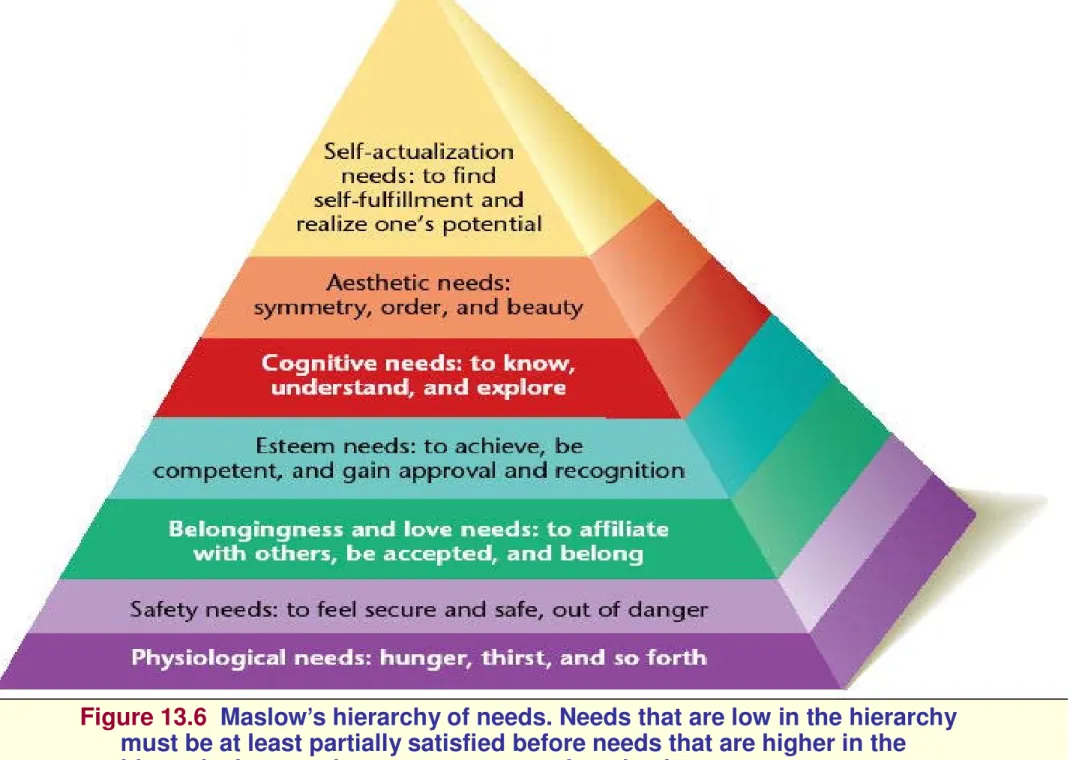
Hierarchy of needs
'(
)
*
+
,
Self-actualization
'
-
.
/
,
Csikszentmihalyi
’
s flow
Carl Rogers
Unconditional positive regard
Criticisms
Difficult to test
0
1
2
3
Figure 13.6 Maslow’s hierarchy of needs. Needs that are low in the hierarchy must be at least partially satisfied before needs that are higher in the hierarchy become important sources of motivation.
The Humanistic Approach
Maslow
Maslow
’
’
s Hierarchy
s
of Needs
of Needs
Self
Self--actualizationactualization Esteem needs
Esteem needs
Belongingness and love needs
Belongingness and love needs
Safety needs
Safety needs
Physiological needs
Personality:
Traits or Situations?
Trait view
We think and behave consistently
across situations
Situationist view
Our thoughts and behaviors change
with the situation
Interactionist view
Both traits and situations affect
Trait Theories: The Big Five
Extraversion Withdrawn O u tg o ing N eu rotic ism S tab l e U ns tab l e A g reeab l eness L o w H ig hC onsc ientiou sness
U nde p e ndab l e D e p e ndab l e
O p enness to exp erienc e
Trait Theories: Eysenck
’
s
Three-Factor Model
Extraversion Withdrawn O u tg o ing N eu rotic ism S tab l e U ns tab l eP sy c h otic ism / N onc onf orm ity
Measuring Personality:
Interviews and Observation
Interviews
Structured set of questions (can be modified)
Focuses on specific thoughts and behaviors Hard to generalize beyond interview
Observation
Focuses on behaviors, not thoughts
Measuring Personality:
Inventories
Questionnaires (paper or computer)
9
:
Produce a personality profile
Easy to score and statistically analyze
;
<
=
>
?
@
A
=
>
B
Measuring Personality:
Projective Tests
Include Rorschach and TAT
Concerns about validity and reliability
Biological Influences on Personality
/
Do horse breeds have
common personality traits?
Do dog breeds have
Temperament
Innate tendencies to behave in
certain ways
Correlation between temperament
at infancy and adulthood
Shyness
Theories of Temperament
Buss and Plomin
’
s four factors
Sociability
C
D
Emotionality
G
H
Activity
I
J
Impulsivity
K
J
Rothbart and Derryberry
Reactivity
L
M
Biologically Based Personality Theories
Gray’s behavioral inhibition and activation systems
BIS: Right frontal lobe BAS: Left frontal lobe
Biologically Based Personality Theories
Cloninger
’
s theory
Reward dependence Harm avoidance Novelty seeking PersistenceZuckerman
’
s theory
Sociability Neuroticism-anxietyImpulsive sensation seeking Activity
Heritability
Heritability of personality
Minnesota twin studies
Heritability of specific behaviors
.5 for work and leisure interests .44-.8 for happiness
Learning and Cognitive
Elements of Personality
Learning
Conditioning Social learningSociocognitive
CDPQ
Expectancies Locus of control Self-efficacy Reciprocal determinismPersonality and Birth Order
•A g r e e a b l e •E x t r a v e r t e d •O p e n t o e x p e r i e n c e •L e s s i d e n t i f i e d w i t h f a m i l y •C o n s c i e n t i o u s •N e u r o t i cL a t e r -b o r n
M i d d l e -b o r n
F i r s t -b o r n o r
o n l y c h i l d
Personality and Gender
Female
R
More empathic More neurotic Greater social connectednessMale
S
Greater individuality More aggressive More assertiveN a t u r e o r n u r t u r e ?
T
U
V
W
T
Personality and Culture
Difficult to compare personality across cultures
Collectivism
X
Y
$
%
Focus on the needs of the group
Chinese, African, Latin American, Arab cultures
Individualism
Z
[
$
%
Focus on needs of the individual