The Joint Council on Thoracic Surgery
Education (JCTSE)
“
Educate the Educators
”
Faculty Development Course: Analysis of the
First 5 Years
Stephen C. Yang, MD, Ara A. Vaporciyan, MD, Rebecca J. Mark, MA, MBA,
Deborah A. DaRosa, PhD, Frank T. Stritter, PhD, Maura E. Sullivan, MSN, PhD, and
Edward D. Verrier, MD
Division of Thoracic Surgery, Department of Surgery, The Johns Hopkins Medical Institutions, Baltimore, Maryland; Division of Surgery, Department of Thoracic and Cardiovascular Surgery, The University of Texas MD Anderson Cancer Center, Houston, Texas; The Joint Council on Thoracic Surgery Education, Inc, Chicago, Illinois; Department of Surgery, Northwestern University Feinberg School of Medicine, Chicago, Illinois; Office of Educational Development, School of Education, University of North Carolina, Chapel Hill, North Carolina; Department of Surgery, University of Southern California, Los Angeles, California; and Division of Cardiothoracic Surgery, Department of Surgery, University of Washington, Seattle, Washington
Background. Since 2010, the Joint Council on Thoracic Surgery Education, Inc (JCTSE) has sponsored an annual
“Educate the Educators”(EtE) course. The goal is to provide United States academic cardiothoracic surgeons (CTS) the fundamentals of teaching skills, educational curriculum development, and using education for academic advance-ment. This report describes the course development and evaluation along with attendee’s self-assessment of skills through thefirst 5 years of the program.
Methods. The content of this 21/2-day course was based
on needs assessment surveys of CTS and residents attending annual meetings in 2009. From 2010 to 2014, EtE was offered to all CTS at training programs approved by the Accreditation Council for Graduate Medical Educa-tion. Course content was evaluated by using end-of-course evaluation forms. A 5-point Likert scale (1 [ poor, 5 [ excellent) was used to obtain composite assessment mean scores for the 5 years on course vari-ables, session presentations, and self-assessments.
Results. With 963 known academic CTS in the United States, 156 (16.3%) have attended, representing
70 of 72 training programs (97%), and 1 international surgeon attended. There were also 7 program co-ordinators. Ratings of core course contents ranged from 4.4 to 4.8, accompanied with highly comple-mentary comments. Through self-assessment, skills and knowledge in all content areas statistically improved significantly. The effect of the course was evaluated with a follow-up survey in which re-sponders rated the program 4.3 on the usefulness of the information for their career and 3.9 for educational productivity.
Conclusions. The EtE program offers an excellent op-portunity for academic CTS to enhance their teaching skills, develop educational activities, and prepare for ac-ademic promotion. With its unique networking and mentorship environment, the EtE program is an impor-tant resource in the evolution of cardiothoracic surgical training in the United States.
(Ann Thorac Surg 2016;102:2127–32)
Ó2016 by The Society of Thoracic Surgeons
W
ith an ever-changing surgical curriculum, trainingparadigms, adult learning practices, advances in technologies, and clinical time pressures, a focused course designed especially for cardiothoracic (CT) sur-geons (CTS) involved with the education of faculty, resi-dents, and students is an appropriate mandate. This
endeavor was done with the hope of generating an“army
of educators” who will lead the new wave of education
for the next generation of CTS.
This first education effort in faculty development for
CTS was modeled on the successful American College
of Surgeons “Surgeons as Educators” (SAE) course,
which now is in its 23rd year of existence. That course, using a combination of didactic and interactive teaching sessions, is given over 6 days, and constantly in high demand. One of the objectives after the creation of the Joint Council on Thoracic Surgery Education, Inc (JCTSE) in 2008 was to focus on faculty development. It
was proposed to present a modified version of the SAE
course, the “Educate the Educators” (EtE) course, due
to the limited time commitment of CTS. This report describes the needs assessment used in the course
Accepted for publication April 18, 2016.
Presented at the Poster Session of the Fifty-second Annual Meeting of the Society of Thoracic Surgeons, Phoenix, AZ, Jan 23–27, 2016.
Address correspondence to Dr Yang, Division of Thoracic Surgery, Department of Surgery, The Johns Hopkins Medical Institutions, 600 N Wolfe St, Blalock 240, Baltimore, MD 21287; email:[email protected].
Ó2016 by The Society of Thoracic Surgeons Ann Thorac Surg 2016;102:2127–32 0003-4975/$36.00
Published by Elsevier http://dx.doi.org/10.1016/j.athoracsur.2016.04.080
development, attendees’ course evaluation, and their
self-assessment of skills development through thefirst 5
years of the program.
Material and Methods
The goal of EtE is to engage every CT surgical residency program in the United States (U.S.). The content of this
21/2-day course was based on several needs assessment
surveys of CTS and residents attending The Society of Thoracic Surgeons (STS), the Thoracic Surgery Di-rectors Association (TSDA), and the Thoracic Surgery Residents Association (TSRA) meetings in 2009. The SAE course was used as a framework for EtE. A list of 25 pertinent topics from the prior year’s SAE meeting was organized into four main categories: curriculum development, evaluation/assessment, education admin-istration and management, and teaching skills. Faculty
and residents surveyed were asked to assign a score
based on an anchored 5-point Likert scale (1 ¼ not
necessary, 5¼required) to each of these topics[1]. Once
the more popular topics were selected, the overall EtE course schedule was organized.
From 2010 to 2014, EtE was offered to all CTS at training programs approved by the Accreditation Council for Graduate Medical Education (ACGME). The goals of the
EtE course are outlined inTable 1. The quality of course
content, presentations, and meeting logistics were eval-uated by using end-of-course on-line evaluation forms,
using a 5-point Likert scale (1¼poor, 5¼excellent). An
external reviewer (F.T.S.) provided an annual debriefing
feedback critique. Annual course modifications were
implemented after these summative and formative eval-uations. Continuing medical education credits were offered beginning in 2013. Statistical analysis of the self-assessments before and after the course was done using
the pairedttest on the Stata 12 software (StataCorp LP,
College Station, TX) with significance defined as apvalue
of 0.05 or less.
Results
Course Design and Development
A total of 209 responses were obtained from the STS, TSDA, and TSRA meetings in 2009. The results from this Table 1. Goals of the“Educate the Educators”Program
Improve the teaching skills of cardiothoracic surgeons Practice and receive feedback
Provide a framework to develop a skills lab or educational curriculum for implementation at the home institution Understand how to convert educational efforts into career
advancement
Table 2. Needs Assessment Survey Results (n¼81) for the“Educate the Educators”Program
Topic Title Average Scorea
Curriculum development Curriculum Development and Planning 4.3b
Instructional Materials and Methods 4.1
Program and Faculty Evaluation 4.1
Use of Technology in Education 3.8
Writing Goals and Objectives 3.7
Needs Assessment 3.5
Evaluation and assessment Surgical/Technical Skills in Teaching and Assessment 4.5b
Performance Ratings 4.1
Testing and Measurement 4.1
Due Process and the Failing Student 4.0
The ACGME Competencies 3.2
Education administration and management Education for Career Promotion and Goal Development 4.5b
Motivating Faculty to be Effective 4
Implementing Change 3.8
Management of Time and Priorities 3.7
Leadership Competencies 3.6
Conflict Management 3.6
Resident Selection and Interviewing 3.0
Teaching skills Teaching in the Operating Room 4.8b
Teaching Technical Skills 4.6b
Feedback Skills 4.1b
Principles of Adult Learning: How People Learn 3.9b
Questioning Skills 3.8
Teaching in the Clinic/Office 3.5
Formal Presentations and Lectures 3.2
aScoring was based on a 5-point Likert score: 1¼not needed, 5¼essential. bTopics chosen for course.
ACGME¼Accreditation Council for Graduate Medical Education.
REPOR
needs assessment are reported in Table 2. Because the program design was to be shorter than the American College of Surgeons SAE week-long course, only the top
subjects were picked (Table 3), yet havingflexibility for
breakout sessions and invited lectures.
Implementation
One of the main objectives for faculty development was to contact every ACGME-approved training program. Since inception, EtE is offered to all CTS at
ACGME-approved training programs. Notifications were done
through constant emails to program directors and co-ordinators and announcements at the annual TSDA meetings. In recent years, personal phone calls were made to program directors and chairs representing those who have not attended in the past. With all these efforts Table 3. “Educate the Educators”Daily Course Schedule
Day 1 Evening: registration and welcome
Day 2 Introduction of Attendees and Course Overview How People Learn
Curriculum Design Formative Feedback
Teaching in the Operating Room Evaluation of the Day and Feedback Day 3 Teaching Psychomotor Skills
Skills Assessment
Workshop (topics decided annually) Evaluation of the Day and Feedback
Day 4 Converting Education Effort Into Promotional Currency Cashing-in on Your Education Portfolio
Wrap-up/Open Discussion/Course Evaluations
Table 4. Institutions Represented by Surgeons at the“Educate the Educators”Courses 2010 to 14a
Albany Medical College (2) Texas Heart Institute/Baylor College of Medicine (3)
Allegheny General Hospital (3) The Methodist Hospital
Beth Israel Deaconess Medical Center (3) Tufts Medical Center
Boston University University of Alabama at Birmingham
Brigham and Women’s Hospital (4) University of Arizona
Catholic University School of Medicine, Santiago, Chile University of California, Davis Medical Center Cedars-Sinai Medical Center (2) University of California, Los Angeles (2) Children’s Hospital/University of Nebraska University of California, San Francisco (2) Children’s Hospital of Philadelphia University of Chicago (2)
Cleveland Clinic Foundation (2) University of Cincinnati
Duke University Medical Center (4) University of Colorado (4)
East Carolina University University of Iowa Hospitals (3)
Indiana University School of Medicine (3) University of Kentucky (3) Johns Hopkins Medical Institutions (2) University of Louisville (3)
Loma Linda University University of Maryland
Long Island Jewish (2) University of Miami
Loyola University Medical Center (2) University of Michigan (4) Massachusetts General Hospital (3) University of Minnesota (3)
Mayo Clinic (2) University of Mississippi (2)
Medical College of Wisconsin University of North Carolina (2)
Medical University of South Carolina University of Oklahoma (3) Memorial Sloan Kettering Cancer Center (3) University of Pennsylvania (3)
Montefiore Medical Center (3) University of Pittsburgh (6)
Mount Sinai Medical Center (2) University of Rochester
New York Presbyterian Hospital (3) University of Southern California (3)
New York University Medical Center University of Texas Health Science Center at San Antonio (5) North Shore University Hospital University of Texas MD Anderson Cancer Center
Northwestern University University of Texas Southwestern Medical Center (2)
Ohio State University Hospital (3) University of Utah (2)
Oregon Health & Science University (3) University of Virginia (3)
Pennsylvania State University University of Washington (4)
Rush University Medical Center (2) University of Wisconsin School of Medicine (4) St. Christopher’s Hospital for Children Vanderbilt University Medical Center
St. Louis University (2) Virginia Commonwealth University Health System (2)
Stanford University Washington University School of Medicine (4)
Swedish Heart & Vascular Institute Yale-New Haven Medical Center (2)
aThe number in parenthesis indicates more than 1 attended, n¼70. In 2015, an additional institutional representative from the University of Florida was
included, but the data were not included in the analysis. One participant has since died. Prior participants have moved to institutions previously not represented (University of Kansas, Emory University).
through thefirst 5 years, 70 of 72 certified training
pro-grams (Table 4) have sent 1 or more surgical faculty to this
course, one new program was represented in 2015, and 7 program coordinators have attended (1 attended
twice, Table 5). Several institutions have been
repre-sented on multiple occasions. Although some institutions still have not had formal representation at EtE, 5 in-stitutions have recruited past attendees who currently have active educational roles in their organization.
Course Evaluation and Review
The class size of CTS varied annually. Of the 157 surgeons,
49 (31%) identified themselves as strictly cardiac, 66 (42%)
strictly general thoracic, 10 (7%) strictly pediatric cardiac, 19 (12%) both cardiac and thoracic, and the remaining 13 (8%) a mixture of the above specialties. One international surgeon attended. CTS leadership was also represented, with 32 program directors and 10 divisional chiefs/ department chairs attending the course. Program co-ordinators were invited to attend in 2013, and this analysis includes 7 coordinators, 1 of whom attended twice.
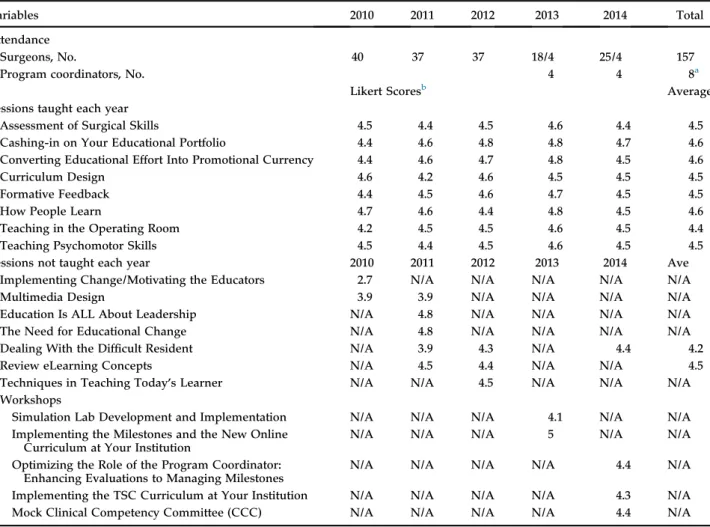
The composite mean evaluation data from the core presented topics and those not presented annually from
2010 to 2014 are listed inTable 6. Specifically, topics on
developing an educator’s portfolio, using educational activity for promotion, and understanding adult learning principles consistently receive the highest ratings (4.6). Workshops focusing on milestones implementation, educational leadership/change, and eLearning concepts received the highest ratings (5.0, 4.8, and 4.5 respectively). Table 5. Seven Institutions Represented by Program
Coordinators at the“Educate the Educators”Courses 2013 to 2014
Duke University Medical Center Loyola University Medical Center Oregon Health & Science University University of Colorado
University of Southern California University of Wisconsin (attended twice)
Table 6. Attendance and Composite Evaluation Scores of“Educate the Educators”Topics and Workshops From 2010 to 2014
Variables 2010 2011 2012 2013 2014 Total
Attendance
Surgeons, No. 40 37 37 18/4 25/4 157
Program coordinators, No. 4 4 8a
Likert Scoresb Average
Sessions taught each year
Assessment of Surgical Skills 4.5 4.4 4.5 4.6 4.4 4.5
Cashing-in on Your Educational Portfolio 4.4 4.6 4.8 4.8 4.7 4.6
Converting Educational Effort Into Promotional Currency 4.4 4.6 4.7 4.8 4.5 4.6
Curriculum Design 4.6 4.2 4.6 4.5 4.5 4.5
Formative Feedback 4.4 4.5 4.6 4.7 4.5 4.5
How People Learn 4.7 4.6 4.4 4.8 4.5 4.6
Teaching in the Operating Room 4.2 4.5 4.5 4.6 4.5 4.4
Teaching Psychomotor Skills 4.5 4.4 4.5 4.6 4.5 4.5
Sessions not taught each year 2010 2011 2012 2013 2014 Ave
Implementing Change/Motivating the Educators 2.7 N/A N/A N/A N/A N/A
Multimedia Design 3.9 3.9 N/A N/A N/A N/A
Education Is ALL About Leadership N/A 4.8 N/A N/A N/A N/A
The Need for Educational Change N/A 4.8 N/A N/A N/A N/A
Dealing With the Difficult Resident N/A 3.9 4.3 N/A 4.4 4.2
Review eLearning Concepts N/A 4.5 4.4 N/A N/A 4.5
Techniques in Teaching Today’s Learner N/A N/A 4.5 N/A N/A N/A
Workshops
Simulation Lab Development and Implementation N/A N/A N/A 4.1 N/A N/A
Implementing the Milestones and the New Online Curriculum at Your Institution
N/A N/A N/A 5 N/A N/A
Optimizing the Role of the Program Coordinator: Enhancing Evaluations to Managing Milestones
N/A N/A N/A N/A 4.4 N/A
Implementing the TSC Curriculum at Your Institution N/A N/A N/A N/A 4.3 N/A
Mock Clinical Competency Committee (CCC) N/A N/A N/A N/A 4.4 N/A
aProgram coordinators were invited beginning in 2013, and 1 coordinator attended twice. bScores were based on a 5-point Likert scale 1¼poor, 5¼
excellent.
JCTSE¼Joint Council on Thoracic Surgery Education, Inc; N/A¼not applicable; TSC¼(joint JCTSE/TSDA) Thoracic Surgical Curriculum; TSDA¼Thoracic Surgery Directors Association.
REPOR
At the end of each program annually, the faculty would immediately debrief about the positives and negatives of
the course. An independent faculty development
specialist (F.T.S.), with nearly 40 years of medical educa-tion experience, would provide a detailed written report;
together with the postcourse survey evaluations, modifi
-cations in the course would occur for the subsequent
year. This feedback process influenced the move to the
current Chicago location, the addition/removal of core lecture topics, and having breakout workshops with
specific topics important for that current year (eg,
Mile-stones introduction, implementation of the new Thoracic Surgery Curriculum, starting the Clinical Competency Committee).
Learner Outcomes
Through self-assessment, the learners felt that skills and knowledge in all content areas improved with statistical
significance, mostly with these same three topics. Results
of the self-assessment are reported in Table 7, outlining
the ratings before and after the encounter. All content
areas significantly improved after the course. Perhaps the
greatest areas of improvement were related to providing better feedback, using education as a vehicle for academic promotion, and developing one’s educator’s portfolio.
The effect of the course was evaluated with a follow-up survey in 2015. Graduates were asked elements on how the program affected their educational career, academic productivity, and promotion on a similar 5-point Likert scale. Of the 157 CTS, 44 (28%) returned the completed survey. They rated the program an average of 4.3 on the usefulness of the information for their career and 3.9 for educational productivity. EtE was used to revise/improve their residency program (27 [61.4%]), build a new training program or curriculum (20 [45.5%]), pursue educational research/publications (18 [40.9%]), and get an academic promotion (17 [38.6%]).
Comment
The debate remains whether great teachers are born or made. Numerous strategies have been implemented
during the last several decades to improve teaching,
influenced by the prevailing theories of learning,
instructional design, and leadership development. Over time, teaching has been associated with a skill that is
associated with, but separated from, content expertise[2].
The American College of Surgeons saw the gap and the need for specialized education and developed the SAE
course in 1993[3]. The 6-day SAE remains an extremely
popular course, so much so that availability remains a challenge.
The JCTSE was conceived in 2008 with a mission to identify, introduce, and support innovative educational techniques, while improving faculty teaching expertise as
the educational paradigm evolves[4]. The development
of surgical faculty to teach better was one of the top pri-orities. The concept was to present a course similar to the
SAE, but shorter, tofit the needs of the busy residency
program directors and clinical CTS who generally have the predominant teaching responsibilities. It was also felt
that a dedicated “immersion” program would enhance
teaching and networking among similar educators. An intention of EtE is to engage every CT surgical residency program in the U.S. Through constant national an-nouncements, emails to program directors and co-ordinators, and personal contacts, we were able to get 70 of the 72 ACGME-approved programs (94%) to send a
representative during the first 5 years of EtE, with 1
additional program represented in 2015.
During thefirst 4 years, the 21/
2-day course was held on
the campus of the University of North Carolina with the TSDA Boot Camp generally midsummer to coincide with the start of the new CT residents and fellows. The deci-sion during the initial discusdeci-sion was that this program should be held separate from any other national meetings
and that an “immersion” program would allow total
concentration on the topics; the venue might be augmented and synergistic with the TSDA Boot Camp. Having the faculty of the EtE and the Boot Camp, as well as the CT resident trainees, would provide several unique observational, teaching, and networking opportunities. In 2014 the course was moved to Chicago for several reasons because of feedback from the attendees. Scheduling Table 7. Composite Self-Assessment Averages of Skills Ability Before and After the“Educate the Educators”Course From 2010 to 2014 in 141 Participantsa
Skill
Pretest Mean (SD)
Posttest Mean (SD)
pValue (two-tailed)
Designing a Curriculum 2.1 (0.83) 3.6 (0.51) <0.001
Teaching in the Operating Room 3.3 (0.85) 4.1 (0.58) <0.001
Designing a Multimedia Lecture 3.4 (0.87) 3.9 (0.56) 0.001
Designing a Teaching Session 3.1 (0.87) 3.9 (0.53) <0.001
Providing Constructive Feedback 2.9 (0.90) 4.1 (0.42) <0.001
Teaching Psychomotor Skills 3.2 (0.88) 4.1 (0.46) <0.001
Implementing Change in Your Setting 2.8 (0.78) 3.5 (0.87) <0.001
Leading a Team 3.2 (0.72) 3.8 (0.61) 0.001
Creating Educational Activity into Promotional Currency 2.5 (0.29) 4.2 (0.40) 0.005
Creating an Educator’s Portfolio 2.5 (0.29) 4.0 (0.25) <0.001
aScores based on a 5-point Likert scale: 1¼poor, 5¼excellent.
difficulties for faculty and attendees, due to conflicts during the summer months, resulted in last minute can-cellations. Although the facilities at the University of North Carolina were ideal, the attendees asked for a more centralized national location and one convenient to an airport; hence, a site transfer to Chicago. Finally, there became increasing distractors between the faculty of the Boot Camp and EtE, causing a slight distraction in effec-tive and focused teaching by the Boot Camp faculty.
Key to the course was the ability to develop and implement a curriculum. EtE essentially was a new cur-riculum, and presented here are the essential compo-nents of curriculum development, including design,
development, implementation, evaluation, and review[5].
This course also embodied the seven principles of adult
learning[6]:
Instruction was problem centered.
Case or problem solving was experience oriented.
The learning environment was supported by
enthusiastic faculty with respect for learners.
Positive and negative feedback was given to the
learners.
Active teaching (simulation, small group discussion,
brainstorming) was interspersed through the course.
Prior experiences were presented and built upon.
Adequate preparation and groundwork was given
for each section.
Surgical education, training, and teaching paradigms
have evolved significantly during the past 10 years, but
change also brings on challenges. Four different
path-ways to thoracic surgical board certification now exist, the
volume of knowledge and operative technologies have been greatly augmented, the learner uses traditional and electronic means of gathering information, and restricted residency work hours and a shift toward outpatient op-erations lessens the experience with direct patient con-tact. All of these issues require current-day educators to
develop innovative techniques for more efficient transfer
of information and skills to produce a competent surgeon. As such, a faculty development course, such as EtE and SAE and other similar institutional and national society programs, are key to the educational vitality of those who oversee residents and students. Other than the SAE
report by DaRosa and colleagues [3] in 1966, no other
similar reports have been published on faculty develop-ment programs established for surgical or medical subspecialties.
How best to measure the long-term effectiveness from
graduates of this course is unclear. From ourfirst survey
measuring longitudinal progress, a number of new initia-tives have already been created at the institutional level,
including developing simulation laboratories, new
curricular formats to address the educational needs, and reestablishment of a previously deactivated training program. A new research group focused on education has been created from alumni of this course, called the Thoracic Education Cooperative Group (TECoG). Future endeavors to measure course effectiveness include further follow-up surveys, progression of career advancement, and educational research and study activities.
This report has several limitations. Perhaps the data were biased because those who attended already had an interest in surgical education. The surveyed population for the needs assessment to develop EtE and the number of attendees represent only a small fraction of the total teaching workforce of academic CTS. Returns from the follow-up survey were low.
In summary, the EtE program offers an excellent op-portunity for academic CTS to enhance their teaching skills, develop educational activities, and provide avenues for academic promotion. It also provides a unique envi-ronment for networking and mentorship and is an important resource in the evolution of CT surgical training in the U.S.; it is the hope to continue this as an annual course and perhaps to expand globally as an initiative for the globalization of thoracic surgical educa-tion. Effectiveness in changing the landscape of CT sur-gical training is hard to objectively measure, but those who have provided feedback have felt that EtE was very useful as a catalyst for their own educational careers.
JCTSE, Inc, is grateful to the continued support by The Society of Thoracic Surgeons and the help in the early development of this course by the American Association for Thoracic Surgery, the American Board of Thoracic Surgery, and The Thoracic Surgery Foundation.
References
1. Martin J, Regehr G, Reznick R, et al. An objective structured assessment of technical skills for surgical residents. Gastro-enterology 1995;108(Suppl):A1231.
2. Wilkerson L, Irby DM. Strategies for improving teaching practices: a comprehensive approach to faculty development. Acad Med 1998;3:387–96.
3. DaRosa DA, Folse JR, Reznick RK, Dunnington GL,
Sachdeva AK. Description and evaluation of the Surgeons as Educators course. J Am Coll Surg 1996;183:499–505.
4. The Joint Council on Thoracic Surgery Education, Inc. Avail-able atwww.jctse.org. Accessed January 20, 2016.
5. DaRosa DA, Derossis A. Applying instructional principles to the design of curriculum. In: Distlehorst LH, Dunnington GL, Folse JR (eds). Teaching and Learning in Medical and Surgical Education: Lessons Learned for the 21st Century. Mahway, NJ: Lawrence Erlbaum Associates; 2000:57–68.
6. Knowles MS. Applying principles of adult learning in con-ference presentations. Adult Learn 1992;4:11–4.
REPOR