WHEN A GOOD GOD MAKES BAD PEOPLE: TESTING A THEORY OF RELIGION AND IMMORALITY
Joshua Conrad Jackson
A thesis submitted to the faculty at the University of North Carolina at Chapel Hill in partial fulfillment of the requirement for the degree of Master of Arts in the Department of Psychology
and Neuroscience (Social Psychology).
Chapel Hill 2018
© 2018
ABSTRACT
Joshua Conrad Jackson: When a Good God Makes Bad People: Testing a Theory of Religion and Immorality
(Under the direction of Kurt Gray)
When might religious belief lower ethical standards? We propose a theory of religion and immorality that makes three central predictions. First, people will judge immoral acts as more permissible when they make divine attributions for these acts, seeing them as enabled by an intervening God. Second, people will be more likely to make divine attributions when evaluating passive immorality (e.g. keeping a lost wallet) than active immorality (e.g. pick-pocketing) since
LIST OF TABLES ... vi
LIST OF FIGURES ... vii
CHAPTER 1: BASIS FOR PREDICTIONS ... 1
Introduction ... 1
The Present Research... 8
CHAPTER 2: DIVINE ATTRIBUTIONS ENCOURAGE IMMORALITY ... 11
Study 1: Religious Belief and Divine Attributions Divergently Predict Moral Judgment ... 11
Study 2: Prayer Group Attendance and Religious Belief Divergently Predict Crime Rates... 16
Study 3: Divine Attributions Produce Permissive Moral Judgments ... 20
CHAPTER 3: PASSIVE IMMORALITY FACILITATES DIVINE ATTRIBUTIONS ... 23
Study 4: The Active-Passive Divide ... 23
Study 5: The Passive-Active Divide in a General Sample ... 28
Study 6: The Liberating Power of Prayer ... 31
Study 7: Agency, not Severity ... 34
CHAPTER 4: RELIGIOUS BELIEF PREDICTS PASSIVE IMMORALITY ... 38
Study 8: Judging the Self ... 38
Study 10: The Library Thief ... 45
Studies 11-13: Religious Priming and the Envelope Game ... 47
CHAPTER 5: INTERNAL META-ANALYSIS ... 51
CHAPTER 6: GENERAL DISCUSSSION ... 56
APPENDIX 1: DIVINE ATTRIBUTIONS SCALE ... 65
APPENDIX 2: PASSIVE AND ACTIVE IMMORALITY VIGNETTES ... 67
APPENDIX 3: TABLES OF FINDINGS ... 69
APPENDIX 4: FIGURES OF FINDINGS ... 72
LIST OF TABLES
Table
1. Correlation between predictors in Study 1.………70 2. Predictors of moral permissibility in Study 1……… 3. Predictors of statewide crime rates in Study 2………...72
LIST OF FIGURES
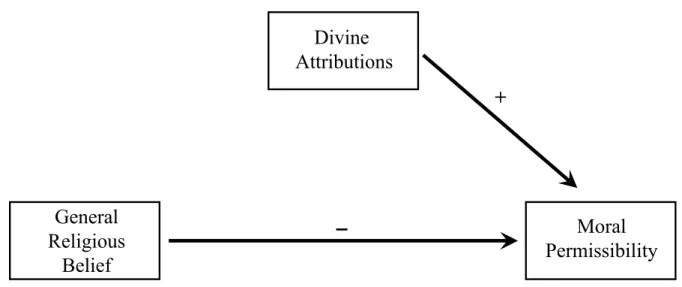
Figure 1 – Hypothesized model for prediction 1………...73
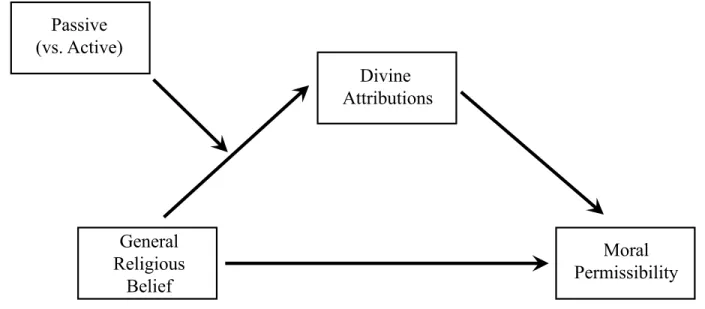
Figure 2 – Hypothesized model for prediction 2………...74
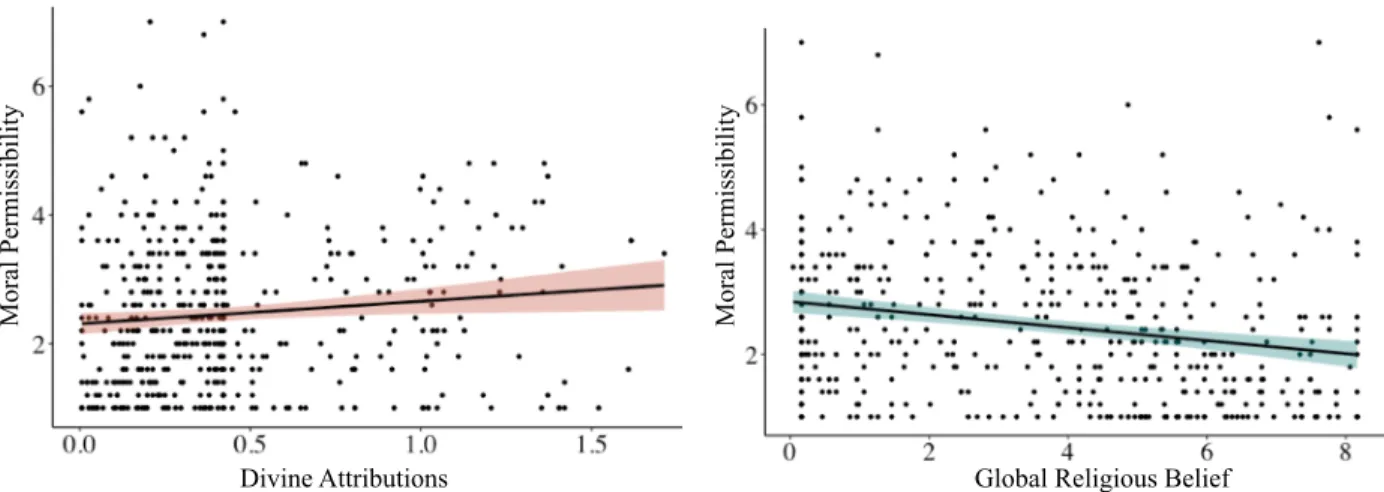
Figure 3 – Moral permissibility as a function of divine attributions and religious belief……….75
Figure 4 – Statewide Crime rate as a function of prayer and importance of religiosity…………76
Figure 5 – Moral permissibility as a function of experimental condition………..77
Figure 6 – Study 4 moderated mediation………...78
Figure 7 – Study 5 moderated mediation………...79
Figure 8 – Study 6 moderated mediation………...80
Figure 9 – Study 7 moderated mediation………...81
Figure 10 – Study 8 moderated mediation………...………...82
Figure 11 – Study 9 coding scheme………...83
Figure 12 – Parking accuracy as a function of car type……….84
Figure 13 – Library section overdue rate as a function of library of congress category………...85
Figure 14 – Results of religiosity on passive immorality in the envelope game………...86
Figure 15 – Meta-analytic effect of religion on moral permissibility………87
CHAPTER 1: BASIS FOR PREDICTIONS
Introduction
In 2014, Reese Wekhoven, Cally Guasti, and Lara Russel bought a couch for $20 from a Salvation Army store. At first the couch seemed perfectly ordinary, if a little lumpy. But the roommates soon realized that the lumps were actually envelopes stuffed with $100 bills. After excitedly pulling out the money, they were faced with an ethical dilemma: should they keep it? The roommates ended up returning the money to its rightful owner—an elderly woman whose husband had stashed their savings in the couch before passing away. Upon receiving the cash, she speculated that “this is my husband looking down on me and this was supposed to happen.”
The widow’s assumption of divine intervention seems harmless at first, but consider what would have happened if Reese, Cally, and Lara had seen the money as a gift from above. The roommates could have easily assumed that God had sent them the couch to help Lara pay off her debt or help Reese provide for his parents. Yet if they had made these attributions, they would have kept the cash for themselves and deprived a widow of her savings. Matthew 7:7 says “Keep on asking, and you will receive what you ask for. Keep on seeking, and you will find. Keep on knocking, and the door will be opened to you.” However, windfalls sometimes come at the expense of others, and a door that opens for you may be a door slammed upon your neighbor.
religion, whatever its imperfections, at least instills morality. On every side, there is conclusive evidence that the contrary is the case and that faith causes people to be more mean [and] more selfish.”
Unfortunately, Hitchens—and most other pundits of religion and morality—seldom collected data. If they did, they would see that past studies show no clear direct link between religion and morality. In this spirit, we pivot from the question of “Does religion make people bad?” to “When does religion encourage immorality?” Inspired by situations like the roommates’ couch dilemma, we explore how people’s attributions of God’s will can lead them to justify stealing lost wallets, keeping overdue library books, and cheating on exams.
Our studies suggest that believers can justify questionable behavior when they believe in a God who intervenes in specific circumstances to help people, and when there is no clear person responsible. In cases like finding an envelope of cash, an overdue library book, or money in a lumpy couch, believers in an intervening God may not see immorality but instead a gift from above. After all, who are we to second-guess divine provenance?
Religion and Morality Contain Multitudes
on morality, and that focusing on the global question of “Does God makes you good” might be unproductive (Jong, 2015; Whitehouse & McKay, 2014). We might be better served by looking for the specific forms of religion that might encourage or discourage morality, as well as the forms of morality that might be more common or less common with religion.
One popular approach to studying religion and morality focuses on a single form of “morality”—prosocial behavior—but divides up “religion” to study differences between
moralizing gods (e.g. the Abrahamic God) and non-moralizing gods. According to some theories,
the emergence of moralizing gods encouraged unprecedented large-scale cooperation, enabling small tribal societies to grow in population size and wealth (Johnson, 2016; Norenzayan et al., 2016; Purzycki et al., 2016). Scholars have supported theories of moralizing gods by arguing that properties of these gods—like their ability to monitor or punish human behavior—reliably make people more prosocial.
The supernatural monitoring hypothesis argues the belief in an actively monitoring god encouraged people to behave more prosocially, just as if another person were always watching (Norenzayan et al., 2016; Purzycki et al., 2016). Monitoring encourages good behavior, but so might the threat of punishment (Johnson, 2016), which helps to explain why people who believe in punitive gods tend to be more compliant with social norms, more willing to pay taxes, and more willing to lend money to unrelated strangers (see also Norenzayan, 2013). People who believe in an angry God also tend to give more in economic games than people who believe in a loving God (Shariff & Norenzayan, 2010), and Hell beliefs predict less crime across the
economic games and actively cheat less in laboratory paradigms (Aveyard, 2014; Hadnes & Schumacher, 2012; Mazar et al., 2008; Piazza et al., 2011; Pichon, Boccato, & Saroglou, 2007, Study 2; Randolph-Seng & Nielsen, 2007; Shariff & Norenzayan, 2007).
Another approach to studying religion and morality keeps “religion” a single construct but divides up “morality” into different moral values. For example, Graham and Haidt (2010) theorized that religious people emphasize a broader set of moral values compared to their secular counterparts (see also Bruce, 2013). Graham and Haidt (2010) focus particularly on the values of loyalty, authority, and purity, which they claim are especially important to religious individuals, and can explain why religious people donate more to charity and volunteer more in their
community than their secular counterparts.
These approaches offer valuable nuances to the study of religion and morality, but they share two limitations. First, many studies deconstruct either “religion” or “morality,” but few deconstruct both at the same time. Some theoretical work has discussed nuances within both of these constructs (McKay and Whitehouse, 2014), but much of this work—along with other past literature—suffers from a second limitation: it almost exclusively focuses on how religious belief encourages forms of morality. Theories of moralizing gods and religious values help explain when religious people will donate more to anonymous strangers or comply with social norms, but not when religious people may be less kind or generous or less likely to follow prosocial norms (Galen, 2012; Greer et al., 2005; Leach, Berman, & Eubanks, 2008).
harmful behavior. Since people view God as unquestionably moral (Heiphetz, Lane, Waytz, & Young, 2016; Heiphetz, Lane, Waytz, & Young, in press), they are less likely to second-guess or change harmful circumstances if they believe these circumstances are the result of divine will. These divine attributions may be especially likely in harmful situations that lack a clearly responsible human agent because this encourages people to see God as responsible—and seeing God’s good will at work allows earthly injustice to be justified.
An Intervening God May Encourage Immorality
Most people want to be generous and kind, but sometimes it is hard to pass up
selfishness. It is especially tempting to be selfish when self-serving circumstances seem meant to be. It might feel like a sign when your browser window shuts down on the last page of filing
taxes, or when a blizzard unexpectedly arrives on the day of your jury duty. You need not be religious to feel a little superstitious in these cases, especially since superstition serves your interests. However, believing in an intervening God might encourage immorality by
transforming earthly temptation into Heaven-sent signs. This is even more likely when people perceive God as actively intervening to help them. In the two cases above, for instance, people who believe in an intervening God could easily see God as responsible for their tax-avoiding computer troubles or jury-skipping blizzard. Moreover, since “God is good,” these divine attributions may lead them to deem their own misbehavior—or even other people’s self-serving misbehaviors—as less immoral.
(Gelfand & Jackson, 2016) and cause some degree of perceived harm, whether personal or societal (Schein & Gray, 2017)—both skipping jury duty and cheating on taxes would fit this description. When laypeople make these harm-related moral judgments, they must integrate perceptions of intention (Gray, Jenkins, Heberlein, & Wegner, 2011; Foot, 1967), suffering (Schein & Gray, 2015) and causation (Hume, 2006). Our theory focuses on perceptions of causation: we suggest that harmful acts seem less immoral (and therefore more permissible) when people make divine attributions for the causes of these acts. Consider again the case of the lumpy couch: in one interpretation of this scenario, Reese, Cally, and Lara are causally
responsible for any harm that befalls the widow. However, people who see divine intervention might see God as causally responsible for event (i.e. God put the money in the couch for the roommates to find), allowing the roommates to escape responsibility for any wrongdoing.
Some work offer support for the role of divine attributions in justifying immorality. Believers may be more likely to aggress against out-groups vilified in the bible (Johnson, Rowatt, and Labouff, 2010), and are more likely to blast someone with noise after reading a bible passage endorsing anger (Bushman, et al., 2007). Of course, while participants in the noise blast experiment were explicitly reminded about God, believers in real life must infer His hand behind events. People’s assumptions about God’s goodness makes it seem unlikely that believers would see His hand behind many immoral events, even when their outcomes are self-serving; instead, people may make divine attributions mostly in cases when human causation is ambiguous—what we term passive immorality.
Passive Immorality: Making Room for the Hand of God
clearer intention and causation—i.e., agency—on the part of the perpetrator (Gray, Waytz, & Young, 2012; Gray, Schein, & Ward, 2014). While the first is a case of active immorality (i.e., a commission), the second represents passive immorality (i.e., an omission). Empirical studies in philosophy and moral psychology find that people judge the harm caused by commissions as morally worse than equivalent harm caused by omissions because the causal responsibility for omissions is unclear (Baron & Ritov, 2004; Cushman, Young, & Hauser, 2006; Spranca, Minsk, & Baron, 1991, DeScioli, Christner, & Kurzban, 2011). We label omissions “passive
immorality” to reflect their psychological experience: rather that actively causing harm, one simply needs to accept when harm is caused by external circumstance.
Past research supports the potential link between passive immorality and divine
attributions. People are motivated to attribute events to the actions of a single intentional agent (Rosset, 2008). The most obvious intentional agent is usually another human being (Oldridge, 2004; Tannenbaum, Uhlmann, & Diermeir, 2011), but when it proves difficult to find a person to hold accountable, believers often look toward the heavens (Laurin, Sharrif, Henrich, & Kay, 2012). The urge to find an intentional agent is especially strong for harmful events (Knobe, 2003), and people will often see the hand of God behind suffering (Gray & Wegner, 2010). We extend this logic to consider when people might make divine attributions when evaluating immoral behavior. When immorality has a clear human culprit—like in the case of pick-pocketing—God’s hand seems unlikely. But in cases of passive immorality—like finding a wallet on the street—divine attributions are much more likely.
punitive and monitoring God (Johnson, 2016; Norenzayan et al., 2016) and a rigid deontological view of moral principles (Shariff, Piazza, & Kramer, 2014). Although these elements may steer believers away from active forms of immorality, they are less relevant in passive immorality in which God’s beneficence may be more salient. Consider the mindset of a pick-pocketer versus someone finding a wallet: The religious pick-pocketer will be keenly aware that God is
watching—and might punish—his transgression. But the religious wallet-finder will be more attuned to whether God wanted him to find the wallet, which would encourage him to keep it. The Present Research
Overview of predictions. Thirteen studies examine when religious believers will permit
and engage in immorality. In particular, we test three predictions: First, people who make divine attributions for immoral acts should see them as permissible. Second, making divine attributions for immorality should be most common in cases of passive immorality—when there is no clear human agency—because this makes it easier to infer God’s agency. Third, because believers can make divine attributions for passive immorality, they should be more likely than non-believers to perpetrate these acts.
Prediction 1: Divine Attributions Encourage Immorality. Studies 1-3 tests whether
seeing the hand of God behind earthly events can make immorality seem more permissible. In light of past work linking religion with prosociality, we suggest that religiosity in general may encourage moral strictness, but that divine attributions should encourage moral permissibility (see Figure 1). Study 1 supports this prediction using a large online survey—and also establishes that individual differences in divine attributions are distinct from several related constructs. More support for this prediction comes from archival analyses (Study 2) and an experimental
Prediction 2: Passive Immorality Facilitates Divine Attribution. Studies 4-7 test our
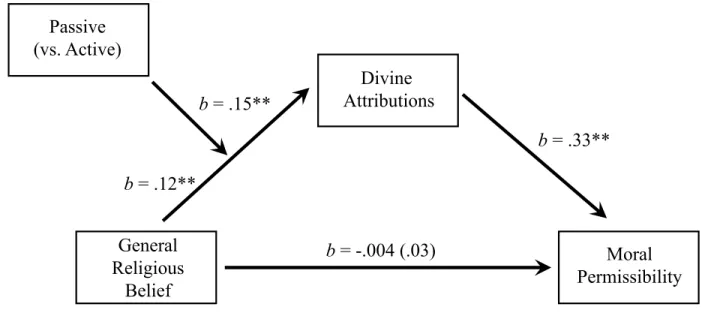
second prediction about when people make divine attributions—in cases of passive immorality. These divine attributions should then predict moral permissibility, resulting in the moderated mediational model shown in Figure 2. Studies 4 and 5 show that religious people in passive—but not active—contexts are especially likely to make divine attributions, which then predicts moral permissibility. These effects are amplified when God’s agency is salient after prayer (Study 6) and are not explained by act severity (Study 7).
Prediction 3: Religious Belief Predicts Passive Immorality. Studies 8-13 test our third
prediction that believers should be more likely to justify and perpetrate passive immorality compared to believers. Study 8 shows that religious people are more likely than non-religious people to view their prior acts of passive immorality as justified, an effect that is
mediated by divine attributions. Studies 9 and 10 test the link between religion belief and passive immorality in the field. Study 9 shows that drivers with religious decorations on their cars are worse parkers than drivers with either secular decorations or no decorations, and Study 10 shows that library books on Christianity are more frequently overdue than books from nearly any other topic.
Internal Meta-Analysis. Following these thirteen studies, an internal meta-analysis
summarizes support for our key predictions: (a) divine attributions positively predicts moral permissibility while the remaining variance in religious belief negatively predicts moral permissibility, (b) divine attributions are stronger for passive immorality than active
CHAPTER 2: DIVINE ATTRIBUTIONS ENCOURAGE IMMORALITY
Studies 1-3 tested whether seeing the hand of God behind earthly events made immorality seem more permissible. Study 1 developed a new measure of divine attributions, Study 2 conducted an archival analysis religiosity and crime, and Study 3 experimentally manipulated divine attributions.
Study 1: Religious Belief and Divine Attributions Divergently Predict Moral Judgment
Our first study assessed people’s evaluations of morally questionable behaviors and measured both their global religious belief and their specific tendency to attribute earthly events to an intervening God. We predicted that divine attributions would correlate positively with moral permissibility, whereas other aspects of belief would correlate negatively with
permissibility—making people morally stricter (Piazza & Sousa, 2012; Shariff et al., 2014). Developing a measure of divine attributions also gave us the opportunity to examine its
discriminant validity—specifically whether divine attributions are distinct from global religious belief, intrinsic religiosity, and participants’ view of a benevolent (versus angry) God.
Method
Participants. The lack of prior relevant research made it difficult for us to estimate a
specific effect size in our power analysis. We recruited five-hundred participants from Amazon Mechanical Turk, which gave us > 99% power to detect a medium-sized effect of f2 = .15 and
leaving a final sample of four hundred ninety-seven participants (242 men; 255 women; Mage
38.82, SD = 13.06)1.
Ethics Statement. All studies in this paper were approved by the University of North
Carolina, Chapel Hill Institutional Review Board (IRB# 15-3184).
Procedure. Participants evaluated a series of moral transgressions before completing a
series of religion scales in counterbalanced order: (a) divine attributions, (b) global religious belief, (c) intrinsic religiosity, and (d) views of God. Participants then filled out demographics and were debriefed.
Moral Permissibility. To assess moral permissibility, we adapted five scenarios from
Greene and colleagues (2001) in which someone could make a self-serving but potentially immoral decision. The decisions were (a) putting false information on their resume to get a coveted job, (b) writing off personal expenses as business expenses, (c) insider trading, (d) using a personal relationship with a judge to win a law case, and (e) keeping a lost wallet during a time of need, rather than returning it to the owner. Participants rated each decision on a scale from 1 (“Not at all Immoral”) to 7 (“Very Immoral”). We reverse-coded this scale, so that higher scores indicated more permissibility.
A factor analysis of participants’ responses across the five scenarios revealed a robust one-factor solution, with one factor explaining 58% of variance (Eigenvalue = 2.90), and no other factors explaining more than 13% of variance (Eigenvalues < .65). We therefore combined the five responses into a single index (α = .82).
Global Religious Belief. To measure global religious belief, we used the supernatural
beliefs scale (SBS), a 10-item measure (a = .97) often used as a measure of global religious
belief (Jong, Bluemke, & Halberstadt, 2013). The SBS contains a series of statements regarding the existence of supernatural entities (e.g., There exists an all-loving, all-knowing, all-powerful God). Although this measure is oriented towards Christian religious beliefs, 98% of religious participants in our sample identified as Christian , and so we considered it to be appropriate. We discuss the potential for cross-cultural differences in this paper’s general discussion.
Divine Attributions. To assess people’s tendency to make divine attributions above and
beyond their global religious belief, we developed a measure in which participants chose the ending of ten sentences with one of three alternatives—one detailing no divine intervention, one detailing indirect divine intervention, and one detailing direct divine intervention. For example, “when a person of faith is hoping to have a child, God…” (a) “doesn’t directly intervene,
allowing the person to try conception with their partner”, (b) makes sure that the person and their partner are fertile, so that they can conceive”, and (c) directly and immediately arranges for the woman to become pregnant. Our measure of divine attributions was internally consistent (α = .93), with a factor analysis revealing robust one-factor solution, with one factor explaining 63% of variance (Eigenvalue = 6.32), and no other factors explaining more than 7% of variance (Eigenvalues < .70). This scale is listed in Appendix 1.
Participants were generally unlikely to make direct divine interventions—the scale had an average of 1.23 with a large positive skew (skewness = 1.58)—however, a substantial number of participants did score above the scale’s midpoint (n = 103), indicating variance in divine
non-divine sources (e.g., biology, society, personal agency), as research shows that people attribute events to multiple causes (Legare & Gelman, 2008; Lupfer & Layman, 1996).
Intrinsic Religiosity. We measured intrinsic religiosity using Gorsuch and MacPherson’s
(1989) updating of Allport’s and Ross’s (1967) religious orientation measure. This scale contains ten items—three of which are reverse scored—such as “My religious beliefs are what really lie behind my whole approach to life” and “It doesn’t matter what I believe so long as I lead a good life” (R) that are designed to capture individuals’ intrinsic faith. Participants rated each item on a scale from 1 (“Strongly Disagree”) to 4 (“Strongly Agree”). The measure has been used
extensively, and typically shows high reliability. In this study, however, the scale’s three reverse scored items did not load highly with the other items and factored separately in an exploratory factor analysis using varimax rotation (with eigenvalues of 5.94 and 1.87, respectively). Rather than use these reverse coded items in a separate scale, we dropped them from analysis and only used the non-reversed items, which showed high reliability (a = .97) and loaded onto a single factor (Eigenvalue = 5.78, 83% of variance explained). See Cohen and colleagues (2017) for more information on this scoring of intrinsic religiosity.
Views of God. We measured participants’ views of God using Shariff and Norenzayan’s
Correlations between Scales and Analytic Strategy. Before fitting models, we
analyzed our inter-scale correlation and probed for potential multicollinearity. The zero-order correlation matrix between scales is presented in Table 1.
Inter-item correlations revealed moderate correlations between divine attributions and other measures of religiosity, but these correlations did not exceed .45, suggesting discriminant validity between divine attributions and other measures of religious belief. In contrast, global beliefs and intrinsic religiosity were highly intercorrelated (r = .86), suggesting that these measures tapped similar constructs. Views of a loving God were also highly correlated with intrinsic religiosity and global religious belief.
Results
How do divine attributions and religious beliefs predict moral judgment? Zero-order correlations showed that global religious belief correlated negatively with ratings of moral permissibility, r = -.18, p < .001, but divine attributions showed no correlation, r = .05, p = .26. However, divine attributions and global religious belief were correlated (r = .38, p < .001) making it difficult to interpret these correlations.
Multiple Regression. We next conducted a multiple regression that allowed us to test the
independent effects of divine attributions, global religious belief, and views of God on perceived moral permissibility2. As predicted, divine attributions predicted increased moral permissibility
of the scenarios, while global religious belief predicted decreased moral permissibility. See Table 2. This effect—also displayed in Figure 3—was robust to whether divine attributions were
2 Intrinsic religiosity and global religious belief were highly collinear, and so we only entered global beliefs into our
modeled alongside the SBS or intrinsic religiosity, and neither participants’ views of a loving God nor a punishing God predicted ratings of moral permissibility.
Discussion
Study 1 supported our prediction: people making divine attributions viewed morally questionable behaviors as permissible, whereas global religious belief predicted decreased permissibility. This study also confirmed that divine attributions were distinct from global religious belief, intrinsic religiosity, and views of a loving and forgiving (versus harsh and punitive) God. In sum, people who think that God often directly intervenes in situations also believe that it is permissible enjoy the benefits of morally questionable situations. We next examined whether this effect would replicate in state-level crime data.
Study 2: Prayer Group Attendance and Religious Belief Divergently Predict Crime Rates
Study 2 tested whether the average level of divine attributions within a US state positively predicts that state’s crime level—and whether global religious beliefs negatively predicts crime levels. To separate divine attributions from aspects of global religious belief, we analyzed three different variables: (a) statewide prayer group attendance, (b) the importance of religion in people’s lives, and (c) service attendance. We reasoned that prayer groups often involve people asking God to intervene in their lives and therefore tap divine attributions. Conversely, the general importance of religion and service attendance should better tap global religious belief. While we acknowledge that not all prayer is petitionary (Ladd & Spilka, 2006; Ladd & Spilka, 2002), past studies have found that the general frequency of prayer robustly correlates with petitionary prayer (Banzinger, Uden, & Janssen, 2008). We therefore
Method
Materials and Measures.
All variables were at the state level and drawn from large American national databases. Prayer Group Attendance. To operationalize divine attributions, we used the 2014 Pew
Religious Landscape Survey, which asked 35,000 Americans from all 50 states to rate how frequently they participated in prayer or religious study groups using a 1-4 scale, with anchors at 1 (“Seldom/Never”), 2 (“Several times a year”), 3 (“Once or twice a month”), and 4 (“At least once a week”). We computed a weighted score for each state by multiplying each scale value by the percentage of people who indicated that value (i.e. if 23% of people indicated “1”, this would be represented as .23 x 1), and then summing the values. The resulting index was a continuous measure where higher values represented higher state-level prayer group attendance.
Global Religious Belief. To operationalize global religious belief, we used another item
from the 2014 Pew Religious Landscape Survey, which asked Americans to rate how important religion was in their life on a scale from 1-4, with anchors at 1 (“Not at all important”), 2 (“Not too important”), 3 (“Somewhat important”), and 4 (“Very Important”). We computed a weighted score for each state using the same method as our divine attribution measure.
Service Attendance. To operationalize service attendance, we used yet another item in
Crime. To assess statewide measures of crime, we used data from FBI’s Uniform Crime
Reporting (UCR) database. Crime data has been stored in the UCR each year since 1958, so for greatest consistency with our measures of religiosity, we sampled data from the 2013-2014 wave of data collection. This wave includes data on murder and manslaughter, forcible rape (based on two definitions), robbery, aggravated assault, burglary, larceny-theft, and motor vehicle theft. Crime rates are represented as frequency of crimes per 100,000 people to avoid confounding criminal activity with population size.
Covariates. To control for other influences on religious belief and crime, we also
included states’ average incomes (2014 gross state income per capita from the Bureau of
Economic Analysis), education levels (percentage of people to graduate with a bachelor’s degree from the 2014 US Census), and inequality (Gini coefficients from the 2014 US Census). No other variables were added to avoid multicollinearity.
Results
Global Religious Belief, Prayer Group Attendance, and Crime. In a multiple
regression that included wealth, inequality, and education, prayer group attendance, global religious belief, and service attendance, prayer group attendance was significantly positively correlated with crime rate. Unstandardized betas indicated that every one unit increase in prayer group attendance (on a 1-4 scale), states would be expected to have 2,924 more crimes per 100,000 people. Global religious belief was negatively but non-significantly correlated with crime rates. See Table 3 for a display of all model coefficients.
Replicating without Outliers. Further analysis showed that these results were
state (New Mexico), which had 4317.8 crimes for every 100,000 people. Prayer group
attendance remained a significant positive predictor of crime, b = 2331, SE = 790, t(43) = 2.95, p = .005, and importance of religion remained a non-significant negative predictor, b = -308, SE = 915, t(43) = -.34, p = .74. These effects are graphed in Figure 4.
Correlations. For completeness, we also report zero-order correlations. Global religious
belief and overall crime were positively correlated, r = .31, p = .03, as were prayer group attendance and overall crime, r = .41, p = .003. However, these correlations are difficult to interpret, since these religion metrics were highly correlated with each other, r = .88, p < .001 and with measures of state-wealth, rs < - .53, ps < .001, and education, rs < - .53, ps < .001. We therefore encourage readers to interpret our multiple regression, which is more informative. Discussion
State-level prayer group attendance significantly predicted more crime, whereas global religious belief and service attendance predicted significantly less crime. This
non-significance could stem from measurement issues (error, insufficient power, missing variables) or because the relationship between global religious belief and crime may be more nuanced, depending upon other components of belief like Heaven and Hell beliefs (Shariff & Rhemtulla, 2012).
attributions of divine agency, rather than general religious determinism. To more precisely manipulate this construct, our next study manipulated divine attributions and measured individual people’s attitudes towards self-serving harms.
Study 3: Divine Attributions Produce Permissive Moral Judgments
When God seems to answer prayers, do people see the harm caused as more morally permissible? We tested this question with a large online sample of religious participants, who read about the same immoral behaviors as in Study 1. Participants were told either that God had facilitated these behaviors (making divine attributions salient), a religious friend had facilitated these behaviors (making religion generally salient) or had no information (providing a control condition). We hypothesized that people would evaluate morally questionable acts as more permissible in the divine attribution condition, but less permissible in the religious friend condition, consistent with our correlational findings in Studies 1-2.
Method
Participants. Given Study 3’s between-subjects experimental design, we chose to
advertise for a large sample of 600 religious participants on Amazon Mechanical Turk. However, 667 participants (349 men, 313 women; Mage = 36.92, SDage = 11.49) ended up completing the
survey and passing our screening (“Do you believe in God or gods?”). This sample gave us 80% power to detect an effect as low as f = .12 (d = .24).
Procedure. Participants completed the procedure on Amazon Mechanical Turk. They
began by reading scenarios of questionably moral behavior, and then provided demographic information.
Moral Permissibility. To assess perceptions of moral permissibility, we adapted our
self-serving but morally questionable decisions involving (a) wrongly getting a job, (b) taking illegal business donations from an investor, (c) insider trading, (d) using a personal relationship with a judge to win a law case, and (e) keeping a lost wallet during a time of need. The behaviors described in (a) and (b) were slightly different in order to accommodate our manipulations. Participants used a 1-7 scale anchored at 1 (“Not at all Immoral”) and 7 (“Very Immoral”) to rate each behavior’s immorality. This scale was again reverse scored so that higher scores
corresponded to more moral permissibility.
Divine Attribution Manipulation. In the divine attribution condition, participants read
that they prayed to God and God answered their prayers by arranging the circumstances that made their morally questionable decision possible. In the religious friend condition, participants read that they asked a friend from church to help them and the friend arranged for the morally questionable circumstances. In the control condition, there was no explanation of who was responsible for the circumstances. Other than this manipulation, the information in the vignette was identical. Below is the “lost wallet” vignette across our study’s three conditions.
Divine Attribution Condition. You have been hit by hard times recently, and you are struggling to pay the bills. You pray to God to help with money. God hears your prayers and leads you towards a wallet that is lying on the ground. You open the wallet and find that it contains several hundred dollars in cash as well the owner's driver's license. From the credit cards and other items in the wallet it's very clear that the wallet's owner is wealthy. You keep the wallet.
Religious Friend Condition. You have been hit by hard times recently, and you are struggling to pay the bills. You ask your friend from church for money. Your friend listens and some days later he leads you towards a wallet that he has found lying on the ground. You open the wallet and find that it contains several hundred dollars in cash as well the owner's driver's license. From the credit cards and other items in the wallet it's very clear that the wallet's owner is wealthy. You keep the wallet.
license. From the credit cards and other items in the wallet it's very clear that the wallet's owner is wealthy. You keep the wallet.
Belief in Divine Intervention. Manipulating divine intervention requires that participants
believe in a God who intervenes to help people. Therefore, we included a yes/no screening item—after participants read all scenarios—that asked participants “Do you believe that God intervenes in life to help people?” Of our 667 participants, 536 agreed with this item and were included in our primary analysis.
Results
Condition on Moral Permissibility. Does providing divine attributions lead to increased
perceptions of moral permissibility? A one-way ANOVA revealed a significant effect across conditions, F(2, 532) = 7.18, p < .001, with planned contrasts showing that participants in the divine attribution condition rated these morally questionable actions as more permissible than those in either the control condition (Ms = 3.28 versus 3.02, SEs = .09, p = .058) or the religious friend condition (Ms = 3.28 versus 2.79, SEs = .09, p < .001). By contrast, participants rated these actions as marginally less permissible in the religious friend condition than the control condition (Ms = 2.79 versus 3.02, SEs = .09, p = .076). See Figure 5.3
Discussion
This study showed that—for those who believed in an intervening God—making divine attributions salient led participants to see morally questionable actions as more permissible than making religion in general salient. Unlike a fallible religious friend, God’s infallible beneficence allows people to ignore the harm caused by God’s actions.
3 Another way to analyze the data is to include both those who believe and disbelieve in divine intervention and use
CHAPTER 3: PASSIVE IMMORALITY FACILITATES DIVINE ATTRIBUTIONS
The first three studies found that an intervening God can make morally questionable acts seem more permissible, but not all morally questionable acts are equally likely to involve God. Studies 4-7 used vignettes to test whether situations of passive immortality are more amenable to divine attributions—and therefore increase moral permissibility.
Study 4: The Active-Passive Divide
Is the hand of God more salient in situations of passive immorality? We examined this question by having participants rate a series of vignettes that described people benefiting from morally questionable scenarios—with or without active human agency. We then tested a
moderated-mediation model: does religious belief encourage people to make divine attributions for passive (versus active) immorality, which then increases judgments of moral permissibility? As in Studies 1 and 3, characters in these vignettes made self-serving and harmful decisions. However, since the characters’ decisions did not directly benefit participants, we could test whether people would make divine attributions when they did not personally stand to gain from these attributions.
Method
Participants. Effect sizes from multiple regressions in Study 1 (f2 = .02-.03) suggested
question) and 29 additional participants did not finish the study, leaving a final sample of 390 (166 men, 224 women; Mage = 38.46, SD = 13.03) in our analysis.
Procedure. Participants first completed the screener question of whether they were
religious or not. Participants who qualified for the study then rated six scenarios before providing demographics including religious belief.
Stimuli. Each participant evaluated six vignettes that each described a person who
benefited through a morally questionable scenario. We manipulated within subjects whether this scenario was passive (i.e. had no clear human cause) or active (i.e. had a clear human cause). Participants always saw an equal number of passive and active scenarios with the specific pairing of scenario and active/passive condition (active/passive) was randomly assigned. Examples of passive and active scenarios are below, and Appendix 2 lists the full set of stimuli.
Passive Condition. Jim has worked hard at his company for three years, but he has not yet received a promotion. Jim desperately hopes to be promoted. One Monday, Jim’s boss calls for a meeting. He tells Jim that the company’s operations manager has been fired for drinking on the job and offers Jim the position. Jim is friends with the operations manager, and knows that he does not usually drink. But he keeps his doubts to himself and accepts the position.
Active Condition. Jim has worked hard at his company for three years and is
well-regarded, but has not yet received a promotion. Jim hopes desperately to be promoted. He knows that he is directly in line for the operation manager’s position, so one day he plants a bottle of liquor in the operation manager’s desk and leaves an anonymous tip with his boss. The operations manager is fired and Jim gets the job.
For each scenario, participants indicated their agreement with 6 statements using a five-point scale anchored at 1 (“Strong Disagree”), 2 (“Disagree”), 3 (“Neither Agree nor Disagree”), 4 (“Agree”), and 5 (“Strongly Agree”).
Divine Attributions. The first item assessed divine attributions, asking whether the
participants were asked whether “Jim was offered the operations manager’s job because of a higher power.” This made it clear that participants were judging whether God had orchestrated the circumstances behind passive immorality (e.g., Jim being offered the job), rather than the character’s actions (e.g., Jim accepting the job).
Moral Permissibility. The other five items assessed moral permissibility, asking whether
the character in the story “deserved” to achieve their goal, whether they were “justified” in how they had achieved their goal, the unjustness of the circumstances (reverse coded), whether the character had a good character, and whether the character was immoral (reverse coded). The scale showed high reliability of .92, with no item showing an item-total correlation of less than .49.
Global Religious Belief. Global religious belief was measured using the SBS—placed at
the end of the study, which prevented it from biasing responses to our dependent measures. Analytic Strategy. Prior to testing our hypothesis, we restructured the data in order to
test for interactions between active/passive immorality and participant religious belief. Ratings of scenarios (N = 4680) were nested within participants and analyzed through a repeated measures multilevel model using a restricted maximum likelihood (REML) estimation. We treated condition as a level 1 variable since it varied within participants, and we treated participant religiosity as a level 2 variable since it varied across participants. All models tested for the cross-level interaction terms between independent variables, and intercepts were modeled as randomly varying across participants to take into account the nested structure of the data.
Results
Passive vs. Active Immorality, Religious Belief, and Divine Attributions. The first
should interact, such that people should make more divine attributions for passive versus active immorality, and this gap should be especially large for strong believers. Note that this does not mean that the effect of condition should only be detected for strong believers, but that the effect of condition should increase linearly based on the strength of their belief.
As predicted, whether participants made divine attributions for a scenario depended on an interaction between condition and global religious belief, b = .11, SE = .02, t(1948) = 5.12, p < .001. To unpack this interaction, we examined simple slopes at one standard deviation above and below the mean of global religious belief (Aiken & West, 1991). Participants were always more likely to make divine attributions for passive versus active immorality, but this effect was especially strong in the more religious (+1 SD), b = .70, SE = .05, t(1948) = 15.49, p < .001, compared to the less religious (-1 SD) participants, b = .37, SE = .05, t(1948) = 8.23, p < .001.
Additional analyses revealed that religion was negatively and significantly associated with divine attributions behind active immorality, b = -.07, SE = .03, t(496.5) = -2.42, p = .02, but positively and non-significantly associated with divine attributions behind passive
immorality, b = .03, SE = .03, t(496.5) = 1.09, p = .27. These latter simple slopes should be interpreted with caution, however, since even low-belief participants in this all-religious sample reported belief in God.
Overall, these results supported our prediction that passive immorality would encourage divine attributions, especially amongst those who had high global religious belief.
Divine Attributions on Moral Permissibility. The second link of our theoretical model
= .52, SE = .02, t(1499) = 27.92, p < .001. People making divine attributions viewed self-serving harms as more justifiable.
Religious Belief on Moral Permissibility. The final link of our theoretical model
(Figures 1-2) predicts that religious belief should be negatively related to moral permissibility after removing variance associated with divine attributions. As predicted, global religious belief predicted less permissibility towards immorality when it was added to a multiple regression with divine attributions, b = -.07, SE = .02, t(352.40) = -4.38, p < .001. In this same regression, divine attributions predicted greater moral permissibility, b = .51, SE = .02, t(1439.60) = 27.90, p < .001, replicating Study 1’s finding.
Moderated Mediation. We predicted that religious belief (X) would interact with
active/passive condition (W) to produce divine attributions (M), which would then predict moral permissibility (Y). In order to confirm this moderated mediation, it was necessary to confirm three effects: (a) that religious belief and condition significantly interact to predict divine attributions, (b) that divine attributions significantly predicted moral permissibility, and (c) that divine attributions remained a significant predictor of moral permissibility when global religious belief, condition, and their interaction term are added to the model.
passive immorality as less wrong than active immorality. Figure 6 displays the full set of model coefficients.
Total Effects of Global Religious Belief. In addition to considering our theoretically
specified paths, we examined—for completeness—the total effects of global religious belief on moral permissibility. Overall, religious belief was associated with less moral permissibility, b = -.09, SE = .02, t(388) = -4.85, p < .001. However, this effect was moderated by active/passive condition, b = .08, SE = .02, t(2728) = 3.85, p < .001. Religious belief was associated with significantly less permissive judgments of active immorality, b = -.12, SE = .02, t(555) = -5.99, p < .001, but not passive immorality, b = -.04, SE = .02, t(899.30) = -1.59, p = .11. We suggest that these null general effects are unsurprising given the specific importance of divine attributions. Discussion
The results of Study 4 revealed that, as predicted, religious people judging passive (versus active) immorality were more likely to make divine attributions—and therefore more likely to see passive immorality as more morally permissible. Once these divine attributions had been covaried out of religious belief, belief then predicted less moral permissibility, replicating our findings from Study 1. The next study sought to replicate this effect with a general sample including both religious and non-religious people.
Study 5: The Passive-Active Divide in a General Sample
This study attempted to generalize the effects of Study 4 by replicating them in a sample of participants that included both believers and non-believers.
Method
Participants. We selected our sample size for Study 5 using Study 4’s effect sizes to
moral permissibility (f2 = .32), and (b) the effect of active/passive condition on divine attributions
(f2 = .09). Power analyses with these effects gave respective sample recommendations of 34 and
121. In order to test for mediation, we sampled more than this recommendation, advertising for 150 participants. Three additional participants signed up for the study, providing a sample of 153 participants for analysis (78 men; 75 women; Mage = 39.70, SD = 14.28).
Materials and Procedure. Our materials, procedure, and analytic strategy were nearly
identical to Study 4. However, Study 5 did not screen for only religious participants. Results
Passive vs. Active Immorality, Religious Belief, and Divine Attributions. As
predicted, whether participants made divine attributions for a scenario depended on an
interaction between condition and global religious belief, b = .08, SE = .01, t(1, 763) = 5.54, p < .001. People were always more likely to make divine attributions for passive rather than active immorality, but this effect was especially strong in highly religious people (+1 SD), b = .61, SE = .06, t(763) = 10.45, p < .001, compared to people low in belief (-1 SD), b = .15, SE = .06, t(763) = 2.62, p = .009.
Additional analyses revealed that religion was non-significantly associated with divine attributions behind active immorality, b = .04, SE = .02, t(186) = 1.57, p = .12, but significantly and positively associated with divine attributions behind passive immorality, b = .12, SE = .02, t(186) = 5.07, p < .001. In sum, passive immorality encouraged divine attributions, and this
effect was more pronounced for religious people.
Divine Attributions on Moral Permissibility. As predicted, participants’ divine
Religious Belief on Moral Permissibility. As predicted, global religious belief predicted
less moral permissibility towards when added to a multiple regression with divine attributions, b = -.05, SE = .01, t(915) = -4.40, p < .001, again suggesting that global religious belief was tied to reduced moral permissibility once controlling for divine attributions. In this same regression, divine attributions predicted greater permissibility towards immorality, b = .47, SE = .03, t(915) = 14.01, p < .001.
Moderated Mediation. As with Study 4, we predicted that religious belief (X) would
interact with passive-active context (M) to produce divine attributions (M), which would then predict moral permissibility (Y). Our previous analyses had already shown (a) that religious belief and context significantly interacted to predict ratings of divine attributions, (b) that divine attributions significantly predicted moral judgment. Therefore, we tested for whether (c) divine attributions remained a significant predictor of moral permissibility when global religious belief, passive-active context, and their interaction term were added to the model.
In a multilevel regression, divine attributions remained a significant positive predictor of moral permissibility, b = .36, SE = .03, t(380) = 12.07, p < .001. The global belief × condition did not reach significance in this model, b = -.04, SE = .02, t(775.30) = -1.47, p = .07, indicating full mediation. As in Study 4, divine attributions significantly explained why highly religious people are less likely to judge passive immorality as wrong compared with active immorality. Figure 7 shows the full set of model coefficients.
Total Effects of Religious Belief. Overall, religious belief was non-significantly
attributions. See our internal meta-analysis for further discussion of the total effect of religious belief on immorality.
Discussion
Study 5 found that religious believers were most likely to make divine attributions when evaluating passive immorality (compared to active immorality). As in other studies, these divine attributions predicted more moral permissibility, whereas global religious belief was associated with less moral permissibility once divine attributions had been covaried out. Our next study tested whether prayer widens this passive-active divide, making passive immorality seem even more divinely ordained and morally permissible.
Study 6: The Liberating Power of Prayer
Study 6 tested whether prayer allowed religious believers to make even stronger divine attributions when evaluating passive immorality. Prayer—at least petitionary prayer—involves asking God to intervene in earthly affairs, which likely makes divine attributions more salient. This study used the passive immorality scenarios from Study 5 and manipulated whether the character in the vignette prayed.
An effect of prayer on the justification of passive immorality would support our earlier results linking the prevalence of prayer groups to crime (Study 2) and the salience of prayer to moral permissibility (Study 3). While Study 3 also used prayer to manipulate divine agency, Study 6 included a broader sample of both religious and non-religious participants and did not explicitly tell participants if (or how) God had answered a person’s prayers. We therefore expected that the presence of prayer would increase divine attributions—but more so for
Method
Participants. Sample size was determined using the same power analysis as Studies 3-4.
The study was advertised on Amazon Mechanical Turk to 150 participants, but 4 did not
complete the study, leaving a sample of 146 participants (71 men, 75 women; Mage = 38.34, SD =
12.86) participants.
Stimuli and Procedure. All participants read five of the passive immorality scenarios
vignettes from Studies 4 and 5, however, half of participants read that the character prayed for an outcome, (e.g., “Jim desperately hopes to be promoted, and eventually, he prays for a better position”) while the other half read only that the character hoped for the position, (e.g., “Jim desperately hopes to be promoted”).
Participants answered the same items about moral permissibility as in Studies 4 and 5 but also answered an additional item about inferences of divine agency: “Jim would not have
received his job if he hadn’t hoped/prayed for it.” When combined with our original divine attributions items (i.e., “Jim received his job because of a higher power”), this item formed a reliable divine attributions index (a = .81). We measured global religious belief with the SBS. Results
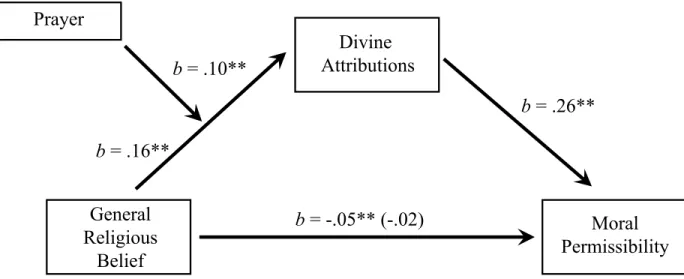
Prayer, Religious Belief, and Divine Attributions. As predicted, whether participants
made divine attributions for a scenario depended on an interaction between prayer and global religious belief, b = .10, SE = .04, t(140) = 2.26, p = .03. Examining the simple effects revealed an interesting pattern: prayer non-significantly increased divine attributions amongst highly religious people (+1 SD), b = .20, SE = .18, t(140) = 1.16, p = .25,4 but decreased it amongst
people low in belief (-1 SD), b = -.36, SE = .18, t(140) = -2.04, p = .04. These effects suggest that religious people may always see the hand of God in passive immorality, and that non-religious people may become demonstrate reactance against the idea that prayer is effect.
However, when we examined the effect of global religious belief within each prayer condition, a more expected pattern of results emerged: religion was more strongly linked to divine attributions in the prayer condition, b = .22, SE = .03, t(140) = 6.82, p < .001, compared to the control condition, b = .12, SE = .03, t(140) = 4.10, p < .001. In sum, prayer was associated with divine attributions as a linear function of belief, and believers were especially likely to make divine attributions when prayer was salient.
Divine Attributions on Moral Permissibility. As predicted, participants’ divine
attributions were positively associated with moral permissibility, b = .20, SE = .03, t(211.49) = 6.14, p < .001. People making divine attributions viewed self-serving harms as more permissible.
Religious Belief on Moral Permissibility. As predicted, global religious belief
significantly and negatively predicted moral permissibility, b = -.04, SE = .01, t(156.01) = -3.42, p < .001, when it was added to the model that included divine attributions. Divine attributions
remained a significant positive predictor of moral permissibility in this model, b = .26, SE = .04, t(238.89) = 7.08, p < .001.
Moderated Mediation. As with Studies 4-5, we predicted that religious belief (X) would
whether (c) divine attributions remained a significant predictor of moral permissibility when global religious belief, prayer condition, and their interaction term were added to the model. In a general linear model that included the global religious belief × prayer condition interaction term, divine attributions remained a significant positive predictor of moral
permissibility, b = .26, SE = .04, t(240.72) = 6.91, p < .001. Moreover, the global belief × prayer condition interaction did not reach significance, b = .01, SE = .02, t(138.47) = .23, p = .82, indicating full mediation. This suggests that divine attributions can fully account for why religious individuals are more permissive of passive immorality following prayer. Figure 8 shows all model coefficients.
Total Effects of Religious Belief. We also tested the total effects of religious belief on
moral permissibility. Overall, religious belief had no effect on moral judgment, b = -.0001, SE = .01, t(142) = -.01, p = .99, and this effect was not moderated by prayer condition, b = .03, SE = .02, t(140) = 1.29, p = .20. We again suggest that these null general effects are unsurprising given the specific importance of divine attributions.
Discussion
It can be tempting to think that a lost wallet is part of God’s plan, and this temptation is even stronger after prayer. Believers viewed capitalizing on morally questionable scenarios as more permissible when they followed prayer, because of God’s apparent agency.
Study 7: Agency, not Severity
means that they often see low severity violations as worse than non-believers (Piazza & Landy, 2013; Piazza & Sousa, 2014; Shariff et al., 2014). Nevertheless, we empirically tested this idea by manipulating the severity of passive immorality scenarios—which we predicted would have no effect on divine attributions.
Method
Participants. The sample size was determined as in Studies 4 and 5. One hundred fifty
participants (61 men, 89 women; Mage = 39.25, SD = 12.83) completed this study on Amazon
Mechanical Turk.
Materials and Procedure. Materials and items were similar to those of Studies 4 and 5,
except that used only passive immorality scenarios were used, and the severity of these transgressions was manipulated between subjects. An index of ratings of moral permissibility index was highly reliable (a = .89).
Manipulation of Severity. Harmfulness reliably predicts immorality (Schein, Goranson
& Gray, 2015) and so we manipulated scenario severity via harmfulness. For example, in the scenario when Jim’s is promoted at the expense of his coworker, that coworker is either a single parent (high severity) or not (low severity). To confirm our severity manipulation, we conducted a pilot study on Mechanical Turk in which 45 participants (25 men, 20 women; Mage = 34.33, SD
Results
Severity, Religious Belief, and Divine Attributions. If severity predicted divine
attributions, then severity could plausibly account for the passive-active divide revealed in Studies 4 and 5. However, severity did not significantly predict divine attributions, b = .03, SE = .13, t(148) = .20, p = .84. Severity also did not interact with global religious belief to predict divine attributions, b = .02, SE = .05, t(146) = .52, p = .61, although—as expected—global religious belief did significantly predict divine attributions, b = .10, SE = .03, t(146) = 3.01, p = .003. In other words, religion was significantly and equivalently associated with divine
attributions regardless of whether acts were severe, b = .12, SE = .03, t(146) = 3.65, p < .001, or not severe, b = .10, SE = .03, t(146) = 3.00, p = .003. This makes it unlikely that severity drove our earlier effects of human agency on divine attributions.
Divine Attributions and Moral Judgment. As in previous studies, divine attributions
positively predicted moral permissibility, b = .19, SE = .03, t(378.80) = 5.56, p < .001. Religious Belief on Moral Permissibility. Global religious belief was a marginally
significant negative predictor of moral permissibility when included in a multiple regression with divine attributions, b = -.03, SE = .01, t(151.70) = -1.84, p = .06. Divine attributions remained a significant predictor of moral permissibility in this model, b = .21, SE = .04, t(413.30) = 5.86, p < .001.
Mediation. In Studies 4 and 5, we documented moderated mediations in which global
and moral permissibility controlling for severity. All coefficients for this model are displayed below in Figure 9, and a Monte Carlo simulation confirmed that the mediated effect was statistically significant, CIs [.001, .04]. This indicates that severity does not account for the relationship between divine attributions and moral judgment.
Total Effects of Religious Belief. We also tested the total effects of religious belief on
moral permissibility. Overall, religious belief had no effect on moral judgment, b = -.003, SE = .01, t(148) = -.24, p = .81, but this main effect was moderated by severity, b = -.06, SE = .03, t(146) = -2.37, p = .02. For low-severity passive immorality, religious belief was
non-significantly associated with moral permissibility, b = .03, SE = .02, t(146) = 1.47, p = .15. For high-severity passive immorality, religious belief was negatively (but marginally) associated with moral permissibility, b = -.04, SE = .02, t(146) = -1.89, p = .06.
Discussion
CHAPTER 4: RELIGIOUS BELIEF PREDICTS PASSIVE IMMORALITY
Our studies have so far shown that divine attributions increase moral permissibility (Studies 1-3) and that passive immorality increases divine attributions (which in turn increase moral permissibility; Studies 4-7). These next studies (8-13) tested the direct link between religious belief and passive immorality. Study 8 tested whether religious believers were more likely than non-believers to justify their past passive immorality. We then tested whether believers were more likely to perpetrate two forms of passive immorality: parking across multiple spaces (Study 9) and keeping overdue library books (Study 10). Finally, Studies 11-13 tested whether religious priming or self-reported religious belief predicted passive immorality on a novel task, the “envelope game.”
Study 8: Judging the Self
Would religious believers—compared to non-believers—view their own past passive immorality as more morally permissible? We predicted that our moderated mediation model (Figure 2) would replicate in participants’ own self-judgments: religious participants recalling passive immorality would show higher divine attributions than participants recalling active immorality and would be more likely to justify their past immoral behavior.
Method
Participants. We used the same power analysis as Studies 4-7 to determine sample size
from this sample—16 from the active immorality condition and 3 from the passive immorality condition—because they could not recall a memory that matched our prompt and performed analyses on the remaining 170 participants (96 men; 72 women, 2 gender missing; Mage = 36.67,
SD = 12.43).
Immorality Recall. Participants began the study by recalling a memory of immorality.
Participants in the passive immorality condition were asked to “recall a time in which you did not stop something good from happening to you, even though it negatively impacted someone else. For example, accepting a promotion even though it meant someone else would be fired.” Those in the active condition were asked to “recall a time in which you got something you wanted by purposefully harming someone else. For example, intentionally getting somebody fired so that you could get a promotion.”
Divine Attributions and Moral Permissibility. Participants evaluated their immoral act
using adaptations of the seven statements from Studies 4-7. The first two items (a = .75) concerned participants’ divine attributions. They included whether the event was “meant to be” and whether it was caused by “a higher power.” The next five (a = .80) concerned moral permissibility. They included whether participants “deserved” their benefit, whether they “were justified” in how they got what they wanted, whether their actions were “wrong” (reversed), whether they were a person “of good moral character”, and whether they were “immoral” (reversed).
Analytic Strategy. Since this was a between-subjects study in which participants
Results
Passive vs. Active Immorality, Religious Belief, and Divine Attributions. As
predicted, participants’ divine attributions depended on an interaction between active/passive immorality condition and their global religious belief, b = .15, SE = .05, t(164) = 2.67, p = .008. Highly (+1 SD) religious people made more divine attributions for passive rather than active immorality, b = .89, SE = .21, t(164) = 4.13, p < .001, but people low (-1 SD) in religiosity were equally likely to make divine attributions for passive and active immorality, b = .07, SE = .22, t(164) = .30, p = .77. Additional analyses revealed that religion was non-significantly associated
with divine attributions behind active immorality, b = .04, SE = .04, t(164) = .71, p = .48, but significantly and positively associated with divine attributions behind passive immorality, b = .18, SE = .03, t(164) = 5.18, p < .001. In other words, passive immorality encouraged only religious people to make divine attributions for their behavior, and religious people were more likely to make divine attributions for passive versus active immorality.
Divine Attributions on Moral Permissibility. As predicted, participants’ divine
attributions were positively associated with moral permissibility, b = .33, SE = .06, t(168) = 5.40, p < .001. People who saw God’s hand behind their own wrongdoings saw these wrongdoings as
less wrong.
Religious Belief on Moral Permissibility. In our previous studies, religious believers
A secondary analysis explored the total effect between religious belief and moral permissibility. While there was no significant interaction between religious belief by type of immorality, b = -.03, SE = .02, t(140) = -1.30, p = .20, religious belief correlated with seeing one’s own passive immorality as more permissible, b = .07, SE = .03, t(164) = 2.37, p = .02, but one’s own active immorality, b = .01, SE = .04, t(1, 164) = .23, p = .82.
Moderated Mediation. As in our previous studies, we predicted that religious belief (X)
would interact with active/passive condition (M) to produce divine attributions (M), which would then predict moral permissibility (Y)—but now towards one’s own past actions rather than the actions of vignette characters. Our previous analyses had already shown that (a) that religious belief and condition significantly interacted to predict ratings of divine attributions, (b) that divine attributions significantly predicted moral judgment. Therefore, we tested whether (c) divine attributions remained a significant predictor of moral permissibility when global religious belief, condition, and their interaction term were added to the model.
As predicted, divine attributions remained a significant positive predictor of moral permissibility, b = .23, SE = .06, t(163) = 3.68, p < .001. Moreover, the global belief × condition interaction did not reach significance, b = -.03, SE = .04, t(163) = -.57, p = .57, indicating full mediation. As in studies in which participants judged others, divine attributions significantly explained why highly religious people judge their own passive immorality as permissible. Figure 10 shows all model coefficients.
Discussion