Corresponding Author: K.R.Sekar, School Of Computing, SASTRA University, Tirumalaisamudram, Thanjavur, TamilNadu, India – 613402.
QoS based Associative Rule Mining (QARM) - An Intuitive way for Component
Selection
1
K.R. Sekar, 2M.H. Arifa Banu, 3K.S. Ravichandran, 4J. Sethuraman
School Of Computing, SASTRA University, Tirumalaisamudram, Thanjavur, TamilNadu, India – 613402.
Abstract: In any business application, services play a paramount role and are provided by software components. Every application requires a myriad of components based on innumerable types of services. Among the components, finding an enhanced compatible component is a phenomenal task. This work can be accomplished in terms with the quality of service (QoS) with respect to different types of applications. The QoS relatively dominant for a certain combination of services for ‘n’ different applications can be identified through a static mapping between each service and a number of QoS linked with it and also by using the property of association principle achieved through apriori algorithm from the user gathered service requirements. The frequently associated QoS is then used to find the most appropriate components for satisfying the user criteria.
Key words: Software Component (SC), Association, QoS, Application, Services, QoS based Associative Rule Mining(QARM)
INTRODUCTION
Each business enterprise needs a variety of applications to gain competitive advantage in the market. Identifying the most suitable and reliable components for these variety of applications out of the enormous market is a colossal task. The considered applications are Web Based(WB),Expert system(EX),Embedded systems(EM),Network(NW) and Mobile(MB) applications. The identified QoS components for the above applications are listed as Performance(PE), Security(SE), Scalability(SC), Accuracy(AC), Reliability(RE), Portability(PE),Documentation(DO),Usability(US),Consistency(CU),Customization(CU),Maintenance(MA),Int erfacecomplexity(IC),Robustness(RO),Flexibility(FL),Interoperability (IN), and Semantic(SM). The user requirements are gathered through the interface by prompting the user to give the number of applications demanded by his/her enterprise and the services required for each. The association rule of the Apriori algorithm provides the best combination of components likely to be suited for the needs of the end user by the construction of bitmap tables and by the process of fixed mapping between the services and QoS linked with it.
The components available off the shelf with the third party vendor are chosen in a prioritized manner granting maximum benefits for the above organization. The key benefits of this methodological approach lies on its strength of an economical purchase achieved via bulk Purchases and reduced component requirements. The added advantages being license compliance provided by the supplier, reduced warehousing and disposal costs, increased operational efficiency and in-time delivery of products.The following deals with related works, which use the concept of ARM and component selection.
Works which have used the concept of ARM for data mining domains have been discussed, additionally the other concepts which were involved in the process of component selection are also discussed, and proposed methodology for QARM for component selection for various applications is also discussed. A plausible example for the QARM proposed methodology is analyzed. Working example, implementation strategies with screenshots are depicted and then conclusion and acknowledgement. And finally related works and references are given.
Related Work:
Association rule mining (ARM) is being applied in a vast area of research including the fields of classification, clustering, reviews, products assignments etc.
In the field of classification, various methodologies have been proposed to identify the classifier, which is very vital in the process of decision making. Bayesian networks, decision trees are the commonly used methodologies. The AFS association rules for classification can be used to handle multiple date types occurring simultaneously using AFS algebra and fuzzy concepts. The product portfolio identification and product benefit offerings can also be identified using the same.
knowledge extracted in any business scenario dynamically is very challenging but can be achieved through associativity. The concept of associativity integrated with natural language processing also finds its use in the search domain query expansion techniques because of lack of knowledge of person searching .A method of specifying and selecting the optimized components by maintaining a Truth maintenance system using the concept of AI to promote reuse and up-to-date changes has been proposed. A domain specific component based development for web based applications had been also proposed.
In our approach, we define a generic component selection for various applications simultaneously. It is also made sure that the challenges of component based development and the open issues of COTS are taken to higher level respectively. A similar approach for component based development for multiple applications has also been stated previously without the principle of association.
Proposed System:
The user, for his business enterprise is asked to enter the specific applications demanded and the corresponding services required for each application (with QoS awareness). For simplicity, we consider 5 applications and 5 services for each. A Bitmap table is constructed for his requirements. A fixed mapping is done between each service and a number of Qos. QARM –QoS based Associative Rule Mining is then employed to find the most appropriate components for the user gathered data.
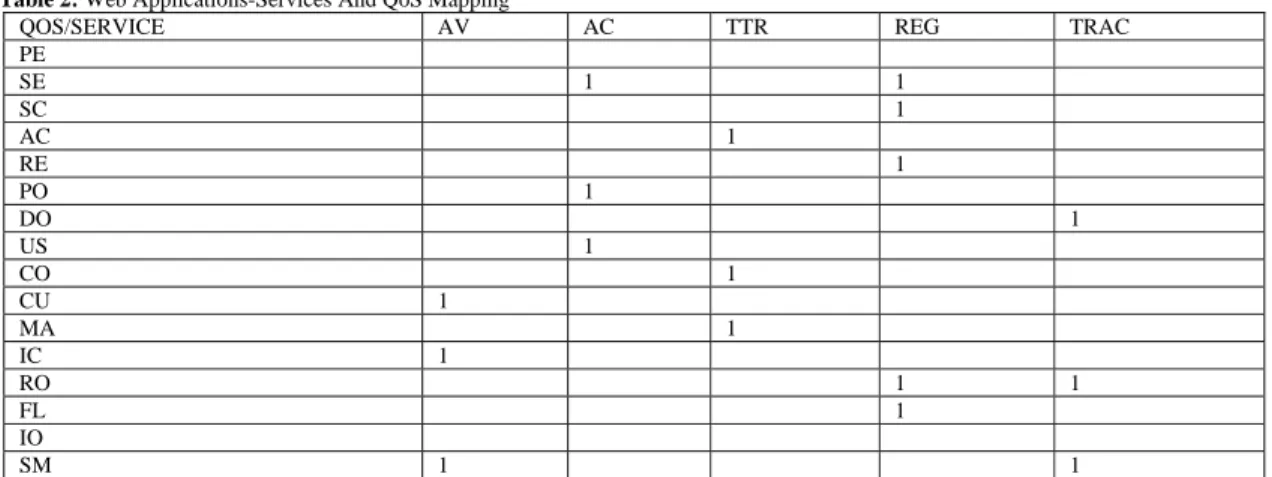
The following tabular column specifies the mapping done for each application.
1. Theafore mentioned 16 QoS are taken along columns and the services required for the application is taken along the rows. Each service can map into a number of QoS.
2. A ‘1’ specifies that a QoS is mapped into a particular service or else no.
3. A one to many (onto or into) function mapping is performed between services in the domain and the QoS in co-domain.
Table 1: Network Applications-Services and QoS mapping
QOS/SERVICE CM TP RT BW M
PE 1 1 1
SE 1
SC 1 1
AC 1 1
RE 1
PO 1
DO US 1
CO 1
CU
MA 1
IC RO FL 1 IO SM
LEGEND: CM-Congestion Management, TP- Throughput, RT- Response Time, BW-Bandwidth, M-Mobility.
Table 2: Web Applications-Services And QoS Mapping
QOS/SERVICE AV AC TTR REG TRAC
PE
SE 1 1
SC 1
AC 1
RE 1
PO 1
DO 1
US 1
CO 1
CU 1
MA 1
IC 1
RO 1 1
FL 1
IO
SM 1 1
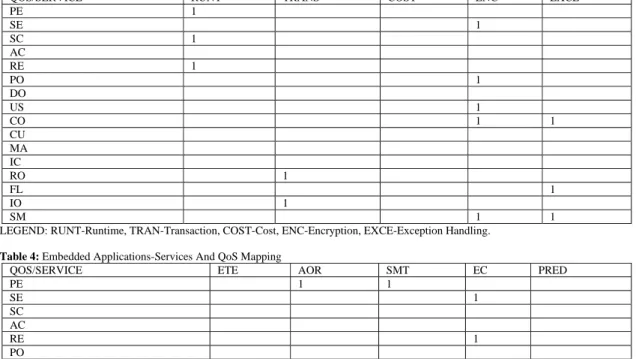
Table 3: Expert Applications-Services And QoS Mapping
QOS/SERVICE RUNT TRANS COST ENC EXCE
PE 1
SE 1
SC 1 AC RE 1
PO 1
DO
US 1
CO 1 1
CU MA IC
RO 1
FL 1
IO 1
SM 1 1
LEGEND: RUNT-Runtime, TRAN-Transaction, COST-Cost, ENC-Encryption, EXCE-Exception Handling.
Table 4: Embedded Applications-Services And QoS Mapping
QOS/SERVICE ETE AOR SMT EC PRED
PE 1 1
SE 1
SC AC
RE 1
PO
DO 1
US 1
CO 1
CU 1 1
MA 1
IC
RO 1
FL 1
IO 1
SM
LEGEND: ETE-End to End Admission control, AOR-Allocation of Resources, EC-Error Coding, PRED-Prediction
Table 5: Mobile Applications- Services And QoS Mapping
QOS/SERVICE M SCH GOS BSH AUTH
PE 1
SE 1 1
SC 1
AC 1
RE 1 1 1
PO 1 1
DO
US 1 1
CO
CU 1
MA
IC 1
RO 1 1
FL
IO 1 1
SM
LEGEND: M-Mobility, SCH-Scheduling, GOS-Grade of Service, BSH-Base Station Handover, AUTH-Authentication
Furthermore it is to be noted that Documentation (DO) and Cost factors are always considered for all applications demanded.
The Apriori Algorithm can be used to find the most frequently associated QoS among these applications in the user data. The pseudo code for the algorithm can be stated as follows:
L1= {frequent 1 length items}; for (k= 2; Lk-1 !=null; k++) do begin
Ck= candidates generated from Lk-1 (Lk-1 x Lk-1) for (each transaction t in database) do increment the count of all candidates in Ck that are contained in t
The minimum support (minsup) is a crucial factor to be considered in the algorithm. The factor can be defined by,
Minsup = floor(no.of .transactions/g), Where g=2(generally)
The above formula is selected in a manner that the associativity between the QoS for various applications is maintained by a optimized minimum factor of 50%.The value of ‘g’ can be increased or decreased based upon the level of association desired.
Once the associated QoS for various applications have been found in a prioritized manner, the components off-the shelf (COTS) should be selected in a way that it qualifies for the prioritized QoS values.
Working Examples:
Consider that the following table represents best, the user demanded applications and the services required for each.
1. The rows representing the services and the columns representing the applications. 2. A ‘1’ denoting that the service is demanded the particular application or else no.
SERVICES/APP NW WB EX MB EM
CM 1 TP RT BW
M 1 1
AV 1
AC
TTR 1
REG
TRAC 1
RUNT 1
TRANS 1
COST ENC EXCE
SCH 1
GOS 1
BSH AUTH
ETE 1
AOR SMT EC
PRED 1
The above user preferred services for each
Applications are mapped to its corresponding QoS based upon the mapping tables given above.
Thus we get a bit map table representing the applications in columns and QoS in rows. A ‘1’ symbolizes a QoS being preferred for an application or else no.
QOS/APP NW WB EX MB EM
PE 1 1 1 1 1
SE 1 1
SC 1 1
AC 1 1 1
RE 1 1 1
PO 1
DO 1 1 1 1 1
US 1 1 1
CO 1 1 1 1
CU 1 1
MA 1 1
IC 1
RO 1 1 1
FL 1 1
IO 1 1
To propose the execution for the frequently associated QoS we create 2 files Minsup-Minimum support
1. Configuration File-specifying the no. of QoS per transaction, no. of transaction and Minsup in successive lines respectively.
2. Application File-specifying each application as a row and each QoS as a column with values 1 or 0.
If we take the value of, Minsup=floor(5/2), taking g=2 Minsup=2 or 40% of the applications The prioritized QoS are,
Priority(high)=7 length QoS set={1,2,4,5,7,8,9} (i.e) {PE, SE, AC, RE, DO, US, CO}
Priority(low)=6lengthQoS set={1,3,5,7,13,15},{1,4,7,9,10,13},etc..
If we take the value of,
Minsup=60% of the applications, The prioritized QoS are,
Priority(high)= 4 length QoS set={1,4,7,9} (i.e) {PE, AC, DO, CO}
Priority(low)=6 length QoS={1,7,10},{1,7,13} etc..
The execution process can be explained as,
QoS SET SUPPORT
PE 5 AC 3 RE 3 DO 5 US 3 CO 3 CU 3 RO 3 1-length qos set
QoS SET SUPPORT
PE,AC 3 PE,RE 3 PE,DO 5 PE,US 3 PE,CO 3 PE,CU 3 PE,RO 3 AC,DO 3 AC,CO 3 RE,DO 3 DO,US 3 DO,CO 3 DO,CU 3 DO,RO 3 2-length qos set
QoS SET SUPPORT
PE,CE,DO 3 PE,CE,CO 3 PE,RE,DO 3 PE,DO,US 3 PE,DO,CO 3 PE,DO,CU 3 PE,DO,RO 3 AC,DO,CO 3 3-length qos set
QoS SET SUPPORT
PE,AC,DO,CO 3
One can introduce many more priority states not just ‘high’ and ‘low’- which are the current 2 state prioritization. The n-state prioritization is defined by the no. of .transactions and the minsup value and the COTS.
n-state prioritization, n=no.of.transactions*u; where, 0<=u<=1;
u is user-defined and is based upon The no.of.components,
The factor of QoS rating of each component and
The QoS satisfied by each component, provided by the user and seller. Especially for web services-[7] and generally [9].
Then the components off the shelf are selected in such a way that the most prioritized QoS are satisfied (i.e.)- priority(high), if not, the next prioritized (i.e.)- priority(low) and so on till all QoS mapped according to user gathered data are satisfied by the components.
Implementation:
The configuration file would look like,
The Application file would look like,
To implement the association of QoS, we code in java program in net beans environment. For a fixed minsup value of 60%, we get the prioritized QoS set as,
If we take minsup value as 40%, we get the prioritized QoS set as,
Conclusion:
From the above said it is very evident that for choosing a component for multiple applications QARM may give us the optimized amount of components and the best required for an application. QARM helps in selecting the preferable components among a given set of valid components. These components are the ones which are highly suitable with QoS for that particular combination of OS and Application. Hence they are capable of providing an efficient system.
ACKNOWLEDGMENT
We deeply appreciate the stupendous work done in implementing the above novel idea by the following Third Year CSE 2010-2014 SASTRA students: G.Leodaniel and M.Balakumaran.
REFERENCES
Andrew, P. Seddon, PearlBrereton, 1996. Componet selection using non-monotonic reasoning.Artificial Intelligence in Engineering, 10(3): 235-241.
Daniel, A., Menascé, Honglei Ruan, Hassan Gomaa, 2007. QoS management in service-oriented Architectures.Performance Evaluation, 64(7-8): 646-663.
Dimitrios Tsesmetzis, Ioanna Roussaki, Efstathios Sykas, 2008. QoS-aware service evaluation and Selection.European Journal of Operational Research, 191(3): 1101-1112.
Ivica Crnkovic, Magnus Larsson, 2002. Challenges of component-based development.Journal of Systems andSoftware, 61(3): 201-212.
Jianxin Jiao, Yiyang Zhang, 2005. Product portfolio identification based on association rule Mining.Computer-AidedDesign, 37(2): 149-172.
Min Liu, Mingrui Wang, Weiming Shen, Nan Luo, Junwei Yan, 2012. A quality of service (QoS)-awareexecution plan selection approach for a service composition process Future Generation Computer Systems, 28(7): 1080-1089.
Min Song, Il-Yeol Song, Xiaohua Hu, Robert B. Allen, 2007. Integration of association rules and ontologies for semantic query expansion “,Original Research Article, Data & Knowledge Engineering, 63(1): 63-75.
Sang C Park, Selwyn Piramuthu, Michael, Shaw, 2001. Dynamic rule refinement in knowledge-based data mining systems. Decision Support Systems, 31(2): 205-222.
Sekar, K.R., K.S. Ravichandran, Abhishek singh, 2012.Enhancement of software component compatibility in enterprise software development using high peer and low peer. Journal of Theoretical and Applied InformationTechnology, 46(1): 011-016.
Seung C. Lee, Ashraf I. Shirani, 2000. A component based methodology for Web application development.Journal ofSystems and Software, 71(1-2): 177-187.
Tang, J.F., L.F. Mu, C.K. Kwong, X.G. Luo, 2011,An optimization model for software component selection under multiple applications development. Europen Journal of Operational Research, 212(2): 301-311. Vuong Xuan Tran, Hidekazu Tsuji, Ryosuke Masuda, 2009. A new QoS ontology and its QoS-based ranking algorithm for Web services.Original Research Article, Simulation Modelling Practice and Theory, 17(8):1378- 1398.
Wei Wang, Hua Xu, Wei Wan, 2013. Implicit feature identification via hybrid association rule Mining.Expert Systems with Applications, 40(9): 3518-3531.
Xin Wang, Xiaodong Liu, Witold Pedrycz, Xiaolei Zhu, Guangfei Hu, 2012. Mining Axiomatic fuzzy set association rules for Classification problems.European Journal of Operational Research, 281(1): 201-210.