Original Article
Evaluation of efficacy of niosomal clindamycin
phosphate
1%
solution
in
comparison
to
conventional clindamycin phosphate 1% solution in
the treatment of acne vulgaris: A randomized
controlled trial
Introduction
Acne is a common skin disease that affects 95% of people during their life1. Increased sebum
production secondary to androgenic hormones as well as follicular hyperkeratinization have been
inflammatory acne lesions. Production of inflammatory cytokines by Propionibacterium acnes (P. acnes) has a role in the pathogenesis of inflammatory acne lesions.2-5
Oral antibiotics have been used for the treatment Saman Mohammadi, Hoda Badakhsh, Abbas Pardakhti*, Maryam Khalili, Saeedeh Farajzadeh**, Rezvan Amiri, Azadeh Mohebbi, Mahin Aflatoonian
Department of Dermatology, Kerman University of Medical Sciences, Iran.
* Department of Pharmaceutics, School of Pharmacy, University of Medical Sciences, Kerman, Iran.
** Department of Dermatology, Leishmaniasis Research Center, Kerman University of Medical Sciences, Iran.
Abstract Background Adverse effects including pruritus and erythema as well as increased bacterial resistance have been reported with topical clindamycin. Niosomal structures can lead to improved drug efficacy and decreased side effects because of selective effect on target organ. In this study, we decided to evaluate efficacy of niosomal clindamycin in comparison with conventional form.
Methods This study is a double-blinded clinical trial on 100 acne patients divided into 2 groups (50 patients in each group) that has been done from 2014 to 2017 in Kerman, Iran. The efficacy of niosomal clindamycin 1% in comparison with conventional form was evaluated by counting acne lesions and grading acne with Global Acne Grading System. The Chi-square test and student t test were used to determine drug efficacy and side effects. The data were analyzed using SPSS 16 (SPSS Statistics, IBM, Armonk, NY, USA). P value <0.05 was considered significant.
Results There was a significant difference between 2 treatment groups in reduction of acne lesions at the end of the study (P<0.05). The mean score of acne according to Global Acne Grading System at the end of the study was 6.64± 3.26 and 8.21±3.42 in niosomal and control group, respectively and this difference was statistically significant(P=0.023).
Conclusion Niosomal clindamycin has higher efficacy without increased adverse effects than conventional type. So, we can use niosomal form in treatment of inflammatory acne lesions, particularly in patients with low adherence to treatment and high expectations from treatment.
Key words
Address for correspondence Dr. Mahin Aflatoonian Dermatology Department, Afzalipour Hospital,
Kerman Medical University, Kerman, Iran Ph: 09125987542
Email:[email protected]
gastrointestinal adverse effects and refractory candidiasis are among the common side effects that cannot be tolerated by patients.6,7 In the
previous studies the efficacy of topical antibiotics was comparable with oral antibiotic in the treatment of mild to moderate acne lesions.8, 9 Despite lower systemic side effects of
topical antibiotics due to low skin absorption, topical antibiotics can result in local irritation than systemic drugs. So, topical treatments have lower acceptance by patients with acne.7,10
Topical clindamycin is an antibiotic from lincosamide group that is commonly used in treatment of acne lesions. Efficacy of clindamycin on acne lesions is through reduction in the number of P. acnes and inflammation. This drug also has a mild comedolytic effect. Adverse effects that have been reported with clindamycin include dryness, peeling, pruritus, burning sensation and erythema. Rarerly, serious adverse effects such as vertigo, gastrointestinal adverse effects such as diarrhea and pseudomembranous colitis have been reported. Furthermore, increased bacterial resistance to topical antibiotics such as clindamycin has been reported. So, topical antibiotics is no longer used as monotherapy, especially for maintenance therapy or applied for more than three months.7
Novel drug delivery systems such as niosomes are nanometer sized vesicular composing of non-ionized surfactants and cholesterol that lead to better penetration of drug through bi-layer lipid of stratum corneum. Also, niosomal formulations demonstrate higher efficacy with lower adverse effects due to selective effect on
target organ (pilosebaceous structure) and gradual delivery of the drug.11,12 In this study we
decided to evaluate efficacy of niosomal clindamycin phosphate 1% with conventional type in the treatment of acne lesions.
Materials and Methods
This study is a double-blinded clinical trial which 100 participants (50 patients in each group), with facial acne, between 12 to 33 years of age were enrolled in the study. The patients enrolled the study from dermatologic clinic in Afzalipour hospital in Kerman, Iran, from 2014 to 2017. According to the results of the pilot study, the sample size was estimated 100 patients with a statistical power of 80% (the rate of efficacy in treatment group A and B was 70 % and 40 %, respectively, α=0.05).This proposal was approved in Kerman ethics committee with ethical code of K/535/93.
Patients were taught to use the drug twice a day on cleaned and dried skin after washing with water and baby soap. We evaluated efficacy and adverse effects of the treatment during 4 visits at 2ed, 4th, 8th and 12th weeks. We assessed efficacy of the treatment by counting the inflammatory and non-inflammatory lesions, grading by GAGS and assessment of quality of life by Cardiff Acne Disability Index (CADI).
The GAGS is a system for grading acne severity based on type of the lesions and site of the lesions. Type of the lesions includes comedone, papule, pustule and nodule scored from 1 to 4, respectively. Site of the lesions includes forehead, right cheek, left cheek, nose, chin and trunk that have an area factor from 1 to 3. Score in an area is calculated by multiplying an area factor by the highest score result from type of the lesion. Final score is graded as acne severity to 4 groups including mild (1-18), moderate (19-30), severe (31-38) and very severe (more than 38).13
CADI questionnaire includes 5 questions about effects of the disease on appearance, emotional feelings, type of dressing, social relationship and behavior of the patients since 1 month ago with 4 choices for each question, scored from 0 to 3. The final score can range from 0 to 15 by summing each question score. Reliability and validity of this questionnaire in Persian version was evaluated (Cronbach’s alpha coefficient=0.79, Pearson correlation coefficient=0.72).14
Response rate to treatment categorized in 4 groups by counting the lesions as excellent response (reduction in number of lesions more than 75%), good response (reduction in number of lesions from 50% to 75%), fair response (reduction in number of the lesions between 25% and 50%) and poor response (reduction in number of the lesions less than 25%).
Preparation of niosomes
Multi-lamellar vesicles (MLVs) were prepared by conventional thin film hydration method. Briefly, all bilayer forming lipids, containing Span 60/Tween 60/Cholesterol (35:35:30 molar ratio) were dissolved in chloroform. Organic solvent was evaporated in rotary evaporator. The resultant lipid layer was maintained in a vacuum desiccator overnight for removing trace organic solvent residual. Dried lipid film was hydrated at 700C by clindamycin phosphate solution in deionized water (10 mg/ml) for 30 min. The resulting niosomal suspension was used for acne treatment. Sorbitan monostearate (Span 60), polysobate 60 (Tween 60) and cholesterol were purchased from Fluka, Switzerland. All other chemicals and solvents were in analytical grade and prepared from Merck, Germany.
The data were analyzed using SPSS 16 (SPSS Statistics, IBM, Armonk, NY, USA). Descriptive method was used to calculate frequency, relative frequency central tendency and scatter plot index. The Chi-square test and student t test were also used to determine drug efficacy and side effects. Moreover, QoL in both groups was compared using “Student’s t -test”. We used repeated measurement analysis for assessing efficacy of treatment modalities during the time. p-value <0.05 was considered significant.
Results
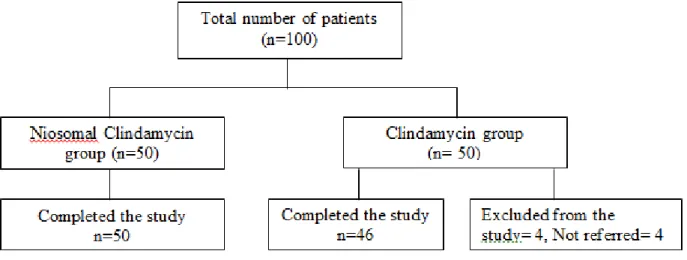
Basic characteristics One hundred patients
Figure 1 Study algorithm
14.05±3.9 in niosomal and conventional group, respectively (p-value=0.884) (ranging 6-23) that was representative of mild to moderate severity of acne.
Treatment efficacy
Inflammatory acne lesions The mean number of
inflammatory acne lesions at the beginning of the study was 12.92±12.13 and 14.45±11.76 in niosomal group and control group, respectively .The mean number of inflammatory acne lesions at the end of the study was 2.14 ± 2.77and 3.80±3.94 in niosomal group and control group, respectively. We observed reduction in the number of inflammatory lesions in both treatment group during the therapy, but significant difference was only observed in 12th weeks of the therapy (p=0.018). Percentage of reduction in inflammatory lesions of acne at the end of the study was 78.38% and 71.63%, respectively.
Non-inflammatory acne lesions Mean number
of non-inflammatory acne lesions at the beginning of the study was 11.48±9.45 and 16.01±14.38 in niosomal and control group, respectively. Mean number of non-inflammatory acne lesions at the end of the study was 3.98±3. 41and 6.56±6.22 in niosomal and control group,
respectively (P=0.01).We observed significant difference in reduction of non-inflammatory acne lesions from 8th week of the treatment. Reduction in percentages of non-inflammatory acne lesions at the end of the study was 62.95% and 55.74% in niosomal and control group, respectively.
Total acne lesions The mean number of total
acne lesions at the beginning of the treatment was 24.4±16.92 and 30.54±18.77, respectively. The mean number of total acne lesions at the end of the treatment was 6.12±4.77and 10.36±7.02, respectively (P=0.04). We observed significant difference in reduction of total number of the lesions from 2nd week of the treatment. Reduction in percentage of total acne lesions at the end of the study was 71.72% and 64.31% in niosomal and control group, respectively.
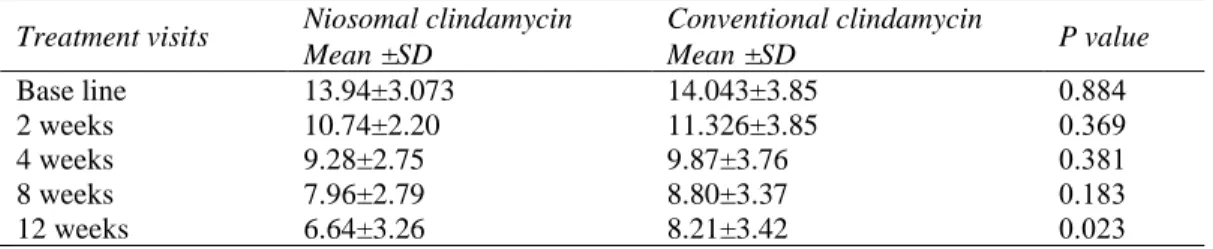
Global Acne Grading System (GAGS) The
Table 1 GAGS score in two groups during the treatment visits
Treatment visits Niosomal clindamycin Conventional clindamycin P value
Mean ±SD Mean ±SD
Base line 13.94±3.073 14.043±3.85 0.884
2 weeks 10.74±2.20 11.326±3.85 0.369
4 weeks 9.28±2.75 9.87±3.76 0.381
8 weeks 7.96±2.79 8.80±3.37 0.183
12 weeks 6.64±3.26 8.21±3.42 0.023
Table 2 Counting of acne lesions in two groups during the treatment visits Treatment visits
Niosomal clindamycin
Conventional
clindamycin P value Mean± SD Mean± SD
Number of non-inflammatory acne lesions Base line 11.48±9.45 16.01±14.38 0.06 2 weeks 8.54±7.152 12.065±11.71 0.08 4 weeks 6.48±5.715 9.673±10.422 0.07 8 weeks 4.72±4.38 7.79±7.31 0.01 12 weeks 3.98±3.41 6.56±6.22 0.01 Number of inflammatory acne lesions Base line 12.92±12.13 14.45±11.76 0.53
2 weeks 7.6±6 9.26±8.54 0.27
4 weeks 4.8±4.20 6.41±6.675 0.16 8 weeks 3.34±3.96 4.59±4.91 0.17 12 weeks 2.14±2.77 3.80±3.94 0.01
Response rate to treatment Rate of excellent,
good, fair and weak response in niosomal clindamycin were 53.8%, 30.76%, 15.38% and 0%, respectively. Excellent, good, fair and poor response rate in conventional clindamycin was 27.08%, 45.83%, 20.83%, 6.25%, respectively. The difference between two groups was significant (P=0.04).
Efficacy of treatment during the time We
assessed efficacy of treatment during the time by repeated measurement analysis. Each treatment group showed significant reduction in acne lesions and GAGS score during time (P=0.001).But reduction in percentage of non-inflammatory, inflammatory and total acne lesions during time between two groups was not significant (p=0.95, 0.24, 0.45, respectively).
Quality of life At the beginning of the study the
QoL score by CADI questionnaire was 12.36 and 11.89 in niosomal group and control group that decreased to 9.52 and 8.61 at the end of the study, but difference was not significant between
Adverse effects There was no significant
difference between 2 treatment group regarding adverse effects including erythema, dryness and peeling. Most of the side effects have mild severity and they were observed most frequently in first month of treatment. Reduction in severity and frequency of adverse effects were observed with continuation of treatment. The most frequent adverse effects were peeling and redness, respectively.
Discussion
In the present study, 53.8% of the patients in niosomal group demonstrated more than 75% reduction in acne lesions (vs.27.08% in control group), the difference was significant. But, there was no significant difference between the two treatment groups regarding quality of life and adverse effects. Furthermore, niosomal clindamycin was more efficacious without increase in adverse effects.
conventional form led to more reduction in number of acne lesions (62.8% vs. 42.9%, respectively).15 This study has showed that
newer drug structures such as liposomal formulations lead to higher efficacy and lower drug toxicity due to lower systemic absorption. Also, considering selective delivery of drug in target organ, lower side effects have been reported with these structures.1, 11, 12 In our study,
percentage of reduction of total acne lesions at the end of the study was 71.77% in niosomal clindamycin that was higher than Skalko study but it was done for 4 weeks (vs. 12 weeks in our study). Also, the latter study had higher number of acne lesions at the beginning of the study as compared to our study.
Niosomal structures have advantages such as better stability of drug, easier drug production and lower cost comparable with liposomal structures1. To date, there is no study to evaluate
efficacy of niosomal clindamycin in acne lesions. In one study in Kerman, niosomal erythromycin 4% led to reduction of 66.6% and 40% in number of inflammatory and non-inflammatory lesions (vs. 78.38, 62.95 in our study). Also the rate of good and excellent response in niosomal erythromycin was 39.9% that was lower than our study (84.56%).16 In our
study more reduction in number of the acne lesions and good and excellent response rates can be explained by less drug resistance to clindamycin in comparison to erythromycin that was mentioned in previous studies results.17, 18
Our patients’ experienced lower frequency of adverse effects with niosomal clindamycin in comparison with niosomal erythromycin, but severity of adverse effects were higher in our study than niosomal erythromycin. In our research most patients were female and patients had more lesions than niosomal erythromycin study. So, higher frequency of adverse effects in our study can be because of more susceptibility of women’s skin than men to treatment and also
application of drug on more surface area due to greater number of acne lesions.11
Several studies have reported that combination therapy of clindamycin with tretinoin or benzoyl peroxide led to higher response rate than monotherapy with clindamycin. In one study by Ochsendorf et al. in 2015, combination of clindamycin and tretinoin had 65.2%, 51.6% and 54.5% reduction in percentage of inflammatory, non-inflammatory and total acne lesions, respectively.19 The advantage of addition of
tretinoin to clindamycin in Ochsendorf study was the easier penetration of clindamycin into target organ. But better response rate in our study (78.38%, 62.95% and 71.72%, respectively) is indicative of more selective penetration of niosomal clindamycin than combination of clindamycin and tretinoin. The prevalence of adverse effects in Ochsendorf study was 4% in comparison to our study that varied between 6-20% depending on type of adverse effects.19 Higher prevalence in adverse
effects in our study can be due to difference in geographical region between the two studies. We accomplished the study in Kerman, a province with hot and dry weather condition (in comparison to Ochsendrof study in Germany with temperate weather). So, we expected higher side effects including peeling, erythema and skin dryness in our study.
In another study in 2009 by Cook-Bolden et al. combination of clindamycin 1.2% with benzoyl peroxide 2.5% had reduction of 64.1%, 48.7% and 52% in number of inflammatory, non-inflammatory and total acne lesions, respectively.20 Our study showed more reduction
adverse effects in combination therapy with benzoyl peroxide was significantly higher than our study.
Strengths of our study were randomization, double–blindness and application of several methods for evaluation of efficacy of the treatment including counting of acne lesions, assessment of quality of life with Cardiff Acne Disability Index and grading acne with Global Acne Grading System. Our study limitation was absence of evaluation of bacterial resistance of treatment modality due to high cost of laboratory tests. In order to evaluate bacterial resistance to niosomal clindamycin in comparison to conventional form, we recommend more studies with greater sample size.
In our study the excellent response rates were significantly higher in niosomal group than control group, but the difference between adverse effects was not significant. So, niosomal clindamycin may have better acceptance in patients due to higher efficacy especially those with lower adherence to treatment.
References
1. Vyas A, Kumar Sonker A, Gidwani B. Carrier-based drug delivery system for treatment of acne. The scientific world journal. 2014; 2014.
2. Gollnick HP, Dreno B. Pathophysiology and management of acne. J Eur Acad Dermatol Venereol 2015; 29: 1-2.
3. Gollnick HP. From new findings in acne pathogenesis to new approaches in treatment. J Eur Acad Dermatol Venereal 2015; 29: 1-7.
4. Deplewski D, Rosenfield RL. Role of hormones in pilosebaceous unit development. Endocrine reviews 2000; 21(4): 363-92.
5. Beylot C, Auffret N, Poli F, Claudel JP, Leccia MT, Del Giudice P, et al. Propionibacterium acnes: an update on its role in the pathogenesis of acne. J Eur Acad Dermatol Venereol 2014; 28: 271-8.
6. Nast A, Dreno B, Bettoli V, Deqitz k, Erdmann R, Finlay AY et al. European evidence-based (S3) guidelines for the treatment of acne. J Eur Acad Dermatol Venerol 2012; 26 (Suppl.1): 1-29.
7. Whitney KM, Ditre CM. Anti-inflammatory properties of clindamycin: a review of its use in the treatment of acne vulgaris. Clinical Medicine Insights. Dermatology. 2011; 4:27.
8. Gratton D, Raymond GP, Guertin-Larochelle S, Maddin SW, Leneck CM, Warner J et al. Topical clindamycin versus systemic tetracycline in the treatment of acne: results of a multiclinictrial. J Am Acad Dermatol 1982; 7: 50-3.
9. Katsambas A, Towarky AA, Stratigos J. Topical clindamycin phosphate compared with oral tetracycline in the treatment of acne vulgaris.Br J Dermatol 1987; 116:387-91.
10. Leccia MT, Auffret N, Poli F, Claudel JP, Corvec S, Dreno B. Topical acne treatments in Europe and the issue of antimicrobial resistance. J Eur Acad Dermatol Venereol 2015; 29(8):1485-92.
11. Mohammadi S, Khazaeli P, Shamsi Meymandi S, Aflatoonian M, Khalili Meybodi M, Mehrolhasani N, et al. Comparison of the efficacy of isotretinoin 0.05% niosomal gel versus adapalen 0.1% gel in the treatment of acne vulgaris: A randomized, double-blind clinical trial. Journal of Dermatology and Cosmetic. 2016; 7(2): 66-73.
12. Aflatoonian M, Fekri A, Rahnam Z, Khalili M, Pardakhti A, KhazaeliP, et al. The efficacy of combined topical niosomaldapsone gel and intralesional injection of meglumine antimoniate in comparison with intralesional meglumine antimoniate and cryotherapy in the treatment of cutaneous leishmaniasis. J Pak Assoc Derma. 2017; 26(4):353-60.
13. Witkowski JA, Parish LC. The assessment of acne: an evaluation of grading and lesion counting in the measurement of acne. Clinics in dermatology. 2004;22(5):394 14. Aghaei SH, MazhariniaN, JafariP,
Abbasfard Z. The Persian version of the Cardiff Acne Disability Index. Saudi Med J 2006; 27(1):80-2.
16. Mohammadi S, Farajzadeh S, Pardakhty A, Khalili M, Mohebbi A, Yousefian MR. A survey to compare the efficacy of niosomal erythromycin alone versus combination of erythromycin and zinc acetate in the treatment of Acne vulgaris. JKMU 2017; 24(5): 420-30.
17. Desrosiers M, Bendouah Z, Barbeau J. Effectiveness of topical antibiotics on Staphylococcus aureus biofilm in vitro. Am J Rhinol 2007; 21(2): 149–53.
18. Simonart T, Dramaix M. Treatment of acne with topical antibiotics: lessons from clinical
studies. British journal of dermatology. 2005; 153(2): 395-403.
19. Ochsendorf F. Clindamycin phosphate 1.2%/tretinoin 0.025%: a novel fixed‐dose combination treatment for acne vulgaris. J Eur Acad Dermatol Venereol. 2015; 29(S5): 8-13.