ORIGINAL ARTICLE
First evaluation of alkylpyrazine
application as a novel method to decrease
microbial contaminations in processed meat
products
Matthias Schöck
1,2, Stefan Liebminger
3, Gabriele Berg
2and Tomislav Cernava
1,2*Abstract
Every year about 20% of the globally produced meat gets lost due to microbial spoilage. Nevertheless, the demand for processed meat is constantly rising and producers are searching for novel strategies to reduce microbial con-taminations in their products. In the present study, we evaluated the applicability of alkylpyrazines as antimicrobial agents. These fragrant molecules naturally occur in different vegetables, fruits, roasted nut and meat. Several pyrazine derivatives are readily added to processed products for flavoring purposes in the food industry. To evaluate their potential for application, two derivatives were tested for their antimicrobial activity against meat-associated bacterial contaminants and chicken meat as a whole. Isolates assigned to Carnobacteriaceae, Enterobacteriaceae, Listeriaceae, and Moraxellaceae were substantially inhibited in the pilot tests. Moreover, treatments of pyrazine-susceptible isolates resulted in 4-log reductions in bacterial cell counts. The effect was more pronounced when the model contaminants were exposed to higher concentrations of 5-isobutyl-2,3-dimethylpyrazine. In a first small-scale application with processed chicken meat, it was demonstrated that the antimicrobial effects of 2-isobutyl-3-methylpyrazine can be improved by additionally lowering the water activity on the meat surface when maltodextrin is used as a carrier sub-stance. At low pyrazine dosages, the number of viable bacteria was decreased up to 95% in comparison to the cor-responding controls. A complementary imaging method that was developed to assess the efficacy on the product, reinforced the applicability of this two-component system.
Keywords: Alkylpyrazines, Spoilage bacteria, Antimicrobial volatiles, Volatile organic compounds, Preservation
© The Author(s) 2018. This article is distributed under the terms of the Creative Commons Attribution 4.0 International License (http://creativecommons.org/licenses/by/4.0/), which permits unrestricted use, distribution, and reproduction in any medium, provided you give appropriate credit to the original author(s) and the source, provide a link to the Creative Commons license, and indicate if changes were made.
Introduction
Meat is an important energy, protein, and micronutrient source in the human diet. Due to population growth, but also adaption of developing countries, especially China, to the western civilization, the meat demand is steadily increasing (OECD-FAO 2017). The high amount of meat consumption is an enormous burden for the environment nowadays, mainly because it is fastidious in production. It is well known, that animal products generally have a higher water demand than crop products. Depending
on the meat source the amount of required water varies from 4300 to 15,400 m3/ton (Mekonnen and Hoekstra
2012). In addition to the enormous demands of natural resources for the production of meat, the preventive use of antibiotics made livestock farms a prevailing source of drug-resistant microorganisms (Heuer et al. 2011). Both, the enormous environmental burden of animal protein and the health implications of intensive farming are alert-ing. Nevertheless, a considerable proportion of produced meat is wasted nowadays. A recent study of the Food and Agriculture Organization of the United Nations (FAO) showed that almost 20% of the whole meat production is lost annually, this conforms to 263 million tons of meat (FAO 2011). Lipid oxidation, autolytic enzymatic spoilage
Open Access
*Correspondence: [email protected]
2 Institute of Environmental Biotechnology, Graz University of Technology,
Petersgasse 12, 8010 Graz, Austria
and microbial spoilage are the main causes for spoilage. They are responsible for the change of color, texture, odor and flavor of meat. Microorganisms are an important cause for such deterioration processes (Zhou et al. 2010). To preserve meat, which provides favorable growth condition for different microorganisms, our ancestors invented different techniques like salting, drying, smok-ing, fermentation and canning (Dave and Ghaly 2011). All of these traditional techniques extent the shelf life of meat and meat products but underlie the disadvantage that they change composition, appearance, tenderness, flavor, juiciness and nutritive value of the treated meat. Nowadays other techniques like refrigeration, ionizing radiation, chemical preservation, high hydrostatic pres-sure and packaging are more common (Dave and Ghaly
2011; Zhou et al. 2010). They provide the means for bet-ter conservation of the physical and chemical properties of fresh meat. Today’s health awareness of consumers led to new trends in food processing (Bigliardi and Galati
2013). Chemical or artificial substances like nitrites, sul-phites or benzoic acid are avoided by many consumers (Dave and Ghaly 2011). Alternative conservation tech-niques like biopreservation and natural antimicrobials are essential for green label products that attract con-sumers with their natural image (Zhou et al. 2010). Dis-tinct metabolites from microbial origin, including lactic acid, are known to enhance the shelf life of fresh meat (Stiles 1996). Nevertheless, there is still a great demand for efficient and environmentally friendly strategies.
In order to find suitable alternatives for conventional food preservatives, we focused on microbial volatile organic compounds (mVOCs), which are mediators of various interactions in nature (Effmert et al. 2012; Kan-chiswamy et al. 2015). They are produced by the major-ity of known organisms and can serve as communication molecules between organisms of the same species, but also between organisms across organismal kingdoms (Effmert et al. 2012; Ryu et al. 2003). Recently it was shown that alkyl-substituted pyrazines, distinct mVOCs produced by Paenibacillus polymyxa, are mediators of antimicrobial effects against a series of plant and human pathogens (Cernava 2012; Rybakova et al. 2016). Spe-cific pyrazine derivatives were already employed for the decontamination of eggshells and demonstrated a com-parable efficiency to conventional treatments (Kusstat-scher et al. 2017). Pyrazines belong to the chemical group of diazines, which consist of an aromatic heterocyclic ring with two nitrogen atoms in para-orientation and dif-fer in residues substituted to the carbon atoms of the ring structure. By decision of the Flavor and Extract Manu-facturers Association (FEMA), pyrazines are declared to receive GRAS status. They are generally recognized as safe in their application as flavoring substances (Adams
et al. 2002). Based on these findings, 5-isobutyl-2,3-di-methylpyrazine (5IB23DMP) and 2-isobutyl-3-methyl-pyrazine (2IB3MP) were utilized as model 2-isobutyl-3-methyl-pyrazines for laboratory scale treatments of processed chicken meat strips. The first substance, 5IB23DMP was used to iden-tify pyrazine sensitive meat-derived microorganisms due to the similar antimicrobial effect to the pyrazine mixture emitted by the highly antagonistic P. polymyxa
GnDWu39 (Cernava 2012; Rybakova et al. 2016). The second substance, 2IB3MP was used due to its conveni-ent flavor profile, resembling the smell of bell peppers (Rognon and Chastrette 1994). The overall aim of this study was to determine if microbial contaminations can be sufficiently reduced in meat products by application of antimicrobial, alkyl-substituted pyrazines. Moreover, we wanted to define the required dosages for adequate pyra-zine treatments that could later find application in meat processing. The potential preservatives were tested in a hurdle technology combining 2IB3MP as active ingredi-ent with maltodextrin as carrier substance and storage at 4 °C. Treatment efficiencies were assessed with culti-vation-dependent methods in combination with a novel textile imprint method coupled with confocal laser scan-ning microscopy.
Materials and methods
Antimicrobial efficiency tests with 5‑isobutyl‑2,3‑dimethylpyrazine
rRNA gene fragments were amplified with the 27F/1492R primer pair. All 16S rRNA gene fragment sequences were deposited at Genbank (https://ncbi.nlm.nih.gov/ genbank).
Combined treatments of processed meat
with 2‑isobutyl‑3‑methylpyrazine and maltodextrin
The processed chicken meat strips, which were, accord-ing to manufacturer’s information, roasted in sunflower oil and salted with table salt, were obtained from a local supermarket (Graz, Austria). All samples utilized for this study were packed in sealed plastic containers. A mix-ture of maltodextrin (Myprotein, UK) containing 20% 2-isobutyl-3-methylpyrazine (2IB3MP; FCI SAS, France) was utilized as active ingredient for the treatments. The weight of the meat strips was determined in sterile 50 ml plastic tubes and then stored on ice during further processing. Three distinct amounts of active ingredi-ent (0.015 g/g meat, 0.045 g/g meat and 0.075 g/g meat) were added. After addition of the active ingredient the tubes were shaken for 15 min on an automated shaker at 130 rpm to ensure homogeneous distribution on the meat pieces. The tubes were incubated for 48 and 96 h at 4 °C to simulate storage conditions. To verify the effi-ciency of the treatment, meat strips together with 10 ml of 0.85% NaCl for each g meat were added into flasks and shaken for 15 min at 130 rpm to detach the microorgan-isms. The resulting suspension was diluted and plated on NA plates. After incubation of the plates at room temperature for 48 h the colony forming units per gram (CFU/g) meat were calculated. In addition, a control without maltodextrin and a second control containing pure maltodextrin (0.036 g/g meat) without 2IB3MP was incubated with the treated samples. All quantifications of viable cells were conducted with five replicates for each treatment and sampling time point.
Analysis of textile imprints with differential staining
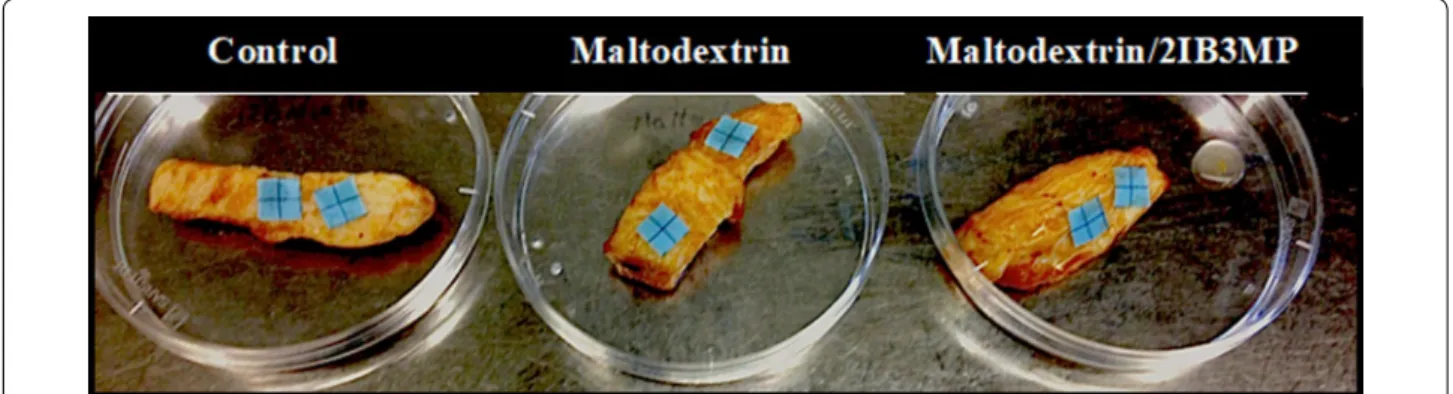
Polyester-based textile fabrics used for the production of clean room garments (Dastex, Muggensturm, Germany) of a defined size (1 cm × 1 cm) were excised. The textile pieces were autoclaved and dried at 65 °C. Chicken meat pieces were treated with maltodextrin (0.036 g/g meat) or maltodextrin/2IB3MP (0.075 g/g meat). Controls were included, these samples were not treated with any of the active ingredients. The meat pieces were stored for 72 h at 4 °C. After storage, two textile pieces were attached to each piece of meat (Fig. 1) and stored at 4 °C for addi-tional 24 h. The textile pieces inoculated on the meat were stained with the LIVE/DEAD® Baclight™ kit
(Inv-itrogen, Karlsruhe, Germany). The dyes were prepared as described in the manufacturer’s protocol. A final volume of 100 μl of each fluorochrome solution was transferred onto the textiles and incubated for 15 min in the dark. The micrographs were recorded with a Leica TCS SPE confocal laser-scanning microscope (Leica Microsys-tems, Mannheim, Germany). For the SYTO® 9
green-fluorescent dye an extinction/emission wavelength at 485/530 nm was applied and for the red-fluorescent dye propidium iodide an extinction/emission wavelength at 485/630 nm.
Statistical analysis
For the microbial reduction experiments, the statistical analyses (ANOVA and post hoc analysis with Scheffe’s test) were performed with Data Analysis ToolPak Stat-Plus (AnalystSoft Inc., Los Angeles, USA).
Results
Treatment of isolated meat contaminants with 5‑isobutyl‑2,3‑dimethylpyrazine
The preliminary experiments employed for the anti-microbial efficiency evaluations of 5IB23DMP showed
a substantial reduction of livable cells in five out of the eight tested isolates in 0.3% aqueous suspension (Table 1). In 0.6% pyrazine suspensions, a log-4 reduc-tion was observed for one addireduc-tional isolate that was not affected by the lower concentration. Isolates that were not affected by the employed pyrazine derivative were assigned to the bacterial lineage Bacillus at genus level. One of these resilient isolates was assigned to Bacillus amyloliquefaciens, while the other was not assignable at species level by analysis of the 16S rRNA gene fragment. The isolate that was able to withstand 0.3% 5IB23DMP treatments was identified as Carnobacterium maltaro-maticum, which belongs to the Gram-positive Firmicutes. Three of the sensitive isolates were assigned to Gam-maproteobacteria, with two members of the bacterial family Enterobacteriaceae. Brochothrix thermosphacta, a bacterium associated with meat spoilage, which belongs to the Gram-positive Listeriaceae was also substantially reduced at both tested pyrazine concentrations.
Quantification of aerobic mesophilic bacteria on pyrazine‑treated meat samples
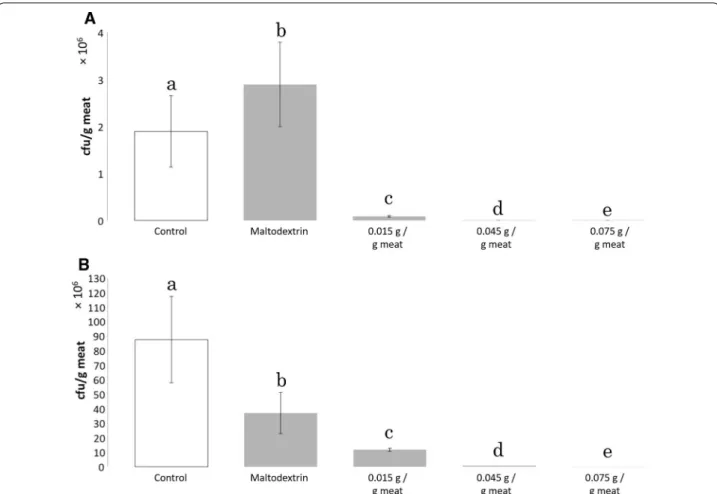
The processed chicken meat strips were treated with three defined dosages of maltodextrin with 20% 2IB3MP (w/w) and compared to a non-treated control. In addi-tion, processed meat samples were treated with malto-dextrin without pyrazine supplementation (0.045 g/g meat). Treatments with pure maltodextrin that was not supplemented with pyrazine, showed a significant reduc-tion in CFU counts after 96 h of storage (Fig. 2). Here, the treated samples had an average of 3.7 × 10⁷ CFU/g, while the control contained 8.75 × 10⁷ CFU/g. Signifi-cant reductions in viable bacteria occurred already after
48 h in all pyrazine-containing samples (Fig. 2). Dosage-dependent reductions were observed when different maltodextrin/2IB3MP dosing was compared. Following the storage at 4 °C and 48 h, samples that were treated with 0.015 g of the antimicrobial preparation per Gramm meat, contained 8.65 × 10⁴ CFU/g compared to 5.7 × 10² CFU/g for the highest dosage (0.075 g/g meat). After 96 h storage under the aforementioned conditions, samples that were treated with the same maltodextrin/2IB3MP dosages contained 1.17 × 10⁷ CFU/g and 1.8 × 10⁵ CFU/g respectively.
Visualization of the treatment efficiency with confocal microscopy
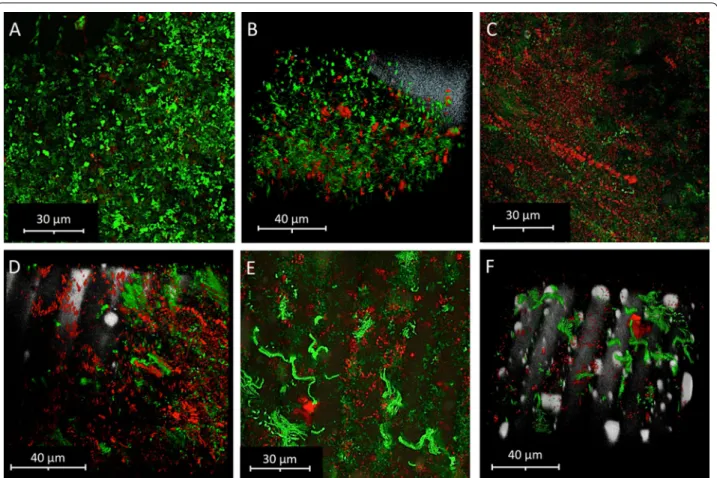
Contaminating bacteria that were present on the pro-cessed chicken meat were visualized with a novel textile imprint method and confocal laser scanning microscopy (CLSM). This method also includes microorganisms that were not accessible with the cultivation-dependent effi-ciency analyses. Micrographs with differentially stained microorganisms showed varying proportions of living and dead bacteria on the analyzed specimens (Fig. 3). Maltodextrin-treated meat strips (micrographs C and D) and maltodextrin/2IB3MP-treated chicken strips (micrographs E and F) in comparison to untreated con-trol meat strips (micrographs A and B) showed reduced counts for living bacteria. Moreover, micrographs of the maltodextrin/2IB3MP-treated samples showed a shift in the cell morphology of the microbial population that was not observed with other samples. While the control sam-ples primarily showed free-living cells and small aggre-gates, these samples harbored high proportions of chain forming microorganisms. In the samples that were only treated with maltodextrin, the total number of cells was comparable with the control. Nevertheless, the maltodex-trin treatments resulted in a substantially higher propor-tion of dead cells.
Discussion
Applicability of alkylpyrazines as preservatives for processed meat products
To our knowledge, this is the first study to demonstrate preserving effects of alkylpyrazine derivatives in com-bination with processed meat. The utilized model sub-stance, 2-isobutyl-3-methylpyrazine, was identified as a potential preservative, which could increase the shelf life of processed chicken meat in future applications. Efficacies of various dosages were verified in a double evaluation that combined cultivation-dependent tech-niques and differential staining microscopy. The overall results indicate that the combination of an antimicro-bial alkyl pyrazine and maltodextrin is a promising strat-egy to reduce microbial contaminations on convenience Table 1 Efficacy of an alkylpyrazine derivative
(5-isobutyl-2,3-dimethylpyrazine) against bacteria
Pure cultures of isolates obtained from processed meat products were incubated in aqueous pyrazine solutions. Combinations of isolates and pyrazine concentrations that led to a 4-log reduction are labeled with ‘+’, while such with lower reduction rates are labeled with ‘−’
Tested isolate 4‑log reduction in aqueous pyrazine solution
0.3% 0.6%
Bacillus amyloliquefaciens HT1C − −
Bacillus sp. HT1B − −
Brochothrix thermosphacta HT1G + +
Carnobacterium maltaromaticum HT1Z − +
Proteus sp. HT1W + +
Psychrobacter sp. HT1F + +
Serratia sp. HT1E + +
products. Although no protective atmosphere was used for re-packaging of the treated meat, we observed bacte-rial counts that are acceptable by current regulations in the European Union (Regulation (EC) No 2073/2005). It can be expected that the efficiency of the presented method can be improved when packaging of the product is done in an industrial environment that provides fur-ther means for the avoidance of contaminations. Recent studies indicate that various natural substances, espe-cially essential oils, can be used to increase the shelf life of chicken meat (Fratianni et al. 2010; Ntzimani et al.
2010). However, consumers’ demands are not always fulfilled by these preservation methods due to altera-tions in the product’s overall appearance. Here, pyrazine-rich extracts provide a promising alternative that can be applied together with maltodextrin or other suitable car-riers on ready-to-eat poultry products. In addition, the application of these extracts could enhance taste prop-erties by adding different notes of roasted flavors to the final product.
Several pyrazine-tolerant microbes were shown to resist the treatment at lower concentrations and to increase in their relative abundance. This effect disappeared when the pyrazine concentration was increased. From the current perspective, sufficient concentrations of alkylpyrazines can substantially decrease the number of viable contaminants. For this reason, follow-up studies will focus on pyrazine-rich extracts obtained from bell peppers and other vegetables for non-conventional and natural shelf life extension.
A new method to visualize microbial contaminants on the meat surface
To assess the treatment efficacy beyond aerobic meso-philic plate counts, a complementary approach was developed to omit cultivation-related biases. The com-bination of microbiological, molecular, and differential imaging experiments was highly useful in previous stud-ies that focused on antimicrobial effects of alkylpyrazines (Cernava 2012; Kusstatscher et al. 2017). In the current study, microbial contaminations were not accessible for visualizations with CLSM imaging and differential
staining due to fluorophore interferences with the meat. The developed imprint method allows to omit this unwanted interference and provides quick estimates on the preservation efficacy. Studies that focused on the applicability of live/dead staining techniques, demon-strated that the results are influenced by various physi-ological and chemical factors (Netuschil et al. 2014). Especially cells that are embedded in biofilms are difficult to evaluate with such approaches. Therefore, it remains to be determined how the imprint method performs when compared to in situ visualizations. Taken together, we could show with different methods that the applica-tion of alkylpyrazines substantially decreases the number of viable microorganisms on treated products. This pro-vides the basis for future applications of these bacteria-derived metabolites that are already present in various foods that are regularly consumed by humans.
Abbreviations
and Extract Manufacturers Association; GRAS: generally recognized as safe; mVOCs: microbial volatile organic compounds; NA: nutrient agar; OECD: Organization for Economic Co-Operation and Development.
Authors’ contributions
TC, GB, and SL developed the study design. MS performed the labora-tory experiments and the statistical analyses. SL optimized the process of combined alkylpyrazine/maltodextrin treatments. TC and MS evaluated the obtained data and visualized all results. TC, GB, and MS wrote the manuscript. All authors reviewed the final version of the manuscript. All authors read and approved the final manuscript.
Author details
1 ACIB GmbH, Petersgasse 14, 8010 Graz, Austria. 2 Institute of Environmental
Biotechnology, Graz University of Technology, Petersgasse 12, 8010 Graz, Austria. 3 Roombiotic GmbH, Stremayrgasse 16, 8010 Graz, Austria.
Acknowledgements
The authors gratefully acknowledge the help of Zohartze Monteagudo (Graz) during laboratory analyses.
Competing interests
The authors declare that they have no competing interests.
Availability of data and materials
All 16S rRNA gene fragment sequences of the utilized meat-associated isolates were deposited at Genbank (https://ncbi.nlm.nih.gov/genbank) under the accessions MG807444–MG807451.
Consent for publication
Not applicable.
Ethics approval and consent to participate
Not applicable.
Funding sources
This work was supported by the Federal Ministry of Science, Research and Economy (BMWFW), the Federal Ministry of Traffic, Innovation and Technol-ogy (bmvit), the Styrian Business Promotion Agency SFG, the Standortagentur Tirol, the Government of Lower Austria and ZIT-Technology Agency of the City of Vienna through the COMET-Funding Program managed by the Austrian Research Promotion Agency FFG (Grant Number 282482).
Publisher’s Note
Springer Nature remains neutral with regard to jurisdictional claims in pub-lished maps and institutional affiliations.
Received: 12 February 2018 Accepted: 27 March 2018
References
Adams TB, Doull J, Feron VJ, Goodman JI, Marnett LJ, Munro IC, Newberne PM, Portoghese PS, Smith RL, Waddell BM, Wagner BM (2002) The FEMA GRAS assessment of pyrazine derivatives used as flavor ingredients. Food Chem Toxicol 40:429–451
Besson I, Creuly C, Gros JB, Larroche C (1997) Pyrazine production by Bacillus subtilis in solid-state fermentation on soybeans. Appl Microbiol Biotech-nol 47:489–495
Bigliardi B, Galati F (2013) Innovation trends in the food industry: the case of functional foods. Trends Food Sci Technol 31:118–129
Cernava T (2012) Identification of volatile organic compounds from plant-asso-ciated bacteria. Master’s thesis, Graz University of Technology
Dave D, Ghaly AE (2011) Meat spoilage mechanisms and preservation tech-niques: a critical review. Am J Agric Biol Sci 6(4):486–510
Effmert U, Kalderás J, Warnke R, Piechulla B (2012) Volatile mediated interac-tions between bacteria and fungi in the soil. J Chem Ecol 38:665–703 FAO (2011) Global food losses and food waste—extent, causes and
preven-tion. Rome. http://www.fao.org/docrep/014/mb060e/mb060e00.pdf. Accessed 8 Dec 2017
Fratianni F, De Martino L, Melone A, De Feo V, Coppola R, Nazzaro F (2010) Preservation of chicken breast meat treated with thyme and balm essen-tial oils. J Food Sci 75:528–535
Heuer H, Schmitt H, Smalla K (2011) Antibiotic resistance gene spread due to manure application on agricultural fields. Curr Opin Microbiol 14:236–243 Kanchiswamy CN, Malnoy M, Maffei ME (2015) Chemical diversity of microbial
volatiles and their potential for plant growth and productivity. Front Plant Sci 6:151
Kosuge T, Kamiya H (1962) Discovery of a pyrazine in a natural product: tetra-methylpyrazine from cultures of a strain of Bacillus subtilis. Nature 193:776 Kusstatscher P, Cernava T, Liebminger S, Berg G (2017) Replacing conventional decontamination of hatching eggs with a natural defense strategy based on antimicrobial, volatile pyrazines. Sci Rep 7:13253
Mekonnen MM, Hoekstra AY (2012) A global assessment of the water footprint of farm animal products. Ecosystems 15:401–415
Netuschil L, Auschill TM, Sculean A, Arweiler NB (2014) Confusion over live/ dead stainings for the detection of vital microorganisms in oral biofilms-which stain is suitable? BMC Oral Health 14:2
Ntzimani AG, Giatrakou VI, Savvaidis IN (2010) Combined natural antimicrobial treatments (EDTA, lysozyme, rosemary and oregano oil) on semi cooked coated chicken meat stored in vacuum packages at 4 C: microbiological and sensory evaluation. Innov Food Sci Emerg Technol 11:187–196 OECD-FAO (2017) OECD-FAO agricultural outlook 2017–2026. http://www.
agri-outlook.org. Accessed 8 Dec 2017
Rognon C, Chastrette M (1994) Structure-odor relationships: a highly predic-tive tridimensional interaction model for the bell-pepper note. Eur J Med Chem 29:595–609
Rybakova D, Cernava T, Köberl M, Liebminger S, Etemadi M, Berg G (2016) Endophytes-assisted biocontrol: novel insights in ecology and the mode of action of Paenibacillus. Plant Soil 405:125–140
Ryu CM, Farag MA, Hu C-H, Reddy MS, Wei H-X, Paré PW, Kloepper JW (2003) Bacterial volatiles promote growth in Arabidopsis. Proc Natl Acad Sci USA 100:4927–4932
Stiles ME (1996) Biopreservation by lactic acid bacteria. Antonie Van Leeuwen-hoek 70:331–345