The Impact of Learner Language Knowledge on Teacher-learner Authentic Partnership
Jamel Chaaraoui*
University of Jeddah, Saudi Arabia
Corresponding Author: Jamel Chaaraoui, E-mail: [email protected]
ABSTRACT
The language teacher and learner (T-L) partnership is a give-and-take relationship that gains authenticity through mutual awareness that their collaboration can only happen through the learner’s autonomy as an active partner and a source of information. To play that role properly, the learner’ language performance is expected to have a high level of TL knowledge reflected in norm-based grammar. Put differently, the more established the T-L partnership is, the more accurate the learner’s TL is expected to be. To explore the level of TL knowledge that can enable the learner to play the role of a reliable partner, the present study measured the English grammar global accuracy of the foundation students at a Saudi university. The results obtained show that the learner’s TL is noticeably inaccurate, implying that T-L partnership is still far from being true in that academic context. As such, the T-L alienation requires appropriate pedagogical interference believed to reconcile between the teacher and learner in a quest to activate the learner’s academic role and build their sound linguistic competence.
Key words: Teacher-Learner Partnership, Collaboration, Source of Information, Active Partner, Learner Autonomy, Norm-based Grammar, Linguistic Competence
INTRODUCTION
The T-L partnership is an academic and social bond that makes of language teaching and language learning a shared task designed and produced through communication, and collaboration between the teacher and learner with trust,
autonomy, and mutual confidence. By being a partner, the
learner’s TL performance is expected to be well-studied,
mutually chosen, and grammatically accurate. In oth -er words, without being equipped with enough language knowledge, learners cannot look for information, comment on it, and suggest the teaching techniques suitable for them to learn language easily and acquire it fast. The T-L
part-nership is ultimately based on the learner TL proficiency
level that can only be achieved through the global grammar accuracy. The T-L partnership, as a key to successful lan-guage learning, is investigated in the academic background being studied through the measurement of the global gram-mar accuracy in the learner language produced in an oral presentation test. The level of grammar accuracy is the
measurable construct that can reflect the learner’s ability of playing the role of a teacher’s partner. In return, the level
of learner TL grammar accuracy will also reveal about the teacher awareness of such a vital academic principal,
part-nership. Based on the results obtained, the present study first examines how inaccurate TL grammar reflects a cer -tain academic reality. Then, it will suggest the appropriate
Published by Australian International Academic Centre PTY.LTD.
Copyright (c) the author(s). This is an open access article under CC BY license (https://creativecommons.org/licenses/by/4.0/)
http://dx.doi.org/10.7575/aiac.ijalel.v.8n.1p.10
measures that can reinforce the adoption of such a principal in the appropriate way.
FROM GRAMMAR ACCURACY TO COMMUNICATIVE COMPETENCE
Based on Ellis’s (2003) and Wolfe-Quintero et al.’s (1998)
Operationalisation of Accuracy, the objective measures of grammar adopted in the current experimental research are
1) error density, 2) types of errors, 3) mean number of er
-rors per 100 words (Kuiken & Vedder, 2007), and 4) mean number of errors per AS-Unit (Lambert & Engler, 2007).
That is, the term grammar investigated in the present study is both morphological and lexical, examining the internal structure of words as well as their syntactic relationships. The research objective behind that is to investigate how the learners’ interlanguage abides by the TL norms in the
pro-duction of single words as well as in syntactic units. In fact,
grammar global accuracy is vital as it addresses the code that assigns functions to language messages whether or
spo-ken or written. In this respect, Hymes (1966, p. 53), asserted
that the “communicative form and function are in integral relation to each other”. That is, each form has a function therefore implements a certain meaning to the message con-veyed. So, the ability to create grammatical utterances is
the ability to communicate, (Canale and Swain 1980). In
a word, communicative competence can only be achieved ARTICLE INFO
Article history
Received: September 04, 2018 Accepted: December 14, 2018 Published: January 31, 2019 Volume: 8 Issue: 1
Advance access: December 2018
through grammatical competence. The communicative abil-ity means their possession of the rules that permit the speak-er to make judgments about whethspeak-er or not uttspeak-erances are
grammatical. In the same vein, Savignon (1985, p.130) even equates language proficiency with knowledge of grammar rules. Also, for Bachman (1990) and Brown (1994), basic to the communicative competence is the grammatical compe-tence which is being measured in learner language to inves-tigate the ability of that learner to act as partner in language learning process with full academic agenda and well-estab-lished vision.
THEORETICAL FRAMEWORK
The T-L partnership sets the foundation of the type of
re-lationship between the teacher and student. Based on trust,
autonomy, and cooperation, it is assumed that the learner would have enough linguistic competence that permits them to understand and produce language accurately.
In a bottom-up investigation, the present study aims at
measuring the amount of grammar global accuracy in the learner’s language to examine the type of relationship be-tween the teacher and learner, and how that is translated in the learner’s TL grammar accuracy. The investigation links between the types of grammar errors on the one hand and the type of T-L relationship on the other hand. The research
ques-tions are the following: What are the learner’s grammar er -rors, why have they persisted, and what do they reveal about the T-L partnership in the academic context under study?
METHOD
Global grammar accuracy has been gauged via six objective
measures: error density, error free AS-Units, frequency of
error per AS-Unit, mean number of errors per 100 words,
most common error procedures, most common error types.
Participants
For data reliability and case authenticity, a group of 50 male foundation students at King Abdul Aziz University were ran -domly chosen. All the learners had almost seven years of exposure to English as a foreign language in Saudi Arabia.
Materials
The materials used in this study are videotaped oral presen-tation consisting of two modes of speech: a monologue pre-pared by the students in advance. The oral production was segmented into AS-Units. And errors recoded were
catego-rized into types and procedures (Corder, 1973).
RESULTS
The results will account for the errors recorded in terms of
density, categories, types, and frequency. In this respect, it
is important to point out that the language is grammatically
inaccurate. More specifically, the level of grammatical ac
-curacy is uneven between the two modes of speech. More accurate grammar in the pre-planned monologue and with more substitution error categories whereas in the dialogue, the online-planned dialogue is less accurate and with the more dominance of omission errors category. Last but not least, the sole majority of errors are interlingual.
Error Density
As shown in Table 1, there is a mean average of 169.20
words produced in the monologue, and that number is high enough to express any idea or describe any scene, event, or a
point of view. It reflects a considerable language knowledge, command and proficiency on the part of the speaker whose
language repertoire seems to be rich enough to allow for self-expression and for the choice of a variety of topics. Sim-ilarly, the density of language production is reinforced by the
big number of AS-Units produced in the monologue - 17.42 AS-Units with 9.5 words per unit. In terms of language qual
-ity, the mean number of sentences is 10.68. That number is
surprising as the mean number of words can hold more sen-tences.
The AS-Unit is syntactically-based and flexible enough to include even single words (Ellis 2003). Despite that, there are as many as 9.5 words per AS-Unit higher than the ideal number which is 7 to 9 words per English sentences
in spoken language which is considered less complex than
the written one. However, the speakers’ language com
-mand is better identified after detecting the density and
types of grammar errors made in that big number of words produced. Accuracy wise, the mean number of grammar
errors is 11.89 errors per 100 words. That sizable amount
of errors drives the oral output produced not to be very
ac-curate grammatically (C) given the 10-day period of time
provided to the students to prepare their oral presentation topics.
Clearly, the considerably dense language produced in the monologue is highly inaccurate as described by Ellis
(2003) who defined accuracy as “the extent to which the
language produced in performing a task conforms to native
speaker norms” (p. 339). That is, the learners’ type of inter -language in this academic context seems to be an
accumu-lation of unrefined TL knowledge over the years. That high level of error density reflects the fact that the learner has not
formally acquired much of the TL structural norms due to the lack of enough exposure and practice required when he is the centre of the TL teaching efforts. English is necessary only in science majors in higher education but not highly
urgent for future jobs or for daily communication. Back in
time, teachers of English in the intermediate and secondary schools extensively use the learners’ mother tongue as the sole means of communication and language of instruction
(Fareh 2010). So, the absolute majority of students learn
English instrumentally; to get the pass grade. As a result, the students’ type of English is made up of scrambled parts of speech clinging in the mind over the years more than a
build-up of language structures developed and refined over
Table 1 . Number of errors made by the 50 Subjects both in the Monologue and Dialogue
ELCS ELCA Total Monologue
Mean number of words 254.13 94.43 169.20 Mean number of errors in
grammar 28.3 11.95 20.12
Mean Number of errors in
grammar per 100 words 11.13 12.65 11.89 Mean Number of Words per
AS-Unit 11.02 7.98 9.5
Mean Number of AS-Units 23,02 11.82 17.42 Mean number of sentences 13.98 7.38 10.68 Dialogue
Mean number of words 72.21 28.19 50.2 Mean number of errors in
grammar 12.96 7.48 10.22
Mean Number of errors in
grammar per 100 words 17.94 26.53 20.36 Mean Number of Words per
AS-Unit 6.13 2.86 4.49
Mean Number of AS-Units 11.51 10.10 10.80 Mean number of sentences 4.34 0.96 2.65
In the dialogue, the mean number of words produced is 50.2, exactly 29.67% of the mean number of words produced
in the monologue although the dialogue was meant to elabo-rate on the ideas and topics produced in the monologue.
Af-ter the speaker gains confidence in the monologue, his per -formance is expected to be better and his language of more quality. On the opposite, together with the very few words produced, The mean number of AS-Units produced in the
di-alogue is 10.80. That number is misleading as the number of words per AS-Unit does not exceed 4.49, less than 50% of
the number of words produced per AS-Unit in the monologue. Another strong reinforcement of the poor language
perfor-mance is the high mean number of errors per 100 words. It is as enormous as 20.36 errors. On the other hand, the number of sentences produced in the dialogue is just 2.65; almost all the
words produced were sporadic as no syntactic body was built to arrange them.
Error Categories
The error categories, which are omission, addition,
substi-tution, and permutation, serve as a mirror to reflect the bal
-ance between L1 and L2 or predomin-ance of any of them in
the learner interlanguage system translated in the linguistic norm abidance in this academic context. They also display the nature of the linguistic gaps; interlingual as is the case under study or intralingual which show a higher level of
pro-ficiency level. on the part of the language user.
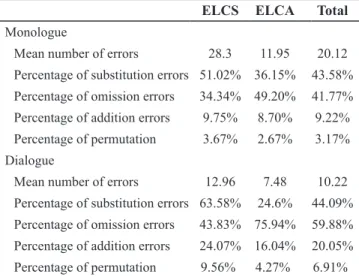
As shown in Table 2, the mean number of errors is 20.12 per 169.20 words – the mean number of words produced in the monologue. More specifically, the error procedures in the
monologue are ranking as follows:
1) 43.58% of the grammar errors made are substitution errors; 2) 41.77% are omission errors;
3) 9.22% are addition errors; 4) 3.17% are permutation errors.
Clearly, in the preplanned, closed task, the monologue, the speaker has time to prepare, reformulate, and edit what
they intend to say and therefore be as accurate as he/she can. In such a mode of speech, the substitution is the most com -mon error category. That is expected as the speaker has time
to find the correct grammar structure to convey the message
intended. So, the erroneous substitution category seems highly convenient for more expressiveness in this case.
More specifically, the substituting parts of speech and grammar structures imply awareness of the speakers about L2 grammar norms, and that entails a considerable L2 proficiency level. Low proficiency level learners do not have richness of
grammar rules and a variety of alternative speech parts in their language repertoire to employ as alternatives for substitution.
That raises more expectations of having a higher level of L2
competence and a better language performance in the next task,
the dialogue. However, the second most employed erroneous
category in the monologue is the omission one. Although it ranked second, it is not very different in amount from the per-centage of substitution. Omitting parts of speech represents lack
of awareness, a strict deviance from L2 grammar system norms,
and a serious break of the language grammar rules. The convic-tion of the seriousness of such error category is reinforced by
the erroneous additions which ranked third with 9.22%. That is,
omitting or adding a grammar element represents a serious de-viance to grammar norms more than substituting or permuting that element. The oral presentation task is an academic test in which the learners compete to get the best grade.
Also, the foreign language learnt in class is standard; L2 dialects and/or varieties are ruled out. So, the high percentage
of erroneous omissions automatically implies lack of
aware-ness of the L2 grammatical system and a low L2 grammar proficiency level. That also leads to two logical interpreta
-tions: the learners under study have a low English proficiency
level, and the quantity and quality of language of language is prepared and frequently practised before the test. Also, the
substitution errors that ranked first does not mean richness
in alternative parts of speech and grammar structures in the
speakers’ language repertoires. Instead, those substitution
errors were instances of overgeneralising L1 grammar rules.
Table 2. Error procedures reported in the Monologue and
Dialogue of all the subjects
ELCS ELCA Total Monologue
Mean number of errors 28.3 11.95 20.12 Percentage of substitution errors 51.02% 36.15% 43.58% Percentage of omission errors 34.34% 49.20% 41.77% Percentage of addition errors 9.75% 8.70% 9.22% Percentage of permutation 3.67% 2.67% 3.17% Dialogue
In the dialogue, where language production is more spon -taneous and more expressive of the speaker’s interlanguage
competence, the mean number of errors is 10.22 in every 50.2 words produced. As can easily be noted, the language produced in this task is extremely erroneous. More specifi -cally, the error categories ranking has changed as follows:
1) 59.88% of the grammar errors are omission errors. 2) 44.09% are substitution errors.
3) 20.05% are addition errors. 4) 6.91% are permutation errors.
In the dialogue, the language produced is so poor syntac -tically and quantitatively. Similarly, the omission error cat-egory has become the most frequent. Although the learners had been given ten days to competitively prepare for their oral test; the choice of good topics and elaborate language with accurate grammar, they produced highly frequent erro-neous substitutions. Those systematic errors of substitution
and omission reflect the learners’ little knowledge of the TL
grammar basic norms even if the time taken for preparation and the choice of topics are generously given to the
learn-ers. With this level such as it is, enough awareness of the
TL grammar norms is very unlikely. On the other hand, the dominance of systematic omission errors in the dialogue
seems to depend to a large extent on the L1 norms. For ex -ample, many free morphemes in English are treated as bound morphemes the way they are in the learner’s mother tongue. Few examples of those bound morphemes in Arabic are sub-ject pronoun + verb; preposition + obsub-ject pronoun; article + noun; article + adjective, etc.
In the same vein, even the third person singular bound
morpheme in English “-s”, which has no counterpart mor-pheme of the same function in Arabic, is considered as plural “-s” of the plural and overgeneralised as such because the
plural “-s” is easily acquired and identified first as its plural -isation function can be clearly instilled in the learner’s mind
and second it has no counterpart in L1, where pluralisation is
rather derivational. The bound morpheme “-s” is overgener-alised most of the time as a plural morpheme although it can
very well be first person singular or a possessive ‘’s’, which is
slightly different in structure. Such a grammatical uncertainty
is translated in summarizing those three grammar rules into
one; pluralisation. That behaviour is due to the lack of prac-tice, and the lack of practice leads to demotivation and ends
in instrumentalism in learning a foreign language. In this re
-gard, James (1998) concluded that the lack of grammatical
accuracy could be attributable to the restricted chances to
produce output. In the dialogue, the omission error category
procedure dominates all other erroneous categories, and that goes hand in hand with a steep rise in the number of errors and the sharp decrease in the quality and quantity of the oral output. The linguistic output produced, especially in the
di-alogue, reflects grammar errors of all kinds, morphological
and lexical, indicating that the type of language knowledge is still explicit despite the long years of exposure.
Error Types
The type of L2 grammar error is so important that it reflects
the way the learner acquires language, potential role of the
mother tongue in producing the L2, and the type of language
knowledge gained through practice. There are four major er-ror types detected in the oral output of the subjects under
study: overgeneralization, ignorance of rule restrictions, in -complete applications of rules, and false concepts
hypothe-sized (Richards 1971).
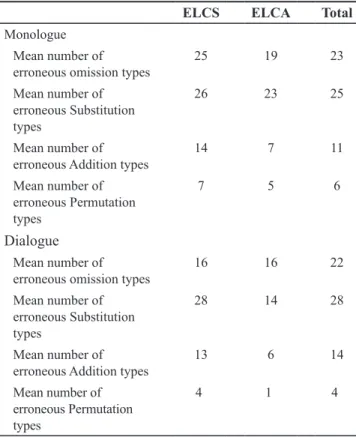
As shown in Table 3, the error types in the monologue are
ranked as follows:
1) 25 types of erroneous substitutions; 2) 23 types of erroneous omissions; 3) 11 erroneous additions;
4) 6 erroneous permutations;
Obviously, substitution as well as omission errors are predominant just like wrong additions and permutations; less used and not very different in number. The big number
of all errors types together is 65, and that is a clear evidence
of the great deal of inaccuracy in the language produced in
the monologue despite the fact that it was prepared 10 days
in advance.
Table 3. The types of errors made by the 50 Subjects both in the Monologue and Dialogue
ELCS ELCA Total
Monologue Mean number of
erroneous omission types 25 19 23
Mean number of erroneous Substitution types
26 23 25
Mean number of
erroneous Addition types 14 7 11
Mean number of erroneous Permutation types
7 5 6
Dialogue
Mean number of
erroneous omission types 16 16 22
Mean number of erroneous Substitution types
28 14 28
Mean number of
erroneous Addition types 13 6 14
Mean number of erroneous Permutation types
4 1 4
The same hierarchy of error types of the monologue is recorded in the dialogue; substitution as the most commonly
adopted with 28 times while the omission procedure comes second with adopted 22 times, and the addition is the third with 14 times. They all make up 68 types of errors 3 times
more than the types made in the monologue given the num-ber of words produced. Surprisingly, with the few words produced in the dialogue, the number of errors types in all procedures has grown far more than they were in the
mono-logue. In other words, errors of different types thrived in the dialogue, reflecting the extremely poor and highly inaccurate
Most Common Error Types and Categories
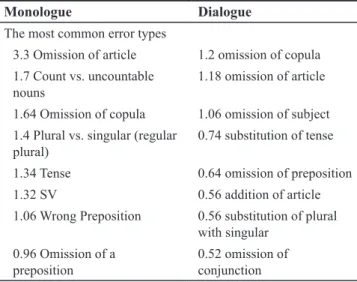
In the monologue, the types of errors recorded are highly
uneven; some types are very common while others are com-mon, and yet others are less common as indicated in the chart below. In this respect, it is significant to point out to
the fact that the ranking of the erroneous categories mea-sured in the chart above is a variable different from the ex-tent to which single types of error are common regardless of
the category they belong to. In a word, the commonality of
error types is not consistent with the commonality of erro-neous categories.
Omission of articles
Although the most dominant error category is the substitu-tion, the incomparably most common error type recorded is
the omission of article with a mean average of 3.3 errors
i.e., bobulation 4 million beoble K. H. R1. That is very
ex-pected of the learners whose proficiency level in the target
language is low and whose interlanguage is still fully based on the grammar system of their mother tongue. Furthermore,
the omission of article is a predicted error as the definite ar -ticle in Arabic (al-) is bound morpheme i.e. (Altaks haar al-yawm = the weather is hot today) and the indefinite article is
implicit in Arabic, the learners’ mother tongue i.e. (London madeenatun kabeera = London (is) (a) big city). The
omis-sion process is due to the fact that indefiniteness in Arabic is marked by the absence of the definite article (Schulz, 2004). In the same line, Elgibali (2005:36) compared the article sta
-tus in both languages, “In English, the indefinite article is
used with the countable noun in the singular form whereas
in Arabic there is no indefinite article”. This grammar aspect was reinforced in the finding of Alhaysony’s (2012) anal -ysis on errors committed by Saudi female EFL learners in
their use of articles in their written samples. By and large, L1 interference negatively affected the process of foreign
language acquisition of the articles.
Substitution of countable and uncountable nouns
The second most common error made in the monologue is the erroneous substitution of countable and uncountable nouns. Such error is not developmental as it abides by a system already established in the interlanguage of the learn-er. i.e., Fast food are expensive TH. GH. N1. Fast food in
Arabic is a plural noun. So, Arab learners of English tend to pluralise uncountable nouns as it suits their L1 system.
Countability of nouns is not homogeneous between the two
languages L1 and L2; many uncountable nouns in English are countable in Arabic i.e. (population, information, fast food). In other words, as they intersect, interlingual factors
affect learners’ second language perception.
Omission of copula
The third most common error in the monologue is the
omission of copula with a mean average of 1.7 Errors. I.E. My number id 0907471‟ a. F. R1. That is another
major systematic error that is clearly l1 negative trans
-fer-based. Back to arabic, the learners’ mother tongue, the copula is implicit. In the same line, (keshavarz (2006)
made it clear that there is no explicit copula as an
indepen-dent morpheme in arabic. For that reason, arab efl learn -ers have to struggle to distinguish between the grammar
norms of their l1 and the tl being studied. Such an ellipti -cal syntactic element in arabic is negatively transferred to
english, causing a syntactic gap. In the same respect, but
-ler-tanaka (2000) were more specific about that when they
claimed that the omission of the copula is more frequent in the present tense than in other tenses. Just like arabic
(abu-chacra 2007) who said that arabic does not have the
copula in the present tense.
Misuse of singular and plural forms
The three other most common errors are the follow-ing. First, the misuse of singular instead of plural forms is the fourth most common error with a mean average of
1.4 i.e. and then continue the (0.7”) two packet (1.7”) in a day S. M. U2. This particular error seems different in nature from the others. The deficit in providing the plu
-ral suffix “-s” to the word “packet” can be interpreted on
more than one basis. First, the grammar system of the TL is not well-applied where the learner is still not aware that
the regular plural forms in English need the suffix “-s” in a three morphological forms’ “-s”, “-es”, and “-ies”. In
this case, the error is developmental although it displays a basic gap in the TL knowledge on the part of the learner
who shows a low level of L2 competence. It can also be interpreted as an inference based on L1 norms where the
number and the noun i.e. “two + packets” are not two free morphemes in Arabic.
They are rather two morphemes bound together in a
sin-gle word. So, once the learner, with a rare exposure to L2, finds them as two free morphemes, they resort to apply the rule of L1 related to the number; dual numbers in Arabic
are bound morphemes making up one compound morpheme (Waladain= two boys). In numbers, from 3 till 10, the noun is pluralized and behaves as a free morpheme i.e. (nine boys) whereas numbers from 11 and above, the noun takes a singu -lar form and also behaves as a free morpheme (ihda’achar walad = eleven boys) as the number is enough to convey pluralisation. (i.e. forty man) although the number is not
above 10. Unlike in English, there is no irregular plural in
Arabic. So, with a lack of competence in English, the errors like three mans are well-expected.
Substitution of tense
Tense is the fifth most common type of error with a mean av
-erage of 1.34 i.e., It starts {fe (0.2”)} from (0.6”) seventeenth century until now Y. H. A4. The verb was not conjugated
into the present perfect although the adverb of time requires that. Tense wise, there is a big difference in conjugation rules between Arabic and English. There are only two tenses in Arabic; the perfect (the past) and the imperfect (the simple
English; the perfect, the prefect progressive, and the simple that go with the past, the present, and the future. This goes
hand in hand with Abu-Chacra’s (2007) conclusion that most Arab EFL students have difficulties in the use of English
verbs due to the absence of verb conjugation in Arabic. The perfect type of tense is implicit in Arabic. Morphologically as well, the perfect tense in English requires a helping verb “had” for the past, “have or has” in the present, and “will have” for the future. That grammar rule does not have an equivalent in Arabic. Moreover, the helping verb that does
that job is not available as a grammar entity in Arabic. In his study, AbiSamra (2003) found that tense errors are very
common among Arab students as there is no time sequence in their language.
The subject-verb (SV) agreement
The sixth most common error is the subject-verb agreement
with an average of 1.32 errors i.e. My father tell me that A.
O. U2. This type of systematic error raises a major issue
about the type of English instilled in the learner’s repertoire.
First of all, the third person suffix “-s” is very confusing
given the rare exposure to the TL as a foreign language.
The suffix “-s” is mostly acquired and digested as a signal of the regular plural form suffix that can only be added to
nouns but not to verbs as the students is more familiar with
it in that function that was learnt first at the basic level and
kept unpractised. That is reinforced by the fact that there is
no suffix in the learner’s mother tongue that has one form
but plays more than one function. Put differently, the plu
-ralisation function of that suffix which is first learnt is the
one that will remain the basic norm that the learner seems to abide by, and it is even more potentially digestive in the
learner’s mind as it has a clear function in the learner’s L1, pluralisation. On the opposite, there is no suffix in the learn
-er’s L1 that plays the function of a third person singular in
the present simple and that is applied to singular subjects as he, she, it in English. However, it is challenging for the
learner whose exposure to the TL is rare to accept a second
very different function of the same suffix (possessive ‘s), let alone a third (third person “-s”). The suffix “-s” declares
the regular noun plural but hard to accept it added to a verb in the present simple to declare that the subject is singular. That is very confusing unless abundant exposure and prac-tice makes the difference.
The second function opposes the first. How it declares
the plural form when added to a noun and singular when
added to a verb in the present simple. What makes the suf
-fix more confusing is the apostrophe ‘s added to a noun to signal possession. Indeed, many students cannot clear
-ly distinguish between the suffix “-s” and apostrophe “s”
due to their similar forms, varied functions, lack of equiva-lents in the mother tongue, and lack of practice. As for the helping verb used in the present continuous, the singular form “is” is the commonly used one to the extent that it is overgeneralised to include both the singular and the plural (as in Many people in Abha is working. H.N. U2) and the
present and the past tense (as in He is happy more at that time Gh. H. R1). In other words, the majority of the learners
tend to use the singular helping verb “is” more often with both the singular and plural subjects and in both the pres-ent and the past continuous tenses. The plural form of the helping verb “are” is kept undigested by the majority of the learners in this academic context. A possible interpretation of such a grammatical behaviour is the way conjugations are derived in Arabic; all verb derivations occur partially in Arabic i.e. (yadhhabu (goes), dhahaba (went). Even more, the conjugation of irregular verbs produces completely new forms. So, the subject-verb agreement is most of the time plural subject used with the singular helping verb “is” not the other way round.
Omission and substitution of prepositions
The seventh and eight most common errors are related to
the same function word – preposition. There is a mean av
-erage of 1.06 wrong prepositions and 0.96 erroneous omis -sions of preposition. The grammar element is the same yet the types of errors are two: substitution and omission. The learner either carries out a wrong substitution of preposi-tions i.e. and then continue two packet in a day S. M. U2
or omits it all together where they get the money? Y. H. U2. In Arabic, there are 21 prepositions (mawdoo3.com), however, in English, there are about 150 prepositions (Kof
-fi 2010). Also, one preposition in Arabic can have three equivalents in English i.e. the preposition of time (fi = in,
on; at). So, a major part of this dual errors of preposition is morphological and the no one-to-one relationships of
prepositions across the two languages, L1 and L2; some
prepositions have equivalent in the other language while others do not.
In this case, the EFL learner may not be aware of gram -mar rule restrictions given the polysemous nature of the
En-glish prepositions that account for those dual errors (Koffi (2010, p. 299). Furthermore, most prepositions in Arabic
are free morphemes if they are followed by nouns (min Ahmad = from Ahmad) and bound morphemes they are
fol-lowed by pronouns (minho = from him). However, in both cases, they are always free morphemes in English. Back in the literature, Scott and Tucker (1974) study of preposition found that errors ranked second but in Mukattash’s (1981)
they ranked fourth among general grammatical errors. Those two ranks showed the grammatical challenge faced by the Arab EFL learner in acquiring and producing English prep-ositions, especially at the beginning of the FL learning
pro-cess. To be more specific, Abu Chacra (2007) claims that
simple prepositions were incorrectly used in a high frequen-cy by Arab learners of English due to the transfer of Arabic prepositional knowledge to English.
In sum, the finding in the present study echoed AbiSam
-ra’s (2003) assertion that interference from learners’ mother
tongue was the main cause of errors.
As shown in Table 4, the most common types of language
errors in the monologue are mainly the following: the
Table 4. The most common error types reported in the
Monologue and Dialogue of the 50 Subjects
Monologue Dialogue
The most common error types
3.3 Omission of article 1.2 omission of copula 1.7 Count vs. uncountable
nouns 1.18 omission of article
1.64 Omission of copula 1.06 omission of subject 1.4 Plural vs. singular (regular
plural) 0.74 substitution of tense 1.34 Tense 0.64 omission of preposition 1.32 SV 0.56 addition of article 1.06 Wrong Preposition 0.56 substitution of plural
with singular 0.96 Omission of a
preposition 0.52 omission of conjunction
The dialogue is more expressive of the learner’s L2
knowledge and interlanguage make-up as it is online
lan-guage planning, coding, formulation, and production. It is
so spontaneous that the speaker does not have much time to rethink, edit, or elaborate the language to be produced. As such, the online task in the oral presentation under study
is characterized by four important facts: the grammar errors
were obviously more frequent in the dialogue than in the monologue given the number of words produced whereas the overwhelming category of errors is the omission with
71.21% of all errors. The omission category is an explicit break of the L2 norms as it drops whole structural entities;
lexical or morphological grammar elements. The big density of errors is accompanied with poor quality of language; no sentences or clauses produced. Furthermore, the conscious explicit knowledge does not help the speakers to be spon-taneous and with high automaticity of processing in that it takes care of the rules of grammar at the expanse of language
elaborateness. In spite of that, a high density of errors was
recorded. That implies that the EFL learners under study are not yet aware of the TL grammatical norms, nor have they developed some implicit language knowledge; their
conver-sations lack much of smooth flow of words and elaborate
language.
DISCUSSION
In spite of the many years of exposure to the TL, the errors
are still basic and diverse; of all morphological and lexical types possible. Those types have persisted for a long period
of time- L1-negative-transfer based and fossilized (Selinker 1972). In fact, there seems to be no progress in language
learning or language acquisition as all types of errors the beginner EFL learner can make are recorded. Almost are in-terlingual rather than developmental, displaying the utterly explicit type of TL knowledge which renders the learner un-able to communicate in that language accurately and spon-taneously. The persistence of those interlingual linguistic errors is basically indicative of an academic culture not of a
sudden coincidence in time. It intuitively raises compelling
questions about the academically established relationship between the learner, the teacher, and the whole academic philosophy.
With the basic interlingual errors persistence, the learn -er’s exposure to the TL does not exceed a few months. An-other fact indicates that the successive teachers have not been aware of the language problems the learner has been
facing (Chaaraoui, 2017). As there is no vision that regu -lates the teacher and learner partnership where each party assumes certain roles and responsibilities.
As far as the learner is concerned, it recommended that they should be trained semester by semester and year by year in meetings, workshops, and direct questions and answers to
express themselves about the following matters: 1) to dis -cuss and choose the most interesting curricula topics for the
learners to guarantee their motivation (Chaaraoui, 2017), 2)
to give feedback in questionnaires and surveys about teach-ing methods, techniques, and the best way for error
correc-tion among other factors, 3) to look for informacorrec-tion from sources other than the teacher, etc. Year by year, the learner would gain more confidence in themselves as real partners (Chaaraoui, 2017), and in return more trust is given by the teacher-partner. Indeed, when the learner possesses the TL forms, they would apply and automatize them properly in communicative demands at a later stage (Nunan 2007). In
that stage, the relationship between meaning and form would
be transparent (Nunan 2001:193).
As for the teacher, they do not seem to play the role of a learner’s partner given the fact that the same basic errors have been persisting over and over again. The T-L partner-ship does spring from the teacher’s awareness of the learn-er learn-errors and TL challenges so that they invent and create teaching methods and techniques and teaching materials and activities to remedy to helps to correct them, and to prevents them from being part of the learner’s language anymore. Actually, among the teacher’s basic tasks is to have a re-cord of the learners’ errors and to invent pedagogical ways to help the learner acquire the accurate TL easily and fast to prevent them from being fossilised. For example, those
errors could be included in tests, both mock and official, to draw the learner’s attention not to make them again. Basic
to the teacher’s job is to analyse the error’s origins (Crystal,
2010) and to be equipped with the necessary explanation and
pedagogical strategies of treating errors according to their complexity and with proper teaching technique(s) and
activ-ities. Teaching objectives should also prioritise L1 and L2 differences (Richards, Platt, J. and Platt, H 1992).
Socially, the teacher should develop a good relationship with the learner by showing fairness, cooperation, humour,
and trust in their intention and endeavour. Besides, it would
be quite helpful to create channels of communication like social media applications, emails, backboard system, and
teaching aids such as realia, chats, textbooks, magazines, newspapers, radio, films, music, maps, pictures, computers, etc. (Iedema (2003). Learners’ efforts should be encouraged
how errors are better be corrected (Li, 2012) to guarantee
involvement and self-esteem.
From the types of linguistic errors recorded, there seems to be no pedagogical reality that puts the teacher with learner in a productive pedagogical give-and-take relationship that sets the roles and responsibilities of each of them and has clear pedagogical and concrete objectives.
In sum, the teacher and learner are very far from being
partners. They rather come to class to study a subject that the learner does not seem to be enthusiastic about, nor does the teacher seem to have enough knowledge to manage the situation or authority to hold the student responsible to abide by it.
The inexistence of T-L partnership raises questions about the academic system in itself. For example, the number of learners per class may not consolidate the academic vision of partnership, nor does the testing system take into account the test regularity, rubrics, and contents. The TL language prac-tice, especially in the productive skills, for example, does not cannot to be included in tests rubrics. Also, designing the curricula developmentally does not seem to be taking place. Topics included in the curricula do not seem to be appealing, motivating and interesting to the learners. Teachers seem to have not had enough training, workshops, and forums in which they learned and practiced how to deal with students
of different language proficiency levels and of different TL
challenges.
CONCLUSION AND RECOMMENDATIONS
With such high level of language inaccuracy recorded in the
learner’s language performance after nearly seven years of exposure to English as a Tl, the learner does not seem to be able to function as a partner. They are rather a passive receiver of information from the teacher who seems to be the sole source of information and alienated from the learner’s needs. The results of the current research calls for explicit radical academic intervention in the curricula design, profes-sional teacher, giving the learner a role to play as a partner at a young age towards more autonomy to communicate with the teacher and help choose and discuss teaching materials topics, teaching techniques, and testing techniques.
REFERENCES
AbiSamra, N. (2003). An analysis of errors in Arabic
speakers’ English writing. In Mourtaga, K. (Ed.), Inves-tigating writing problems among Palestinian students studying English as a foreign language. Unpublished doctoral dissertation.
Abu-Chacra, F. (2007). Arabic, an Essential Grammar. New York, Routledge.
Alhaysoni, M. (2012). An Analysis of Article Errors among
Saudi female EFL students: A case study. Asian Social Science, 8(12).
Bachman, L.F. (1990). Fundamental Considerations in Lan
-guage Testing. Oxford etc.: OUP.
Brown, H.D. (1994). Teaching by Principles: An Interac
-tive Approach to Language Pedagogy. Prentice Hall
Regents. Beijing: Foreign Language Teaching and Re
-search Press, 2001.
Butler-Tanaka, P. (2000). Fossilization: A Chronic Condi -tioner is Consciousness-raising the Cure? Unpublished
MA Thesis, University of Birmingham, Birmingham. Canale, M. & Swain, M. (1980). Theoretical Bases of Com
-municative Approaches to Second Language Teaching
and Testing. Applied Linguistics, 1 (1), p. 1-47.
Chaaraoui, J. (2017). Foreign Language Learning Peda -gogy: Learner Centredness vis-à-vis Linguistic Com-petence - Action and Reaction. International Journal of Language and Linguistics. (5) 6, pp. 187-200. doi: 10.11648/j.ijll.20170506.14
Corder, S. P. (1973). Introducing Applied Linguistics. Har -monds worth: penguin.
Crystal, D. (2010) - English As a ‘Global’ Language? www. macmillanglobal.com/blog/teachingtips/david-crystal-english-as-a-global-language. Published on 19th April,
2010 in Teaching Tips by Matt Kay
Elgibali, A. (2005). Investigating Arabic: Current Parame -ters in Analysis and Learning. Studies in Semitic
Lan-guages and Linguistics Series. Brill Academic Publish
-ers, Boston, MA.
Ellis, R. (2003). Task-based Language Learning and Teach
-ing. Oxford, England: Oxford University Press.
Fareh, S. (2010). Challenges of Teaching English in the Arab World: Why Can’t EFL Programs deliver as expected? Procedia Social & Behavioral Sciences.2, 3600-3604. Hymes, D. H. (1966). Two Types of Linguistic Relativi
-ty (with Examples from Amerindian Ethnography). In W. Bright (Ed.), Sociolinguistics: Proceedings of the UCLA Sociolinguistics Conference. The Hague: Mou
-ton, pp. 114-167.
Iedema, R. (2003). Multimodality, Resemiotization: Extend
-ing the Analysis of Discourse as Multi- Semiotic Prac
-tice. Visual Communication, 2(1): 29-57.
James, C. (1998). Errors in Language Learning and Use.
London: Longman.
Keshavarz, M. H. (2006). Error Analysis: A Practical Course
for English Students and Teachers. SAMT, Tehran.
Koffi, E. (2010). Applied English syntax: Foundations for word, phrase, and sentence analysis. Dubuque, Iowa: Kendall Hunt Publishing Company. Print.
Kuiken, Folkert and Ineke Vedder (2007). Cognitive Task Complexity and Linguistic Performance in French L2 Writing. In Inves- tigating Tasks in Formal Language Learning, Maria del Pilar García Mayo (ed.), 117–135.
Clevedon: Multilingual Matters.
Lambert, C.P., & Engler, S. (2007). Information distribution and goal orientation in second language task design. In M.P.G. Mayo (Ed.), Investigating Tasks in formal lan
-guage learning, (pp. 25-43). Clevedon: Multilingual
Matters.
Li, W. (2012). An Eclectic Method of College English
Teaching. Journal of Language Teaching and Research,
3 (1): 166-171.
Mukattash, L. (1981). Wh-Questions in English: A Problem for Arab Students. International Review of Applied Lin
Nunan, D. (2007). Standard-Based Approaches to the Evalu
-ation of ESL Instruction. In. J. Cummins & C. Davison. (Eds.), International Handbook of English Language Teaching (pp. 421-438). New York: Springer.
Nunan, D. (2001). Second Language Acquisition. Carter, R. & Nunan, D., (eds.). The Cambridge Guide to Teaching English to Speakers of Other Languages [C], pp 87- 92. Cambridge: Cambridge University Press.
Richards, Jack C., John P. & Heidi P. (1992). Longman Dic -tionary of Language Teaching and Applied Linguistics.
Harlow: Longman.
Richards, J. C. (1971). Error Analysis and Second Language Strategies. Language Sciences, 71 (17), 12-22.
Savignon, S. (1985). Evaluation of Communicative Compe
-tence: The ACTFL Provisional Proficiency Guidelines.
Modern Language Journal. Vol., 59, 129- 134.
Schulz, E. (2004). A Student Grammar of Modern Standard Arabic. Cambridge: Cambridge University Press. Selinker L. (1972). Interlanguage. IRAL 10, 209–231. Wolfe-Quintero K., Inagaki S. and Kim. H.-Y. (1998). Sec
-ond Language Development in Writing: Measures of Fluency, Accuracy, and Complexity. Honolulu: Univer