PHYSICAL REVIE%'
8
VOLUME 29, NUMBER 4Diffusion
in systems with
static
disorder
P.
J.
H.Denteneer andM. H.
ErnstInstitute for Theoretical Physics, Princetonpiein 5,P.O.Box 80006,3508-TA Utrecht, The Netherlands (Received 28June 1983)
%'e study diffusion in systems with static disorder, characterized by random transition rates Iw„),which may beassigned to the bonds [random-barrier model (RBM)] or tothe sites [random-jump-rate model (RIM)]. We make an expansion in powers ofthe fluctuations
5„=(to„'
—
(w')
)/(w
')
around the exact diffusion coefficientD=1/(to
')
in the lowfrequency regime, using di-agrammatic methods. Forthe one-dimensional models we obtain asystematic expansion in powersof Vz of the response function (transport properties) and Green's function (spectral properties}.
The frequency-dependent diffusion coefficient in the RBM is found as Uo(z)=D —, a2V—Dz
+cxoz+a)z
+
'',
where K2=(5 ),
cxomcludes lip to fourth-order flllctuatlons andcx)lip tosixth order. In the RJM, Uo(z)
=B.
Similarly, we obtain results (very different in RBMand RJM) forthe frequency-dependent Burnett coefficient Uq(z}and the single-site Green sfunction Go(z) [which determines the density ofeigenstates
M(e}
and the inverse locaHzation length y(e} ofrelaxational modes oftlM system]. The spectral properties ofboth models are ideIltlcal Slid agree with exact re-sults at low frequencies for the spectral properties of random harmonic chains. The long-time behauior ofthe velocity autocorrelation function in RBMisq&(t)=(
)t'r~+(
.
)t '~' and forthe Burnett correlation function
p4(t)=(.
~~ )t',
withcoefficients that vanish on a uniform
lat-tice. Forthe RJM,
g2(t)=&6+(t)
and y4(t)=( )t '~.
The long-time behavior ofthe momentsofdisplacement (n
),
and(n4),
and the staying probability Po(t) are calculated up torelative or-der t ~.
Acomparison ofour exact results with those ofthe effective-medium (or hypernetted-chain) approximation (EMA) shows that the coefficient aoin Uo(z) asgiven by EMA is incorrect, contlary to suggestions made ln the literature. Forthe RJM all results can be tlivially extended tohigher-dimensional systems.
I.
INTRODUCTIONDiffusion or hopping conductivity in systems with stat-ic dlsordcr sho%'s lntcrcstlng non-Markovian behavior, which recently received much attention. ' ' A review
of
hopping models was given by Alexander etal.
' and more recent results can be found inRefs. 2—
16.
One can assign the static disorderto
the bonds, as is done in random-barrlcr n1odels ' ' ' ' oI' to thc sltcs as ls done lnrandom-jump-rate models.
'
Another classof
models are exactly solvable one-dimensional stochastic Lorentz models, discussel by van Beijeren,''
in which the lattice distances SI'crandom variaMcs.Here we restrict ourselves to hopping models
of
the random-barrier or random-jump-rate type, described bya
master equation.It
is known from approxi-mate ' ' ' ' ' ' and exact theories that thefrequency-dependent diffusion coefficient Uo(z) at low frequencies (z
—
+0) behaves as Uo(z)=D
—
,
'tt2v'Dz+
.
,where-D=
1/& w ')
is the exact diffusion coefficient and tr2=&(w '—
&to '&) &/&w '&.
The inverse Laplace transformof
Uo(z) corresponds to the velocity autocorre-lation function{VACF},
y2(t), which shows thewell-known long-time tail
y2(t)-t '"+
'/of
diffusion in sta-tionary randoln Q1cdla, such as ln thc d-dlmcnslonal Lorentz gas.' For
higher-order terms, only approximate results based on an effective-medium approxlmatlon (EMA) have been obtained by Webman and Klafter' withterms
of
order up to zincluded and by Haus et a/. with termsof
order up to z included.It
has been suggest-ed'
that the EMA gives exact results to termsof
order z included.In this paper we present new results for the asymptotic (low-frequency and long-time) properties
of
hopping modelsof
random-barrier or random-jump-rate type, which are based on an expansion in powersof
thefluctua-tions
5„=(w
'—
&w '&)/&w '& around the exact dif-fusion coefficient (see Sec.III).
The terms in this expan-sion are calculated usinga
diagrammatic method (see Ap-pendix A) and it is shown that this fluctuation expansion is a systematic expansion in powersof
Vz (see Appendix8).
InSec.
IV we give explicit results for the frequency-dependent diffusion coefficient in the formUo(z)=D
—
2&2vDz+ctoz+ct~z
+
' '',
and for many relatedfunctions
of
interest. Our calculations show that the EMA is in fact the hypernetted-chain approximation for the present diagrammatic method and that the EMA results for Uo(z) are already incorrect in termsof
order z, in disagreement with the suggestionsof
Webman and Kla-fter and Haus etal.
(seeSec. IV).
We have also calculatedin
Sec.
IVthe staying probabihty,Po(t),
and the single-site Green's function Go(z), which determines the spectral propertiesof
the eigenmodesof
the system. The resultingeigenvalue problem is identical to that for the harmonic chain with random masses or random force constants. Our results appear to be in con1plete agreen1ent arith
1756
P.
J.
H.DENTENEER AND M.H.ERNST 29cent exact results
of
Nieuwenhuizen for the densityof
states and inverse localization lengthof
eigenfunctions inaharmonic chain with random masses.
For
a random-jump-rate model, discussed inRefs.
7 and 25, all results can be trivially extended to higher-dimensional systems, as shown inSec.
V, where someof
the d-dimensional lattice functions are analyzed. InSec.
VIwe present abrief discussion
of
our results.The hopping models
of
interest are described bya
mas-ter equation
of
the general formwhere
p„(t)
represents the probabilityof
finding the ran-dom walker (hopping particle) at time t on site n(n
=0,
1,2,. . .
,N—
1)of
a regular one-dimensional latticewith periodic boundary conditions (p»+~
—
—
p„)
and lattice distance equal to unity (an overdot denotes a derivative with respect to time). The transition matrixL„allows
only transitions between nearest neighbors and the transi-tion rates
w„(n=0,
1,. .
. , N—
1) occurring inL„~
are positive time-dependent random variables, with asite-independent distribution vr(w). The first few inverse mo-ments (w
')
=
w m(w)dw are assumed to exist0
(I
=
1,2,..
. , 6). In this paper angular brackets(
)
alwaysdenote an average over random variables [w„
I.
We consider two types
of
hopping models, a bondprob-lexn and asite problem, in which the random variables are assigned to the bonds [random-barrier model (RBM)]and to the sites [random-jump-rate model
(RJM)],
respectively. The master equation for theRBM
has the explicit formexact relation in the
RJM
for all times and for generaldimensionality, implying that the VACF gran(t)=D5+(t) [with
f
5+(t)dt=1],
without any long-time tail. How-ever, long-time tails show up in the Burnett correlation function, related to the fourth momentof
the displace-ment.II.
PROBABILITIES OF DISPLACEMENT, RESPONSE AND GREEN'S FUNCTIONSFrom a macroscopic point
of
view one is interested inP„(t),
the probabilitiesof
displacements n at time tina
sta tionary initial ensemble, averaged over the randomvari-ables [w„I [the analog
of
the Van Hove functionG(r,
t)],
which determines most quantities
of
physical interest, such as the transport properties.Of
particular interest are the lower momentsN—1
(n'),
=
g
n'P„(t).
n=0(2.1)
For
instance the diffusion coefficient follows from the long-time behaviorof
the mean-square displacement,(n'),
=2Dt.
The Fourier transform
of
P„(t)
(the so-called intermedi-ate scattering function) is the generating function for these moments. In our analysis we actually calculate theresponse function W(q,z), which is the Fourier-Laplace transform
of
P„(t):
N
—
1W(q,
z)=
g
e't"P„(z)
.
p» w»—1(p»
—
1 p»)+»(p»+1
p»)(E„—
1)w„—(E„—
1)p„,
(1.
2)where
E„f„=
f„+~
and w„denotes the random transition rate for jumps across the nearest-neighbor bond betweenthe pair (n,
n+
1). The stationary solutionof (1.
2) is a site-independent constant:Laplace transforms are in general denoted as
F(z)
=
I
e"F
(t)dt and the reciprocal lattice vectorq=2~l/N
with l=
—
—,'X+
1,.
.
.
,—,'X
lies in the first Brillouin zone(1BZ).
It
is further convenient to use the orthogonality relationsN
—
1N
g
e'"'t
't'=$,
, N
—
'~
~'e~»—~&n=0
qG1BZ
(2.3) normalized such that
g„o'
g„=N.
The master equation forthe (isotropic)
RJM
reads0
I
n wn —1pn —] 2wnpn+wn+1J n+]=
—
(2—
E„—
E„')
w„p„.
(1.
4)Henceforward the limits on the summation signs will be dropped and every sum over sites runs from
n=0
until n=i%
—
1and all q sums run over the 1HZ.In generalized hydrodynamics it is often convenient to express the response
function,
~
(q, z) in termsof
agen-eralized diffusion coefficient U(q,z) as Here a random jump rate
v„(or
waiting time1/v„)
isas-signed to the nth site and the particle jumps with equal
probability to one
of
it» nearest-neighbor sites. Hence the transition rate for a jump to any nearest neighborof
thenth site is
w„=
—,'v„.
The stationary solutionof (1.
4) isg„=
C/w„,
where Cis determined from the normalization conditiong„g„=N,
yielding C '=
g„(Nw„)
=(w
).
Using the exact diffusion coefficient for this modelD=1/(w
'),
as given by Haus et al., one findsthe stationary solution
of (1.
4) as.
x
(q, z)=
[z
+q'U(q,
z)]
The ordinary diffusion coefficient Dfollows from D
=
lim lim U(q,z) .z~Oq~O
(2.4)
(2.5)
W(q,
z)=
—
—
—
q2(n
2)(z)+
—
q(n
)(z)+
~ 4 4
2 2 4l (2.6)
The Laplace transforms
of
the momentsof
displacement,(n )(z),
generated by (2.2),i.
e.,P„=D/w„.
(1.
5) can be expressed in termsof
U(q,z). To
do sowe expand29 DIFFUSION IN SYSTEMS WITH STATICDISORDER 1757
(n—
')(z)=z
'U, (z)+z
'U',
(z) .Here Uo(z) is the "frequency-dependent" diffusion coeffi-cient
[Uo(0)=D]
and U2(z) is the frequency-dependent modified Burnett coefficient. The inverse Laplace transformsof
Uo(z) and U2(z) will be referred to as the velocity autocorrelation function (VACF) q)2(t) and the Burnett correlation function q)q(t), respectively. ' 'In order to relate the macroscopic probability
of
dis-placements to the solutionof
the master equation(1.
1), we observe that the conditional probability or Green's-function solutionI
„(t)
of (1.
1) withI
„(0)
=5„equals
the probability
of
a displacement (n—
m) in afrozen con-figuration{u)„j,
given that the walker starts at site m. LetP~
be the stationary initial distribution (with normali-zationg
f~=N)
for a frozen configuration{w„j,
asgiven in
(1.
3) and(1.
5); then~„(t)
=
g
r„,
(t)q rN
(2.9)and use it
to
obtain a similar expression for W(q,z).
Com-parison with (2.6) then yields—,'
(n')(z)
=z-'U,
(z),
(2.8)
Lqq
=N
ge
q (E& 1—)io(E
—
1)e=f*(q)
~qqf(q')
=(f*
~f),q,
and in the
RJM
from(1.4):
Lqq
=f'(q)f
(q)~qq=(f'f
~)qqwhere
Wq«
N—
—
'g
w„e'"'qf
(q)=e
'»—
1.
The Laplace transformation
of
(2.12) reads pq(z)=
g
Pqq (z)%qq——[P(z)%]qqq'
where the Green's function is defined as
I'qq(z)=[(z+L)
']qqThe response function can finally be put in the form
P
(q,z)=(P
(z))
=
y
(I
(z)(P ~)
q'=((z+L)-'q
)„.
(2.15)
(2.16)
(2.17)
(2.18)
(2.19)
(2.20)
is the probability
of
a displacement n in a frozen configu-ration Iu)„j
averaged over all possible starting positionsof
the random walker. The macroscopic probabilityof
dis-placements is thenNote that the response function differs in general from the
auerage Green's function (which is the diagonal element
of
the averageof
the Green's functionI
q»):
P„(t)=(~„(t))
=N
'g
(I'„(t)g
),
(2. 10) (2.21)p,
(t)=
ge""~„(t)
. (2.11)With the help
of
(2.9) and the orthogonality relation (2.3)itcan be written in the form
where the angular brackets denote an average over the random variables {
w„j.
The probabilities
rr„(t)
for a frozen setof
{io„j
valuesdo not have the translational symmetry
of
the lattice; however, averages( )
do have this symmetry. We there-fore introduce the Fourier transformHowever, in the
RBM
P
(q,z) andS(q,
z) coincide since=1
is the uniform stationary distribution(1.
3) or equivalently %qq~ 5qq.
A quantity
of
interest is the densityof
eigenstates.If
one represents pq(t) by p»(t)=e»'»"pq
then (2.12) reduces to an eigenvalue problem,Lp=ep
with solutions {e,
p»'j
(a
=
1,2,. . .
,N).
Using the well known identity(x
i0)
'=—P(1/x)+mi5(x),
w.hereP
denotes the princi-pal value and5(x)
the Dirac5
function, we can write the average densityof
eigenstates per lattice site asM(e)=N
'g
(5(e
e))—
p
(t)=
QI
(t)%=[I
(t)%]
q'
where we have introduced
e'q"p e
'q™
qq'
~
pmn,m
(q
—
q')(2.12)
(2.13)
=(mN) 'Im
g
((e
e i0)
')—
—
=
—
~-'tm
N-'
g
(( e+L
+
i0)
')—
q
'Im[Gp(
—
e+i
0)] .
(2.22)Here p»(t) satisfies the transformed master equation:
p»=
—
XL»»
p»=
(Lp)».
—
(2.14)Here Go(z) is the auerage single site Green's fu-nction de-fined in terms
of
(2.21)throughq'
G„(z)
=N
'g
e '«"9'(q,z).
(2.23)The transition matrix in the
RBM
can be obtained directlyP.
J.
H. DENTENEER AND M.H. ERNSTGreen's function is the exponential growth rate (inverse
localization length)
y(c) of
eigenfunctions. In one-dimensional cases this concept'
can be explained byconsidering our eigenvalue problem in configuration space
by putting pn(t)
=e
"pn in(1.
2) and(1.
4). The transfor-mationsu„=
—,w„(p„+I
—
p„)
forRBM
andu„=w„p„
forRJM
map these eigenvalue equations onto—
Eun=
w„(un+
I+
u„ I—
2u„)
.
In this case we doQot use periodic boundary conditions but consider eigenfunctions vanishing at both ends
of
the chain. The solutionuz(c) of
this recursion relation withQ ]
=0
and Qo=
1 1sapolynoIMa1of
degI'eeX
1Q6»&herethe coefficient
of
{—
e) isgiven by+„0
(1/w„).
Lete„
withn=0,
1,2,. . .
,Ã
—
1 be the (unknown) zerosof
this polynomial, theQX
—
Iuiq{e)=
g
[(c„—
c)/w„]
.An eigenfunction must vanish at both ends
of
the chain. Since uiv(en )=0,
the zeros c'nof
uiq(e) are the eigenvalues.If
the solutionsof
(2.24) grow exponentially fast, then the large-N behaviorof
y(c)=N
'(ln
~uiq(c) ~)
withe+e„
measures the exponential growth rate provided
y(e)
is positive. Inthe thermodynamic limit, where the spectrum becomes dense,y(e)
can be defined by taking c just above orbelow the real-c axis, so thatequally well to the isotropic
RJM
even for general dimen-sionahty.We start with the
RBM,
where the average Green's function (2.21)and the response function (2.20) areidenti-cal as explained below (2.
21):
~
—
I~
g i (qn—q')qq'=
~
ne5„=D(1/w„—
(1/w )
),
(3.
2c)where W ' is the matrix inverse
of
W as can be verified from (2.17) and (2.3).
Using amatrix identity wewriteI
(z)={z+f
8'f)
'=f
'W
'(zW'+ff
)'f
where we have used (2.
13). For
z~O
the above functions reduce to~(qO)=[f(q)l
'(~
'&[f'(q)]
'=
[2D
(1—
cosq)]We want to expand the resolvent in the proper fluctua-tions aI'ound their value at
z=O,
y(c)=Re'I
X
'(In[uiq(c+i
0)]
)
IPf
—
1=Re
N 'g
(In[(e„e+iO)—
/w„])
.
(2.25)=
f
'(1+6,
)(z+zA+a))
'f,
where wc 11Rvcused (2.17)to wrltc
co(q)
=Df*(q)
f
(q)=2D(1
—
cosq).
(3.
3)The positivity
of
this function is related tothe exponentiallocallzRtloll
of
Rll clgcllfllIlctlolls.For
our purpose it is moxe convenient to considerdy /de
Rs lt ls directly related to tllc slllglc-sltc Grccll s function (2.23):
The function for the
RBM
follows from these equationsW(q,
z)=((1+6)(z+ro+zh)
')qq.
If
we neglect the fluctuations in(3.
5)we find the Green's function go(q, z)for auniform lattice with a constant tran-sition rateD=
1/(
w '):
go(q,z)
=
[z +co{q)]
(3.
6)(2.26)
In the following we use the abbreviated notation go(q) for go(q,
z).
In our systematic approach we expand the response function in powersof
6,
which yields for the RHM,Here y(0)
=0
since the eigenfunctions with c—
+0,i.
e.,the long-wavelength modes withq~O,
are essentially the same as in the uniform lattice and are therefore not local-1zed.a
(q, z)=go(q)
zc0(q)g0(q)A(q,z—
)(3.
7)Our method is a generalization
of
Zwanzig's calcula-tion' for the response function M(q,z) in theRBM,
which leads to asystematic expansion in powersof
Wz asz~O
with q=avz
and a fixed. The essential point in this calculation is the proper choiceof
fluctuations: Auc-tuations1/w„—(1/w )
around the exact inverse diffusion cocfflclcntD
=(1/w).
Thc nlctllod call bc Rppllcdgen-DIFFUSION IN SYSTEMS WITH STATICDISORDER 1759
q'U(q,
z)=~(q)+r(q,
z) (3.10)I'(q,
z)=[~(q
z)l
'—
[gp(q,z)]
'eralized diffusion coefficient U(q, z)defined in (2.4) with is identical to the response function
(3.
5) in theRBM.
The response function
P
(q,z) and the generalized dif-fusion coefficient U(q,z) or1(q,
z) defined in(3.
10) can again be expanded in powersof
b,:=zto(q)A (q,
z)[1
—
zoo(q)gp(q)A (q,z)]
(3.11) W(q, z)=gp(q)+co
(q)gp(q)A (q,z),
(3.
14)~(q,
z)= ((z+
f"f
~)
'(I+&)
)«
=
((1+
6,)(z+zA+co)
'(1+
6,))«
.(3.
12)Note that the average Green's function (2.21) for the
RJM
S(q,
z)=((z+f
fW)
')«
= ((1+
b,)(z+zh+co)
—')
«
(3.13)For
theRJM
the response function (2.20) contains the sta-tionary initial distribution(1.
5),g„=D/w„
through the matrixV.
It
satisfies4=1+
b, on accountof (3.
2a). Combinationof
(2.20) and (2.16)gives the response function for the
RJM
in the formI
(q, z)= —
co (q)A (q,z)[1+to
(q)gp(q)A (q,z)]
where A(q,z)is given in (3.8).
In order to calculate the terms in the fluctuation expan-sion
of
A(q, z) we have developed a diagrammatic expan-sion. As the method is rather involved it is presented in a separate appendix, AppendixA.
The resultof
these calcu-lations, with sixth-order fluctuations included[i.
e., terms with l=0, .
.
.
, 4 included in the definition(3.
8)of
A(q,
z)],
is given by the following formula, which is ap-plied toone-dimensional hopping models in Sec. IV and to higher-dimensional ones inSec.
V:A(q,
z)=a2hi
—
z~3hi+z
[~4hi+a~2(gphi+gi+hih2)]
—
z'~2~i(2gphi+3h
~h2+4gihi+hi)
+z
K'z(gph i+2gph igi +2gph ih2+&
ih3+h
&h 2+h2+
3g2h&+4g3)+
' ' ' (3.15)
The functions
g„(n
=1,
2,3, ..
.)defined in(85) of
Appen-dix8
depend on q and z whereash„(z)
andh„(z),
definedin
(Bl)
and(89),
depend only on z. The cumulantsat=((5
)) are given in termsof
momentspt=(5')
with5=D(w
'—
(w'))=D/w
—
1. The first fewof
them are given byK2=P2~ K3=P3~
2
K4
—
—
p4—
3p2, K5—
—
p5—
10p3p2,K6 ——p6
—
15p~2
—
10p3+
2 30p23.
(3.16)
%e
have assumed that the p~ with /(6
exist.The main goal
of
this paper is to present a systematic calculationof
the small-z and -q behaviorof
the response function, in particular for the rangeof
q values with qof
order aVz (with a fixed) or smaller.
For
the one-dimensional case we have made a systematic analysisof
the small-q and -zbehaviorof
all terms in the fluctuation expansion, which is presented in AppendixB.
There it isshown that
((zhgp)
)«
isof
orderz~'"
witha(l)
=
—,'[
—,'(i
+
1)] to leading order for small z withq=ttVz.
The function[x]
is the largest integer smaller than or equal tox.
Hence the perturbation expansion(3.
15) starts with a termof
order z '~ in the one-dimensional case and is exact to orderz'
terms included. The contributions to (3.15) from((bgp)
),
proportional toK3 K4K2, and K6, should be neglected as they are at least
of
order z[see
(814)].
diffusion coefficient Up(z) and modified Burnett coeffi-cient U2(z), defined in (2.7),at low frequencies, as well as the long-time behavior
of
the momentsof
displacement. We further calculate the long-time behaviorof
the staying probability Pp(t) and the small-z behaviorof
the single-site Green sfunction Gp(z), which describes the densityof
eigenstatesM(e)
and the inverse localization lengthy(e)
at the lower end
of
the eigenvalue spectrum.To
calculate Up(z) and U2(z) we need the q expansion (2.7)of
q U(q,z)=to(q)+I'(q,
z).
AsI
(q, z) has been ex-pressed in(3.
11)and(3.
14) in termsof
A(q,z),we also in-troduce its qexpansion:A(q,
z)=Ap(z)
—
qAz(z)+
(4.1)Bycollecting the results
of
Appendix8
to the relevant or-der in zone finds from(3.
15)DAp(z)
=
—,tt2(D/z)'~+ap+ai(z/D)'~
+0(z),
DA, (z)
=b,
D/z+b,
(D/z)'"+
O(z'),
(4.2) where the coefficients at and bt, listed in TableI,
have been expressed in the cumulantsai.
Coefficients withi=0
involve at most fourth-order fluctuations, those withi=
1sixth-order fluctuations.
For
theRBM
the coefficients Up(z) and U2(z), occur-ring in the q expansion (2.7)of
the generalized diffusion coefficient, can be expressed inAp and Az with the helpof
(3.
10) and (3.11):
IV. RESULTS FOR ONE-DIMENSIONAL HOPPING MODELS
Up(z)
=D
+zDAp(z),
.U2(z)
=
—
„D
+z[DA2(z)+
—,~DAp(z)—
D2Ap(z)],
(4.3)
From the results
of
the preceding section andof
Appen-dixes A andB
one can calculate the frequency-dependentP.
J.
H.DENTENEER AND M.H. ERNSTTABLE 1.Coefficients in terms ofcumu1ants.
Qp
Cp
C1
Sp
1 11
—
4K3+24K21345
TK 16 K2 96K2K3+2304K2
7 2 27K2
29 107
108K2K3+216 K2
1 1
12
+
1081 3 24K2
—
54K2K3+271 1 127 12 2K3+108 K2
1 665 5747 12K2+4K4 432K2K3+ 3456K2
1
( I,+K3
16K2} 15
15
(K2
—
2K4+2K2K3 16 K2}1 1 2
—
4K2—
4K3+8K21 3 2 7 25 3
16(
—
K2+ 2K3+ 2K4+ 2K2—
2K2K3+ 16K2)EMA
1 3
—
4K3+8K221 3 8K4 16"2 16K2K3+
~
K21 4 K2
1 3 3
—
4K2K3+ 8K21
12
1
24 K2
1 1 '2
12
—
2K3+K233 12K2+4K4
—
8K2K3+32 K2 16(—
~+K3—
4K2}3 2
1 3
(K2 2K4+K2K3 2K2} exact
16(
—
K2+
2K3+
2K4—
3K2K3+
45K23}Up(z)=D[1+ ,
'III(z/—D)'+ap(z/D)
+~I(z/D)'
'+O(z
)],
UI(z)=D[cp+ci(z/D)'
+O(z)],
1 L 1
CP
=
12+bP
—
4K21
C)
=6)
—
aPKP+ 24K2.
(4.5)
walks on uniform lattices, since
&z=D
((Ip(Ip
'))I)
vanishes. Also the higher corrections, apand a1,are vanishing on auniform lattice. The long-time
behavior
of
the VACF g &(t)is given by the secondderiva-o
f
(4.'7).It
has the well-known long-time t—'~+
'~ (d is the dimensionahty), typic»«dif«»o»n
stationary random media, such as the Lorentz gas.The long-time behavior
of
the fourth moment follows similarly from (2.8),(4.4) and (4.5):ExpressiolIS
for
cp aIldci
1II terms Of cllIIllllalltS ICI a1'egiven in Tab1e
I.
For
theRJM
we obtain similarly from(3.
10) and(3.
14)—
(n4),
= ,
'D
t +(4/—3Vm)»(Dt)
/+d,
Dt+2d
i(DI
/It)I~'+0
(tP) (4.8)Up(z)=D,
Uz(z)
=
—,',D
+
D
Ap(z)(4.6) with the coefficients dt defined as
dp
=cp+
20p+
~K2,dI
—
—
c
1+2a
I+
apiiz,=D[
2Iiz(D/z)'~+
—
„+ap+ai(z/D)'~
+O(z)]
.
(4.9)In the last line
of
(4.6) we have used (4.2). Themost strik-ing difference between (4.4) and (4.6) regarding Up(z) is the occurrenceof a
I/z singularity in theRBM
and the absenceof
any singular terms in theRJM,
and regardingUz(z) the weaker
~z
singularity in theRBM
and the stronger 1/Vz singularity in theRJM.
Next, we consider the moments
of
displacement(n
)„
which have been expressed in Up and UI in (2.8).For
theRBM
the long-time behaviorof
the mean-square displace-ment follows from (2.8) and (4A) as,
' (n2)t,=Dt+~&(Dt—/Ir)I~I+ap+ai(~Dt)
(4.7)
To
dominant order the average mean-square displacement is described in termsof
an effective diffusion coefficientD=
1/(Ic
')
fora
corresponding uniform lattice, around which we expand in fluctuations. The second term represents a long-time tail, vrhich is absent in randomand 11sted
I
TableI.
The above results are also sufficient
to
calculate the fourth cumulant(&n')),
=&n'),
—
3((n'),
)',
where the leading term behaves asaIt+
~ for t +a&. The long-ti—me behaviorof (d/dt)((n
)),
=8
(t)
increases proportional toIIzv
t
as t mao. In a unifor—m lattice this term vanishesand
8(t)
approaches afinite limit8(
00)=D/12,
which is called the super-Burnett transport coefficient.One sometimes considers' ' amodified Burnett
coeffi-cient Uz(0), which is, according to (4.4), given by
U2(0)
=cpD
in theRBM.
The Burnett correlation func-tion y4(t), which is the inverse Laplace transformof
U2(z)„has a
long-time tail y4t~
with -a coefficient that vanishes on auniform lattice.In the
RIM
the mean-square displacement, deduced from (2.8) and (4.6),satisfies the remarkably simple form(n
),
=2Dt,
valid for all times, as was first shown byno long-time tail. However, long-time effects caused by
the randomness in the medium, occur in
(n
},
.
Its
long-time behavior can be deduced from (2.8) and (4.6) and isgiven by
—
(n
},=
—,'D
tz+
~2(Dt)'~z+(
—,',+a
)Dt+2a,
(Dt/m)'~+O(t
). (4.10)The cumulant &&n
"}}
is again proportional to azts~z,which represents
a
long-time tail, vanishing ona
uniform lattice. In the IUM the quantities&(ao)
and UI(0) are divergent due tothe effectsof
long-time tails and the Bur-nett corrdation function y&(t) has a long-time tail, to bccoIIlpalcd wltll +4(t) t 1I1tllc
RBM.
The probabilities
of
displacementP„(t)
can also be ob-tained from the small-z, -q behaviorof
the response func-tionP
(q,z) through Fourier inversionof
(2.2).
We are specially interested in the probabilityof
zero displacement or staying probabilityPo(t)
in caseof
a stationary initial distribution [see (2.10) and (2.11)].
Its Laplace transform isgiven byPo(z)=N
'gP
(q,z).
(4.11)Furthermore we are interested in the average single-site Green's function Go(z), corresponding tothe staying prob-ability in case
of a
uniform initial distribution [see(2.23)]:
Go(z)
=N
'g
9'(q, z}
.
Go(z)
=h
i(z)—
zN 'g
to(q)go(q)A (q,z).
(413) Bysubstituting(3.
15)for A(q,z)and introducing the func-tionsk„(z),
f„(z),
andf„(z),
defined in (B4)and(Bll)
of
Appendix
B,
we find by including fluctuations up to sixth olderThe latter function determines the spectral properties
of
the eigenmodesof
the system [seeEqs. (2.22)—
(2.26)].
In theRBM
both functions coincide; in theRJM
they do not. Starting with theRBM,
whereP
=9
and PoGo-
—
accordingto (3.
1), itfollows from(3.
7) and(Bl)
in Appen-dix8
that(4.14)
Go(z}=h,
—
zazhlhz+zzaphzihz—
zi[gc4hik2+az(hlkI+
f
I+hihlkz)]+z
alas(2hiki+3h
Ihzkl+4hif
i+hlkz)
—
z5aI[hlk4+2hi
fi+2h
Ihzkl+(h
Ihs+hihz+h2)kl+3hl
fl+4fI
]+
'+rl(z/D)+O(z'~
)],
(4.15) wllcrc thc cocfflcfcnts ro andr
1 al'c listed ill TableI.
Tllisresult is in complete agreement with the low-frequency behavior
of
the characteristic function Q(z) in a harmonic chain with random masses as determined by Nieuwenhuizen, ~whereGo(z)=dQ(z)/dz.
The a.t in this
case are cutnulants
of
the mass distribution. In this paper the small-z behavior is determined explicitly up to termsof
order z ~ included.It
is used to calculate the specific heat for harmomc chains with random masses. The long-time behaviorof
the staying probability also follows from (4.14) with Go(z)=Pa(z)
in theRBM:
P,
(t)=(4~Dt)-'"
—
(r,
/2v
~)(Dt)-'"+O(t
")
.
-(4.16)This function is given in full detail as it is also needed in
Sec.
V for higher-dimensional systems. From the small-z behaviorof
these functions as obtained in AppendixB
we fllldG
(z}=D
'[
,
(D/z)'/
,
K +—r (z/D—)/—
y(e)
=
,
'aze/D+
—,'—rI(C/D)2+
0(C3).
Po(z)
=hi
(z)+X
'
g
co (q)go(q)A (q,z)=
Go(z)+E(z),
(4.18)where Go(z) is the single-site Green's function (4.14), winch also applies to the
RJM
and wheleUsing the replica method Stephen and Kariotis ob-tained the same result
for
the densityof
states.For
the inverse localization length they only obtained the first term on the right-hand sideof
(4.17). The Green's func-tion Go(z) for theRJM
is identical to the one in theIBM
by virtue
of (3.
13)and so are the spectral properties. We restrict ourselves to the staying probabihtyPo(t),
which can be obtained from (4.11)and(3.
14) in the formand (4.17}
Furthermore, the single-site Green's function Go(z) deter-mines the density
of
eigenstates~(e)
through (2.22) and the inverse localization lengthy(e)
through (2.26). Since Go(z) is known through (4.15)forsmall z, we have for the lower endof
the spectrum(a~0):
M(c)
=(2Ir)
'(De)
'~ (ro/Ir)D ~e'~+—
O(e
~ )«z)
=&
'g
~(q)go(q)A (q,z).
(4.19)In deriving
(4.
18) we used the relation t0(q)go(q)1762 P.
J.
H.DENTENEER AND M.H. ERNST 29E(z)
=
~2h)k)
—
ZK3h )k)+z
[Kgh,k)
+K2(hlk2+f)
+h)
h2k))]
—
zK2K3(3h)h2+h))k)+z
)(2(h)h3+h)h2+h2)kl+
(4.20)With the help
of
(B12) it results in the following small-z behavior:E(z)=D
'[
,
a2(D—/z)'i+so+s)(z/D)'i
+O(z)],
(4.21)
d
o)(q)=D
g
f*(q,
)f(q
)a=1
=2D
g
(1—
cosq~) a=1(5.3)
where the coefficients so and s) are listed in Table
I.
The long-time behaviorof
the staying probability follows by adding (4.21)and (4.15) and yields after Laplace inversionP,
(t)
=
(1+)(.
,
)(4~Dt)—'"
-,
=DN
g
1/w—
—
exp[in(.
q—
q')]
.q q n W
—
[(s,
+r
o)/2M~](Dt)'~'+O(t
'~'}
.
(4.22)Itsfluctuation expansion isgiven by
(5.4)
It
isof
interest to compare the propertiesof
both hopping models. The response function M(q, z)to lowest order in z(with q
=)(v
z andz
fixed) is the same as in the uniformchain with an effective diffusion coefficient
D
=
1/(
w ').
The same holds for the dominant, long-time behaviorof (n
),
and(n
),
[see (4.7)—
(4.10)].
Here, the effectsof
randomness show up in correction termsof
order V z or 1/V t. The same dominant behavior can again beseen in the staying probabilityPo(t)
[see (4.16)]of
theRBM.
However, in theRJM
the fluc-tuations in the random medium increase the dominant, long-time behaviorof Po(t)
in (4.22) by a factor(1+)(2),
when compared to the staying probability on a uniform chain with effective diffusioncoefficien D
=1/(w
').
V. RJM IN d DIMENSIONS
The results
of
the previous sections can be triviallygen-eralized to d-dimensional systems for the isotropic
RJM.
Consider a hypercubic lattice with N sites, labeled n, with unit lattice distance and periodic boundary condi-tions. A random jurnp rate v is assigned to the site n, from where the hopping particle jumps to a nearest-neighbor site with a transition rate w=v
/2d. Themaster equation for this model reads
Ena
E-.
a)w-&-a=1 (5.1)
where
E
n=
n+
e with e a unit vector in thea
direc-na
tion. Haus et
al.
have shown that the relation(n~),
=2Dt
withD
'=(w
')
is valid for all timesif
one starts with the stationary initial distribution. This im-plies the absence
of
long-time tails in the VACF q)2(t).Nevertheless long-time tails do occur in the fourth mo-ment, as we will see below. After introduction
of
Fourier transforms most stepsof
Secs.II
andIII
can be reiterated and one obtains forthe response function[cf. (3.
12}]W(q,
z)=go(q)+o)'(q)go(q)a (q,
z),
(5.5)with A
(q,
z) defined by(3.
8) and calculated up tosixth-order fluctuation contributions included in
(3.
15). The lattice functions h„'"'(z), g„' '(q, z), etc., are thed-dimensional analogs
of
the corresponding one-dimensional expressionsh„(z),
g„(q,
z), etc. The same applies to the Laplace transformof
the staying probability, Po(z), givenin (4.18)
—
(4.20). The problem is therefore reduced to ananalysis
of
the d-dimensional lattice functions. Here werestrict ourselves to the contributions from second-order fluctuations and obtain by virtue
of (3.
15)and (4.1)A(q,z)
~()(z)
=~2h') '(z),
with
h', '(z)
=(2')
J
I
dq, dqd[z +co(q)]
(5.6)
(5.7) The function h') '(z) is the single-site Green's function for a uniform d-dimensional hypercubic lattice with diffusion constant
D
=
(1/w
)
'.
For
two-dimensional square lat-tices ityieldsh(P)( ) 2
~
4D~(z+4D)
zy4D
(5.8a)where
E(u}
is the complete elliptic integralof
the first kind. Itsdominant small-z behavior ish)
'(z)=
—
(1/8vrD)ln(z/4D) . (5.8b)2
For
a three-dimensional simple cubic lattice h') '(z) is an integral over an elliptic functionK(u)
(Ref. 34) and its small-z behavior ish)
'(z)=h)
'(0)
(4'
~)
'Vz-+
.
-. .
The long-time tail in the fourth moment followsfrom (4.6) and (2.8) as
~(q,
)=(( +
W'/D)'(1+5.
))
=((1+~)(z+o)+«)
'(I+&))--,
(5.2)(n„),
=4!D [1+)(2H(d)(t)],
dt (5.9a)
where
H (t)
isthe inverse Laplace transformof
h)(z) (Ref.1)
1763 DIFFUSION IN SYSTEMS WITH STATIC DISORDER
H'
'(t)=[H"'(t)]"=e
'dD'[I,
(2Dt)]d=(4m.Dt) d~' as
t~~
.
(5.9b)Here
Io(x)
is a modified Bessel function.For
the long-time behaviorof
the staying probability we find an expres-sion analogous to (4.22):P,
(t)=(1+~,
)(4irDt) d~'.
(5.10)Analogous results can be derived for the low-frequency behavior
of
the single-site Green's function G (z),which determines the spectral propertiesof
relaxational modes in d-dimensional systems.VI. DISCUSSION
In order to study diffusion properties
of
one-dimensional hopping models we have developed anexpansion in powers
of
the fluctuation5„=(w„—
(w')
)/(w
')
around the exact diffusion coefficientD
=1/(w
),
using a diagrammatic method. This has been done for two typesof
hopping models: theRBM,
in which the random variables are assigned to the bonds, and theRJM,
in which they are assigned to the sites.For
small frequencies(z~O)
this fluctuation expan-sion is shown to yield a systematic expansionof
the response functionP
(q,z), and the average Green's func-tion$(q,
z) in powersof
vz for small zwithq-vV
z and v kept fixed. This expansion does not cover the full (q,z) dependenceof
W(q,z)for small qand z. The region where q tends to zero first is not covered by our results, as can be illustrated by calculatingU(0,
z) and U(q,O), defined in (2.4), fortheRJM.
From (2.7) and (4.6) one sees that+
'a,
(~D)
''t
—
'
'+0(t
'
')
(6.4)1x -' '-
' '
-'
&~g2ph31 1X3 2
2x +2gp
1x
lim
U(0,
z)=D
z~O
1X 2X
.
— -' r 3~ '= = -' +2gOg lhl
X2go1,
Next we obtain from
(3.
12),(3.
2), and (A3)1X X'2hlh2 lx ' '
'
'' '= ''= ~~h1h2A
(q,O)=
(1+a&)/to(q)
(6.2)3
X2g2h1
2
1x - -
'
- ~2g1 2xso that
3 Xgg2hl
&2h1h3
(6.3)
lim U(q,
0)
=D/(
I+@2)
.
q~O1X -' '& '~ '~
X4h3
3 2X -' -' -' ~ ='
XP
3gph1
r
/ '
~
The transport properties can be obtained from
P
(q, z) [see (2.1)—
(2.8)] and the spectral properties fromS(q,
z) [see (2.22)—
(2.26)].
The difference between
P
and9'
is the following: In the definition (2.20)of
P
(q, z) occurs an average over allstarting positions
of
the hopping particle with a weightfunction
g„,
that is the stationary solutionof
the master equation(1.
1)for a frozen setof
random variablesIw„).
This equilibrium weightP„may
depend on the site label n, as is the case in theRJM.
In the definition (2.21)of
9(q,
z) the possible starting positionsof
the hopping par-ticle are given an equal weight.The frequency-dependent transport coefficient Uo(z}for the
RBM
is given in (4.4). The leading contributionsUo(z)=D+
—,a2(Dz)'~+
have been obtained beforeby exact calculations, ' by the effective-medium approxi-mation (EMA),
'
by renormalization-group methods, and by mode-coupling theories. The higher-order terms2x 3
X2g3
1x
K2X3g, h,
X2g33
/
2X X2X3g1h1 2x
1X X.32g3
/
1x
X~h2 ~2+3hlh2 1x
2x
'
~ 2 4
X3gPh1
X2X4gPh1
X2X3h1 1x
1X
etc.(9more)
1X -' '~ &' " -' X5h1 1x
etc.(14more)
X6h15
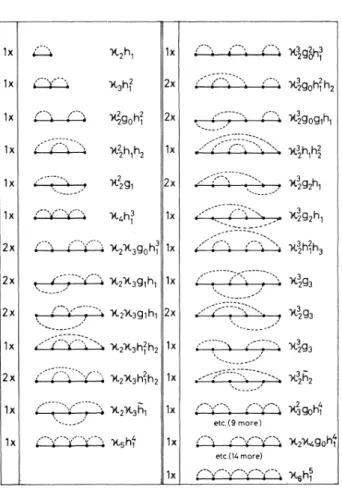
FIG.
1. Diagrams representing the terms ((Ago}'b,)«
in the fluctuation expansion (l=1,
2,..
.,5).in
(44) of
order zandof
order z arenew results.There exist approximate calculations based on the EMA
by Webman and Klafter' to order z and by Haus et
al.
to order z
~,
which differ already in termsof
order z from the exact results (4.4), contrary to the suggestion made in Refs. 8 and10. For
our comparison with the termsof
order z / we have used the resultsof Ref.
8,'in which clusters containing three sites have been used in-steadof
the lower approximationof
two-site clusters.It
appears that the approximate EMA results are completely accounted for by the contributions from diagrams inFig.
1,that are built as series-parallel circuits
of
the first dia-gram element (the so-called hypernetted-chain diagrams), their analytical contributions can be simply expressed in the contributionhi(z) of
the first diagram (see Appendix A). The diagrams inFig.
1, whose contribution containg„(q,
z)(n)
1)orh„(z)
(n)
1), do not have a series-parallel structure. The EMA is therefore the hypernetted-chain (HNC) approximation ' iof
our diagrammatic method.Table
I
gives the EMA values together with the exact onesof
all coefficients appearing in Sec.IV.
P.
J.
H. DENTENEER AND M.H.ERNSTThe first term represents the well-known long-time tail
qtz-t
' + '/of
diffusion in stationary random media,such as the d-dimensional Lorentz gas. ' Note that the long-time tails are absent in random walks on uniform lat-tices, where a11cumulants xI are vanishing.
The corresponding mean-square displacement for the
RBM
is given in (4.7). For
theRJM
we recover the exact results(n
),
=
2Dt and qt2(t)=D5+(t)
of
Haus etal.
The results (4.4)for the frequency-dependent (modified) Burnett coefficient Uz(z) in the
RBM
are new. Thelead-111gloilg-tin1c tail 1111ts iilvcl'sc Laplace tiailsfor111, whicll is the Burnett correlation function y&(t), behaves as t with a coefficient depending on sixth-order fluctuations. The closely related moment
(n
),
is given in (4.8). The HNC diagrams reproduce again the EMA resultsof Ref.
10for
(n
)„and
the EMA valuesof
the coefficients to-gether with the exact ones can befound in TableI.
For a
discussionof
the EMA results it is more instruc-tive to make the following observation.If
we denote Uo(z} as calculated from the EMA by W(z), then inspec-tionof
the structureof
the diagrams inFig.
1 shows thatU(q, z) in the EMA is given by
co(q)8'(z)/D,
so that the response function W(q, z)=
[z+co{q)
W(z)/D]
'.
In the EMA all quantities derived from the response function (transport coefficients, correlation functions, and mo-mentsof
displacement) are completely determined by the frequency-dependent diffusion coefficientW(z).
A simi-lar approximation for the Lorentz gas has been proposed by Alder and Alley, and Ernst and vanBeijeren"
have shown, using a diagrammatic analysis, that the contribu-tions neglected in Alder and Alley's approximation areof
the same type as in theEMA.
The Burnett functions for the
RJM
behave again verydifferently from those
of
theRBM,
as can be seen by comparing Uz(z) in (4.4) and (4.6).
The same result for the dominant contribution to Uz(z) in theRJM
has alsobeen obtained from the mode-coupling theory, and from renormalization-group methods. Also the probability
of
zero displacement or staying probability Po(t) behaves quite different inRBM
andRJM
[cf.
(4.16) and (4.22)].
The average Green's function determines the spectral properties, which are the same in both models
[cf.
(3.
1)and
(3.13)],
and also identical to the spectral propertiesof
harmonic chains with random masses or random spring constants.'1
This can be seen by replacing the eigenvaluec
in (2.24) by cu.
In fact, the master equation{1.
2)for theRBM
describes, after replacementof
p„by p„,
the lattice dynamicsof
a harmonic chain with random spring con-stantsIui„I.
The eigenvalue problem in lattice dynamicsis obtained by the rePlaceinent Pn(t)
=e'"'Pn.
Our results (4.17} for the low-frequency behaviorof
the densityof
states~{@)
and for the inverse localization lengthy(c)
(see
Sec. Il)
are the same as the recent exact resultof
Nieuwenhuizen, obtained by entirely different methods. In
a
separate publication we have also considered a fluctuation expansion in bare fluctuations5„=
(urn—
(ui)
)/(ui )
for theRBM,
which provides a systematic methodto
describe the large-z behaviorof
response and Green's functions. Comparisonof
the exact resultsof
Uo(z) with the corresponding EMA result shows againthat the EMA accounts only for the hypernetted-chain di-agrams.
The bare fluctuation expansion for the average Green's function gives also a simple method to determine the mo-tnents
of
the areratts spectral density,f
dee"M(ei
in hopping models or in random harmonic chains, in com-plete agreement with the resultsof
Domb etal.
7For
theIUM the results have been extended to higher-dimensional systems.
ACKNO%I EDGMENT3
want to thank
T.
M.
Nieuwenhuizen and H. van Beijeren for clarifying discussions.APPENDIX A
X
ff
go(q;),
whcl'c +»» rcplesciits thc fillctllatioii
~
—
ig
5
ein(»—
»')W (A2)
and the random variables
5„=D
(1/ui„—
(
I/ui)
)=D/w„—
1 with n=0,
1,. . .
, N—
1 are distributed in-dependently.It
can be represented by diagrams consistingof
(l+2)
/inc segments,',
labeled with a wavenumber q;
E
Iq,qi,.
..
,qi,q'I,
and(l+1)
vertices,, labeled with a site label n;&In&,
. . .
,
nt+ij
and separating the line segments, andof
dashed lines"'
of
connecting vertices withequal site labels. The contribution
of a
diagram is determined by thefol-lowing diagram rules:
J'
(1)
a
factor%'5„e'"'»»'for
each (2)a
factor go(q) for each(3}a
5„„
for each(4)sum over all internal q;;
(5)sum over all n;, excluding those terms where uncon-nected n; are equal;
(6)average over all random variables
5„.
An important stat1st1cal concept ln the cRlculat1on 1s
that
5„'s
are independent random variables. This implies that averagesof
the form(5„,
5„5„, .
)
are onlynon-vanishing
if
each label occurs at least twice, since(5„)
=0.
Therefore, each vertex must be connected with at least one other vertex througha
dashed line.If
the site1Rbel Pl 1s connected
to
I
other vertices, lt contributes afactor
(5„)
=
p,
independentof
site nIn this appendix we develop
a
diagrammatic method for calculating the fluctuation expansion A(q,z) defined in (3.8). The (l—
1)th term in the expansionof
go(q)A (q,z)isapart from a factor (
—
z) equal to[cf.
(3.7) and(3.
8)](go(~go)'")»»
=
go{q)go{q')«»»,
~».
.
."
~»,')
As an example consider the term
of
second order in the fluctuation,&go(~go) )qq' ',
q,
=le
g g
e '
'e
'
'5„,
„,
&5„,5„,
)go(q)go(ql)go(q')=go(q)go(q')5„pzhi(z»
Tllcfourtll-order tcrnl,
&go(~go
}"
&qqLg 4/
r
f 7
/
(A4)
Ill tile fll'sf, teITll nI
—
—
nz n3—
n——
4 or symbolically (1234),in the next term nI
—
—
nz+n3
n4 or (12——
)(34) and similarly we have(14}(23)»d
(13)(24). The first term is simplyglveIl by
(1234)
=go(q)go(q')5qq p~h I(z).
(A6)Next consider as an example the last term in (A5).
(13)(24)
=-go(q)go(q')pz&'
g
go(qi)go(qz)go(q3)e"
Pl)Qtl2
(A7a)
q
=n
i(q—
qi+qz
—
q3)+nz(ql
qz+q3
q)
—
.
—
The restricted double sum
(ni&nz)
in (A7a) is split into an unrestricted double sum minus a single sum (ni—
—
nz)yielding
(E
5qq q +q E)5qq'. Usillg dc—flnltloll(85)
this term yields
(13)(24)=go(q)go(q')5„v
zlgi(qz}
—
hi(z}1.
Similarly we find
(AS)
(12)(34)
=go(q)go(q')5„p'[go(q}h'(
)—
h'(
)1(A9)
(
14)(23)
=go(q)go(q'}5qq pzfhi(z}hz(»
—
hi(»1 .
Using the cumulants
(3.
16)the terms (A6), (AS), and (A9)cRQbecombined 1Gto
where (2.3) and
(81) of
Appendix8
have been used. .Ob-serve that matrix elements & )qq are diagonal on account
of
translational invariance.The third-order term, becomes similarly
&go ~go)')qq
---
=g,
(q)g,
(q}5„.
p,
h',(z).
We may therefore modify the diagram rules and assign
a
value «4h I to the first diagram in (A5) with four
connect-ed vertices, and values «zgohi, «zh, hz, and Kzgi
to
thesecond, third, and fourth diagrams, respectively, with two pairs
of
connected vertices. In general we assign to each setof
j
connected vertices a weight, given by thejth
cu-Illulallt Kl
.
The number
of
independent q; variables in the modifieddiagrams can be determined by observing that the total wave number is conserved at each vertex,
i.
e.,if
we assign wave numbers to solid lines and dashed lines, the sumof
incoming q's equals thatof
outgoing q's. Consequently, each term ill & )qq lsP10Portlollal 'to 5qq .The diRgrRrrl coIltributloIls RIC Ilow cRIIcU1Rtcd
Record-ing to the modified diagram rules:
(1)label external lines with wave vector q; label internal lines such that the sum
of
incoming wave numbers equals the sumof
outgoing wave numbers;(2)a factor go(q) for line segment q;
(3)sum over all independent internal q's with a weight (4) a factor
g".
z(KJ)'
for a diagram with mI.(j
=2,
3,. . .
)setsof
j
connected vertices.Next we consider fifth- and sixth-order fluctuations. The fifth-order terms are symbolically denoted as (12345) (one such term) and (12)(345), (13)(245), (14)(235), (15)(234), (123)(45), (124)(35), (125)(34), (134)(25), (135)(24), (145)(23)(ten such terms), or by corresponding diagrams (see
Fig.
1),where all diagrams are listed as well Rs the correspoIldiIlg R11Rlytic cxpressioIls RIld the molti-plicityof
each diagram. The subtracted terms in the 10 termsof
type ()(")
contain factors p3pzhi(z}, thatcan be combined with the contribution
p5h,
(z) from (12345) to yield the modified diagram, containing cumu-lants insteadof
moments p.k, represented bygo(q)«5h I
.
The remaining contribution
of
()(")
can becalculateddirectly from the modified diagram rules. As an example consider (135)(24),
&go(~go }'&qq
=
go(q)g'o(q'}5qqX[«ghI+Kz(goh I
+
hIh3+g
I)]
.
(A10)r
/
q q i'
q&~82
Ego(qi)
X
go(qz)go(q3)go(qi—
qz+q3}=«z«3go(q)&
I@go(qi)gl{ql,
z)=«z«~oz(q)hl(z),
(A12)q1 g2) g3
P.
J.
H.DENTENEER AND M.H.ERNST(go(Ago)
}
=go(q)
I~511,(z)+Ii21~2[2go(q)hi(z)+3hi(z)h2(z)+4III(z)gl(q,
z)+hi(z)]}
. The function II2(z) is defined in(Bl).
The calculation
of
the sixth-order term is much more involved. We shall only illustrate how the subtracted terms re-sulting from the restricted n; summations may be combined with other terms to yield the modified diagrams. Consider the following terms calculated according to the original diagram rules:(123456)
=p6gohi,
(12)(3456)=p2iu4go(go& i
—
hi)(123)(456)=Plgo(gob
i—
II i),
(A14)(12)(34)(56)
=P2g0(ggh i—
2giih i—
hiII2+2II
i ).
With the use
of
the definition(3.
16)of
the cumulant a.6the last terms on each line, proportional to hI,can be combined into a modified diagram (123456)with a value I~6hohi, as there are 15 terms
of
type(")(
.
), 10of
type (.
)( - ),and 15
of
type(")(.
*)(").
A more detailed comparisonof
terms enables us to combine ~M~~oh I with thoseof
type(")(")(")
to obtain the modified diagram (12)(3456)with a value Ii2&4gohi.
In this way one finds that the first term on each lineof
(A14)represents the contribution accordingto
the modified diagram rules, provided all moments HAMI arere-placed by cumulants
xi.
As an example we give the modified diagram contribution from (15)(23)(46),X
go(qi)go(q2)go(q—
qi+q2)
+go(q2)=a2g2(q,
z)h,(z),
where
(85)
has been used. The total contributionof
the sixth-order fluctuation terins gives finally (seealsoFig.
1):&gO(~gO)'&
=
gO&Z(gOhi+2gohlgi+2gO~
iI2+3II Ig2+4g2+~
ihl+I
ih2+h2)
+go+3(goh I
+4h
Igi+2~
1~2+2h
l~1+g4)+go+2+4(2go~ I+6
Ilg1+4~
ih2+
3h1 I1)+go+6II1 (A16)All functions have been defined in
(Bl), (85),
and(89),
ex-ceptgO(ql)gO(q2)gO(ql)go(q4)
g)pe+~p)4
&&go(q
—
qi+q2
—
q&+q4).
(A17) The notation is systematic in the sense that all functions g;(q, z) with i=1,
2,.
.
.,
represent contributions from "self-energy" diagrams that depend on the external wave IluIllbcl q, wllcl'cas tllc lclllailllllg contributions h (z) alldh;(z) (i
=1,
2,. . .
,) are independentof
q. The simplestq-dependent self-energy diagram is the fourth one in (A5) with acontribution ~2gi (q,
z).
Also note that the diagrams whose contribution does not contain the functiong„
(n
)
1)orh„(h
)
1)are built as series-parallel circuitsof
the very first diagram. These diagrams will bereferred to as hypernetted-chain diagrams. Their contributions can be expressed as products (of powers)of III,
II2,h3,. .
.
, whereII„~
i—
—
(—
1)"h i"/n!
(n)
0) [see(81)
and(82)]
and the superscript on hi denotes the nth derivative with respect to z.A.PPENDIX
8
Thc cRlculRtlon
of
fhc scparafc terms in thc fluctuation expansion presented 111AppcIldix Ais in facf,independentof
flicnulllbcl'of
dimensions. The behaviorof
these terms for small zand small q will strongly depend on the dimen sionalityof
the system.In this appendix we define the functions appearing in
II,(
)=&
'+go(q),
n=1,
2,. .
.
,with go(q)
=
[z
+
~(q) ]
and~(q)
=
2D (1—
cosq). From(81)
we have(81)
II,
(z)=(i
—
II) 'Il„'l(z),
n=2,
3,.
.
.
.
The prime denotes dlffclclltlatloll wltll rcspcct to z. On account
of (82)
all these functions can be derived from &I(z). In the thermodynamic limit(X~oo)
the sums withqc18Z
may be replaced byinte-grals (2ir) I
f
dq.
, and the function &I(z) reduces toan elementary integral:III(z)
=(2ir)
'J
dq[z+2D(1
—
cosq)]=
[.
(.
+4D)]-'"
.
(83)
Arelated set
of
functions isI
Appendix A and in the results quoted in Sec.
III,
and we will calculate them for the one-dimensional case. When possible we give exact expressions, otherwise we determine tllc doIIllllallt slllRll-z bcllRvlol wlfh q=Icv
z alld Ic kept fixed, which issufficient for our applications.In the remaining part
of
this appendix we present a power counting argument to estimate the leading small-z behaviorof
all terms in the diagrammatic expansion. These arguments are given for the one-dimensional case, but can be extended togeneral dimensions ina
k„(z)=N 'go)(q)go(q),
n=1,
2,.
.. .
Because
(82)
is also valid fork„and
k)(z)
=
I—
zh) (z) allk functions can be derived from h)
(z).
The next set
of
functionsto
be defined isg„(q,
z) (n=1,
2,3),
withg)(q,
z)=N
'
g
go(q) )go(qz)go(q—
q)+q»
gz(q»)=N
'
g
go(q))go(q2)go(q—
q)+q2)
g3(q z) N
y
go(q))go(q2)go(q 3)Xgo(q
—
q)+q3)go(q
—
q2+q3)
.
The function
g,
(q, z) can be evaluated exactly by transforming the integration variables according towk =exp(iqk)
(k
=1,
2)
and w=exp(iq)
T.heng,
(q„z)is a double integral over the unit circlesc,
in the complex w)and Lop plane:
ww)wz[(ww) w2
e—
)(ww)w2e—
)]
g)(q,
z)=(
—
D) (2~i)
dw,dw21 1 (w)
—
e )(w)—
e )(w2—
e )(w&—
e )where we have defined e
+e
=2cosha=
2+z/—
D
The integration can be performed using complex con-tour integration, yieldingg)(q,
z)=(gD
)'cosh(3a)(sinha)
[cosh(3a)
—
cosq]g)
(q,z)=3(4Dz)-'(9z+Dq')-',
g2(q
z)=(4Dz
)'(1gz+Dq
)(9z+Dq2)
(87)
In our calculation
~e
only need the small-z and -qbehavior (with q
=~v
z and a.fixed). The dominant con-tribution for q,z~0
isg
(q,z)=(2'D3~ z'~
)'(45z+Dq
)(9z+Dq2)
Wefurther need
h„(z)
(n=
1,2):
(88)
h„(z)
=N
'g
go(q)g) (q,z),
(89)
which can be evaluated in the same way as sketched for
g)(q,
z)and givesThis dominant behavior can also be obtained directly by substituting qk
=xk(z!D)'
in the original q integral andletting the integration boundaries +n.
(D/z))~
tend toin-finity. The remaining integrals can be performed using
complex contour integration. This method gives for g3(q, z)(q,
z~O)
h)(z) =(25D
) 'smh(4a)(sinha)[sinh(2a)]
=2
5D ~z ~ asz—
+0,
h2(z)=(2
D
)'I(sinha)
+[sinh(3a)]
I(sinha)[sinh(2a)]
=5)&2
D
3~zz 7/z as z—
+0 . Again the dominant contribution for z~0
can be obtained more easily by the method described below(87).
Thelast set
of
functions needed is defined as(810)
(811)
f)(z)
=(2
D3)'[sinh(3a)
—
sinh(2a)—
sinha](sinha)[sinh(2a)]
'=3&2
5D 3~zz 3/z asz~O,
f)(z)=h)(z)
—
zh2(z)=3X2
'D
'~'z '~2asz~O,
f„(z)=N
'g
o)(q)go(q)g„(q,z),
n=1,
f„(z)
=N
'g
o)(q)g(~)(q)g„(q,z),
n=1,
2,3,
f„(z)
=N
'g
o)(q)go(q)g„(q,z),
n=1
.
Only for
f
) andf
) we have an exact expression; for the others the dominant behaviorfor
z+0
iseva—luated asbefore:f,
(z)=7X2
"D
'"z
'"
asz
0,
---
(812)
f
(z)=2
D
zasz
0,
f)(z)=9X2
"D
~z ~as