To the Graduate Council:
I am submitting herewith a dissertation written by Michael L. Ratliff entitled “Preservice Secondary School Mathematics Teachers‟ Current Notions of Proof in Euclidean Geometry.” I have examined the final electronic copy of this dissertation for form and content and recommend that it be accepted in partial fulfillment of the requirements for the degree of Doctor of
Philosophy, with a major in Education.
Dr. P. Mark Taylor, Major Professor
We have read this dissertation and recommend its acceptance: Dr. Vena M. Long
Dr. JoAnn Cady Dr. Jerzy Dydak
Accepted for the Council: Dr. Carolyn R. Hodges,
Vice Provost and Dean of the Graduate School
Preservice Secondary School Mathematics Teachers‟ Current Notions of Proof in Euclidean Geometry
A Dissertation Presented for the Doctor of Philosophy
Degree
The University of Tennessee, Knoxville
ii
iii
Acknowledgements
There are many people who are responsible for my education, and I express gratitude to all of them. I could not have completed this degree without the instruction, guidance,
encouragement, and support provided by these people. There are a few from this group that I want to acknowledge who are most responsible for the completion of this degree.
I want to thank the ACCLAIM Management Team for their belief in me and support, especially Dr. Vena Long, Dr. Bill Bush, Dr. Mike Mays, Dr. Carl Lee, and Dr. Robert Mayes. This opportunity has forever changed my professional life. Also, I want to thank my dissertation committee: Dr. P. Mark Taylor (chair), Dr. Vena Long, Dr. JoAnn Cady, and Dr. Jerzy Dydak. I appreciate the guidance and also patience that each of you demonstrated as I completed this work.
In addition, I want to thank a few people from my home institution, Lindsey Wilson College: Dr. Bill Luckey, Dr. William Julian, Dr. Bettie Starr, and my Division colleagues. I could not have finished without the support and encouragement that all of you provided.
I‟m thankful for the many life-long friendships that I now have with those from my cohort and the other two cohorts. I hope that all of you achieve your professional and personal goals in life, and I thank all of you for the support and encouragement offered along our doctoral paths.
I want to thank my family for their support and encouragement. And, I want to thank my very good friend, Faylene, for your support and encouragement this past year.
iv Abstract
Much research has been conducted in the past 25 years related to the teaching and
learning of proof in Euclidean geometry. However, very little research has been done focused on preservice secondary school mathematics teachers‟ notions of proof in Euclidean geometry. Thus, this qualitative study was exploratory in nature, consisting of four case studies focused on identifying preservice secondary school mathematics teachers‟ current notions of proof in Euclidean geometry, a starting point for improving the teaching and learning of proof in Euclidean geometry.
The unit of analysis (i.e., participant) in each case study was a preservice mathematics teacher. The case studies were parallel as each participant was presented with the same Euclidean geometry content in independent interview sessions. The content consisted of six Euclidean geometry statements and a Euclidean geometry problem appropriate for a secondary school Euclidean geometry course. For five of the six Euclidean geometry statements, three justifications for each statement were presented for discussion. For the sixth Euclidean geometry statement and the Euclidean geometry problem, participants constructed justifications for
discussion.
v
vi
Table of Contents
Chapter 1 : INTRODUCTION... 1
Background of the Study ... 1
United States Schools, Geometry and Proof ... 1
Learned Societies, Organizations, Committees and Proof... 12
The Researcher‟s Interest and Motivation ... 14
Statement of Problem ... 15
The Research Questions ... 16
Delimitations and Limitations ... 17
Chapter 2 : REVIEW OF LITERATURE ... 19
Defining Proof ... 19
Proof Schemes ... 21
External Conviction Proof Schemes ... 22
Empirical Proof Schemes ... 23
Deductive Proof Schemes ... 23
Functions of Proof... 23
Pedagogical Approaches ... 26
Recommendations and Standards ... 27
Proof and Dynamic Geometry Software ... 28
Discussion ... 31
Chapter 3 : RESEARCH DESIGN ... 33
Rationale for Case Study ... 33
Participants ... 34
Data Collection ... 34
Phase One... 35
Phase Two ... 36
Phase Three ... 36
Data Analysis ... 37
Chapter 4 : RESULTS ... 39
Interview Structure... 39
Case Study One: Michelle ... 40
The First Interview ... 41
The Second Interview ... 53
The Third Interview ... 63
Justifications and Proof Schemes ... 72
Functions of Proof... 76
Case Study Two: Billy ... 76
The First Interview ... 77
The Second Interview ... 90
The Third Interview ... 99
Justifications and Proof Schemes ... 105
Functions of Proof... 109
Case Study Three: Julia ... 109
The First Interview ... 110
vii
The Third Interview ... 129
Justifications and Proof Schemes ... 136
Functions of Proof... 141
Case Study Four: Anna ... 141
The First Interview ... 142
The Second Interview ... 152
The Third Interview ... 160
Justifications and Proof Schemes ... 166
Functions of Proof... 169
Cross-case Analysis ... 169
Justifications and Less Familiar Euclidean Geometry Statements ... 169
Dynamic Geometry Software and Enhancing Understanding ... 171
Dynamic Geometry Software and Reinforcing Comprehension ... 172
Chapter 5 : CONCLUSIONS ... 175
Summary of Study ... 175
Findings... 176
Michelle‟s Notions ... 176
Billy‟s Notions ... 177
Julia‟s Notions ... 179
Anna‟s Notions ... 180
Implications... 181
Future Research ... 183
LIST OF REFERENCES ... 184
APPENDICES ... 189
Appendix A: Consent Forms ... 190
Appendix B: Figures ... 192
viii List of Figures
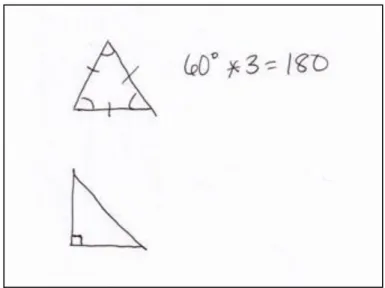
Figure 4.1: Michelle's triangles used in her explanation of statement one. ... 41
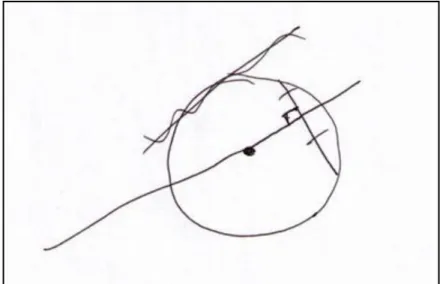
Figure 4.2: Michelle's sketch used in her explanation of statement two. ... 46
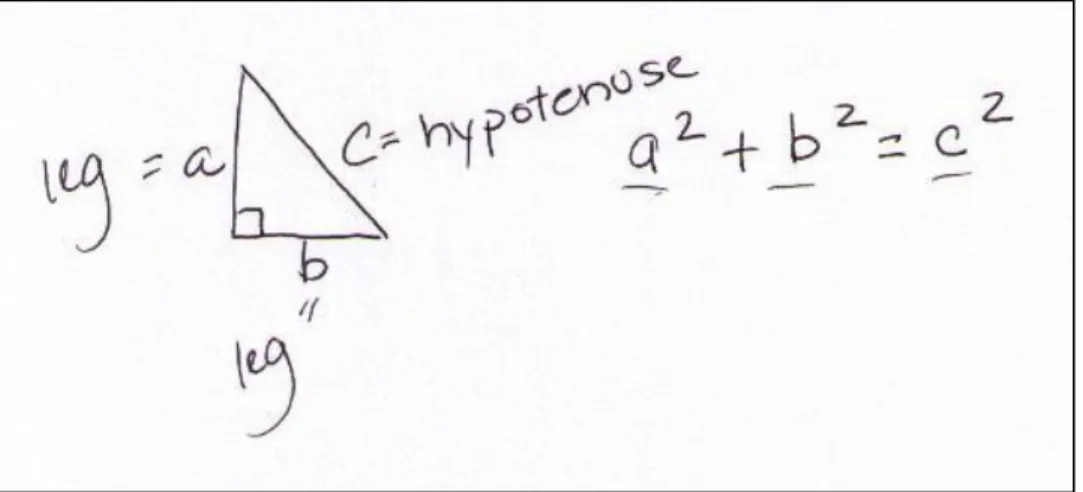
Figure 4.3: Michelle's right triangle used in her explanation of statement three. ... 49
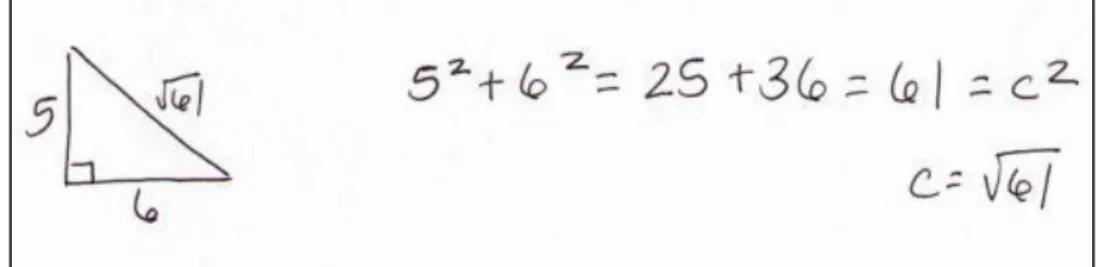
Figure 4.4: Michelle's concrete example used in her explanation of statement three. ... 50
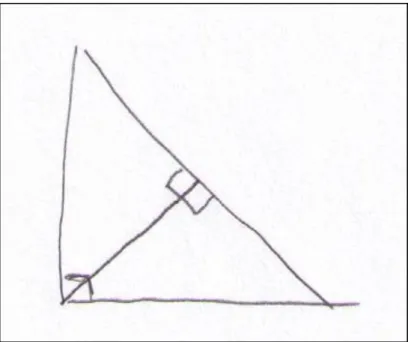
Figure 4.5: Michelle's right triangle used in her explanation of statement four. ... 54
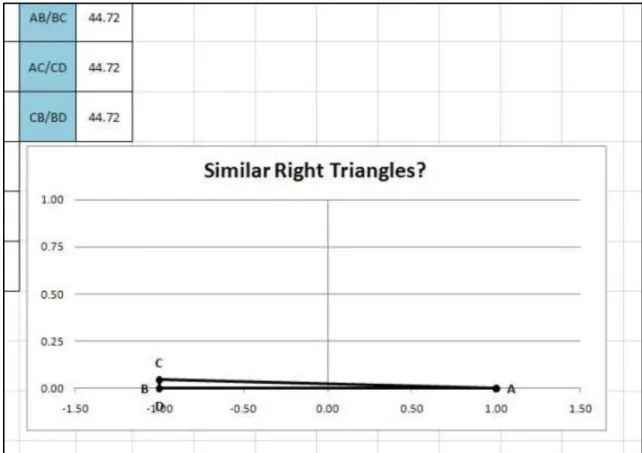
Figure 4.6: A right triangle with altitude generated randomly using a spreadsheet; segments and appear to coincide. ... 56
Figure 4.7: Michelle's triangle used in her explanation of statement five. ... 59
Figure 4.8: Michelle's investigation of an isosceles triangle with a ‘short’ base. ... 61
Figure 4.9: Michelle's diagram for task one. ... 64
Figure 4.10: Michelle's sketch for her justification of task one. ... 66
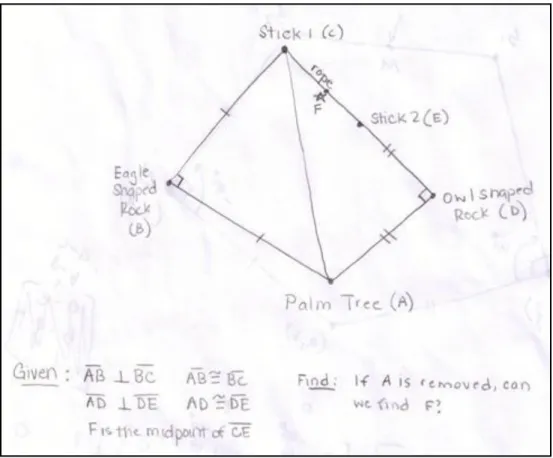
Figure 4.11: Michelle's diagram for task two. ... 68
Figure 4.12: Michelle's initial Sketchpad diagram for task two. ... 69
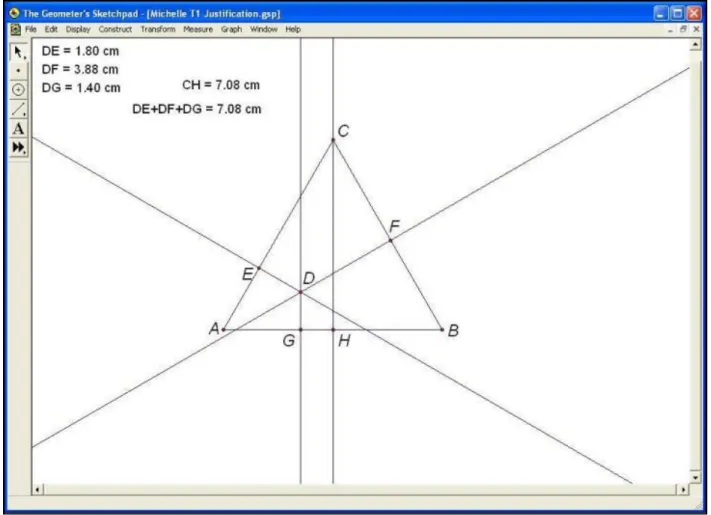
Figure 4.13: Michelle's Sketchpad diagram with constructed for task two. ... 70
Figure 4.14: One of Billy's triangles used for justification one of statement one. ... 78
Figure 4.15: A caption of Billy's Sketchpad triangle, very close to a degenerate triangle. ... 80
Figure 4.16: Billy's diagram used in his explanation of statement two. ... 82
Figure 4.17: Billy's right triangle for statement three. ... 85
Figure 4.18: Billy's concrete example for statement three. ... 86
Figure 4.19: Billy's right triangle used in his explanation of statement four. ... 91
Figure 4.20: Billy's triangle used in his explanation of statement five. ... 95
Figure 4.21: Billy's Sketchpad diagram for task one. ... 99
Figure 4.22: Billy's Sketchpad diagram of the problem situation in task two. ... 102
Figure 4.23: Julia's very obtuse triangle. ... 112
Figure 4.24: Julia's diagram used in her explanation of statement two. ... 115
Figure 4.25: Julia's diagram used in her explanation of statement three. ... 118
Figure 4.26: Julia's right triangle used in her explanation of statement four. ... 122
Figure 4.27: Julia's triangle used in her explanation of statement five. ... 126
Figure 4.28: Julia's diagram for task one. ... 130
Figure 4.29: Julia's Sketchpad construction used for justification of task one. ... 131
Figure 4.30: Julia's diagram for task two. ... 133
Figure 4.31: Julia's Sketchpad diagram for task two. ... 134
Figure 4.32: Anna's diagram for statement two. ... 146
Figure 4.33: Anna's right triangle used in her explanation of statement four. ... 152
Figure 4.34: Anna's diagram used in her explanation of statement five. ... 156
Figure 4.35: Anna's diagram for task one. ... 160
Figure 4.36: Anna's diagram for task two. ... 163
Figure 4.37: Anna's Sketchpad diagram for task two. ... 164
Figure 4.38: Summary of participant preferences of justifications for statement two, four, and five. ... 170
Figure A.1: Student consent form. ... 190
Figure A.2: Instructor consent form. ... 191
Figure B.1: Five triangles used for justification one of statement one. ... 192
ix
Figure B.3: Two captions of a manipulated triangle with angles measured and summed
constructed using Sketchpad for justification two of statement one. ... 193 Figure B.4: A deductive proof of statement one from Ulrich’s geometry textbook (1987, p. 182). ... 194 Figure B.5: Justification one for statement two. ... 195 Figure B.6: A circle used in justification two of statement two marked with dashed lines
indicating where the creases were from the folding. ... 196 Figure B.7: Caption of the spreadsheet that generated 100 analytic examples used in justification three of statement two. ... 197 Figure B.8: Justification one of statement three, Garfield’s proof. ... 198 Figure B.9: Three non-similar right triangles used in justification two of statement three. ... 199 Figure B.10: Caption of a right triangle constructed using Sketchpad for justification three of statement three. ... 200 Figure B.11: Caption of a spreadsheet used for justification one of statement four. ... 201 Figure B.12: A deductive proof presented verbally and partially written as justification two of statement four... 202 Figure B.13: Caption of a right triangle constructed in Sketchpad used in justification three of statement four... 203 Figure B.14: Caption of a spreadsheet with a randomly generated triangle, measurements, and calculations used for justification one of statement five. ... 204 Figure B.15: Caption of the triangle constructed using Sketchpad, with measurements and
x List of Tables
Table 4.1: Proof schemes identified by Michelle (M) and the researcher (R). ... 75
Table 4.2: Proof schemes identified by Billy (B) and the researcher (R). ... 108
Table 4.3: Proof schemes identified by Julia (J) and the researcher (R). ... 140
1
Chapter 1 : INTRODUCTION
The mathematics education discipline‟s landscape has changed drastically in the past 20 years. The changes have been prompted mainly by various reports, publications and
recommendations from stakeholders in mathematics and mathematics education (e.g., federal and state governments, National Council of Teachers of Mathematics [NCTM], and
Mathematical Association of America [MAA]) and also the impact of new technology (e.g., graphing or graphics calculators, spreadsheets, mathematics software, and web-based applets). These changes have sparked an interest and challenge of attaining a better understanding of aspects of proof from various perspectives – students at all grade levels including college-level, preservice mathematics teachers, and inservice mathematics teachers.
This study‟s focus is preservice secondary school mathematics teachers‟ current notions of proof in the context of Euclidean geometry.
Background of the Study
The purpose of this section is to provide a brief history of proof in geometry courses in United States schools, professional organizations‟ proof positions and the researcher‟s
motivation for the study.
United States Schools, Geometry and Proof
2
difficulties to students‟ maturity level and the lack of change in the nature of the content that was most often presented in textbooks as an imitation of Euclid‟s model.
In 1892, The National Education Association (NEA) appointed the Committee of Ten to address secondary school problems which included instructional and learning issues in
mathematics. A Committee charge was “to select school and college teachers of certain subjects to consider the proper limits of each subject, the best methods of instruction, the most desirable allotment of time for the subject, and the best methods of testing the pupils‟ attainments” (Center for the Study of Mathematics Curriculum [CSMC], 2004, ¶ 2). The Mathematics Sub-Committee of the Committee of Ten produced five reports including recommendations, two that pertained to geometry (CSMC, 2004): (1) Special report on the teaching of concrete geometry –
recommendations for the inclusion of experiential and experimental geometry in elementary curricula, and (2) Special report on the teaching of formal geometry – recommendations
reaffirming demonstrative geometry‟s place in secondary [school] curricula with the inclusion of projective geometry. From these reports and the belief that mental discipline can be achieved through academic studies, formal (demonstrative) geometry was identified by the Committee of Ten as a means for attaining “the art of demonstration (or proving)” (Herbst, 2002, p. 287; Sinclair, 2008). The Committee affirmed that study in the physical sciences provided training in inductive reasoning (Sinclair, 2008). The Committee argued that current instructional practices in geometry promoted the memorization of demonstrations rather than student demonstrations; thus, the opportunity to achieve mental discipline was being minimized. Instructional changes were needed for success in demonstrative geometry (Herbst, 2002).
The Committee of Ten‟s work prompted change in the early-20th
3
discussed including suggested methods and strategies for developing proofs. One of the most influential was the Schultze and Sevenoak textbook published in 1913. The authors presented the two-column format, a format that “moved to establishing a norm for the production and control of proofs by students” (Herbst, 2002). Shibli (1932, as cited in Herbst, 2002, p. 297) indicated that the format “emphasized more strongly the necessity of giving a reason for each statement made, and it saves time when the teacher is inspecting and correcting written work.”
The most popular textbooks in the early-20th century were by Wentworth, Wentworth and Smith, and Myers. A characteristic of the Wentworth and later the Wentworth and Smith
textbooks was “the abundance of „original‟ exercises (proofs left to student analysis and
ingenuity) as opposed to „book proofs‟ (full demonstrations to be memorized for reproduction)” (Donoghue, 2003, p. 335). Myers‟ textbook was produced through consultation with
mathematics department faculty from the University of Chicago, including department chair E. H. Moore. The motivation for the textbook was Moore‟s belief that “mathematics should be taught as a laboratory science, with experiments and concrete applications” ([1903] 1926, as cited in Donoghue, 2003, p. 338). The textbook combined algebra and geometry with a greater emphasis on algebra, prompted by Moore who advocated the "use of more algebra and arithmetic in the teaching of geometry" (Sinclair, 2008, p. 34), and more formal deductive reasoning with original proofs in later chapters. Also, a teacher‟s manual was developed because of Myers‟ recognition that assistance for mathematics teachers would be needed for successful use of the textbook (Donoghue, 2003).
4
view the instruments of a laboratory as peripheral to geometric understanding, or as dispensable to it” (Sinclair, 2008, p. 35).
Another factor that influenced the mathematics curriculum and a consequence that Moore and other educators didn't anticipate was the tremendous increase of students attending
secondary schools between 1890 and 1920 (Roberts, 2001). The number of students increased two and half times between 1890 and 1900. The enrollments doubled by 1912, and doubled again by 1920. Social efficiency, linking the "education of students more closely to their future employment" (Roberts, 2001, p. 692), became a primary goal of education during this time. This shift to a more vocational education (i.e., practical mathematics) and the decreased enrollments in the classical mathematics courses (including geometry) caused some to call the time period from 1915 until 1940 a "'twenty-five year depression' in school mathematics" (Duren, 1967, as cited in Roberts, 2001, p. 694).
In 1923, a report by the National Committee on Mathematics Requirements (NCMR), formed under the umbrella of the MAA, identified the principal purposes of teaching plane demonstrative geometry as (as cited in Sinclair, 2008, p. 38):
(1) To exercise further the spatial imagination of the students; (2) To make him familiar with the great basal propositions and their applications; (3) To develop understanding and appreciation of a deductive proof and the ability to use this method of reasoning where applicable; and (4) To form habits of precise and succinct statement, of the logical organization of ideas and of logical memory.
5
The NCMR report also stated that the “disciplinary value of geometry rested on the manner in which it was taught” (Sinclair, 2008, p. 38), thus, a shifting of responsibility from the textbook to the teacher. However, textbooks continued to assume this responsibility, as indicated in Clark and Otis‟s 1925 and 1927 texts (as cited in Sinclair, 2008, p. 38): “we teach geometry primarily for the purpose of training the student in the methods and habits of thought that result in power to reason and analyze, to discover, and to prove in a logical manner that which has been discovered.”
In 1926, the NCTM stated “the purpose of demonstrative geometry is not mensuration, this being sufficiently cared for in the work in intuitive geometry; its purpose is, in part, to demonstrate the truths already known intuitively” (p. 27). That is, “show the application of logic to the proof of mathematical statements” (NCTM, 1926, p. 27). Textbooks in the first quarter of the 20th century promoted engaging students in proof activities beyond memorization and reproduction or proofs presented in textbooks. However, Herbst (2002) argued that the
established norm of the two-column format, a staple in high school geometry for the remainder of the century, promoted “disassociating the doing of proofs from the construction of
knowledge” (p. 307).
In the 1930s, Progressive Plane Geometry by Wells and Hart and Integrated
Mathematics with Special Applications to Geometry by Swenson became popular in United
6
minimum. The minimum exercise level included all content identified by the College Entrance Examination Board.
The Swenson text, a two-book set, was an attempt to relate other mathematics to geometry, thus making "the mathematics of the tenth year more comprehensive, dynamic, and functional in character" (Donoghue, 2003, p. 347). Formal proofs of theorems were included in the text as oral exercises in class; applications of theorems were the assigned homework
problems (Burton, 1939, as cited in Donoghue, 2003). Advice for reasoning in everyday life was offered as a ten-page supplement to the second book (Donoghue, 2003), a transition to the functional aspects of deductive reasoning.
The NCTM, founded in 1920, began publishing a series of yearbooks in 1926. The thirteenth in the series was Fawcett‟s The Nature of Proof (1938), reprinted in 1995 by NCTM because of the “renewed interest in Fawcett‟s pedagogical approach to geometry and his emphasis on helping students to develop critical, reflective thinking processes” (Donoghue, 2008, ¶ 5). The yearbook was a two-year study based on Fawcett‟s instructional experiences and experiments in high school geometry. The purpose of his study was to improve students‟
thinking skills, both reflective and critical, by emphasizing the logical processes of proof in a demonstrative geometry setting rather than the factual content of the discipline (Fawcett, 1938, p. 12). Fawcett provided opportunities for students to “apply the deductive method to situations that have clear relevance to their own lives” (Donoghue, 2008, ¶ 3). This approach was utilitarian, but emphasized the application of the deductive method rather than the application of geometry to everyday life.
7
relegated to an elective credit status by many high schools (Sinclair, 2007). Possibly contributing to this decline, Sinclair (2007) suggested that many students were inclined to take courses that would secure employment during this time period.
In 1935, Nicolas Bourbaki, a pseudonym used by a group of mainly French
mathematicians (known as the Bourbaki Group), penned a series of modern mathematics books with the goal of basing all mathematics on set theory; their method consisted of rigor and generality (Sinclair, 2007). Dieudonné, a member of The Bourbaki Group, stated "the basic principle of modern mathematics is to achieve a complete fusion [of] 'geometric' and 'analytic' ideas" (1973, as cited in O‟Conner and Robertson, 2006, ¶ 5). He also promoted a "strict
adherence to the axiomatic methods, with no appeal to the 'geometric intuition,' at least in formal proofs: a necessity which we have emphasized by deliberately abstaining from introducing any diagram in the book" (quoted by Brown, 1999, as cited in Sinclair, 2007, pp. 48-49). This intentional omission of diagrams contradicted the Greek tradition of visual argument. Sinclair stated "the original meaning of the Greek word , 'to prove,' was to make visible or to show" (2007, p. 49).
Whitely (1999, as cited in Sinclair, 2007) claimed that "a field of mathematics 'dies' when it is no longer viewed as an 'important' area of mathematical research, and argued that geometry 'died' in this sense through the 1920s-1940s (at least in North America and parts of Europe)" (p. 46). Whitely's claim was based on the decline of geometry in research mathematics, a decline that began with only three of Hilbert's 23 important, unsolved problems, proposed in 1900, being geometry problems and amplified by the work of The Bourbaki Group (Sinclair, 2007).
8
past accomplishment (and as an exercise in logical proofs) but not as a continuing source of new mathematics" (Sinclair, 2007, p. 47) and were often taught by logicians and historians of
mathematics as a service course for preservice secondary school teachers (Sinclair, 2007). In 1940, the Committee on the Function of Mathematics in General Education of the Progressive Education Association placed emphasis on the mathematics that would "meet the needs of students and develop personal characteristics essential to democratic living" (Sinclair, 2007, p. 53). However, many began to question high school mathematics curricula because of the mathematics deficiencies of inductees upon entry into World War II; an interest in geometry being "taught for theoretical rather than practical purposes" (Sinclair, 2007, p. 53) gained momentum.
Geometry textbooks that were common from the period 1941 to 1960 were similar to Schorling, Clark, and Smith's (1948) Modern-School Geometry, a text that wasn't as formal as earlier popular textbooks (Donoghue, 2003). Schorling, Clark, and Smith claimed that "the chief benefit to the student from his study of geometry is the training he receives in reasoning" (1948, as cited in Donoghue, 2003, p. 359). An introductory section, written as a conversational
dialogue, was included before students began formal proofs; the purpose of the section was "to show students how to work backward from a desired conclusion to the given hypothesis" (Donoghue, 2003, p. 360). Also, a syllogistic reasoning section appeared with excerpts from the United States Declaration of Independence as exercises. Most practical applications of geometry in the text were related to science and industry (Donoghue, 2003).
9
approaches to demonstrative geometry concerned Birkhoff and Beatley (1941, as cited in Donoghue, 2003, p. 356): "In a course in demonstrative geometry our prime concern is to make the student articulate about the sort of thing that hitherto he has been doing quite unconsciously. We wish to make him critical of his own, and others', reasoning."
Beginning in the late-1950s and early-1960s, the mathematics curriculum underwent many changes. These changes produced a curriculum often referred to as New Math which was designed to “bridge the gap between school and college mathematics” (Sinclair, 2007, p. 57). Of the secondary school mathematics courses, geometry was the least affected by these changes as deductive reasoning was already a strong component of the course. Nevertheless, the SMSG, funded by United States government monies, produced a 7-12 mathematics „suggested‟
curriculum that included a modern geometry program based on a combination of Hilbert‟s and Birkhoff‟s postulational systems (Sinclair, 2007).
The SMSG‟s work influenced the content of most geometry textbooks used in secondary schools during the 1960s and 1970s including Jurgensen, Maier, and Dulciani‟s geometry
textbooks, the most popular of this era with a market share that exceeded 50% (Donoghue, 2003; Sinclair, 2007). Other factors such as the development of classroom manipulatives (e.g.,
geoboards and tangrams) and technology advancements (e.g., copy machines and overhead projectors) also had an impact on geometry instruction.
A movement in the 1970s based on an alternative definition of congruence, “two figures are said to be congruent if and only if there exists a distance-preserving transformation that maps one figure onto the other” (Sinclair, 2007, p. 65), generated textbooks such as Coxford‟s
Geometry: A Transformation Approach (1975). This approach made secondary school geometry
10
By the late-1970s, the „back to the basics‟ reform movement was underway as “the widespread sentiment was that the new math [New Math] had failed” (Herrera and Owens, 2001, p. 87). This movement which emphasized procedural skills, mainly computation and algebraic manipulation, dominated the following decade, the 1980s: “Socratic dialogue and pedagogical approaches of discovery were relinquished for those backed by principles of behavioral psychology” (Herrera and Owens, 2001, p. 87). During this time, geometry was most often separated from measurement (a strong connection in the New Math) and identified as a “basic skill that all students should have” (Sinclair, 2007, p. 70); this „basic skill‟ geometry was integrated throughout the K-12 mathematics curriculum.
Though „basic skill‟ geometry now existed, geometry, the secondary school mathematics course, continued with textbooks influenced by the SMSG work (e.g., HBJ Geometry (Ulrich, 1984, 1987), Geometry (Hirsch, et al, 1984, 1987), and Basic Geometry (Jurgensen and Brown, 1988)). Also, the percentage of high school graduates who took a geometry course steadily increased in the 1980s (Sinclair, 2007, p. 78): 47.1% in 1982, 58.6% in 1987, and 63.2% in 1990. However, another reform in mathematics education, prompted by factors including a sense of a national crisis generated by publications such as the National Commission for Excellence in Education‟s A Nation at Risk (1983) and the United States government, more technological advances such as the personal computer, and a dissatisfaction of the „back to the basics‟ curriculum by many in the mathematics and mathematics education community, was on the horizon by the end of the decade (Donoghue, 2003; Herrera and Owens, 2001; Sinclair, 2007).
In 1989, NCTM published Curriculum and Evaluation Standards for School Mathematics, a document that took more than 10 years to assemble (Sinclair, 2007). The
11
the basics‟ curriculum (Herrera and Owens, 2001). The recommendations in Standards and advances in technology caused significant changes in geometry textbooks that altered the
secondary school geometry course. Most notably, Standards recommended that “justification and reasoning became matters for all students, in all areas of mathematics – not only in geometry” (Sinclair, 2007, p. 79). Thus, proof (i.e., deductive proof) wasn‟t the central focus in the secondary school geometry course any longer.
A popular textbook series during this time was a series developed by the University of Chicago School Mathematics Project (UCSMP) and included the textbook Geometry (Coxford, Usiskin, and Hirschorn, 1993) described as “the study of visual patterns” (Donoghue, 2003). The textbook was aligned with NCTM‟s Standards, emphasizing “the wide applicability of geometry to recreations, practical tasks, the sciences, and the arts” (Sinclair, 2001, p.79) and integrating algebra (Donoghue, 2003). Given this emphasis, deductive proofs derived from an axiomatic system (most often using the two-column format) were minimized in favor of “deductive arguments expressed orally and in sentence or paragraph form” (Sinclair, 2001, p.79) and informal investigations using manipulatives or dynamic geometry software. This was often interpreted by many as Standards‟ vision of secondary school geometry was “… geometry no longer requires proof” (McLeod, in press [2003], as cited in Herrera and Owens, 2001, p. 90). Such interpretations resulted in a polarization in mathematics education during the 1990s, a debate concerning traditional mathematics curricula and instruction versus reform mathematics curricula and instruction.
The NCTM responded in 2000 with another publication, Principles and Standards for School Mathematics [PSSM], a document that addressed many misinterpretations by updating,
12
on mathematical proof as “a formal way of expressing particular kinds of reasoning and justification” (PSSM, 2000, p. 56) and was implemented across all grade levels (known as the „Reasoning and Proof‟ process standard). Thus, deductive proof became more central in
secondary school geometry courses, but often in an investigative (or discovery) environment as many textbooks were developed encouraging the use of manipulatives and dynamic geometry software to form conjectures for students to prove or disprove.
Learned Societies, Organizations, Committees and Proof
Proof is a very complex notion situated in the complex activity of teaching and learning. Also, proof in the secondary school mathematics classroom has most often been associated with 9th or 10th grade geometry. The Conference Board of the Mathematical Sciences [CBMS], an organization with representation from sixteen professional societies in the mathematical sciences, (2001, p. 41) states:
High school geometry was once a year-long course of synthetic Euclidean plane geometry that emphasized logic and formal proof. Recently, many high school texts and teachers have adopted a mixture of formal and informal approaches to geometric content, de-emphasizing axiomatic developments of the subject and increasing attention to visualization and problem solving. Many schools use computer software to help students do geometric experiments – investigations of geometric objects that give rise to conjectures that can be addressed by formal proof.
13
The MAA (2004, p. 52) states mathematics majors preparing to teach secondary school mathematics should “learn to make appropriate connections between the advanced mathematics they are learning and the secondary [school] mathematics they will be teaching.” Many advanced mathematics courses contain proof (e.g., college geometry, discrete mathematics, abstract
algebra, etc.) and proof is present in secondary school mathematics (namely, the 9th or 10th grade geometry course). For specific curricula details, the MAA defers to the CBMS
recommendations.
In the NCTM‟s Principles and Standards for School Mathematics, standards are partitioned into two groups, content standards and process standards. The Geometry Standard (content) and the Reasoning and Proof Standard (process) exist across all grade levels, Pre-K thru 12, with stated expectations. For grade levels 9-12, the NCTM (2000, p. 308) recommends that students should “establish the validity of geometric conjectures using deduction, prove theorems, and critique arguments made by others” in their analysis of characteristics and properties of two- and three-dimensional geometric shapes. In the Reasoning and Proof Standard, the NCTM (2000, p. 342) states:
Instructional programs should enable all students to:
Recognize reasoning and proof as fundamental aspects of mathematics; Make and investigate mathematical conjectures;
Develop and evaluate mathematical arguments and proofs; and Select and use various types of reasoning and methods of proof.
This process standard is a common thread in the curriculum; that is, it applies to all content standards. Furthermore, the NCTM has six principles designed to promote high-quality
mathematics education. Among these principles is The Technology Principle (NCTM, 2000, p. 24): “Technology is essential in teaching and learning mathematics; it influences the
14
is that a study of mathematics should allow students to think and act like mathematicians
including the use of available resources for exploration. Hence, reasoning and proof in geometry using technology is appropriate in a secondary school mathematics curriculum.
The Researcher’s Interest and Motivation
About the researcher.
In the transition from an instructor of mathematics to a mathematics education researcher, two quotations by George Pólya – “The Father of Modern Problem Solving” (Musser, Burger, and Peterson, 2006, p. 1), resonate with me:
Quotation 1 (O‟Conner and Robertson, 2002, ¶ 13): I came very late to
mathematics. …as I came to mathematics and learned something of it, I thought: Well it is so, I see, the proof seems to be conclusive, but how can people find such results? My difficulty in understanding mathematics: How was it discovered? Quotation 2 (Pólya, 1998, p. 1): To teach effectively a teacher must develop a feeling for his subject; he cannot make his students sense its vitality if he does not sense it himself. He cannot share his enthusiasm when he has no enthusiasm to share. How he makes his point may be as important as the point he makes; he must personally feel it to be important; he must develop his personality.
Similar to Pólya, I came late to mathematics and even later to teaching mathematics, having earned an undergraduate degree in physics that required mostly utilitarian mathematics.
With the physics focus, the underlying structures and the culture of mathematics were of little interest to me. This changed suddenly when I began graduate study in mathematics and also teaching remedial and general education mathematics as a graduate assistant teaching instructor. My lack of understanding of the underlying structures and the culture of mathematics were underscored when required to do proofs in graduate coursework.
15
underlying structures and the culture of mathematics, and proof, both formal and informal, was the litmus test for this learning. So, the quest throughout my teaching career has been to learn those underlying structures and the culture of mathematics.
The geometry course incident.
In a geometry course that I taught for undergraduate mathematics majors planning on pursuing a career of teaching mathematics in secondary schools, students were given a
homework task of finding a proof of the Pythagorean Theorem for presentation and discussion at the next class session. One student misunderstood the assignment directions; she interpreted “find a proof of” as “prove” the Pythagorean Theorem.
At the next class session, she was the first to present. Her presentation was a construction, including measurements and calculations, and manipulation of a right triangle in a dynamic geometry environment (specifically, The Geometer’s Sketchpad® [Sketchpad], Key Curriculum Press‟ dynamic geometry software). This prompted a class discussion of proof in geometry (and mathematics in general) in which the students were challenging one another‟s notions of proof.
At the conclusion of class, many students were accepting the student‟s presentation as a proof, but a different type of proof than proofs they had experienced in their respective
secondary school geometry courses or previous college-level mathematics courses. This incident, observed by me, was the motivation for this research.
Statement of Problem
Proof is a very complex entity. It has a historical relevance unrivaled in the discipline of mathematics, a discipline with truths (if one accepts given assumptions). Bressoud (1999, p. xiii) stated:
16
something is true is far from understanding why it is true and how it connects to the rest of what we know. The search for proof is the first step in the search for understanding.
Mathematicians most often seek truths with proof as the vehicle for advancing conjectures. On the other hand, scientists advance conjectures “that are tested against reality, that are maintained so long as they agree with reality, and that are refined or rejected when they fail in their
predictions" (Bressoud, 1999, p. xi).
In the recent history of the teaching and learning of proof in secondary school mathematics (and at other levels), computer and manipulative explorations are often used to establish truths (de Villiers, 1997; Hanna, 2000). However, many have claimed that verification is not the sole function of proof (Bell, 1976; Balacheff, 1988; Hanna, 1990, 2000; Hersh, 1993, de Villiers, 1999). Furthermore, as Harel and Sowder (2007) indicated, many factors
(mathematical, historical, epistemological, cognitive, sociological, instructional, and cultural) are involved in the learning and teaching of proof and its functions. Hanna (2000) stated "proof can make its greatest contribution in the classroom only when the teacher is able to use proofs that convey understanding" (p. 7). Thus, identifying preservice secondary school mathematics teachers' current notions (conceptions and misconceptions) of proof in Euclidean geometry is a starting point for improving the teaching and learning of proof.
The Research Questions
In his 1925 Presidential address to The Mathematical Association (Great Britain), Hardy (2003, p. 13) stated:
17
honest attempt to understand the subject he teaches as well as he can, and should expound the truth to his pupils to the limits of their patience and capacity.
This study is an honest attempt to better understand a component of the teaching and learning of proof in the field of mathematics education. To accomplish this task, the lead research question and supporting questions are:
Lead research question
What are preservice secondary school mathematics teachers' current notions of proof in Euclidean geometry?
Supporting questions
a. What factors (e.g., proof schemes) form these notions? b. What functions of proof are foundational in these notions?
c. With a knowledge of various proof schemes and functions of proof, do preservice secondary school mathematics teachers' notions of proof change?
Delimitations and Limitations
Since this study is a qualitative study consisting of four simultaneous case studies, the cases were four preservice mathematics teachers who have completed the geometry course required for their respective major program of study. The preservice mathematics teachers were from three different colleges or universities. Data sources included interviews (including course instructors, when possible), task observations, and document analyses; data, per participant, was collected in a three-month time frame.
18
minimized with purposeful sampling – specifically, as Patton (2002) indicates, a sample
19
Chapter 2 : REVIEW OF LITERATURE
The purpose of this chapter is to review the relevant literature associated with proof in geometry courses. In this chapter, definitions of proof, proof schemes, functions of proof in mathematics, pedagogical approaches, recommendations and standards regarding proof, and proof in the context of dynamic geometry software are investigated. The chapter concludes with a synthesis of the literature prompting appropriate next steps for research.
Defining Proof
Proof is a word in the English language with different meanings depending on the context in which the word is used. To a mathematician, proof has a very precise meaning, “… a finite sequential set of statements that leads from definitions, axioms (i.e., statements the truth of which is unquestioned in a given theory), and theorems (i.e., statements the truth of which has already been proved) to a conclusion, in such a way that as long as the axioms are accepted and the definitions are agreed upon, the conclusion is inevitable and its validity must be recognized” (Movshovitz-Hadar, 2001, p. 585). In Weisstein‟s The CRC Concise Encyclopedia of
Mathematics (1999, p. 1456), proof is “a rigorous mathematical argument which unequivocally
demonstrates the truth of a given proposition.” Weisstein (1999, p. 1456) also acknowledges the ongoing “debate among mathematicians as to just what constitutes proof” citing, as an example, the use of a computer for exhausting individual cases in the proof of the Four-Color Theorem.
20
compared to the previous definitions from the mathematics encyclopedias. Kornegay‟s mathematics dictionary definition implies proof is more than an object, a complete set of statements supporting a proposition; proof is a process.
The definitions of proof given in dictionaries based on the frequency of usage in the English language are more subjective in nature. Consider the following dictionary definitions: (1) “The evidence or argument that compels the mind to accept an assertion as true” (Kleinedler (Ed.), 2002, p. 1116); (2) “That which makes good or proves a statement; evidence sufficient (or contributing) to establish a fact or produce a belief in the certainty of something” (The Oxford English Dictionary, 1970, p. 1463); (3) “Something that proves a statement; evidence or
argument establishing a fact or the truth of anything, or belief in the certainty of something” (The Oxford English Dictionary, 2009, ¶ 12); and (4) “Evidence sufficient to establish a thing as true,
or to produce belief in its truth” (The Random House Dictionary of the English Language, 1987, p. 1549). Movshovitz-Hadar (2001, p. 585) aptly states:
In mathematics, unlike in many other areas, the standards of proof demand that every assertion be given a conclusive proof, that is, a proof beyond any doubt. It is the certainty provided by rigorous proof that sets mathematical knowledge apart from all other kinds of knowledge, including the sciences [physical and natural]. In higher mathematics, proofs are absolutely essential because often theorems are nonobvious and even hard to believe. However, in lower levels of mathematics, there is often a tension between the demand to give a formal proof and the feeling that a proof is not necessary, particularly if the claim at hand seems intuitively clear and self-evident.
Movshovitz-Hadar concisely explains the difference and importance of the definition of proof in mathematics compared to definitions in dictionaries which are most often based on frequency of usage in the English language.
21
each step following logically from an assumed or previously proved statement and from previous steps" (p. 144). In Principles and Standards for School Mathematics (NCTM, 2000), "a
mathematical proof is a formal way of expressing particular kinds of reasoning and justifications" (p. 56).
Stylianides (2007, p. 291) proposes a conceptualization of the meaning of proof in school mathematics:
Proof is a mathematical argument, a connected sequence of assertions for or against a mathematical claim, with the following characteristics:
It uses statements accepted by the classroom community (set of accepted statements) that are true and available without further justification;
It employs forms of reasoning (modes of argumentation) that are valid and known to, or within the conceptual reach of, the classroom community; and
It is communicated with forms of expression (modes of argument representation) that are appropriate and known to, or within the conceptual reach of, the classroom community.
This definition is a mathematical definition of proof, axiomatic in nature, yet a means for transitioning from informal justifications (often based on intuition and investigation) to the formal proof in a mathematics classroom. Such transitioning aligns with the basic constructivist principle of students constructing new knowledge from previous knowledge.
Proof Schemes
22
construction of new knowledge; (2) The integrity of proof, historically understood and practiced, must be preserved; and (3) Proofs are social as in a person‟s argument must be accepted by others. Proof‟s subjectivity and the recognition of these factors demanded the need for the construct proof scheme, “a term we use to describe one‟s (or a community‟s) conception of proof” (Harel and Sowder, 2007, p. 808). Using definitions for conjecture versus fact, proving, and ascertaining versus persuading, Harel and Sowder (2007) refined the construct: “A person‟s (or a community‟s) proof scheme consists of what constitutes ascertaining and persuading for that person (or community)” (p. 809).
Proof schemes can be organized into three categories (Harel and Sowder, 1998; 2007): (1) External conviction (initially named externally based) – the evidence that ascertains a person and what a person uses to persuade a community reside in some outside source; (2) Empirical – a person's evidence consists of examples; and (3) Deductive (initially named analytic) – a person's evidence is based on deductive reasoning. Furthermore, Harel and Sowder created subcategories for each proof scheme category.
External Conviction Proof Schemes
23 Empirical Proof Schemes
Empirical proof schemes are comprised of two subcategories (Harel and Sowder, 1998; 2007): (a) Inductive – a person's evidence consists of examples often including quantitative information; (b) Perceptual – a person's evidence is based on visual interpretations.
Deductive Proof Schemes
Deductive proof schemes consists of two subcategories (Harel and Sowder, 1998, 2007): (a) Transformational – a person's evidence consists of generality, demonstrates operational thought in the proving process, and the justification is framed using logical inference; and (b) Axiomatic – a person's evidence consists of generality, operational thought, and logical inference (i.e., transformational), and also includes the structural knowledge that the mathematical system in which the person is constructing proofs consists of a beginning set of accepted truths (axioms).
Functions of Proof
24
mature men," a possible explanation for this difficulty of teaching and learning as many texts in the twentieth century were derivatives of Euclid's model. Given proof's importance in
mathematics and the challenges of teaching and learning proof, identifying functions (or roles) of proof could provide insights regarding the teaching and learning of proof.
Bell claimed that proof has three functions in mathematics (1976, as cited in Clements, 2003): (1) Verification – concerned with establishing the truth of a proposition; (2) Illumination – concerned with conveying insight into why a proposition is true; and (3) Systematization – concerned with organization of propositions into a deductive system. Knuth (2002, p. 487) stated "... mathematicians recognize that a primary role of proof in mathematics is to establish the truth of a result; yet perhaps more important, particularly from an educational perspective, is their recognition of its role in fostering understanding of the underlying mathematics." Knuth's statement suggests that verification and illumination are more significant than systematization, with illumination having the greater role with regard to understanding mathematics.
25
In 1999, building on the work of Bell (1976), Balacheff (1988), Hanna (1990), Hersh (1993), and others, de Villiers identified six functions of proof in mathematics (Harel and Sowder, 2003, p. 819):
Verification – a means to demonstrate the truth of an assertion according to a predetermined set of rules of logic and premises;
Explanation – the seeking of insight into why an assertion is true;
Discovery – situations where through the process of proving, new results may be discovered;
Systematization – the presentation of verifications in organized forms, where each result is derived sequentially from previously established results, definitions, axioms, and primary terms;
Communication – the social interaction about the meaning, validity, and importance of the mathematical knowledge offered by the proof produced; and
Intellectual challenge – the mental state of self-realization and fulfillment one can derive from constructing a proof.
According to de Villiers, these functions are not mutually exclusive. Bell's functions of proof are a subset of de Villiers when one equates illumination to explanation.
Based on the work of Bell (1976), de Villiers (1990, 1999), and Hanna and Jahnke
(1996), Hanna (2000, p. 8) presented a comprehensive list of the functions of proof and proving: Verification – concerned with the truth of a statement;
Explanation – providing insight into why it is true;
Systematization – the organization of various results into a deductive system of axioms, major concepts and theorems;
Discovery – the discovery or invention of new results;
Communication – the transmission of mathematical knowledge; Construction of an empirical theory;
Exploration of the meaning of a definition or the consequences of an assumption; and
Incorporation of a well-known fact into a new framework and thus viewing it from a fresh perspective.
26
Pedagogical Approaches
In recent years, educators have debated the relative emphasis that formal proof should have in secondary school geometry. Three approaches as to how a secondary school geometry course should be approached emerged from these discussions (Battista and Clements, 1995): (1) The continued traditional focus on axiomatic systems and proof; (2) The abandonment of proof for a less formal investigation of geometric ideas; and (3) The gradual movement from an informal investigation of geometry to a more proof-oriented focus.
Along with these three approaches, consideration of the use of dynamic geometry software such as Sketchpad must be taken into account. Claims that “the opportunity offered by such environments [dynamic geometry software] to „see‟ mathematical properties so easily might reduce or even kill any need for proof and thus any learning of how to develop a proof” have been made (Laborde, 2000, p. 151). In fact, in 1993 Grünbaum presented proofs of geometric conjectures using Mathematica and the argument that "... if experiment after
experiment with randomly selected points reaffirms the same result, the probability of the result being false effectively becomes zero" (de Villiers, 1997, p. 22). Furthermore, Grünbaum (1993, as cited in de Villiers, 1997, p.22) stated:
Do we start trusting numerical evidence (or other evidence produced by
computers) as proofs of mathematics theorems? ... if we have no doubt – do we call it a theorem? ... I do think that my assertions about quadrangles and
pentagons are theorems ... the mathematical community needs to come to grips with the possibilities of new modes of investigation that have been opened up by computers.
de Villiers (1997) claimed that proof as a means of verification of an assertion was a narrow viewpoint – that is, proof has other valuable functions in mathematics.
27
Geometry: An Investigative Approach (Publisher: Key Curriculum Press, 2003) and Cox‟s
Informal Geometry (Publisher: Prentice Hall, 2006). These textbooks, coupled with secondary
school students‟ struggles with formal deductive proof, might make approaches (2) and (3) more appealing for secondary school teachers.
Recommendations and Standards
The CBMS, sponsored by the American Mathematical Society (AMS) in cooperation with the MAA, offered six recommendations for the preparation of mathematics teachers. Two of the six recommendations were relevant to geometry and proof. The CBMS (2001, p. 41) recommended that mathematics teachers need an “understanding of the nature of axiomatic reasoning and the role that it has played in the development of mathematics, and facility with proof” if they are to be well-prepared to teach a secondary school geometry course. In this context, the implication is that proof is very formal – that is, a student endeavor of pure mathematical nature. The CBMS (2001, p. 41) also recommended that mathematics teachers need the “ability to use dynamic drawing tools to conduct geometric investigations emphasizing visualization, pattern recognition, conjecturing, and proof.” In this context, the implication for proof could be informal (an inductive approach that supports the argumentation of a conjecture‟s validity), formal, or possibly both. Clearly, the two CBMS recommendations support Battista and Clements‟ (1995) approach (1) and one could argue that all recommendations support approach (3).
28
[emphasis added] and discourse of mathematics, including ways to reason mathematically, solve problems, and communicate mathematics effectively at different levels of formality [emphasis added]; and in addition, develop their perspectives on the changes in the nature of mathematics, and the way we teach, learn, and do mathematics resulting from the availability of technology [emphasis added]” (p. 132). The standard is applicable to mathematics in its broader context across all grade levels; but, with emphasis added, speaks to the preparation of secondary school teachers of geometry. Note that the CBMS recommendations are consistent with the NCTM standard.
In the NCTM's Principles and Standards for School Mathematics, the following statement clearly states the challenge that teachers have (NCTM, 2000, p. 311):
One of the most important challenges in mathematics teaching has to do with the roles of evidence and justification, especially in increasingly technological environments. Using dynamic geometry software, students can quickly generate and explore a range of geometric examples. If they have not learned the
appropriate uses of proof and mathematical argumentation, they might argue that a conjecture must be valid simply because it worked in all the examples they tried.
This was exactly the circumstance that occurred in my geometry class described in Chapter 1. In fact, another student in the class accepted the presentation as a proof based on the sheer number of examples that could be generated by dragging the vertices (separately) in the sketch and observing that the Pythagorean relationship remained true.
Proof and Dynamic Geometry Software
29
mathematical argumentation) or formal proof (i.e., deductive proof)? That is, what are preservice secondary teachers‟ current notions (conceptions and misconceptions) of proof in a dynamic geometry software environment?
Pandiscio (2002) explored these notions in a qualitative research study, a case study consisting for four participants. His choice of case study was based on the nature of the study – a research question of the explanatory variety. His sample size was of concern, but he defended his choice of small sample size well in the methodology portion of his article. A limitation in this study was that discourse among students and/or with the professor wasn‟t reported beyond that of the data collection instruments or techniques. However, Pandiscio indicated that discourse among students and/or with the professor wasn‟t a focus in the study.
According to Pandiscio (2002), three themes emerged that illustrated how preservice secondary school mathematics teachers view proof and how technology might influence student work with proof: (1) After using dynamic software, preservice mathematics teachers were concerned that high [secondary] school students will believe proofs are unnecessary; (2) Preservice teachers still believed a formal proof was different from “proof by many examples,” but after repeated use of dynamic software, they questioned the value of the formal proof for high [secondary] school students; and (3) Preservice teachers believed that the greatest value of dynamic software is helping students understand key relationships that are embedded in a proof.
30
students use a dynamic geometry software to establish “meaning of Geometry theorem.”
However, Mariotti (2000) also suggested that this “meaning of Geometry theorem” at a status of justification using the software as mediation may promote a passage from an „intuitive‟ geometry to a „theoretical‟ geometry validated by formal proof. If so, secondary school students might value proof as a necessary activity for this “meaning of Geometry theorem.”
The second theme refers to preservice secondary school mathematics teachers valuing proof, rather than secondary school students valuing proof. Pandiscio (2002, pp. 218-219) shared preservice teachers‟ statements:
Statement 1: All we did in my geometry class was proofs.
Statement 2: Isn‟t the point of geometry to learn how to use deductive logic? Statement 3: I never really understood why we did all those proofs, but I got the impression that the only reason we took geometry was to learn how to do proofs. Statement 4: Well, I never really thought about why we should include proof, I just figured that was what geometry was all about.
These statements seem to support proof and geometry as synonymous entities for these
preservice secondary school mathematics teachers; however, they could not give a reason why this should be so. Possibly, a misconception in preservice teachers‟ understanding of formal proof in mathematics exists in general. Are these preservice secondary school mathematics teachers „practicing‟ proof in any of their other mathematics courses? Pandiscio does not indicate whether the preservice secondary school mathematics teachers are exposed to proof in other mathematics courses.
The third theme is a statement valuing the use of the software as a tool for better understanding “key relationships that are embedded in a proof.” In supporting this theme, Marrades and Gutiérrez (2000, p.119) state:
31
empirical to abstract ways of conjecture and justification. Such transition is very slow, and has to be rooted on empirical methods used by students so far. In this context, DGS lets students make empirical explorations before trying to produce a deductive justification, by making meaningful representations of problems, experimenting, and getting immediate feedback.
It appears as if the dynamic aspect of such geometry software is the key feature in students‟ explorations.
Pandiscio (2002, p. 216) summarized the three themes into one major finding for his study: “The most striking result is that all four participants saw dynamic software as a tool to make sense of proofs, but not necessarily as a tool that is helpful to create proofs.” Others (de Villiers, 1997; Hanna, 2000; Marrades and Gutiérrez, 2000) have suggested that dynamic geometry software could be a valuable tool helpful in creating proofs.
Discussion
From the review of this body of literature, it appears that the preservice secondary school mathematics teachers value formal proof in a dynamic geometry software environment.
However, it is unclear why preservice secondary school mathematics teachers value formal proof in geometry. Understanding the function(s) of formal proof in mathematics seems to be an issue for these students. Also, it seems that preservice secondary school mathematics teachers
understand the difference between proof (i.e., formal or deductive) and mathematical argumentation (i.e., informal or inductive). However, it is unclear whether they understood appropriate uses of these two modes of justification in mathematics. This will be important given the increased availability of dynamic geometry software environments (e.g., GeoGebra).
32
33
Chapter 3 : RESEARCH DESIGN
The purpose of this chapter is to present the research design for this study. Harel and Sowder (2007) indicated many factors (mathematical, historical, epistemological, cognitive, sociological, instructional, and cultural) are involved in the teaching and learning of proof and its functions. Hence, preservice secondary school mathematics teachers' current notions, both conceptions and misconceptions, of proof are complex entities. Thus, a qualitative approach was selected as the method for investigating the proposed questions.
Rationale for Case Study
By definition, a case study is the exploration of "a single entity or phenomenon ('the case') bounded by time and activity (a program, event, process, institution, or social group) and collects detailed information by using a variety of data collection procedures during a sustained period of time" (Merriam, 1988; Yin, 1989, as cited in Creswell, 1994, p. 12). In this research study, the entity is preservice secondary school mathematics teachers' current notions of proof in Euclidean geometry and will be bounded by a time length of three months (approximately).
Participant activities observed by the researcher included validations of Euclidean geometric statement justifications, explanations of self-constructed justifications of a Euclidean geometric statement and problem, and explanations of Euclidean geometric statement
justification preferences as a secondary mathematics school teacher versus that of a mathematics learner. Other activities included interviews with participants‟ geometry instructors (when possible) and the review of relevant course documents.
34
the opportunity for the researcher to: (1) clarify and understand complexities, and (2) provide insights that change behavior, refine existing knowledge, or identify problems (Peshkin, 1993).
Participants
The participants for this study were four preservice secondary school mathematics teachers from at least three colleges or universities. The selection of the participants was done strategically and purposefully as „information-rich‟ cases provided the researcher an opportunity to "learn a great deal about matters of importance" (Patton, 2002, p. 242). Participants were selected using the following process:
I contacted college and university faculty within a 150 mile distance from my locale who teach a college-level geometry course that was included in the degree program for secondary school mathematics teachers. (Note: The college-level geometry course need not be limited to Euclidean geometry; however, Euclidean geometry must receive significant attention in the course.)
After informing faculty of the study, I requested a list of possible participants.
The main criterion for selection was that the participant successfully completed a college-level geometry course where dynamic geometry software was available for use.
Other criteria for selection involved logistics - meeting times concur for the participants and me, and the participants' ability to communicate with me electronically.
In this study, a preservice secondary school mathematics teacher was the unit of analysis (case). It should be noted that a preservice teacher's geometry instructor (when possible) was a secondary participant as he or she was interviewed and the interview data was used in building the case record. Thus, the selection of a secondary participant was dependent on the selection of a participant.
Data Collection
35
Those forms included interview (semi-structured) transcripts from both participants (preservice secondary school mathematics teachers) and secondary participants (course professors, when possible), anecdotal notes from the playback of the recorded interviews and the review of the interview transcripts, document analyses of both previous geometry course documents and any documents generated by participants via assigned Euclidean geometry tasks, and participant emails. The four researcher constructed case records served as data for the cross-case analysis.
At the first meeting, each participant was informed of the nature of the study; however, the actual research questions were not revealed. Also, a statement regarding participation in the study and right to opt out without negative consequences was read aloud by me to each
participant (including any secondary participants) and also presented in writing with the appropriate informed consent forms (see Figure A.1 and Figure A.2).
Though data collection was ongoing over a three-month time frame, three major phases guided this collection.
Phase One
Phase one was the first month of the study. It consisted of an interview with each participant and, if necessary and possible, an interview with each participant's geometry course professor. The participant interview was a semi-structured interview primarily targeting the first supporting question. Participants validated multiple justifications of three Euclidean geometry statements. The purpose was to identify each participant's preferred proof scheme(s) used in the justifications. After a participant interview was completed, an interview with the participant's geometry course professor (if necessary and possible) was conducted for the purpose of
36 Phase Two
During the second month of the study, a second semi-structured interview with each participant occurred. The interview was similar to the first with participants validating multiple justifications of two statements from Euclidean geometry; again, the purpose was to identify each participant's preferred proof scheme(s) used in the justifications. However, researcher questioning was more in-depth in the second interview as the identification of participants' interpretations of function of proof, the second supporting question, became a focus. Again, an interview with each participant's geometry professor (if necessary and possible) followed the participant interview; the purpose of the second professor interview was to determine the professor's perspective on functions of proof.
Phase Three
37
Also, two emails were sent to each participant following the third interview requesting: (1) identifications of proof scheme(s) for the statement and task justifications; and (2)
identification(s) of functions of proof that the participant values with explanation(s). Data Analysis
There were two levels of data analysis for this research study. The first level of analysis generated the case records for the four case studies. The second level of analysis was a cross-case analysis of the four cross-case records.
The following steps were used in the first level of analysis (Creswell, 1994; Stake, 1995, as cited in Leedy and Ormrod, 2005, p. 136): (1) Organization of details about the case –
specific details (facts) about the case were arranged in a logical order; (2) Categorization of data – categories were identified that helped cluster the data into meaningful groups; (3)
Interpretation of single instances – specific documents, occurrences, and other bits of data were
examined for the specific meanings they might have in relation to the case; (4) Identification of patterns – the data and their interpretations were scrutinized for underlying themes and other
patterns that characterized the case more broadly than a single piece of information can reveal; and (5) Synthesis and generalizations – an overall portrait of the case was constructed and conclusions were drawn that may have implications beyond the specific case that was studied. Data analysis for each case study began immediately after the first interview was completed and was ongoing throughout the three phases. The analysis of phase one was used to inform the data collection for phase two; and phase two analysis was used to inform the data collection for phase three.
38
39
Chapter 4 : RESULTS
The purpose of this chapter is to present the research results of this study. The results include four case studies, one per participant, and the themes derived from the cross-case analysis of the four case studies. Each case study is presented chronologically based on the primary data source – the three participant interviews; secondary data sources were used to construct a more complete case study. The section concludes with the results of the cross-case analysis.
Interview Structure
All participant interviews were semi-structured. The first interview consisted of the presentation of three Euclidean geometry statements and three justifications for each statement. After a justification was presented, the lead question was “Is this justification convincing?,” then “Why?” or “Why not?” depending on the participant‟s response to the first question. Responses prompted other probing questions and dialogue. Much of the second interview was structured like the first but with two statements instead of three; also, Harel and Sowder‟s proof schemes (1998; 2007) and Hanna‟s functions of proof (2000) were presented. The third interview consisted of a geometry statement where participants provided a justification(s) and a problem that required participants to answer and then provide a justification for the answer.