359
24
DAIRY DEVELOPMENT
Piet Leegwater & Jan Hoorweg
ABSTRACT
The growth of the dairy sector as it has occurred in Kilifi and Malindi Districts is one of the few examples of successful agricultural development in the coastal region in the past decades. Between 1985 and 1997 dairy cattle have more than doubled in number. Three livestock systems are described: conventional grazing, zero-grazing and fenced pastures. Particular attention is given to intensive dairy farming by smallholders. Household and herd characteristics are discussed together with the necessary feeding regime and labour requirements. Milk production is reviewed in terms of milk destination, local demand and local consumption. It is argued that the success of dairy development in the districts is the result of three converging factors: the start of a large dairy farm with a dairy factory near Kilifi town; the start of a programme of technical support for intensive dairy farming by smallholders; and the deregulation of the milk trade.
INTRODUCTION*
Livestock was the main source of subsistence for the communities in the drier zones of Coast Pro-vince in earlier days. The importance of livestock is reflected in the fact that dowry is still expressed in cattle, although nowadays, marriages are arranged more and more by cash payments. Milk was (and still is) an important product for local consumption. At times of surplus, ghee was processed and traded with coastal towns and cattle were (and still are) important as reserve capital during periods of food
* The authors wish to thank Prof. Allan Degen, Ben Gurion University, for his comments.
shortage. However, since the opening up of the hinterland and the increased access to employment elsewhere, alternative ways have emerged to secure survival.
Immigrants from India settled in Mombasa (and the rest of Kenya) from the early start of the colo-nial period. They brought a different food culture with distinct preferences for milk and dairy prod-ucts. The demand for fresh milk in Mombasa stimulated milk collection from farmers in the hin-terland as well as keeping of dairy cows in stable on Mombasa Island (the first instance of what was later to be called zero-grazing). Once transport to and from the interior improved, goods were exchanged
for milk with herdsmen in the hinterland. Mombasa and other stops along the railway line became market centres for the milk from the hinterland. With the emerging national drink, tea with milk, the demand for fresh milk further increased. At first, the milk trade was in the hands of middlemen, but it was taken over later by the Kwale-Kilifi Dairy Co-operative Union (KKDCU) which, in time, started a milk processing plant in Mariakani. Feeder roads were constructed to Bamba in Kilifi District and Kinango in Kwale District with collection and cooling centres along these roads. Milk supply varied seasonally. Figures from the late 1970s showed that the amount of milk handled by the Mariakani plant varied from 30-35,000 litres/day in the lush season to less than 5,000 litres/day in the dry season (Booker 1982).
Despite the integration of the hinterland in the coastal milk market, the quantities of milk were not sufficient to meet the increasing urban demand and milk products had to be imported from up-country. In 1978, KKDCU was taken over by the Kenya Creameries Co-operative (KCC) but the latter company soon discontinued the milk collection in the hinterland. Instead, a new dairy plant was built in Miritini in the early 1980s with a capacity to process 120,000 litres of reconstituted milk per day to supply the national schoolmilk programme, amongst other needs. Milk was processed from imported milk powder and butter oil, at first do-nated by European countries, while fresh milk from up-country was transported by rail. In addition to
schoolmilk distribution, KCC established a distribu-tion network for processed milk and effectively managed to gain a monopoly. It expanded its production at the Miritini plant. The dairy plant in Mariakani continued to receive milk from local producers but KCC failed to make the necessary investments. Consequently, the existing infrastruc-ture deteriorated and local producers again relied on private transport or, alternatively resorted to processing of ghee. In Kilifi and Malindi Districts, however, developments occurred that greatly stimulated intensive dairy farming. This chapter will focus on dairy farming in these districts as an example of what can be achieved under the right conditions.
Kilifi and Malindi Districts
The two districts account for about a third of the coastal population and the agro-ecological condi-tions are fairly typical for the region, ranging from coastal plain to inland ranching zone. The total number of local/beef cattle has remained almost constant over the past 10 years with official esti-mates of 200,000 in 1985 (Kenya 1986) and 208,000 in 1996 (Kenya 1997). The largest numbers are found in the hinterland of Ganze and Malindi. The herds are mainly composed of East African Zebu, a multipurpose indigenous breed (Table 24.1). In the period 1985-96, dairy cattle was estimated to have tripled in number from 13,000 to 42,000; although these being government estimates they are proba-
Table 24.1 Cattle population in Kilifi District by division, 1996
Bahari Ganze Kaloleni Magarini* Malindi* Total Local/Beef breeds 18,750 65,280 40,500 26,100 57,390 208,020
Dairy breeds 22,000 930 2,240 3,120 13,939 42,229
* Now Malindi District
bly on the high side. Half of the number probably consists of grade cattle1, the other half is local Zebu kept for dairy purposes. Dairy cattle is mainly found in the coastal areas, such as Bahari Division and parts of Malindi.
The first important development was the start, in 1963, of intensive dairy farming at a former sisal plantation near Kilifi town. This private company, Kilifi Plantations, gradually increased its herd size and, in time, with several thousand dairy cows be-came the main milk supplier. It also bebe-came the main supplier of dairy stock to development pro-jects along the coast.
One such was the Dairy Development Project (DDP) of the Ministry of Livestock Development. The programme was started in 1980 with technical assistance from the Netherlands Government and ended in 1995. The principal objective was to im-prove dairy management practices on mixed farms of smallholders, with the introduction of so-called zero-grazing systems. The programme started in six districts in different parts of the country, including Kilifi. This was the second major development that occurred. Initially, DDP selected areas in Kilifi where climatic conditions allowed the cultivation of Napier grass (i.e. CL3 zones in Bahari and Kaloleni Divisions). Earlier attempts to keep dairy cattle in grazing systems had been unsuccessful because of high losses due to cattle diseases (East Coast Fever and Trypanosomiasis). Once DDP proved success-ful, more farmers gained confidence in the system, particularly attracting farmers located in the coastal plains. In the drier parts of the district a semi-zero system of grazing was introduced (i.e. CL4 zones in Bahari and Ganze Divisions). With the experiences in Kilifi District, the programme was expanded to
1 According to the New Shorter Oxford English Dictionary grade cattle are crossbred cattle. In Kenya, however, the term is used to refer to purebred animals of foreign stock as well as crossbreeds of local and foreign stock.
Kwale and Lamu Districts in 1990.2
During the first phase, DDP provided grants to pioneer farmers. Later on it assisted with loans or with obtaining loans from the Agricultural Finance Corporation. Subsequently, in 1992, Heifer Project International (HPI) started activities in Coast Pro-vince. HPI works through women's groups (and mixed groups). After constructing dairy units and planting fodder, about half the group members receive a heifer in calf. Members have to pass on the first born female calf, as heifer, to other group members. Between 1992 and 1995, HPI distributed 164 animals (of whom 42 died) to eight groups with 366 members – three groups in Kilifi District (Masha 1998). This particular support and more emphasis on women's participation in general meant that by the end of 1995 about a third of the 300 DDP-farmers were women. The number of DDP-farmers is still growing and it is expected that by the end of 1997 there will be 450 registered DDP-farmers in Kilifi District alone (Mwova 1997). Diffusion of knowledge and improvements in support services have resulted in the improvement of dairy practices and dairy stock at other farms as well.
Apart from technical support and training, DDP has also stimulated farmers to organise themselves in interest groups, for example, the Bahari Dairy Club. This club opened a marketing and cooling centre in Kilifi town in 1987. The annual turnover in 1992 was nearly 200,000 litres (Kenya 1993). In 1996, however, the Club was halted due to organ-isational and management problems. In 1997, a cooling centre with a capacity of 2,000 litres was opened in Gede with the support of HPI. It has
about 190 dairy suppliers and handles 650 l/day or 200-250,000 l/year, mainly destined for the Malindi market.
The third stimulus for dairy development was the privatisation and liberalisation of the milk marketing in 1992, by which Kilifi Plantations gained access to the urban market, notably Mombasa. In 1995 the company started to process milk from DDP-farmers and other smallholder dairy farmers in addition to the milk from its own farm. By the end of 1997 almost 1,000 small-holders were delivering milk to the company.
DAIRY PRODUCTION SYSTEMS
Conventional grazing
The majority of cattle in Kilifi and Malindi Districts are local breeds kept in conventional grazing sys-tems, mainly in the hinterland. The characteristics of this production system are communal grazing, herding cattle on behalf of others, pooling of cattle, and distribution over several herds. Herd sizes range from 20 to 100 animals. A survey in 1983 showed that more than three-quarters of the herds had multiple owners (2-9 owners per herd) and that nearly one-third of the households had lent out cattle to others in order to spread risks and proba-bly also to hide wealth (Bartman 1984). The fact that different people own livestock in the same herd hampers efforts to improve herd production through investments. Not only ecological condi-tions but also ownership arrangements are con-straints to increase milk production from local herds. In respect to grazing rights, the demarcation of rangeland and group ranching has, on the one hand, given some protection against intruders but, on the other hand, imposed obstacles of its own be-cause animals can no longer move freely to less affected areas during drought periods.
Milk production is seasonal and fluctuates with
the quantity and quality of grass in natural pastures. During day-time, the cows and calves graze to-gether. At night, calves are separated from cows and, in the morning, the cows are milked. Cows are in milk for about six months at a time. The amount of milk for human consumption per lactating cow ranges from 0.5-1.5 litres per day. Customarily, the milk is destined for the household looking after the animals, as payment for services. When there is fresh or sour milk at the farm it is customarily offered as a drink to neighbours and other people visiting the household.
Before, nearly every household in the hinterland was involved in livestock farming but this is no longer the case. Surveys in 1985-86 showed that only a minority of the households in the hinterland can derive a substantial income from cattle. Only 32% of the households had more than five livestock equivalents (LE)3 and 19% had more than twenty LE (Foeken et al. 1989). In these households, milk is still important for local consumption as well as for ghee processing. Sour milk is used as a drink or as a relish with food. At the time of KKDCU, fresh milk was sold to the detriment of ghee processing, and according to oral information, even at the cost of household consumption (Gerlach 1963). The collapse of the collection network in the late 1970s may have resulted in more milk for local consump-tion; however, it is unlikely that this could compen-sate for the decrease in incomes.
In the coastal hills and in the coastal plain local breeds are kept in similar ways as in the hinterland. However, the environmental conditions are more favourable for ticks and tsetse flies, the transmitters of East Coast Fever and Trypanosomiasis, respec-tively. Death rates among cattle are generally higher and herd sizes smaller than in the hinterland.
Zero-grazing
In 1980, DDP started with the promotion of zero-grazing for smallholders: animals are kept perma-nently on stable; feed and water are brought to them. Requirements are that there is sufficient land at the farm for fodder cultivation and access to water of good quality. Artificial insemination (AI) reserves the capacity of the unit primarily for the female stock. This production system is labour-intensive but offers a regular income throughout the year. At first, the system was designed for the densely populated areas in the central highlands where land is a major constraint. Results from the first DDP-farms already showed that the output per unit of land compared favourably with that of cash crops (van der Valk 1985; Mwangi et al. 1986). However, compared to the up-country highlands, the conditions at the Coast are quite different. In the rural areas of Coast Province there is more land available per farm, but soil fertility is lower and rainfall less predictable, which makes fodder cultiva-tion more complicated and fodder conservacultiva-tion necessary. A more intensive system of disease control is required. Due to the hostile environment, few farmers possessed the dairy cattle needed to start and most farmers who joined DDP had to purchase suitable animals. For the same reason, female stock was hardly offered for sale and the main supplier for prospective DDP-farmers was Kilifi Plantations. Later, DDP-farmers started to supply each other and newcomers with animals. As a consequence, investment costs at the start were high and participants had to rely more heavily on loans than farmers elsewhere in the country. However, there was the advantage that the coast offered a higher milk price for producers, compara-ble to the consumer prices for processed milk from KCC.
Fenced pastures
The system of fenced pastures is used at the few large-scale farms such as Kilifi Plantations and was used at the former ADC farm at Kisiwani. DDP has also experimented with fenced pastures for dairy farmers in the interior.
Kilifi Plantations grazes its herd of 2,400 cattle on open fields which are fenced into 100 'paddocks'. At night the animals stay out in the open and are fed fodder and concentrates to supplement the natural grazing. The company has a total of 4,000 acres of pasture and the milk herd is broken up in smaller herds of about 125 animals. Milking takes place in the fields. Young stock and pre-calving cows are kept in separate units. At any one time, about 1,000 cows are in milk (Wilson 1998). Because of its scale and mechanisation, the company is able to con-serve fodder of good quality. Artificial insemination and disease control are done at the farm by own personnel (i.e. spraying, 10-day dipping and routine vaccination). In all, the dairy farm employs a labour force of 400, of which 300 are directly concerned with the herds, 100 with the milk plant.
The milk production of Kilifi Plantations is in the order of 3.7 million litres/year or 320,000 l/month. Peak production is 380,000 l/m but in the dry months (February-March) production can be as low as 250,000 l/m. All milk is pasteurised at the com-pany plant and, apart from milk, small quantities of yoghurt, cream and butter are produced. The company distributes directly to retailers in the area from Malindi to Mombasa, as well as the South Coast up to Ukunda.
In addition to production from the own herd the plant also reconstitutes about one million litres of milk a year; the powder is purchased from KCC or directly imported. In 1995, Kilifi Plantations took the initiative to start collection, processing and marketing of milk from smallholders, a regional aspect of dairy development that had been ne-glected by DDP. Kilifi Plantations currently buys about 1 million l/y; 100,000 l/m in peak months and 60,000 l/m in low periods. This development was possible because of deregulation measures in 1992 which gave the company access to markets, notably Mombasa, that were earlier controlled by KCC. The collection area is roughly that around Kilifi Creek and north to Malindi town (in the southern part of Kilifi there is still great local demand for raw milk and farmers there can easily sell their milk). In early 1998 there were 985 farmers recorded with the company; however, there were only 500 which were actually delivering milk – on average 5 l/day. The company provides certain services to regular sup-pliers, namely provision of concentrates and me-dicines, sale of animals on hire/purchase terms, sponsoring of a veterinarian, and breeding bulls at outfarms. In a way, Kilifi Plantations has taken over part of the services of the former DDP-programme, which ended in 1995, excepting extension, training and advice services which are not provided.
SMALLHOLDER CHARACTERISTICS
The characteristics of the smallholder dairy farms are of particular interest to understand the devel-opment of the sector. Farm and household char-acteristics are discussed at the hand of information from a case study among different groups of dairy farmers and livestock keepers in the hinterland (Leegwater, Ngolo & Hoorweg 1991). This study evaluated the milk production and milk consump-tion characteristics of different groups.4 Results concern three dairy systems: DDP-farms; independ-ent dairy farms (neighbours of DDP-farms also keeping dairy cattle) and livestock farms (traditional farmers in the drier hinterland of the district). The general population in the area of DDP-activities was represented by a sample of rural households taken from a parallel study done a year earlier (Hoorweg, Foeken & Klaver 1995).
Household size and farm size were much larger among the three livestock groups than among the general population (Table 24.2). The incomes of the three livestock groups, particularly the DDP-farmers and independent farmers, were higher than that of the general population (Table 24.3). The livestock farmers in the hinterland had a lower income mainly because of the absence of cash crops al-though their income was still higher than that of the general population.
The livestock income was highest in the group of DDP-farmers (Ksh.13,100)5, followed by the in-dependent dairy farmers (Ksh.8,500) and hinterland farmers (Ksh.7,500) but in all three groups livestock contributed 20-30% of total household income. Nearly all dairy farmers belonged to the group of wealthy and middle-class households, not only ...
4 The findings on food consumption and the effects of increased milk consumption are reported elsewhere (Hoorweg, Leegwater & Veerman 1998).
Table 24.2 Household characteristics by type of livestock farmer, 1986/87
DDP- Independent Livestock General farms dairy farms farms population
(N=30) (N=25) (N=11) (N=90)
Household size* 14.9 (8.9) 17.6 (10.7) 15.2 (9.9) 10.0 (5.9)
Farm size (acres, av.) 28.5 25.3 22.6 9.0
* Average number of persons (adult equivalents in brackets)
Source: Leegwater et al. 1991
Table 24.3 Household income composition by type of livestock farm, 1986/87 (averages in sh/household/year)
DDP Independent Livestock General farms dairy farms farms population
(N=30) (N=25) (N=10) (N=90)
Food crops 6,200 5,300 3,000 2,800
Cash crops 7,700 14,100 100 3,500
Livestock 13,100 8,500 7,500 200
Off-farm income 19,400 18,100 14,800 2,800
Total 46,400 46,000 25,400 9,300
Source: Leegwater et al. 1991
because of income from dairy farming, but also because of high incomes from cash crops and off-farm employment.6
Herd characteristics and development
All DDP-farms owned grade cattle, whereas six farms also kept local cattle. The herds at the inde-pendent farms showed a more variable composition consisting of grade and local cattle. At the livestock farms all cattle were of local breed. The latter farms had the largest herd with an average of 39.8
6 The higher incomes of the livestock groups are partly due to the larger household sizes (Table 24.1). But even when household income was corrected for household size only 3% of the DDP-farmers (N=1) and 4% of the independent dairy farmers (N=1) could be classified as poor (with incomes below Ksh.1,000/adult equivalent) versus 52% of the general population.
mals. The independent farms had 19.1 animals and the DDP-farms only 6.3 animals. Despite the differ-ences in breeding and farming systems, there was little difference in herd composition; the number of cows ranging from 40-46%; heifers from 21-26%; bulls from 11-16%; and calves from 18-21%.
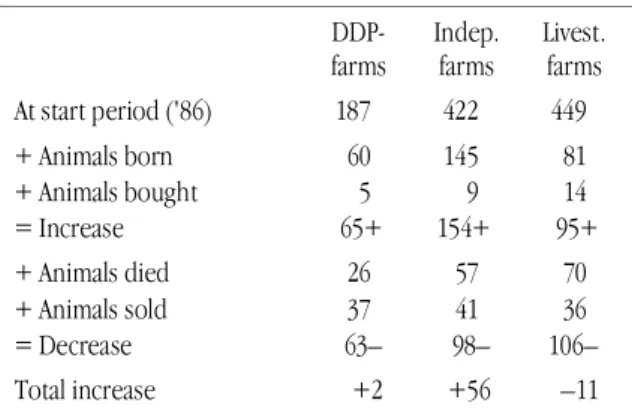
Table 24.4 Annual herd development by type of livestock farm, 1986/87 (number of animals)
DDP- Indep. Livest. farms farms farms At start period ('86) 187 422 449
+ Animals born 60 145 81
+ Animals bought 5 9 14
= Increase 65+ 154+ 95+
+ Animals died 26 57 70
+ Animals sold 37 41 36
= Decrease 63– 98– 106–
Total increase +2 +56 –11
Source: Leegwater et al. 1991
addition, most of these farms were located in areas (Ganze and Kaloleni Divisions) where cattle density was higher, which in itself increases the risk of contamination with disease. Independent dairy farmers did sell relatively fewer animals and their herds increased considerably in size.
Feeds and feeding
Intensive dairy farming requires more water than traditional farming as well as good quality water. Daily access to a reliable water source is a precon-dition for DDP-farms. This water is needed not only for the cattle to drink but also to clean the stables and the utensils. Indeed all DDP-farms used piped water although only few were directly connected to water pipes – the majority still had to arrange water transport and storage facilities. DDP promoted the use of donkeys for water transport and the con-struction of water tanks to store rainwater.
Productive dairy cows have high nutritional re-quirements which cannot be met by fodder alone and cows have to be supplemented with concen-trates. Still, it remains essential that enough fodder of good quality is offered. DDP opted for Napier grass as the principal fodder. Several varieties were tested on farmunder different conditions and diffe-
rent cutting regimes (Wouters 1986a; 1986b). Compared with the highlands, production and quality of Napier grass in Kilifi District were gener-ally low because of moderate soil fertility and climatic conditions. Silage making was introduced to conserve grass. Also, Leucena, a legume, was introduced as a fodder crop. Despite the efforts by DDP to stimulate fodder production, the results stayed behind. The majority of DDP-farmers still made use of ordinary grass and half the farmersdid graze their cattle on common pastures for one month or more per year, accepting poor feeding conditions and higher risk of disease contamina-tion.
In addition, the DDP-farms and some of the independent farms supplemented the cows in lac-tation with concentrates – an average of three kg per animal. This compares with an average pro-duction per lactating cow of 4.8 litres per day which means that milk production was primarily the result of feeding concentrates and not from feeding Napier grass or other fodder. The favourable price of concentrates7 did indeed make it attractive to feed concentrates and to give less attention to the quality of fodder.
Farm labour
Labour requirements in zero-grazing systems are high and a large number of people are necessarily involved in the daily production process. Compared with traditional production systems some activities are new, while others have to be carried out more intensively. Fodder has to be harvested and trans-ported every day to the stable to be chopped and fed to the animals. In many cases water has to be
collected and transported; the stable has to be cleaned and the manure brought back to the Napier fields as fertiliser. Calves are reared separately from the cows, which are milked twice a day; the milk has to be sold or delivered in time. Disease control and breeding demand more attention, and so on (Wouters 1986c).
At the 30 DDP-farms in the study, there were 62 persons responsible for one or more activities; 38 family members and 24 labourers. Family members were mainly men: the head and/or his son(s). At a quarter of the DDP-farms women were actively involved; some even as de facto managers, notably at farms that employed labourers. Labourers were employed at 16 farms; at 13 farms they did all the work. At the 25 independent farms, 46 persons were involved mainly in dairy farming; 36 family members and 10 labourers. At eight farms the labourers performed all daily work. At the livestock farms in the hinterland only family members were involved in the care for the animals.
Comparing DDP-farms with independent farms, the number of people involved in dairy farming was about the same; about two persons per farm, on average. However, the groups looked after a differ-ent number of animals: three animals per person at the DDP-farms and ten animals per person at the independent farms. In other words, the main difference is not that DDP-farms employ
Table 24.5 Average daily milk production and cows in lactation by type of livestock farm, 1986/87
DDP- Indep. Livest. farms farms farms (N=30) (N=25) (N=11) Milk production (litres)
per farm 9.4 5.1 3.8
per lactating cow 4.8 1.9 0.7
per cow present 3.4 0.6 0.2
Cows in lactation (%) 68% 34% 36% Source: Leegwater et al. 1991
more people but that production is realised with fewer animals than at the independent dairy farms.
SMALLHOLDER MILK PRODUCTION
Milk production per cow and milk production per farm were much higher at the DDP-farms (Table 24.5). The percentage of cows in lactation was twice as high as at the independent farms and at the farms in the hinterland. At the DDP-farms, evening milk represented 38% of the production. At the independent farms only three farms had evening production and in the hinterland group none.8
Milk destination
Most of the milk was sold (Table 24.6). At the DDP-farms, 80% of production was destined for sale. About a quarter went to destinations outside the location, the rest to local consumers. The inde-pendent dairy farmers and livestock farmers sold about two-thirds of the production. Nearly all these sales were in the nearby location. DDP-farmers reserved about one-fifth of the milk for home consumption; among the independent dairy farmers and livestock farmers this rate was higher (about a third). In absolute terms, the differences were smaller and had a different order: independ-ent farmers reserved 1.8 litres for home consump-tion, DDP-farmers reserved 1.6 litres and livestock farmers 1.2 litres.
Table 24.6 Destination of milk production by type of live- stock farm, 1986/87 (% of total production)
DDP- Indep. Livest. farms farms farms (N=30) (N=25) (N=11)
Local sales 56 55 50
Sales outside location 23 – 10
Home consumption 17 35 32
Left over at end of day 4 10 8
Total 100 100 100
Source: Leegwater et al. 1991
Local customers
Examination of local customers – 24 regular clients of DDP-farmers – showed them to consist primarily of wage earners. The heads of households had permanent jobs near home and their level of education was relatively high. More than half were employed by the government (N=14), e.g. as teacher or extension worker, others were self-employed (5) or working in the private sector (2). The group was further characterised by smaller households; 25% of the households had fewer than five members. Income and income composition were atypical for rural households. The average household income was three times higher than that of the general population and about three-quarters of the household income was from employment.
Local consumption
Milk consumption at the time was generally low in the rural areas (Kenya 1981; Hoorweg et al. 1991; Niemeijer, Foeken & Klaver 1991). Nearly all DDP-farmers and dairy customers, however, reported regular milk consumption while this was only the case with 10% of the rural population. Milk was nearly always used with tea but 50% of the DDP-farmers and their customers also used it as a drink, most likely for the children. The DDP-farmers consumed about 1.5 litres/day; the customers about
1.0 l/day (but their consumption per person was higher because of smaller households). Milk consumption among the general population was quite low: 56 ml/household/day. Clearly, milk was too expensive for these households and this was indeed mentioned by respondents. The study from which the above results are taken also found that the higher milk consumption is of benefit to the children. Children of DDP-farmers and customers, irrespective of income differences, scored higher on the measures of anthropometry generally taken as indicators of nutritional status (Hoorweg et al.
1998).
DISCUSSION
Rural development
Dairy farming as an economic activity can broaden the resource base of the region and thus contribute to rural development, i.e. improve the living condi-tions of rural households. Among the various kinds of agricultural commercialisation, dairy farming is unique in that it entails the production of a high-quality food that can be used for sales as well as for home consumption. Used for home consumption, milk is important for young children and pregnant and lactating mothers. If sold, milk sales provide a steady, daily flow of income; quite different from the usual bulk payments for most cash crops. Milk sales for local consumption may benefit other households in the community thus contributing to the improvement of nutritional conditions of farmers and customers alike. However, the price for milk remains a constraint for those who need milk most.
Dairy production
dairy farming is the most advanced, milk produced by local herds (210,000 heads producing 20-25,000 litres/day) is about the same as that produced by grade dairy cattle (20,000 heads producing an estimated 30,000 litres/day).9The major differences between these herds are that the local herd is producing milk from grazing natural pastures while milk production by the dairy herd is mainly based on the feeding of concentrates; and that most of the milk produced by the Zebu herd is locally con-sumed while most of that produced by the dairy herd enters the market.
DDP has succeeded in creating a viable small-holder dairy system in a hostile environment for grade cattle. Where other systems failed, the con-cept of zero-grazing provided the conditions re-quired to keep diseases under control as well as for a high and regular milk production. The positive balance of female stock is rather unique for small-holder dairy projects (De Jong 1996). Prospects for sustaining the system are good as progress has been made in the control of East Coast Fever through pre-immunisation by artificial infection and treatment (Thorpe 1993). Other purported benefits, such as a more intensive exploitation of land (important in densely populated areas with a high ecological potential), were less clear in this case, the average size of the DDP-farms was 28.5 acres with 12 acres near the homestead. This confirms that dairy farmers belonged to relatively wealthy households with access to sufficient capital; even more than strictly needed for investment in a dairy unit.10 For that reason it is likely that dairy farming
9 It is assumed that in the local Zebu herd of 210,000 animals about 10-12% of the animals are cows in lactation with an average milk production of 1 l/day per cow. In the dairy herd of 20,000 animals 30% of the animals are assumed to be cows in lactation with an average production of 5 l /day per cow.
10 The study described the situation ten years ago among the first group of participants. There is no reason to expect that since that time differential changes have affected the
will remain out of reach of most rural households that already have problems to sustain a minimum level of existence (Hoorweg et al. 1995).
For the latter households the positive aspect of the programme was the increase in employment opportunities at farms of the more wealthy house-holds. About half the dairy farms did run the dairy unit with family members. The other half employed labourers. The latter farms had more cattle, farmers were wealthier and were more involved in off-farm activities than the first group. In the case of house-holds employing labourers it seems that the in-vestment in a dairy unit was a choice out of many opportunities. Despite the fact that the production system is labour intensive, it did not compete with other economic activities because the labour requirements were met by hired labour; in contrast with the farms not employing labourers. The latter group was more engaged in agriculture. If they desired to enlarge the dairy unit they had to reduce other activities or hire labourers, the costs of which come on top of necessary investments. Since they had lower incomes it was more difficult for them to take this step.
Dairy consumption
Milk production at the Coast is still far behind demand. Milk and milk products are imported from up-country. Consumer prices for milk are relatively high in this part of the country. Consequently,
producers who deliver directly to consumers can easily compete with processed milk and still fetch a good price. Processors of local milk also have the advantage that transport costs can be low while processing can be limited to pasteurisation. How-ever, with a higher milk production, DDP-farmers face the problem of marketing, a problem they share with independent dairy farmers and livestock farmers in the hinterland. The opportunity to deliver milk to Kilifi Plantations has greatly im-proved the marketing conditions for a large number of small farmers. Kilifi Plantations has access to milk markets in Mombasa and Malindi and prospects to market more milk are promising. The feelings in the industry are less optimistic, however, because of fear of stagnant production levels and increasing costs (Wilson 1998).
Fears generally exist that when dairy farming is commercialised, farmers will reduce the amount of milk kept for family consumption. Such trends were observed earlier in the hinterland of Kilifi and Kwale Districts in connection with the Mariakani Milk Scheme mentioned earlier (Gerlach 1963). The danger was also mentioned in connection with Operation Flood, the large dairy scheme in India (Doornbos et al. 1990). However, the objective of DDP was to create new production units and not to market milk from existing units and, in this case, the dairy farmers indeed kept 1.5-2.0 litres a day for home consumption.
The local clients for DDP-milk consist of house-holds with better paid jobs, either employed in the non-agricultural sector or employed by the gov-ernment. They and the dairy farmers often use milk as a drink, most likely for the children. There are few customers among the rural households which confirms the existing insight that milk is not an
important means to improve nutritional conditions among low income rural populations (DGIS 1992). Milk is an expensive source of energy and protein and even when used as an ingredient, for example to add to maize to increase energy density, it is still more expensive than preparing a porridge of maize, vegetable oil and beans.
CONCLUSION
The general performance of the agricultural sector in the Coast is poor and farmers have shown little interest to invest in the modernisation of agricul-ture (Kenya 1985; 1986; 1989; Waaijenberg 1987). In fact, rural areas have to cope with a decreasing interest in agriculture in favour of off-farm ment. Many adults are involved in off-farm employ-ment and two-thirds of the rural households derive an income from this source (Hoorweg et al. 1995). DDP has, at least, stimulated an inverse flow of capital and created employment opportunities in the agricultural sector.
REFERENCES
BARTMAN C. (1984). Livestock and small-scale farmers, a description of the situation around Kilifi. Wageningen: Agricultural University, Training Project in Pedology. BOOKER (1982). Kwale and Kilifi integrated development
project. Nairobi /London: Booker Agriculture Interna-tional Ltd.
DE JONG, R. 1996. Dairy stock development and milk production with smallholders. Wageningen: Agricultural University, PhD thesis.
DGIS (1992). Livestock Production in developing countries. The Hague: Ministry of Development Cooperation. DOORNBOS M., DORSTEN F.V., MITRA M. & TERHAL P. (1990).
Dairy aid and development. India's Operation Flood (Indo-Dutch Studies on Development Alternatives; III).
New Delhi/London: Sage.
FOEKEN D., LEEGWATER P., NIEMEIJER R., VEERMAN W. & HOORWEG J. (1989). Seasonality in the Coastal Lowlands of Kenya. Part 3: Socio-economic profile. Nairobi / Leiden: Ministry of Planning & National Development / African Studies Centre, Food and Nutrition Studies Programme, Report no. 32.
GERLACH L.P. (1963). Traders on bicycle: A study of entrepreneurship and culture change among the Digo and Duruma of Kenya. Sociologus (Berlin), 13(1), 32-49. HOORWEG J., NIEMEIJER R., FOEKEN D., OKELLO W. &
VEERMAN W. (1991). Economic and nutritional conditions at settlement schemes in Coast Province.
Nairobi / Leiden: Ministry of Planning & National
Development / African Studies Centre, Food and Nutrition Studies Programme, Report no. 36.
HOORWEG J., FOEKEN D. & KLAVER W. (1995). Seasons and nutrition at the Kenya Coast. Aldershot: Avebury. HOORWEG J., LEEGWATER P. & VEERMAN W. (1998). Nutrition
in agricultural development: Intensive dairy farming by rural smallholders. Paper submitted for publication. KENYA, REPUBLIC OF (1981). The integrated rural surveys,
1976-1979: Basic report. Nairobi: Central Bureau of Statistics.
KENYA, REPUBLIC OF (1985). Annual report 1984, Kilifi District. Kilifi: Ministry of Agriculture and Livestock Development.
KENYA, REPUBLIC OF (1986). Annual report 1985, Kilifi District. Kilifi: Ministry of Agriculture and Livestock Development.
KENYA, REPUBLIC OF (1989). Kilifi District development plan 1989-1993. Kilifi: Ministry of Planning and National Development.
KENYA, REPUBLIC OF (1993). Annual report 1992. Kilifi: Ministry of Livestock Development, District Livestock Production Office.
KENYA, REPUBLIC OF (1997). Annual report 1996. Kilifi: Ministry of Livestock Development, District Livestock Production Office.
LEEGWATER P., NGOLO J. & HOORWEG J. (1991). Nutrition and dairy development in Kilifi District. Nairobi / Leiden: Ministry of Planning and National Development / African Studies Centre, Food and Nutrition Studies Programme, Report no. 35.
MASHA R. (1998). Personal communication. Heifer Project International, regional co-ordinator.
MWANGI Z.J., VAN WOERSEM B.L.M., MOSI R.O. & BOOTSMA A. (1986). Report of the third joint Kenya/Netherlands evaluation mission on the Dairy Development
Programme. Nairobi / The Hague: Government of Kenya / Government of the Netherlands.
MWOVA (1997). Personal communication. District Livestock Officer.
NIEMEIJER R., FOEKEN D. & KLAVER W. (1991). Seasonality in the Coastal Lowlands of Kenya. Part 4/5: Food
consumption and anthropometry. Nairobi / Leiden: Ministry of Planning & National Development / African Studies Centre, Food and Nutrition Studies Programme, Report no. 38.
THORPE W. (1993). Disease prevalence and characterisation in small holder cattle in Kaloleni Division. In Integrated approach to livestock improvement with special reference to East Coast Fever immunization in Kilifi District, Coast Province of Kenya. Proceedings of a Seminar held at Bamburi Beach Hotel, Mombasa, Kenya, 5-6 November 1992. Nairobi: Kenya Agricultural Research Institute.
VAN DER VALK Y.S. (1985). Economics of zero-grazing.Paper prepared for Symposium on 'Zero-Grazing for Milk Production' of the Animal Production Society of Kenya, Kabete, November 1985. Nairobi: Ministry of Agriculture and Livestock Development, Dairy Development Project. VOSKUIL G.C.J. (1986). Report on the original demonstration
farms. Nairobi: Ministry of Agriculture and Livestock Development, Dairy Development Project. WAAIJENBERG H. (1987). Agriculture in the Kilifi area
(mapsheet 198), Kenya. In H W Boxem, T de Meester & E M A Smaling eds. Soils of the Kilifi area, Kenya.
Wageningen: PUDOC.
WOUTERS A.P. (1986a). Dry matter yield and quality of Napier grass on farm level. Progress report 1985.
Naivasha: Ministry of Agriculture and Livestock Development, Dairy Development Project. WOUTERS A.P. (1986b). The productivity and quality of
Napier grass (var. bana grass) during the dry season at three levels of N-application. Naivasha: Ministry of Agriculture and Livestock Development, Dairy Development Project. DDP/R10/101.