Multiple-Choice Questions
Circle the letter for the choice that best completes the statement or answers the question.
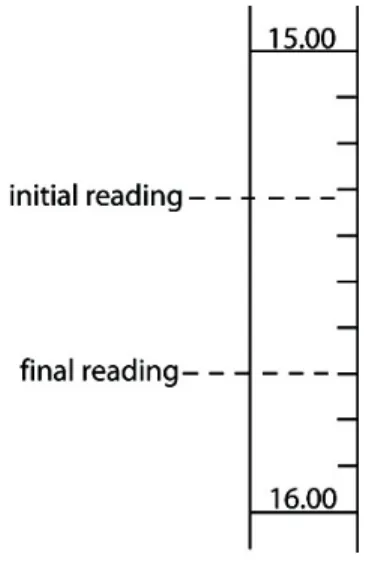
1. The diagram of a burette shown below shows the initial and final readings (in mL) during titration. What volume of acid was delivered from this burette?
a) 15.32 mL
b) 0.38 mL
c) 0.68 mL
d) 1.70 mL
The pH range over which some indicators change colour is shown below in Table 8.1. Use this information for questions 2 and 3
Table 8.1 pH Range and Colour Change of Indicators Indicator pH Range Colour Change
Methyl red 4.8–6.0 red–yellow
Bromothymol
blue 6.0–7.6 yellow–green–blue
Phenol red 6.6–8.0 yellow–red
Phenolphthalein 8.2–10.0 colourless–pink
2. In a titration, an acid is the titrant that is in a burette. The titration goes past the equivalence point and the indicator colour is red. Referring only to the indicators listed in the table, what indicator was used?
c) phenol red
d) bromothymol blue
Copyright © 2007, McGraw-Hill Ryerson Limited, a subsidiary of the McGraw-Hill Companies. All rights reserved.
3. A titration is to be carried out with the equivalence point coming at pH = 7.5. Referring only the indicators listed in the table, which one would be the best choice for this titration?
a) methyl red
b) bromothymol blue c) phenol red
d) phenolphthalein
4. A 15.0 mL sample of an acid is to be titrated with a base. The equivalence point comes at
pH = 6.6 but the indicator that is used changes colour at pH = 9.9. Which statement describes the error that will occur?
a) Too much base will be used.
b) The titration will go past the equivalence point. c) Too little base will be used.
d) Answers (a) and (b) are correct.
5. In the reaction below, the concentration of A is 0.2 mol/L, and the concentration of B is
0.1 mol/L. For what combination of reactants will neither be a limiting reagent?
A + 2B C
a) 10 mL of A + 10 mL of B b) 10 mL of A + 20 mL of B c) 20 mL of A + 10 mL of B d) 10 mL of A + 40 mL of B
6. A 20.0 mL sample of 0.080 mol/L sodium hydroxide is titrated with
hydrochloric acid. The initial burette reading of the acid is 11.64 mL. If the concentration of the HCl is 0.06 mol/L, what is the final burette reading at the equivalence point?
a) 38.31 mL b) 26.67 mL c) 15.03 mL d) 11.64 mL
7. 300 kL of sulfur dioxide and 100 kL of oxygen react in the presence of a
catalyst to form sulfur trioxide. All gases are measured at 100 oC and 100
kPa pressure. What volume of sulfur trioxide is produced?
2SO2(g) + O2(g) 2SO3(g)
b) 300 kL c) 100 kL d) 400 kL
Copyright © 2007, McGraw-Hill Ryerson Limited, a subsidiary of the McGraw-Hill Companies. All rights reserved.
8. The following data were obtained in an experiment to precipitate barium sulfate.
Na2SO4(aq) + Ba(NO3)2(aq) 2NaNO3(aq) + BaSO4(s)
The precipitate was recovered by filtration. Mass of filter paper = 1.56 g
Mass of filter paper + precipitate = 13.78 g
The predicted mass of precipitate for this reaction is 14.09 g.
What is the percentage yield in this experiment? a) 97.78%
b) 89.37% c) 86.73% d) 90.93%
9. 25.0 mL of 0.600 mol/L KOH is pipetted into a beaker. 4 drops of
bromothymol blue indicator are added. After the addition of 30.0 mL of 0.400 mol/L HCl, what will be the colour of the indicator?
a) pink b) green c) yellow d) blue
10. A strip of magnesium metal having a mass of 0.86 g is burned in a bottle
of oxygen.
2Mg(s) + O2(g) 2MgO(s)
Based on this mass of magnesium, the expected yield of magnesium oxide is 1.43 g. The mass of magnesium oxide produced is 1.00 g. What is one
conclusion that could account for this result? a) The magnesium was not 100% pure.
b) Mechanical losses occurred during transfer of the product. c) Oxygen was a limiting reagent.
d) Any of the above answers account for this result.
Numerical Response Questions
For each numerical response question, record the answer in the following response box.
11.
12.
13.
15.
Copyright © 2007, McGraw-Hill Ryerson Limited, a subsidiary of the McGraw-Hill Companies. All rights reserved.
11. What mass of mercury(II) oxide, HgO(s), is predicted to be produced when 2.000 mol of oxygen gas and 1.000 mol of mercury are allowed to react?
2Hg(l) + O2(g) 2HgO(s)
12. When 12.71 g of copper react with 8.000 g of sulfur, 14.72 g of copper(I)
sulfide is produced. What is the percentage yield in this reaction?
2Cu(s) + S(g) Cu2S(s)
13. Aluminium hydroxide, Al(OH)3(s) can be precipitated when aqueous
solutions of aluminium sulfate, Al2(SO4)3(aq), and sodium hydroxide,
NaOH(aq), react as shown in the equation:
Al2(SO4)3(aq) + 6NaOH(aq) 3Na2SO4(aq) + 2Al(OH)3(s)
Predict how many moles of Al(OH)3(s) can be produced when 0.060 mol of
NaOH(aq) react with 0.030 mole of Al2(SO4)3(aq).
14. What mass of the reagent in excess will remain after the reaction in which
0.3604 g of H2O(l) react with 0.8000 g of O2(g)?
2H2O(l) + O2(g) 2H2O2(l)
15. In the reaction between 0.060 mol of aluminium metal and iron(III) oxide,
2.234 g of iron is produced. How many mol of iron(III) oxide reacted?
Copyright © 2007, McGraw-Hill Ryerson Limited, a subsidiary of the McGraw-Hill Companies. All rights reserved.
Written Response Questions
Answer each question in the space provided. Use complete sentences and diagrams when necessary.
16. A double-replacement reaction is used in a precipitation experiment. The precipitate formed is recovered by filtration. The precipitate is washed, dried, and weighed to find the experimental yield. The percentage yield is then calculated.
Poor laboratory technique can lead to experimental error. Indicate if the technique described will increase or decrease the calculated percentage yield. Explain your reasoning.
a) The precipitate is rinsed with tap water, dried, and weighed.
________________________________________________________________________________
________________________________________________________________________________
________________________________________________________________________________
________________________________________________________________________________
b) A stirring rod is used to agitate the solution containing the precipitate while filtering. The stirring rod is not rinsed into the funnel at the end of this procedure.
________________________________________________________________________________
________________________________________________________________________________
________________________________________________________________________________
________________________________________________________________________________
17. Muriatic acid (hydrochloric acid) is used in some toilet bowl cleaners. An experiment was designed to compare the concentration of acid in different products. Answer the following questions concerning the procedure that would be followed to titrate samples of cleaner.
a) Sodium hydroxide is selected as the titrant. Why is this a good choice?
______________________________________________________________________________
______________________________________________________________________________
______________________________________________________________________________
______________________________________________________________________________
The burette is rinsed out with distilled (or de-ionized) water and then rinsed with the standard solution of sodium hydroxide before filling with the standard NaOH(aq) solution. Why is the burette rinsed with sodium hydroxide solution?
______________________________________________________________________________
______________________________________________________________________________
______________________________________________________________________________
______________________________________________________________________________
c) Sketch the titration curve for this titration. Label each axis and the equivalence point.
18. Chrome yellow is the common name given to lead(II) chromate, a pigment used in some paints. Calculate the predicted yield of this pigment that can be prepared by mixing 375 mL of
0.200 mol/L lead nitrate with 450 mL of 0.175 mol/L potassium chromate.
Pb(NO3)2(aq) + K2CrO4(aq) 2KNO3(aq) + PbCrO4(s)
________________________________________________________________________________
________________________________________________________________________________
________________________________________________________________________________
________________________________________________________________________________
________________________________________________________________________________
________________________________________________________________________________
Copyright © 2007, McGraw-Hill Ryerson Limited, a subsidiary of the McGraw-Hill Companies. All rights reserved.
19. A sample of impure zinc is added to dilute hydrochloric acid, HCl(aq), and the hydrogen gas produced is collected at 25.0 oC and 103.5 kPa.
Zn(s) + 2HCl(aq) ZnCl2(aq) + H2(g)
a) What volume of hydrogen gas, H2(g), is expected to be produced when 15.00 g of zinc
that is 90.0% pure is added to 120.0 mL of 4.00 mol/L hydrochloric acid?
Zn(s) + 2HCl(aq) ZnCl2(aq) + H2(g)
_________________________________________________________________________________
_________________________________________________________________________________
_________________________________________________________________________________
_________________________________________________________________________________
_________________________________________________________________________________
_________________________________________________________________________________
_________________________________________________________________________________
_________________________________________________________________________________
_________________________________________________________________________________
_________________________________________________________________________________
_________________________________________________________________________________
_________________________________________________________________________________
b) If 4.88 L of H2(g) is actually collected, what is the percentage yield in this reaction?
_________________________________________________________________________________
_________________________________________________________________________________
_________________________________________________________________________________
20. Silver can be recovered from waste solutions by a reaction with copper metal.
Cu(s) + 2Ag(aq) Cu2(aq) + 2Ag(s)
When 1.00 kg of copper react, 3.12 kg of silver is recovered. What is the percentage yield in this reaction?
Copyright © 2007, McGraw-Hill Ryerson Limited, a subsidiary of the McGraw-Hill Companies. All rights reserved.
Answers to Multiple-Choice Questions 1. b 2. b 3. c 4. d 5. d 6. a 7. a 8. c 9. d 10. d
Answers to Numerical Response Questions 11. 216.6 g
12. 92.48%
13. 0.020 mol
14. 0.4800 g O2(g) 15. 0.020 mol
Answers to Written Response Questions
16. Percentage yield =
Errors that increase the experimental yield, increase the percentage yield; errors that decrease the experimental yield, decrease the percentage yield.
a) There are two possible answers.
(i) Tap water contains varying amounts of dissolved minerals. If the tap water contains large amounts of dissolved minerals, after drying, the precipitate will contain these minerals and will thus have a greater mass. This will increase the experimental yield and the percentage yield.
(ii) The precipitate might be slightly soluble in water and when it is rinsed with tap water, some of the precipitate might dissolve and be washed away. This possibility will result in a decreased experimental yield and percentage yield.
17. a) Since hydrochloric acid is a strong acid and sodium hydroxide is a strong base, the equivalence point will occur at pH = 7. The indicator bromothymol blue is a neutral green colour at pH = 7. The equivalence point will coincide with the endpoint.
b) A standard solution is one for which the exact concentration is known.
c) Rinsing with water ensures that reagents left from the last time the burette was used are washed away. A film of water will remain inside the burette that will have a slight diluting effect on the sodium hydroxide that is to be added. Rinsing the burette with sodium hydroxide ensures that the inside of the burette is coated with the same solution that is to be added, namely the NaOH(aq).
d) Titration curve for sample of toilet bowl cleaner
18. n(Pb(NO3)2) = cV = = 0.0750 mol
= 0.0750 mol PbCrO4
n(K2CrO4) = cV = = 0.07875 mol
0.07875 mol K2CrO4(aq) = 0.07875 mol PbCrO4
Copyright © 2007, McGraw-Hill Ryerson Limited, a subsidiary of the McGraw-Hill Companies. All rights reserved.
Less PbCrO4 was produced using Pb(NO3)2(aq); thus Pb(NO3)2(aq) is the limiting reagent. M(PbCrO4) = 323.21 g/mol
Predicted mass of PbCrO4 = 0.0750 mol PbCrO4 323.21g/mol = 24.2 g
19. a) Mass of Zn in sample = 0.900 15.0 g = 13.5 g
M(Zn) = 65.41 g/mol
n(Zn) = = 0.20639 mol
n(H2) = 0.20639 mol Zn(s) = 0.20639 mol H2(g)
n(HCl) = cV = = 0.480 mol HCl(aq)
n(H2) = = 0.240 mol H2(g)
Less H2(g) is produced by the Zn(s), thus the Zn(s) is the limiting reagent.
Find volume of H2 at 25.0 oC and 103.5 kPa. T = 25.0 oC = 298.15 K
V(H2) = = 4.94 L
20. n(Cu) = = 15.7356 mol Cu
mol Ag produced = 15.7356 mol Cu(s) = 31.47128 mol Ag
Predicted: m(Ag) = = 3394.8 g = 3.3948 kg
Percentage yield = 100% = 100% = 91.9%
Copyright © 2007, McGraw-Hill Ryerson Limited, a subsidiary of the McGraw-Hill Companies. All rights reserved.