Basel II Compliance Solution
Framework
Table of Contents
Background...3
Basel II Challenges...4
The Cognizant Basel II Solution Framework...5
Basel II Solution Overview ...6
The Cognizant Approach...7
Phase 1: Assessment ...7
Phase 2: Data Design and Remediation ...8
Phase 3: Solution Rollout ...9
Ongoing Monitoring and Programme Management...10
Cognizant Experience and Benefits ...10
Case Study – A Leading Financial Institution...11
Business Background...11
Business Need ...11
The Cognizant Solution ...11
Technology and Architecture...11
Background
The underlying aim of Basel II is to promote safety and soundness in the financial system by allocating capital in organisations to reflect risk more accurately. This can be attained only by the combination of effective bank-level management, market discipline and supervision. Basel II will impact the entire spectrum of banking, including corporate finance, retail banking, asset management, payments and settlements, commercial banking, trading and sales, retail brokerage and agency and custody services.
Basel II is based on three mutually reinforcing pillars:
PILLAR 1: MINIMUM CAPITAL REQUIREMENTS Basel II is not just an improvement on Basel I – it is a totally new approach on where and how an
organisation’s information and data is managed. For banks which think through the implications for their finance and risk-management functions, there will be substantial rewards in management capability, as well as in lower capital charges. The New Accord focuses on improving risk measurement methodologies:
• Credit risk measurement methods are more elaborate. • Operational risk measurement is introduced for the
first time.
• Market risk measurement remains unchanged.
Credit Risk
Business Implications
The areas of concern for most banks here will be in risk categorisation and risk management:
• All credit exposures have to be rated and ratings should recognise the effect of credit risk mitigating techniques.
• Credit rating processes needs to be separated from the loan approval process.
• Rating of customer will have to be the sole determinant of the relationship management and credit administration activities.
• Allowances for loan losses & capital adequacy need to be linked with the respective credit rating.
IT Implications
Basel II would require banks to have an automated and centralised internal credit evaluation system. This will necessitate reconfiguration of data-management schemes, with impact on how extraction, transformation and loading are done. The action points from the IT perspective would be to:
• Conduct organisational level data and information system analysis to understand the structure, quality and consistency of its existing databases.
• Decide the rating models, the analytical and simulation systems, that will be required to generate the risk ratings.
• Review and refine rating output reporting techniques to suit the needs of various users.
• Capture information on collateral and other credit-risk mitigation techniques.
• Ensure sufficient granularity, in terms of the number of individual rating grades, each of which need to be mapped to a default probability, in a consistent manner, for all credit businesses.
Operational Risk
Business Implications
• Banks need to base the capital charge for operational risk on both expected and unexpected losses.
• A new supervisory system to ensure regular validation of loss rates, risk indicators and size estimations needs to be in place to ensure the proper inputs to the regulatory capital charge.
IT Implications
Operational risk presents a newer area of risk
technology. There is a need to develop sound internal loss-reporting practices, supported by an infrastructure of loss database systems that are consistent with the scope of operational losses defined by supervisors and the banking industry.
The Cognizant Basel II Roadmap
An opportunity to research, resolve and develop an enterprise-wide
risk management system
The other challenges in managing operational risk include:
• Data integrity through strict authorisation procedure and clear audit trails.
• Proof of transaction, origination & information delivery need to be captured to ensure "non-repudiation" of genuine transactions by the counter party.
• Business continuity and disaster recovery plan need to be in place.
• Data on high-frequency/impact and low-frequency/high-impact events needs to be collated.
PILLAR 2: SUPERVISORY REVIEW PROCESS
This involves bank management to develop systems that support the internal capital assessment process. It should also allow for setting targets for capital that are commensurate with the bank’s particular risk profile and control environment. The systems would clearly need to support:
• Internal processes that allow for supervisory review and intervention.
• Internal control over the regulatory capital management process.
• Regulator visibility into the risk management infrastructure.
PILLAR 3: MARKET DISCIPLINE
With banks adopting the more advanced approach, extensive disclosure requirements need to be met (in terms of extent and frequency of reporting). The changes and enhancements in the existing systems and architecture would include:
• Segregation of systems on the basis of their functionality: e.g. source & reporting systems. • A fully integrated reporting system to meet the
requirements of Pillar 3.
• Providing data to different user groups (front, back and middle-office customers) through multiple channels.
Basel II Challenges
Basel II requires a final compliance with the statutes of all three pillars, and a time-bound transition is the most feasible manner of progress. In this regard, the
immediate concern of banks will be addressing the modified risk-identification and risk-management framework laid down in the Accord.
The challenge for banks and financial institutions will be multi-dimensional.
1. Banks need to reorganise within the given timeframe
A 2002 KPMG Survey of 190 banks in 19 countries indicated that data collection was widely viewed as the main obstacle to implementation. Over 60 percent of the Banks saw the timing of the implementation as the main cause for concern. Less than 20 percent had started with the implementation for Credit Risk, and less than 10 percent for Operational Risk.
Banks will need a new strategy to support data integration between finance, operational and risk-management functions. They will need to build a more streamlined and responsive organisation to take better risk management, performance management and capital allocation decisions.
2. Banks need to streamline / re-engineer their business processes, primarily with respect to supervision and control
Supervision will need to be risk-focused and increasingly concerned with validating systems. Supervisors also need to carefully review the manner in which loss
3. Banks need to manage data effectively to support advanced measurement approaches and an active market disclosure regime
Credit data management will mean warehousing the bank’s credit-loss experience as a pivotal step, wherein a wide range of data sources will need to be used. Exposure and collateral data needed for Operational Risk reporting have to be derived from a combination of front-office, back-office and middle-office decision-support systems.
4. Banks can look forward to unification of book-keeping for management and regulation
Basel II seeks to eliminate the practice of keeping two sets of books, thereby using the same parameters to determine regulatory capital as those that management uses to run the bank.
The Cognizant Basel II
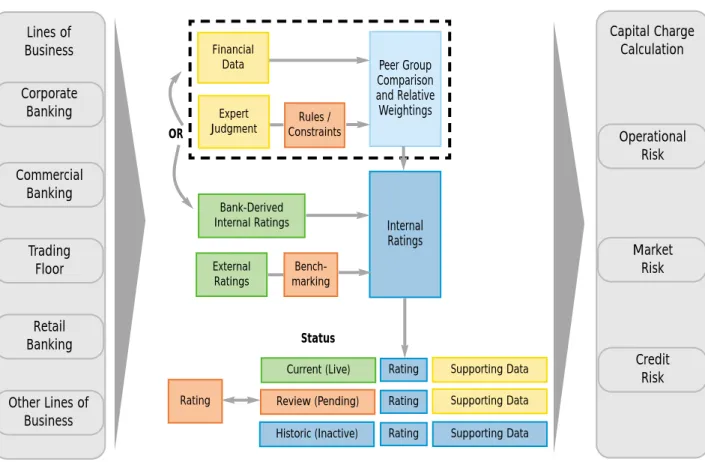
Solution Framework
Cognizant’s Basel II solution is based on the following key elements:
• A well developed underlying data model, giving the required flexibility to model for a variety of products, enabling the build-up of historical information and managing collateral information.
• A flexible rule-based risk weighting tool handling multiple scenarios.
• A ‘smart’ risk mitigation engine, for optimal utilisation of netting, collateral and guarantee information. • A transparent system, to trace the derived calculations
by means of audit trails and detailed reports, supported by end-user computing tools.
Corporate
Banking
Commercial
Banking
Trading
Floor
Retail
Banking
Other Lines of
Business
Lines of
Business
Operational
Risk
Market
Risk
Credit
Risk
Capital Charge
Calculation
Supporting Data Supporting Data Supporting Data
Rating Rating Rating
Historic (Inactive) Review (Pending) Current (Live) Rating
Status
Internal Ratings
Bench-marking External
Ratings Bank-Derived Internal Ratings
Peer Group Comparison and Relative Weightings Expert
Judgment Financial
Data
Rules / Constraints
OR
BASEL II SOLUTION OVERVIEW Functional Solution View
The functional system would contain the following features to be in line with the Basel II norms: • Capture rating dimensions across each facility and
borrower and also adjusted borrower grade based on Guarantees.
• Capture transaction-specific details like Collateral, seniority, product type, purpose and other factors affecting the Loss Given Default (LGD).
• Grade Descriptions and Criteria that are uniform across Lines Of Business and geographies.
• System that allows independent functioning of Risk Rating and Credit Approval departments.
The data from different Lines of Business provides for the derivation of rating for each individual facility and borrower. This information is further used to calculate the capital charge for credit, operational and market risk. The application supporting the same supports the requirements for the three pillars. The technical architecture further elaborates the solution to each of these pillars.
Technical Solution View
Basel II requires creating a technical framework that • Supports the requirements of Pillar 1by providing an
enterprise-wide data management capability for the data required for the calculations and providing risk-calculation engines to calculate the required capital. • Facilitates compliance with Pillar 2by supporting
internal control over the regulatory capital management process and by providing regulator visibility into the risk management process.
• Supports the comprehensive reporting requirements of Pillar 3.
All three requirements begin with the need for data quality and ownership, as the capital calculations for
credit and operations risk are dependent on the quality of data. To begin with banks will encounter the following data management challenges:
• Data Types:Banks deal with dynamic data (data that changes continually), static data (e.g. risk-scoring parameters) and hybrid data (derived from the previous two types e.g. PD, LGD and EAD)1 simultaneously.
• Data Sources:There is a challenging and wide range of data sources used in a bank. For example, in the case of exposure and collateral data, these would have to be derived from a combination of front-office, back-office and middle-back-office decision-support (analytics) systems.
• Data Granularity:Banks will not be able to use existing data architectures for disparate functions such as regulatory reporting and capital calculation, together. This is because data would now be required at different levels, and to cater to different types of decision support.
In addition to the Data Management challenges, new reporting requirementswill require:
• Augmenting data from altogether new data sources or getting additional data from existing data sources both internal and external.
• Building new reporting applications or enhancing existing decision support applications.
Therefore, banks need to define their architecture, find the necessary data and build their databases to support these areas. The road to Basel II compliance will require firms to devise a staged implementation to address the various areas of risk covered in the recommendations. The following sections underline Cognizant’s Phased Solution Approachtowards Basel II, clearly outlining the phases of implementation.
THE COGNIZANT APPROACH
Cognizant outlines a three-phase approach to help banks plan and implement their Basel II complianceprogramme.
Assessment phase
• System study and Gap analysis. • Implementation roadmap.
• Review internal rating system to assess the bank’s preparedness.
Data Design and Remediation • Data Architecture & Data management. • Data Analytics.
Solution Rollout
• Testing the Solution & Procedures. • Supervisory approval and Certification.
PHASE 1: ASSESSMENT
i) System Study & Gap AnalysisThe assessment phase involves evaluation of the bank’s preparedness compared to the stated approach with respect to risk management and Basel II
recommendations. The gaps in processes, methods, structures, data and systems are identified.
Initial Assessment
• Scope Definition after discussions with stakeholders. • Study of existing Systems, applications, technologies
and tools used.
• Study of available data sources and ensuring data adequacy.
Gap Analysis
• Identify gaps in the risk reporting against Basel II risk reporting requirements.
• Identify (broad-based) new data sources / new data elements within existing data sources that would bridge this gap.
Establish data adequacy for loss events and key risk indicators for operational risk.
Deliverables
• Gap Analysis Results.
• Basel II Compliance Recommendations. • Tools evaluation scorecard and Toolset
Recommendation.
ii) Implementation Roadmap
The implementation roadmap will be conceptualised and drawn up to address the gaps identified in the first step: • Existing systems will be required to interface with new
systems for an enterprise wide solution framework. • Requisite data i.e., data for loss events, exposure
ratings, default events, key risk indicators, historical default, LGD, EAD and collateral would need to be captured.
• Systems & procedures have to be established to recover data from diverse existing sources. • Data model for comprehensive understanding,
monitoring and managing credit risk exposure, using meta-data driven approach, mapping data sources with the target data structures which would have to be built.
Deliverables
• Project Charter. • Project Plan.
iii) Review Internal Rating System (IRS)
With gaps analysed, costs approved and timeliness set, the IRS of the bank should be reviewed:
• The goal of this review should be to align the system to IRB recommendations.
• In case the bank has not been using IRS, an appropriate IRS will have to be implemented. • A high level of statistical capability will be required
PHASE 2: DATA DESIGN AND
REMEDIATION
i) Data Architecture & Data Management The next great challenge is the implementation of an integrated enterprise-wide risk management solution. The solution would also provide comprehensive analytical capabilities and establish a flexible infrastructure.
Cognizant’s Basel II Data Warehouse service offering is focused on aligning the risk-reporting framework along the three risk types – Credit Risk, Market Risk and Operational Risk.
Data management involves:
• Review of existing data sources for risk data. • Review of existing data management architecture. • Evaluation of existing toolset for ETL
(Extract–Transform–Load), Database, Metadata and Data Profiling tools.
• Review of Metadata data collection strategy.
The Cognizant Basel II DW Architecture The key components of the architecture are: • Data Collection from disparate source systems. • Integration of data using the ETL tool of choice. • Data Storage and Persistence with a scalable RDBMS. • Interpretation layer to service the various access
mechanisms – like OLAP tools.
• Distribution channels to handle the delivery aspects.
The architecture provides for diligent Metadata capture at every stage with a metadata repository. The following activities fall under the scope of this step:
Design
• Data Modelling.
• ETL Design – Mappings, using data profiling tool for "dry run" of business rules.
• Report design.
• Metadata capture at every stage. 1800
Feedback Loop for Control purposes.
Internal Data Sources
External Data / Collaterals
ETL Basel II
Risk DW
Credit Risk Calc
Engine
Market Risk Calc
Engine
Oper Risk Calc Engine
Operational Risk Reporting
App Market Disclosure
App Credit Risk
Reporting App
Corporate Firewall / Intranet
External / BIS Users
Internal / Supervisory
Users
Construction • ETL Development. • Report Development. • Unit Testing.
Deliverables
• ETL Design document. • Reports Design document. • Unit Test Plans & Logs.
ii) Data Analytics & Reporting
Given the complexity of capital computation, the bank may want to use rule engines as the basis for "capital charge calculators." Further, once the required data is available, capital adequacy calculations and reporting capabilities should be built for supervisory oversight and market disclosures. Appropriate analytical tools should be chosen to analyse historical data across different dimensions and to validate internal risk models.
The presentation layer comprises of the three business intelligence applications:
Credit Reporting Application
• Provides various measures of credit risk like PD, LGD, and EAD.
• Powered by a Credit Risk data mart / cube. The calculation engine for this application gets the data from the Risk Warehouse, which collects the requisite data from internal and third party ratings systems for creditors and other collaterals.
• Two versions of this application are possible – one for internal reporting & the other for BIS -facing.
Market Disclosure Application
• Application is market facing and gives an overall P/L performance information, risk outlook, loss events and their probabilities.
• Powered by the Market Risk data mart / cube. The corresponding calculation engine obtains the data from the P/L modules of the Enterprise Financials applications via the Risk Warehouse.
Operational Risk Reporting Application • This application reports Operational Risk through its
many measures like PE (probability of event), EI (Exposure Indicator), LGE (Loss Given Event) with its own data mart / cube.
• The calculation engine gets data from financial applications, customer data, Loss data from various applications and other collateral.
PHASE 3: SOLUTION ROLLOUT
i) Testing the Solution and ProceduresA Basel II project of this size and magnitude should be extensively tested using internal and external data to ensure reliability. Capital adequacy calculations for different approaches against the Basel II framework and benchmarking results with market observed data. • System / Regression / Performance testing. • User acceptance testing.
• Implementation (phased) at key locations. • Rollout – to all locations of organisation.
Deliverables
• System test plan & test logs. • Implementation / Rollout plan.
ii) Supervisory approval & certification
The Basel compliance project enters its final stage and is ready to go live when the key areas requiring supervisory approval are identified and communicated to the regulator, along with the details of the bank’s preparedness. The regulators may carry out an onsite inspection prior to attesting the compliance of the bank.
Execution Team*
The Cognizant execution team will consist of the following specialists. Some of them will provide offshore consultation to the key member(s) at the client site: • Banking Domain Experts.
• Data Warehouse Architects. • Database Specialists.
• Data Warehouse & Business Intelligence tool specialists.
(* Team composition and stage durations mentioned above are only indicative and may vary with the scope of the study and complexity of the environment. Actual team and project duration is determined during the initial Project Planning & Scoping stage in consultation with the client team.)
Ongoing Monitoring and
Programme Management
For successful Basel II compliance, an ongoing monitoring of the compliance activities and aprogramme management approach are the two essential components. Cognizant suggests forming a Basel II Program Management Office (PMO) to coordinate various projects under a Basel II compliance programme.
The responsibilities of the PMO would include: • Schedule management.
• Project Coordination.
• Communications (internal and external) management. • Resource Management.
• Issue Management.
• Knowledge and Document management. • Quality Management.
• Implementation Management. • Process and Procedure development. • Change Management.
• Risk Management.
COGNIZANT EXPERIENCE AND BENEFITS Strong Domain Focus:Cognizant has a strong banking domain focus with a team of domain consultants and technology specialists. Cognizant has been in the forefront of offering leading-edge technology solutions for solving business challenges. With a combined strength of over two thousand associates in the banking domain,
Cognizant has expertise and experience in the areas of portfolio management, brokerage, asset management, custody, clearing and settlement, wealth management, risk management, stock exchanges, retail banking, cards processing, payment solutions, customer interfacing, commercial lending and investment banking.
Technology Bandwidth:Cognizant’s experience across various technologies and platforms has consolidated its presence with large financial institutions. Cognizant is involved in application management across platforms and technologies such as mainframe, mid-range, workstation, networks and the Internet, in projects varying from legacy systems to web-integration projects.
Data warehousing expertise:Our expertise in data warehousing and management reporting systems with a well-defined Basel II compliance solution framework, coupled with the extensive Banking domain expertise is well suited to address this key link to total compliance. • Well aligned to the key business drivers – reporting of
credit, market and operational risk.
• Well thought out Business Intelligence framework that is robust and extensible.
• Leverages existing Business Intelligence infrastructure.
Key Differentiators
1) Focus -With a 100% focus on business verticals, Cognizant works with large clients in the core areas of systems software, engineering services, products, training and enabled services.
2) Offshore Maturity- Cognizant’s onsite/offshore mix percentage has been steady at a 15-30% onsite: 70-85% offshore average across all kinds of projects. 3) Customer Responsiveness- Close interaction
with clients, through the deployment of local relationship management / account management teams, who are empowered to make decisions for speedy resolution of issues.
4) Onsite/Offshore Delivery Model- Cognizant has a proven onsite/offshore project management model with clearly defined roles, reporting structures and escalation mechanisms and the deployment of Client Partner and Account management teams. The advantage of this model lies in concurrent execution from onsite and offshore locations; this ensures a physical proximity to the client as well as a focused, scalable team at offshore.
CASE STUDY – A LEADING FINANCIAL INSTITUTION Business Background
The client is a leading North American financial institution providing financial services to more than 9 million customers, including retail and small business banking customers as well as corporate and investment banking customers.
The client is involved in an enterprise wide project – Integrated Systems and Information Strategy (ISIS) towards achieving Basel II compliance. ISIS – Credit Exposure Application System is a part of the overall initiative, which deals with Credit Creation process.
Business need
The key drivers for the Credit Creation exercise were: • Every Line of Business in the bank used its own Credit
Approval system.
• There was no enterprise-wide owner for the Credit System.
• Multiple technologies and coding standards existed in the system.
The Cognizant Solution
As a part of the Credit Risk project for the client, Cognizant analysed the existing decentralised, inconsistent and fragmented data and processes and came out with the following solution framework: • Development of a credit data management system to
move from a silo-based approach to an Enterprise-wide approach.
• Creation of a common methodology for data capture and data management that extends across lines of business.
• Design, development and implementation of the functional capability to better support credit origination, adjudication, and operations across the different lines of business in the bank.
Technology and Architecture
The application was based on a J2EE architecture framework. The guiding principle of the proposed solution was to ensure a greater degree of user friendliness and flexibility as the system grows, in order to support the objectives with which the application had been envisaged.
The system was designed around web based ‘n’-tier architecture consisting of a Browser interface for users, J2EE compliant Web and Application Server and a Relational Database.
Business Benefits
• Delivered a single credit structuring and adjudication application.
• Eliminated multiple paper processes.
• Ensured all data required for credit risk management is captured in electronic form.
Cognizant Technology Solutions Ltd 20 Orange Street, London WC2H 7ED Phone: +44 (0)207 321 4888 Fax: +44 (0)207 321 4890 Email: [email protected] www.cognizant.com
About Cognizant
Cognizant (Nasdaq: CTSH) is a leading provider of IT services. Focused on delivering strategic information technology solutions that address the complex business needs of its clients, Cognizant provides
applications management, development, integration and re-engineering, infrastructure
management and a number of related services such as enterprise consulting, technology architecture, program management and change management through its onsite/offshore outsourcing model.
Cognizant’s more than 15,000 employees are committed to partnerships that sustain long-term, proven value for customers, by delivering high-quality, cost-effective solutions.
The Cognizant Financial Services Practice
Banking and Financial Services is one of the key industry domains serviced by Cognizant. In order to specifically address the needs of the banking
industry, Cognizant has a full-fledged Banking Business Practice consisting of over 500 highly qualified and trained technical and business consultants. Our Banking Practice leverages
comprehensive understanding of the business and technology drivers, helping deliver quick and innovative solutions to an industry that thrives on speed, efficiency and bottom-line results.
Cognizant monitors the trends in the Banking industry closely, initiatives and developments such as Basel II,
Continuous Linked Settlement, Open Finance, Account Aggregation and orients itself to emerging domains quickly. A dedicated team of business analysts with cross-domain industry experience is involved in monitoring the industry and shaping Cognizant solutions to give clients a sustainable competitive advantage. Cognizant works on a diverse portfolio of projects in areas of banking covering retail, corporate, investment banking, capital markets, private banking, investment management, treasury & security services, credit cards and imaging and archival solutions.